Seeing 2 Rabbits Spiritual Meaning: 10 Meanings, the Real Pair and the Honest Count
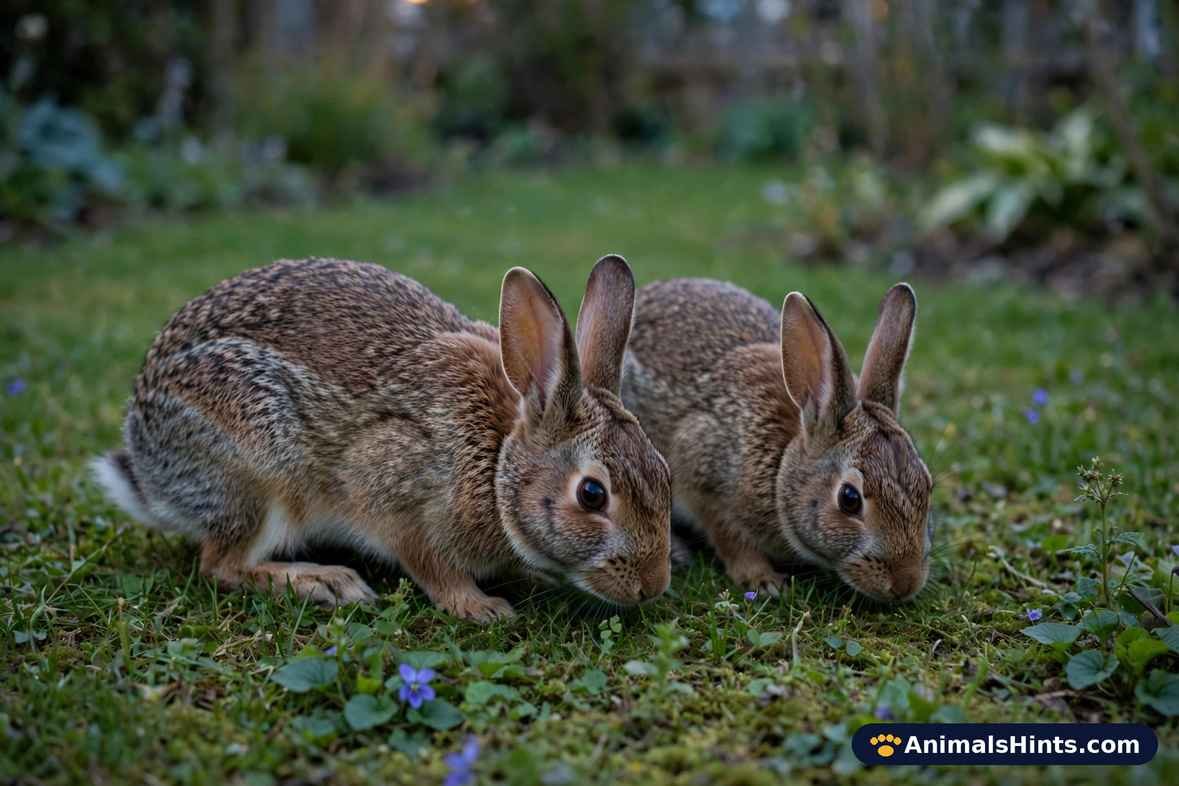
One rabbit in the garden is a visitor. Two, grazing the same patch of lawn in the same low light, feel like an arrangement — and the seeing 2 rabbits spiritual meaning, as the animal-sign tradition construes it, is built almost entirely on that feeling: partnership, balance, the sense that whatever is coming will arrive with company. This article hands that reading on in full, in the guide’s own order, labelling it as it goes: these are interpretations people cherish, not findings anybody has demonstrated.
Underneath the symbolism there are also two living animals to account for, and they turn out to be the most instructive part of the subject. Wild rabbits are social creatures that live in groups and feed at dawn and dusk, so a pair is not the exception in a rabbit’s evening — it is close to the rule. The real animal gets its share of these pages: the warren the pair came from, the breeding season that fills gardens with couples, what ancient texts do and do not say about this animal’s family, and the plain question of whether any tradition, anywhere, actually grades how many animals you saw.
What follows keeps the two registers separate on purpose. The folklore is reproduced completely and warmly, because it is the reason the search exists. The record is printed beside it at its true strength, because a pair of rabbits deserves better than to be flattened into either a portent or a punchline.
What Do Two Rabbits Symbolize Spiritually?
The tradition’s answer begins with the number itself. Where a lone rabbit stands for the quick, solitary virtues — alertness, intuition, the well-timed leap — a pair is read as those same virtues doubled and steadied by company. Balance is the headline: two animals moving together are taken as a picture of forces that have stopped competing and started cooperating, the practical half of a life and the feeling half finally grazing the same ground. Partnership follows from it, in every register the word allows — a bond being formed, a friendship deepening, two people whose efforts have begun to synchronise.
Duality is the pair’s second theme, and it is the one the guides lean on hardest. One rabbit is made to carry the mind — planning, caution, logic — and the other the heart, with its instincts and sensitivities, and the pair stands as a standing invitation to let the two work as a team rather than take turns overruling each other. Prosperity and fresh starts complete the standard reading, borrowed from the rabbit’s famous fertility: a creature that multiplies, seen doubled, is filed as abundance with its hand raised.
This site already keeps the single-animal version of the sign, and the contrast is worth a sentence. In the rabbit crossing your path readings, one animal darts through your route and the message is about timing — freeze, listen, then move. A pair does not dart. It stays, and grazes, and lets itself be watched, and the tradition takes that staying as the whole difference: the single crossing asks how you move; the pair asks what you are moving with.
The Real Rabbits Behind the Pair
Before any meaning is attached, the animals themselves deserve a hearing — because a pair in the garden looks very different once you know how a wild rabbit’s evening is organised. The burrowing rabbit behind most of these sightings is the European rabbit (Oryctolagus cuniculus), and it holds a distinction worth knowing: among all the rabbit and hare family, it is the only one known to live in stable social groups underground. Its groups occupy warrens — networks of tunnels and chambers that can run metres deep and tens of metres long — and within them the animals keep a settled order, dominant bucks at the top, each group holding its own ground against the neighbours.
Government welfare guidance for the species puts the shape of that life plainly: wild European rabbits live in stable groups of between two and ten individuals, and they are crepuscular — a word this run has met before — meaning they come above ground mostly in the early morning and the evening, at dawn and dusk. The research literature agrees on the group size, counting two to eight adults plus the season’s juveniles, grazing together at the warren’s edge and taking turns at sentinel duty, one animal sitting up tall while the others feed.

Hold that picture and the pair explains itself. Two rabbits together at dusk are, most often, two members of one warren group who have emerged for the evening graze — quite possibly a buck and a doe, since the breeding season runs through the warmer half of the year and most young are born between February and August. Company is not a garnish on this animal’s life; it is the structure of it. A bonded pair grooming at the burrow mouth is doing exactly what the species’ whole social system produces, every evening, whether anyone is watching or not.
One contrast keeps the record honest, and it matters for North American readers especially. The cottontails common across American gardens are a different arrangement entirely — largely solitary animals that rest in shallow forms in the grass rather than warrens, and meet mainly to mate. Two cottontails together in spring are most likely a courtship in progress, the buck having found the doe by scent. Either way, on both continents, the arithmetic is the same: where rabbits live, they live near other rabbits, and the evening brings them out together.
10 Spiritual Meanings of Seeing Two Rabbits
Ten meanings are promised in his heading, and his page honestly lists ten; they are reproduced below in his order, counted as they were found. Read every one as folklore speaking in its own voice — a lens the tradition offers for the encounter, not a forecast vouched for here.
1) Partnership and Harmony
The flagship reading grows straight out of the animal’s social nature. Rabbits thrive in company, and the tradition takes a pair as an emblem of connection done well — cooperation, unity, trust, the mutual support of two creatures whose arrangement plainly works. As a sign it is read toward bonds: a romance entering a steadier phase, a friendship proving itself, a working partnership finding its rhythm. The guides add a balancing clause — the pair as giving and receiving in equilibrium — and file the whole entry as an encouragement to nurture the connections that already hold this shape.
2) Duality of Mind and Heart
The second meaning assigns the pair an interior job. One rabbit is made to stand for the rational faculty — thought, planning, logic — and the other for the emotional one, and the pair is offered as a prompt to notice where the two have fallen out of step: fear arguing with courage, doubt with faith. The remedy the tradition offers is integration rather than victory; decisions improve, in this telling, when neither faculty is allowed to govern alone. Light and shadow are folded into the same entry — growth, the guides say, comes from carrying both halves of yourself in one field of view.
3) Signs of Abundance and Prosperity
A single rabbit already carries the abundance file, on the strength of the species’ famous breeding rate; a pair is read as that file underlined. The tradition files the sighting under incoming opportunity — resources expanding, work advancing, blessings arriving unscheduled — and attaches a condition that recurs across this whole shelf: gratitude and receptivity on the reader’s side. His version adds the Chinese zodiac strand, where the Rabbit stands for luck and gentle elegance, doubled here. As ever on this page, the entry is printed as the tradition’s claim about the sign, not as a forecast anyone has tested.
4) New Beginnings Approaching
The fourth meaning reads the pair as a threshold. New chapters — in a relationship, a project, a private resolve — are said to be close, and the doubling is taken as emphasis: the renewal energy of the single rabbit, squared. Folk tellings cast rabbits as messengers of transformation, and this entry follows them, urging preparation and optimism over resistance. It is worth noticing, because the record section below will return to it, that this is one of the entries where the animal’s real calendar cooperates with the symbolism: pairs are commonest exactly when the year is beginning again, in the first warmth of the breeding season.
5) Heightened Intuition
Rabbits survive by noticing things early, and the tradition converts that vigilance into an inner faculty. Two rabbits, in this reading, strengthen the single animal’s lunar, intuitive file: attend to the inner voice, trust the instinct that arrived before the evidence, watch dreams and sudden insights for the message’s second half. The pair is cast as a guide straddling the physical and the intuitive worlds, and the entry closes on protection — intuition, in the guides’ phrase, as a tool for clarity and balance rather than a parlour gift.
6) Adaptability in Life Situations
The sixth meaning admires the reflexes. Rabbits answer a changing situation by changing — a freeze, a zigzag, a new route to the burrow — and a pair is read as that lesson taught in stereo: shift strategy instead of resisting the shift. The guides aim it at stuck arrangements, at work and at home, and add the pair’s own refinement — that the two animals adapt together, which makes the entry as much about teamwork under pressure as about flexibility alone. Agility, in this strand, is filed as a mental and emotional strength wearing a physical disguise.
7) Fertility and Creativity
The seventh meaning is the oldest file the rabbit carries, and the pair states it at full volume: fertility, in the literal register of expanding families and in the figurative one of ideas, projects and work ready to multiply. The tradition turns the sighting into a nudge to act on inspiration while it is warm — to plant the thing, start the thing, say the thing — on the theory that abundance follows where effort, intention and imagination are pointed the same way. Of all ten entries this is the one with the deepest roots in the animal’s real biology, which is precisely why the guides have leaned on it for so long.
8) Emotional Balance
Two rabbits grazing in step become, in the eighth reading, a picture of an inner state: emotional harmony, equilibrium, the books of giving and receiving balanced. The entry is framed as a gentle audit — where have you been overextending, where neglecting your own needs — and it borrows the animals’ unhurried coordination as the model answer. His version names the ordinary dualities outright — joy set against sorrow, patience against urgency, love against independence — all to be carried rather than resolved. Mindfulness is the prescribed instrument; steadiness is the promised result.
9) Spiritual Growth Through Connection
The ninth meaning turns the pair outward again. Growth, in this strand, is something that happens between creatures rather than inside one: relationships, shared experience, mentorship, the accumulated small kindnesses of a connected life. Two rabbits are read as evidence that the reader’s own development is currently routed through other people — that humility, receptivity and attentiveness to a companion are the curriculum. It is the partnership entry revisited at a higher level, and the guides treat the repetition as deliberate: connection, first as comfort, then as the path itself.
10) Messages from Your Subconscious
The last meaning makes the pair a mirror. Two rabbits, in this reading, reflect what has not yet been said aloud — a buried feeling, an unspoken wish, a fear that has been politely ignored — and nudge the reader toward the internal conversation. Dreams and intuition are named as the channels through which the message continues after the sighting ends. The tradition’s closing claim for the whole list is modest by its standards: that growth begins in self-awareness, and that an animal quiet enough to watch without alarming may be the right emblem for the work of watching yourself.
Why Do I Keep Seeing Two Rabbits in the Backyard?
The guide’s own section on repeat sightings reads them as a call for attention — nature communicating through small signs, the subconscious recognising a pattern, opportunities for growth and cooperation gathering nearby. His practical observations are the better part of the section and they survive the transfer intact: watch how the two animals actually behave. Rabbits moving cautiously, freezing and bolting, teach one lesson about alertness; two rabbits sitting peacefully together teach another, about companionship. Cycles and transitions close his version — the pair as a recurring reminder to prepare for change and to be grateful for ordinary signs.
The garden itself files a plainer report, and it deserves equal space, because it explains the keep in the question. A backyard that shows you two rabbits repeatedly is a backyard inside a warren’s grazing range, with the three things rabbits commute for: short grass to eat, cover to dive into, and a dusk hour when the household is indoors. Rabbits are creatures of fixed rounds. The same animals will work the same lawn at the same low light for weeks, which means repeat sightings are not an escalating message — they are a timetable. You have not been chosen; you have been scheduled, by an animal that keeps better hours than most people.

Spring sharpens the pattern. Through the breeding months the garden fills with couples — a buck attending a doe, chasing, circling, the whole brief theatre of rabbit courtship played out on the lawn — and later with the season’s young, small enough to be mistaken for a different species altogether. Two rabbits in April are a season announcing itself. The folklore is welcome to the sighting; it simply has to share it with the calendar.
Why Two Is the Most Ordinary Number of All
This section exists because the topic itself rests on a number, and the number deserves an audit before the symbolism built on it goes any further. Here is the audit’s whole finding, stated plainly: no classical list grades animal counts. The old sign-books and omen traditions this site checks against — the ones that grade twitches, itches, crossings and encounters — read the animal and the circumstance. None of them, in any record this run has been able to fetch, maintains a table in which one rabbit means this and two rabbits mean that. The arithmetic of signs, the idea that the count itself is the message, is a modern layer of the genre — tidy, memorable, and young.
That does not make the pair readings worthless; it makes them a specific kind of thing. Partnership, balance and duality are what the modern tradition does with the number two wherever it finds it — two birds, two deer, two rabbits — and the readings in the list above are that habit applied to this animal. They are best held the way this page holds all of it: as a vocabulary the culture currently uses for an encounter, not as a code the encounter was sent in.
Against that, set the zoological arithmetic, which runs the other way. For a social animal that grazes in groups at dusk, two is close to the minimum interesting count, not a remarkable one — a warren’s edge at evening will show you two, four, seven, whatever the group’s size and the grass’s quality dictate, and a lone rabbit is if anything the less typical sight. The other crossing animals on this shelf make the contrast neatly. The skunk crossing your path material deals with a loner by design, an animal whose whole defence assumes it travels unaccompanied. Rabbits assume the opposite. If a count is to be read at all, the honest reading of two is that you have seen the species being itself, in its ordinary company, at its ordinary hour — which is a fine thing to have seen, and needs no inflation.
Biblical Interpretations of Seeing a Pair of Rabbits
The guide’s biblical section is gentle in tone, and its reading can be carried at the strength he gives it. Rabbits, in his presentation, are associated with humility, gentleness and vigilance; scripture does not address pairs of rabbits directly, he concedes, but he takes the animal as one of the Bible’s teaching creatures, citing the care-for-animals principle of Proverbs 12:10 — “A righteous man regardeth the life of his beast” — as the strand’s anchor, and a Leviticus passage as its second support. From those materials he builds the interpretation his readers come for: the pair as an echo of unity and mutual support, cooperation and balance drawing blessing, humility and patience outperforming force and haste.
That is his reading, and it stands here as his. But his section also contains a factual claim about what Leviticus says, and it is wrong in a way that matters to the strand — wrong enough that this page will not repeat it even inside quotation, and the next section sets out the actual text, word by word, so the reader can weigh the interpretation against the record it claims to rest on.
What the Bible Actually Says About Rabbits — and Never About Pairs
The census takes a minute and settles most of the matter. Search a complete King James text for the word “rabbit” and the return is empty — rabbit 0, rabbits 0. The word did not enter English Bibles, because the animal it now names was not the animal the Hebrew text was listing. What the KJV has instead are two neighbouring words. The first is “hare”: two occurrences, both in the dietary laws — “And the hare, because he cheweth the cud, but divideth not the hoof; he is unclean unto you” (Leviticus 11:6), and the same animal named again in the retelling at Deuteronomy 14:7. The hare is a true member of the rabbit family, and its entire biblical career is that single classification: unclean, a food-law entry, carrying no omen, no blessing and no symbolism of any kind.
The second word is “coney” — two occurrences, with its plural “conies” twice more: “And the coney, because he cheweth the cud, but divideth not the hoof; he is unclean unto you” (Leviticus 11:5); “The high hills are a refuge for the wild goats; and the rocks for the conies” (Psalm 104:18); “The conies are but a feeble folk, yet make they their houses in the rocks” (Proverbs 30:26). Here the translation itself needs a flag, and this site has planted it before: the Hebrew word behind “coney” is shafan, and the creature it actually names is the rock hyrax of the Levantine hills — no relation to rabbits at all. The coney passages are lovely, and Proverbs’ feeble folk who house themselves wisely in the rocks is a genuinely fine text — about a hyrax.
So the record, complete: the rabbit family appears in scripture only as the hare, twice, in lists of animals not to eat. No pair of rabbits appears; no single rabbit appears under that name; no encounter with any of these animals is read as a sign by any biblical writer. The guide’s Leviticus citation, offered in support of the opposite classification, in fact lists the hare among the unclean — the correction is printed here at full strength because his whole strand leans on it. What survives the audit is his Proverbs 12:10 anchor, which is real and does teach regard for animal life — as an ethic for the reader, not as a meaning for the sighting. The biblical pair of rabbits is, in the strictest sense, an interpretation in search of a text, and this page labels it as exactly that while leaving the interpretation itself standing, attributed, in the section above.
Spiritual Meaning of Two Rabbits Crossing Your Path
When the pair does not stay to graze but crosses — two shapes cutting your route in sequence — the guide’s reading sharpens into something more urgent than the lawn version. A double crossing, in his telling, is not a random event: it points at decisions, and specifically at decisions whose timing matters, choices that arrive in pairs and situations that will require collaboration. The two animals are read as synchronisation made visible, a reminder that your actions ripple into other people’s fields as theirs do into yours, and the section closes on attentiveness — every step counted, surroundings observed the way the animals themselves observe them.
The crossing shelf on this site lets the pair be measured against its neighbours, and the comparison flatters it. The squirrel crossing your path readings deal with a single quick animal and a message about stores and speed; the deer in your path material deals with one animal that stops and holds your gaze. Two rabbits do neither. They cross as a unit, neither leading the encounter nor lingering in it, and the tradition’s emphasis on paired decisions — choices that cannot be taken alone — is the genre simply describing what a coordinated crossing looks like, then handing the description back as advice.

The practical footnote belongs in this section too, since crossings and roads keep the same hours. Rabbits cross at dusk and dawn, low and fast and often in file — where one has crossed, a second may be a breath behind it, which is a sentence worth having read before you meet it from behind a steering wheel. Slow for the first rabbit. The pair the folklore celebrates is, on the road, a straightforward piece of defensive driving.
What Does It Mean to See Two Rabbits of Different Colors?
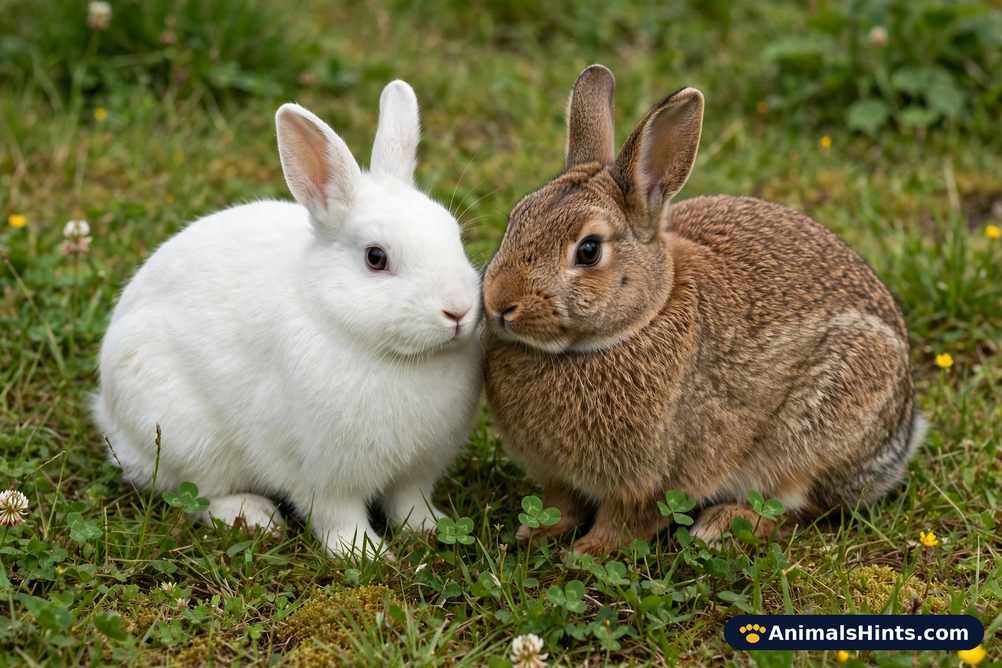
The guide’s colour section reads a mismatched pair as contrast made visible: two rabbits of different colours stand for opposing qualities within a life or a personality that are asking to be integrated rather than ranked. His worked example is a white rabbit beside a brown one — innocence and purity alongside grounded, practical energy — and the lesson he draws is that balance does not require sameness. Differences acknowledged, in his telling, become richness; the section closes on flexibility, urging the reader to stay open-minded while remaining rooted in their own values.
The colour files on this site’s wider shelf support the pieces of that reading, and one practical note from the single-rabbit file belongs here at full strength, because a mismatched pair is where it most often applies. A white rabbit outdoors is, in most places, not a wild animal at all: white coats barely exist in wild populations, and a white rabbit in a garden or park is usually an escaped or released domestic — an animal that cannot camouflage, cannot find a warren, and will not last long unhelped. If your different-coloured pair includes a white one, the kindest reading of the encounter is a practical one: the sighting may be less a symbol than a small rescue waiting to be organised, through a local animal shelter or rabbit rescue.
Dreams of Two Rabbits: Spiritual Interpretations
The guide’s dream section comes out of the dream-dictionary tradition — a folk literature with conventions of its own, not a tested science — and what follows is reported strictly on those terms. In that tradition, two rabbits in a dream carry the waking pair’s file into the subconscious: partnerships, opportunities and intuition, with growth said to be possible across relationships, creative projects and personal goals alike.
His handling turns, as the dictionaries’ handling usually does, on the animals’ behaviour in the dream. Playful rabbits are read as joy and abundance, and as a favourable mark for collaborations and joint ventures. Cautious or hesitant rabbits reverse the direction — vigilance prescribed, a pause advised, situations to be evaluated before action. Timing and choice close the section: opportunities arriving interconnected, chances that can be missed by inattention, and the standing instruction of the whole topic, to trust intuition while still taking the practical steps.
Are Two Rabbits a Sign of Good Luck?
In the guide’s verdict, yes — and, as with the skunk’s luck on this shelf, the luck described is of a particular kind. Rabbits have carried a luck file across cultures for centuries, on the back of their fertility and abundance associations; two together are read as that file amplified, prosperity and growth arriving in pairs, teamwork and shared goals singled out as the likeliest vehicles. His version is careful enough to attach the genre’s usual condition: luck is not guaranteed, and what the symbolism actually points at is a set of conditions — alertness, readiness, the willingness to act at the right moment — that make good outcomes more likely.
One qualification has to ride along, the same one attached to every sign in this article. Whatever luck is present sits in the interpretation rather than the event: the pair predicts nothing, and a sighting shrugged off carries nothing away with it. Strip the word luck down and the tradition is really recommending a stance — stay attentive, keep your partnerships in good repair, move when the moment opens — and people who live that way do tend to fare better, which is not the same thing as a rabbit arranging it. Judged as folklore the verdict is coherent, even attractive. Judged as a claim about the future it has, like every entry in this article, no evidence behind it at all, and it is printed with that label showing.
How to Watch a Pair of Rabbits Well
Enough interpretation — this section is about conduct, for the next time the garden produces its pair.
Watch from the distance the animals choose. A pair that knows you are there and keeps grazing has set the terms; settle where you are and enjoy being tolerated. Move closer and the terms change — a freeze, a thump of the hind foot as a warning to the warren, then both animals gone in a zigzag. Binoculars from a window beat ten careful steps across the lawn, every time.
Leave them unfed and unhandled. Wild rabbits do well on the garden’s own menu and badly on ours; bread and carrots are poor substitutes for grass, and feeding gathers animals in the open where cats and foxes learn the timetable too. Never pick a wild rabbit up — the handling itself can injure or kill a prey animal through stress — and keep dogs from chasing, even in play. A rabbit that cannot get away from a dog is in genuine danger, not in a game.
Mind the two exceptions. The first is the baby that is not abandoned: a young rabbit sitting alone in the grass is usually exactly where its mother left it, and she returns at dusk to feed it, so the right move is to leave it precisely where it sits and keep pets away until dark. The second is the rabbit that lets you walk up to it. A healthy wild rabbit does not; one that sits still for an approach is commonly unwell or injured, and the kind response is a call to a wildlife rehabilitator or vet, not a closer look. Kept at that strength — watch, do not touch, intervene only when the animal itself is clearly failing — the etiquette costs the encounter nothing.
Final Thoughts
Two rabbits in the evening grass are the gentlest sight on this site’s whole encounter shelf, and the tradition has treated them accordingly — partnership, balance, abundance, beginnings, a subconscious said to be leaving notes. All of it has been passed along here in the guide’s own order, with its credentials shown: the meanings belong to modern folklore, the number symbolism is younger than it sounds, and the Bible, when its actual words are counted, contains no rabbit at all — only a hare in a food list and a hyrax wearing the rabbit’s name in translation.
Set the symbolism down and a plainer picture is left standing. Two creatures sharing a field without friction. Attention divided between feeding and watching, so that both get done. A life organised around company, rhythm and a safe place to return to. If the pair has a lesson that survives every audit on this page, it is that one, and it was never really about rabbits.
The rabbits, for their part, have no stake in any of it. Tomorrow’s dusk will find them back on the same lawn with the same companion, and the day slept away in the warren they dug together and defend together — a whole underground architecture raised by a social animal for a social life. That much needs no interpreter, and it is enough.