Rabbit Crossing Your Path: Spiritual Meaning, Signs and Messages
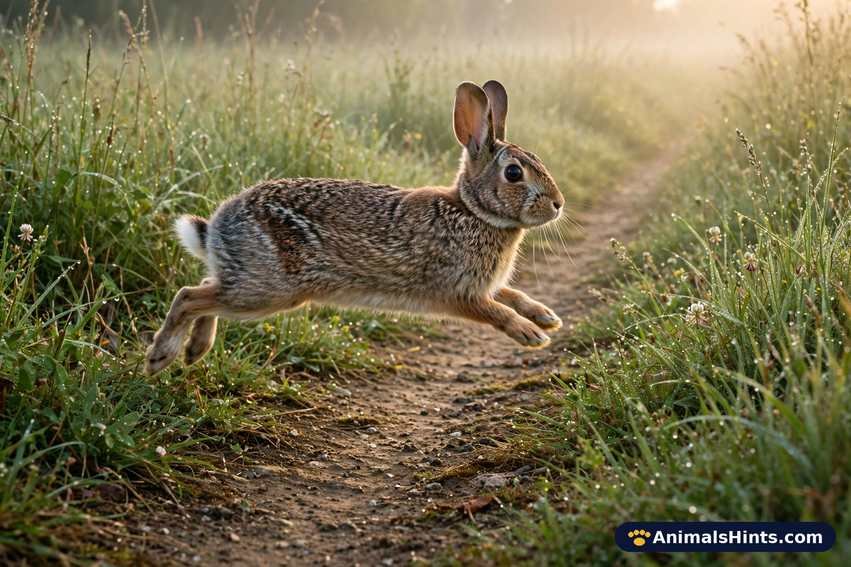
You are out early, the light is still low, and a rabbit slips across the path ahead of you before vanishing into the grass. The spiritual meaning of rabbit crossing your path is read in the animal-meaning traditions as a soft prompt to pay attention: life can change direction quickly, and the readers of such signs treat the moment as a nudge about timing, patience and trust.
Most crossings happen at dawn or dusk for a plain biological reason: rabbits do their travelling and feeding in the half-light at both ends of the day. That is worth knowing before any reading begins, because the encounter is part of the animal’s ordinary routine. Readers of signs say that is exactly why it lands — an everyday creature, met at an in-between hour, tends to stay in the mind.
This guide walks through the twelve meanings the tradition attaches to the crossing, what a night encounter and each rabbit colour are said to add, an honest check of what the Bible does and does not say, and the good-or-bad-omen question. Every reading is printed as the tradition it is, and the animal facts underneath are kept separate and checked.
What Does Seeing a Rabbit Mean Spiritually?
In the symbolism literature, the rabbit stands for a cluster of qualities few other animals carry together: gentleness without weakness, watchfulness, quick wits and a deep tie to spring and new growth. It is a prey animal that survives by sensing early and moving fast, and the traditions built on it tend to praise awareness over force.
A crossing adds motion to that picture. A rabbit seen sitting in a field is read one way; a rabbit that deliberately crosses the line you are walking is read as a message about direction — where you are headed, what is about to intersect with it, and whether you are awake enough to notice.
Modern spirit-animal writing treats the rabbit as a teacher of the soft skills: listening before speaking, moving only when the moment is right, and thriving without needing to dominate anything. Older traditions are less therapeutic but land in a similar place — across European, African and Asian folklore alike, the rabbit is the small creature that outlasts bigger ones, which is why its appearances keep being read as encouragement for the underdog.
The kindest way to hold the idea is the way folklorists hold most animal signs: as a reading, not a ruling. A very different encounter — finding a dead rabbit — carries its own separate set of interpretations on this site, and the two should never be blurred together.
The Real Rabbit Behind the Crossing
Before the readings, the animal itself. The rabbit most likely to cross a North American path is a cottontail, most often the eastern cottontail (Sylvilagus floridanus); across Europe and much of the rest of the world it is the European rabbit (Oryctolagus cuniculus), the species every domestic rabbit descends from. Hares are the larger, longer-legged cousins: they live above ground in shallow scrapes called forms, and their young are born furred and open-eyed, while rabbit kittens arrive blind and hairless in a lined nest.

Cottontails feed and travel mainly at dawn and dusk, with quieter spells of activity through the night. Startled, a cottontail’s first defence is not speed but stillness: it freezes flat in cover and trusts its mottled coat. Only when danger comes close does it burst out, zigzagging for the nearest thicket at up to about 18 miles an hour, white tail flashing.
Its senses explain the freeze. A rabbit’s eyes sit on the sides of its head and give it a view covering nearly the whole circle, with a small blind spot right at the nose; its long ears swivel independently to track sounds from different directions at once. A rabbit crossing open ground is travelling through the most exposed minutes of its day, which is why crossings are brief.
One more habit matters for a crossing article: rabbits are route-keepers. Cottontails travel worn runs through the grass between their feeding grounds and their cover, using the same lines day after day, and a path crossing is usually one of those runs intersecting one of ours. The encounter feels personal; to the rabbit, it was the commute.
The breeding record behind the fertility symbolism is genuinely remarkable. A cottontail doe carries a litter for roughly a month — about 25 to 35 days — and can raise several litters in a single season, each of around five blind kittens tucked into a shallow, fur-lined hollow in the grass. European rabbits dig the famous communal burrow systems called warrens; cottontails, by contrast, never dig and simply borrow the cover they find.
12 Spiritual Meanings of a Rabbit Crossing Your Path
Below are the twelve readings the animal-meaning tradition attaches to this encounter, kept in the competitor’s order. Each is given with the piece of rabbit nature or folklore it grew out of, so you can see why readers land where they land.

1. New Opportunities and Growth
The first reading treats the crossing as a door swinging open in front of you. A rabbit does not drift across a path; it picks its moment and commits. Readers take that decisiveness as a picture of an opening that will not wait forever — a role, a move, a conversation — and of the growth that follows if you step through while it is open.
The growth half of the reading leans on the rabbit’s own calendar. Few animals rebuild their numbers as fast each spring, and the traditions read that surge of new life as a promise that a stalled area of your own life can restart just as quickly once conditions turn.
2. Swift Action Encouraged
Where the first meaning is about the door, this one is about your feet. The rabbit’s whole survival plan is a two-beat rhythm — long stillness, then an instant, whole-hearted dash. The tradition reads a crossing as a prompt to copy the second beat: if you have already done your watching and weighing, the sign says move now rather than after another week of circling.
It is worth noticing what the reading does not say. The rabbit never dashes blindly; it freezes first and listens. Swift action in this tradition means decisive action after attention, not impulse dressed up as courage.
3. Gentle Strength and Resilience
A rabbit has no claws worth mentioning, no venom, no size. It survives in a landscape full of foxes, hawks and coyotes by being alert, quick and very hard to discourage. Readers draw from that a picture of quiet resilience: strength that does not announce itself, and endurance that works by sensing trouble early instead of fighting it late.
The warning thump belongs here too. A rabbit that senses danger drums a hind foot so the whole warren or family group hears the signal through the ground. The tradition reads that as resilience practised for others — looking out for your people is part of the strength, not a distraction from it.
4. Spiritual Guide Between Worlds
Rabbits live a double address: hidden in burrow, nest or thicket, then out across open ground. Folklore noticed, and cast the rabbit as a go-between — a creature comfortable in the concealed world and the visible one. A crossing, in this reading, is a guide moment: something from the hidden side of your life stepping briefly into view.
The hour strengthens the reading for many people. Crossings cluster at dawn and dusk, the seams of the day, and threshold times have always attracted threshold meanings. The sign is usually read as an invitation to take your inner life — dreams, hunches, unfinished feelings — as seriously as your outer one for a while.
5. Symbol of Fertility and Abundance
This is the oldest and most concrete reading of the set, because it rests on plain biology. A healthy doe can produce litter after litter through the warm months, each litter several young, and those young can breed within a few months of birth. Pre-modern communities watching fields refill with rabbits every spring drew the obvious conclusion, and the rabbit became a walking emblem of increase.
In the modern reading, fertility is usually widened beyond children: projects multiplying, work bearing fruit, a household or a savings pot growing. The abundance strand adds gratitude — the rabbit takes only grass and leaves and still thrives, which readers use as a picture of enough.
6. Connection to Lunar Energy
No animal is tied to the moon more thoroughly than this one. In Chinese tradition the Jade Rabbit lives on the moon as companion to the moon goddess Chang’e, pounding the elixir of life with a pestle — a figure already present in some of China’s earliest surviving poetry. In Japanese and Korean tellings the same rabbit pounds rice cakes instead, and related moon-rabbit figures appear in Indigenous traditions of the Americas as well.
The reading built on that folklore treats a crossing — especially near dark — as a pull toward lunar qualities: intuition, cycles, rest and renewal, the wisdom of things that grow in phases rather than straight lines. A rabbit met under a rising moon is, for readers of this strand, the symbol at its strongest.
7. Trickster and Cleverness
The folklore of three continents agrees that the rabbit wins by wit. Br’er Rabbit, the hero of African-American tales published by Joel Chandler Harris in Uncle Remus (1881), descends from the hare tricksters of West and Central African storytelling, and he out-talks and out-runs stronger animals in story after story. In Ojibwe tradition, the great trickster and culture hero Nanabozho most often takes rabbit shape.
So one strand of the crossing reading is about brains over bulk: if you are outmatched on resources, the sign nudges you toward the clever route — the sideways solution, the well-timed word, the briar patch your opponent does not know you were raised in.
8. Harbinger of Transformation
Rabbits are creatures of rapid change: born blind and helpless, grown and independent in weeks, and remade by every season. The snowshoe hare of North America makes the point physically, moulting from summer brown to winter white as the snow arrives and back again in spring — a twice-yearly reminder that in this family, changing your covering to match the season is a survival skill, not an inconsistency. The tradition reads a crossing as a marker that a change already under way in your life is real, and closer to complete than you think.
Unlike the butterfly readings elsewhere in this genre, the rabbit’s transformation is not about beauty emerging. It is about pace and readiness — becoming the version of yourself the next season requires, without mourning the coat you have shed.
9. Symbol of Hope and Perseverance
Every rabbit that crosses your path is, statistically, a small victory: a soft, edible animal that has dodged predators since it left the nest and is still here, still feeding, still raising young. Readers lean on that record for the hope reading — persistence by a creature with every excuse to give up.
The perseverance half is about manner as much as outcome. The rabbit does not endure by hardening; it stays soft, stays alert, and keeps to its rounds at the same hours each day. The tradition offers that routine as the shape of hope that actually lasts.
10. Emblem of Luck and Prosperity
The luck reading has a famous physical mascot: the rabbit’s foot. In the African-American hoodoo tradition documented across North America since the nineteenth century, the charm is specifically a rabbit’s left hind foot, and older accounts attach conditions — the animal, the place, the phase of the moon. It was never a generic trinket in its home tradition, and it is printed here as that tradition, not as a recommendation.
Stripped of the charm, the prosperity reading simply borrows the fertility logic in modern dress: rabbits multiply, so a crossing is read as a hint that what you are building can multiply too — provided, readers add, you move with the rabbit’s timing rather than against it.
11. Call to Tune into Intuition
A rabbit survives on information gathered before anything is visible: ears rotating toward sounds you cannot hear, eyes taking in almost the full circle at once, a nose that never quite stops testing the air. Meaning eleven reads the crossing as a summons to use your own early-warning system the same way.
Practically, readers take it as a prompt to slow a decision down and listen for the first, quiet signal — the detail that felt off, the person whose words and tone did not match — before the louder evidence arrives. The rabbit’s lesson is that intuition is not magic; it is attention that arrives early.
12. Reminder of Balance in Life
The last reading looks at the rabbit’s whole rhythm: long rests hidden in cover, short bursts of exposed effort; grazing and vigilance shared in the same minute; a life split between the safety of the thicket and the food of the open field. A crossing is read as a snapshot of that rhythm crossing yours.
Readers apply it as an audit rather than a prophecy. Where has your own balance tipped — all hiding and no venturing, or all exposure and no rest? The rabbit, the tradition says, does neither for long, and the crossing is the reminder to correct the tilt.
Symbolism of a Rabbit Crossing Your Path at Night
A night crossing is the same event in the animal’s busiest hours. Cottontails are built for the dim end of the day and stay active in spells after dark, so a rabbit on a lamplit road or a moonlit track is not lost or behaving strangely — it is commuting. Readers of signs, though, treat the darkness itself as part of the message.
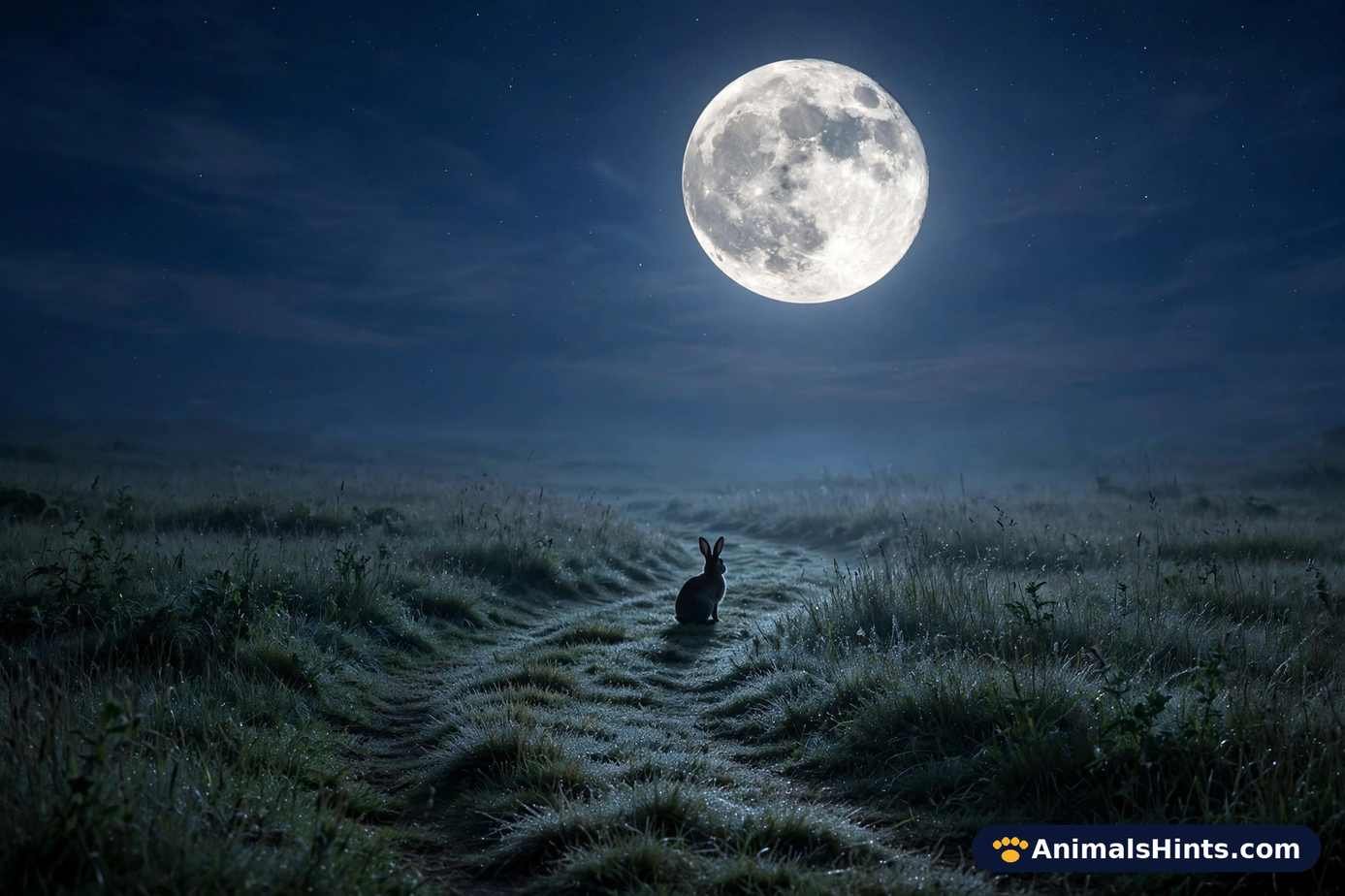
The night reading leans first on the moon traditions described above: the Jade Rabbit overhead, the animal as companion to a moon goddess, the link with cycles and the unseen. A crossing after dark is therefore read as an intuition matter — a dream to record, a feeling you have been out-arguing in daylight, a quiet decision that wants making without an audience.
The dream strand belongs to the night reading as well. Because the rabbit is abroad while the human world sleeps, folklore ties it to the dream life — several modern guides treat a rabbit crossing on a night walk as a prompt to attend to what your recent dreams have been circling, especially recurring ones. That is a reading, not a psychology claim, and it is printed at exactly that level.
It also tends to be read more gently than daytime signs. Like the possum, another creature most people only ever meet after dark, the night rabbit is cast as a reminder that a great deal of life — including yours — does its real work unseen. Practical footnote from the animal’s side: at night a rabbit is even harder to spot and quicker to bolt, so watch from where you stand rather than following it into the dark.
Seeing a Different Colored Rabbit Crossing Road
Colour is the fine-tuning of the reading, and the competitor treats each shade as its own paragraph. One honest note before the shades: a truly white rabbit outdoors is unusual in the wild — outside snowy country it is often an escaped or released domestic rabbit — while brown is simply what a wild rabbit normally looks like. The readings follow the tradition; the notes keep the animal real.
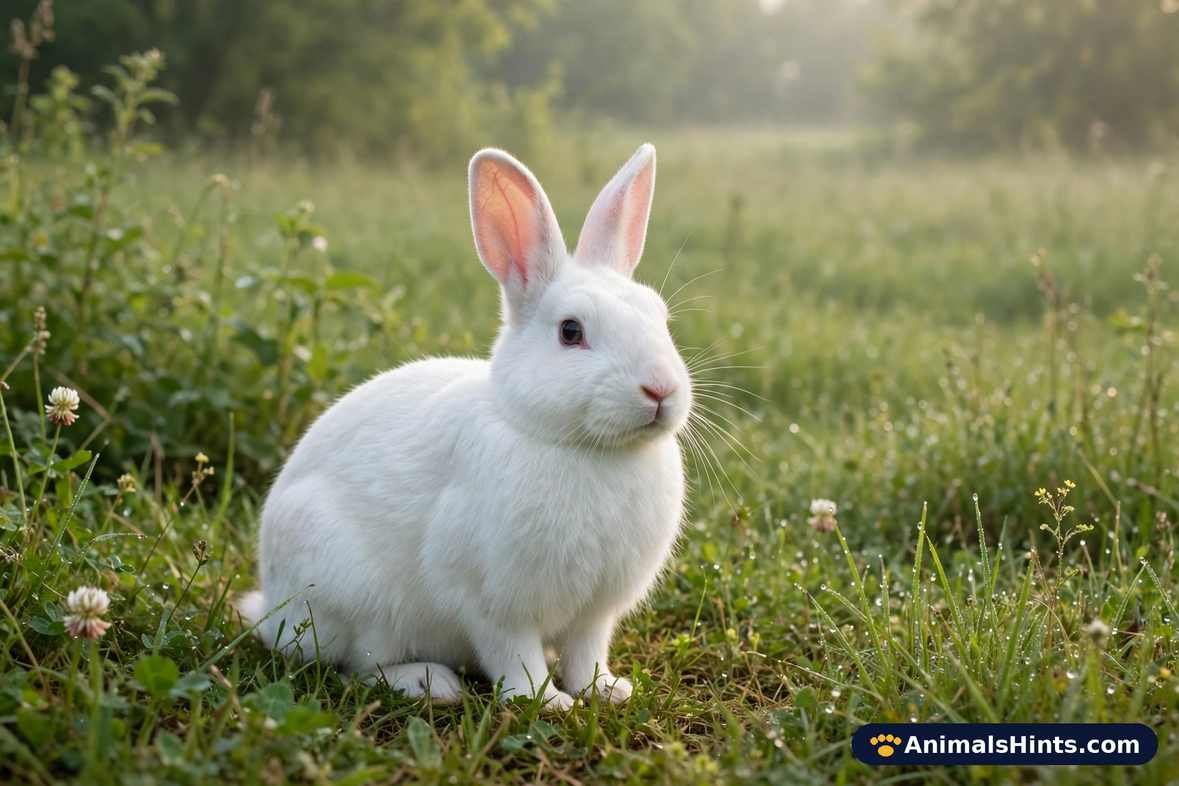
White Rabbit: The white rabbit carries the purity strand of the tradition — innocence, a clean start, peace after a messy stretch. Because a white coat is also the colour of surrender flags and fresh snow, some readers add surrender: laying down a fight you cannot win and letting a situation reset. If the animal looked plump, tame or unafraid, it may genuinely have been somebody’s pet, and a local rescue’s advice matters more than any reading.
Brown Rabbit: Brown is the wild default, and its reading is the grounded one: home, earth, stability, the unglamorous good. A brown rabbit crossing is read as encouragement to value what is already under your feet — the ordinary work, the nearby people — rather than chasing a brighter sign. Readers often pair it with the fertility strand, since brown is also the colour of turned soil in planting season.
Black Rabbit: The black rabbit gathers the shadow readings: the unknown, the unexamined, things moving in your life that you have not yet looked at directly. Most modern readers frame it positively, as an invitation rather than a warning — the part of the story you keep skipping is asking for a chapter. In several European folk tellings a black rabbit is simply rare and therefore notable, no darker than that.
Gray Rabbit: Gray sits between the certainties, and its reading does too: in-between phases, mixed signals, a situation that is neither the ending you feared nor the beginning you wanted. The tradition advises the rabbit’s own behaviour for gray days — stay low, keep your ears working, and do not commit to a dash until the picture clears.
How a Wild Crossing Differs From a Pet Rabbit Sighting
Almost all rabbit symbolism in books and online was written with the domestic rabbit in mind — the hutch rabbit, the house rabbit, the magician’s rabbit. A wild crossing is a different category of event, and it is worth separating the two before the readings blur.
A pet or escaped rabbit encounter is about relationship: an animal that depends on people, appearing in a human place. A wild crossing is about timing: an independent animal with its own route, whose path and yours happened to intersect for three seconds. The tradition’s crossing readings — direction, timing, thresholds — belong to the second kind, which is why this guide keeps returning to the wild animal’s habits.
Two field marks keep the categories straight. A wild cottontail is lean, grizzled brown, and gone the moment it clocks you; hares are bigger again, with very long black-tipped ears and a loping, almost deer-like run. A rabbit that lets you approach, looks rounded and well-fed, or wears an unusual coat — pure white, patched, long-haired — is almost certainly domestic, and kindness to it means a call to a rescue or a vet, not a handful of grass.
What Does the Bible Say About a Rabbit Crossing Path?
Directly, nothing — no passage in Scripture describes a rabbit or hare crossing anyone’s path, and the Bible does not treat animals crossing as omens anywhere. What the text does say about the animal is narrower, and it is worth having exactly.
The hare appears in the dietary laws. Leviticus 11:6 (KJV) reads: “And the hare, because he cheweth the cud, but divideth not the hoof; he is unclean unto you.” Deuteronomy 14:7 repeats the classification. The “cheweth the cud” wording reflects the ancient writer’s grouping; what rabbits actually do is pass food through twice by reingesting soft droppings, a process called cecotrophy — similar in purpose to cud-chewing, different in mechanics, and no contradiction once the two are kept apart.
Context matters for how the passage is usually received today. The clean-and-unclean lists were food law for ancient Israel, a boundary system for one people’s table, and mainstream Christian teaching has long read those dietary rules as belonging to the old covenant rather than as a standing verdict on the animals themselves. Nothing in the listing calls the hare evil, ominous or unlucky — it is a menu classification, and later tradition that turned “unclean” into “ill-omened” was adding something the text does not contain.
One popular proof-text is not about rabbits at all. Proverbs 30:26 praises the “conies” as “a feeble folk, yet make they their houses in the rocks” — but the Hebrew word behind “conies,” shafan, is the rock hyrax, a small cliff-dwelling mammal of the region, and modern translations say so. The verse is lovely, and its wisdom about small creatures thriving by choosing good shelter can still be reflected on — as long as it is not quoted as a rabbit text. The honest summary: Scripture lists the hare among unclean animals for ancient Israel’s table, and offers no omen teaching about crossings at all.
What Folklore Actually Records About Rabbits
Because rabbit lore is repeated so freely online, it helps to separate the documented record from the embroidery — three famous claims show the difference.
The goddess Eostre is often said to be a Celtic spring goddess whose sacred animal was the hare, and the source chain does not hold. The monk Bede, writing in the eighth century, is the only ancient author who mentions Eostre at all — as an Anglo-Saxon month name, with no animal attached. The hare partnership was proposed by a scholar in 1874 with a “probably,” and the Oxford Dictionary of English Folklore concludes there is no evidence for it; the Easter hare itself is first recorded in German folklore in 1682. A spring hare tradition exists — it is just centuries younger than the internet claims.
The Easter Hare stands on firmer paper than Eostre does. The egg-bringing hare of German Lutheran tradition, the Osterhase, was described in print in 1682 — the same record that anchors the Easter hare generally — as a figure who judged whether children had behaved and left coloured eggs for the good ones. German settlers carried the custom to Pennsylvania in the 1700s, and from that documented root grew the modern Easter Bunny. Spring-rabbit lore, in other words, is real; it is just early-modern and German rather than ancient and Celtic.
The Chinese zodiac strand, by contrast, is solidly documented: the Rabbit is the fourth sign, traditionally described as gentle, elegant, cautious and quick-witted, and recent Rabbit years include 1999, 2011 and 2023. The rabbit’s-foot record is documented too, as described in the luck section above — a specific charm from a specific tradition, not a universal ancient custom.
Literature added one strand folklore did not: the white rabbit you follow. Lewis Carroll’s Alice’s Adventures in Wonderland (1865) opens with Alice chasing a waistcoated White Rabbit down the rabbit hole, and the image lodged so deeply in English that “following the white rabbit” became the everyday phrase for pursuing a strange lead into an unfamiliar world. When a modern reader feels a crossing is an invitation to investigate something, Carroll deserves part of the credit.
The working rule the record suggests: rabbit lore is richest exactly where it is most local — hoodoo practice in North America, the moon tales of East Asia, African hare-trickster stories carried across the Atlantic. Grand claims about what “the ancients” everywhere believed tend to dissolve on inspection; the local ones keep checking out.
Rabbit Crossing Your Path: Good or Bad Omen?
Put the tradition’s own strands side by side and the lean is clearly positive: luck, fertility, new beginnings, clever escapes. Nine of the twelve readings above are encouraging, and the remaining three — intuition, balance, transformation — are advisory rather than alarming. No major strand of the tradition treats the rabbit as a herald of disaster.
The one wary note is local and should be kept at that size: some British folk tellings treat meeting a rabbit early in the morning, especially as the first creature of the day, as a caution for the hours ahead. It sits in the record as a regional wrinkle, not a rival doctrine, and the same islands hold plenty of rabbit-luck the other way.
The balanced verdict most modern guides land on — and the one this page endorses — is that the crossing is an omen only in the reading you give it. The rabbit was certainly not delivering a verdict on your life; it was crossing to cover or to food. What the moment reliably offers is a pause, and the tradition’s real content is what it suggests you do inside that pause: look, listen, and choose your next move on purpose.
How to Respond When a Rabbit Crosses Your Path
Start with the animal, because it has the most at stake in the next three seconds. On foot, simply stop and let it pass or slip away; a rabbit that freezes in front of you is deciding whether you are a threat, and a few still seconds settle the question kindly. Do not chase it for a closer look or a photograph — a chased rabbit burns energy it needs and may bolt across a road to escape you.
Driving asks for the calmer version of the same courtesy. Ease off and brake smoothly if the road behind you allows; never swerve hard for a small animal, because the swerve is how minor wildlife encounters become serious accidents. Most rabbits clear the road in one or two bounds if given the moment.
If you watch it go, watch without pursuing and skip the flash after dark: a night rabbit startled by a burst of light bolts first and navigates second, which is how a harmless photo attempt ends with an animal in the road. A phone held low at a distance, or simply your own attention, gives the cleaner memory anyway.
Afterwards comes the part the tradition actually cares about. If the crossing stayed with you, note what you were in the middle of — the decision, the worry, the plan — because readers of this sign treat that context as the message’s address. And if the rabbit you met looked white, tame or injured rather than wild, let the practical response lead: a local wildlife rescue will know whether it needs help.
Final Thoughts
A rabbit crossing your path is one of the smallest dramas in nature: a prey animal, a few exposed strides, and gone. The traditions gathered around it — twelve meanings deep, with the moon, the tricksters and the luck charms folded in — are really a set of lenses for that brief pause, and the honest ones admit the animal was simply on its way somewhere.
If you take one strand with you, take the rabbit’s own method. The animals are crepuscular by design, doing their travelling in the thoughtful half-light at either end of the day, and they pair that patience with total commitment once they move; other travellers get read the same way, and the readings collected for a deer crossing your path make a fine comparison. Freeze, listen, then go — as spiritual advice goes, the rabbit’s version is hard to beat.
FAQs
What does it mean when a rabbit crosses your path spiritually?
Tradition reads it as a prompt about timing and direction: an opportunity opening, a decision that wants making, or a call to trust your first quiet instincts. It is a reading, not a prediction — most crossings happen because dawn and dusk are the rabbit’s travelling hours.
Is a rabbit crossing your path a sign of good luck?
In most strands of the tradition, yes — the rabbit carries luck, fertility and fresh-start readings, and the rabbit’s-foot charm comes out of that same stream. One regional British telling advises morning caution, but the overall lean of the record is firmly positive.
What does it mean if a rabbit crosses your path and stops?
Readers treat a stop as emphasis: the rabbit freezing is its way of listening before it moves, so the sign is usually read as “pause and assess before your next step.” In plain animal terms it is also exactly that — a prey animal checking whether you are dangerous before choosing its route.
How should I respond to a rabbit crossing your path?
Practically: stay still on foot, brake gently and never swerve if driving, and never chase it. Reflectively: the tradition suggests noting what you were thinking about when it crossed, since readers treat that moment’s context as the part of the sign meant for you.