Royal Blue Spiritual Meaning: Symbolism, Shades, the Bible and Dreams
If you are asking about royal blue spiritual meaning, the modern symbolism tradition gives this deep, saturated shade a distinct brief: authority held with calm. Where blue in general is read for peace and honest speech, royal blue is the shade the genre ties to wisdom, confidence and a will that knows its own purpose.
That distinction matters, and this page keeps it in view. The competitor page behind this topic treats blue as a whole family; the question that brought you here names one member of it. Royal blue sits at the family’s intense end — darker and richer than sky blue, brighter than navy — and its readings lean toward sovereignty rather than softness.
What follows keeps the family’s full map but reads it through this one shade: what blue symbolises, the psychology of wearing it, fourteen spiritual meanings weighed for royal blue in particular, the shades side by side, the cultural and scriptural record, dreams, the throat chakra, and the animals that wear this colour for real.
What Does the Color Blue Symbolize?
Blue is the colour of the two largest things a person can look at: the sky overhead and open water. Symbolism writers take their first reading from that scale. A colour that fills both heaven and sea gets credited with breadth — truth that is not cramped, peace that is not fragile, and a kind of faithfulness modelled on things that are simply always there.
Loyalty and trust form the second strand. Blue is the colour institutions reach for when they want to look dependable, and the genre reverses the logic: because dependable things wear it, wearing it is read as a pledge of steadiness. Honesty belongs to the same cluster — blue is treated as the colour of speech that does not need decorating.
Royal blue takes each of those strands and tightens them. The symbolism tradition does not read it as the gentle member of the family. It is blue with the volume raised: trust become authority, calm become command of a room, truth become the confidence to state it plainly. The sections below keep returning to that difference, because a reader who dreamed, wore or kept meeting this particular shade is rarely asking about softness.
Why Is Royal Blue Royal? The Name, the Pigment and the Price
Start with a surprise: the name is young. Colour historians date the first recorded use of “royal blue” as a colour name in English to roughly 1810–1820 — within living memory of the steam engine. The story attached to it, repeated by reference works with a careful “it is said”, is that clothiers in Rode, Somerset, won a competition to create a shade for a dress for Queen Charlotte, consort of George III, and the winning deep blue took the name it still carries. Treat that as the trade’s own origin story rather than a court record: it is widely retold, plausibly rooted, and not documented the way a statute is.
The shade itself kept moving after it was named. Dictionaries long defined royal blue as a deep, dark blue, sometimes with a violet or faint reddish cast; the brighter royal blue most screens now show was standardised only in the late twentieth century, when web colour lists fixed the name to a vivid mid-blue. One name, two related shades — which is why fabric, paint and gem trade royal blues do not always match each other.
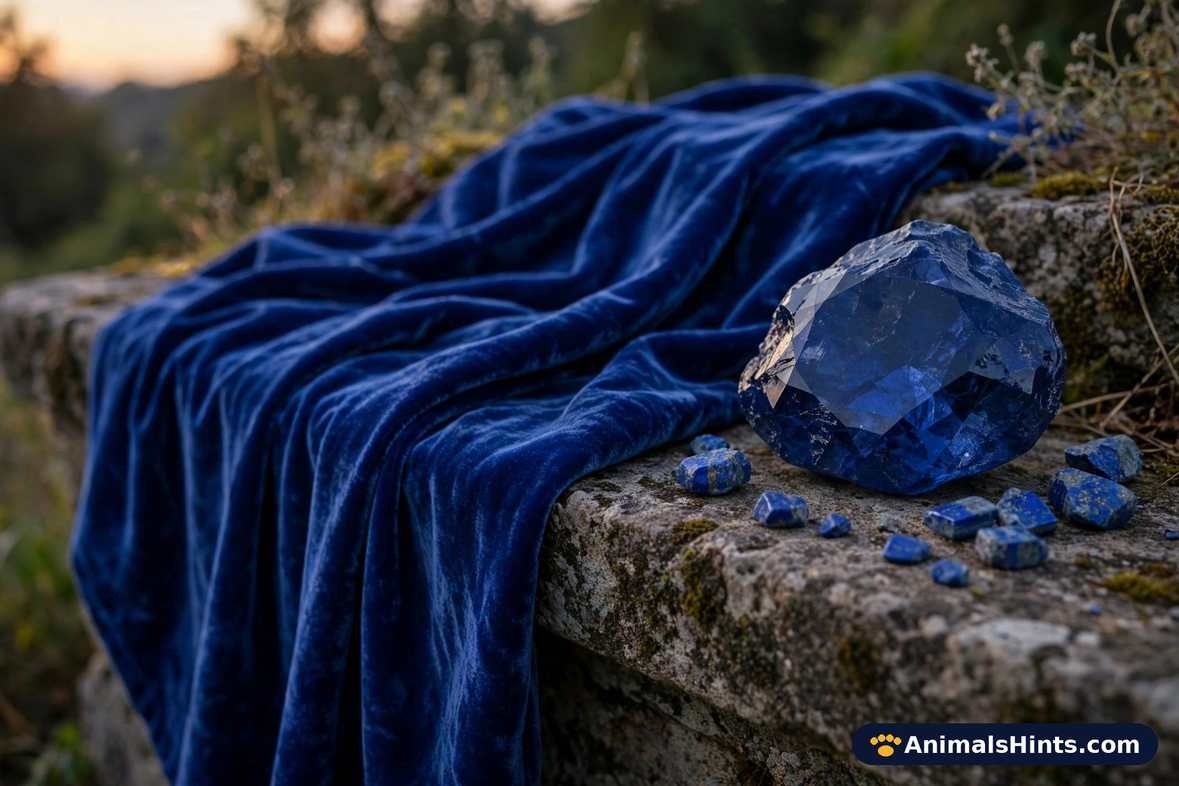
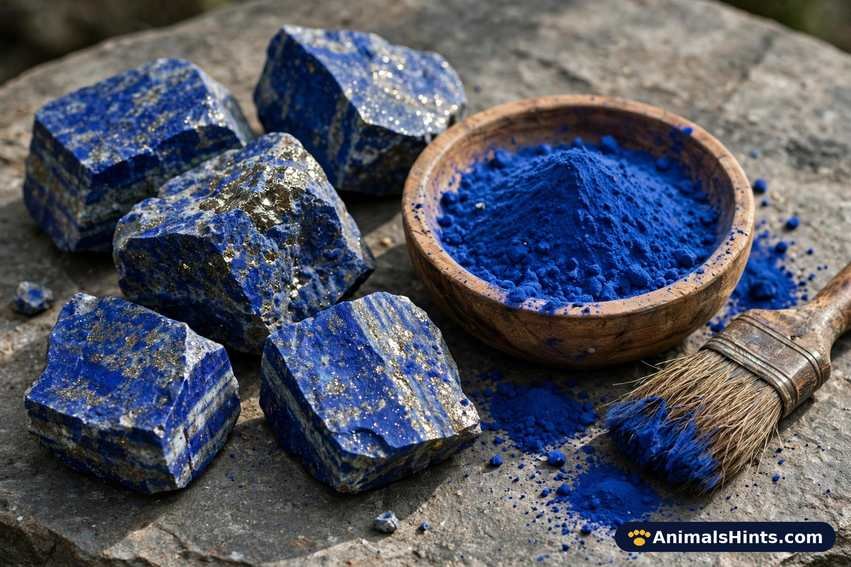
What made any deep blue fit for royalty in the first place was price. For centuries the finest blue pigment in European painting, ultramarine, was ground from lapis lazuli — a rock, not a single mineral, whose blue comes from lazurite, flecked with golden pyrite — mined overwhelmingly in one district, Badakhshan in what is now Afghanistan, and carried over sea routes to Venice. Its name means “from beyond the sea”. It could cost more than gold, contracts for altarpieces sometimes specified exactly where it could be used, and painters reserved it for the most honoured figures in a picture — above all, in Renaissance practice, the robes of the Virgin Mary. A colour that expensive did not need a marketing department to acquire a royal reputation.
The monopoly broke in 1828, when Jean-Baptiste Guimet won a French prize of six thousand francs for a synthetic ultramarine, with Christian Gmelin publishing a method of his own almost simultaneously. Deep blue became cheap within a generation. Royal blue the name arrives at almost exactly that moment — a shade christened for a queen just as the laboratory was ending the scarcity that had made such shades royal at all.
Heraldry had reached the same stone by an older road. The heraldic tincture for blue is azure, a word that travels from Persian lāžward — the name of lapis lazuli itself — through Arabic into European languages. Azure is one of the five colours recognised since heraldry’s earliest period, drawn in uncoloured engraving as horizontal lines, and in the later correspondence tables it is paired with the sapphire and the planet Jupiter. Popular guides attach loyalty and truth to azure, and those pairings are everywhere repeated — but heraldic authorities themselves assign no official meanings to tinctures; the loyalty reading is a later writers’ layer, printed here at that strength.
The gemstones close the circle. In the gem trade, “royal blue” is a grade name: the most prized saturation class for blue sapphire, the variety of corundum — aluminium oxide, hardness 9 on the Mohs scale, second only to diamond — whose blue comes from trace iron and titanium. Sapphire is the modern September birthstone, standardised on the 1912 list. A shade name born in a dressmaking contest ends up grading the stone of kingship: the word “royal” in this colour family is doing documented work at every level.
Psychology of Wearing Color Blue
Colour psychology’s standard portrait of blue is a calming one: the wearer is read as composed, approachable and steady, and blue surroundings are the genre’s usual prescription for lowering the temperature of a conversation. People who favour blue are sketched as harmony-seekers — orderly, sincere, and more interested in a thoughtful exchange than in winning one.
Shade steers the reading, and this is where royal blue separates from its family. Pale blue on a person reads as openness. Navy reads as discipline. Royal blue, in the genre’s account, reads as self-assurance: it is the shade chosen when the wearer wants blue’s trustworthiness without its softness — the interview, the presentation, the ceremony. Symbolism writers tie that effect to the shade’s history above: a colour named for a queen and priced like a jewel does not apologise for taking up space.
One caution belongs to the whole section, and the honest colour articles in this family keep making it: these are conventions of reading, not measurements. A preference for a shade can describe taste and intention; it cannot certify temperament, and no study consulted for this page tests royal blue as a separate stimulus at all. The psychology of this exact shade is the family’s general blue psychology, intensified by convention — nothing stronger is claimed here.
14 Spiritual Meanings of Blue Color
Fourteen meanings follow, in the competitor’s order — the modern colour-symbolism genre’s standard list for blue, taken one at a time. Each is a belief, a tradition of reading the colour, framed as such; and because this page answers for royal blue, each entry notes what changes when the shade deepens to this one.
1. Calmness and Tranquility
The root meaning. Blue is read off the sky at rest and water lying still, and the tradition takes the hint: this is the colour of a nervous system settling. Royal blue keeps the calm but changes its posture — less like a lullaby, more like a held note. Its tranquillity is the kind a person in charge is supposed to radiate.
2. Purity and Cleansing
Water washes, and blue is water’s colour, so the genre reads blue as the sign of a rinse — emotional weather cleared, a room’s mood reset. For royal blue the image sharpens: deep water rather than rain. The cleansing attributed to this shade is the thorough kind, the sort that reaches what surface washing cannot.
3. Divinity and Eternity
A colour that covers the sky gets credited with what the sky suggests: no edge, no expiry. Hindu tradition paints Krishna and Shiva blue, a documented iconography the culture section below takes up properly. Royal blue’s share of this meaning is its saturation — the genre treats the deepest wearable blue as the closest a cloth or a stone comes to that unbounded colour.
4. Trust and Stability
Blue’s dependability, again — but notice which blue institutions actually choose for their most formal signals. It is rarely the pale shade. Seals, flags and ceremonial dress reach for the deep end of the family, and the genre reads that choice back as meaning: royal blue is trust that has been given office hours and a title.
5. Adaptability and Fluidity
Water takes the shape of its container without surrendering what it is, and the tradition builds a lesson on it: move, bend, continue. Royal blue carries this meaning at its most dignified — the adaptation of a river in its channel rather than a puddle in a footprint. Flexibility, in this shade’s reading, never looks like weakness.
6. Vastness of Infinity
The sixth meaning is scale. Ocean and firmament are the two experiences of near-infinity available to unaided eyes, and both wear this colour. Meditators in the genre use deep blue as the visual form of that scale — a reminder that the self is small inside something that is not. Royal blue, the family’s most concentrated shade, is the one usually chosen for the exercise.
7. Spiritual Transformation in Alchemy
The genre’s alchemy entry treats blue as a stage of inner work: a cooling, dissolving phase in which old attachments loosen before anything new is built. Handle the attribution honestly — alchemy’s documented colour sequence for the great work runs through blackening, whitening, yellowing and reddening, and a specifically blue stage belongs to modern spiritual writing about alchemy rather than to the old texts themselves. The meaning is printed as the genre gives it, at that strength.
8. Connection to the Cosmic and Unknown
Night moves this meaning from the sky to what hangs in it. Deep blue is the colour of the hour when stars become visible, and the tradition reads it as the colour of questions larger than the asker. Royal blue sits close to that night register without going black, which is why the genre reaches for it when it wants mystery that still feels orderly.
9. Healing and Health
Blue is assigned a cooling quality in the genre’s healing vocabulary — the shade you picture when fever, temper or swelling needs to come down. That is a symbolism claim, and this page prints it as one: no clinical finding consulted makes any blue a treatment. What can be said plainly is that calm surroundings are kind to sick people, and blue is the colour calm surroundings most often wear.
10. Wisdom and Knowledge
Here royal blue stops borrowing the family’s meanings and starts owning them. The competitor’s own text, at this entry, reaches for the dark shades by name — navy, cobalt and royal blue are his examples of blue as wisdom. The tradition’s logic is plain: wisdom is not the brightest thing in the room but the deepest, and this is the family’s deepest working shade.
11. Spiritual Aura and Divine Blessing
Aura readers in the genre place blue in the field of people they describe as truthful, empathic and spiritually developed, with the deeper blues marking the teachers. Royal blue in an aura is accordingly read as the blessing shade — protection with seniority. Aura colour is a modern interpretive system with no measuring instrument behind it; the reading is reported as the system’s own.
12. Celestial Love and Truth
The twelfth meaning weds the family’s two great themes: love, and the truth love is supposed to survive on. “Celestial” is the operative word — this is affection imagined at sky scale, unbothered and unpossessive. In royal blue the pairing gains its formal register: devotion stated like a vow rather than whispered like a secret.
13. Inner Peace and Clarity
Distinct from the first meaning’s calm, which is about surroundings, this one is about weather inside: the moment after a decision when the mind stops arguing with itself. The genre pictures it as deep water gone transparent. Royal blue’s clarity is of that kind — not the sparkle of a shallow stream but the stillness of a deep one.
14. Inspiration and Intuition
The list closes with the quiet faculty. Intuition, in the genre’s telling, does not announce itself; it arrives the way colour returns at dawn, gradually and then completely. Deep blue is its assigned colour because deep blue is where the family’s listening happens — the shade of the third-eye region in the modern chakra rainbow, a placement the chakra section below examines with its history attached.
Shades of Blue and Their Spiritual Significance
The competitor prints five shades as subsections, and they are kept in his order. Read them as a walk from the family’s front step to its throne room — the fourth entry is this page’s subject, and it gets the longest stay.
Light Blue
The family’s softest voice: serenity, gentleness, emotional first aid. Symbolism writers assign it beginnings and apologies — the shade of a sky after weather has passed. It is kept brief here because almost nothing in its reading transfers upward unchanged; deepen this shade and every quality it owns changes register.
Sky Blue
Blue at its most expansive, named for the daytime firmament. The genre reads it as freedom and uplift — prayer imagined as something rising. Its honesty is its openness: a colour with nowhere to hide anything, which is precisely the quality royal blue trades away for depth.
Royal Blue
The shade this page exists for, and the competitor’s own entry for it is the strongest in his set: spiritual authority, divine will, wisdom and inner strength; the shade linked to spiritual leaders and to people the genre describes as channelling higher knowledge; in meditation, the colour used to align personal purpose with something larger than the self. The documented record assembled above supports the authority half of that reading unusually well — a name awarded in a queen’s dress competition, a pigment once rationed by contract, a tincture paired with sapphires, a grade reserved for the finest stones. Where the reading turns mystical, it is printed as the genre’s. Where it rests on price, scarcity and ceremony, it rests on paper.
Navy Blue
Royal blue’s nearest neighbour and easiest confusion. Navy is blue taken almost to black: introspection, discipline, the night watch. The practical difference a reader can use — navy recedes and royal blue advances. In a wardrobe or a room, navy asks to be trusted quietly; royal blue asks to be noticed being trustworthy.
Turquoise or Aqua Blue
The family’s border with green, and the symbolism changes at the crossing: refreshment, emotional repair, communication with a pulse in it. Turquoise the stone has its own long protective history in more than one culture, which the genre borrows for the shade. Set beside the green spiritual meaning, turquoise reads as the moment blue remembers that water is alive.
Royal Blue in the Animal World: Peacocks, Macaws and a Butterfly Made of Light
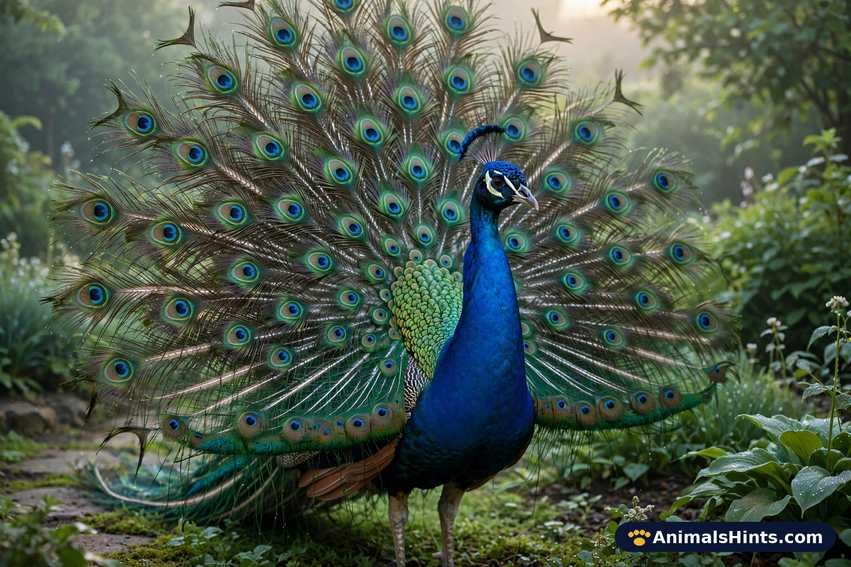
Animals that wear this shade almost never own it as pigment. The peacock is the type case: the saturated blue of the male’s neck and breast is structural colour. Inside each tiny barbule of those feathers sits a two-dimensional lattice of melanin rodlets and air channels set in keratin — a photonic crystal — which returns blue to the eye while the feather’s actual pigment, towards its hidden base, is plain brown. The bird is not dyed royal blue. It is engineered to perform it, fresh, out of whatever light is falling.
The hyacinth macaw comes closer to wearing the colour outright. At about a metre from beak to tail tip it is the longest flying parrot, and its plumage is an almost unbroken cobalt blue, broken only by bare yellow skin around the eye and beak. It lives in the wetlands and savannas of Brazil, Bolivia and Paraguay, and it is listed as Vulnerable — the royal shade, in the wild, is not common and not secure.
The family’s third exhibit carries a caution this site has filed before: the blue morpho’s wings are brown underneath and blue only from above, by the same structural trick as the peacock’s neck — the full account lives in our guide to the blue butterfly meaning. And the bird most North American readers actually meet in this colour, the blue jay, is a backyard regular whose own symbolism this site treats alongside its red neighbour in the post on cardinal and blue jay spiritual meanings. Nature’s royal blues, taken together, teach the symbolism an honest lesson: the colour of authority is usually not a substance. It is an arrangement.
Cultural and Religious Significance
The competitor’s strands are kept in his order, each carried at the strength the record allows.
In ancient Egypt, blue stood close to the divine and to the Nile’s gift of life renewed, and the material form of that blue was lapis lazuli, imported at great cost and set into the objects Egyptians made for gods and kings. The pigment history above is this strand’s evidence: a civilisation does not pay beyond-the-sea prices for a colour it considers ordinary.
In Christianity, blue gathers around the Virgin Mary. Renaissance patrons paid ultramarine prices to clothe her, and the convention hardened into iconography: Mary’s mantle is blue because blue was the costliest honour a painter could lay on a figure. Later devotion reads the colour back as purity and heavenly grace — a meaning that began, unusually traceably, as an invoice.
In Hinduism, blue is worn on the skin of gods. Krishna is painted and sculpted blue across centuries of art, and Shiva carries the blue throat of the Neelkanth story, in which he holds the world’s poison in his throat rather than swallow it. Interpreters read the divine blue as the infinite — sky and ocean carried on a body — and the reading is the tradition’s own, offered at that strength.
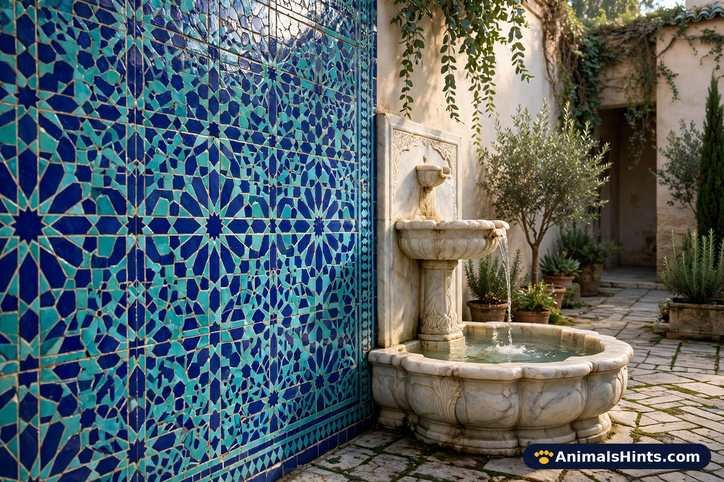
In Islamic tradition, blue covers architecture: the tiled domes and mosque walls of the Persian and Ottoman worlds are the largest blue surfaces most civilisations ever built, and blue-glazed tile and the blue bead against the evil eye alike are used with protective intent. The colour stands, in that built record, for heaven made habitable and harm kept at the threshold.
In Native American cultures, the competitor’s general strand needs its usual correction: there is no single Native blue teaching, because there is no single Native culture. Blue does appear in documented Indigenous practice — turquoise above all, treasured across the Southwest as a protective stone — but a pan-tribal symbolism of the colour blue is a modern summary, and it is printed here labelled as one.
In Chinese philosophy, the competitor assigns blue to spring and renewal. The documented system underneath is the five-phases correspondence, in which the colour of spring and the east is qing — a word whose range covers blue and green together, which is why translations split. The strand survives at that precision: a blue-green of growth and return, not a royal blue in anything like the European sense.
What the Bible Actually Does With Blue
The competitor’s blue page never opens the Bible, so this section is this article’s own — and blue turns out to be one of the Old Testament’s most specified colours. The high priest’s robe is prescribed in a single instruction: “And thou shalt make the robe of the ephod all of blue” (Exodus 28:31, KJV). Ordinary Israelites are given a smaller version of the same colour to wear: a “ribband of blue” on the fringe of their garments (Numbers 15:38, KJV) — blue as a standing reminder, carried at the hem of everyday dress.
And once, the King James text puts this colour family and royalty into a single sentence. Mordecai, the Jewish exile raised to honour at a foreign court, leaves the king’s presence “in royal apparel of blue and white, and with a great crown of gold” (Esther 8:15, KJV). It is the closest Scripture comes to this page’s exact subject: blue, worn royally, as the visible sign of a reversal of fortune.
Two honest bounds close the section. The Hebrew colour word behind these verses, tekhelet, names a blue-violet dye whose exact hue scholars still debate — it is not the nineteenth-century shade this article is named for, and no verse hands down a symbolism code for any colour. What the texts genuinely give blue is use, not doctrine: the colour of priestly dress, of a commanded reminder, and of one famous royal wardrobe.
Spiritual Interpretations of Dreaming About the Color Blue
Dream interpretation belongs to folklore, and no authoritative dream dictionary exists to settle it. The competitor prints four strands; they follow in his order, as the genre tells them, with the royal-blue case kept apart exactly as his own text keeps it:
- Clear blue skies: Read as peace, mental clarity and freedom — the dreamer’s affairs imagined with the weather taken out of them; optimism, in the genre’s shorthand.
- Dark blue waters: Read as depth work — submerged feelings and unexamined truths rising toward attention; navy in dreams is assigned to the subconscious itself.
- Light blue: Read as healing and emotional release — forgiveness after conflict, in the genre’s telling, and the restoration of an easier peace.
- Royal or electric blue: His final strand is this page’s shade exactly: read as spiritual power, awakening perception, divine protection and a strong connection to celestial beings — the genre’s most senior dream register for the whole family.
Notice the pattern across the four: the lighter the dreamt blue, the gentler the errand; the deeper and more saturated it gets, the more the reading turns toward authority and calling. Royal blue dreams, in this system, are never read as rest. They are read as summons.
Color Blue and Throat Chakra in Spiritual Practices
In the modern seven-chakra rainbow, blue belongs to the throat: Vishuddha, “especially pure”, the centre the system places at the throat and assigns to communication, expression and truthful speech. Royal blue’s place in that scheme is at the centre’s formal end — the genre reaches for the deep shade when the subject is not casual talk but declared truth: the vow, the testimony, the sentence a person has decided to stand behind.
The history deserves its sentence, because this family keeps its chakra claims honest. The classical Sanskrit description of the throat lotus, in the Sat-Chakra-Nirupana, gives Vishuddha sixteen petals of a smoky tone, red vowels, and a white circular region for its element, space. The bright blue throat centre familiar today is the modern scheme’s assignment, popularised in the twentieth century — a workable convention, widely taught, and a recent one. A blocked-throat reading, on either version, is a metaphor for reflection, never a diagnosis.
Practice, in the genre, follows the colour: meditating on blue light at the throat, chanting and singing to work the actual instrument, and wearing the family’s stones — the competitor names lapis lazuli, turquoise, aquamarine and blue lace agate. Of those, lapis carries by far the longest documented record, and it returns at this article’s close.
How to Use Royal Blue’s Meaning in Everyday Life

Begin with dress, because the psychology section’s finding is a practical one: royal blue is the shade for occasions where you want to be read as both trustworthy and senior. It does the work at interviews, ceremonies and difficult meetings that navy does quietly and pale blue does gently — it declares. Used daily it can over-declare, which is the genre’s one wardrobe caution for this shade.
In rooms, treat it as an accent with authority rather than a field colour. A single royal blue element — cushions, a chair, a door — organises a space the way a seal organises a document. It pairs by contrast: against the warmth of the red spiritual meaning held in small doses, against the metal examined in the gold spiritual meaning, and as the deep ground that lets the black spiritual meaning read as depth rather than darkness. Beside the grey spiritual meaning it is the classic formal pairing — the shade that gives grey’s neutrality a decision to support.
For reflection, use the shade the way its meanings suggest: as the colour of the considered statement. Write the difficult letter on paper you associate with it; keep the journal for decisions, not for venting. Royal blue’s whole teaching, across every section of this page, is that calm and authority are not opposites — and a practice that rehearses saying true things calmly is the most literal way to use it.
Final Thoughts
Royal blue earns its name more honestly than most colours earn theirs. The name is documented to a queen’s dress competition in the early nineteenth century. The prestige underneath it is documented further back still — to a rock mined in one Afghan valley, priced above gold, rationed by contract onto the shoulders of the Virgin, and carried into heraldry inside the very word azure. Few symbolism traditions can show their working like that.
That grounding is what separates this shade’s record from pure invention, and this page has tried to keep the two sorted: the fourteen meanings, the aura and the dream readings belong to a modern genre and are framed as its beliefs; the pigment, the tincture, the gemstone grade and the three verses belong to the record and are stated as fact. Held in that order, each kind keeps its value.
It is fitting that the stone which carried this colour through most of human history is also the one the genre still reaches for first. Lapis lazuli — lazurite’s blue flecked with fool’s gold, mined at Sar-e-Sang for more than six thousand years — was royal before the shade had a name, and it remains the shortest summary of everything the name came to mean: depth that had to be travelled for, and was.
Frequently Asked Questions
What does the color blue symbolize spiritually?
Spiritually, blue symbolises truth, peace and faithful communication — the sky’s breadth and the sea’s depth read as qualities of soul. Royal blue, this page’s shade, concentrates the same symbolism into authority, wisdom and calm command.
How does blue affect our psychology?
In colour psychology, blue is read as calming and clarifying: it steadies emotion, supports focus and makes people and rooms seem trustworthy. Too much of the deep shades can feel cold or distant, the genre warns, so balance them with warmth.
What does liking blue say about your personality?
In the genre’s portrait, blue lovers value peace, honesty and clear speech — calm, thoughtful, loyal people who prefer harmony to conflict. Treat that as the tradition’s sketch rather than a diagnosis; a favourite shade describes taste, not character.
How can I use blue’s spiritual meaning in my life?
Wear blue when honest, calm communication matters; use it in a room where clarity is wanted; meditate with it for steadiness. For royal blue specifically, reserve it for the formal register — the decision, the declaration, the occasion that deserves the family’s most authoritative shade.