Spiritual Meaning of a Deer in Your Path: Signs, Numbers and What to Do
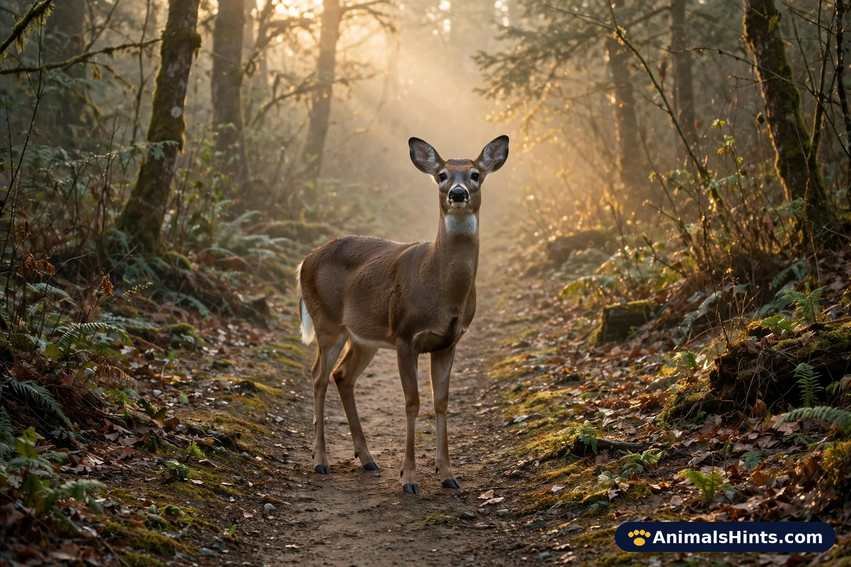
You stop on the trail because she has already stopped on it: a deer, mid-path, watching you decide what happens next. The spiritual meaning of a deer in your path is understood in the animal-sign traditions as a gentle interruption — a prompt toward softness, sharper instincts and a slower pace, delivered by an animal that survives on exactly those three things.
Most path meetings happen at the dim ends of the day, and that timing is biology before it is symbolism. Deer do the bulk of their travelling and feeding around dawn and dusk, so a figure standing in your route at first light is usually an animal on its ordinary rounds. Sign readers say the ordinariness is the point: the message, if there is one, arrives wearing everyday clothes.
This guide gives the tradition’s ten readings in full, separates the doe, the stag and the fawn, checks what older traditions genuinely record about deer, and covers the numbers, the driving case and the dream version. Every reading is labelled as the belief it is, the natural history underneath it is checked, and one short passage deals plainly with road safety, because a deer in a road path is a hazard before it is anything else.
What Does Seeing a Deer in Your Path Symbolize?
At the broadest level, the tradition treats a deer blocking your route as a symbol of a pause worth taking. Other animals cross and are gone; a deer in your path often stands its ground for a few seconds, ears working, and that shared stillness is what readers build on. Four strands recur through the symbolism literature, and they set the grammar for everything that follows.
- Calm carried into a unsettled stretch. The deer is read as proof that composure is a usable strategy, not just a mood — the animal stays level while fully alert, and the sign is taken as an invitation to do the same.
- Renewal and turning seasons. Deer are creatures of visible cycles, growing and shedding, shifting coats, raising spotted young each spring. A meeting is read as a marker that one phase of your own life is giving way to the next.
- Intuition and sharpened awareness. Few common animals run on finer information. The tradition casts the deer as a reminder that your earliest, quietest signal about a situation deserves a hearing before the louder evidence arrives.
- Compassion and emotional softness. The deer’s whole manner — unhurried, unarmoured, quick to forgive a false alarm and return to grazing — is read as a model for handling people, yourself included, without force.
Held at that strength, the symbolism is a set of lenses rather than a verdict. The deer was crossing to food, to cover or to its young. What the moment reliably offers is a few seconds of enforced attention, and the traditions differ mainly in what they suggest you notice during them. Dawn meetings carry one extra association on this site: the first hour belongs to more than one messenger, and our held companion guide to crows cawing in the morning meaning treats the day’s other early caller.
The Real Deer in Your Path
Before the readings, the animal. The deer most likely to stand in a North American path is the white-tailed deer (Odocoileus virginianus); in Europe the common path-side species are the roe deer and the larger red deer, and in Japan the sika. The vocabulary matters for the variant readings later: an adult female is a doe, an adult male a buck or — especially of red deer — a stag, and a young deer in its first year is a fawn.
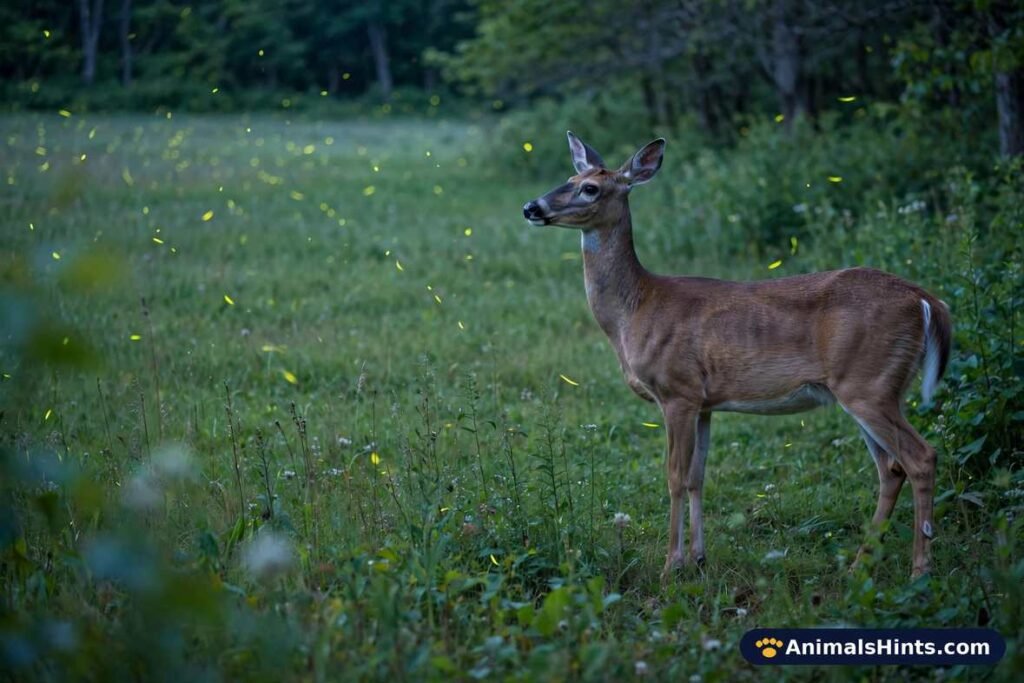
White-tails are crepuscular, most active in the twilight hours around dawn and dusk, which is the plain reason path encounters cluster then. Through the middle of the day they mostly rest in cover, chewing the cud like the ruminants they are. A deer met at noon is not lost or behaving strangely; it has simply been disturbed from its bed, or is moving between one and the other.
Its senses explain the famous pause in your path. A deer’s nose is its leading instrument — scent is how it maps danger long before anything is visible — backed by large ears that swivel independently toward separate sounds and by eyes placed for a wide field of view and fine-tuned to movement and low light. When a deer stops and stares, it is not posing. It is running a full check: wind, sound and motion, in that order, before it commits to a direction.
The body language of those seconds is readable. A relaxed deer feeds, flicks its tail loosely and lowers its head again. An uneasy one stamps a forefoot, snorts sharply through its nose and raises its white tail like a flag as it bounds off — the tail signal that gives the white-tail its name and warns every deer behind it. Prey animals live under real pressure: coyotes, bobcats, bears and wolves all hunt deer where their ranges overlap, and the vigilance the symbolism praises is, in the field, a survival budget spent carefully. Night offers no full rest from it either; deer share the dark hours with other quiet travellers such as the possum, and most movement between feeding grounds happens then.
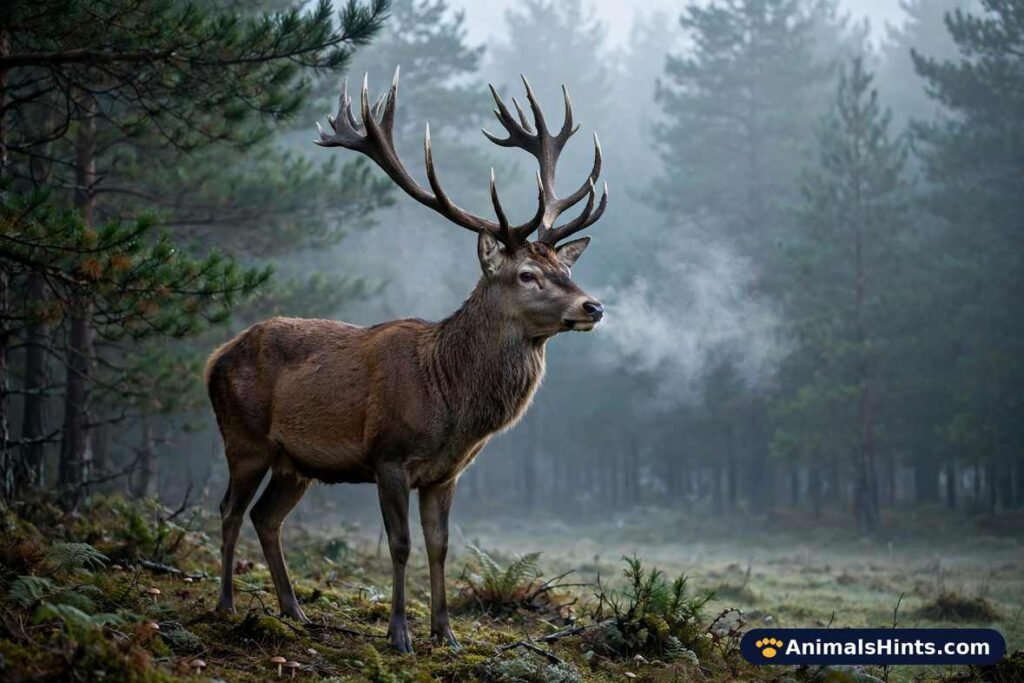
One male feature carries a whole symbolism of its own. Bucks grow antlers each spring and summer — living bone, covered while growing in a soft skin called velvet — use them through the autumn breeding season, and cast them in winter to begin again. No other common animal rebuilds so large a part of itself every single year, and the renewal readings in the next section lean on that fact harder than on any other.
10 Spiritual Meanings of a Deer Crossing Your Path
The tradition attaches ten readings to this encounter, and they keep the tradition’s own sequence below. Each one is paired with the bit of deer biology or older lore behind it, so the logic of the reading is visible rather than merely asserted.
1. A Sign of Spiritual Guidance
The first reading casts the deer as a guide animal: a creature that appears on the route itself, rather than off to one side, and is therefore read as commenting on the route. In this strand, the encounter is taken as reassurance that a decision you have been circling is being accompanied — not answered for you, but walked with.
The guidance pictured is deliberately undramatic. A deer leads by example rather than instruction: it checks the wind, trusts what it finds and moves when moving is right. Readers take that as the shape of the help on offer — quiet confirmation, arriving at walking pace.
2. A Reminder to Be Gentle and Kind
The second reading is the one the animal’s manner writes almost by itself. A deer meets the world without armour, claws or any plan that involves hurting anything, and it flourishes anyway. The tradition reads a path meeting as a prompt to audit your own approach: where has hardness become a habit rather than a necessity?
Self-kindness is named as often as kindness to others in this strand. The deer rests when resting is due and startles without shame when startling is warranted, and readers borrow both permissions — to soften a self-criticism that has run past its usefulness, and to stop apologising for ordinary caution.
3. Encouragement for New Beginnings
The third reading rests on the antler cycle described above. An animal that sheds a crown of bone each winter and grows a larger one each spring is a walking argument that a finished chapter is raw material rather than a verdict. readers take a deer standing in the path as a sign that a beginning may be nearer than it feels.
The counsel attached is patient rather than urgent. Antlers grow over months, not overnight, and the reading borrows the timescale: start the new thing in its season, feed it steadily, and do not judge a spring growth by a winter standard.
4. Symbol of Inner Peace and Calm
The fourth reading looks at how a deer holds itself between alarms. A grazing deer is not a careless one — its ears never fully clock off — yet it manages to spend most of its life in an unhurried rhythm of feeding, resting and moving on. Readers read a path encounter as a mirror held up to their own baseline: peace, in this telling, is not the absence of watchfulness but watchfulness without panic.
The practical form of the reading is usually small: a walk taken without a phone, a decision slept on, a room in the day kept deliberately unfilled. The deer is not presented as a monk. It is presented as an animal whose calm is a working state, which is what makes it borrowable.
5. Sign to Slow Down and Appreciate Life
The fifth reading is the trail encounter read literally. A deer in your path makes you stop — that much is not symbolism at all — and the tradition simply asks what you did with the stop. In this strand the sign is aimed at people moving through their days at a speed that edits out everything except the destination.
Appreciation, here, is given the deer’s own scale. What a deer stops for is unremarkable treasure: fresh browse, clean water, a patch of sun at the field edge. The reading suggests the human equivalent is equally modest and equally available — one meal actually tasted, one view actually looked at, per day, on purpose.
6. Encouragement to Trust Your Senses and Instincts
The sixth reading is built on the finest sensory equipment of any animal most readers will ever meet. A deer commits to its first information — a scent thread, a twig’s snap — without holding a committee about it, and it is usually right to. The tradition reads a crossing as a nudge to grant your own first signal the same courtesy.
The reading is careful about what instinct is. In the deer it is not a mystical faculty; it is attention that arrives early, before the threat is visible. Readers are advised to treat their own version the same way: the detail that felt wrong, noticed and written down, rather than a hunch obeyed blindly or dismissed entirely.
7. Symbol of Compassion and Unconditional Love
The seventh reading gathers around the doe. Few sights in nature are as plainly devoted as a mother deer’s season: nursing on a schedule, leading fawns to cover, returning to the same hidden nursery spots day after day. A path meeting is read, in this strand, as a reminder of love practised as routine care rather than declared feeling.
Forgiveness is the form this reading most often takes in modern guides. The deer is an animal that startles and then, minutes later, grazes calmly in the same field — it does not carry the alarm around all day. Readers borrow that pattern for grudges: feel the startle honestly, then put it down and get back to feeding your own life.
8. Connection to Spiritual Thirst and Divine Grace
The eighth reading is the set’s explicitly religious one, and it grows from a single famous image: the deer at the stream. In devotional writing the animal’s drinking — head down, unguarded, at the water it needs to live — became a picture of the soul approaching what it most deeply needs. The full verse behind the image, and the honest limits of it, are dealt with in the traditions section below.
Read at that strength, a deer in your path is taken as a prompt about thirst rather than about answers: what have you been needing — rest, prayer, company, forgiveness — and postponing? Grace, in this strand, is pictured the deer’s way: unhurried, unforced, and available at ground level to anyone who stops long enough to drink.
9. Reminder of Loyalty and Protecting Your Peace
The ninth reading looks at the herd. Deer are not solitary by preference: does and their young travel in family groups, and even adult bucks keep company outside the breeding season. A crossing — especially by more than one animal — is read as a prompt about your own herd: who is in it, and whether the membership still deserves the loyalty it gets.
The second half of the reading is the boundary. A deer gives its trust slowly and withdraws it instantly, without drama, the moment the wind changes. Readers take that as the model for protecting peace: loyalty offered warmly to the proven few, and a clean, unembarrassed exit from whatever keeps startling you.
10. Message of Balance, Partnership, and Harmony
The tenth reading is the numbers reading in embryo, and it belongs properly to pairs. Two deer moving together — most often a doe with a grown youngster, or two does from the same family group — are read as an emblem of life held in balance: vigilance and rest, giving and receiving, the wild route and the home ground.
Even for a single deer, this strand finds the same pattern inside one animal: a creature built half for stillness and half for explosive speed, spending its days alternating the two. The reading’s counsel is an audit rather than a prophecy — find the half of the rhythm you have been skipping, and restore it.
A Doe, a Stag or a Fawn: How the Deer Itself Changes the Reading
The ten readings above treat “a deer” as one symbol, but the animal standing in your path is always a specific one, and the tradition — sensibly, for once — adjusts the reading to fit. The variants below follow the animal’s real life first and the symbolism second.
The doe in your path. A doe is the commonest encounter of all, and her reading is the maternal, sustaining one: provision, patience, care given on schedule. Biologically she is also the group’s anchor — family parties of does and young are the stable unit of deer society — so her crossing is read as a prompt about the people who depend on your steadiness, and about letting yourself be looked after in turn.
The stag in your path. An antlered buck is read with more ceremony: dignity, earned standing, strength that rarely needs demonstrating. The biology supports the register — those antlers are grown fresh each year at real cost and carried through exactly one season of contests — so the stag’s strand adds a note the doe’s lacks: stature is seasonal, rebuilt annually, and never a permanent possession to coast on.
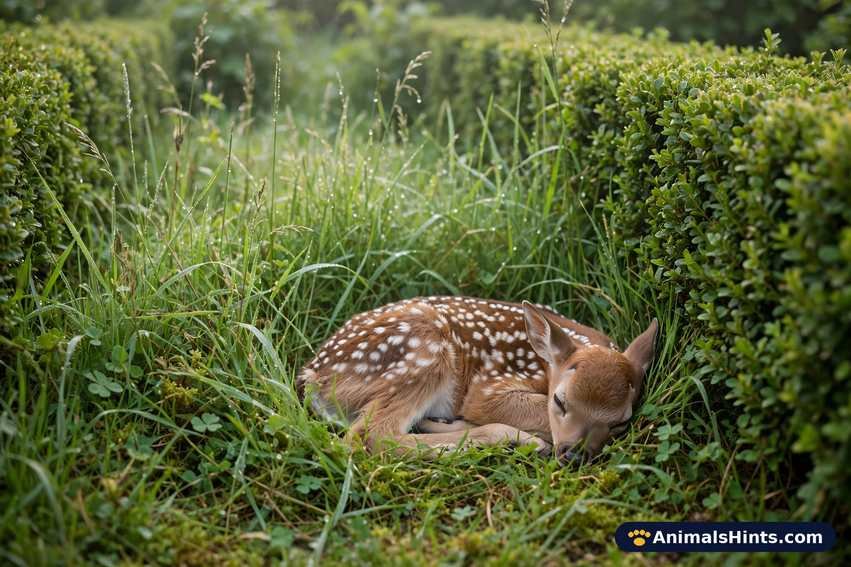
The fawn in your path. A spotted fawn is the variant that most changes the practical advice, because a fawn met alone is almost never abandoned. For its first weeks a fawn is a hider: its mother leaves it tucked in grass or at a garden edge for hours at a time, returning to nurse, precisely because her own scent and size would draw predators to it. The fawn’s near-scentlessness and its spotted camouflage are the whole strategy. The reading attached is tenderness and protected beginnings — something new in your life being kept quiet until it can stand — but the animal’s need outranks the reading every time: never approach, touch or feed a lone fawn, and leave the area so its mother can return. If a fawn is plainly injured or still in the same spot after a full day, the right response is a call to a licensed wildlife rehabilitator, not an attempt to help it yourself.
Cultural and Religious Explanations
The competitor’s survey gathers four cultural strands, kept below in the same sequence he uses, each at the strength the record supports.
Native American traditions. There is no single Native teaching about deer, and any honest summary has to start there: hundreds of distinct nations hold their own deer stories, ceremonies and hunting ethics. Across many of them, though, the deer figures as a teacher of gentleness and of gratitude for an animal that feeds people — hunted with ceremony in numerous traditions, thanked rather than merely taken. A deer crossing is received in that broad frame as a reminder to move attentively and take only what is needed. Treat it as that and no more: a broad pattern across a record far richer than any summary.
Celtic spirituality. In the medieval Welsh and Irish literary record, the white stag is a genuine recurring figure: an otherworld animal whose appearance signals that the boundary with the Otherworld is near, and whose pursuit leads heroes out of the ordinary world and into adventure. The antlered figure of Cernunnos, known from Iron Age art including the Gundestrup cauldron, gives deer a divine association in the older Celtic world as well. Modern Celtic spirituality reads a stag in your path through that inheritance — guidance, and a quest quietly beginning. The bounded version is in the traditions section below.
Buddhism. The Buddhist connection is place before it is symbol: the Buddha’s first sermon was preached in a deer park — Mrigadava, at Sarnath near Varanasi — a sanctuary where deer were protected. Buddhist art ever since has flanked the wheel of the teaching with two deer, the emblem still set above monastery doors, and the deer in that art stand for the gentleness and attentiveness the teaching asks of its hearers. A deer encounter is read in this strand as a call to listen properly before anything else.
Christianity. Christian devotional writing takes its deer almost entirely from one psalm image — the thirsting hart at the water brooks — read as the soul’s longing for God, with the full KJV wording and its limits set out below. Beyond that image, deer appear in the Bible as clean animals permitted as food and as emblems of sure-footedness, and no biblical passage treats a deer crossing anyone’s path as an omen. The Christian strand is printed at exactly that size: a devotional image, honestly bounded, not a doctrine of signs.
What Older Traditions Actually Record About Deer
Because deer lore is repeated so loosely online, it helps to lay out what can actually be checked, tradition by tradition — including the one famous verse, quoted exactly.
Scripture first. Psalm 42:1 (KJV) reads: “As the hart panteth after the water brooks, so panteth my soul after thee, O God.” Hart is the old word for a male red deer. The verse is a simile about longing — the psalmist compares his soul’s thirst for God to a deer’s thirst for water — and it is printed here as exactly that: devotional imagery of the first quality, and not a teaching that a deer appearing in your path carries a message. Modern paraphrases that swap in “deer” and softer verbs are not the KJV text and are not quoted as if they were.
Norse record. Deer stand inside the world’s machinery in Old Norse poetry. Grímnismál, in the Poetic Edda, names four harts — Dáinn, Dvalinn, Duneyrr and Duraþrór — who stretch their necks up and feed among the branches of Yggdrasil, the world tree; Snorri repeats the four in the Prose Edda. It is a striking, checkable detail, and a bounded one: the poem assigns the stags no omen role and no message for travellers, and none is claimed here.
Shinto record. Japan holds the strongest documented case of deer as divine messengers anywhere. At Kasuga Taisha in Nara — founded in 768 — tradition tells that the deity Takemikazuchi arrived from Kashima riding a white deer, and the sika deer of Nara have been protected ever since as messengers of the shrine’s gods, a status they still hold as designated natural monuments. A wild animal treated as a god’s envoy for over twelve centuries is a documented religious practice, not a modern invention, and it is the firmest ground under the whole “deer as messenger” idea.
Chinese record. In Chinese decorative art the deer is a documented visual pun: the word for deer, lu, is a homophone of lu, the word for an official’s salary and rank, so herds of deer on Qing dynasty porcelain — the famous “hundred deer” vases — carry a wish for prosperity and a successful career, and deer shown with pine and peach add longevity to the message. That is art history, verifiable in museum catalogues, and it gives the prosperity strand of deer symbolism a firmer address than most animal lore ever gets.
The Celtic bound. The white stag deserves its caution as well as its fame. The motif is genuinely medieval — Pwyll’s hunt in the First Branch of the Mabinogi leads him to Arawn, lord of the Otherworld — but the tidy modern package of “the stag as Celtic guide to enlightenment” is a later embroidery laid over those stories, and the Mabinogi‘s own stag is not even described as white. The record supports an otherworld threshold animal in medieval Welsh and Irish literature. It does not support a single pan-Celtic deer doctrine, and none is printed here.
Symbolic Meanings of 2, 3, or 4 Deers Crossing Path
The numbers tradition counts animals, and this section keeps the competitor’s headings — including his ungrammatical “Deers,” which is his wording, left as found. In the field, groups have ordinary explanations: two is usually family, three or four a small party of does and young travelling together. The readings are the tradition’s layer over that fact.
When 2 Deer Cross Your Path
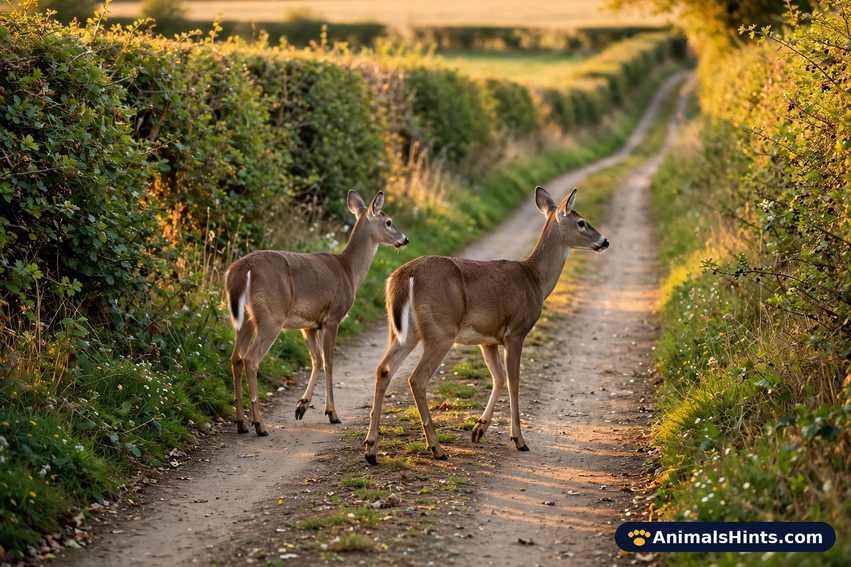
Two deer are read as the partnership configuration: balance between two people, or between two sides of one life. Because a real pair is most often kin — a doe and her grown fawn, two sisters from the same family group — the reading leans toward bonds that are given rather than chosen, and toward the work of keeping them in repair.
When 3 Deer Cross Your Path
Three is read as the growth number: body, mind and spirit in the genre’s usual triad, or past, present and future in its other. A trio crossing is taken as a sign that several strands of a life are moving in the same direction at once, and the counsel attached is simply not to interrupt a rare alignment with unnecessary doubt.
When 4 Deer Cross Your Path
Four is the stability configuration: foundations, the four directions, the household holding its shape. In animal terms four is a small herd — the largest group most readers will meet on a path — and the reading borrows the herd’s own logic: safety in settled company, and progress made at the pace the slowest member can keep.
What Does It Mean When a Deer Crosses Path While Driving?
The driving case is where this article deliberately changes register, because it is the one version of the encounter that can hurt somebody. The tradition reads a deer on the road as the slow-down sign at its most literal — an interruption, a warning to attend, a crossroads moment — and those readings are set out below. But they come second, and the practical passage comes first, in its own short block, because no reading of any encounter outranks the safety of the people in the car.
The practical note, plainly. Slow down in deer country, above all at dawn and dusk and in the autumn breeding season, and scan the road edges rather than the road. If a deer steps into the road ahead of you, brake firmly and stay in your lane: do not swerve. Safety authorities are consistent on this point — a sudden swerve is how deer encounters turn into far worse crashes, into oncoming traffic, trees or ditches. One deer usually means more nearby, so pass the spot slowly even after the first animal clears. Never approach or feed a wild deer, on the road or anywhere else; an injured deer is strong, frightened and best left to the professionals you can call once you are safely stopped.
With that said, the tradition’s own reading of the driving case is not foolish. A driver who has just braked for a deer has been forcibly returned to the present moment, and sign readers treat that jolt as the message: hurry examined, attention restored, the next stretch of road — and of whatever the road stands for — driven awake. Encounters with other travellers carry the same jolt in smaller doses; our guide to birds flying in front of your car while driving collects the winged version of the same interruption. Reflect on it afterwards, at home, at walking pace. That sequencing — safety in the moment, meaning later — is this page’s whole position, and it is not negotiable in the other direction.
Deer in Your Path in Dreams
Dreams are the one place a deer can cross your path with no biology involved at all, and the tradition treats the dream version as its own case rather than a copy of the waking one.
In the dream-reading literature, a deer crossing ahead of the dreamer is most often read as a gentle course correction being contemplated rather than imposed: a direction in waking life that the dreamer already half-knows needs softening, slowing or changing, pictured by the sleeping mind as an animal stepping calmly into the road. A doe in a dream leans, in this literature, toward the nurturing and receptive side of the dreamer’s own life; a stag toward dignity, standing and the wish to be taken seriously; a fawn toward something new and still too young to be exposed.
Two honest bounds belong with all of that. No dream dictionary is a verified instrument — these are the genre’s conventions, printed as conventions — and the same dream image means different work in different lives. The most defensible use the tradition offers is the simplest: note what the dream deer interrupted. In dreams as on trails, readers treat the thing you were travelling toward when the animal stepped in as the address the message was sent to.
Deer Encounters: Good or Bad Luck?
Weighed as a whole, the tradition leans warm. The messenger record at Nara, the prosperity pun in Chinese art, the gentleness and renewal readings in the modern lists — the centre of gravity is blessing, guidance and good fortune, and no major strand treats the ordinary deer as a herald of disaster.
The qualifications are about manner rather than menace. A calm deer that watches you and moves off at its own pace is read as the harmonious case. A deer that startles violently, or one found injured, is read by modern guides as a prompt toward your own state — vulnerability, scattered attention, peace in need of protection — which is advice dressed as omen, and harmless enough at that size. What no strand in the record honestly supports is a prediction: a deer crossing settles nothing about your future, and this page’s verdict is the tradition’s own best version of itself — treat the encounter as good luck of the only verifiable kind, a few seconds of beauty and enforced attention that cost you nothing.
Final Thoughts
A deer in your path is a small, complete story: an animal on its rounds, a traveller on theirs, and a few seconds in which both stop and take each other’s measure. The traditions gathered around that moment — ten modern readings, a deer park at the start of Buddhism, messengers still protected at Nara, a psalm’s thirsting hart — are best held the way this guide has tried to hold them: warmly, and at their documented strength.
If the moment stays with you, the reflection the tradition actually recommends is a quiet inventory rather than a search for codes. What were you hurrying toward? What would gentleness change about the next hour of it? Other path meetings invite the same inventory — the readings for a rabbit crossing your path make the closest comparison — and the animal itself supplies the method either way.
The deer, after all, rebuilds its finest feature from nothing every year, and trusts a fresh antler to be ready when the season asks for it. Slowing down long enough to grow the next version of things is, as spiritual advice goes, unusually well supported by the evidence.
FAQs
What does it mean when a deer crosses your path spiritually?
Spiritually, the tradition reads it as a gentle interruption: guidance, softness, sharpened intuition and a prompt to slow down. It is a reading, not a prediction — deer cross paths at those hours because twilight is when deer travel and feed.
What does seeing 2 deer crossing your path mean?
Two deer are read as partnership and balance — a bond in good repair, or two sides of one life moving together. In the field a pair is usually family: a doe with a grown fawn, or two does from the same group.
What does seeing 3 deer crossing your path mean?
Three deer are read as growth and alignment — several parts of a life moving the same way at once. The genre often maps the three onto body, mind and spirit, and takes the sighting as encouragement rather than warning.
What does seeing 4 deer crossing your path mean?
Four deer are read as stability and protection: foundations holding, and progress at a settled pace. In animal terms it is a small family party travelling together, which is where the reading gets its feeling of safety in company.