Hazel Eyes Spiritual Meaning: 15 Meanings, Myths, Personality and the Science
Some eye colours hold still for the camera and some never do. Hazel is the restless one: brown beside the pupil, gold in the middle distance, green at the rim, and a different verdict from every window it stands near. The hazel eyes spiritual meaning, as the symbolism guides present it, grows straight out of that restlessness — balance, adaptability, earth energy and an old-soul depth are all read off a colour that refuses to be only one thing.
Below, the guides’ account is followed section by section in the sequence they chose — definition, facts, the fifteen meanings, personality, the chameleon question, folklore, dreams, omen — and every claim is tagged with its true category as it appears. Tradition is printed as tradition. Underneath it sits the measured record: what an iris is actually doing when it looks hazel, how common the colour really is, what researchers found when they tested eye colour against character, and what the oldest text on the shelf says about the word itself.
One limit governs everything below. An iris colour is not an occurrence. It does not arrive one morning carrying news; it is settled before birth and carried for life. What follows is therefore portrait-lore — a way people have learned to talk about a permanent feature — rather than a system of signs about coming events, and that is the strength at which everything below is offered, from the first section to the last.
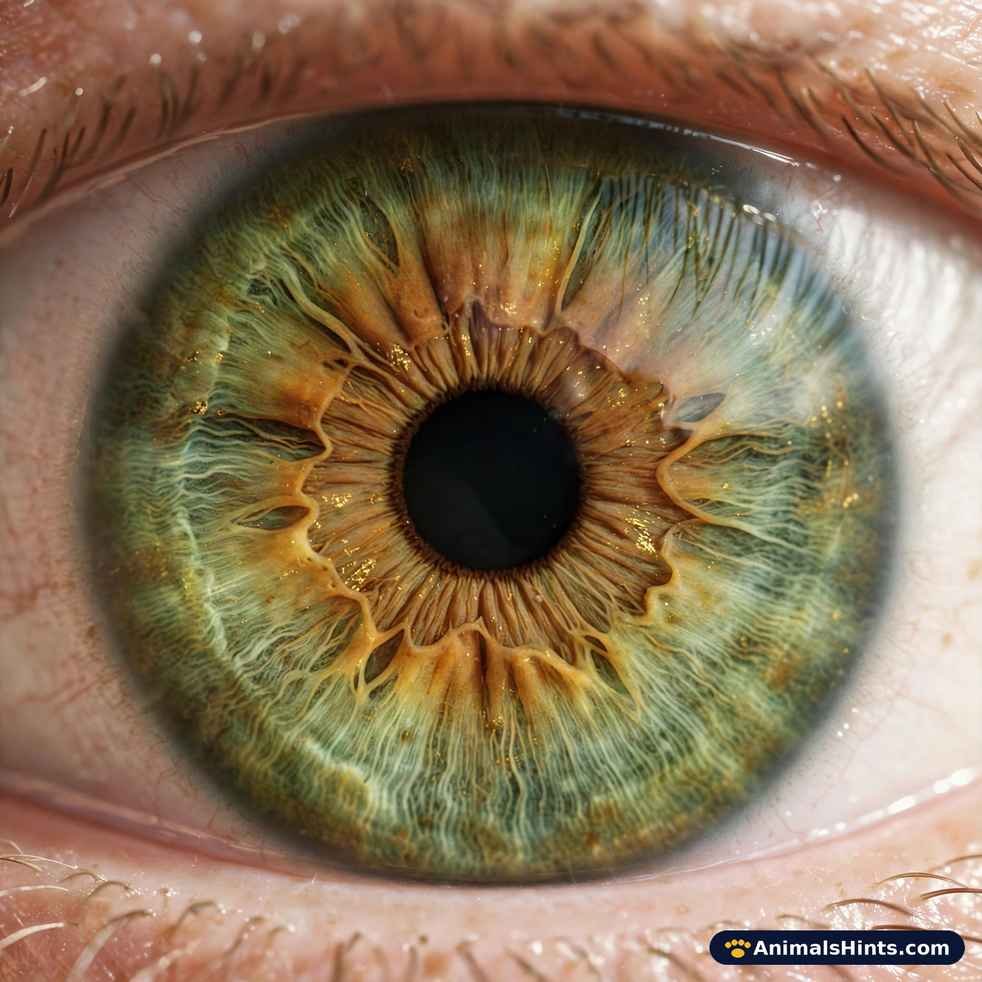
Define Hazel Eyes
Hazel names an iris that will not commit to a single colour. The guides define it as a meeting of green, brown and gold in one eye, usually darker toward the centre and lighter toward the edge, so that the overall impression depends on where the light is coming from and what the wearer has on. Two people can both be filed as hazel-eyed and look quite different: one mostly golden brown with green flecks, the other mostly green held inside a brown ring.
Even the reference record admits the word is slippery. The encyclopaedia summary of eye colour notes that definitions of hazel vary — traditionally it meant a light brown or gold, the shade of a hazelnut shell, while looser modern usage covers the mixed brown-and-green iris that can look brown in one room and green in the next. That double usage explains a good deal of the confusion around the colour, including why hazel is so often argued with its neighbours: the green eyes spiritual meaning on one side, where the melanin runs thinner, and the amber shelf on the other.
What is not in dispute is the naming. The colour is named for the nut of the hazel tree — a brown shell with a golden cast — which is worth remembering when the Bible section below arrives, because the tree came first by several thousand years.

Facts and Characteristic Features of Hazel Eyes
The guides’ fact shelf opens with rarity, and the record broadly backs the shape of the claim while correcting its size. Hazel is genuinely uncommon — far less common than brown, somewhat more common than true green — and it turns up across many ancestries wherever the genetics for a middling melanin load occur, with its stronghold in northern and central Europe. The guides also note, correctly, that a hazel iris often shows a visible contrast between its centre and its rim, giving the eye a layered, almost jewelled look, and that photographers prize the colour because it catches light unevenly and interestingly.
One popular claim on this shelf needs its mechanism stated plainly. The guides say emotion can shift a hazel eye’s appearance, and something real sits underneath that: when a pupil dilates or narrows — with light, focus or arousal — the iris tissue compresses or spreads, and the balance between the brown centre and the green rim changes with it. The pigment does not change. The geometry does. The table below reproduces the guides’ summary of the feature word for word, as they print it.
Table: Key Characteristics of Hazel Eyes
| Feature | Description |
|---|---|
| Color Variation | Mix of green, brown and gold that shifts with lighting |
| Melanin Level | Medium melanin levels offer both light and dark tones |
| Rarity | Less common than brown, more common than green |
| Common Descriptions | Warm, changeable, earthy, glowing |
| Cultural View | Often linked with intuition, luck and mystery |
Judged against the measured record, the table is a fair summary with one soft row. The melanin row is right that hazel sits in the middle band, though “medium” hides the important detail — the pigment is spread unevenly, which is the whole reason the colour layers. The rarity row is right in direction; the prevalence section below puts the audited number on it.
The Real Science of Hazel Eyes: A Middle Dose of Melanin, Unevenly Spread
No iris carries a green, gold or hazel pigment. Melanin is the only colouring agent the eye possesses — the pigment family behind skin and hair tones too — and the rest of what we call eye colour is light behaving on its return journey. Behind the iris’s front layer lies a dark pigmented sheet, present in every healthy eye. The front layer, the stroma, is where the dose varies. Load it fully and almost all incoming light is absorbed: the eye is brown — the colour read on the brown eyes spiritual meaning shelf. Drain it almost dry and the tissue throws short wavelengths back at whoever is looking, which reads as blue. Hazel occupies the ground between, and distribution is its signature: a heavier melanin load than green carries, spread patchily, so the pupil’s neighbourhood runs brown or gold while the thinner-pigmented rim lets scattered light tint it green.
That is why hazel will not sit still. A structural colour is a hostage to its lighting: bright sun strengthens the green, dim interiors let the brown dominate, and a gold or rust-coloured shirt can pull the whole iris toward amber. The pupil’s size plays its part too, squeezing and stretching the coloured ring. Nothing about the eye itself has changed between breakfast and dusk; the viewing conditions have. The folklore of the colour-changing eye, examined in its own section below, is this ordinary optics wearing a costume.
The genetics are a committee, not a switch. Something like sixteen genes have been tied to eye colour in the inheritance literature, and two adjacent ones — HERC2 and OCA2, both on chromosome 15 — account for most of the variation: a regulatory stretch inside HERC2 controls how much melanin OCA2 is allowed to make. Hazel appears only when that control lands in the slim band between full output and almost none; that narrowness is part of why the colour is uncommon. The prevalence figure deserves the same care. The competitor page for this topic states flatly that hazel occurs in “about 5% of the world’s population,” and for once the circulating number survives the audit: the eye-colour reference table gives hazel at about 5% of the world population and about 10.3% of the population of the United States, concentrated in northern and central Europe and most common in the United Kingdom. Five per cent is the figure at reference strength — printed here at exactly that strength, as an estimate from the standard summary rather than a census.
One boundary keeps the filing honest. Where the two eyes carry different colours, or a single iris holds two sharply distinct zones, clinicians use a different word — heterochromia — and it is not simply a dramatic form of hazel. Hazel is one iris blending its shades gradually; the two conditions are filed separately in the clinics even when the guides sweep them together.
15 Spiritual Meanings of Hazel Eyes
The guides attach a standard set of fifteen readings to this colour; they are set out below in the guides’ sequence, under the guides’ headings. A pattern announces itself early: nearly every entry retells the colour’s own biography as a character sketch — a shifting iris becomes adaptability, an earthy palette becomes grounded wisdom, a layered ring becomes layered understanding. Every one of them belongs to the tradition and is attributed to it; not one describes any real individual.
1. Insight and Deep Inner Vision
The opening reading takes the layered iris as a picture of layered sight. A colour that seems to hold several depths at once leads the guides to describe its owners as underneath-noticers: unspoken motives, quiet emotions, the detail the rest of the room missed. The perceptiveness is then extended outward: such people are said to be turned to for clarity when a matter is confused. It is the colour’s appearance doing the arguing, and the entry is printed as the guides’ symbolism, not as an observation about anyone’s abilities.
2. Wisdom Rooted in Earth Energy
The second reading draws on the palette. Brown and gold are the colours of soil, bark and ripe grain, and the tradition reads an iris wearing them as a sign of wisdom of the practical kind — patience, experience, judgement that stays steady when circumstances do not. Logic and feeling are said to be held in balance, which is the colour mix retold as a temperament. People are described as seeking out such a person for advice and reassurance. The portrait is attractive; it remains a portrait, painted by the guides from the colour’s earth tones.
3. Protective Aura Against Negativity
Here the guides claim the layered colour works as a shield: harmony within the eye is read as harmony projected outward, repelling tension and ill feeling from a room. The hazel-eyed person of this reading becomes a peacemaker whose calm discourages conflict before it starts. No mechanism is offered and none exists in any record this page can check — the claim belongs entirely to folk symbolism, and it is filed here at that level, as a belief people hold about the colour rather than an effect the colour has.
4. Adaptability and Versatile Strength
The fourth reading is the chameleon quality promoted into a virtue. Because no two meetings with a hazel iris look quite alike, the guides infer a person who adjusts — to new places, new ideas, sudden reversals — without coming apart. Resilience is attached: quicker recovery from setbacks, a talent for finding the workable angle. The reasoning is openly analogical, from appearance to character, and the guides themselves present it as symbolism. It is recorded here in that frame.
5. Adventurous Energy and Spontaneous Courage
Movement in the colour is read, fifth, as movement in the person. The tradition’s hazel-eyed figure is curious, restless with dull routine, willing to take the considered risk and explore the unfamiliar path, and is credited with pulling companions along by example. Boldness and inspiration are the words the guides reach for. As with the entries around it, this describes the tradition’s idealised wearer of the colour — a character in a symbolic system — and not a prediction about the next hazel-eyed stranger.
6. Independent Spirit With Calming Presence
The sixth reading pairs two qualities the guides treat as the colour’s twin poles: self-reliance and calm. The hazel-eyed person is said to stand alone comfortably when standing alone is required, yet to cool a room’s temper by being in it — leading, when they lead, with a quiet voice rather than volume. Independence that does not curdle into distance is the summary the tradition gives. It is a flattering composite, printed as the tradition’s composite.
7. Transformation and Mental Agility
A colour that changes under light becomes, in the seventh reading, a mind that changes under thought. The guides credit hazel-eyed people with quick processing, an ability to examine a problem from several sides before committing, and a pattern of continual self-revision — learning, discarding, improving. Mental flexibility is offered as the source of their problem-solving reputation. The entry’s logic is the shelf’s logic throughout: the eye’s behaviour, transferred to the person by metaphor.
8. Openness to Intuition and Creative Flow
The eighth reading makes the shifting iris an emblem of an open channel: intuition arriving as a clear idea rather than a laborious conclusion, imagination that blends instinct with logic, and a sensitivity to emotional weather — moods and motives registered before they are announced. Artistic and inventive work is where the guides say this shows most. None of it is testable as stated, and the shelf does not pretend otherwise when read carefully; it is a vocabulary for praising a striking feature, recorded here as such.
9. Connection to Nature Spirits and Hidden Realms
The ninth reading is the shelf’s oldest-sounding. Forest tones in an eye led storytellers, the guides say, to link its owners with the unseen population of the natural world — spirits of wood and field — and with a corresponding ease in wild places: attention to animals, weather and seasons, and messages read into all three. This is folklore about folklore, motifs rather than documented ethnography, and it is printed at that strength; the myths section below returns to the same material with its cautions attached.
10. Harmony Between Opposites
An iris that holds light and dark in one ring invites a reading about balance, and the tenth entry accepts the invitation. Calm and energy, softness and strength, patience and action are said to coexist in the hazel-eyed person, who is therefore cast as a fair judge and a stabilising presence in disputes — someone who can hold both sides of a question because their eyes visibly hold both ends of a spectrum. The symbolism is neat, internally consistent, and entirely symbolic.
11. Healing Aura and Emotional Restoration
The eleventh reading gathers the colour’s warmth into a comforting presence. Hazel-eyed people are described as listeners who do not judge, whose steadiness helps others set down stress, and who drift naturally into the roles of trusted friend, teacher and confidant. Where the third reading cast the same calm as a shield for the wearer, this one casts it as medicine for everyone else. Both are the tradition’s claims about an atmosphere, and atmosphere is not measurable in the way the guides’ confidence suggests — the entry is filed as attributed belief.
12. Messenger of Inner and Cosmic Wisdom
The twelfth reading raises the stakes of the first. Where that entry claimed insight into people, this one claims insight into patterns — connections and meanings below the surface of events, an old-soul quality, a gift for interpreting dreams and intuitions. This one, the twelfth, has the widest reach of any claim on the shelf and the thinnest checkability; the guides offer it as spiritual interpretation. It is entered here as the tradition’s teaching, without endorsement — nothing in the tested record, set out in its own section below, supports knowledge arriving by iris colour.
13. Symbol of Personal Growth and Continuous Change
The thirteenth reading returns to transformation, now as biography rather than temperament. Because the colour never presents the same face twice, its owners are read as people whose lives are a sequence of revisions — patterns outgrown, directions changed, selves rebuilt — and whose example licenses others to attempt the same. Growth that intimidates is reframed, in this telling, as growth that is simply the hazel way. A story the guides tell about the colour; printed as that story.
14. Uniqueness and Magnetic Charisma
Rarity does the work in the fourteenth reading. An uncommon colour is remembered, and being remembered is read as magnetism: warmth and individuality that draw attention without performance, the confidence to be visibly different. There is a plain observation buried in this one — unusual features are indeed more noticeable and more memorable — and the honest version of the entry is exactly that. The charisma built on top of it is the tradition’s addition, and it is labelled as such.
15. Symbol of Protection and Energetic Shielding
The set closes where the third reading began, with protection — this time specified as a guard against envy, harmful intentions and emotional turmoil. The guides ground the claim in the colour’s composition: earthy tones for stability, green highlights for alertness, the two together forming a field that deflects negativity. It is the shelf repeating its favourite chord at the close, and the repetition itself is informative about how these sets are assembled — by accumulation around a colour’s associations, not by investigation. Printed, like the rest, as attributed tradition.
Personality Traits of an Individual with Hazel Eyes
Gather the fifteen readings into one place and they compose the guides’ standard temperament for this colour. It deserves a hearing as a whole — under its proper label, which is a composite portrait, not a psychological profile. Flexibility is its headline: a free-thinking balance of logic and instinct, curiosity worn openly, quick adjustment to new rooms and new demands without surrendering an inner consistency. Strength and sensitivity are paired — strong-willed, yet quick to register emotional shifts in others — and the pairing is credited with a natural, unforced leadership. Independence is prized but so are deep connections; friends are said to lean on the hazel-eyed person precisely because the calm holds under stress.
Creativity completes the composite: an affinity for art, design, writing and the natural world, a mind that works in layers the way the iris does, and an ease in moving between long reflection and sudden action. The adventurous streak from the meanings shelf reappears as a taste for new ideas and unfamiliar places. It is a generous portrait, and generosity is itself a clue to its origin — composites assembled from a colour’s pleasant associations tend to flatter. What happened when the underlying claim was actually tested is the next section’s business.
What Science Has Actually Tested: Eye Colour and Personality
The direct answer can be given in one sentence: no credible evidence connects the colour of a person’s iris to their personality — not to intuition, creativity, calm, courage or any other trait on the shelf above. The readings are an interpretive tradition; wherever psychology has gone looking for character traits that travel with an iris colour, it has come back empty-handed.
What investigators have managed to study is the adjacent question — not the character of the person being looked at, but the impressions of the people doing the looking — and the colour failed that test too, on its fairest running. Kleisner and colleagues, publishing in PLoS ONE in 2013, took photographs of eighty students and collected trustworthiness ratings for each face; the brown-eyed faces came out ahead of the blue-eyed ones. The decisive step came next: the same photographs were shown again with the eye colour digitally swapped, and this time the ratings showed no colour effect at all. The authors’ verdict was that whatever had driven the first result lived in the facial features that accompanied the colour — bone structure and expression — and not in the iris. A companion study on perceived dominance landed in the same place. Research of this kind measures beholders, and even on those terms the iris was innocent; the face had done the work.
That is the tested record, and it points a single way. Iris colour is a fact of pigment dosage and ancestry; a personality is what a whole life assembles. Symbolism is how the guides bridge the two — an old and genuine cultural practice — but a bridge of symbols is not evidence, which is why this page keeps the two in separate rooms.
Is It True that Hazel Eyes are Eye Color Chameleons?
The guides’ favourite question about this colour has a straightforward answer: the eyes do not change, and the appearance genuinely does. Both halves matter. No pigment in a hazel iris alters across a day; the melanin a person wakes with is the melanin they sleep with. But the impression the iris gives is assembled at the moment of looking, out of the light available, the angle of view, the colours surrounding the face and the size of the pupil — and all four of those change constantly.
So the reported shifts are real reports. Beside a bright window, with the pupil narrowed and daylight flooding the stroma, the thinner-pigmented rim dominates and the eye reads green. Under dim indoor light the pupil widens, the brown centre takes up more of the visible ring, and the same eye reads brown. Sunset light and warm clothing pull it toward gold. The folklore built on the chameleon reputation — versatility, hidden depths, a hint of magic — is built on genuine optics, and the optics need no magic: a structural colour is expected to behave this way, and hazel, holding the widest spread of pigment of any common colour, shows the effect most.

Superstitions, Myths and Folklore Associated with Hazel Eyes
The older record the guides inherit is mostly admiring, and mostly unsourced. Its recurring figure is the hazel-eyed person as a noticer: someone credited in village telling with sensing danger early, reading unspoken intentions, and spotting the detail that mattered during travel, trade or dispute. The shifting colour was taken as the outward sign of a shifting awareness, always a half-step ahead of events.

European legend tied the colour to the woods. Earthy tones suggested trees, soil and leaf-light, and storytellers made hazel-eyed children out to be fortunate or gifted — carrying nature’s balance of intuition and courage. A second strand ran warmer and less innocent: hazel eyes in love stories glow at emotional moments, standing for mystery, passion and a bold heart, which made their owners exciting and unpredictable figures in romance. A third strand attached the colour to luck in journeys and ventures, on the reasoning that earth energy brings stability and increase.
Two cautions belong with this material. The first is provenance: these motifs circulate from guide to guide rarely arriving with a named culture, a date or a source tale attached, so they are printed here as the story-registers they are, not as documented ethnography. The second is tone: the modern guides keep the admiration nearly unanimous, but rarity has made other ages suspicious of unusual eyes, and the fuller folklore of eye colour generally — the shelf this site meets again in the amber eyes spiritual meaning — holds wariness alongside the praise. Hazel’s record, as it has come down through the guides, is unusually kind; that kindness is itself part of what has been transmitted, and it must not be read as a complete archive.
What the Bible Actually Says About Hazel — a Tree, Never an Eye
From time to time the colour is sent to scripture for backing, so its record is worth stating completely — and completeness is easy here, because the record is a single line. Search the whole King James Version for “hazel” and exactly one verse answers, and it is not about an eye, a person or an omen. It is about a tree. Jacob, in Genesis, “took him rods of green poplar, and of the hazel and chesnut tree” (Genesis 30:37) — hazel rods cut alongside poplar and chestnut for the flock-breeding episode at Laban’s troughs. The word names the wood the colour was later named after, and that single appearance is the whole of its biblical career.
No other colour steps in to do the work instead. A fresh full-text count of the KJV gives 116 for “eye” and 502 for “eyes”, yet across all of those passages the text never once assigns a colour to an eye — the same boundary this site found when reading the birthmark in eye meaning at full length. Eyes in scripture are tender, haughty, dim, opened, lifted up; they are never green, brown or hazel. The colour words themselves keep to their own territories: “brown” occurs 4 times, all in Genesis 30 among Jacob’s cattle; “amber” 3 times, all in Ezekiel’s throne vision, describing a gleaming substance and never a person. Everything on the hazel-eyes shelf was therefore built outside the Bible — folklore and modern symbolism layered onto a colour — and it loses nothing by being labelled accurately.
Interpretations of Dream About Hazel Eyes
Dream lore handles this colour by the same rules as the waking lore, with one extra layer of distance. In the guides’ dream lore, hazel eyes appearing in a dream point toward something the dreamer is overlooking — clarity or insight being ignored while awake — because eyes in dreams are conventionally read as vision, truth and judgement, and a mixed colour adds mixed feelings to the reading. A peaceful dream of hazel eyes is glossed as trust, loyalty and gathering personal strength, a period of sharpening intuition; the green-and-brown blend is taken to picture heart and mind in agreement.
An intense dream reverses the direction. There the eyes are read as a call for balance — priorities being juggled, motives around the dreamer not fully visible, a situation that is not what it first seems, mirrored by a colour that is not what it first seems either. Of all the shelves in this genre, dream interpretation is the softest, and it is printed at that strength: a vocabulary the tradition offers for a striking image, not a decoding of anyone’s night. If a dream of hazel eyes documents anything reliably, it is only that the colour had already lodged itself in the dreamer’s waking imagination.
Is It a Good Omen to Have Hazel Eyes?
The guides answer their own question warmly: yes. In their accounting the green-and-brown combination gathers fertility, stability, intuition and renewal into one feature, and a child born with it is counted blessed — charming, well-judged, balanced in spirit. Modern versions of the reading add adaptability and confidence, and point to the compliments the colour collects in ordinary conversation as supporting evidence of an inner glow.
The honest framing belongs beside the warm one. An omen, strictly, is a sign read off an event; an iris colour is not an event but an inheritance, fixed before the person it belongs to had any story at all. What the tradition is really doing in this section is delivering a verdict on the colour’s symbolism — and as a verdict on symbolism, “good” is a fair summary of a record that is, as the folklore section noted, unusually kind. Read that way, the section is harmless and even generous. Read as a fortune attached to a newborn’s eyes, it claims a kind of knowledge nobody holds.
How to Read Hazel-Eye Meanings Honestly
The sections above supply four checks, and four are enough to weigh this topic honestly. First, the colour is optics and dosage: a middle amount of melanin, spread unevenly over a scattering tissue, which is why it layers and why it shifts. Second, treat the personality material as what it is — folklore with a long history, whose nearest tested cousin, perception, turned out to ride on faces rather than irises. Third, the Bible shelf holds one tree: scripture’s single “hazel” is a rod in Jacob’s hand, and no text colours any eye. Fourth — and this is the check the others hang on — a colour is not an occurrence. The usual subjects on this site are events: an itch, a burning, a left eye twitching spiritual meaning — things with a beginning and an end. An iris has neither; it is something a person simply is. The colour shelf this article belongs to, from the green spiritual meaning outward, builds portraits out of symbolism, and a portrait is best used when it is known to be one.
None of that empties the topic. Roughly one person in twenty carries this colour; it is named for a nut; uneven pigment and returning light manufacture it; four centuries of story have been hung on it. A page about it needs no fortunes to justify itself — only accurate looking, with folklore and physics each kept in its own labelled place.
Final Thoughts
Two ends of the record meet in this colour, and it earns its reputation at both of them. Physically, hazel is the most conditional of the common colours — a middle dose of melanin dealt unevenly, brown where it gathers and green where it thins — so the same pair of eyes can honestly be described three ways in one day. Culturally, it is a screen for the stories people project onto in-between things: balance, adaptability, old souls, quiet protection. This page has kept the screen and the eye separate on purpose, because each is more interesting when it is not mistaken for the other.
One idea survives the separation, and it is the one the colour’s own physics keeps offering. Hazel exists because light behaves differently depending on the medium it crosses — scattering where the tissue is thin, absorbed where the pigment is deep — and the name for that scattering, the Tyndall effect, belongs as much to blue skies and glacial streams as to any iris. On a single point the guides turn out to have been right without knowing the reason: a second look is genuinely rewarded here. What it pays out is optics, ancestry and a tree in Genesis — which turn out, on inspection, to be enough.
FAQs
1. What is the spiritual meaning of hazel eyes?
The guides’ tradition answers: insight, balance, adaptability and earth-rooted wisdom, read off an iris that blends brown, gold and green. The whole shelf is symbolism attributed to the colour — no verse in scripture assigns any eye a colour, and controlled research finds no character traits attached to irises.
2. What personality traits are associated with hazel eyes?
The tradition’s composite: flexible and curious, strong-willed yet sensitive, independent but loyal, creative and calm under pressure. Read them as the folklore’s claims, which is how they are printed here — when the neighbouring claim was put to a controlled test, the impression turned out to ride on the face rather than the eye colour.
3. What superstitions are associated with hazel eyes?
The folklore casts hazel-eyed people as early noticers of danger, carriers of nature’s blessing, lucky travellers and figures of mystery and passion in love stories. The motifs circulate largely without named sources, and this page prints them as story-registers rather than documented ethnography.
4. Are hazel eyes considered rare, and does that affect their meaning?
Yes to the rarity, at audited strength: about 5% of the world’s population on the reference table the eye-colour literature uses, and about one in ten people in the United States. The rarity plainly feeds the significance — uncommon features attract stories — but the stories are symbolism, and they are labelled as such throughout this page.