Ladybug Spiritual Meaning: 14 Meanings, the Name and the Beetle Behind the Luck
Few insects get welcomed indoors, photographed, and wished upon. The ladybug is the standing exception, and the ladybug spiritual meaning that has gathered around it — luck, protection, love, renewal — is the largest body of folklore attached to any beetle. That whole tradition is laid out complete in what follows: all fourteen of the readings the guides give a sighting, the colour table, the counting customs, the dream and dead-beetle readings, each one labelled as what it is.
Underneath the folklore sits an animal with an unusually well-documented life, and the two never share a shelf in what follows. The beetle behind the symbol has a name that turns out to be a prayer, a defence made of its own bitter blood, and an appetite that university extension services have counted aphid by aphid. Where a reading rests on that documented record, the article says so. Where a reading is modern symbolism writing — most of the fourteen are — it says that instead.
One line is worth drawing before the meanings begin. Scripture gets the same treatment here as everywhere on this site: it is checked by counting: the King James text names a beetle exactly once, in a list of insects that may be eaten, and it never names this one. The famous connection between the ladybird and the Virgin Mary is real, but it is medieval European devotion, not a verse — and the difference matters to how much weight each claim can bear.
What Does a Ladybug Symbolize?
Ask the tradition for its shortest answer and it gives three words: luck, protection, renewal. The ladybug is read as a small, winged assurance that things can turn — that a season can change, a crop can be saved, a run of bad weather in a life can break. Its dome of a back and unhurried walk make it easy to approach, and unlike almost every other insect that enters a house, it is almost never met with a rolled newspaper.
The renewal reading is borrowed from the animal’s own biography. A ladybird reaches its spotted adult form only by passing through stages that look nothing like it — a spiky grey larva, then a motionless pupa glued to a leaf. Symbolism writers lean on that arc hard: the finished beetle is their standing picture of a self that came through an unrecognisable middle.
Context is the tradition’s own rule for reading a sighting. A beetle on a windowsill, a beetle on a sleeve, a beetle found dead — each is given a different weight, and the sections below follow that order: the fourteen general readings first, then the colours, the counts, the dead and the dreamed, and at the end the plain question of whether any of it amounts to a good-luck sign.
What Is a Ladybug, Really?
Start with the correction entomologists never tire of: it is not a bug. True bugs are the Hemiptera, the sap-sucking order of aphids and shield bugs. The ladybird is a beetle, family Coccinellidae — a name built on the Latin coccineus, scarlet — and the professionals who study it mostly call it a lady beetle. More than 6,000 species have been described, on every continent except Antarctica, running from under a millimetre to nearly two centimetres.
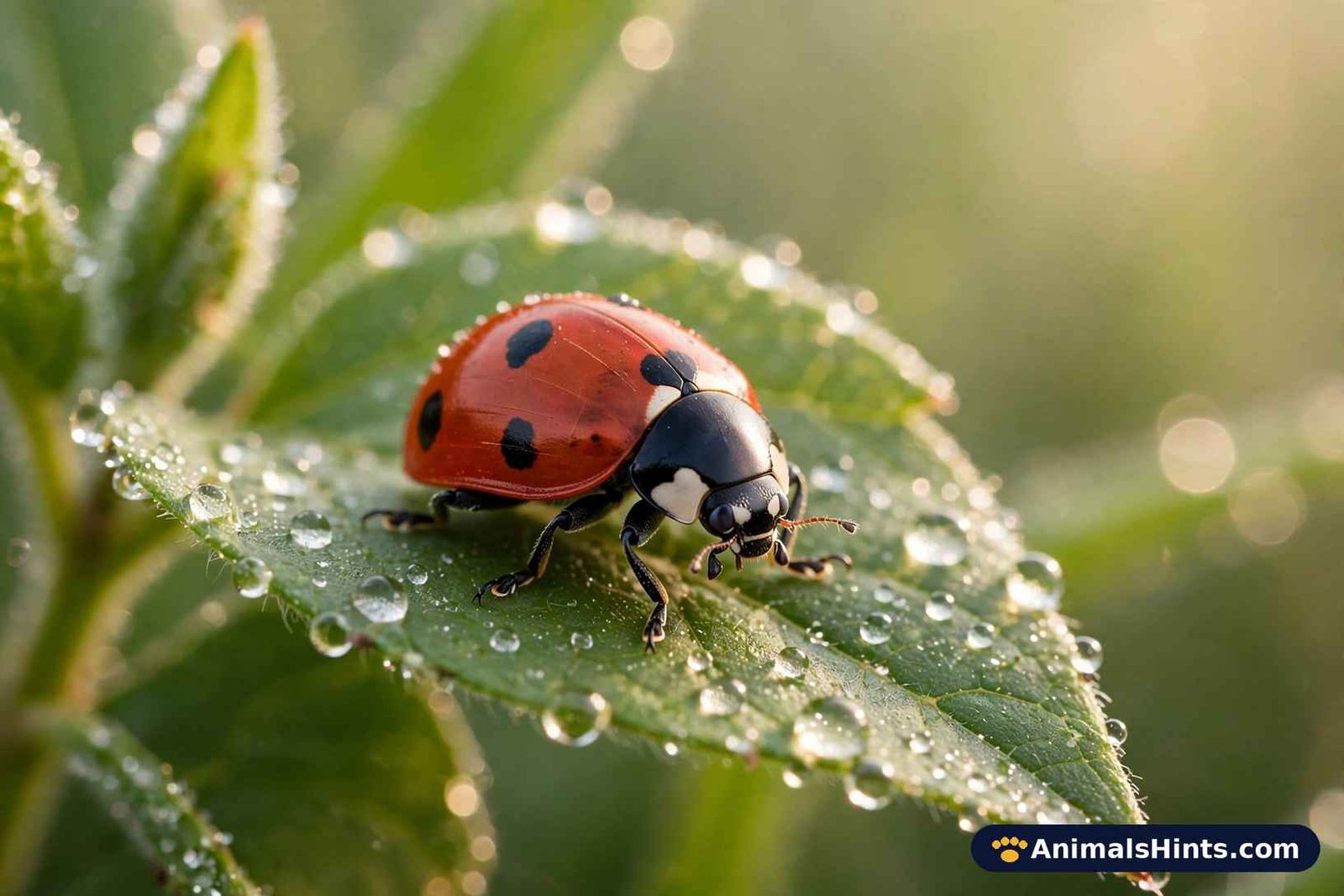
The one the folklore pictures is a single species. Coccinella septempunctata, the seven-spot ladybird, wears three black spots per wing case, plus a seventh where the two cases meet, on a scarlet shell about seven millimetres long. It is among the most familiar ladybirds in Europe, and it was carried to North America on purpose, released again and again as a living insecticide against aphids. When a storybook, a greeting card or a symbolism site draws “a ladybug”, this is the beetle it draws.
The name is the oldest symbolic item on the page, and it is documented rather than invented. In Britain the insect was called “Our Lady’s bird” — the Lady being Mary, the mother of Jesus, who was painted in a red cloak in early art. The seven spots of the common species were read as her seven joys and seven sorrows. Germany keeps the same dedication in Marienkäfer, Mary’s beetle. Meaning 11 in the list below, the Virgin Mary connection, is the one reading in the fourteen with roots this deep.
The famous colours are a warning, and an honest one. A ladybird’s blood carries bitter alkaloid defences — more than fifty kinds have been found across the family — and a disturbed beetle squeezes drops of that fluid out through its knee joints, a trick called reflex bleeding, so that a bird which mouths one tastes the poison before it commits. The red is therefore not decoration. It is a label that tells the truth about the contents, which is why predators learn it once and leave the pattern alone for life.
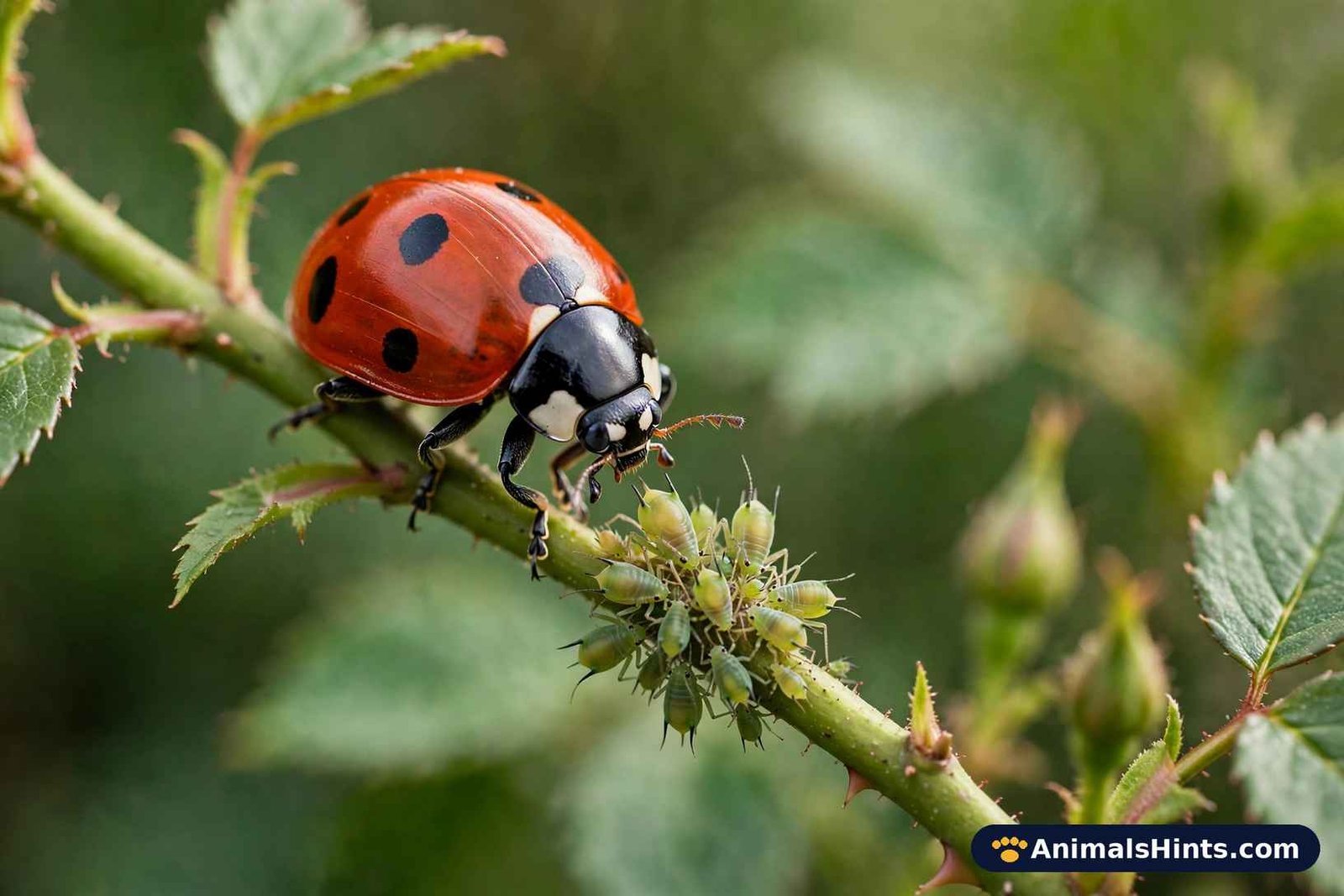
What the beetle does with that protection is eat. Adults and larvae both hunt aphids, the soft green insects that colonise roses and broad beans, and the appetite has been measured rather than merely admired: extension entomologists put a single lady beetle’s lifetime consumption at as many as 5,000 aphids, with a larva working through several hundred before it ever grows wings. This is the fact the whole luck tradition stands on, and the verdict section near the end returns to it.
One complication belongs in any honest account. The harlequin ladybird, Harmonia axyridis, an East Asian species spread around the world as a pest-control agent, is larger than the seven-spot, wildly variable in pattern, and inclined to spend the winter inside houses in clusters. It outcompetes several native ladybirds and eats them as well as aphids; it reached Britain in 2004 and has been tracked spreading ever since. A large share of the “ladybugs” found indoors in autumn, and a share of the ominous readings attached to them, belong to this one immigrant species.
14 Spiritual Meanings of Seeing a Ladybug
1. Transformation and New Beginnings
The first reading is the life cycle read as biography. Egg, larva, pupa, adult: nothing in the sequence resembles the stage before it, and the guides take the finished beetle as proof that a person mid-change is not lost, only unfinished. A sighting under this meaning is read as encouragement to stay with a process whose end cannot yet be seen — the new chapter arriving in instalments rather than all at once.
2. Spiritual Aspiration and Connection Between Earth and Cosmos
A ladybird spends its life at ankle height and yet owns a pair of wings. The tradition makes that double citizenship into a reading: grounded aspiration, the wish to reach upward without leaving daily life behind. Under this meaning the beetle appears to people who are looking for clarity or direction, and the point of the reading being that the search itself can be conducted from where you stand.
3. Good Fortune and Blessings
This is the family’s founding reputation, and alone among the fourteen it began as an observation rather than a metaphor. A field with ladybirds in it was a field whose aphids were being eaten; the harvest that followed was measurably better. From that working fact grew the wider belief that the beetle’s arrival announces a blessing on its way, in whatever department of life the finder happens to need one.
4. Readiness to Take Bold Steps
The guides give repeated sightings a particular use: they are taken as a nudge directed at someone hesitating over a decision already half-made. The logic is the insect’s own scale — proof, in the tradition’s phrasing, that a step does not need to be large to be the one that changes things. Its brightness is read as confidence, and its refusal to hurry as permission to act without drama.
5. Bringing Luck and Joy
A landing is the most personal form a sighting can take, and this reading rests on the finder’s own reaction: people smile. The tradition treats that involuntary lift as part of the message — the beetle as a courier of lightness, arriving unannounced at the moment a day needs one. It is the gentlest meaning in the list and asks the least of the reader: notice the small good thing while it is still on your hand.
6. Protection and Renewal in Native American and Celtic Cultures
His page credits both Native American and Celtic tradition with a guardian reading, and the documented record supports the shape of it in one specific case: the Cherokee honoured the insect under the name “Great Beloved Woman”, a title carried by the highest-ranking woman in their government, who was painted in its colours for ceremonies. The wider claim — crop guardianship across many peoples — is the genre’s generalisation of records like that one, and is printed here at that strength.
7. Bearers of Divine Messages
Timing is the whole of this reading. A beetle that arrives while a question is being turned over — a decision worried at, a prayer half-formed — is read by the tradition as a delivered answer, or at least a delivered prompt to reflect. Nothing in the beetle marks one visit as a message and the next as an insect looking for lunch; the meaning is assigned by the moment, and the guides are content to leave the assignment there.
8. Spirit Animals Symbolizing Luck and Transformation
As a spirit animal, in the modern genre’s sense of a recurring guide-figure, the ladybird is assigned to people in transition: the stuck, the restarting, the quietly rebuilding. Its qualifications are the ones this list keeps circling — it transforms completely, it protects what it lands on, and it does both without aggression. The reading promises no rescue; it offers company of a particular kind, small and persistent.
9. Symbols of Health, Fertility, Protection, and Grace
The cluster in this heading grew out of the garden. A beetle that keeps plants alive gets credited, by extension, with keeping other living things alive: health returning, households growing, a general atmosphere of tended-ness. The grace belongs to the animal’s manner — it crosses a leaf or a wrist without alarming anything — and the tradition reads the manner back into the meaning.
10. Symbol of Innocence, True Love, Happiness, and Divine Intervention
Love enters the list here, on the strength of the beetle’s softness and its old matchmaking customs, which are set out in documented form under Myths, further down. Read this way, a sighting during an emotional passage of life is taken as reassurance that affection is moving somewhere underneath events. The divine-intervention half of the heading is the same reassurance with the volume raised: unseen help, arriving at beetle scale.
11. Connection to the Virgin Mary and Divine Blessings
This is the list’s one historically anchored meaning, and the anchor is the name itself. “Our Lady’s bird” is not a metaphor the symbolism sites coined; it is what the insect was actually called, because the red shell recalled Mary’s cloak in early painting and the seven spots were counted as her seven joys and seven sorrows. A sighting read through this meaning is therefore the oldest reading on the page — a small red reminder of divine care, carried in the language for centuries before it reached the internet.
12. Optimism and Resilience as a Spirit Animal
The resilience here is not a figure of speech; the animal is genuinely hard to discourage. It overwinters in the cold, sometimes in clusters packed into bark and fence posts, and comes out in spring to start again. The tradition borrows that endurance for its readers: the sighting as a prompt to keep a hopeful posture through a hard stretch, on the evidence of a creature that does exactly that at seven millimetres.
13. Creativity and Prosperity
The genre attaches this meaning most often to the orange forms of the beetle, orange being its assigned colour for artistic energy. From creativity the reading steps to prosperity by a short path — new work made, new openings found — and the beetle’s restless exploring of a plant, stem by stem and leaf by leaf, is offered as the temperament to copy. Of the fourteen, this is among the most recent constructions, and it is flagged as such.
14. Spiritual Messengers and Protection Against Evil
The list closes where several old European traditions began: the ladybird as a small guard posted at the threshold. In the folklore the bright shell was said to carry light into a house and turn harm aside, and a beetle near a door or window was welcomed rather than swept out for exactly that reason. The messenger half of the heading repeats meaning 7 with the emphasis on warning — guidance that arrives, in this telling, because something needs watching.
From Egg to Adult: The Six Weeks Behind the Symbol
The transformation the first meaning celebrates takes about six weeks in the seven-spot, and every stage of it is a working predator or a meal waiting to happen. A female lays her yellow eggs in upright clusters of ten to thirty, placed with a hunter’s judgement: on a leaf or stem within crawling reach of an aphid colony, so that what hatches wakes up inside its food supply.
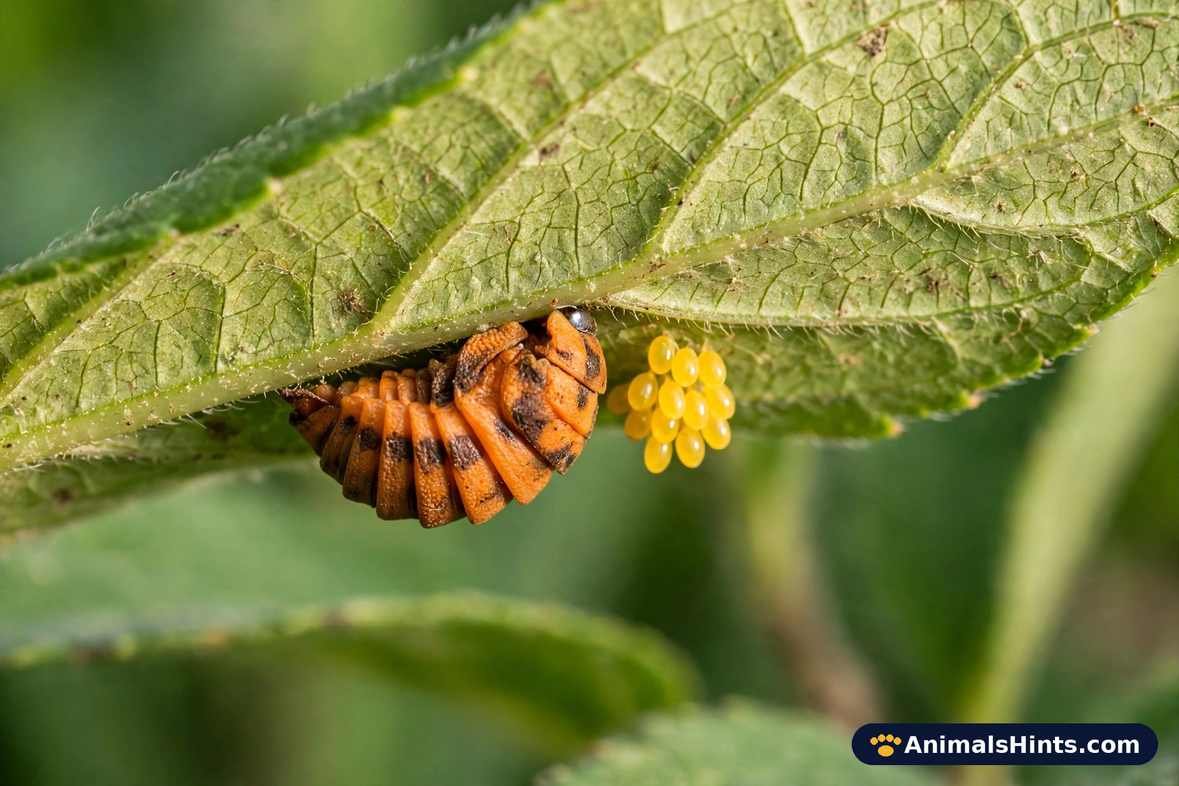
The larva that emerges after roughly four days looks nothing like its parent — elongated, grey-black, spiky, more miniature alligator than beetle. It eats from its first hour, starting with its own eggshell, and across four growth stages it works through several hundred aphids. Then it stops, glues its tail end to a leaf, and sits out about eight days as a pupa while the adult is assembled inside.
What climbs out is the fact the colour siblings on this site keep returning to: the new adult is soft, pale and unmarked. The red deepens and the spots print themselves over the following hours — the pigments are carotenes for the scarlet and melanins for the black — so every red ladybird anyone has ever wished on spent its first morning yellowish and blank. The finished beetle may then live a year or two, sleeping through the cold months, often in company, and starting the cycle again in spring.
Cultural and Religious Significance
Europe’s version of the ladybird is a farmhand with a saint’s name. Beyond the Our Lady dedication, Christian folk belief in parts of the continent treated the insects as heaven’s own gatekeepers; Sweden’s name for them translates as “Keys of Heaven”. Jewish tradition knew the same beetle as the “Cow of Moses our Teacher”, and across the Atlantic the Cherokee held it in the ceremonial regard described under meaning 6. Few insects anywhere have been given titles in three religions.
His page adds an Asian strand, in which the beetle is read as a carrier of messages from the spiritual realm and its red is tied to vitality and joy. No named text or custom is offered behind that attribution on his page, and the research behind this one surfaced none either; it stands here as the modern guides’ attribution, at exactly that strength, beside the documented European and Cherokee records above.
What unites the documented strands is usefulness wearing a halo. Every culture that named this beetle kindly farmed or gardened within reach of aphids, and the kindness consistently follows the appetite. The reverence is real; so is the pest control underneath it.
Biblical Meaning of Ladybugs
His page concedes the essential point in its first sentence, and the census behind this article confirms it precisely: the Bible never mentions ladybugs. Counted word by word through the full King James text, “ladybug” appears zero times, and so does “ladybird”. No verse reads this insect as a sign, a messenger or a blessing, and any biblical meaning assigned to it is interpretation laid over the text from outside.
What the text does hold is a single beetle — exactly one occurrence of the word in the whole canon — and it sits in a surprising place: the dietary list in Leviticus, among the flying insects the Israelites were permitted to eat.
“Even these of them ye may eat; the locust after his kind, and the bald locust after his kind, and the beetle after his kind, and the grasshopper after his kind.” (Leviticus 11:22, KJV)
That beetle is a kind of locust-like food insect in a food law, not a spotted ladybird in a garden, and nothing in the passage attaches meaning to it beyond permission to eat it. The honest biblical shelf for this insect is therefore short: creation’s order, provision, and gratitude — the themes his page reaches for — are genuinely biblical themes, but they are themes believers bring to the beetle, not statements the text makes about it. The Mary connection, often folded into the “biblical” heading on symbolism sites, belongs to the medieval church’s devotion, centuries after the canon closed.
Spiritual Meaning of Different Colored Ladybugs
His page’s colour shelf is carried in his own table below, exactly as the genre gives it. Six colours are listed; the readings are the tradition’s, and the table is furniture of his page reproduced whole.
| Ladybug Color | Spiritual Meaning | Common Themes |
|---|---|---|
| Red | Renewal and strength | Love, passion, vitality |
| Yellow | Creativity | New ideas, expression |
| Orange | Emotional healing | Confidence, motivation |
| Black | Mystery and insight | Depth, transformation |
| Brown | Grounding | Stability, home energy |
| White | Clarity | Purity, intuition |
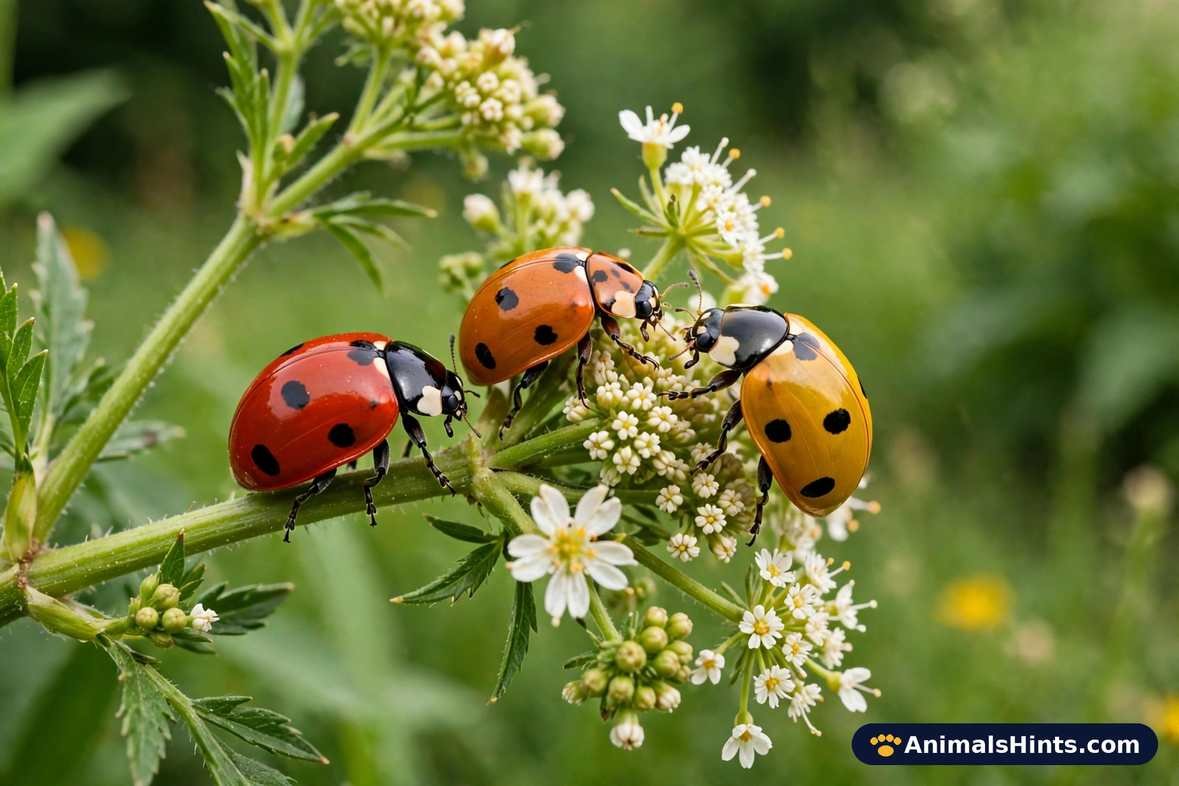
Two honest notes belong under the table. First, the beetle the red row describes is the seven-spot of the earlier sections; the other rows compress a complicated shelf, because a black ladybird is often a dark form of the harlequin, a white one is usually a red species in its first pale hours, and a genuinely yellow one is one of three small species that wear the colour for life. Second, his table stops at six — the full colour shelf on this site runs wider, and each colour’s reading, with the species record underneath it, is kept on its own page: the red ladybug and the brown ladybug and the green ladybug are already published here, and the white ladybug, the blue ladybug and the yellow ladybug complete the set.
Symbolism of Seeing a Number of Ladybugs
His page extends the counting habit from spots to whole beetles, and its ladder is carried here complete, at the weight he assigns it. One ladybug is read as personal guidance, a sign addressed to a private matter. Two are given to partnership and balance. Three stand for creativity and ideas being born; four for stability, structure and foundations; five for change and adventure on the way.
The ladder’s second half runs: six for emotional support and relationships strengthening; seven for spiritual awakening and sharpened intuition, the number’s long mystical pedigree doing the work; eight for prosperity and approaching abundance; and nine for completion — a cycle closing and the next one not yet open.
One caution belongs with the ladder. The older, documented counting custom counts something else: the spots on a single red beetle, tallied in European folklore as months of luck or months until a wish came due. Counting whole beetles up a ladder of meanings is a recent extension of that custom, built by the modern genre and still being built. Both are printed here, but they are not the same age, and the page declines to pretend otherwise.
Spiritual Meaning of Spotting a Dead Ladybug
The tradition’s reading of a dead ladybird is gentler than the finder’s first reaction. It is filed under closure: something finished, a habit or attachment at its natural end, and — in the same breath — the clearing that an ending makes for whatever grows next. His page is firm that the sign is rarely a dark one, and the older folklore agrees in its own way: the beetle was protected in life, and finding one dead was a small sadness, not an omen of harm.
The waking record adds a plainer explanation for the commonest version of this find. Ladybirds that come indoors for the winter — harlequins above all, but natives too — are gambling on shelter, and a share of them lose: a dead beetle on a January windowsill is usually an overwintering casualty that ran out of fat or found the room too warm and dry. Both shelves can be true at once. The tradition supplies the reflection; the season supplies the beetle.
Meaning of Dream About Ladybugs
Dream readings belong to the modern genre outright — the classical dream literature this run has checked gives the ladybird no entry of its own — and his page’s set is carried as that genre’s work. A ladybug landing on the dreamer is read as good news approaching, or a difficulty quietly resolving. A dream full of ladybirds is read as abundance and emotional repair, and dreamers are said to wake from one in better spirits than they slept in.
The two remaining scenes complete his set. An oversized or unusually vivid ladybird is read as a large change being prepared below consciousness, its scale in the dream matching its scale in the life. A ladybird flying away is read as release — a wish to be free of something, or a chapter completing itself and leaving under its own power.
Myths and Superstitions Associated with Ladybugs
The oldest layer of all is a rhyme English children still learn, addressed to a beetle found indoors and sung to send it home: “Ladybird, ladybird, fly away home, thy house is on fire, thy children all roam.” Behind the rhyme stood a working rule of the countryside — harming a ladybird invited misfortune — which protected a useful insect more effectively than any law could have.
European folklore also employed the beetle as a matchmaker: it would crawl across a woman’s hand and then fly off, and its direction pointed toward her true love. And it was consulted as a prophet of practical things — the coming weather, and how the crops would do — which is the luck tradition again, wearing its oldest clothes: a farmer reading the insect that decided his aphids’ fate.
The wish customs gather here too. A landing beetle could be wished upon and blown gently on its way, the wish said to travel with it; and the spots of the common red were counted, in the custom the Number section describes, as months — of luck, or until the wish came due. These are the myths with documents behind them, and they are all, notably, kind: no strand of the old record makes this insect a threat.
A Ladybug Lands on You, or Moves Indoors: What Is Actually Happening
Because so much of the tradition turns on landings and house visits, the animal’s side of both events is worth stating plainly. A ladybird in flight is navigating by landmarks in daylight, and a warm, upright, sunlit surface — a sleeve, a shoulder, a hand — is simply a good place to set down. The landing that feels addressed to you is, on the record, a beetle choosing a perch; the wish custom built on it is the folklore’s, and it costs nothing to keep.
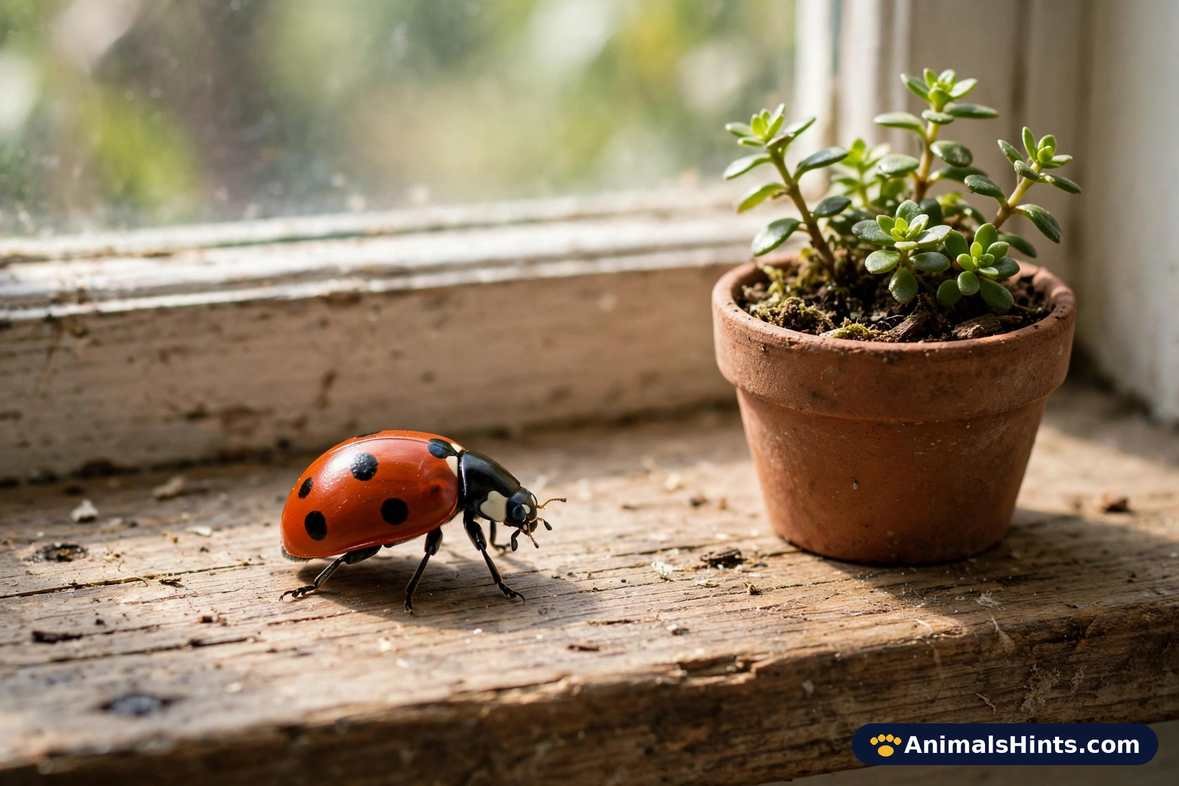
The indoor version has an even plainer engine. From autumn onward, ladybirds look for a sheltered crevice to sleep the winter in, and the harlequin in particular treats a house as a cliff face with central heating, arriving in clusters on sunny walls and slipping inside. A room full of ladybirds in October is not a visitation; it is a hibernation site being inspected.
The handling etiquette follows from the defence described earlier. Never crush one: the reflex blood that makes it taste foul also smells, and it stains. Coax it onto a card or a leaf, carry it to a plant outside, and let it step off. Kept in a jar it will simply die of the two things it came in to escape — hunger and dry air — and released, it returns to the work the next section of this page is about to price.
What to Do if You Keep Seeing Ladybugs
His page’s advice for the repeat sighting is reflective, and it is carried in his order of ideas. Pause at the moment of the sighting and register what you were thinking about at the time; the tradition holds that the timing, not the insect, carries whatever message there is. Treat the recurrence as a prompt toward optimism or toward gratitude — several of the guides suggest saying the wish, or the thanks, silently at the spot.
His last suggestion is the practical one: keep a journal of the appearances. Date, place, what was happening, what changed afterwards. Written down over a season, a run of sightings either resolves into the ordinary pattern — a good aphid year, a house on a hibernation route — or it does not; and either way the reader ends up knowing something true about their own attention, which may be the most defensible gift the tradition offers.
Is It a Good Luck Sign? The Honest Answer
Yes — with one receipt attached, and the receipt is what separates this insect’s luck from most. The ladybird’s reputation began in a measurable transaction: the beetle eats the pests that eat the crop, at a rate extension services put as high as 5,000 aphids in a single lifetime, and a summer rich in ladybirds was, in plain agricultural fact, a luckier summer for the harvest. People did not imagine that correlation. They watched it, season after season, and then they named it.
Everything beyond that first step is folklore, and every part of it has been tagged on its way through this page: the messages, the ladders of numbers, the dream readings, the matchmaking. None of it carries evidence that a sighting predicts anything about a person’s fortune, health or love life, and the beetle’s well-documented behaviour explains its arrivals — food, warmth, landmarks, winter shelter — without remainder. What survives the audit is not nothing. It is the original, older luck, still available to any garden: where this beetle is, the plants it patrols are measurably better off.
Final Thoughts
A ladybug asks very little of the person who finds it: a moment’s attention, a hand held still, a door opened rather than a tissue reached for. The tradition repaid that small courtesy with the largest folklore any beetle owns — fourteen meanings deep, with a saint’s name at the root of it and a nursery rhyme still in print. Taken as folklore, it stands among the kindest bodies of symbolism in the whole catalogue, and this page has carried it whole.
Read as natural history, the same insect is a scarlet warning label that bleeds bitter blood from its knees, hunts from the hour it hatches, and can clear aphids by the thousand before it ever grows wings. The two readings have shared a shell for a thousand years without either one cancelling the other. The next ladybird that lands within reach will be both at once — a small piece of luck, and a working predator taking a rest on its way back to the garden.
FAQs
1. What is the spiritual meaning of a ladybug?
In the tradition, the ladybird stands for good luck, protection and renewal — a small messenger read as bringing reassurance, and in its oldest layer, a reminder of divine care carried in its very name, Our Lady’s bird. The fourteen meanings above are the genre’s full expansion of that core.
2. What does it mean when a ladybug lands on you?
The tradition treats a landing as the sign at its most intimate: a blessing delivered directly, often wished upon before the beetle is blown on its way. On the record, the beetle has chosen a warm, sunlit perch; the two accounts coexist comfortably, and the custom of making the wish is centuries old.
3. Does the number of spots on a ladybug have spiritual meaning?
In folklore, yes: the spots of the common red were counted as months of luck, or months until a wish came due. The longer spot-by-spot ladder on symbolism sites is a modern extension. Biologically, spot number belongs to the species — the seven-spot always carries seven — not to the occasion.
4. What should I do if I see a ladybug spiritually?
The guides’ shared advice is simple: pause, note what you were turning over at the time, and let the moment carry a wish or a word of thanks if that is your practice. Practically: never harm one. Coax it onto a card and carry it out to a plant — the luck, such as it is, belongs outdoors.