Widow’s Peak Spiritual Meaning: 10 Meanings, a Mourning Hood and a Genetics Myth
Most hairlines run across the forehead in a fairly straight line. A widow’s peak refuses to: it dips at the centre into a distinct downward point, a small V written into the hairline itself. Spiritual meaning of widow’s peak carries two inheritances at once. The first is a superstition — the name itself is a piece of old mourning folklore, and it once frightened people. The second is a modern list of ten readings, in which the same point is made to stand for intuition, independence and a driven life. Both inheritances are given in full below.
The two are never allowed to share a shelf here. Where a reading belongs to folklore or to the symbolism guides, it is labelled as theirs. Where a claim can be checked — the documented history of the name, the genetics file, the Bible put through a word-by-word count — it is checked, and the result is stated with no more force than the record permits. Several of the comfortable things said about this hairline, including one taught in school biology classes for generations, turn out to be thinner than their reputation.
One boundary is worth stating before the meanings begin. A widow’s peak is anatomy. It is present from childhood, it changes little, and it is not an event — nothing happens, the way an itch happens or a twitch happens. The old omen lists dealt in events and sensations. What they made of a permanent shape is a shorter and more interesting story, and it receives its full telling below.

What Does a Widow’s Peak Symbolize?
Ask the guides for the core of it and they give intensity and individuality. The hairline does not run straight, and the symbolism begins with that refusal: a point, where other faces have a line. Points suggest arrows and flames to the symbolic imagination, so the peak is read as direction — forward movement, focus, an inner fire that knows where it is going.
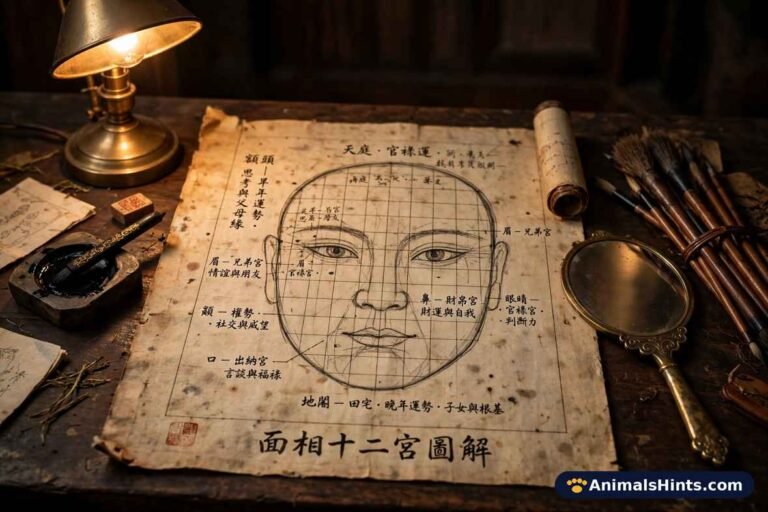
The forehead does the rest of the work. In the face-reading traditions, the forehead is the ground of thought, wisdom and destiny, and anything that marks it draws the eye to exactly that territory. This site’s own catalogue reads the forehead the same way the tradition does — a mole on the forehead is interpreted against the same map — and a point at the centre of that ground is taken, in this strand, as a concentration of whatever the forehead is said to hold: intuition, depth of feeling, a mind that works below the surface.
Underneath both readings sits the simplest one. The peak is less common than the straight hairline it interrupts, and in symbolic language rarity itself is meaningful: whatever sets a person visibly apart becomes, in the symbolic register, the badge of a self that goes its own way. Independence and inner strength are the guides’ usual translation. All of this is the tradition speaking, in its own voice; the record sections further down will show how much of it, if any, the evidence is willing to hold.
What Is a Widow’s Peak, Really?
Begin with the anatomy, which is better understood than the folklore built on it. Hair growth on the forehead is held back by two fields, one above each eye, where growth is suppressed. In most people those two fields meet in the middle and the hairline runs straight across. A widow’s peak forms when the point where the fields’ upper edges intersect sits lower than usual — because the fields are smaller, or set wider apart — and the hairline keeps the point where they cross. The description comes from the standard reference literature on physical measurement, and it makes the peak a piece of geometry before it is anything else: not a growth, not a mark laid on the face, but the visible seam of two growth patterns meeting low.
The genetics, famously, is where the record thins out. Generations of school textbooks taught the widow’s peak as the cleanest example in human genetics: one gene, two versions, the peak version dominant over the straight one. John McDonald of the University of Delaware, who maintains a long-running audit of exactly these classroom traits, searched the scientific literature for the claim and reports that he could not find a single scientific paper that makes it. There are no family studies and no twin studies of the trait in the general population that he knows of. His conclusion is blunt, and it is reproduced here at his own strength, unsoftened: there is no published evidence that the widow’s peak has a genetic basis at all, and it should not be used to demonstrate simple genetics. That families plainly resemble each other in hairlines is everyday observation; that the resemblance has ever been measured into a rule is not something the published record contains.
The counting record explains part of the trouble. Only two studies have looked at the trait in the general population, and they disagree so wildly that the disagreement itself is the finding. Smith and Cohen, in 1973, examined photographs of 1,039 male medical students and found 32 — about 3 percent — with a slight but noticeable peak, and one with a distinctive one. Nusbaum and Fuentefria, in 2009, examined 360 women in hair salons and counted 81 percent as having one. Neither team defined what it was counting. A trait that can be measured at 3 percent or 81 percent depending on where an unmarked boundary is drawn is not a trait with a settled prevalence; it is a judgement call wearing a number. One careful count does exist from a defined community: among young adults of the Isoko people in Nigeria, researchers found the peak in 15.45 percent of males and 16.36 percent of females — close enough that the same record reports no significant difference between the sexes, whatever the older assumption that the peak is a mostly male feature.

Two honest footnotes belong to this section. The first is medical, and it is a boundary rather than a warning. Smith and Cohen’s 1973 paper — the strict study above — was written because the peak can travel with eyes set unusually wide apart, the two sharing the same widely-spaced growth fields; and standard dysmorphology references note that a peak occasionally appears as one feature among many in a handful of rare named syndromes. That is the entire extent of it. A peak by itself, in an otherwise ordinary face, is a normal variant of human hairlines, and nothing in this section licenses reading one as a diagnosis of anything. The second footnote belongs to this site’s own shelves. The classical omen lists this run works from grade sensations and happenings — itches, twitches, burnings, pains. The forehead has a shelf of its own in that system, but it is a shelf for what the forehead feels: the itchy forehead spiritual meaning belongs to it. None of the lists examined for this article grades a hairline’s shape at all. The absence is not an oversight in the lists. A hairline’s shape is not an event, and the lists were catalogues of events.
The site’s hair shelf tells the same story from the opposite direction, because its other occupants are pigment, not geometry. There is the single strand — the single long white hair spiritual meaning turns on one follicle that has surrendered its colour. There is the patch — the mallen streak spiritual meaning turns on a whole forelock of follicles that never had colour to surrender. And there is the full head — the born with grey hair spiritual meaning turns on pigment missing from the first day of life. A strand, a patch, a head: each is an arrival, something that came to be. The peak alone, among the shelf’s occupants, is a shape that simply is — which is why the omen lists, built for arrivals, had no entry ready for it.
Where Does the Name “Widow’s Peak” Come From?
The name is the superstition, preserved in a noun. The etymology record — the Online Etymology Dictionary’s account, carried in the standard references — states it plainly: the term stems from the belief that hair growing to a point on the forehead, suggestive of the peak of a widow’s hood, is an omen of early widowhood. A woman whose hairline dipped at the centre was said to be marked to outlive her husband. The fear came first; the word is the fear, fossilised.
The hood in question was real clothing. Widows in mourning wore a hood or cap with a distinctive pointed piece in front — the French called the style a biquoquet — and mourning hoods of that cut date from around 1530. The word “peak” had been used for a point of cloth covering the forehead since at least 1509, when it appears in Alexander Barclay’s The Shyp of Folys, addressed to fashionable women and their peaks “set aloft”. Applied to hair itself, “peak” dates from 1833, and the full expression “widow’s peak” from 1849. By then the resemblance had been noticed for centuries: the hairline’s point and the mourning hood’s point were the same shape, and the shape had a meaning ready-made for it.
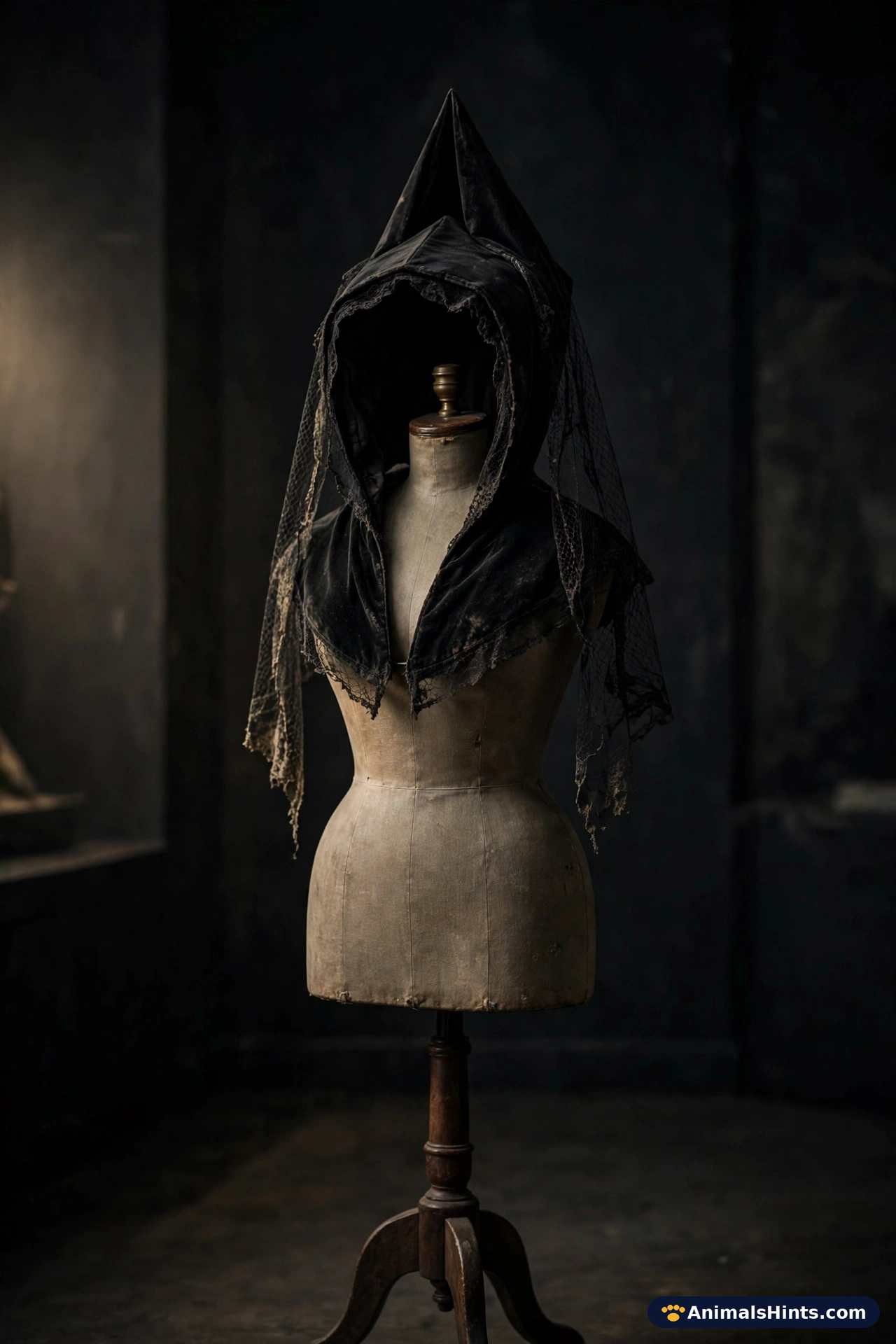
Fashion completed the circle in the most human way possible. The Mary Stuart cap — the cap associated with Mary, Queen of Scots — was cut with a triangular fold of cloth in the middle of the forehead, precisely to manufacture the point on faces that nature had left straight. The omen had become an ornament: women wore an artificial widow’s peak as a style while the superstition that named it was still alive enough to be recognised. It is worth holding the sequence in order, because the meanings sections that follow sometimes reverse it. First the hood, then the resemblance, then the fear, then the word, then the fashion. The hairline itself was there before all of them, meaning nothing.
10 Spiritual Meanings of Widow’s Peak
1) Strong Intuition
The first reading follows from the forehead’s address. In the face-reading strand, insight is the territory assigned to the forehead’s centre, and a mark planted there is read as a sharpened inner instrument: someone who takes a room’s temperature before anyone has spoken, who registers a shift in mood the way skin registers weather. The guides are careful, in their better moments, not to claim dramatic psychic gifts; the intuition they describe is quieter — a gut trusted often enough to become a compass.
The balance the tradition itself recommends is part of the reading: intuition ignored leaves a person restless, intuition obeyed without reflection leaves them overwhelmed, and the growth is in pairing the whisper with judgement. The whole of it is the genre’s portrait of a temperament, hung on a hairline. No study anywhere connects the shape of a hairline to the accuracy of anyone’s instincts, and the reading is shelved here under its true heading — the symbolism tradition’s longest-standing claim for this feature, not a finding.
2) Independent Spirit
A straight line is what hairlines are supposed to draw, and this one declines. The second reading takes that visible nonconformity as the emblem of a temperament: someone who asks why before obeying, who carves a path rather than inheriting one. In the karmic version of the reading, the peak marks a soul that arrived intending to break patterns — to decline the family’s script and write another.
The guides distinguish this independence from isolation, and the distinction matters, because it is what the reading actually claims: self-trust rather than solitude, values chosen consciously rather than received, a reliance on inner conviction when approval is not forthcoming. As symbolism it is coherent — the odd feature for the odd path. As biography it proves nothing, and it is not offered here as proof.
3) Leadership Qualities
Visibility is the mechanism of the third reading. A peak draws the eye to the forehead and gives a face presence, and the tradition reads presence as the raw material of leadership: the person who steps forward when a room hesitates. The leadership described is influence more than office — vision, clarity, the capacity to make others see a possibility — and the tradition attaches a duty to it, that influence be exercised ethically, since whoever shapes the energy of a room answers for its direction.
Folklore strengthens the claim with exhibits, pointing to celebrated bearers — Edgar Allan Poe and Leonardo da Vinci are its favourite names — as if genius and the hairline kept company. The exhibits are the folklore’s own, repeated from guide to guide without a shared source, and they are recorded here at precisely the weight that provenance can bear: appearance never made a leader, and a hairline shared with a genius is a coincidence of anatomy, not an inheritance of gift. The reading survives the audit as a symbol. As an argument, it collapses.
4) Emotional Depth
The fourth reading assigns the peak to the deep feelers: people who experience joy in vivid colour and sorrow in heavy weather, whose emotional range is wider than the average they are compared against. Out of that range, in the tradition’s telling, grows empathy — an attunement to the person left out of the conversation, the friend struggling behind a practised smile — and with it, bonds that run deeper than convenience.
The tradition is equally frank about the cost, and its counsel is carried with the claim: depth without boundaries absorbs other people’s stress, and the prescribed correctives are the grounding practices of the genre — meditation, journalling, quiet walks. When depth is met with wisdom, the reading concludes, it converts into compassion and stops being a burden. The portrait is sympathetic and entirely unverifiable, which is the normal condition of this shelf.
5) Determination and Focus
The point is an arrow, and the fifth reading simply follows where it aims. A widow’s peak is read as drive made visible: long-term goals held in view, progress that continues after others have stopped, obstacles met by adjustment rather than surrender. In the spiritual framing, this determination is soul memory — lessons carried from earlier struggles, surfacing as courage where fear would be the cheaper response.
The tradition adds its own governor, and the governor is the most sensible sentence in the section: a determination curdled into rigidity stops growing; the focus worth having keeps its strength and stays able to turn. The arrow, in other words, is praised for pointing, not for being unable to turn. As with the rest of the ten, this is a reading — a story the shape suggests — and it lives or dies as a story, not as a measurement of anyone’s will.
6) Creative Energy
Originality is the sixth reading, and its logic is the break in the line: creativity, in symbolic language, begins where the ordinary pattern is interrupted. A hairline that departs from the expected course is read as the outward token of a mind that departs from expected courses — seeing past ordinary arrangements, turning pain into poetry and confusion into clarity, solving problems by routes that are not on the map.
The guides support the claim with the usual gallery — Mary Shelley and Bram Stoker are the names most often mustered — and the same bound applies to them as to the leadership exhibits: the feature does not cause the talent, and the gallery is the genre’s decoration, not its evidence. What the reading keeps, once the decoration is discounted, is a metaphor with a long pedigree in the symbolism of broken lines. It is filed as that.
7) Magnetic Personality
A dramatic hairline is a memorable one, and the seventh reading converts memorability into magnetism: presence, the quality of being listened to, the small shift in a room’s attention when a person enters it. The tradition is clear that the loudest version is not the strongest — quiet confidence, in its account, attracts more than volume — and that the true engine of the effect is authenticity: someone at ease with a distinctive feature radiates the ease, and the ease is what draws respect.
Responsibility is the reading’s tail, as it was for leadership: influence can uplift or mislead, and the bearer of a magnetic manner is counselled to awareness of its effects. There is, unusually, a measured finding in this neighbourhood, and it is held for the personality section below, where it belongs — it concerns how faces with this feature are judged by the people looking at them, which is a different thing from the character of the person wearing the face.
8) Karmic Lessons in Relationships
The eighth reading is the one where the list quietly argues with the name. In karmic language, the peak is said to mark a soul that has travelled through complicated relationship stories before, and whose current attachments therefore arrive with unusual intensity — instant familiarity with a stranger, patterns in love or friendship that repeat until their lesson is taken. The lessons named are the standard curriculum of the genre: boundaries from challenges, self-worth from heartbreak, devotion from loyalty, emotional maturity from all of it.
The irony deserves one plain sentence. A list of meanings that includes a karmic education in love is attached to a feature whose very name is a marriage superstition — a prediction about how a bearer’s love story ends. The karmic reading and the old omen cannot both be knowledge, and neither presents evidence; they are two centuries of storytellers using the same small point of hair to talk about the same large subject, which is what the people we love do to us and what we learn from it.
9) Inner Resilience
The ninth reading plants the peak like a flag: fixed at the forehead’s centre, facing forward, it is read as endurance — the emblem of people who come back from setbacks with a strength that surprises onlookers, who bend through hardship without breaking, and who search for meaning inside the hardship while it is still happening. In the tradition’s account this resilience is usually earned early, through challenges that taught adaptation young, and it matures into a quiet confidence that no longer needs to announce itself.
Spiritually framed, the strength is trust in a larger plan — faith that pain carries purpose. Stripped of the frame, it is the genre’s standard tribute to survivors, assigned to this feature because the feature sits where a brow faces weather. The reading is carried as the tribute it is. Hairlines, the record sections have already established, certify nothing about the person beneath them, in either direction.
10) Destiny Driven Life Path
The list closes with the path itself. The point narrows like a road converging, and the tenth reading takes it as the sign of a purposeful journey: a life felt from inside as guided, its experiences connecting like chapters, its challenges legible as the shaping of wisdom and its successes as the building of confidence. Bearers of this meaning are described as people who sense a mission under the ordinary days — and who, when lost, feel something nudge them forward anyway.
The tradition’s own summary gathers the ten into four words — individuality, depth, strength, direction — and offers the whole list as a mirror, not a verdict: believe the signs literally, or take them as poetic metaphor, and the use is the same, which is to recognise qualities in yourself and develop them. That is the most defensible sentence the genre produces about this hairline, and the article’s verdict section, further down, will build on exactly it.
Widow’s Peak Hairline Meanings for Females and Males
The feature is one feature, but the folklore has always read it in two voices, and the competitor’s page follows the custom. For women, the older tradition tied the peak to romance and fate: ardent love shadowed by emotional trials; a woman of deep feeling, intense in love, sure of her instincts and fierce in defence of her independence. The shadow in the female reading is the name itself — the widowhood omen was always aimed at women first, since it was a wife’s hairline that was said to forecast her husband’s grave.
For men, the modern reading runs through popular culture before it reaches symbolism: the sharp hairline as a dramatic, bold frame, mystery and power borrowed from the screen villains the next sections discuss. Translated into spiritual terms, the male peak is given authority, intensity and ambition — a focused mind, a strong drive, a man who knows his direction.
His page concedes the honest point at the end, and the record agrees with the concession: the gender split is culture’s work, not the trait’s. The measured counts found the peak at nearly the same rate in young men and young women of the one community carefully surveyed — 15.45 and 16.36 percent — and the symbolism’s core, once the two voices are set side by side, is a single set of themes wearing two costumes: depth, individuality, willpower. The hairline does not change with the sex of its bearer. The stories do, and the stories are what is being catalogued here.
What the Bible Says About Widows — and Never About a Hairline
Scripture is the one authority this subject is constantly dressed in, so it gets the full treatment here: the King James text counted word by word, the whole file laid out. The counts are these. “Widow” appears 55 times; “widows” 26; the possessives “widow’s” 5 and “widows’” 3 — eighty-nine appearances of the word family in all. “Widowhood” itself appears 4 times. “Forehead” appears 16 times and “foreheads” 8. “Hair” appears 64 times and “hairs” 15. And the words this article is actually about: “peak” appears zero times, and “hairline” zero times. No verse in the Bible names, describes or interprets a widow’s peak. The gap is total, and it is printed plainly: the name’s widow belongs to a sixteenth-century mourning hood, not to any page of scripture.
What the Bible does with its widows is nearly the opposite of the superstition. In the text, a widow is not a woman marked by a sign; she is a person owed protection, and the obligation runs through both Testaments — in the law’s harvest rules, in the prophets’ indictments of those who oppress her, in the early church’s organised care. The New Testament’s definition of religion itself makes her welfare the test of it:
“Pure religion and undefiled before God and the Father is this, To visit the fatherless and widows in their affliction, and to keep himself unspotted from the world.” (James 1:27, KJV)
The one passage where widowhood meets clothing — the closest the text ever comes to this article’s subject — is a story, not an omen. Tamar, in Genesis, lays aside “the garments of her widowhood” and veils herself as part of a stratagem; the garments are mourning dress, worn and removed as circumstances require, and no meaning is attached to any hairline anywhere in the chapter. Europe’s mourning hood, fifteen centuries and more later, is where the dress and the hairline finally meet — in folklore, not in Genesis.
The forehead’s biblical file is as exact, and as silent on the point that matters. Foreheads in the King James text are marked, sealed and struck — they carry signs placed there by others. Ezekiel’s vision has a mark set on the foreheads of the faithful in a corrupt city:
“And the LORD said unto him, Go through the midst of the city, through the midst of Jerusalem, and set a mark upon the foreheads of the men that sigh and that cry for all the abominations that be done in the midst thereof.” (Ezekiel 9:4, KJV)
Revelation takes up the same ground, sealing the servants of God in their foreheads. In every case the forehead is a surface for a mark imposed from outside — a seal, a sign, a wound. It is never a text to be read for character, and no hairline of any shape is described on it. Hair itself fares no more interpretively: the text counts it — “the very hairs of your head are all numbered” — as an image of divine knowledge, and treats it as covering and glory. It never treats it as a forecast. The biblical shelf for a widow’s peak, honestly audited, is therefore empty, and this article leaves it empty rather than stocking it with verses that are about something else.
Personality Traits Associated with Widow’s Peak Hairlines
His page lists the customary four, and they are given here with the tradition’s own assignments. Confidence first: the sharp line reads as boldness, and boldness is assumed to be character before it is anything else. Intensity second: the bearers described as passionate, serious, emotionally strong. Creativity third, on the forehead’s old association with imagination — the feature draws attention to mental energy, and the energy is then presumed. Mystery last: the peak throws shape and shadow across the face, and a face with shadow in it is read as reserved and deep, however friendly its owner turns out to be.
His page also prints the necessary concession — no research confirms any such link, and character is in any case made by upbringing, choices and surroundings — and the concession is correct and complete as far as the bearer’s character goes. But there is one measured finding in this territory, and it cuts the other way: it is about the audience, not the actor. Research by Shawn Rosenberg of the University of California, Irvine, on how voters judge candidates’ faces found that widow’s peaks polled well — the feature was a clear positive, associated with being seen as more competent and as having greater integrity, and the effect ran stronger for female candidates. Read carefully, that is the only empirical result on this page’s personality shelf, and what it measures is an impression in the eye of strangers. The peak does not make a person competent or honest. It makes a face more likely to be judged so — which is the entire real-world mechanism that face reading has ever demonstrably had.
Myths and Superstitions About Widow’s Peak
The myths section of the competitor’s page is short because the mythology, for all its fame, has only three working parts. The first and strongest is the name itself: the peak predicts widowhood. It arose in European folklore, travelled by storytelling, and survives now mostly as the word — his page concedes, and the record confirms, that no evidence has ever connected a hairline’s shape to the fate of a marriage. The second is the romantic corollary: bearers attract dramatic relationships, love stories of unusual highs and lows, intensity as destiny. The third is the shadow: an association with the supernatural, with villains and mysterious figures, which his page itself traces to fiction rather than to any folk practice — literature dressed its dark characters in pointed hairlines, and the hairline kept the costume after the books closed.
Against all three stands the one fact the name section established: the superstition is a resemblance that hardened into a prophecy. A hood had a point; a hairline had a point; the culture that wore the hood read the hairline as the hood’s omen. Nothing in the chain ever touched evidence. The modern guides have mostly retired the fear and kept the feature, re-reading it as strength and self-awareness — a kinder use of the same point, and, unlike the omen, a harmless one. The section that follows gives the fiction its own hearing, since fiction is where the shadow was actually manufactured.
The Widow’s Peak on Screen: Villains, Vampires and a Mouse
The reference record assembles the screen file, and it is more double-sided than the villain story suggests. On the dark side the examples are genuine and famous: in film, the trait is often associated with a villain or antagonist, and Count Dracula is the standing exhibit — the pointed hairline drawn and redrawn until it became part of the vampire’s uniform. Eddie Munster wore it as a child’s version of the same coding. The Joker carries it through comics and films. Hannibal Lecter is repeatedly described as having one in the novels. Real life borrowed the joke in the kindest case on the list: the snooker champion Ray Reardon was nicknamed “Dracula” for his prominent peak and sharp canine teeth, and wore the nickname through a career at the top of his game.
But the same record refuses to let the coding stand as a rule. Mickey Mouse — the most beloved drawn face of the twentieth century — sports a distinctive widow’s peak. The original illustrations of Sherlock Holmes give the detective a prominent one. Steve Ditko drew Peter Parker with it in every Spider-Man panel. Ian Fleming personally commissioned a sketch of James Bond that includes it, and the pulp hero Doc Savage carried it through a decade of adventures. Heroes, detectives, a cartoon mouse and a national spy share the hairline with the vampires.
The pattern underneath is a draughtsman’s shorthand, not a moral law. In ink, a point at the centre of a face is a strong graphic event: it can be sharpened into menace on a villain or softened into a widow’s-peaked charm on a hero, and generations of illustrators reached for it for whichever face needed emphasis. The folklore’s supernatural shadow, examined closely, turns out to be pencil lead. What the screen record actually documents is that the feature is noticeable — which the personality section’s one study already told us, in the language of ballot boxes instead of box offices.

Is Having a Widow’s Peak Considered Good?
His page’s answer is the sane one, and it is carried whole: a feature of the body arrives with no fortune attached — lucky and unlucky are verdicts supplied afterwards, by whichever belief system is doing the reading. In the present day the feature is more often counted an asset than a curse — it frames a face, gives it character, makes it distinctive in photographs and memorable in rooms. Read spiritually, in the modern guides’ register, it is offered as a reminder of uniqueness: a visible piece of heritage and genetics, and a prompt to decide for yourself what story it tells.
The older verdict survives only inside the word. Nobody now organises a marriage around a hairline, and the culture that did has left the fear behind in dictionaries of phrase and fable, where it belongs. Between the two verdicts — the omen’s bad and the modern good — the record sections of this article have already cast their vote: the question itself is the superstition’s last disguise. A hairline is not the kind of thing that can be good or bad fortune. It can only be good or bad evidence, and as evidence about character, fate or marriage, it is none.
A Widow’s Peak Is Not an Omen: The Honest Answer
Everything on the record shelves of this article converges on one distinction, and the distinction is the verdict. Omens, in every list the classical tradition kept, attach to events: something happens — an itch, a twitch, a bird crosses, a picture falls — and the happening is read. A widow’s peak is not a happening. It is a starting condition, present before memory, unchanged by anything the bearer does, as fixed as the colour of an eye. A catalogue of events has no shelf for it, and the census of lists run for this article found exactly that: the forehead is graded for its sensations and never for its hairline’s shape. The silence is structural. There was never a slot for the sign to occupy.
The widowhood prophecy fails on the plainer ground of mechanism. The peak is set by where two fields of suppressed hair growth intersect on a forehead — a matter of developmental geometry completed before birth. Nothing in that geometry connects to a future spouse, a wedding date or a funeral, and no study in the published record has ever found such a connection, for the same reason no study has found a connection between earlobe shape and lottery numbers: there is nothing there to find. The belief is fully explained without it — a hood’s point, a hairline’s point, and a culture fluent in resemblance. Explained, it can be retired.
What the feature genuinely does is smaller and better documented. It runs in families in the loose, unmeasured way of family resemblances. It is noticed — by illustrators, by voters, by everyone who has ever been told they have one — and being noticed, it gets read, and the readings say more about the readers than the read. And it carries, in its name, a genuine piece of social history: the mourning dress of early modern Europe, preserved in everyday speech long after the hoods themselves went to museums. Keep the ten meanings if they please you, as symbolism and self-description. The record asks only that they not be mistaken for knowledge — and that the oldest meaning of the three, the frightening one, be allowed its retirement.

Final Thoughts
Folklore, symbolism and imagination are the three ingredients of this subject, in proportions this article has laboured to keep visible. The name preserves an old fear — a hood, a resemblance, a prophecy nobody could support — and the modern reading answers that fear with strength and individuality: intuition, intensity, an inner fire. Where the myths threatened sorrow, the guides offer a signature. Between the two stands the feature itself, unchanged, a small point of hair that has carried four centuries of other people’s meanings without ever asking to.
The point at your hairline has been talked about for centuries — feared in one age, copied as fashion in another, drawn onto villains at the cinema, trusted at the ballot box. The old superstition is yours to decline; the newer story is yours to adopt; and the guides’ word for what the point becomes, once the fear is refused, is a signature rather than a curse. The record permits either choice. It only insists on calling it one.
Strip away every story and the residue is a hairline you were born with — the low meeting-point of two quiet fields on a forehead. Yet the tales hung on it are evidence of something genuine about the species doing the hanging: we cannot leave a surface uninterpreted. We read significance into everything we look at, and into faces most of all. The whole long discipline of physiognomy — the reading of character and fate from the features of the face — is that search, systematised; this hairline is merely one of its smallest and most durable exhibits, still being read centuries after the discipline itself was retired to the history of ideas.