Brown Ladybug Spiritual Meaning: Grounding, Patience and Quiet Luck
The brown ladybug meaning is a quiet one, and so is the beetle — usually a small, unshowy creature in tan, chestnut or maroon, sitting on bark or a windowsill where a red ladybug would have caught your eye at once. The spiritual reading attached to it is just as quiet: in the modern symbolism genre, a brown ladybug stands for grounding, stability, patience and the practical side of life — home, money handled carefully, and foundations laid slowly.
That reading sits on top of a much older record. Ladybirds as a group carry one of the longest good-luck histories of any insect in Europe, long enough that the English name itself is a dedication — “Our Lady’s bird,” after the Virgin Mary. Brown, though, is the unshowy end of that record. No old list gives the brown beetle its own entry; the detailed brown meanings in circulation today, with their eleven numbered messages, were written by modern symbolism writers building on the colour’s earth associations.
This page keeps those two apart from the first paragraph to the last, and says plainly which is which every time it matters. It gives the genre’s eleven meanings in full, in the order its writers give them, and it also answers the plain questions the symbolism pages skip: which ladybirds are actually brown — because “brown ladybug” is not one species — why one has come into your house, how its life cycle works, and how to tell a ladybird from the brown shield-shaped bug it is most often confused with.
What Does It Symbolize When You See a Brown Ladybug?
Start with the colour, because in this genre the colour is the message. Modern colour symbolism reads brown as the colour of earth, bark, soil and wood — the shades of things that hold other things up. Where the familiar red ladybug gets read for luck, love and bright energy, the brown one is read for the opposite tempo: steadiness over excitement, roots over display, and progress measured in seasons rather than days.
Writers in this tradition therefore treat a brown ladybug as a prompt to look at foundations. Is the routine holding? Is the house, the budget, the relationship, built on something firm? The beetle’s own habits get folded into the reading — it is a slow, deliberate walker, hard to spot against bark, and in no hurry to fly — and the genre takes that as the lesson: stay rooted in what is real, let change happen at growing speed, and do not mistake quiet for stuck.
Colour is the first thing most of us read when a small creature turns up, and the habit runs across this whole shelf of the site — the orange butterfly gets read through its colour in the same way, and the brown butterfly carries an earth-toned reading of its own. At the far end of the same shelf sits what black means spiritually; brown is the middle of that range, the colour of ordinary ground rather than of shadow.
None of this is presented here as fact about the beetle. It is a modern symbolic vocabulary, and it behaves like one: different writers agree on the centre — grounding, stability, patience — and improvise the edges. The biological facts underneath are more specific, and they are worth having before the meanings, because most people who search this phrase have a real insect to identify.
What Is a Brown Ladybug, Really?
The first honest answer is that there is no single “brown ladybug” species. Ladybirds — ladybugs in American English — are the beetle family Coccinellidae, thousands of species worldwide, and brown is simply a colour several of them wear. A brown ladybird in front of you is most likely to be one of four things: a genuinely brown species, a variable species in one of its darker forms, a newly emerged adult whose colours have not yet deepened, or an ordinary red species seen in poor light. The genuinely brown species are real, identifiable, and mostly tied to trees.
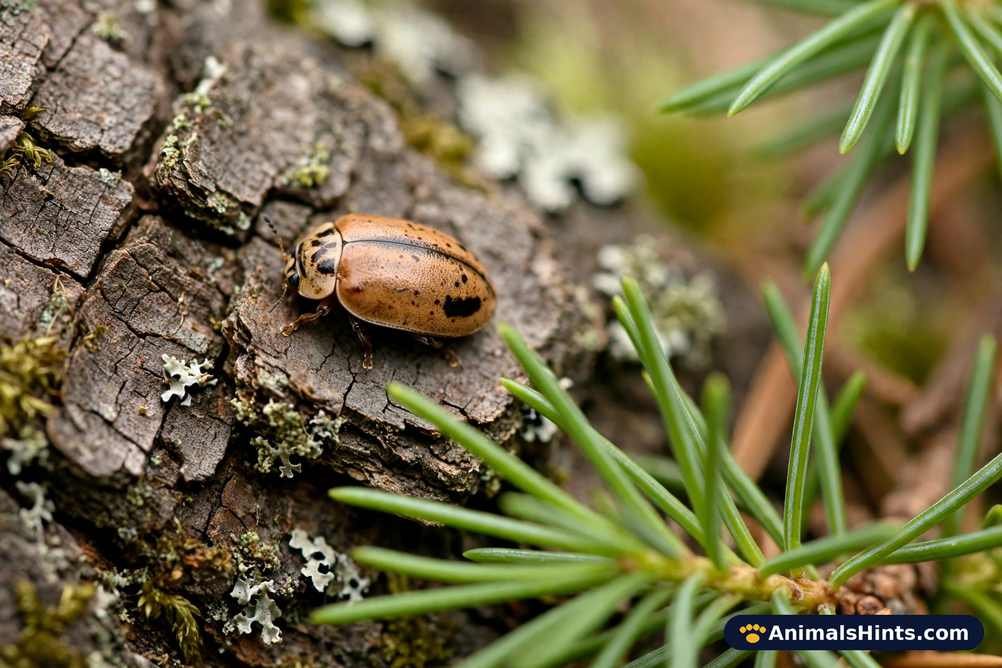
The larch ladybird (Aphidecta obliterata) is the classic brown ladybird of conifer country. It is small — about 3.5 to 5 mm — elongate-oval, and usually light tan-brown, with a dark line where the wing cases meet and sometimes a few dark blotches toward the rear. Its best identification mark is in front: the pronotum, the shield behind the head, is whitish beige with a dark brown mark shaped like a W or M. It lives on conifers — larch above all, but also spruce, pine and fir — where it hunts aphids and adelgids, and it overwinters tucked in bark crevices. It is found across Europe into Asia Minor and has been introduced into North America. One British field guide tradition calls it Britain’s only truly brown ladybird, which is why so many “brown ladybug” sightings near pine trees are this species.
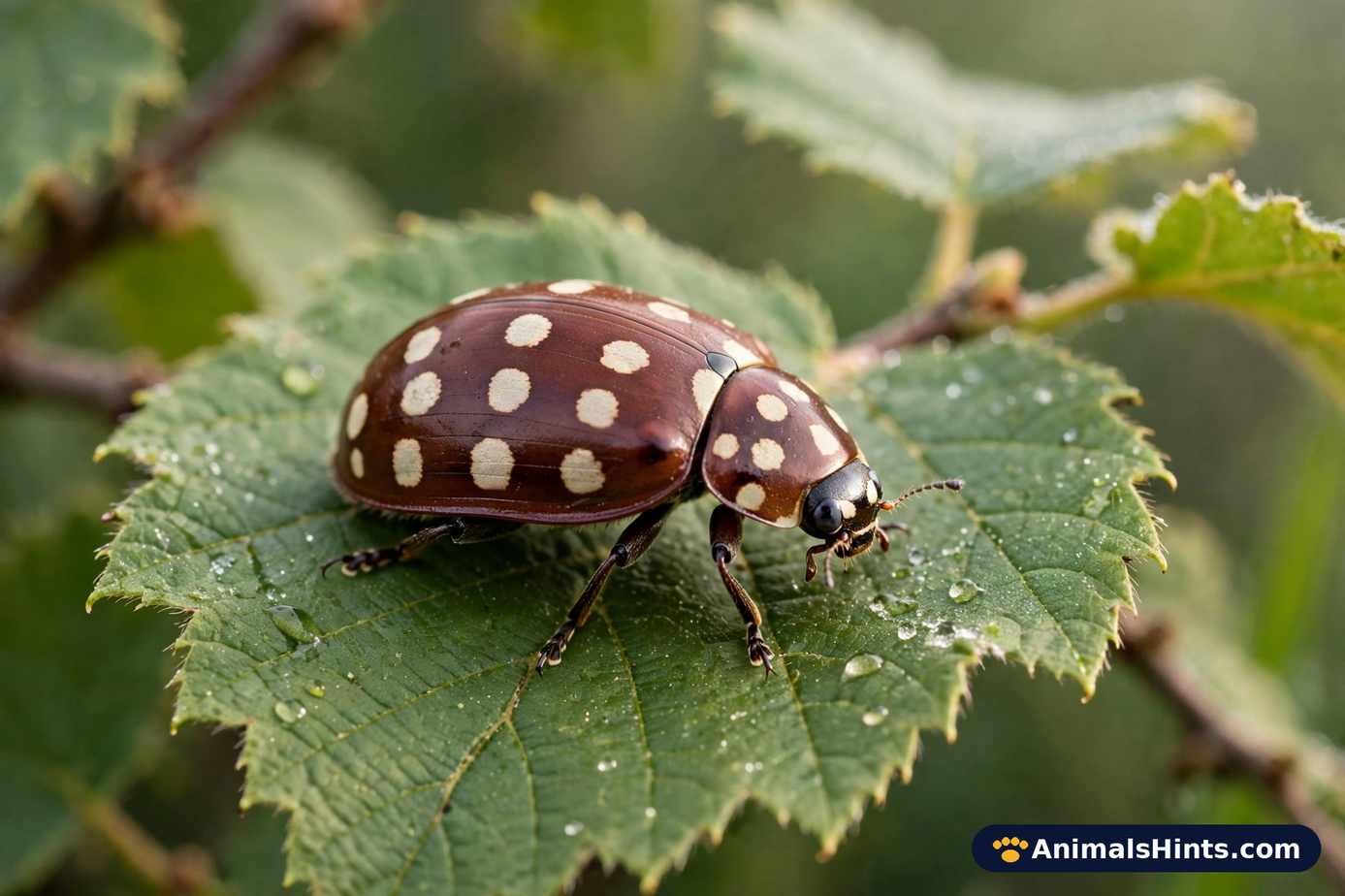
The cream-spot ladybird (Calvia quattuordecimguttata) is the brown ladybird of broad-leaved trees. Its wing cases are a rich maroon-brown carrying exactly fourteen round cream-white spots, its legs are brown, and it hunts aphids and plant lice in woodland, hedgerows and shrubs. It is widespread across Europe, temperate Asia and North America — common, once you know the pattern, and far more likely to be the “brown ladybug with white spots” on a garden fence than anything exotic.
The 18-spot ladybird (Myrrha octodecimguttata) is another maroon-brown tree species, a conifer specialist with typically eighteen cream spots and a pale, moustache-like marking at the base of the wing cases. The hieroglyphic ladybird (Coccinella hieroglyphica) goes the other way: a heathland species whose background colour is given in the recording literature as brown or black, with dark stripes and patches that suggested its name.
Then there are the shape-shifters. The 10-spot ladybird (Adalia decempunctata) is one of the most variable ladybirds anywhere — its spots can number from none to fifteen and its forms run through black, cream, orange and brown. The harlequin ladybird (Harmonia axyridis), the Asian species now widespread in Europe and North America, varies from yellow through orange and red to black, with anywhere from zero to about twenty-one spots, and its duller orange-brown individuals are routinely reported as “brown ladybugs.” Add one more everyday case: every ladybird emerges from its pupa pale and soft, and the colours deepen as the wing cases harden, so a “brownish” beetle on a leaf in the morning may be a red one by the weekend.
| Ladybird | Colour to look for | Where you are most likely to meet it |
|---|---|---|
| Larch ladybird | Tan-brown, dark centre line, beige pronotum with a brown W/M mark | On larch, pine, spruce and fir; under bark in winter |
| Cream-spot ladybird | Maroon-brown with 14 cream-white spots | Broad-leaved woodland, hedges, shrubs |
| 18-spot ladybird | Maroon-brown with about 18 cream spots | Conifers, especially pine |
| Hieroglyphic ladybird | Dark stripes and patches over a brown or black ground | Heathland, on heather and scrub |
| 10-spot ladybird (dark forms) | Brown, orange, cream or black; spots 0–15 | Trees and shrubs almost anywhere |
| Harlequin ladybird (dull forms) | Orange-brown to red or black; spots 0–21 | Gardens, walls — and indoors in autumn |
Two things follow from that table. The first is that a brown ladybird is not a rarity on the edge of disappearance: the cream-spot is common, the larch ladybird is widespread wherever conifers grow, and both are missed mainly because brown on bark is camouflage doing its job. The second is that colour alone never identifies a ladybird — spot pattern, the pronotum mark, size and the tree it is sitting on are the real evidence, and ladybird recording schemes ask for exactly those details.
11 Spiritual Meanings of a Brown Ladybug in the House
The eleven meanings below are the genre’s standard list for this encounter, kept in the order its writers give them. Two honest labels belong at the top. First, the list is modern: its sources are symbolism blogs and spirituality sites of the last two decades, not folklore collections, and its repetitions — protection returns three times under different wording — are the genre’s way of circling the point it cares about most. Second, the “in the house” setting has a plain explanation that the symbolism pages rarely mention: many ladybird species, the harlequin above all, come indoors in autumn on purpose, gathering in clusters in window frames and quiet corners to overwinter. The Royal Horticultural Society’s advice pages describe exactly this — adults forming large aggregations on the sunny side of buildings in autumn, then sheltering inside. A brown ladybug in the house is therefore, biologically, a beetle looking for a winter room. What the genre reads into that arrival is its own layer, and here it is.
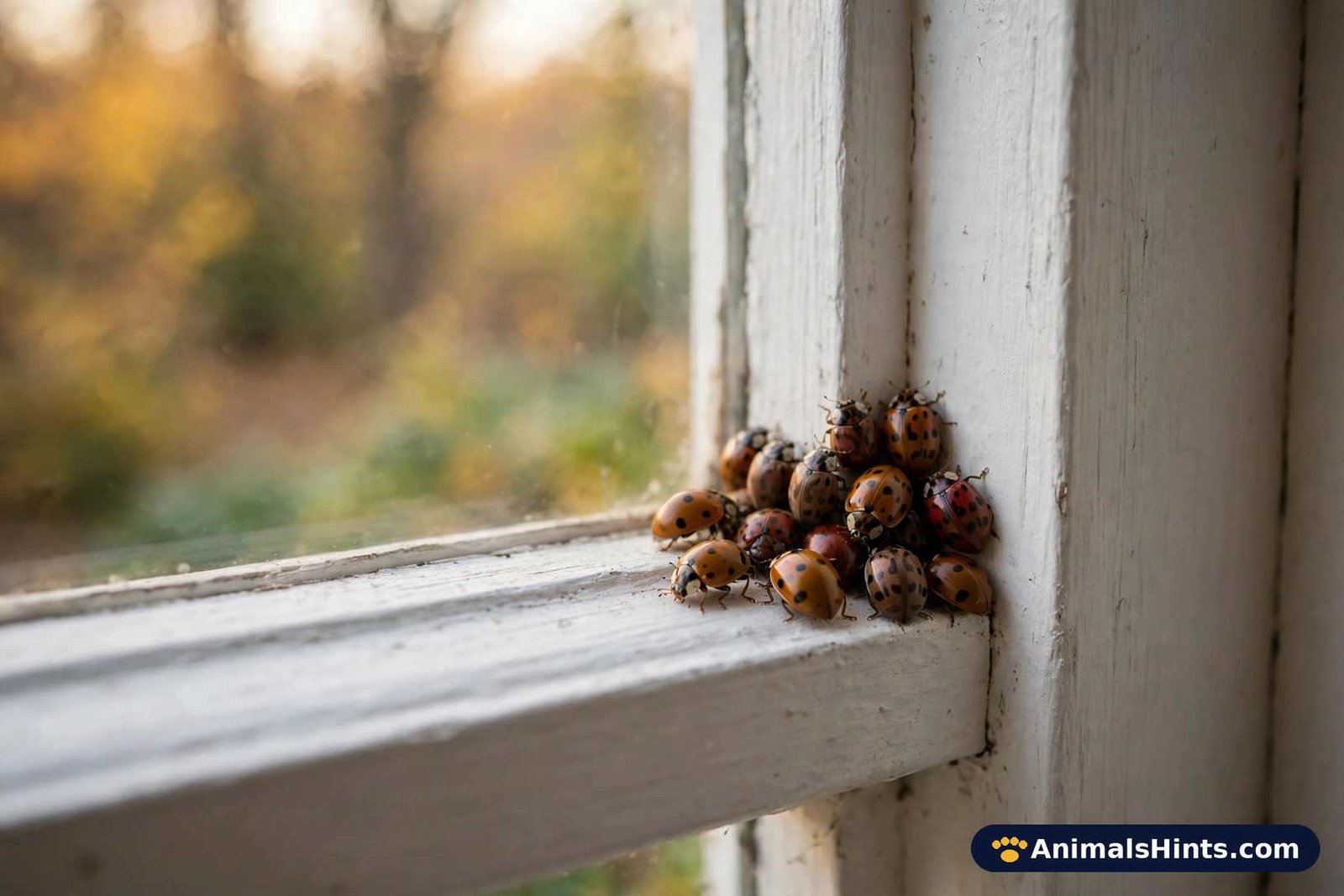
Other small house-visitors get read in the same spirit, incidentally — the centipede found indoors carries a house-meaning tradition of its own on this site — but the ladybird is the only one whose arrival is also a well-documented seasonal behaviour with a name of its own.
1. Protection, Resilience, and Good Luck
The genre’s first reading is the oldest ladybird idea of all, narrowed to this colour: the beetle as a small guardian. Ladybirds have been treated as protected creatures in European tradition for centuries — harming one was the unlucky act — and the brown form inherits that standing with an added shade of endurance. In this reading, a brown ladybug in the house says the home is watched over, and that the household’s difficulties are survivable ones.
Resilience is the meaning’s second half. The writers point to the beetle itself: soft-looking, slow, unarmoured by any standard except a bitter taste, and still here after every winter. The message they draw is that bouncing back does not require becoming harder — it requires becoming rooted.
2. Nurturing and Earthly Protection
The second meaning leans on the colour. Brown is soil, and soil in this vocabulary is what feeds and holds things while they grow. A brown ladybug is therefore read as a sign about care — the unglamorous, daily kind: meals, rest, a home kept in repair, people looked after before they are in crisis.
The earthly-protection half of the heading makes the same point from the other side. In the genre’s framing, this beetle does not promise rescue from above; it points at the protection that is built from below, out of routine, savings, fences mended and health attended to early.
3. Stability and Grounding
This is the centre of the whole list, the meaning the others keep re-approaching. Grounding, in the modern spiritual sense, means returning attention to the physical present — the body, the room, the ground underfoot — and the brown ladybug, coloured like the ground itself, is the genre’s chosen emblem for it.
Read as advice, the sighting asks whether life has become unmoored: too many changes at once, too much time spent braced for the next thing. The suggested response is structural rather than dramatic — a routine restored, one commitment finished before another is started, finances and relationships put on a footing that does not need luck to hold.
4. Protection, Healing, and Longevity
The fourth meaning joins the guardian idea to the ladybird’s actual lifespan, which is longer than most people expect: many ladybirds live a year or more, overwintering as adults and breeding the following spring — a long life for a beetle of that size, and the factual seed from which the longevity reading grows.
Healing, in this entry, is deliberately unhurried. The genre compares recovery to the beetle’s own calendar — a winter of stillness, then a slow return — and reads a sighting during illness or grief as permission to heal at that pace rather than on a schedule set by other people’s expectations.
5. Connection to Stability and Personal Growth
Where the third meaning is about standing still well, the fifth is about building. Its claim is that personal growth is mostly foundation work done invisibly: skills practised without an audience, habits changed one at a time, a life rearranged so that the good days are not accidents.
The brown ladybug suits the reading because the beetle is itself unshowy — no display, no song, nothing that advertises. Writers in this tradition use it to argue that the growth nobody can see is still growth, and that comparing your quiet season to someone else’s bright one is a category error.
6. Protection, Resilience, and Evolution
The sixth meaning is the list’s third pass at protection, and it spends the word differently: protection as the condition that makes change safe. Its image is the ladybird’s own development — egg, hunting larva, still pupa, winged adult — a creature that becomes something else entirely without ever stopping being itself.
Read personally, the sighting is taken to bless a change already under way: a new role, a move, a reinvention. The reassurance offered is not that the change will be easy, but that transformation is this family’s normal way of living, and that the protected, hidden stage in the middle is part of it rather than a failure of it.
7. Messages of Reassurance and Watching Over
Here the genre turns devotional. Some writers read a ladybird that appears at a low moment — especially one that lands on a person or turns up indoors out of season — as a token that the dead are near, or that a guardian presence is. It is the most personal entry on the list and the one its writers state with the least evidence, because there is none to state: it is a comfort-reading, held by the people it comforts.
This page records it because the list is incomplete without it, and labels it for what it is. No tradition with a text behind it teaches that ladybirds carry messages from the dead; the idea belongs to modern bereavement spirituality, where almost any gentle, unexpected creature can be received that way.
8. Sign of Protection During Difficult Times
The eighth meaning overlaps the first, and the difference is timing. The first is a standing condition — a guarded house. This one is read when the difficulty is already present: the diagnosis received, the job lost, the winter being what it is. A beetle that has come indoors to survive the cold, appearing in a home that is itself enduring a hard season, makes an obvious mirror, and the genre uses it.
The practical undertone is worth keeping even if you take none of the symbolism: the ladybird’s strategy in a difficult time is not to fight the season but to shelter, conserve, and wait in good company. As coping advice, that is sounder than most omens manage.
9. Illumination of Inner Strength
The ninth meaning is about recognition rather than rescue. Its reading is that the sighting arrives when a person has been underrating their own record — the hard years already survived, the skills already earned — and that the small, tough, ordinary beetle is a fair portrait of that kind of strength: not loud, not decorated, still working.
Writers connect it to the beetle’s real defences, which are easy to miss. A ladybird’s bright relations advertise poison with their colour; the brown ones rely on blending in, playing still, and tasting worse than they look. The genre’s point is that inconspicuous strength is still strength.
10. Symbol of Healing and Comfort
The tenth meaning returns to healing, as the fourth did, but at the scale of comfort rather than recovery. Where the fourth entry is about the whole arc of getting well, this one is about the small mercies inside a bad stretch — sleep, appetite, a day that hurts less — and reads the beetle’s visit as a marker for those.
It is also the entry where the genre is most honest about its own mechanism, if you read it closely: the comfort is produced by the noticing. A person who has slowed down enough to see a two-tone beetle on a windowsill has already done the thing the omen recommends.
11. A Sign for Personal and Spiritual Growth
The list closes where the fifth meaning began, with growth — but widened from the personal to the spiritual. The closing reading is that a brown ladybug marks a season of deliberate, unglamorous development: study, practice, prayer or reflection done daily and without display, the kind that compounds.
Its final note is the one the whole page has been circling. A creature coloured like bark, that most people walk past, rewarded the person who stopped and looked. Whether you file that under symbolism or under attention, the genre’s advice is the same: the sign is not the beetle. The sign is that you noticed it.
From Larva to Ladybird: The Change Behind the Symbol
Every transformation reading on this page rests on a real life cycle, and the real one is stranger than the symbol. Ladybirds undergo complete metamorphosis — four stages that share almost nothing in appearance. The egg is a tiny yellow-orange oval, laid in a cluster on a leaf, usually within walking distance of an aphid colony. What hatches is not a small ladybird but a larva: elongated, grey to black, often spiky or orange-marked, all appetite. Gardeners who know the adult often kill the larva as a pest, which is a costly mistake — a single larva eats several hundred aphids before it is done growing, and an adult can take dozens a day.

After a few weeks of hunting, the larva fastens itself to a leaf or stem and pupates. Inside that still case the body is rebuilt, and what emerges about a week later is the adult — soft and pale at first, darkening as the wing cases harden. The famous comparison on this site is the caterpillar, whose change into a butterfly gets all the poetry; the ladybird’s version is the same radical trick performed by a beetle, in the open, on the underside of a leaf in your garden.
Two consequences matter for the meanings above. First, the beetle that overwinters in your window frame is an adult in the last stage of that cycle, waiting to breed in spring — which is why the genre’s longevity reading has a factual root. Second, the transformation the symbolism celebrates is not a metaphor the writers invented; it is the animal’s ordinary biology, and it is available to check with a hand lens.
Brown Ladybug Symbolism for Love, Relationships, and Twin Flame
The genre’s love reading for the brown ladybug is the red ladybug’s reading with the volume turned down. Red gets passion, luck in romance and the wish made as the beetle flies away. Brown, in these writers’ hands, stands for the part of love that is not weather but climate: trust accumulated slowly, loyalty shown in ordinary weeks, a household run as a partnership, affection expressed as reliability.
For an established couple, the sighting is read as a nudge toward maintenance — the conversation postponed, the appreciation unspoken, the foundation checked before it cracks. For someone single, the same writers read it as counsel against chasing intensity: build the stable life first, and let love arrive into something that can hold it.
The twin-flame half of the heading needs its label. “Twin flame” is a term from modern popular spirituality, not from any older tradition this page could find, and no folklore source assigns the brown ladybug a role in it. In current genre writing, the brown beetle is used to say that two people must each be grounded before a union can hold — which is the stability reading wearing the vocabulary of the moment. It is recorded here as genre usage, nothing older and nothing verified.
Cultural and Religious Significance
The documented record is European, rural and older than the symbolism genre by centuries — and it belongs to ladybirds as a group, not to the brown ones in particular. No culture this page could check keeps a separate tradition for a brown ladybird; what exists is a rich tradition for the beetle itself, which the brown species share.
The centre of it is a name. In medieval Christian Europe, the story goes, farmers prayed to the Virgin Mary — Our Lady — against the aphids destroying their crops, and the little red beetles that arrived to eat them were named in her honour: “Our Lady’s bird,” shortened over centuries to ladybird in Britain and ladybug in America. German keeps the dedication outright in Marienkäfer, Mary’s beetle; an old French name calls it bête à bon Dieu, the good Lord’s creature. The association is documented independently in several languages, which is unusually strong evidence for a piece of folk etymology — though note the honest limit the reference books add: the association traces to the Middle Ages, while the earliest written records of the English names themselves are seventeenth-century.
Around that name grew the customs. A ladybird landing on you was good luck, and you let it leave when it chose — brushing it off threw the luck away. Its spots were counted like a calendar: in many tellings, the number of spots foretold the number of lucky months ahead; folk tradition also read the seven-spot’s marks as Mary’s seven joys and seven sorrows. And the protection ran both ways — the beetle that protected the crops was itself protected by custom, and killing one was the act that invited misfortune.
The competitor version of this section adds two claims this page could not verify, and they are corrected here rather than repeated. The first is a specifically Asian brown-ladybug tradition of harmony and grounded energy: ladybirds are liked in many places, but no named Asian tradition, text or custom about a brown ladybird turned up in these checks, so the claim is recorded as the genre’s general attribution, unverified. The second is the suggestion of a broad Christian symbolism beyond Mary. The Bible never mentions ladybirds at all. Christianity’s real connection to this insect is the naming tradition above — genuine, documented and quite enough — and anything further is modern devotional writing, labelled as such wherever this page uses it.
What It Means Spiritually to Dream About a Brown Ladybug?
Dream readings in the genre extend the waking ones, and this one is no exception. A brown ladybug in a dream is read as the sleeper’s own foundation asking for attention: the home, the body, the slow work. Landing on the dreamer, it is read as reassurance — protection felt rather than argued. Flying, it becomes the transformation reading again, growth in progress but at the grounded tempo the colour always imposes in this vocabulary.

The honest framework is the same as for the other sections. Dream symbolism of this kind is a modern interpretive genre; older dream-book traditions are enormous and various, but no classical dream text with a ladybird entry was found in these checks, and this page will not invent one. What can be said without invention is smaller and still interesting: the insect people dream about is the one their culture has already loaded with meaning, and in the European tradition that meaning — luck, protection, a name that is a prayer — is real and old, even if the dream dictionary built on it is new.
Brown Ladybug Landing On You or Flying Around You
Of all the encounters on this page, the landing is the one with a documented folk record behind it. In European tradition a ladybird that settles on a person is good luck arriving in person; you keep still, you do not brush it away, and some tellings have the luck counted out in its spots before it flies. The genre’s brown-specific layer adds the grounding note — read it, its writers say, as steadiness choosing you, a reminder delivered at skin distance to slow down and stand on your own foundations.
A ladybird flying around you rather than landing gets the lighter reading: change in motion, a new phase opening, the transformation meaning at its most literal. Biologically, both events are mundane — a beetle exploring a warm, vertical, aphid-adjacent surface, which a clothed human resembles more than we like to think — and the two accounts sit side by side here without either cancelling the other.
One practical word belongs in this section. If a ladybird lands on you, the kind response is also the traditional one: let it walk onto a leaf, a card or a sunlit wall in its own time. Ladybirds can release a bitter-tasting defensive fluid from their leg joints when roughly handled, which is unpleasant for both parties and entirely avoidable.
Is it a Sign from Angel or Heaven?
This heading, in the genre, asks whether the beetle is a messenger — from angels, from heaven, from someone who has died. The honest answer has two parts. As a matter of record: no church teaching, scripture or documented tradition assigns ladybirds that job. The one genuinely religious thread in the ladybird’s history is the Marian name, and that is a dedication given by grateful farmers, not a claim that the beetle carries messages back.
As a matter of experience, the reading exists and is widely held. Modern devotional and bereavement writing treats unexpected, gentle encounters with creatures as signs of presence, and a small harmless beetle appearing at a moment of decision or grief fits that pattern perfectly for the people who receive it that way. This page’s position is the one it takes throughout: the feeling is real, the comfort is real, and neither is evidence of a mechanism. If a brown ladybug at a crossroads steadies you, the steadiness does not depend on settling where the beetle came from.
Brown Ladybug or Brown Stink Bug? How to Tell
This is the identification that actually matters in an American house in autumn, because the brown ladybug’s great impersonator is not a ladybird at all. The brown marmorated stink bug (Halyomorpha halys) is an invasive shield bug from East Asia, established across much of the United States since the late 1990s, and it does exactly what overwintering ladybirds do: gathers on sunny walls in autumn and comes indoors to wait out the cold — sometimes in far larger numbers. It is also, in the words of the US Environmental Protection Agency’s guidance, harmless to people and buildings: it does not bite, sting, spread disease or reproduce indoors. But it is a crop pest and a household nuisance, and it is not a ladybird, whatever the colour suggests.
The differences are easy once you look at shape instead of colour:
- Outline. A ladybird is round to oval and strongly domed, like half a bead. A stink bug is shaped like a shield — broad shoulders narrowing to a flatter back — and noticeably bigger, roughly 12 to 17 mm against a ladybird’s few millimetres (even the large harlequin tops out around 8–10 mm).
- Pattern. The stink bug is mottled, marbled brown-grey all over, with alternating light and dark bands along the edge of the abdomen and pale bands on its antennae. A brown ladybird still shows a ladybird’s architecture: smooth wing cases meeting in a straight line down the back, often with spots or a marked pronotum.
- Smell. Disturb or crush a stink bug and it lives up to its name. A ladybird’s defensive fluid is bitter rather than pungent, and it does not perfume a room.
- Behaviour. Stink bugs sit flat and exposed on walls and curtains; overwintering ladybirds wedge themselves into the corners of window frames and cluster tightly together.
Why the distinction matters for this page: the symbolism record, the luck, the name, the whole tradition, belongs to the ladybird. The stink bug arrived in North America within living memory and carries none of it. Reading omens off a stink bug is a case of mistaken identity — and squashing one indoors is a mistake of a more practical kind.
What to Do When You Find One (and What Not to Do)
Most encounters need no action at all. A brown ladybird on a plant, a fence or a path is a working predator in its workplace; the best response is to leave it where it is earning its keep, and to keep the garden’s aphid-eaters in mind before reaching for sprays that kill them along with the aphids.
Indoors, the gentle options are also the effective ones. A single beetle can be walked onto a card and put out on a sheltered wall or in a shed — outbuildings suit overwintering ladybirds better than a heated room, which can wake them early and starve them. A whole cluster in a window frame is doing no harm where it is; if it must move, sweep it softly into a box and relocate it to a garage, log store or sheltered outbuilding rather than into the cold. What not to do: do not vacuum a cluster into a machine that will kill it, do not spray insecticide at a beneficial insect indoors, and do not crush anything brown before you have checked its shape against the section above.
And one thing to do that this page can recommend without any caveat: record it. Ladybird recording schemes in Britain, Ireland and North America take sightings with a photo, a date and a place, and brown species are exactly the ones under-recorded because they are overlooked. The beetle the genre calls easy to miss is, for the same reason, the one science most needs you to notice.
Final Thoughts
A brown ladybug is a small claim made carefully. Biologically, it is one of a handful of genuinely brown ladybird species — a tan larch specialist, a maroon cream-spot, a variable shape-shifter in a dark form — going about the family business of eating aphids and sheltering through winter. Symbolically, it is the modern genre’s emblem of the unglamorous virtues: grounding, patience, foundations, healing at walking pace. Both accounts agree on the temperament, if on nothing else, and both reward the same act of slowing down to look.
The tradition underneath it is real even where the list is new. A beetle named for Our Lady by farmers it had rescued, counted for luck by its spots, protected by custom for centuries — that record belongs to every ladybird, the brown ones included, whether or not anyone wrote their colour into it at the time. What the brown beetle adds, and it is not nothing, is a correction of emphasis: luck in work clothes, fortune at bark-camouflage scale.
So if one has turned up in your house this autumn, the practical story is that it is sheltering — an adult in diapause, waiting out the cold in the warmest crevice it could find, exactly as its kind has always done. The genre’s story is that steadiness has come to visit. You do not have to choose between them to act well on both: let it stay or move it gently, mend one small foundation, and let the slow season do its work.
FAQs
1. What is the spiritual meaning of a brown ladybug?
In the modern symbolism genre, it stands for grounding, stability, patience and practical matters — home, money and foundations. Brown is read as the earth’s colour; no older tradition gives the brown beetle a separate entry.
2. What does it mean to see a brown ladybug?
Genre writers read it as a prompt to attend to practical foundations and reconnect with the physical world. Biologically, it usually means a genuinely brown or dark-form ladybird is nearby — very often near conifers, bark or hedgerows.
3. Is a brown ladybug rare, and does that affect its meaning?
Not particularly. Brown is a colour several species wear — the cream-spot is common and the larch ladybird is widespread — but they blend into bark and are easily overlooked. The genre reads that overlooked quality itself as the point: a sign you have to slow down to see.
4. How should I respond to seeing a brown ladybug?
Gently. Do not brush it off or crush it; let it walk onto a leaf or card, leave it if it is hunting aphids, and move indoor winter visitors to a sheltered outbuilding. Checking its shape first is wise — its brown lookalike, the stink bug, is a different story entirely.