Red Ladybug Spiritual Meaning: Luck, Love and the Beetle Behind the Symbol
The red ladybug meaning is the showpiece of the whole ladybird family. Where its brown relatives get read for quiet virtues, the red beetle is the one the symbolism genre loads with its biggest themes: luck first of all, then love, passion, vitality and protection — a small scarlet dome asked to carry fortune, romance and life force at once.
Part of that load is genuinely old. Of all the ladybirds, the red ones hold the real folklore record: centuries of European country custom treated this beetle as a protected bringer of luck, and its very name is a prayer — “ladybird” means Our Lady’s bird, a dedication to the Virgin Mary. But the fine detail layered on top today — twelve numbered house meanings, root chakras, twin flames, a meaning for every spot count — is modern genre writing, built within living memory on top of that older, simpler luck.
So this page does for the red beetle what careful reading requires: it gives the genre’s twelve meanings in full and in their usual order, and it keeps the documented record visible beside them. It also takes up the plain questions the symbolism pages leave alone — which beetles actually wear red, why the colour is a warning rather than a decoration, and how to separate a true red ladybird from the scarlet impostor that eats lilies.
What Does Seeing a Red Ladybug Symbolize?
In the genre’s telling, a sighting is first of all encouragement. The beetle is said to turn up when a decision needs confirming or a flat stretch of life needs warming, and it is read as a reminder to trust your own judgement — intuition and emotional clarity are the words its writers reach for. A crossing, in this vocabulary, also announces renewal: something stuck is about to move, and the bright visitor is the advance notice.
Protection is the second theme, and it has a real root. A creature this small, this slow and this apparently defenceless, which nevertheless thrives everywhere, invites a guardian reading — and the genre supplies one: the sighting marks a stretch of life in which you are watched over, your prayers heard, your household shielded from the negativity of the season. The fourth theme, abundance, grows out of the farmyard rather than the temple: ladybirds eat aphids in quantities farmers could measure in saved crops, and a beetle that visibly protected the harvest was read, in time, as a patron of prosperity generally — money, work and opportunity included.
Colour does most of the talking in this corner of symbolism, and red talks loudest. Readers meet the orange butterfly by its colour first as well, but red arrives carrying older and stronger associations than any neighbouring shade — fire, blood, ripe fruit, alarm. At the shelf’s other end, what black means spiritually treats everything hidden; red works the opposite way, with nothing held back at all. What is fact and what is reading stays separated on this page: the luck tradition is documented, the encouragement is the genre’s gloss on it, and the beetle underneath both is a working predator with a chemistry set, which the next section takes up.
Which Beetles Are Actually Red?
“Red ladybug” is no more a single species than “brown ladybug” was — the family Coccinellidae holds thousands of species, and red is a uniform several of them wear. But red, unlike brown, has a title-holder. When anyone pictures a ladybird at all, they picture one beetle, and it is this one.
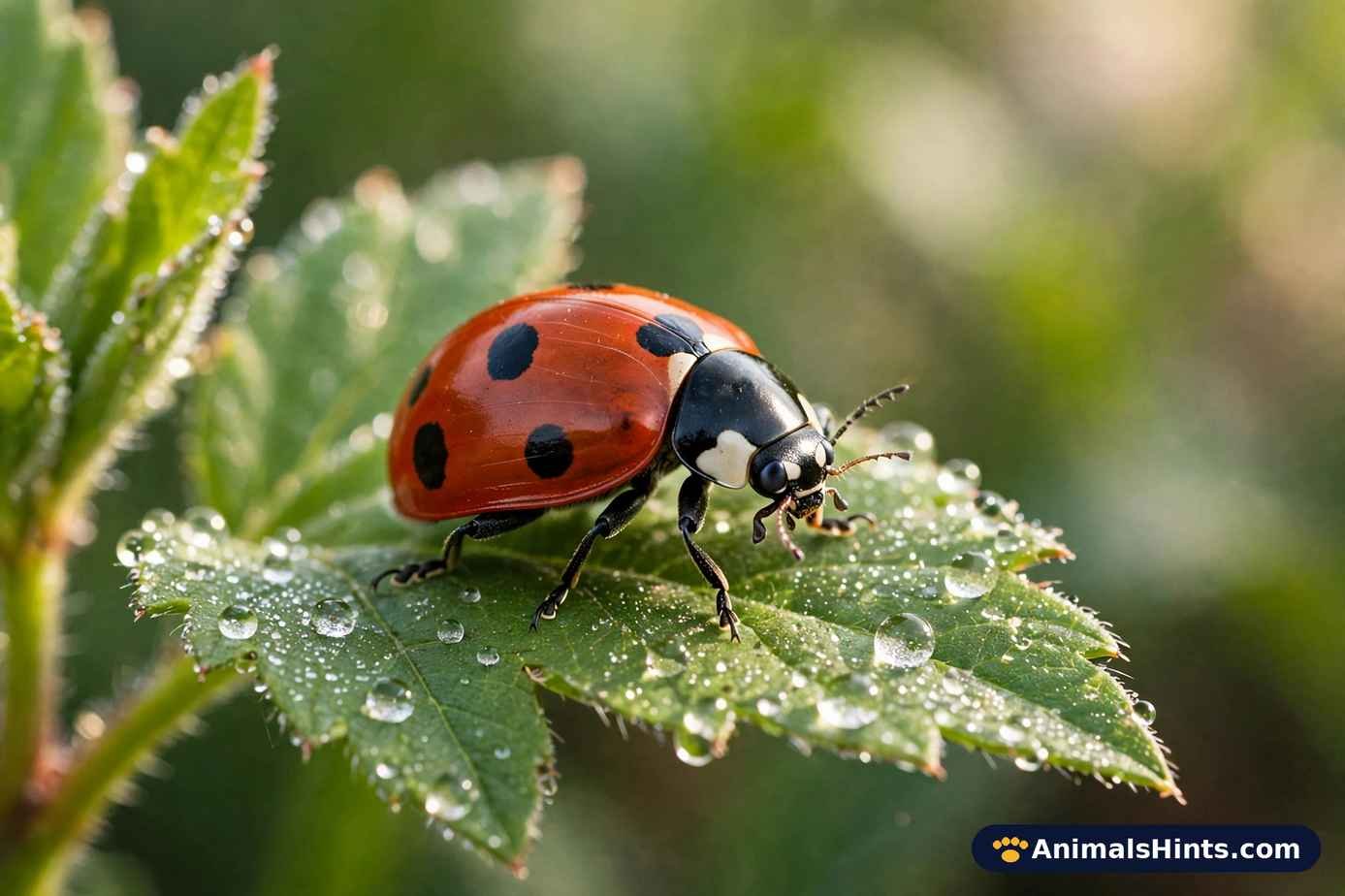
The seven-spot ladybird (Coccinella septempunctata) is the classic. It is a fairly large ladybird, about 6.5 to 7.8 mm long, oval and strongly domed, with three black spots on each red wing case and a seventh straddling the seam where the cases meet, flanked by two small white flecks. The shield behind its head is black with white front corners, and the underside is black throughout. It is native across Europe, most of Asia and North Africa, has been carried to North America as a weapon against aphids, and ranks among the most familiar insects on earth. Adults spend the winter in sheltered places, frequently in company, and emerge in spring to breed.
The two-spot ladybird (Adalia bipunctata) is the seven-spot’s smaller neighbour — roughly 3.5 to 5.7 mm — and its usual dress is a single black spot on each red wing case, two in all. It is also a shape-shifter: the species is famously polymorphic, and its dark forms turn the scheme inside out, black wing cases carrying red spots instead. It ranges across the whole northern world, though its native North American populations have thinned sharply in recent decades.
The convergent lady beetle (Hippodamia convergens) is North America’s own common red. It is a touch more elongated than the seven-spot, 4 to 7 mm, orange-red with up to a dozen or so black spots, and it is named for a detail most people never notice: two white streaks on the black pronotum that lean toward each other rather than running parallel. Gardeners buy it by the thousand for aphid control, and wild populations gather in large overwintering assemblies in sheltered valleys.
The harlequin ladybird (Harmonia axyridis), the Asian arrival now spread across Europe and North America, wears red too — some of the time. Its forms run from orange-red with many black spots to black with red ones, with spot counts anywhere from none to around twenty-one, which is why so many mystery “red ladybugs” on garden walls turn out to be this one beetle in one of its outfits.
Why red at all? The colour is chemistry made visible. Research on ladybird wing cases — including a 2025 study in PLOS One — attributes the red-to-orange ground to carotenoid pigments, the same family that colours carrots, while the black spots are printed in melanin. And the pairing is a signal, not a fashion: bright red with black is warning colouration, advertising that the wearer tastes foul and carries alkaloid defences, coccinelline chief among them. Birds that sample one learn the uniform. Studies comparing ladybird species find the pattern honest in the main — the more vivid and contrasting the shell, the stronger the chemical defence behind it tends to be. Two backup tricks complete the kit: a threatened ladybird lets out a bead of bitter, alkaloid-laced fluid at its leg joints, and it can play dead outright. Even the pale beetle on a spring leaf belongs to this story — a ladybird leaves its pupal case soft and washed-out, and the full red arrives as the wing cases harden.
| Ladybird | Pattern to look for | Where it turns up |
|---|---|---|
| Seven-spot ladybird | Three spots per wing case plus one at the seam; white flecks beside it | Gardens, fields and hedgerows across Europe, Asia and North Africa; introduced in North America |
| Two-spot ladybird | One black spot on each red wing case; dark forms reverse the colours | Gardens and trees throughout the northern hemisphere |
| Convergent lady beetle | Up to about a dozen spots; two white streaks leaning together behind the head | North American gardens and farmland |
| Harlequin ladybird (red forms) | Orange-red with none to around twenty-one spots; strongly variable | Walls, gardens — and indoors in autumn, almost anywhere |
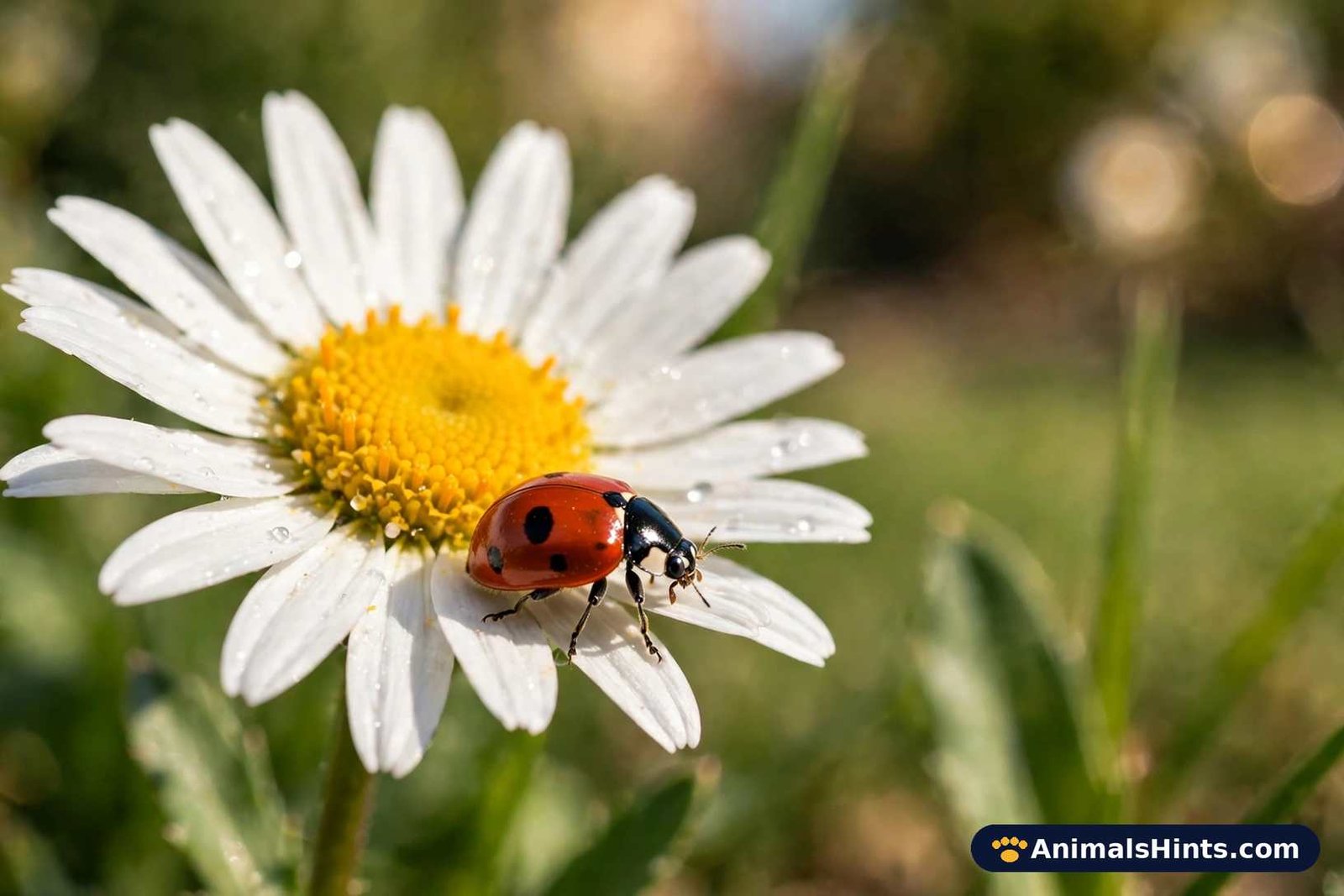
Two conclusions follow. First, when a red ladybug is doing something interesting — gathering on a wall, appearing indoors in October, swarming a rose bush — it is most often one of these four, and the spot pattern plus the pronotum marks will usually name it. Second, the symbolism record was built almost entirely on the first of them. The seven-spot is the beetle in the nursery rhymes and the luck customs, and when the genre says “red ladybug,” the seven-spot is what its imagination is holding.
12 Spiritual Meanings of a Red Ladybug in the House
Here are the twelve readings the genre attaches to this encounter, taken in the order its writers set them down, and two honest labels belong at the top — the same two as apply to every list of this kind. First, the list is a recent composition: symbolism sites and spirituality writers of the last few decades assembled it, and its repetitions — luck and protection return under several headings — are how the genre insists on the points it cares about. Second, the “in the house” setting needs no mystery to explain it. Adult ladybirds overwinter, and a house is shelter: seven-spots tuck into quiet corners, harlequins gather in window frames in autumn clusters, and convergent beetles assemble by the thousand in protected spots. A red ladybug indoors in the cold months is a beetle that has found its winter room. What the genre reads into the arrival is a separate layer, and here it is.
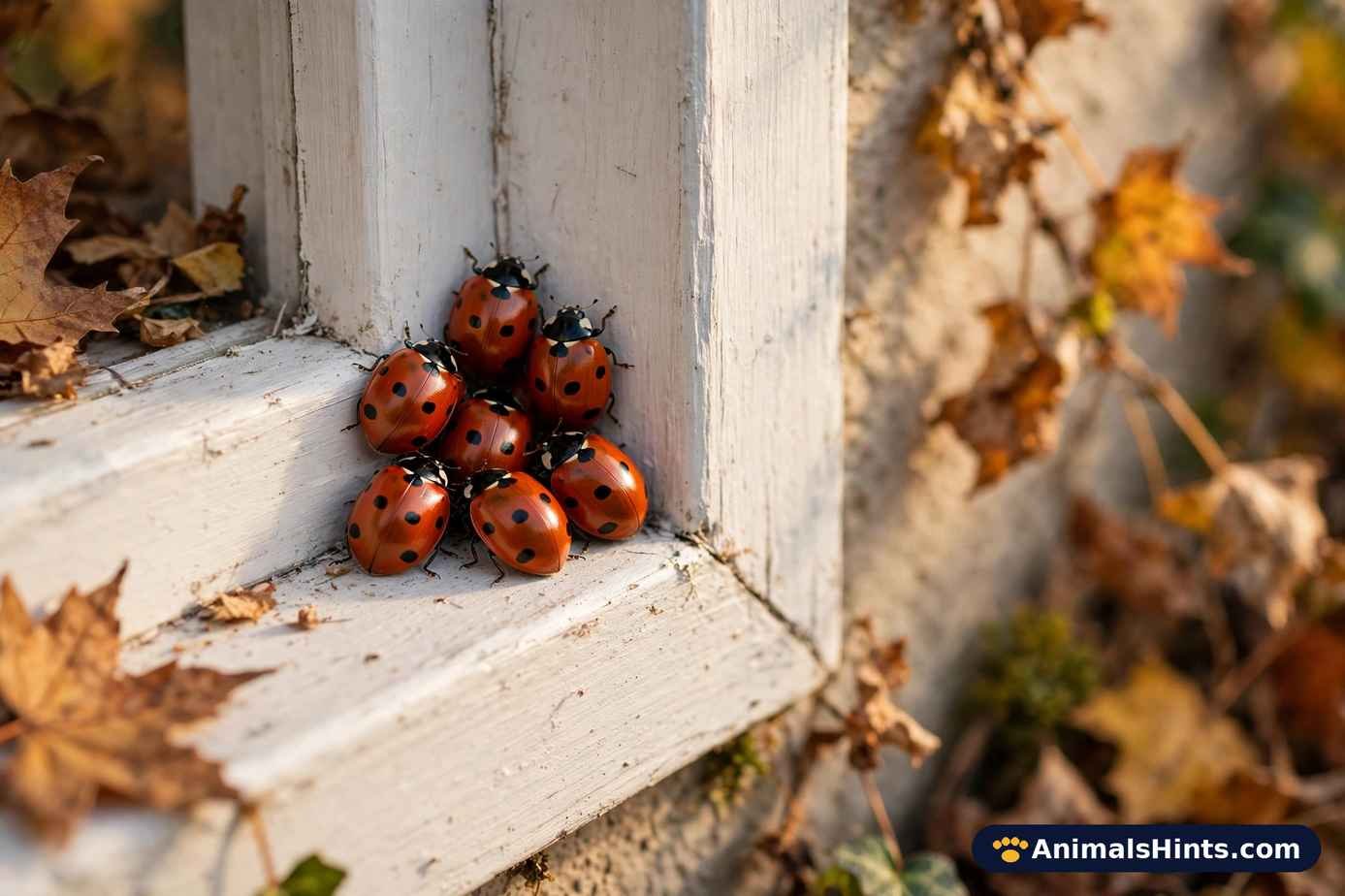
1. Essence of Life & Love
The list opens with the colour’s plainest reading: red as the colour of being alive. In this entry the beetle stands for vitality itself — energy, appetite, enthusiasm for the day in front of you — and for passion, the pull toward the people and pursuits that make days feel warm rather than merely full.
Love is folded into the same heading rather than given its own, because in this vocabulary the two are one force at two temperatures. The practical advice the writers draw is gentle: feed the bonds you already have, show affection while it is still easy to show, and let the sighting count as a nudge to rejoin your own life at full strength.
2. Dream Messenger
Unusually, the list’s second entry is about sleep rather than waking life: it collects what a red ladybug is taken to mean when it appears in a dream — broadly, good fortune forming out of sight, protection felt during a vulnerable passage, and change arriving in its joyful rather than its frightening form.
The entry also carries the genre’s karma note: compassion and mindfulness practised now are read as positive returns later. The fuller dream treatment sits in its own section further down this page; this heading exists because the list’s writers wanted the dream reading counted among the twelve.
3. Heart & Guardian
The third meaning pairs the two themes the whole list keeps circling: the heart and the shield. As heart, the beetle is read for love, passion and emotional honesty — an invitation to open up, say the sincere thing, and let relationships deepen rather than merely continue.
As guardian, it is read for the softening of difficulty: not the removal of problems, but the sense of moving through them accompanied. Luck enters the entry as well, as opportunity drifting toward a person whose defences — in every sense — are kindly rather than closed.
4. Positive Omen
This is the umbrella entry, the one under which the others shelter: the red ladybug as a favourable sign, full stop. Its writers gather the whole bundle here — love, luck, prosperity, outcomes resolving better than feared, protection over all of it — and present the sighting as the universe’s shorthand for encouragement.
Of all twelve, this is the entry with the deepest roots, because the luck at its centre is the one part of the list that folklore genuinely documents. The rest of the bundle is the modern genre arranging its themes around that old, verified core.
5. Biblical Symbolism
The genre’s fifth entry reads the red shell through Christian devotion: scarlet as the colour of Christ’s love, paid for in sacrifice, and the beetle itself as a small token of a protecting heaven — of mercy offered and peace hoped for.
This page’s duty is the label. No ladybird appears anywhere in the Bible, and no scripture assigns this insect a meaning; what exists is modern devotional writing applying the colour red — a colour Christian art and liturgy do load with the blood of Christ — to a beloved beetle. The one documented thread between Christianity and this insect is the naming tradition covered in the culture section below, and it is a thread about Mary, not about symbolism assigned to spots.
6. Spiritual Safeguard
The sixth meaning generalises the guardian theme beyond the heart: the ladybird as a safeguard for the spirit — protection from negative influence, healing after emotional strain, good fortune during growth, and grace in the sense of moving through trouble with unusual calm.
Its writers lean on the beetle’s harmlessness for the image: a creature with no sting, no bite and no malice becomes, in this reading, the emblem of a protection that works by gentleness. Restoration here is deliberately slow — balance returning the way spring does, not the way a switch flips.
7. Virgin Mary’s Symbol
This entry has the most history inside it. The documented core is the name itself: across medieval Europe the beetle was dedicated to the Virgin Mary — Our Lady’s bird in English, Marienkäfer, Mary’s beetle, in German, the good Lord’s creature in old French — and the red seven-spot was the beetle the dedication described.
The genre’s embroidery goes further: the scarlet shell read as Mary’s cloak, and a cherished folk telling matching the beetle’s seven spots to Mary’s seven sorrows and seven joys. The naming record is solid history, repeated independently in several languages; the cloak and the spot-matching are the devotional layer readers added, and they are recorded here as exactly that.
8. A Landing of Luck
Here the genre stands on documented ground again. European custom held that a ladybird settling on a person brought luck with it — the luck was counted out, in some tellings, by the beetle’s spots — and that the visitor was never to be brushed away, because brushing discarded the gift.
The list’s writers keep the emotional shape of the custom: gratitude, optimism, a moment that feels personally addressed. A beetle choosing your sleeve out of a whole garden is a small event; the tradition’s claim is that small is precisely the size luck prefers to travel.
9. Auspicious Invitation
The ninth meaning is about mood as invitation. The beetle’s brightness is read as an offer: joy available here, positive energy on the table, new openings forming in places that had felt stalled — and the sighting itself as the moment the offer is made.
Its writers are frank that the mechanism is partly the noticing. A flash of scarlet on a drab day rearranges a person’s attention whether or not they believe in omens, and this entry simply builds its teaching on that rearrangement: accept the invitation, let the day lighten, act while the lightness lasts.
10. Spiritual Vitality
The tenth meaning returns to life force, now with the genre’s energy vocabulary attached: vitality, optimism, spiritual protection, and — the modern layer, labelled as such — root chakra energy, red being the colour modern chakra writing assigns to survival, grounding and physical wellbeing.
Strip the vocabulary away and the entry’s advice is bodily and plain: honour your energy, guard your health, spend your strength on what deserves it. The beetle, an animal that runs entirely on appetite and season, makes a fair emblem for it.
11. Embrace Passion & Romance
The list’s most purely romantic entry. The red ladybug here is a prompt toward the heart’s active life: reigniting an interest or a desire that had gone quiet, welcoming new connection if you are single, deepening warmth and closeness if you are not.
Its closing observation is the finest in the entry and the one its writers return to: affection compounds through small acts. A creature half an inch long carrying a whole love reading is itself the demonstration that size and significance are different things.
12. Signal of Good Fortune
The list closes by restating its oldest theme at full volume: good luck, success within reach, protection from negativity, and optimism with gratitude as the proper response. Read against the first eleven, it functions less as a new meaning than as the genre’s signature at the bottom of the page.
It is also, fittingly, the meaning closest to the documented record. Farmers who guarded this beetle because it guarded their crops were not performing symbolism; they were practising pest control and calling the result fortune. The genre inherited that verdict and dressed it — the verdict itself is centuries old.
From Egg to Winged Adult: How a Red Ladybird Grows
The transformation language all over this page rests on a real and radical life cycle. A ladybird’s development is complete metamorphosis: four stages, and the animal in the second looks nothing like the animal in the fourth. The egg stage is brief and tactical — small yellow-orange eggs laid in batches on leaves and stems, deliberately placed within a short walk of an aphid colony, because what hatches will be hungry immediately.
The larva is the surprise for most gardeners: an elongated, slate-grey hunter, spiky or warty depending on species — the seven-spot’s carries orange patches along its front section — and possessed of an appetite that outruns the adult’s. Several hundred aphids may pass through one larva before it finishes growing, which is why the kindest thing a gardener can do for a rose bush is learn to recognise this unglamorous stage and spare it. The comparison readers of this site know best is the caterpillar: the ladybird performs the same total rebuild as any butterfly, it simply does so as a beetle, in the open, usually on the underside of a leaf.
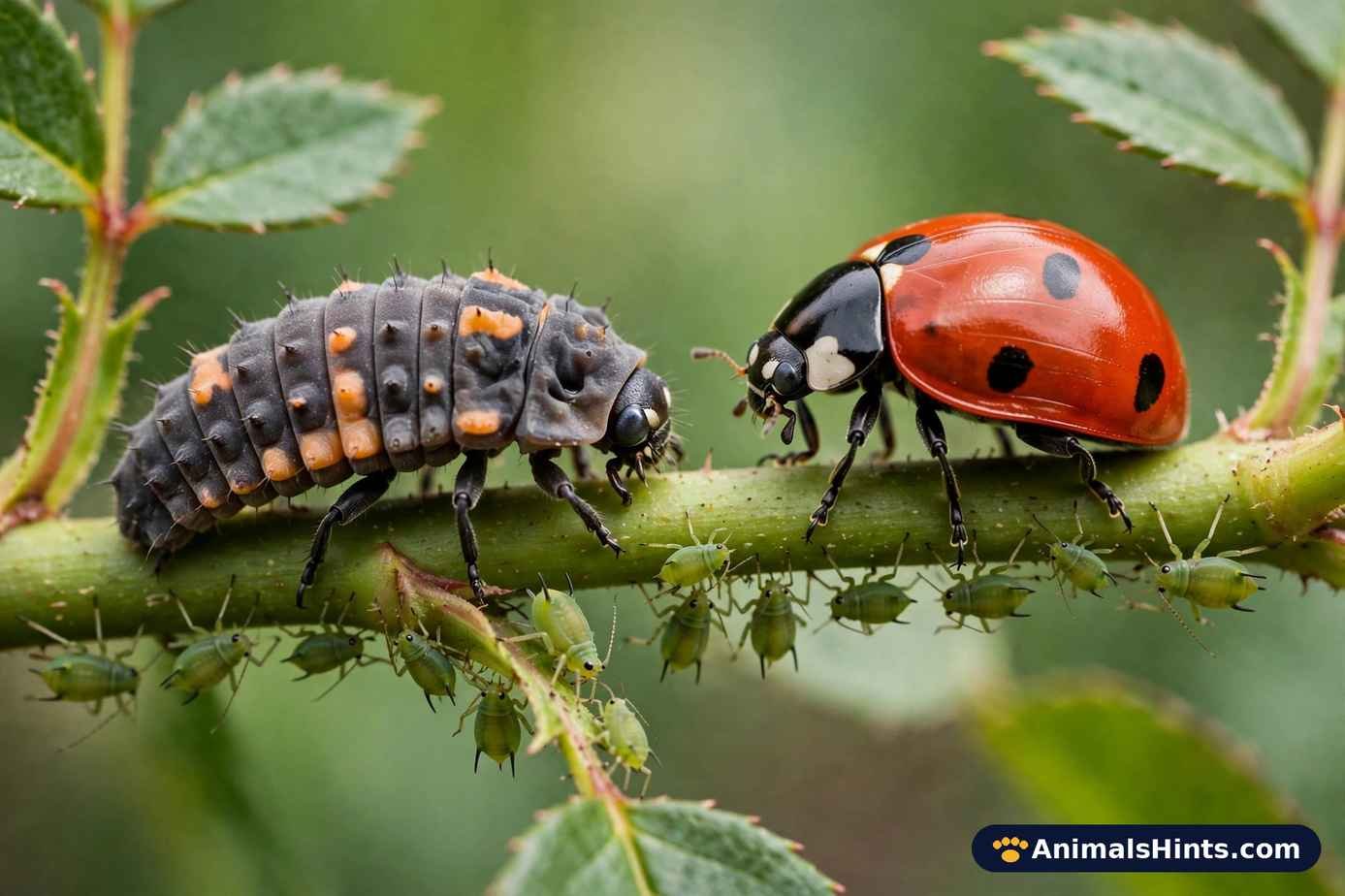
When feeding ends, the larva anchors itself and pupates. The seven-spot’s pupa is about 6 mm, grey-black or sometimes pale orange with dark markings, and inside it the crawling hunter is dismantled and reassembled as a winged, domed adult. The new beetle emerges soft and pale — a washed-out orange ghost of itself — and darkens over hours and days as the wing cases harden and the pigments settle, until the scarlet-and-black uniform is complete.
Two facts from the cycle matter to the meanings above. The adult is the long stage: it is the adult that overwinters, sometimes in aggregations, and breeds the following spring, so the beetle in your window frame in November may be the same individual that hunted your roses in June. And the change the symbolism makes so much of is no imported metaphor — it is this insect’s own ordinary life story, checkable with a hand lens and a little patience.
Red Ladybug Symbolism for Love, Relationship and Twin Flame
For love, the genre gives the red beetle the opposite assignment from its brown relative. Where brown is read for the slow climate of a bond — trust, routine, foundations — red is read for its weather: attraction, warmth, courage, the moment affection becomes action. A sighting during a courtship is read as encouragement; inside an established relationship, as a prompt toward tenderness and honest speech when habit has made both scarce.
For single readers, the same writers pivot the reading inward: the beetle as a sign of readiness kindling, of self-regard returning, of a heart coming back into season. In both cases the symbolism runs on the colour’s associations — red as the shade of the heart’s blood and the hearth’s fire — rather than on anything the beetle does.
For the twin-flame half, a health warning first, stated as plainly here as anywhere on this site. “Twin flame” is vocabulary from modern popular spirituality; no tradition older than the genre itself gives any ladybird a part in it. Genre writers today place the red beetle at supposed turning points of such a bond — a reunion, a healing phase — as confirmation that the connection is protected and its timing trustworthy. That usage is recorded here for completeness, at exactly the strength it deserves: a contemporary reading, not a recovered tradition.
Cultural and Religious Significance
The verified record is European and agricultural, and it belongs to the red ladybird above all, because the red seven-spot was the beetle farmers knew. A predator that cleared aphids from crops was a blessing with wings; protecting it was custom, harming it was the unlucky act, and from that practical reverence the general good-fortune reputation grew. A ladybird alighting on you was fortune arriving in person, its spots counted like a calendar — the number of lucky months ahead, in many tellings.
Above the customs sits the name, the strongest piece of evidence in the whole ladybird file. Medieval Christians, the story runs, prayed to the Virgin Mary for deliverance from the pests eating their crops, and the red beetles that arrived to eat the pests were named for her: Our Lady’s bird, worn down over centuries into “ladybird” and “ladybug.” German never shortened it — Marienkäfer is still Mary’s beetle — and an old French name — bête à bon Dieu — claims it for the good Lord outright. A folk etymology independently preserved across that many languages is as close to proof as folklore gets, though the honest limit stands: the Mary association is medieval, while the earliest written English records of the name itself are seventeenth-century.
Two of the competitor version’s claims fail verification and are corrected here rather than repeated. Its account of an Asian tradition tying this beetle to destined lovers, carrying messages between souls, could not be traced to any named tradition, text or custom in these checks; ladybirds are liked in Asia, as almost everywhere, but the lovers’-messenger story is recorded as the genre’s unattributed claim, not as folklore. The same applies to its unnamed Indigenous transformation stories: the life cycle invites the reading, but no specific people’s tradition was produced, and this page will not lend the claim an authority it could not find. As for Christianity beyond Mary: the Bible never mentions this insect at all. The faith’s genuine connection to the beetle is the naming dedication above — real, old and sufficient — and devotional readings of its red shell belong to modern writing, labelled so wherever this page reports them.
The competitor’s summary table is kept below, its five themes verbatim, with this page’s own account of each.
| Symbolic Theme | Description |
|---|---|
| Protection | The oldest entry in the file: a beetle custom protected because it protected crops, read ever since as a guardian presence. |
| Love Energy | The genre’s reading of the red shell — warmth, attraction and emotional renewal in the heart’s affairs. |
| Intuition | A modern reading: the sighting as a prompt to trust your own judgement at a decision point. |
| Prosperity | Fortune generalised from the farmyard: a harvest-saving beetle become a patron of money, work and opportunity. |
| Transformation | The real life cycle — egg, hunting larva, still pupa, winged adult — read as courage for personal change. |
What It Means Spiritually to Dream About a Red Ladybug
Dream writing in the genre extends the waking readings along predictable lines. A red ladybird moving freely across a dream is read as healing under way and obstacles quietly lifting; one that lands on the dreamer’s hand, as blessing arriving within reach; one in flight, as independence — old emotional weight being set down. During a dreamt conflict, the beetle is read as peace forming beneath the surface, solutions assembling before they can be seen.

The framing honesty is the same as elsewhere on this page. Dream dictionaries of this kind are a modern interpretive genre; the older dream-book traditions are vast, but these checks found no classical dream text that gives the ladybird an entry, and none will be invented here. What can be said without invention is the smaller, sturdier thing: people dream in the symbols their waking culture has already loaded, and few insects arrive pre-loaded like this one — luck, protection and a name that is itself a prayer.
Red Ladybug Landing On You or Flying Around You
The landing is the encounter with the oldest paperwork. In the European custom, a ladybird that settles on a person has brought its luck to the right address: you keep still, you let it stay as long as it chooses, and brushing it off was the one way to refuse the gift — custom treated the brush-off itself as the unlucky act. Some households counted the spots before it left, reading the tally as a term of good months to come.
Flight gets the lighter reading. A ladybird circling you rather than settling is read in the genre as change in motion — momentum gathering, an opportunity approaching, awareness sharpening — the transformation theme at walking pace. The two accounts, folk and biological, coexist without strain: a beetle prospecting a tall, warm, upright surface for food and shelter is doing ordinary beetle work, and a clothed human in a garden qualifies as terrain.
One piece of practical care belongs here. If a ladybird settles on you, the traditional response is also the kind one: offer it a leaf, a fingertip’s bridge to a plant, or a sunlit wall, and let it walk off in its own time. Handled roughly, ladybirds defend themselves with that bitter fluid at the leg joints — harmless, but unpleasant for everyone involved, and entirely avoidable.
Is It a Good Luck Sign?
In the tradition, the answer is the clearest this site ever gets to print: yes. The red ladybird stands at or near the top of Europe’s luck-bearing creatures, and uniquely among them, its luck was earned in a ledger anyone could audit — aphids eaten, crops saved, season after season. The household version simply generalised the farmyard one: a beetle that brought fortune to the field could be trusted to bring it to the windowsill.
The genre’s arithmetic about spots needs separating from the documented custom, because the two are often printed as one. The old custom counted spots as time — lucky months or years ahead — or matched the seven-spot’s marks to Mary’s sorrows and joys. The newer scheme, in which fewer spots mean quick changes and more spots deeper blessings, appears in no folk record these checks could find; it is modern symbolism doing what it does, extending a real custom with invented precision. Its quieter cousin makes the contrast neatly: the brown ladybug is read for grounding and patience, with luck in its older, protective sense — the red beetle alone gets fortune at full brightness.
So the honest summary runs: the luck is traditional, the love and vitality readings are the genre’s legitimate heirs to it, and any reading that arrives with a chart of spot-by-spot fortunes is newer than it looks.
Red Ladybird or Red Impostor? Telling the Look-Alikes Apart
One red beetle in the garden is not a ladybird at all, and it matters, because the two insects want opposite responses. The scarlet lily beetle (Lilioceris lilii) belongs to the leaf-beetle family, not the ladybird family. It is 6 to 9 mm of unbroken scarlet above and jet black below — head, legs, antennae and belly all black — and it never carries a single spot. It is slimmer than any ladybird, built long rather than domed, and it is found where its food is: true lilies and fritillaries, which its adults and larvae can strip to bare stems. Disturbed, it drops from the plant and feigns death, black underside up, vanishing against the soil. Its larvae are worse than inconspicuous — they plaster themselves with their own droppings as camouflage. A Eurasian species, it was first recorded in North America at Montreal in 1943 and has been spreading through lily gardens since. The luck tradition does not belong to it, and the lilies cannot spare it.
The genuine ladybirds manage two confusions of their own:
- The spotless reds. A red dome with no spots at all may still be a ladybird — the California lady beetle wears plain red as its normal dress. Shape is the test: a true ladybird is a high, round dome on short legs, whatever its paintwork.
- The reversed pattern. The twice-stabbed lady beetle (Chilocorus stigma) is a shining black ladybird carrying two red spots — the classic scheme turned negative. It is a real ladybird and a useful scale-insect hunter, red spots notwithstanding.
The working rule is the one this page has used throughout: read the shape before the colour. Dome, short legs and a ladybird’s architecture mean ladybird, in any colour; a long, slim, spotless scarlet body on a lily means the other thing entirely.
What to Do When a Red Ladybug Visits (and What to Avoid)
Most visits call for exactly nothing. A red ladybird working a plant is pest control in progress; the best service you can do it is to leave it on shift, and to remember its appetite before reaching for a spray that will kill the hunter along with the hunted.
Indoors, match the response to the season. In summer, walk the beetle onto a card or your hand and set it on a leafy plant outside. In autumn and winter, think like the beetle: it came in to shelter, and a heated room will wake it hungry with nothing to eat — a cool outbuilding, garage or sheltered log pile is the kinder address. A settled cluster in a window frame harms nothing by staying put; if it truly must move, coax it gently into a box and relocate the company together rather than vacuuming, which kills them, or spraying, which poisons a beneficial insect indoors.
What to avoid is short. Do not squash a red beetle on a lily before checking its shape against the section above — the impostor and the ally are both red, and only one of them eats aphids. Do not keep a winter visitor in a warm jar as a pet; shelter without food is a slow sentence. And do record the sighting if you can: recording schemes on both sides of the Atlantic welcome a photograph, the date and the location, and the common red species are the baseline data the rarer ones are measured against.
Final Thoughts
The red ladybug is the family’s public face, and for once the fame is proportionate. The luck is documented — earned in aphid counts on real farms and carried in custom for centuries. The name is a dedication to the Virgin Mary preserved across half the languages of Europe. The love, vitality and chakra readings are newer coats on that old frame, and this page has kept the joinery visible: tradition where tradition exists, genre where it does not, biology underneath all of it.
The biology deserves the last word, because it turns out to agree with the folklore’s instinct. The scarlet shell that country custom read as fortune is, in the language of science, aposematism — warning colouration, an honest advertisement backed by alkaloids, bitter blood and a talent for playing dead. The farmers who refused to harm this beetle were, without knowing the mechanism, respecting a warning label. If one has landed on your sleeve today, the old instruction still serves: let it stay while it wants, wish if you wish, and walk it gently to a leaf when it is ready to go back to work.
FAQs
What is the spiritual meaning of a red ladybug?
In the modern genre: love, luck, vitality and protection, with red read for passion and life force. The luck is the old part — European custom protected this beetle for centuries; the rest is recent symbolism built on it.
What does it mean to see a red ladybug?
Genre writers read a sighting as encouragement and good fortune approaching — a prompt to trust your judgement. Biologically it means a common red ladybird is near; most often the seven-spot, especially around aphid-rich plants.
Does the number of spots on a red ladybug have spiritual meaning?
The documented custom counted a landing beetle’s spots as lucky months ahead — the count itself was the fortune. Per-number meanings (two for balance, three for creativity) are modern genre additions; in nature the number simply names the species: seven on a seven-spot, two on a two-spot.
How should I respond to seeing a red ladybug?
Enjoy it, and do not brush it off if it lands on you — custom counted that the unlucky move. Let it walk onto a leaf or a wall in its own time; indoors in autumn, a cool outbuilding suits it better than a heated room.