Accidentally Breaking Glass: Meaning in Christianity and the Bible’s Actual Glass Texts
The accidentally breaking glass meaning in Christianity, asked plainly, has a plainer answer than most pages give it: Christianity has no teaching on the subject at all. No verse in the Bible describes a glass breaking, and none reads an omen into one. Count the word itself and it appears just eleven times across the whole King James Bible — as mirrors, or as the shining sea in front of God’s throne, never once as a tumbler on a kitchen floor. That silence is not a gap in this article. It is the article’s central finding, and the count behind it is laid out in full further down.
The question is still worth a whole page, because the moment itself is real and so is the unease it leaves behind. A glass does not break quietly. It goes with a crack that stops conversation, it spreads itself across tiles you walk on barefoot, and for an hour afterwards every step in the kitchen is taken carefully. Spiritual writing has built a large, confident literature on top of that small shock — nine standard readings, a shelf of cultural superstitions, a wedding custom borrowed from another faith entirely — and this page carries all of it, labelled for what it is. The readings belong to the tradition that offers them. The scripture counts, the safety record and the history are stated only as strongly as their sources allow.
The competitor’s page is answered section by section below: his symbolism and nine meanings first, then his four cultures, his Bible passage, his dream and Feng Shui material, and finally his verdict on luck. Woven between his sections stand four that originate here, and in weight they outrank the rest. One is the cleanup, which has to precede any talk of omens. One identifies the single glass that any faith breaks deliberately, and names the faith it belongs to. One counts out, occurrence by occurrence, everything the Bible ever does with the word “glass”. And one takes the bad-luck question head-on — including the celebrated seven years, which folklore fastened onto mirrors and never onto drinking glasses at all.
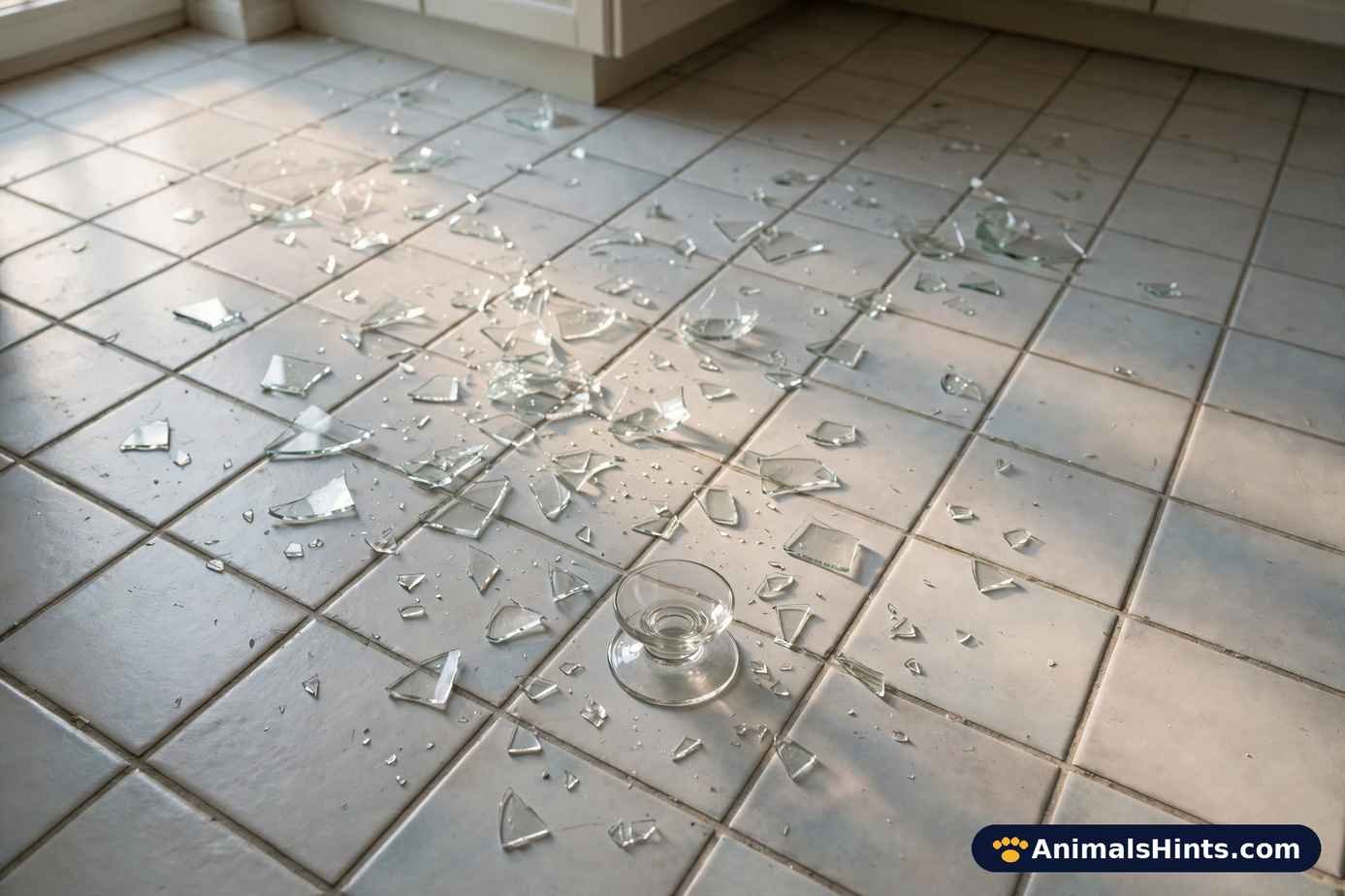
What Does a Broken Glass Symbolize?
The competitor’s symbolism starts from the material itself, and it is the strongest ground his page stands on. Glass holds two natures in one object. Whole, it is the most honest substance in the house: it lets light through, it shows exactly what it holds, it asks to be looked through rather than at. Broken, the same object turns hostile in a second — edges everywhere, its shape gone, its usefulness ended beyond any repair. Few household things change their character so completely in a single moment.
The genre builds its reading directly on that doubleness. A life, a plan, a way of seeing — each is pictured as something transparent and ordered that can hold only until it can’t. On this account, a shattered glass stands for the instant a structure gives way: an arrangement that looked permanent reveals itself as fragile, and the clarity the object used to offer is replaced by a demand to watch where you step. His page draws the standard conclusions from the image — the close of a cycle, tension leaving a situation, a prompt toward change — and frames the whole event less as damage than as disclosure: the break shows you the fragility that was always there.
Held as symbolism, that reading needs no apology, and this page keeps it where it belongs — in the territory of metaphor. A metaphor can organise a feeling; it cannot report a fact about the future. Two sections from now the tradition’s nine developed readings of this single image arrive, complete and in their owner’s order. Ahead of them stands a section no omen page bothers with, which this guide prints first on principle: a real breakage has sharp edges and bare feet to think about before it has meanings.

First, the Floor: Cleaning Up Broken Glass Safely
Before any reading, the practical record — because the one verifiable harm in a broken glass is not symbolic. Shards travel further than they look as if they should, the smallest pieces hide in grout lines and rug pile, and the person most likely to find one is whoever crosses the kitchen next in socks. Household safety guidance is consistent on the order of operations, and it is worth following in that order.
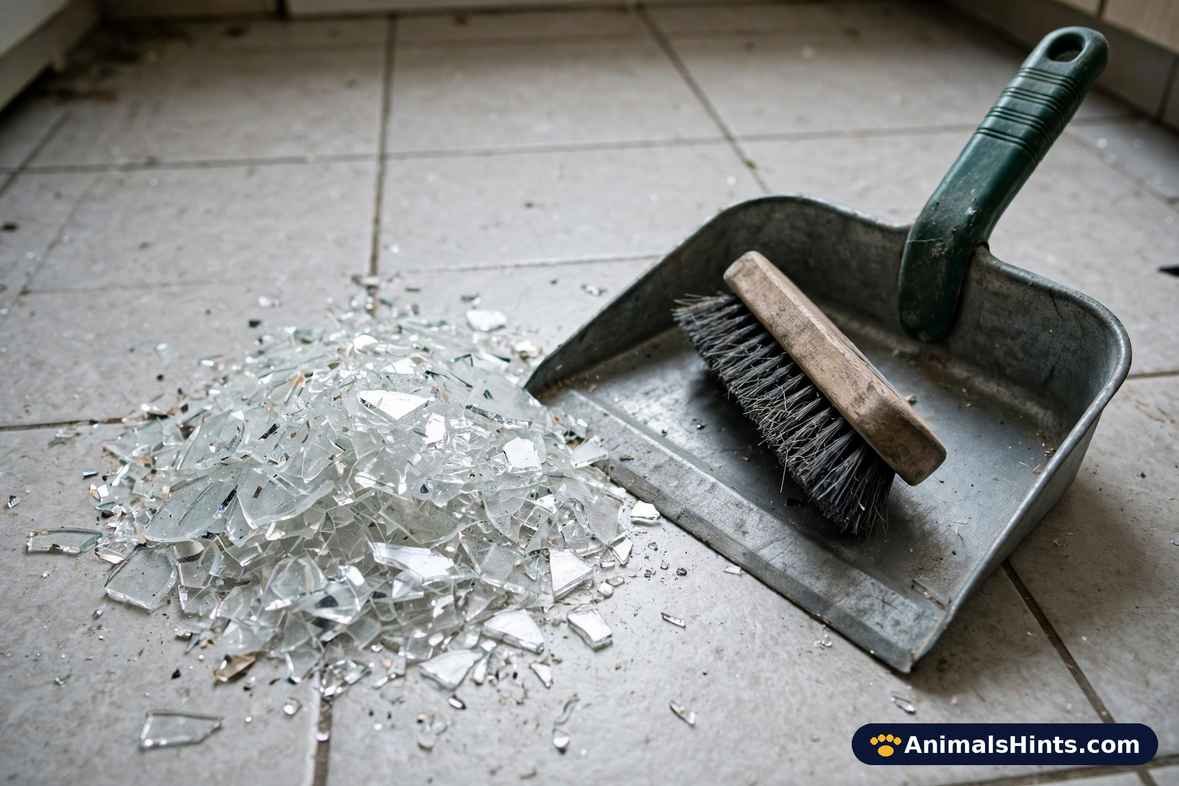
Clear the room first. Children and pets out, and nobody crosses the area in bare feet or socks — put shoes on before you start, and keep them on until the last check is done. Gloves next: thick ones, or none at all and tools instead. The large pieces come up first, lifted with stiff card, tongs or folded cardboard rather than fingers, and go straight into something rigid — a sturdy box, a thick-walled jug, a tin — never loose into a thin bin bag that the edges will slice on its way out of the house. Sweep the middle ground slowly with a stiff brush and dustpan; a fast sweep flicks fragments sideways and widens the field you have to search.
Then hunt the fines. Lay a torch or phone light almost flat on the floor and sweep its beam slowly: pieces too small to see head-on flare in a low raking light. Press a folded, dampened paper towel over the swept area to lift the dust of glass that sweeping leaves, or press a slice of soft bread gently onto the spot — both are standard household practice for the last invisible layer — and drop towel or bread straight into the rigid container with the rest. Wrap the collected glass in several layers of newspaper before the container is sealed, tape it shut, and mark it as broken glass, so the next person to handle it — in your house or outside it — is warned by the label and not by a cut. Any food or open drink standing anywhere near the breakage goes in the bin with it; fragments travel, and no snack is worth the alternative. The commonest household break of all, incidentally, arrives by the route this site’s neighbouring file covers — a picture falling off the wall — and its frame glass deserves exactly this same routine, in exactly this order.
If the glass finds skin before the cleanup does, the NHS pattern is short. Rinse the cut under clean running water. If it bleeds freely and nothing is lodged in it, press a clean cloth or bandage firmly on it — ten minutes of steady pressure is the usual instruction — and raise the injured part: a hand or arm above the head, a leg raised above the level of the heart. If something is embedded, do not pull it out; press on either side of it instead, and let a clinician deal with it. Get urgent medical advice for a cut that will not stop bleeding, that spurts, that leaves numbness or lost movement near it, that is larger than about five centimetres, or that is still dirty after cleaning. Most kitchen-glass cuts are small and stop quickly; the ones on that list are the ones not to sit on.
9 Spiritual Meanings of Accidentally Breaking Glass
Nine meanings make up the genre’s standard set for this event, and the competitor’s list is reproduced entire — same order, same force, nothing thinned down. They are the tradition’s property, offered here as its readings; a finding is a different species of statement, and none of the nine is one. In a single place the record has a correction to enter — a wedding claim inside meaning 7 that belongs to one named faith — and the correction is entered on the spot.
1. Unexpected Changes
His first meaning is the list’s foundation: a break out of nowhere stands for change arriving unannounced. The glass held a shape until it didn’t, and the reading maps that suddenness onto a life — a post, a relationship, a settled arrangement — whose rearrangement has begun before its owner has agreed to it. The feeling the meaning works on is the loss of control in the first second after the crash. Its prescribed turn is toward acceptance: what the universe moves, on his account, it moves because movement had become necessary, and the break is the notification rather than the damage.
2. Healing and Release
His second meaning reads the glass as a vessel that was holding something in. Feelings banked up behind a surface — grief, resentment, words unsaid — are pictured as pressure inside a fragile container, and the shattering as the moment the container stops pretending it can hold them. On this account the incident licenses an unburdening: tears that arrive oddly soon afterwards, a forgiveness finally spoken, a weight named out loud. The meaning’s closing claim is that repair in a person often begins the way it begins in the object — with something giving way first, so that what was sealed in can get out.
3. Transition and New Beginnings
His third meaning is the forward-looking twin of the first. Where meaning 1 stresses the shock, this one stresses the doorway: a phase closing so that its successor can start. The sound of the break is cast as an alarm set by the universe — a noise meant to be heard, marking the boundary between a chapter that has run its course and one that has not yet been furnished. Habits, beliefs and attachments that fitted the old room are, on his telling, candidates for leaving behind in it. The meaning asks the reader to treat an ending performed by accident as an opening performed on purpose.
4. Spiritual Reset and Realignment
His fourth meaning turns the event inward and downward, to calibration. A person who has drifted — off purpose, out of clarity, carrying other people’s weather — is pictured as an instrument out of tune, and the break as the sharp tap that starts the retuning. The destruction in the image is aimed at pattern rather than at the person: arrangements of thought and routine that no longer fit are what shatters, and the energy they were wasting returns to circulation. His page places this meaning just before breakthroughs, as a sequence — first the reset, then the movement it was clearing the way for.
5. Releasing Attachments
His fifth meaning handles the grip. Glass, clear and reflective, is made to stand for the illusions and dependencies a person holds up in front of themselves — the person kept past their season, the object kept past its use, the version of events kept past its truth. The shattering is read as the grip being opened from outside: an act of liberation performed by clumsiness. The inconvenience is admitted inside the meaning itself; nobody enjoys the sweep-up. But on his account the space a released attachment leaves is the point — room, made suddenly, for peace and for whatever is next.
6. Warning or Divine Message
Of the nine, his sixth carries the heaviest charge, and this page’s later sections answer it at the length it deserves. In his telling, a break can be a caution delivered by a higher power: slow down, look again at the decision in front of you, attend to the truth being stepped around. The sound is the mechanism — a noise engineered to interrupt — and the interruption is sometimes framed as protection, a hand on the elbow before a mistake rather than a punishment after one. His prescribed response is pause and prayer or meditation for clarity. The record’s response is filed later on this page, in the omen section, and it is shorter than the claim.
7. Nearing a Positive Milestone
His seventh meaning reverses the omen outright: the break as the last barrier going. A person close to a breakthrough — a goal nearly reached, a long effort near its term — is pictured as separated from it by one final pane, and the shattering as that pane giving way early. Persistence, on this account, is about to be paid. His page supports the cheerful reading with an appeal to weddings — glass, he writes, is sometimes broken at them to mark a joyful transition. It is, and the custom is a real and beautiful one; it belongs to Judaism specifically, it is about remembrance rather than milestones, and a section below is reserved for it, because borrowing it unattributed is how it usually reaches pages like his.
8. Emotional Healing and Moving Forward
His eighth meaning is the second healing entry, and its centre of gravity is different: not release but reconstruction. The scattered pieces are the image — each fragment still catching light, none of them the whole they came from — and the reading built on it is that a healed person is not the unbroken original restored but something reassembled with the breaks admitted into it. The meaning is aimed at readers after heartbreak and loss, and its counsel is collection rather than repair: gather what the experience taught, carry it forward, and let strength mean the carrying rather than the never-having-fallen.
9. Shattering Illusions
With his ninth meaning the list comes back to where the symbolism section started: to seeing. Glass is the material of clarity, and its destruction is read as the destruction of a false clarity — the belief, arrangement or self-portrait that turned out to be a pane with something painted on it. The awakening this meaning describes is uncomfortable by design, because the illusion was load-bearing: it made a situation feel safe. What follows its loss, on his account, is the genuine article — a plainer view, a rise in intuition, decisions made against the real shape of things. The list ends, fittingly, with the tradition’s favourite moral for this event: that the break is not the opposite of clarity but its price.
Glass Breaking Superstitions Across Cultures
The competitor tours four traditions in this section. The tour is kept — same four stops, same sequence, his own subheadings standing over each — and where a strand needs correcting against the record, the correction travels inside that strand instead of waiting in a footnote.
Hinduism
His Hinduism strand gives glass a sacred charge and the break a double reading. Unintentionally broken glass — a mirror, a household vessel — is widely read in the household tradition he summarises as change on its way, and often as a disposal: misfortune or hostile energy that had attached itself to the object leaving with it, spent on the glass instead of on the family. Breakage during worship or at an auspicious moment cuts the other way in his account, toward caution — a reason to pause a decision rather than press it. His strand closes with the priests’ calming rider, which he reports faithfully: such events are not for fearing; they mark energy that has finished its cycle.
Christianity
His Christianity strand is the one this whole page exists to examine, and it is printed here as he writes it before it is examined below. In his telling, glass in Christianity symbolises truth, purity and divine light; its breaking can stand for sin or illusion giving way so that truth shines through, and some read such moments as divine intervention — heaven reaching into the material world and snapping a thing there to stir a believer awake. Brokenness redeemed is a genuine theme of Christian art and literature, he notes, and on that much he is right. What his strand does not have — what no strand can have, because it does not exist — is a doctrine, a text or a rite behind it. Christianity’s actual record on glass runs to eleven word-occurrences, and the two Bible sections further down lay it out entire. His strand is genre writing in Christian vocabulary, and the difference matters to exactly the readers who come asking this page’s question.
Judaism
His Judaism strand is the shortest route to the most solid fact on his page: the famous broken glass of religious practice is real, and it is here. At a Jewish wedding, at the ceremony’s close, the groom crushes a glass underfoot and the room answers “Mazel Tov!” His summary of its sense — remembrance for Jerusalem’s destroyed Temple carried into the happiest hour, joy deliberately tempered, love handled as carefully as glass — is fair as far as it goes. A full section further down is devoted to it, because the custom deserves its complete record and because placing it correctly is the whole point: it is Judaism’s, it is deliberate, and it is about memory. Nothing in it makes an accident into an omen.
Islam
His Islam strand reports a mixed household record and reports it as mixed. In the folk practice he summarises, a breakage can be read as release — the evil eye or a charge of negativity discharged through the object — or, in another mood, as a caution to move carefully in one’s decisions for a while. His strand adds the dream-books’ version, in which broken glass turns the dreamer inward toward self-examination and the repair of clarity. All of it is carried here under the label his own text implies: folk interpretation, held by real communities, filed as theirs — never as doctrine. The same discipline governs every strand on this page, the Christian one included.
The One Glass Broken on Purpose: A Wedding Custom That Is Not Christian
One glass in the religious record is broken deliberately, in public, on schedule — and getting its ownership right is the cleanest way to see what an accidental breakage is not. The custom belongs to Judaism. At the close of a Jewish wedding, after the blessings, the groom sets a glass — usually wrapped in cloth or a napkin, for the practical reason this page’s cleanup section would predict — under his right foot and crushes it. The guests shout their congratulations, and the marriage begins with the sound of breaking glass ringing in it.
The explanations on record are documented ones, and they are about memory and measure, not luck. The most widely given is remembrance: even at the summit of private joy, Jerusalem’s destroyed Temple is recalled, and some couples mark the moment with the psalmist’s vow — “If I forget thee, O Jerusalem” — before the foot comes down. Behind it stands an older rabbinic story-pattern, preserved in the Talmud’s tractate Berakhot, of wedding feasts where the celebration ran too high and a sage restored its seriousness by breaking a vessel in front of the guests: in one account a precious glass cup worth four hundred zuz, in another a white glass. Tempering joy is the custom’s own account of itself. Other layers were added by later folk practice — the sharp noise said to scatter ill-wishers, human and otherwise — and they stand here labelled as such: later layers, attributed to the folklore that carries them, behind the documented core.
The boundary for this page’s question is exact. The wedding glass is Jewish. It is intentional, it is communal, its meaning is announced in advance by the tradition that performs it, and it makes no prediction about anybody’s future. Christian weddings contain no counterpart rite — no glass is broken in any Christian order of service, and the fetched record of Christian practice offers none — which is why the wedding sentence in the competitor’s seventh meaning, repeated unattributed across the genre, misleads precisely the reader who arrives asking what breaking glass means in Christianity. In Christianity, deliberately or otherwise, it has never meant anything at a wedding at all.
Biblical Significance of Broken Glass (Meaning in Christianity)
The competitor’s Bible section opens by conceding the central point, and the concession holds: the Bible does not directly mention glass breaking. His section then reaches for the nearest biblical material, and what it reaches for deserves a careful look, because it shows how this whole literature is assembled. His anchor text is 2 Corinthians 4:7, where believers are described as holding a treasure in vessels of clay — in the King James wording, “But we have this treasure in earthen vessels, that the excellency of the power may be of God, and not of us.” It is a great verse, and it is about pottery. Its point is the contrast between the worth of what is carried and the cheapness of the carrier; glass does not appear in it, broken or otherwise.
From that verse his section builds its reading: brokenness as the doorway to renewal, humility before God, grace arriving after surrender, the breaking-away of pride and worldly attachment pictured as a kind of spiritual cleansing. As devotional writing in the Christian vocabulary, it is recognisable and even moving — the theme of God making something out of shattered lives is a real theme of Christian preaching, and his page handles it gently. But the section’s own heading promises biblical significance, and significance has to come from the text. The text’s actual glass record is small, complete and countable, and the next section counts it. What his section demonstrates — without intending to — is that when the record is silent, the genre fills the silence with the nearest available metaphor and keeps the heading.
What the Bible Actually Says About Glass: Eleven Occurrences, None of Them Broken
The complete record fits in a few paragraphs, and it is given entire. Counting the whole King James text afresh for this page — the run’s standard instrument, its control words landing exactly where the run’s record puts them — the word “glass” stands alone precisely nine times; the plural “glasses” adds one more, and the compound “looking glasses” one more again: eleven in all. The word “mirror” occurs zero times; the KJV’s mirrors are called glasses, which is the first thing the census teaches: in the world of this text, a glass is something you look into, polished metal that gives back a face, not something you drink from or a pane you look through. The word “shatter” occurs zero times. And no occurrence of “glass”, in any form, is broken, breaking, or anywhere near an accident. What the eleven are actually doing divides cleanly into two groups.
The mirror group is the larger. Paul’s famous sentence is the one the tradition quotes most, and quoted word-exact it is about partial knowledge, not about omens: “For now we see through a glass, darkly; but then face to face: now I know in part; but then shall I know even as also I am known.” (1 Corinthians 13:12). James uses the same object for the same kind of point — a man “beholding his natural face in a glass” (James 1:23) — and Paul returns to it in 2 Corinthians 3:18, believers beholding “as in a glass the glory of the Lord”. Job’s Elihu reaches for it as an image of the solid sky: “Hast thou with him spread out the sky, which is strong, and as a molten looking glass?” (Job 37:18). The plural’s single appearance is a list of finery in Isaiah 3:23 — “The glasses, and the fine linen, and the hoods, and the vails” — and Exodus 38:8 records the tabernacle’s brass laver made from the “looking glasses” of the women, mirrors given up as material. Six of the eleven, then, are mirrors: instruments for seeing yourself, in a text that uses them, every time, as pictures of how imperfectly people see.
The remaining five are the material as a simile for something beyond price. John’s throne-room vision sets “a sea of glass like unto crystal” before the throne (Revelation 4:6), returns to it “mingled with fire” in Revelation 15:2, with the victorious standing on it, and closes the canon with a city whose gold is “like unto clear glass” (Revelation 21:18), its street “pure gold, as it were transparent glass” (Revelation 21:21). Glass enters the Bible’s last book as the comparison of choice for a purity so complete it can be seen through. That is the entire file: mirrors for self-knowledge, and a sea and a city of impossible clarity. No drinking vessel is ever called glass. No window breaks. No accident is read. The competitor’s concession, counted out in full, is stronger than he makes it: it is not that the Bible is quiet about broken glass — it is that broken glass is a subject the Bible never takes up, in a canon that mentions glass eleven times and breakage, in other materials, hundreds of times over. “Broken” itself occurs 186 times — broken hearts, broken covenants, broken staffs, broken vessels of clay — and not one of them is this page’s event.
So the Christianity answer, stated at the record’s full strength, is this. If a reader wants to know what their faith teaches about the glass that just broke in their kitchen, the honest reply is that it teaches nothing about it, because the event belongs to a material world the text barely touches and reads no signs in. What a Christian reader does with the moment — pause, give thanks nobody was cut, treat it as a nudge to examine a hurried life — is devotion, and devotion is theirs to practise. What it is not is doctrine, and any page that dresses it as biblical significance is selling the costume without the text.

Interpretations of Shattered Glass in Dreams
The competitor’s dream section moves the event into sleep, and its readings follow the waking list’s logic into the night. A window shattering, a cup falling, a mirror cracking — each is read as an inner change surfacing: suppressed feeling ready for release, a barrier between the waking self and something underneath it beginning to give. His section grades the scenarios by their endings. A break that harms nobody in the dream is the favourable form — liberation, emotional healing under way. A break that cuts is the harder one — inner conflict, or a fear of being exposed at the moment of exposure. His page also keeps the psychological reading standing beside the spiritual one, and credits it plainly: such dreams can grow out of stress and pressure in waking life, the mind rehearsing fragility while the body rests. His closing line for the section is the genre’s favourite consolation — that clarity tends to arrive on the far side of chaos, and a shattering in a dream may be the spirit making room. All of it is printed here as his page prints it: as interpretation offered by a tradition, with the waking-life explanation his own text admits standing next to it.
The Feng Shui and Astrological Perspective on Glass Breaking Accidentally
His final tour stop is the energy shelf. In the Feng Shui framing he summarises, glass belongs with water — clarity, communication, reflection — and an unexpected break is read as a release-valve event: stagnant or negative chi that had pooled in the home disperses through the breakage, and flow resumes. The practitioners he cites follow the event with a remedy rather than a worry — a cleansing of the room, incense or salted water in his account, and a new object set where the broken one stood, so that what enters the room next is fresh and balanced. The astrological framing runs parallel: breakages are noted against the sky’s unsettled periods, Mercury retrograde named in his text as the season of small accidents and crossed wires, and the counsel is the same in both systems — slow down, reground, realign before pushing on. His section’s verdict is that the two traditions agree with his list: an exchange, not an attack; a balance being reset, however sharp the sound it makes. It is carried here, like everything else on his page, as the belief of the systems that hold it.
Is Breaking Glass a Bad Omen?
The competitor’s verdict section is the most careful writing on his page, and its care deserves keeping. He declines the fixed answer. Across cultures, he notes, the same event is filed under warning in one house and blessing in the next; in the spiritual circles he writes for, the break is more often received as a message than as a curse — negative energy leaving a room, a shift under way, an invitation to curiosity about what in a life is ending and what is beginning. And his section ends on the sentence this page most agrees with, because it is where his argument comes closest to the physical record: glass, he writes, does not break without reason. It answers stress, vibration and imbalance, the way people do. Read his verdict whole and it nearly argues itself out of the omen business — a caused event, variously interpreted, whose meanings say more about the interpreters than about the glass. The one famous piece of bad luck still missing from his page is the one readers most often bring to it, and it belongs to a different object entirely.
Seven Years of Bad Luck Belongs to Mirrors: The Omen Record, Answered
Ask a room what a broken glass costs and someone will say seven years. The sentence is famous, it is confident, and it is about a mirror. The seven-year term comes out of the Roman world, on the record the folklore summaries give: Roman belief ran the body and soul on a seven-year cycle of renewal, the reflection in a mirror was held to be bound up with the soul itself — the gods were said to watch souls through mirrors — and so a shattered reflection was a damaged self, needing the full cycle to mend. Greek mirror-divination, catoptromancy, stands behind the Roman layer: reflective surfaces were instruments for seeing more than faces long before they were bathroom furniture. That is the superstition’s actual pedigree — respectable as folklore history, printed here at the strength of the summaries that carry it — and not one step of it touches a drinking glass. A tumbler holds no one’s soul-image in any version of the belief. Even on the belief’s own terms, the seven years were never this page’s sentence; the genre simply lets the mirror’s reputation rub off on everything transparent.
The rest of the omen shelf clears the same way. The claim that a breakage releases trapped spirits or discharges the evil eye is folklore — living folklore, held in real households, and printed in his Islam strand above as exactly that — but no text, test or record stands behind it as an account of what physically happens when crockery falls. And the engine that keeps all such readings feeling true is the one this site’s neighbouring files keep meeting: coincidence, counted selectively. A household breaks glass a few times a decade and lives through thousands of unconnected events in between; the breaks that happen near a memorable week get remembered as signs, and the identical breaks near nothing get swept up and forgotten. The file on someone dying on your birthday runs the identical trick in reverse — a striking coincidence that dissolves the moment it is counted — and a dropped tumbler belongs on that shelf, beside losing your wallet and the rest of the household mishaps that feel like messages because they interrupt a day. The genre files the dark version of the same feeling beside the black spiritual meaning shelf — darkness, the unseen, the thing moving under the surface — and the feeling is real even where the filing is not evidence.
So the honest verdict, at the full strength of everything fetched for this page: a broken glass is an accident with causes — a wet hand, a chipped rim, a shelf edge, thermal shock from a hot rinse on cold glass — and its only certain consequences are the ones the cleanup section deals in. No scripture reads it. No rite fears it. The one tradition that breaks glass on purpose does so to remember the dead and temper joy, which is nearly the opposite of dreading it. A reader who wants the moment to mean something is free to make it mean the thing the genre’s best readings all reduce to — pay attention — and that meaning costs no one seven years of anything.
Final Thoughts
The competitor closes his page on beauty in brokenness, and this page is content to close near him, with the record’s footnotes attached. Across the traditions his tour visits, shattered glass keeps collecting the same family of senses — transformation, release, the turn of a cycle — and there is no harm in the family, so long as its members are introduced honestly: these are meanings people have made, some of them centuries deep, none of them messages the event itself sent. The glass that broke in your kitchen broke because glasses do. What a person does in the pause afterwards — the breath, the stock-taking, the small resolve — is the only part of the event that was ever theirs to assign.
This site would add one thing to his close, and it is the thing the whole page has been walking toward. Of every breakage mentioned anywhere in this article, exactly one is performed by a faith on purpose, in public, with its meaning announced beforehand — and it is not a Christian one, and it predicts nothing. It remembers. A tradition that wanted the sound of shattering glass at the happiest moment of a life chose it as a memorial: joy, held carefully, in full knowledge of what the world can break. Set beside that deliberate act, the accidental one shrinks to its true size — a chore, a sharp quarter-hour, a replacement to buy — and the reader is free to let it be small.
So let the record have the last word it has earned. The Bible’s eleven glasses are mirrors and a shining sea, and none of them breaks; the seven years belong to Roman mirrors; the wedding glass under the chuppah belongs to Judaism and means remembrance, not luck. What is left for the tumbler on your floor is the dustpan, the torch laid flat to catch the last bright pieces, and — if you want it — the pause. The pause was always the real article. The glass was only ever the noise that announced it.

FAQs
What does breaking glass accidentally mean spiritually?
Short version, as the tradition gives it: change arriving uninvited — old patterns, attachments or illusions giving way, and something newer asking for the room. Christianity adds no doctrine of its own to that answer; the Bible never mentions the event. The readings are the genre’s, and they are collected in full above.
Is breaking glass a sign of good or bad luck?
Neither, on the record. The famous seven years of bad luck belong to mirrors, in a Roman belief about the soul’s reflection; no equivalent term attaches to a drinking glass in any tradition fetched for this page. Cultures file the event under blessing and warning alike, which is what usually happens to events that carry no luck of their own.
What does breaking glass symbolize about change?
It is the genre’s central symbol for change precisely because the material performs it so completely: transparent, ordered and whole one second; scattered the next, with no road back. The tradition reads that suddenness as the shape of life’s own transitions — endings that arrive before their replacements are visible.
How should I respond to breaking glass accidentally?
Practically first: shoes on, children and pets out of the room, the pieces up with card and brush rather than fingers, the last fines found with a low torch beam and a damp paper towel, and the whole lot wrapped, sealed in something rigid and labelled. Then, if the moment has left a question behind, take the sound half of the tradition’s counsel: pause, look at what in your life is actually changing, and let the accident lend you the pause rather than a prediction.