White Ladybug Spiritual Meaning: Purity, Renewal and the Pale Beetles Behind the Symbol
Ask a symbolism site about the white ladybug meaning and you will get the softest answer on the ladybird shelf: purity, clarity, a fresh start, luck with its voice lowered. The colour does most of that work — white reads as unmarked, washed clean, full of light — and the beetle does the rest, being small, round, harmless and already famous for fortune. This page sets out the full reading, all twelve meanings of it. It also does something the symbolism pages rarely bother with: it asks which insect, exactly, a white ladybug is.
The answer turns out to be plural. White is a real ladybird colour, worn by a short list of genuine species — a big tree-hunting beetle with fifteen black spots, a gray generalist, a miniature that eats fungus — and it is also two kinds of costume. Every ladybird that ever lived spent its first adult hours pale and spotless, and one of the most photographed “white ladybugs” of all is a woolly larva that will mature into a dark beetle. A symbolism built on the colour and a natural history built on those five cases are different subjects, and a reader deserves both, separately labelled.
What follows keeps them separate. First the colour’s symbolism, then the animals, then the twelve meanings with their layers dated — the centuries-old luck custom at the bottom, the internet genre’s readings on top — so you can see precisely which parts of the white ladybug are old, which are new, and which are beetles.
What Does Seeing a White Ladybug Symbolize?
The genre begins with the colour, and white is its most loaded shade. In the shared vocabulary of today’s symbolism writing, white stands for purity and innocence, for clarity after confusion, for light, protection and a line drawn under the past. Pale creatures inherit all of it: doves, white butterflies — the white butterfly is read in exactly these terms elsewhere on this site — and, here, a ladybird. That vocabulary is recent, a product of the symbolism sites themselves, and on this page it is never allowed to pose as anything older.
Underneath the colour sits the beetle, and the beetle’s contribution is far older than the vocabulary. For centuries, European country people treated ladybirds as protected creatures: welcome in the house and on the crop, unlucky to harm, fortunate when they chose to land on you. Lay white over that reputation and the genre gets its compound symbol — the family’s standing luck, aimed by the colour at peace, healing and renewal instead of at passion or sudden riches. Rarity sharpens it. Pale ladybirds are uncommon enough that a sighting feels singled out, and writers lean on that feeling hard.
The competitor page distils its reading into four strands, which between them generate most of the twelve meanings further down:
- Beginnings — a calm change of season in a life, growth arriving quietly rather than all at once.
- Healing — repair, emotional or spiritual, said to be already under way beneath the surface.
- Guardianship — the beetle cast as a small messenger, taken by believers as evidence of being watched over.
- Cleansing — a clearing-out: stale attachments, habits and fears shown the door.
Strands noted, a limit has to be stated before the list begins. Symbolism can tell you what a colour means to the people who write about colours. It cannot identify a beetle, and with this colour the identification is half the story — so the animals come next.
What Is a White Ladybug, Really?
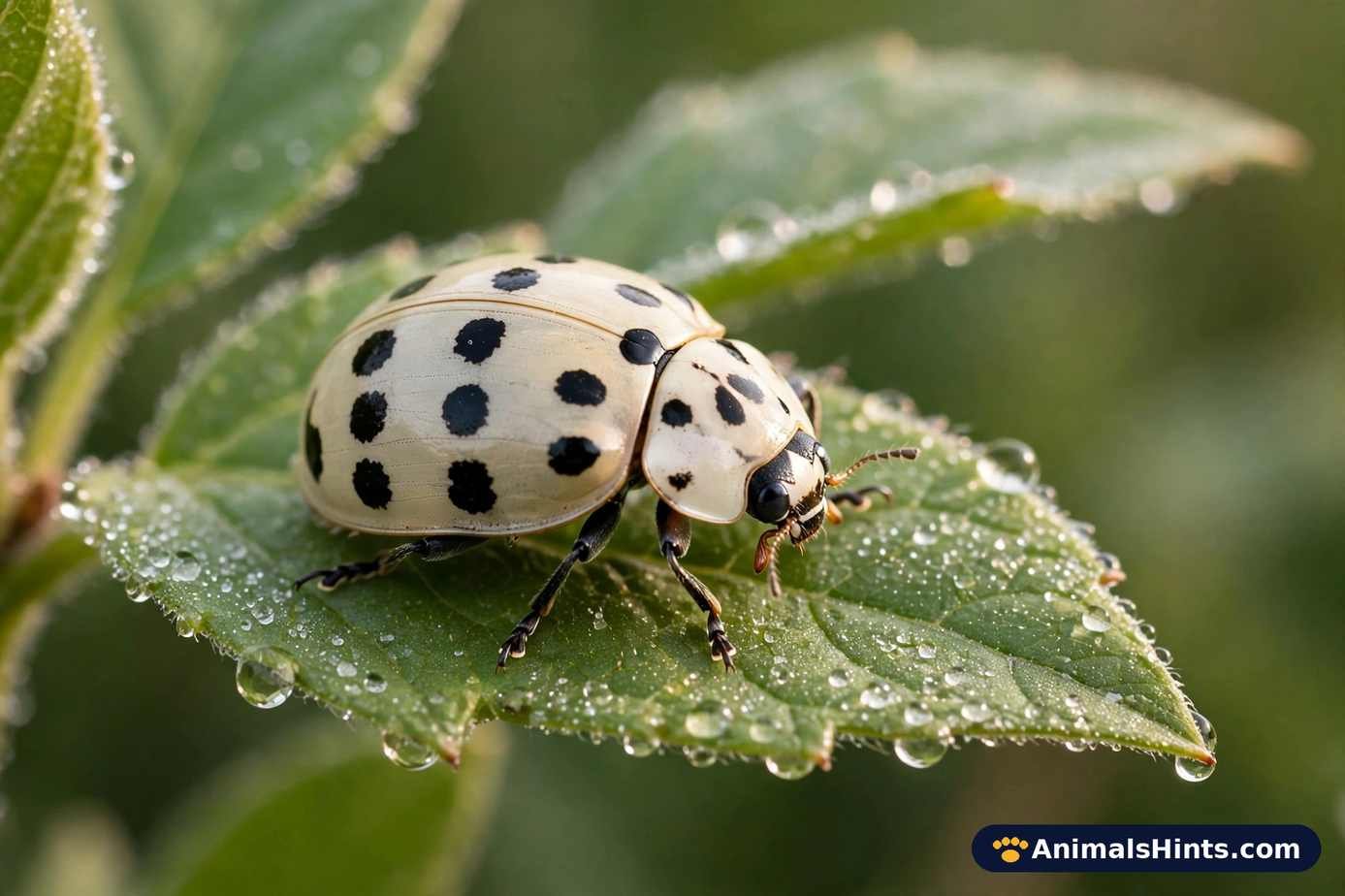
White sits oddly in the ladybird family, Coccinellidae. The family’s famous colours are red, orange and yellow; yet a handful of true species go through life in pale gray, cream or something close to white, spots and all, and around them cluster two impostors that between them explain a large share of reported sightings — the newborn adult in its brief uncoloured window, and a white-coated larva that is not an adult at all. Five cases, taken together, cover nearly every white ladybug a reader will ever be shown.
The fifteen-spotted lady beetle (Anatis labiculata) is the genuine large article, North America’s heavyweight in white. BugGuide, following Gordon’s standard monograph of the family, puts the adult at 7.2 to 9.5 mm — among the biggest lady beetles on the continent — and describes a light gray form carrying fifteen black spots, none of them ringed in pale; the pronotum, the shield-shaped segment behind the head, is white with a black central mark. It hunts aphids in trees across eastern and central North America, so people usually meet it on trunks, fences and walls rather than in flowerbeds. One popular claim about it needs correcting in both directions at once. The species also exists in dark dress — deep purple in Gordon’s account; dark red and black forms are counted by the Royal Alberta Museum — and the internet’s favourite explanation, that white individuals are youngsters whose shells darken as they grow older, is one the standard reference disputes: Gordon treats pale and dark as separate colour forms of the species, with few intermediates, not as stages of a single life. A white fifteen-spotted is wearing one of its species’ settled outfits. It is not a baby, and it is not on its way to black.
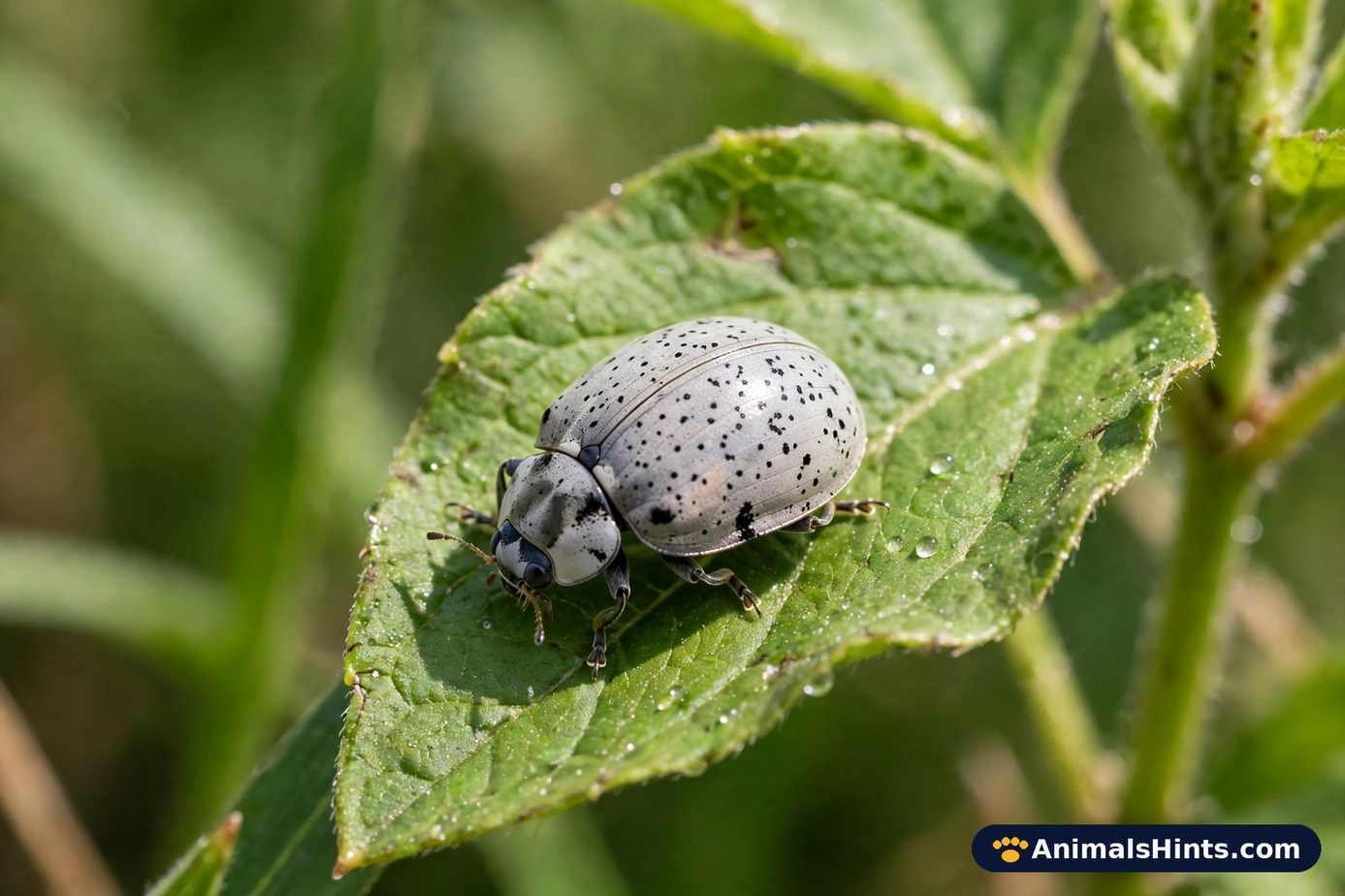
The ashy gray lady beetle (Olla v-nigrum) is the mid-sized regular in gray-white. BugGuide gives 3.7 to 6.1 mm, a ground colour of gray or pale tan, and small black spots with a diagnostic habit — they tend to be triangular, tilting away from the seam down the middle of the back — while white marks on the head help separate it from similar black beetles. Remarkably, the same species owns a second outfit at the opposite pole: black, with two red spots. Pale beetle and black beetle on the same shrub may be one kind of animal in its two coats. Aphids are its living, and its range stretches from most of the United States to Argentina.
The twenty-spotted lady beetle (Psyllobora vigintimaculata) is the miniature, and its address gives it away. University of California guidance puts the adult at an eighth to a sixth of an inch — 3 to 4 mm — with wing cases and thorax in cream, pale grayish or yellowish, marked with eight or nine black-to-brown spots on each wing case and four or five on the thorax. Unlike nearly all its relatives it eats no insects whatsoever. Its food is powdery mildew, the white dusty fungus that coats squash, lilac and rose foliage, and it must graze that mildew to survive and reproduce; consequently it is found wherever the white dusting grows. A tiny white beetle standing in a white patch on a leaf is not hiding. It is feeding. Even its young keep the family look — larvae pale gray to whitish, patterned in dark gray.
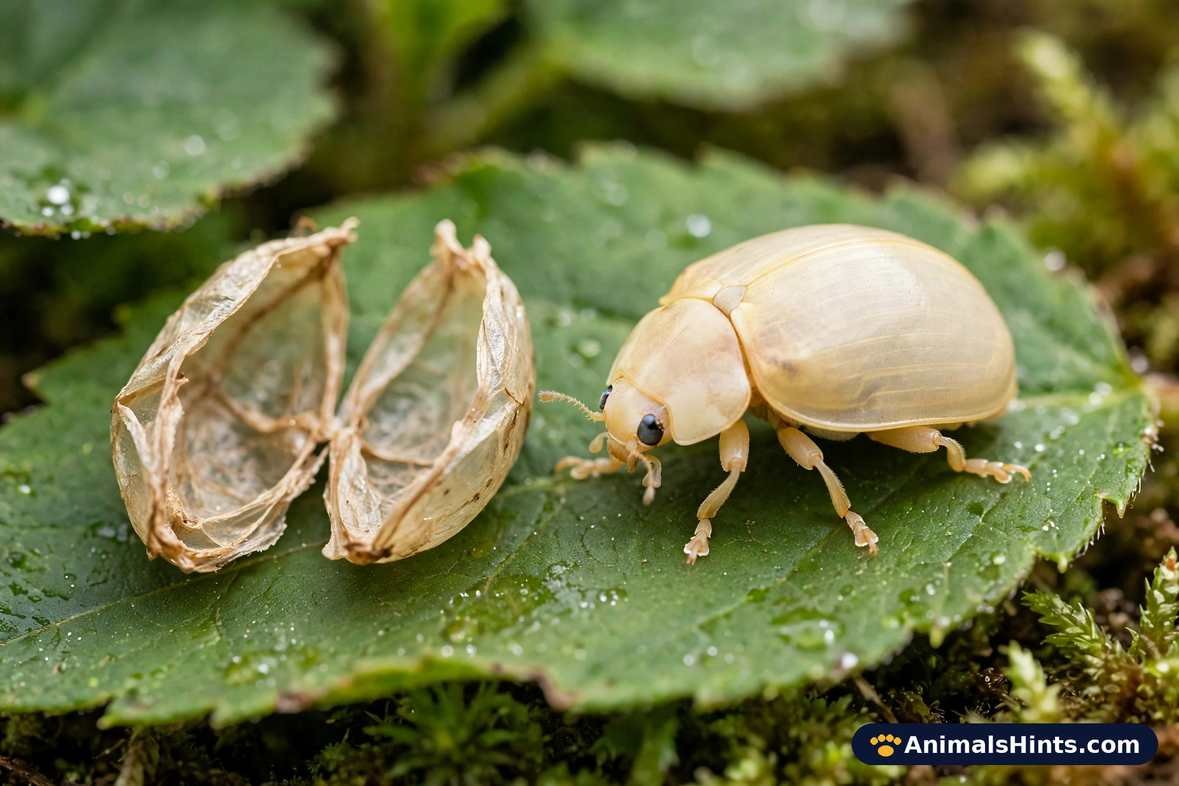
Case four is any ladybird at all, caught young. Emergence from the pupa leaves every species soft, pale cream and entirely without spots; the shell then hardens over the following hours and the adult pattern strikes through as it does. Photograph that window and you have a white ladybug — one that will have stopped existing, as a white ladybug, by tomorrow morning, without travelling a centimetre.
Case five wears white as a coat rather than a colour, and is not an adult in the first place. The mealybug destroyer (Cryptolaemus montrouzieri) is an Australian ladybird now at work in warm gardens worldwide; its adult is an unremarkable dark dome, but its larva is the famous photograph — an oval grub up to half an inch long, shaggy with white waxy filaments. The University of California’s pest programme notes how closely it mimics a mealybug, the sap-sucking pest it preys on, and supplies the checks that separate disguise from wearer: the larva outgrows an adult mealybug to more than twice its size, it moves at a noticeably brisker pace, and if the wax is brushed gently aside, the jointed, alligator-like body of a ladybird larva appears underneath. The fluffy white “ladybug” on a houseplant stem, in other words, is a child in costume — and a costume it will trade for dark brown-black when it grows up. A final caution belongs to the photographs themselves: some of the purest-white ladybirds circulating online are red ones that have been through an image editor, and identification writers say so outright. A shell of impossible, even snow, wearing a familiar red species’ exact spotting, deserves suspicion before it deserves wonder.
| Beetle | Colour to look for | Where you are most likely to meet it |
|---|---|---|
| Fifteen-spotted lady beetle (a true ladybird) | Light gray to cream, 15 black spots without rings, white shield with a black centre mark; large, 7.2–9.5 mm | Eastern and central North America, on trees and trunks, hunting aphids |
| Ashy gray lady beetle (a true ladybird) | Gray or pale tan with small black spots, white markings on the head; 3.7–6.1 mm | Most of the US to Argentina, on aphid-bearing shrubs and trees |
| Twenty-spotted lady beetle (a true ladybird) | Cream to pale grayish, 8–9 dark spots per wing case; tiny, 3–4 mm | On leaves coated with powdery mildew, which is its only food |
| A ladybird in its first hours (any red or orange species) | Pale cream, soft and spotless | Beside its empty pupa case on a leaf, colour arriving within hours |
| Mealybug destroyer larva (a ladybird’s child, not an adult) | White and woolly, oval, up to 1/2 inch, no shell at all | On houseplants and citrus, hunting mealybugs; the adult it becomes is dark |
Two lessons fall out of the table. First, whiteness alone identifies nothing: size, spot count, whether spots carry rings, the plant beneath the beetle and whatever is growing on that plant do the identifying, and they are exactly the details a recording scheme asks a finder to note. Second, the colour classes on this shelf are species wearing their own liveries, not shades on a chart. The red ladybug earns its entry honestly: red is the uniform this family is famous in. The brown ladybug has one because real tree-dwelling species wear tan and maroon; the green ladybug has one because that colour proved to be mostly borrowed plumage on other beetles entirely. White is the reverse case — a colour genuinely worn, by three species living three different lives, and then borrowed twice more by youngsters and larvae. The twelve meanings follow, offered as exactly what they are — readings composed about a colour — with that colour’s wearers now identified.
12 Spiritual Meanings of a White Ladybug in the House
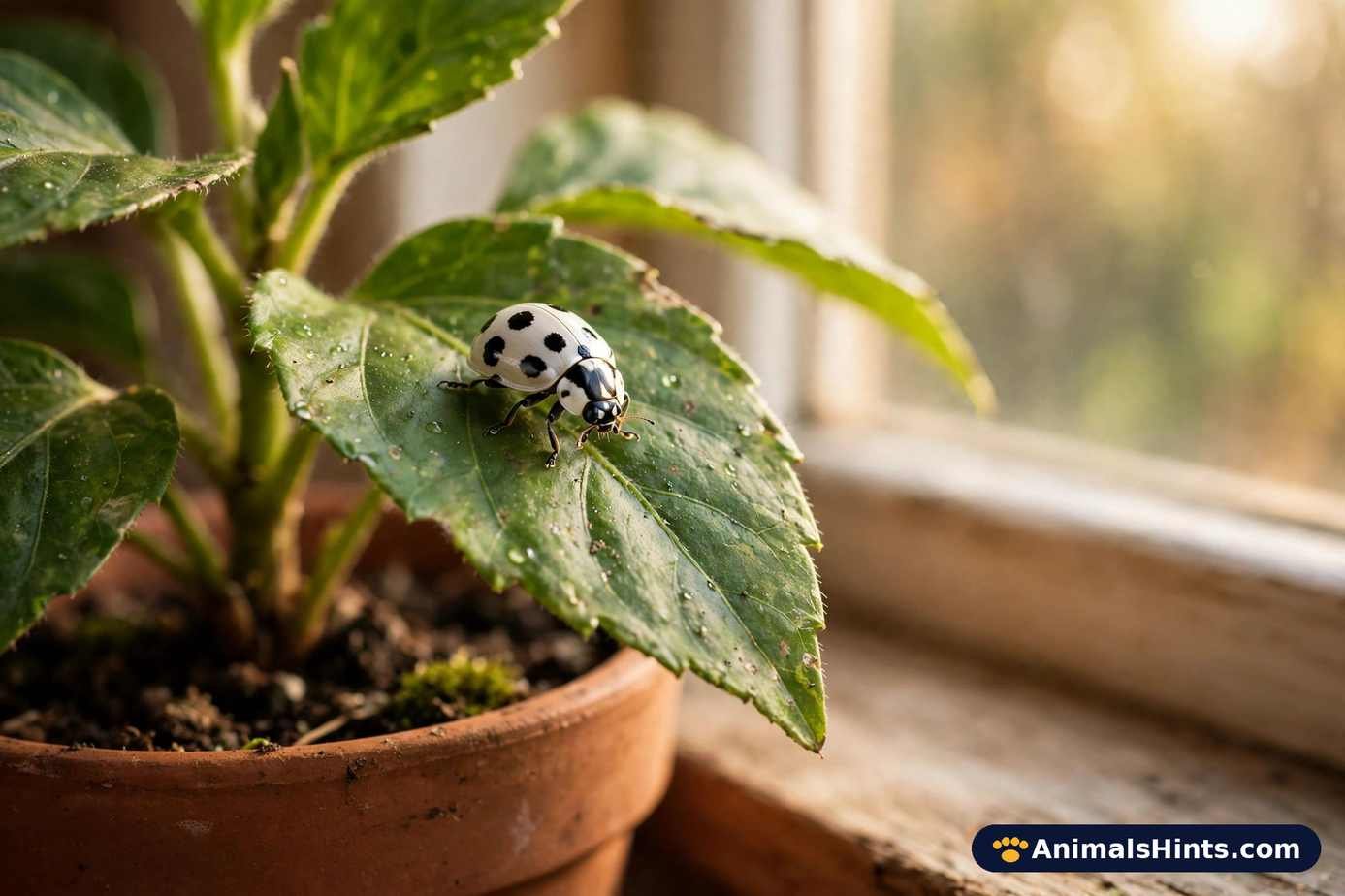
The list itself comes next — the twelve readings the symbolism sites give this colour, in their customary sequence, with two health warnings pinned to the top of it. Warning one: the list is young. Internet-era writers assembled it, and it recycles its favourite ideas under fresh headings, so expect purity to reappear later wearing the clothes of cleansing, and luck to resurface as protection. Warning two concerns the heading’s room. Real ladybirds do come indoors on purpose, packing into window frames when the cold arrives; the pale species are less noted for it, and a white insect discovered inside in midwinter has quite possibly arrived as a passenger on a houseplant — or is no adult at all, but the woolly destroyer larva, which earns its living on houseplants. Unromantic, and likelier. Warnings posted, here is the genre’s account of the visit.
1. Purity and Innocence
The opening reading belongs to the colour outright: white as the unsoiled state, the mind before the world’s static got into it, an invitation to set intentions down clean. The beetle’s contribution is temperament — round, harmless, in no hurry — and the compound is offered as a summons to start over with an uncluttered heart. Take it at its labelled value. The colour association belongs to modern symbolism, the beetle’s protected standing is documented custom, and the purity reading is the recent weld between the two.
2. Personal Transformation
Here the symbolism borrows the beetle’s biography, and the biography is solid: egg, then a spiky hunting larva nothing like its parents, then a motionless pupa, then a winged adult. White adds a refinement the red list cannot offer, because the finished adult itself starts out pale and only later takes on pattern — change caught, as it were, halfway through colouring in. Writers take the white ladybug as the emblem of someone at that same midpoint: old story shed, replacement not yet fully drawn. The life cycle gets a section of its own further down; the lesson extracted from it is the genre’s, and the two stay in separate compartments there as they do here.
3. Divine Guidance
The messenger reading. Contemporary writers like their white creatures airborne between worlds, and this one is cast as reassurance at ground level: you are accompanied, the route is watched, doubt accordingly. Candour requires the label: no tradition predating the symbolism sites appoints this beetle anyone’s postman. What history does supply is the soil the idea grew in — a creature generations of country people refused to harm is halfway to being a creature they might heed. The genre walked the remaining half. The record itself halts at the refusal to harm.
4. Good Luck and Blessings
Beneath this heading sits the deepest root on the list. European custom protected ladybirds for centuries: they were made welcome on crops and clothing, and the one reliable way to damage your own fortune was to damage one of them. Every ladybird inherits that charter, white ones included. On top of it the genre lays a rarity premium — an uncommon sighting read as an emphasised blessing, a breakthrough clearing its throat. The premium is modern arithmetic. The charter underneath it is documented folk practice, and it is the charter, not the premium, that has the centuries in it.
5. New Beginnings
A white surface is the shelf’s standing emblem for the unwritten, and the pale beetle is read accordingly: patterns exited, a brighter chapter begun, endings reinterpreted as the wheel’s low point rather than its stop. Unusually, the natural history hands this symbolism a legitimate prop, and this page points at the prop without mistaking it for evidence. Each adult ladybird’s life does commence in this colour, and the twenty-spotted spends its days removing a white blight from leaves so the leaves can get on with growing. Writers calling the white ladybug a beginning are, this once, narrating the animal as accurately as the idea.
6. Protection
Luck’s sibling heading, and the seam between old and new is easy to show. The old half is custom once more: a beetle everybody protected, whose settling on a crop or a coat counted as fortune preserved, and whose killing was the single act guaranteed to squander it. The new half is the colour’s reinterpretation — purity promoted to shield, light imagined as a barrier that negativity cannot cross, the pale shell as proof of an unseen watch. One root, two vocabularies. This page leaves the join in plain sight rather than sanding it down.
7. Interconnectedness
The most up-to-date entry on the list, phrased wholly in the dialect of energy — threads, ripples, vibrations, the self as a single knot in a woven totality. The older record speaks no such language; its concerns were harvests, luck and a dedication to Mary. Print this one, then, as the modern meditation it plainly is. Its single firm foothold is biological. These beetles genuinely are knots in a web — aphid hunters and mildew grazers whose numbers report on the health of the plants around them. The genre asserts the connection spiritually. The garden exhibits it literally, every day.
8. Harmony and Balance
Today’s writers take the pale end of the spectrum as the resting shade — neither hot nor cold — and assign the beetle the job of prompting an audit: work set against rest, giving against receiving, noise against quiet. As a piece of symbolism it hangs together. As anything beyond symbolism it must not be inflated. No beetle carries a diagnosis or a therapy, and the reading is filed here as a mild prompt attached to a soothing colour, useful exactly insofar as a reader finds the prompt timely.
9. Encouragement to Communicate Honestly
White doubles, in the genre’s scheme, as the truth shade — nothing dyed, nothing concealed — and with a messenger beetle laid over it, the pairing becomes advice: say the unsaid thing, plainly and without cruelty, before silence ferments it. One root under this heading is genuinely aged. The landing custom cast the beetle as an errand-runner long ago — you made a wish on a settled ladybird and let it fly, entrusting the wish to its wings. Modern writers redirect that errand toward honest conversation. The redirection is theirs; the errand itself, in wishing form, is on the record.
10. Spiritual Growth
Transformation’s inward-facing twin: circumstances unchanged, consciousness under renovation — stale beliefs discharged, attention redirected to meditation, journalling, self-examination. The colour scheme supplies a ladder with white at its summit, and the beetle supplies a tempo, its unhurried patrol read as a tutorial in progress that refuses to be forced. The ladder and the lesson are both the modern layer’s, and they are filed under its name. What the record can contribute is merely the tempo itself, which is real: a hunting ladybird crosses a garden slowly because its food is small and scattered. Any sermon built on that pace belongs to the preacher, not the beetle.
11. Abundance and Prosperity
The competitor page credits this meaning to Japanese and Eastern symbolism at large, and this shelf’s rule for such credits is verification or honesty about its absence. No named Eastern tradition fastened to a white ladybird surfaced during these checks — no text, no identifiable custom, nothing beyond symbolism sites citing one another in a circle — so the attribution stands in print labelled as what it is: an unattributed modern attribution. The documented root of prosperity language is domestic and agricultural. Farmers prized ladybirds because the beetles demonstrably rescued crops from aphids, and an insect credited with saving the harvest collects abundance vocabulary the way a harbour collects gulls. The gratitude is history. The fortune-telling erected on it is the genre’s.
12. Cleansing Negative Energies
The final heading is the first one returning in work clothes: purity, announced at the top as a condition, comes back at the bottom as a chore — heaviness dispersed, blockages cleared, rooms and auras swept out, with the genre’s toolkit of white candles, breathwork and visualised light prescribed for the job. None of that toolkit predates the symbolism sites, and it stands here labelled contemporary practice, not inherited rite. Readers who prefer their cleansing beetle-attached and verifiable can have it from the garden instead: the twenty-spotted lady beetle passes its entire life consuming a white pestilence from leaves, one leaf at a time, and leaves them clean behind it. On the subject of this beetle and cleansing, that is the sum of what can actually be shown — and it suffices.
From Egg to Beetle: The Pale Hours Behind the Symbol
Because two of the twelve meanings trade on transformation, the metamorphosis itself deserves its own telling — it is a more peculiar story than the placid adult dome suggests. Act one is a clutch of eggs, yellow-orange, stood upright in a tight raft on a leaf’s underside, usually a short crawl from the aphid colony the hatchlings will need. Act two bears no resemblance to the poster. The larva that emerges is dark, bristled and flecked with orange or yellow, a six-legged appetite that gardeners routinely misidentify as a pest while it does the most valuable hunting on the plant, moulting repeatedly as it grows.
Act three trades motion for architecture. The full-grown larva fastens itself by the tail to leaf or stem and becomes a pupa, a freckled case within which the winged adult gets built. A week, or two in cold weather, and the case splits along the back. Act four is the moment this whole page turns on, because the beetle that drags itself out is wearing nothing: soft, pale cream, spotless, its shell still curing. Colour arrives as the cuticle hardens — pigments deepen, black markings strike through, the glossy dome assembles itself. Spotless white-ladybug photographs are very often portraits of that single morning. Which is why the correct response to a spotless white beetle is scheduling, not reverence: revisit it the next day and it will have filled in its own identification. Those that clear the first day settle in for most of a year, sleeping the winter away in bark, leaf litter or a sheltered corner, and resuming when the garden does.
The destroyer performs the same four acts with the colour schedule inverted, and the inversion is a diagnostic gift. Its white act is the childhood — weeks spent in a woolly disguise inside mealybug colonies, eating the residents. Its adult act is the dark one, a plain brown-black dome that no one pins to a vision board. Other ladybird children dress oppositely, dark and spiny where the destroyer’s is pale and soft, and the twenty-spotted’s young split the difference, pale gray to whitish like their parents. In this family, colour is a timetable as much as a uniform — and any identification that ignores the timetable will misname the animal in front of it.
Biblical Symbolism: Is It a Sign from Angels or Heaven?
The heading puts a question to the Bible, and the Bible’s reply deserves to be given before anything is built on top of it: ladybirds are absent from Scripture, entirely. No colour of the beetle is named, described or enlisted as a sign anywhere in the text. There is consequently nothing to quote — no passage exists that a writer could honestly set under this heading — and any page implying biblical backing for a ladybird omen is upholstering.
The real sacred history sits adjacent to the Bible rather than inside it, in European devotion. The insect’s common name is itself a dedication: the Germans called it Marienkäfer, Mary’s beetle; the English, Our Lady’s bird; the old French named it the good Lord’s creature — a crop-guarding countryside assigning its tiniest ally to the Virgin Mary. The naming is documented, and so is the protective custom that travelled with it. But folk devotion voiced as custom is neither church doctrine nor Scripture, and whatever holiness a white ladybird possesses descends through that naming — through the family’s dedication — rather than through any pale beetle’s individual record.
Angels arrive later still, as the modern genre’s storey on the building. In its vocabulary white belongs to light and heavenly couriers; set that colour on a beetle already carrying a sacred name and a protected charter, and the construction yields a small winged messenger, heaven’s encouragement delivered at walking pace. Comfort taken from that reading is comfort taken from a recent construction, raised on a medieval naming custom, raised on a beetle. Every floor of the building is labelled on this page, so that nobody standing at the top mistakes the view for bedrock.
White Ladybug Meaning in Love, Relationships, and Twin Flames
The love material inherits the assignment made at this page’s opening: white, in the genre’s scheme, signifies purity and calm, so the pale beetle is read for a bond’s quiet condition rather than its intensity. Couples get a gloss of maturing peace — quarrels released, companionship prized above theatre, affection as a low steady heat. Single readers get a different tense of the same message: readiness under preparation rather than a person en route, repair first and alignment afterwards, timing left to powers larger than the reader. Both glosses are contemporary readings inside a contemporary scheme, and they appear here inside that frame and no other.
Twin flames, the heading’s third component, require the label this shelf applies to the concept wherever it appears: the idea is a recent one, spread by present-day spiritual writing, and no older tradition stands behind it in anything these checks could locate. Inside that frame, the white ladybug is cast as the emblem of a purifying interval — two people meant to be separately cleansed and matured ahead of a reunion conducted at a higher register. The single element near this section with genuine age is behavioural, and it belongs to the whole family: a ladybird that settles on you is not to be brushed away. The genre borrows that patience and lends it to its couples. The custom is on the record; the loan is the genre’s.
Black and White Ladybug Spiritual Meaning
The genre reads the pairing as duality — light against shadow, the conscious set beside the unconscious, a self being integrated instead of fought — with the rider that peace means most to those who have met its opposite, and that buried truths surface as stale arrangements dissolve. Filed correctly, that is the shelf’s standard yin-and-yang gloss in modern dress. The black half of the combination carries a long symbolic record of its own, treated at length on this site under black spiritual meaning.
The entomology, as usual, is less mystical and more interesting. Black on white is not a rare omen-pattern in this family; it is standard issue. The twenty-spotted lady beetle can be described, without any poetry at all, as a white beetle bearing black spots. The fifteen-spotted’s pale form is a white shield carrying fifteen black marks, and its dark form is the identical pattern submerged in pigment. The ashy gray owns a pale coat and a black one within a single species. So before a black and white ladybug signifies anything at all, it is in all likelihood one of three ordinary, nameable animals going about a shift. The reading remains available, labelled as the genre’s property. The pattern remains available too, to anyone carrying a hand lens.
What It Means Spiritually to Dream About a White Ladybug
Nowhere does this page’s insistence on sources cost more than in the dream section, because nowhere is there less to source. Dream literature is ancient and enormous — classical authors, medieval compilations, Victorian dictionaries of the night — and across everything these checks could reach, none of it enters a ladybird, in white or any other colour. Everything below is accordingly dream-work of the modern genre, signed as such.
In that reading, the waking list crosses into sleep intact: renewal in progress, guidance sensed rather than heard, burdens in the act of being set down. A flying white ladybug is glossed as release — doubt or guilt lifting — and a landing one as the old luck custom transposed into dream, fortune travelling toward the dreamer for a change. Several together are read as protective company. The gloss coheres, and plenty of readers will find their own nights in it. Antiquity, however, is the one thing it cannot claim: nobody has been interpreting this beetle in dreams for centuries, because until the symbolism sites, nobody was interpreting it in dreams at all.
Is It a Good Sign When a White Ladybug Lands on You?
The landing custom is the one item in this neighbourhood with real centuries on it. Across the family’s European record, the etiquette for a settled ladybird is restraint from start to finish: it is not brushed off, it stays for as long as it chooses, a wish may be laid on it, and its departure happens under its own power — the luck departs with the beetle rather than being seized from it. Modern retellings extend the same courtesy to a white visitor and add the colour’s rider, the moment read as reassurance, as prayer acknowledged, as a subdued yes. The rider is the genre’s contribution. The courtesy beneath it predates the genre by hundreds of years.
A sentence of plain natural history also belongs here. Beetles that land on people in gardens are ordinarily at work, not on errands: a ladybird beats a territory for aphids, a twenty-spotted commutes between mildew patches, and a warm, stationary human is terrain either may cross without ceremony. Readers who want the symbolism have it, filed under its owner’s name. The insect, meanwhile, is making its rounds — and the custom’s counsel, to let those rounds finish undisturbed, turns out to serve both interpretations equally well.
White Ladybug or Something Else? How to Tell
Most white sightings surrender to five checks, none requiring more than a phone camera and half a minute of looking.
Size goes first, since this colour’s species scarcely overlap in scale. Anything white and ladybird-shaped past 7 mm — thumbnail-class, high-domed — is the fifteen-spotted until evidence demotes it. A gray or pale-tan beetle in the 4 to 6 mm band sits in ashy gray range. A specimen at 3 to 4 mm, losable on a fingernail, belongs to the twenty-spotted’s class. Spots go second, and they repay close reading. Fifteen black spots with no pale halo around any of them fit the fifteen-spotted — and halos are the decisive detail, because its near cousin the eye-spotted lady beetle rings every spot in pale, so one ringed spot excludes the fifteen-spotted outright. Eight or nine dark spots per wing case, supplemented by further spots on the shield behind the head, identify the twenty-spotted. Small triangular spots canting away from the back’s centre seam point to the ashy gray.
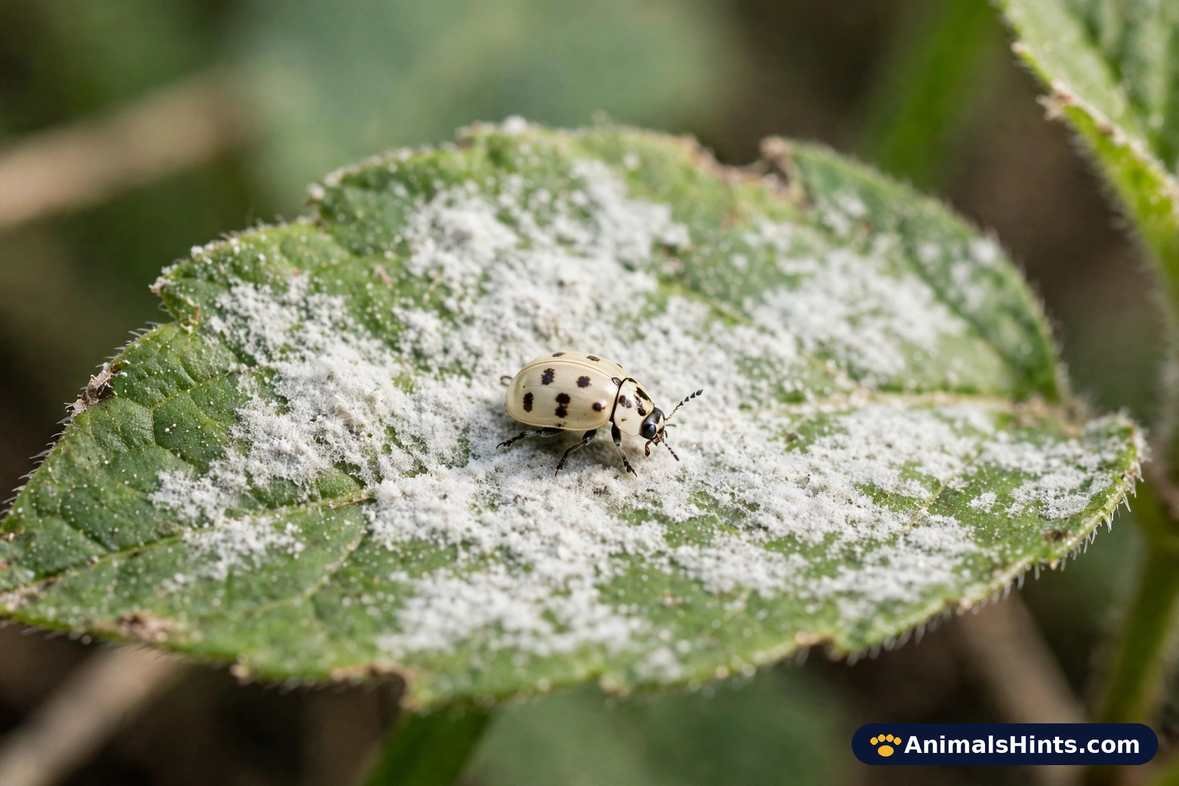
The plant, and whatever coats it, go third — the most truthful witnesses available. A minute white beetle standing inside a floury white patch on a leaf is a twenty-spotted at its dinner: the patch is powdery mildew, and dinner is all it eats. A large white beetle on a tree trunk is a fifteen-spotted between aphid colonies. The fluff test resolves the houseplant mystery. A white oval lacking any shell, all wool and fringe, is a larva by definition, never an adult. Disturb it gently and the disguise separates from the pest it copies: a mealybug — a true pest, and not a beetle in any sense — scarcely reacts, whereas the destroyer’s larva underneath an identical coat walks off at a businesslike pace, and wax brushed aside exposes the jointed, alligator-shaped body that confirms the child’s identity. Waiting settles the residue. A spotless, soft-looking cream beetle parked beside a split husk is a ladybird on its first morning; leave it alone, return tomorrow, and its finished colours will have filed the identification on your behalf.
How to Respond When a White Ladybug Finds You
Look first, and look properly, because the quality of the look determines the value of everything after it. Take the photograph from overhead and from the side, keep the plant in frame, and attach the date and the place; that packet satisfies the identification checks above and any recording scheme you send it to. White finds are precisely the records the schemes are short of — the pale species are local, unevenly mapped and thinly reported — so the photograph functions less as a souvenir than as the single most constructive response going. If the beetle has chosen your skin as its perch, honour the old etiquette: no flicking. Let the visit run out on its own clock, lay a wish on it if the fancy strikes, and when you must move, present a fingertip or a leaf’s edge and allow it to step across voluntarily.
Indoors, transport means a cup slipped over the beetle and a card slid beneath it — never a sealed jar. Ferry it outside and release it onto a sheltered plant — for the miniature species, ideally one carrying mildew on its leaves, which constitutes a restaurant rather than merely a refuge. A sealed jar, airless and foodless, is a slow death for any creature that hunts or feeds daily, and keeping one is recommended nowhere on this site. Should the fluff test reveal your white visitor as a destroyer larva at work on a houseplant, the correct intervention is none whatsoever: the larva is not the infestation, it is the answer to the infestation, consuming the mealybugs responsible. Spraying it away would dismiss the guard for resembling the intruder. For every white sighting the standing recommendation is documentation: a photograph, a date, a place — because these are the shelf’s least-charted insects, and charts drawn from ordinary readers’ sightings are how their maps get corrected.
Final Thoughts
Several subjects have been sharing one name across this page. The symbol is the genre’s mildest ladybird — purity, renewal, guidance and unhurried luck — composed for the colour of first light, yet founded on something with real age under it: a European custom that shielded this family of beetles, welcomed them onto crops and clothing, and treated their landings as fortune. The animals are a small, precise membership: three species that wear white into adulthood — a big tree-hunter whose fifteen spots carry no rings, a gray generalist that also owns a black coat, and a miniature that dines on fungus — flanked by two temporary impersonations, the newborn’s uncoloured morning and the woolly childhood of a beetle destined to be dark.
Keeping the subjects distinct is a gain, not a loss. The symbolism survives being dated; a living genre’s list can be enjoyed in full knowledge of which of its bricks were fired centuries ago and which came out of last decade’s kiln. The beetles survive it too. Next time a pale dome draws your eye along a leaf, you will be equipped to read it in both registers — the tradition’s and the animal’s — and the distinction is worth the keeping, because one of these white insects patrols your trees, one works your shrubs, and the tiniest of them passes its whole existence grazing powdery mildew from your foliage, a cleansing for which no candle was ever required.
FAQs
What does a white ladybug symbolize spiritually?
Modern symbolism assigns the white ladybug purity, renewal, guidance and quiet blessing — the colour of clean beginnings laid across a beetle family long treated as protected and fortunate. Those readings belong to the genre. The fortune beneath them, by contrast, is folk custom with documents behind it.
What does it mean when you see a white ladybug?
The genre takes the sighting for fresh starts and subdued reassurance, amplified in its telling by the sighting’s rarity. In biological plain terms, the animal in front of you is one of a short list: a fifteen-spotted, ashy gray or twenty-spotted lady beetle — three genuinely pale, spotted species — or an ordinary ladybird in its first pale hours, or, if the white thing was woolly and resident on a houseplant, a destroyer larva wearing its disguise.
Is a white ladybug a sign of good luck?
On the evidence this page can stand on, yes — in the family’s sense. Ladybirds rank among European folk custom’s luckiest insects in the fullest available meaning of the phrase: guarded by custom for centuries, made welcome wherever they settled, and treated as fortune the moment one landed. White ladybirds, being true ladybirds, hold the same charter. The genre’s further claim, that rarity concentrates the luck, is its own arithmetic and is filed under its name.
How should I respond to seeing a white ladybug?
Custom’s answer is to leave a landed ladybird unbrushed — let it stay out its visit, then see it gently onto a leaf. If it turned up indoors, bring it out in a cup and set it down on a sheltered plant; if it proves to be the woolly larva on a houseplant, leave it to its work. And take the photograph, with date and place attached: for insects this local and this thinly mapped, the record outranks every other response.