Skunk Crossing Your Path: Spiritual Meaning, the Real Animal and the Honest Record
Few crossings stop a walker as completely as this one. A low black shape ambles out of the dusk, the white stripes register, the tail begins to rise — and everybody involved takes one careful step backwards. The spiritual meaning of a skunk crossing your path, as the keepers of the animal-sign tradition construe it, grows straight out of that moment: boundaries held without aggression, a reputation that does the fighting for you, and respect commanded by an animal that almost never has to prove anything.
The guide this article follows gathers the reading into nine separate meanings, refines it by the hour of the encounter, and sets the animal inside three cultural frames. Every strand of that material is reproduced in the pages that follow, and every strand is marked for what it is: belief, kept by the people who hold it, rather than anything this page claims to have established.
Below the symbolism there is also a living animal to account for — one with ordinary, checkable reasons for crossing a path at dusk. So the real skunk gets its share of this article as well: its nightly rounds, the courteous sequence of warnings it works through before spraying, the chemistry of the spray and the correct response when it lands, the places where older writings genuinely mention this animal and the places where they demonstrably do not, and the unglamorous safety advice that applies to walkers, to dog owners, and to anyone who meets the crossing through a windscreen.
What Does Seeing a Skunk on Your Path Represent Spiritually?
The genre’s reading of this encounter turns on a single unusual quality: deterrence without violence. A skunk is a small, slow animal with no armour, no speed and no climb worth mentioning, and yet almost nothing in its world troubles it twice. The tradition takes the mechanism as the message. The skunk advertises honestly, warns fairly, and reserves its one overwhelming defence for the moment every lesser signal has been ignored — and the folklore reads a crossing as an invitation to run your own life on the same policy: limits stated early, presence held calmly, force kept in reserve and almost never spent.
Balance is the second strand the guides draw from the animal, and it is written on the coat. Black and white run down the same back in roughly equal measure, and the symbolism shelf reads the pattern as duality carried in one body — light and dark, openness and reserve, the public self and the private one — with the lesson that the two halves are a single animal, not enemies. A third strand follows from the skunk’s hours. It is a creature of the edges of the day, and the tradition files it with intuition: knowledge that arrives by scent and sound rather than by sight, trusted anyway.
This site keeps a whole shelf of crossing signs, and the neighbouring volumes show the skunk’s character by contrast. In the rabbit crossing your path readings, the animal’s entire defence is flight; a skunk is the one crosser that never runs. The deer in your path article deals with a creature that halts and holds your gaze — the skunk reverses the arrangement, halting you, at a range of its own choosing. Closest of all is the squirrel crossing your path material, whose animal trusts in speed and in stores laid by. The skunk trusts in neither. It trusts in being believed.
The Real Skunk in Your Path
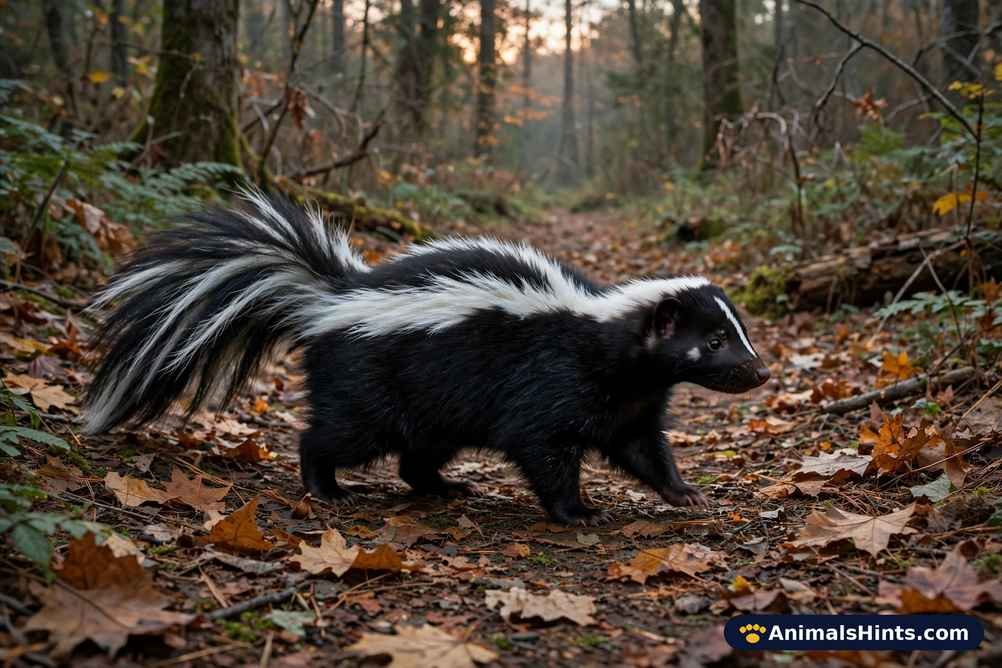
The meanings can wait a page; the animal comes first, because once you know how a skunk spends its night, a crossing stops reading as an ambush. The creature doing the crossing is the striped skunk (Mephitis mephitis) — throughout most of North America a stocky, short-legged mammal about the size of a house cat, found from southern Canada through the United States into northern Mexico. It is built low and deliberate: strong foreclaws for digging, a bushy tail, and a coat patterned like a warning label, because a warning is precisely its function. Biologists call such advertising aposematism — honest signage, worn by an animal whose defence fully backs it up.
A skunk’s day is spent asleep in a burrow — often one dug by another animal and taken over — under a deck, or in a hollow log. Its night is spent foraging, and the foraging is done almost entirely by nose and ear. Skunk eyesight is genuinely poor; the Missouri Department of Conservation describes an animal so near-sighted that a predator can close to within about ten feet before it registers. Smell and hearing, by contrast, are sharp, and the skunk works a route the way you would read a page in the dark: by touch and scent, head down, unhurried. What it is hunting is mostly animal protein of the slow kind — grubs, beetle larvae, grasshoppers, crickets, worms — supplemented by eggs, carrion, fallen fruit and berries as the season offers. The neat cone-shaped holes it leaves in lawns are the receipts of grub-hunting, each one dug by those foreclaws in a single night’s round.
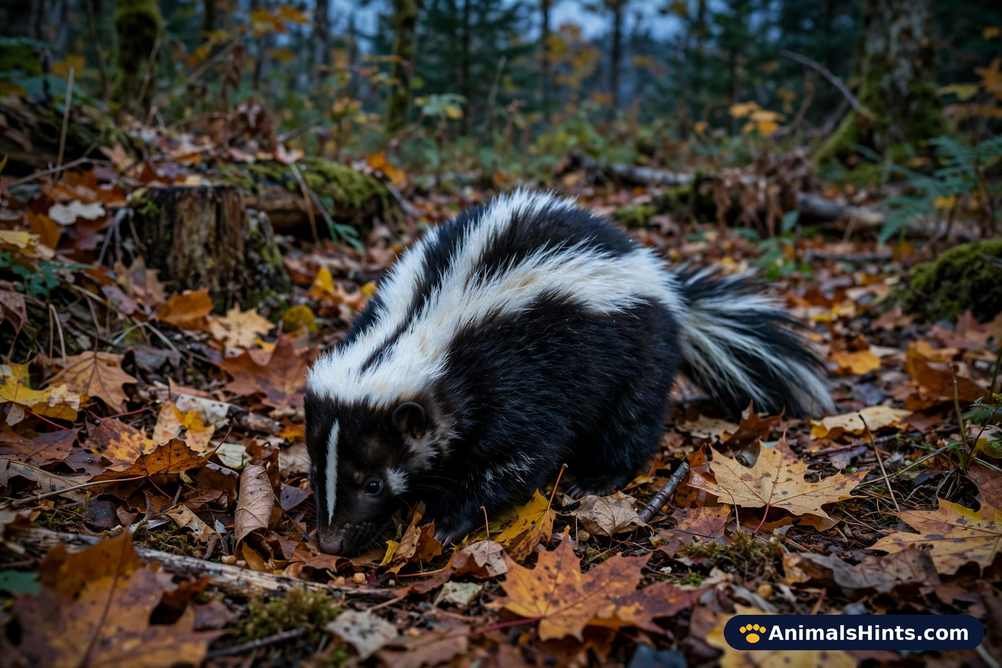
That schedule explains the crossing’s timing. Skunks are nocturnal with a crepuscular lean — out at dusk, busy through the night, heading home before full light — and a footpath through a park, a garden or a wood edge at dusk is simply a corridor across their rounds. You have not been intercepted. You have shared a pavement with the night shift. It also explains the animal’s famous calm. A skunk ambling across your route is not being bold and is not challenging you; it may genuinely not have made you out yet, and it has evolved to assume that its signage will handle the negotiation if one is needed. Mostly, it is right.
9 Spiritual Meanings of a Skunk Crossing Your Path
His meanings section promises nine, and nine is what his page delivers — the headings are counted, kept in his sequence, and set out one by one below, with his day-versus-night refinement closing the section. Treat each as the folklore’s own reading, credited to the folklore throughout: an offered way of seeing the encounter, never a prediction this page stands behind.
1. Asserting Your Boundaries
The flagship reading grows directly out of the animal’s etiquette. A skunk does not hide its limits and does not apologise for them; it publishes them in advance, in stripes, and then enforces them in graduated steps. The tradition casts the encounter as a summons to examine your own arrangements by that standard: where have you been saying yes with your mouth and no with everything else? Where is a limit being discovered by other people only after they have crossed it? The skunk’s version of the virtue is administrative rather than dramatic — the boundary works because it is visible early, stated calmly, and backed consistently. Set it before you need it, the reading runs, and you will rarely need to defend it at full strength.
2. Confidence and Embracing Uniqueness
Most prey animals survive by blending in. The skunk survives by standing out, and the second meaning is built on that inversion. Here is a creature that cannot be mistaken for anything else and does not try to be; its difference is not a liability it manages but the entire basis of its security. The tradition reads a crossing accordingly, as encouragement aimed at anyone currently sanding down their own edges to fit a room: the trait you have been treating as too much — too blunt, too quiet, too strange — may be load-bearing. Confidence here is not a matter of volume. It looks like the skunk’s unhurried walk: no advertisement beyond the truth, no apology attached.
3. Ingenuity and Strategy
The third meaning admires the engineering. Faced with predators larger, faster and better armed than itself, the skunk’s lineage answered not with teeth or speed but with chemistry — a defence that wins the encounter while injuring nobody, deployed only after a sequence of cheaper warnings has failed. The tradition takes the crossing as a lesson in that economy: meet the problem at the lowest level that solves it, spend your strongest resource last, and let timing and positioning do work that force would do worse. Strategy over struggle is the summary the guides give it, and the animal’s own budget backs the reading — a skunk’s spray is a finite store, slowly replaced, and the animal behaves like a creature that knows the price of wasting it.
4. Self-Esteem and Authenticity
A skunk’s reputation is the rare kind that is exactly accurate. Nothing about the animal is bluff: the warning is real, the calm is real, and the consequence of ignoring both is real. The fourth meaning draws the human parallel the guides favour — self-esteem as a match between what you present and what you are. The tradition aims this reading at the exhausting opposite condition, the performed self maintained for approval, and offers the skunk’s arrangement as the restful alternative: be legible. Let people know, by steady evidence rather than announcement, what you value and where you stop. Respect, in this strand, is not requested. It accumulates around a creature — or a person — whose signals never contradict themselves.
5. Trusting Your Inner Feelings
The fifth meaning leans on the skunk’s senses. This is an animal that navigates a dark world with weak eyes and prospers anyway, because the channels it does trust — scent, sound, the feel of the ground — are excellent and it follows them without second-guessing. The tradition reads an encounter of this kind as encouragement aimed the same way: toward the knowledge that arrives without a picture attached, the unease or the quiet certainty that precedes its evidence. Filed at its proper strength, the reading is not an instruction to abandon judgement. It is the genre’s recurring reminder that perception has more than one channel, and that the one you have been discounting may be the one the moment is using.
6. Warning Against Negative Influences
The sixth meaning is the shelf’s cautionary entry, and it borrows the skunk’s oldest job: keeping the wrong company at a distance. In this reading, a crossing invites you to look hard at what you have been letting close — the draining obligation, the corrosive friendship, the habit that costs more than it returns — with the skunk’s own standard applied: proximity is a privilege, and some things should be met, politely and early, with a raised tail. The source guide frames this strand in biblical language, as discernment and the guarding of the heart; the record section below sets out exactly how far the written sources behind that framing go. The reading itself stands here as the tradition states it — a warning, attributed, and aimed at influences rather than at people as enemies.
7. Protection and Loyalty in Native American Traditions
The seventh meaning is the guide’s presentation of the skunk in Native American frames: an emblem of protection exercised peacefully, of loyalty to family and community, and of what the modern animal-medicine literature calls skunk medicine — the teaching that a person can be so secure in their own presence that conflict becomes unnecessary. This page carries the strand as his, held to the measure the documentation allows, and the record section below gives that measure honestly: the pattern of respect for this animal is real, the tidy doctrine is a modern codification, and the two are labelled separately rather than blended. What can be said without inflation is that the skunk’s way of being protected — warned, bounded, and otherwise peaceable — has genuinely been admired on this continent for a long time.
8. Pacifism and Nonviolence
The eighth meaning reads the skunk as the armed pacifist of the animal shelf. It carries one of nature’s most effective deterrents and organises its entire life around not using it: the warnings, the patience, the willingness to simply leave. The tradition hears in the crossing an endorsement of that ordering — strength held as a guarantee of peace rather than as an invitation to combat, and conflicts settled at the level of signals wherever signals will serve. Its modern name for the skill is de-escalation, and the skunk makes a fitting emblem: the creature most capable of ruining your week is the one most committed to giving you every chance to walk away from it.
9. Balance and Accepting Both Light and Dark Aspects
The last meaning is read off the coat. Black and white are not blended on a skunk into a safe grey; they run side by side at full strength, and the tradition takes the pattern as a picture of a self that has stopped trying to amputate its own halves. The bright side and the shadow side, in this reading, are one animal, and the work is integration rather than concealment. The dark half of the pairing is treated in a full article elsewhere on this site: in the black material, the traditions treat the darkest colour as protection, mystery and power kept in reserve. The light half is shelved separately too — the white butterfly pages develop purity and new beginnings in the matching register. A skunk carries the pair simultaneously, which is precisely the point this meaning makes of it.
Meaning of a Skunk Crossing Your Path During the Day Versus at Night
The source guide refines the reading by the clock, and the refinement follows here in his shape. By day, the tradition treats the sign as its clearer and more urgent form: the matter it points at is a waking-life one, to be handled openly — a boundary to state in plain words, a feeling to stop filing away. A skunk met at night is read toward the interior: intuition, the subconscious, the boundary questions you have been conducting with yourself, and protection of the unseen kind.
The animal underneath adds a footnote the folklore does not, and it cuts in a useful direction. Daylight is not a skunk’s shift, but a daytime skunk is not automatically a sick one: nursing mothers forage by day in spring, and young animals keep irregular hours. What does warrant distance and a call to animal control is behaviour, not the hour — an animal that is staggering, circling, or approaching people without any fear at all. The warning section below gives the full sequence; the point here is that the clock alone diagnoses nothing, in either register.
When the Tail Goes Up: The Warnings Before the Spray
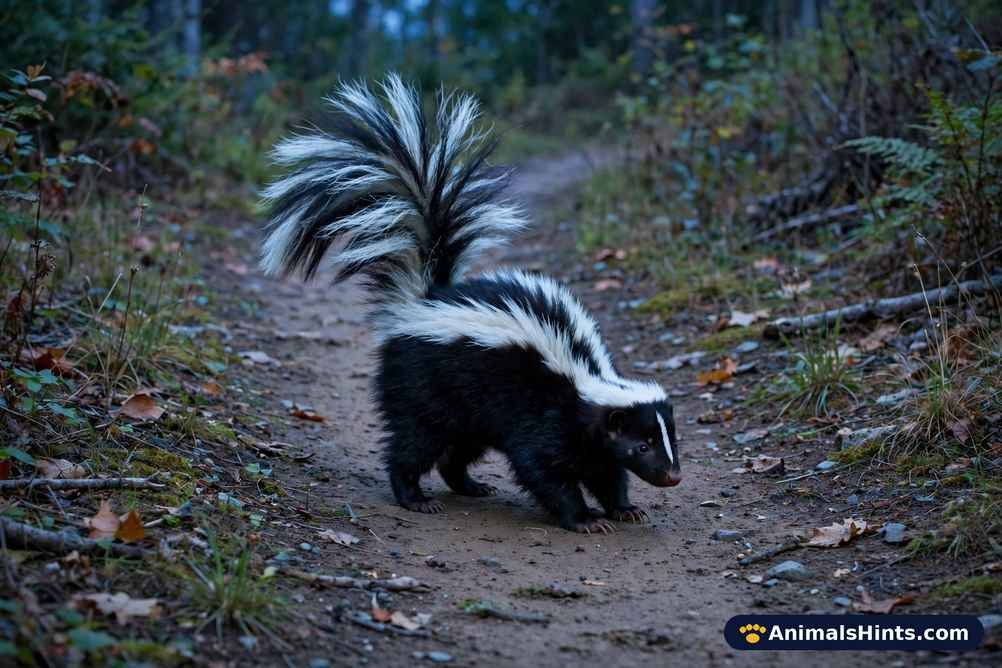
Nothing in this subject repays study like the sequence a skunk works through before spending its one great resource — it is at once the most practical material here and the most flattering to the animal. State conservation guidance — Missouri’s Department of Conservation sets it out as plainly as anyone — describes a creature that will go to remarkable lengths not to spray. Understanding the sequence is also the whole of encounter safety: every step of it is a sentence addressed to you, and each repeats the message at a higher volume.
First comes the coat itself, which is a warning issued permanently and in advance. Then, for a threat that keeps coming: the skunk flares the hairs of its tail, stamps its front feet in a rapid patter on the ground, clicks its teeth, hisses or growls, and may charge a few steps forward and stop short — a bluff advance meant to be believed just enough. Some skunks, the spotted species especially, rear into a handstand with the tail fanned overhead. Only when all of that has failed does the animal bend its body into a U, head and rear aimed at the threat together, and fire.
What fires is musk from two glands beside the anus, pushed out through small nozzles the animal can aim with unsettling precision. In calm air a skunk can place its spray accurately at about ten feet, with some of it carrying considerably farther, and it aims for the face. The chemistry is sulfur chemistry: the active ingredients are thiols, the family of compounds behind the smell of rotten eggs and cut garlic, detectable by the human nose at almost absurd dilution, and accompanied by slower compounds that release fresh thiols when they get wet — which is why a sprayed dog can smell freshly skunked again after a bath. A direct hit to the eyes causes intense stinging, tearing and a temporary inability to see; it is not poisonous, and the effects pass, but they are entirely incapacitating while they last.
The economics explain the etiquette. The glands hold enough for roughly five or six discharges, and refilling them takes the better part of a week and more. A skunk that has sprayed is, for days afterwards, an animal with signage and no substance behind it. Everything about the warning sequence — the stamps, the hisses, the bluff charge — is a creature trying not to be left in that condition. Read generously, the folklore’s whole portrait of the skunk is encoded in this behaviour before any symbolism is added: honest advertisement, fair warning, graduated response, and a last resort that is genuinely last.
What the Record Actually Shows: Skunks in Older Lore and Scripture
Skunk symbolism is repeated on the internet far more often than it is sourced, so this section separates what can be checked from what cannot. Few animal topics have so clean a dividing line: the skunk’s geography alone decides which of the world’s traditions could possibly contain it, and which are borrowing an animal they never had.
The skunk is an American animal, and its name says so. Skunks are New World mammals; the striped skunk’s world is North America, and no skunk of any kind lived in Europe, Africa or Asia for any pre-modern tradition to observe. (The family’s only Old World members are the stink badgers of Southeast Asia, distant cousins no European folklore ever met either.) The English word itself is an Indigenous loan: skunk enters the language in the 1630s from a southern New England Algonquian word — Massachusett squunck, from a root meaning “to urinate” joined to the word for a fox-like animal. Europeans meeting the animal reached for the nearest comparison and sometimes called it after their own polecat. Every genuinely old tradition about this animal is, by that simple geography, an American one, Indigenous in origin — and any account that places skunks in the folklore of the Old World is describing something else, or nothing.
The Celtic strand cannot be a skunk tradition. The source guide’s cultural survey includes a Celtic entry, and it is worth reading his sentence closely: it speaks of animals that used natural defences being linked with spiritual guardianship. Skunks are not named in it, and could not be — no Celtic person ever saw one. What stands there is a modern genre habit, the retrofitting of a general principle onto an animal the tradition never contained. It is carried in the cultural section below at exactly that strength: as a statement about the genre, not about Celtic belief.
For the Native American material, only a pattern can honestly be printed — never a doctrine. There is no single skunk teaching shared across Indigenous North America, because there is no single Indigenous tradition to hold one: the nations number in the hundreds, and each keeps its own animal lore. What can be supported is a general pattern of regard — the animal’s power noticed and respected, its defence admired, its body put to practical use in folk life on this continent, skunk fat among the rendered animal oils of North American home remedy. Against that pattern stands the symbolism genre’s tidy portfolio — skunk medicine packaged as a named system of loyalty, protection and reputation — which is a codification of recent decades, built by the animal-medicine books out of the older regard. The two things are different in kind, and this page keeps them apart.
Scripture does not mention the skunk at all. The test takes a minute and settles the matter: put “skunk” into a King James search on BibleGateway and the return is empty — Bible (0), Topical (0). Geography predicts exactly that result for a text completed more than a millennium before the continents were joined. The one verse the Christian strand of this topic genuinely rests on concerns the heart rather than any animal, and it appears here strictly as an echo, marked as one: Proverbs 4:23 (KJV) — “Keep thy heart with all diligence; for out of it are the issues of life.” Vigilance over what you allow close is something the Bible really does command. It nowhere commands anyone to read a skunk. Keeping those two facts separate is the whole of this page’s method.
Cultural and Religious Explanations
His cultural survey runs to three strands, set out below in the sequence he gives them. Each is held to the ceiling the record section established: where documentation runs out, the strand stops there too, and says so.
Native American traditions. Within the general pattern set out above, many Native traditions are described as respecting the skunk as the animal that commands a wide berth without violence — its scent read not merely as a weapon but as a boundary made physical, and its medicine associated with protection, with healing, and with loyalty to one’s own people. Those who carried skunk medicine, in the genre’s telling, were the peaceful ones whose presence settled rooms. It is presented here at pattern strength only: genuine regard, given systematic shape much later, with no one nation’s teaching passed off as a whole continent’s.
Celtic traditions. This strand stands in the survey wearing its true label. The guide’s Celtic passage attributes to that tradition a regard for naturally defended animals as spiritual guardians, and a teaching about choosing the moment to act or retreat. As a reading of the skunk it cannot be old — the animal was unknown in Europe until the age of contact, when travellers compared it to the polecat they already knew. What the strand genuinely documents is the modern symbolism genre at work, extending a principle it admires onto an animal that illustrates it perfectly. It stands in the survey as exactly that — the only strength it has honestly earned.
Christian perspective. Nothing in this strand pretends to be exegesis, and it is labelled accordingly throughout. Since no skunk appears anywhere in the Bible — the empty search above is not a matter of interpretation — what the strand offers is a devotional analogy built from the animal’s habits: a creature set apart by its nature, living quietly in the world while remaining unmistakably distinct from it, which modern Christian writers take as a picture of integrity maintained under pressure. The heart-guarding verse quoted in the record section is its one genuine textual anchor, and that verse is about vigilance rather than animals. Read as an analogy, the strand is coherent enough. Read as a claim about what scripture says, it collapses — so this page only ever offers the first reading.
Dreaming About a Skunk Crossing Your Path
His page devotes a section to the dream version of the crossing; this article follows him. Dream symbolism belongs to the folk conventions of the dream dictionaries — a genre with its own customs, not a body of tested findings — and everything in this section is offered in that key.
Within those conventions, a dream of a skunk crossing your path counts as a boundary report from the subconscious: somewhere in waking life, the dreamer is tolerating what they would not tolerate rested — someone else’s negativity absorbed as a duty, a truth left unspoken to keep a peace that is not actually peaceful. The dream skunk arrives as the genre’s standard remedy in animal form: say the thing, set the limit, let your presence register.
What distinguishes one such dream from another, in the dictionaries’ handling, is the animal’s behaviour in it. A skunk that simply walks through, unhurried and unthreatened, points the reading toward self-acceptance — a growing ability to be disliked by the wrong people without flinching. A skunk gone defensive, tail up or spraying outright, reverses the direction: frustration banked too long, or an atmosphere around the dreamer that has turned genuinely toxic and wants acknowledging. A skunk merely watched from a distance, neither approached nor fled, stands for the learning state itself — judgement being practised on the question of when a thing deserves engagement and when it should be left to pass at its own range.
What to Do When a Skunk Crosses Your Path
Everything so far has been interpretation. This short section is the exception — plain practice, organised by the situation you are actually in when the stripes appear.
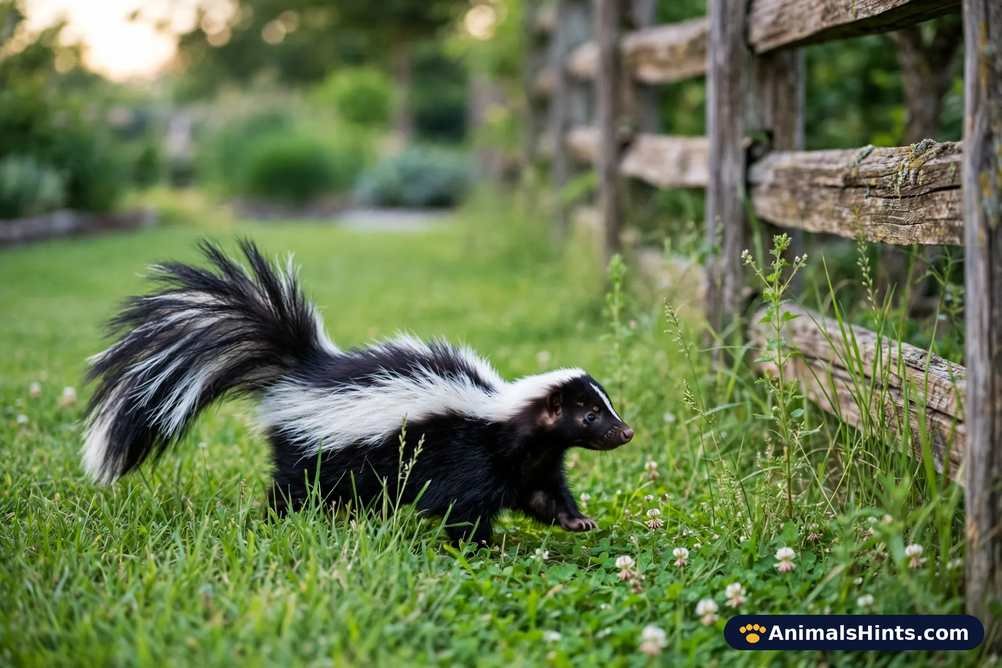
On foot, the whole protocol is distance. Stop, give the animal a wide berth — well beyond the ten feet its spray can accurately cross — and let it continue on its way, or back away slowly yourself. Never corner a skunk, never try to shoo it with a stick or a thrown stone, and keep dogs on a short lead and moving away: the warning sequence described above is addressed to whatever is closing in, and the correct reply to it is to stop closing in. Do not feed it, and do not follow it for a photograph. A healthy wild skunk needs nothing from you, and the encounter is complete at the distance it chose.
If the worst happens anyway, the remedies are chemistry, not folklore. For a sprayed dog, the Humane Society’s published formula is the one extension services repeat: one quart of 3% hydrogen peroxide, a quarter cup of baking soda, and a teaspoon of liquid dish soap, mixed fresh in an open container, worked through the coat, kept out of the eyes, and rinsed after a few minutes. Mix it when you need it and never bottle it — the mixture builds pressure in a sealed container. Tomato juice, the famous remedy, does not neutralise anything; it masks the smell briefly, mostly by exhausting your own nose. Flush sprayed eyes with clean water, keep the dog outside or in a ventilated space until washed, and call a veterinarian if a heavily sprayed dog becomes lethargic or its gums pale — the spray’s compounds can, in rare heavy exposures, damage a dog’s red blood cells.
One caution stands apart from the spray entirely. Skunks are a rabies reservoir species in North America — the CDC counts them among the principal wildlife hosts of the virus across the Midwest and West — and the rule that follows is about behaviour, not fear. A skunk that is out at midday may be perfectly healthy, as the day-and-night section notes; a skunk that staggers, circles, drools, or walks up to people entirely unafraid is a different matter. Do not approach it, do not let pets near it, and call local animal control. Any bite or scratch from a wild skunk, to a person or a pet, is a same-day conversation with a doctor or veterinarian. Kept at that strength — watch the behaviour, respect the distance — the caution costs the encounter none of its pleasure.
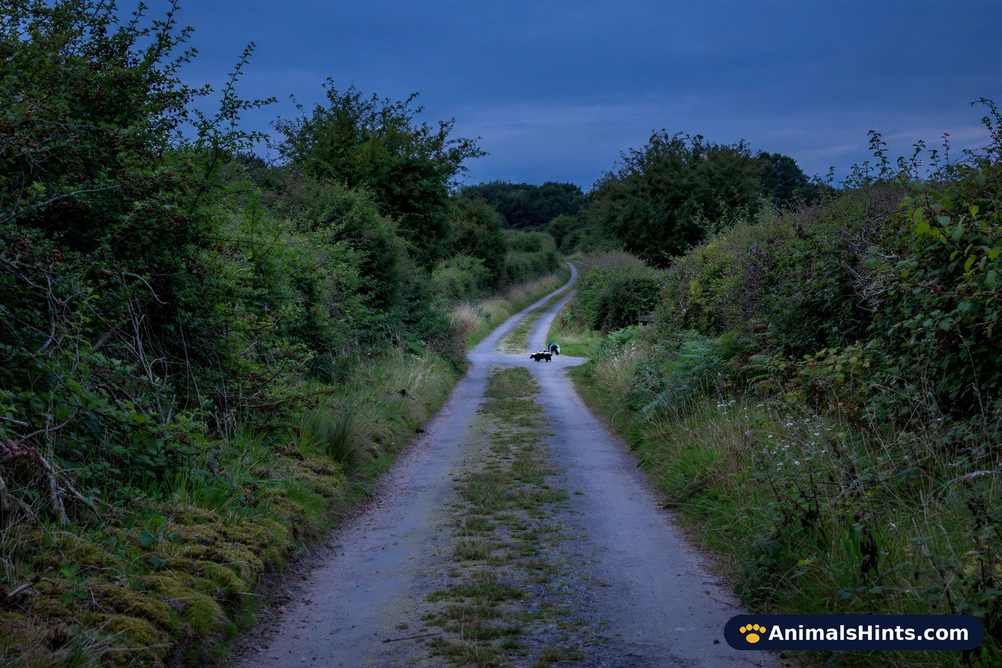
In a car, the skunk’s hours become the driver’s problem. Skunks cross roads at dusk and through the night, slowly, at exactly the height headlights overshoot. Slow down on rural roads after dark, use high beams where you can, and if one is in your lane, slow the car in its own lane whenever the road behind you allows it — and whatever you do, do not yank the wheel. Driver guidance everywhere gives the same reason: a swerve at speed trades a small animal for oncoming traffic, a ditch or a tree, and the manoeuvre, not the skunk, is what injures people. This site’s other driving material is built on the identical principle — it governs the birds flying in front of your car while driving readings as well. Meaning comes afterwards, and only once you are parked.
Is Seeing a Skunk Good Luck?
In the source guide’s verdict, yes — though the luck it describes is of a particular kind. Not windfall luck, nothing arriving by post; the skunk’s version is the luck of being hard to harm. A sighting gets filed as a favourable sign because of what the animal demonstrates: that a creature can be protected, respected and left in peace by the whole neighbourhood, purely on the strength of clear signals honestly backed. The tradition reads the crossing as that condition being pointed out to you — your own presence registering, the right people drawing closer and the wrong ones deciding, on their own, to keep their distance.
The honest qualification is the one this page applies to every sign on the shelf. The luck is in the reading, not in the event: a skunk crossing forecasts nothing, and the same encounter received with disgust delivers nothing at all. What the tradition is really distributing is a posture — advertise honestly, warn fairly, waste nothing — and calling the posture luck because people who hold it tend to need less of the other kind.
Set against the shelf’s dark counterpart, the sign’s optimism explains itself. The dead bird material is where this site files the grief register of animal signs — an encounter with something whose journeys are finished. A crossing sign works the other way for a simple reason: the animal in it is alive, halfway through an errand of its own, and wholly untroubled by your presence. No creature on the shelf carries that untroubled quality further than the skunk.
Final Thoughts
A skunk crossing your path is the most honest encounter on this site’s whole crossing shelf. Other animals dash, freeze, flee or perform; the skunk simply proceeds, at walking pace, in a coat that files its paperwork in advance, trusting a negotiation it has already conducted ten thousand times. Around that unhurried walk the traditions have accumulated — nine modern meanings, an Indigenous name that describes the animal’s one talent with admirable bluntness, a medicine of boundaries assembled only in recent decades — and this page has handed them on complete, warmly, and at no point dressed in more authority than they own.
Remove the symbolism and the residue is, once again, mostly instructions for behaving well. Say where your limits are, early and without heat. Give warnings before consequences, and let the consequences arrive in steps. Hoard your strongest response and use it almost never. On the road, slow down inside your own lane rather than gambling on a swerve. And when something warns you this plainly, in a language this old, the decent answer — in whichever register you prefer — is to take the warning at face value the first time it is given.
Meanwhile the animal itself remains entirely indifferent to its readership. It will be out again tomorrow at dusk, working the same rounds by smell, sleeping the day away in somebody else’s burrow, and carrying — mostly unspent — a defence of sulfur thiols strong enough to clear a field at dilutions of parts per billion, guarded by the most courteous warning sequence in the animal kingdom. Whatever else the sign may mean, that much of it is simply true, and it needs no embellishment.
FAQs
What does it mean when a skunk crosses your path spiritually?
The tradition’s answer is boundaries, self-respect and a defence held in reserve — state your limits early, hold them calmly, and let your presence do the work. Hold it as interpretation rather than prediction; in plain fact, the animal was travelling between its den and its feeding grounds.
Is a skunk crossing your path a sign of good or bad luck?
Across the traditions this page surveyed, the verdict leans favourable — counted less as luck than as a reminder of being protected when your signals are clear. As fact, a crossing predicts nothing at all; if the encounter sends you home to review your boundaries, it has already delivered everything it honestly can.
What does it mean if a skunk crosses your path and sprays?
The tradition reads an actual spraying as the urgent version of the same message — a boundary not merely stated but enforced, and a cue to set firmer ones of your own. Behaviourally, a spray means every warning in the sequence was missed or ignored; the practical section above covers what to do next, for you and for a sprayed dog.
How should I respond to a skunk crossing my path?
On foot: stop, give it well more than ten feet, and back away slowly — never corner it, and keep dogs close and retreating. In a car: slow down within your own lane whenever it is safe to do so, and never swerve for one. If a skunk behaves as if it has no fear of you at all, leave it entirely alone and call animal control.