Uneasy Feeling in Stomach Spiritual Meaning: Gut Instinct, the Second Brain and Real Causes
Most people who search uneasy feeling in stomach spiritual meaning are not in pain. They are sitting with something lower and vaguer — a knot, a churn, a flutter that will not settle — and wondering whether the sensation is trying to tell them something. In spiritual writing, the standard answer is yes: the feeling is read as intuition stirring, a warning arriving early, or emotion that has been swallowed instead of processed.
That reading has a physical neighbour worth knowing about, because the stomach genuinely is wired into the brain by one of the largest nerve networks in the body. Medicine calls the gut a second brain for structural reasons, not poetic ones, and anxiety lands in the stomach through documented pathways. Folklore and physiology therefore share this topic, and this page keeps them on separate shelves, each labelled.
What follows works through the customary ten spiritual meanings in turn, then the emotional causes the genre lists, the cultural readings and the calming practices — and, alongside them, the gut–brain record as medical sources state it, the difference between unease, pain and nausea, and the short list of stomach symptoms that belong to a doctor rather than to any meaning at all. The scope throughout is the stomach and upper abdomen, and the sensation is unease: butterflies, knots, heaviness, churning. Sharp pain is a different sign and is treated as one.

Your Gut: The Body’s Second Brain and Spiritual Center
Begin with the phrase itself, because the genre and the laboratory arrived at it independently. Spiritual writers have long treated the midsection as a sensing organ in its own right — the place where a person registers that something is off before they can say what. The stomach, on this account, notices a room, a relationship or a decision the way skin notices weather: immediately, and without asking the conscious mind for permission.
The healers and teachers the genre draws on placed weight on this region for a matching reason. In several traditional frameworks the belly is where unresolved feeling collects — grief not yet cried, words not yet said, fear not yet named — and where the body’s energy is said to shift before any thought catches up. A stomach that tightens in a meeting or flutters at a doorway is, in that frame, a messenger doing its job early.
Ordinary experience supplies the genre’s best evidence, and the point deserves plain statement because physiology backs it too. Butterflies arrive with excitement as reliably as with dread. Bad news drops the stomach before it reaches the face. A heavy, pressurised feeling settles in during weeks when too much is being carried and nothing is being said. These reactions are fast — faster than reasoning — and every tradition that reads the gut as an intuitive centre is built, at bottom, on that speed.
The section that follows this one gives the medical version of the same wiring, and the two accounts should not be blurred. What can be said here, at the genre’s own strength, is the modest claim its better writers actually make: the sensation deserves attention rather than fear. Whether the attention it deserves is emotional, practical or medical is the question the rest of this page works through.
Why an Uneasy Stomach Actually Happens: The Gut–Brain Record
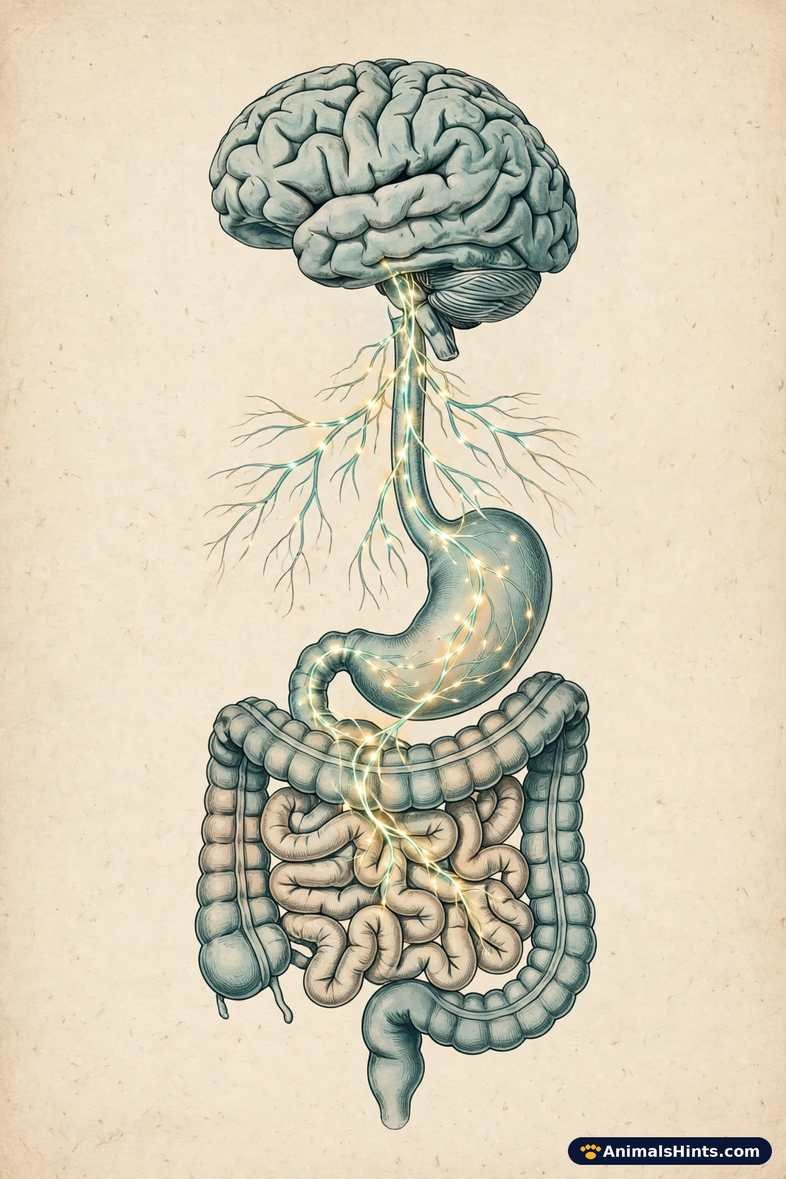
The phrase “second brain” is not a metaphor medicine borrowed from spirituality; it is a nickname anatomists use for the enteric nervous system, the neural network running through the gastrointestinal tract. Cleveland Clinic’s account of the gut–brain connection puts its size at more than 500 million neurons — the most complex neural network outside the brain itself — and notes that it can process conditions inside the gut and generate responses locally, without routing every decision through the head. That partial independence is exactly what earned it the name.
The cabling between the two systems has a name as well. Cleveland Clinic identifies the vagus nerve as the main link between the enteric nervous system and the brain: it carries sensory information about conditions inside the gut upward to the brain, and motor signals back down in response. The same account describes the wider gut–brain axis as a two-way conversation involving the nervous system, the hormone system that manages hunger, fullness and stress, and the immune system — with gut microbes also taking part, since they produce or help produce many of the chemical messengers the two systems exchange.
Two consequences of that wiring matter for this page. The first is that emotion amplifies sensation: Cleveland Clinic describes an alarm loop in which the emotional brain heightens how intense a gut sensation feels, while intense gut sensations in turn raise stress — a feedback circuit, especially strong between brain and gut. A mild churn noticed during a calm week can therefore feel like a five-alarm signal during a frightened one, with no change in the stomach itself. The second is overlap: the same source notes a significant overlap between functional gastrointestinal disorders — conditions such as irritable bowel syndrome, which produce persistent symptoms without an obvious physical cause — and anxiety disorders. An uneasy stomach that keeps company with worry is, medically, a recognised pattern rather than a mystery.
None of this makes the stomach an oracle, and medicine is blunt about the boundary in the other direction too: no clinical source attributes foresight, warnings about other people, or messages about the future to gut sensations. What the record supports is narrower and, used properly, more useful — the stomach is a genuine early register of stress, emotion and digestive state, which is why it so often feels as though it knew first. The appetite system runs on the same wiring, incidentally: the craving peanut butter page on this site works through a neighbouring sensation, the sudden food craving, which likewise arrives from the gut before the mind has voted on it. The warning signs that move a stomach symptom out of this territory altogether are collected in their own section below, before the closing thoughts.
Why Do I Feel Uneasy in My Stomach Metaphysically?
The metaphysical answer, as the genre gives it, starts from imbalance rather than illness. On this view the stomach stirs when a person is pushing past their own limits, carrying a fear they have not admitted, or letting a boundary slide that they privately know should hold. The image the tradition reaches for is a tap on the shoulder: the inner self interrupting a rushed day and asking, quietly, to be consulted.
Another strand of the answer concerns friction with surroundings. Walking into a situation that runs against your values, sitting across from someone whose words and manner disagree, holding back a sentence you need to say — the genre holds that the stomach registers each of these before the mind finishes analysing them. Tightening is its response to conflict, churning to uncertainty, fluttering to an approaching decision. The sensation is treated as data about fit: between you and the room, you and the plan, you and the version of events you are politely accepting.
The genre is also honest, at its best, about timing. The metaphysical reading rarely arrives with its explanation attached; the meaning of a given churn is usually legible only afterwards, once events have shown what the feeling was shadowing. That is why the tradition’s counsel is examination rather than reaction — look at your environment, your relationships, your pending decisions and your emotional state with slightly more honesty than usual, and let the sensation point at whichever of them tightens further when touched.
One line in this account deserves keeping, because the rest of this page hangs on it: in the metaphysical frame the sensation is not an opponent to be fought. It is information to be read. The sections below lay out what the tradition says the signal can mean — and, in the sections this article adds, what it cannot mean, and when it should be handed to medicine instead.
10 Spiritual Meanings of Uneasy Feeling in Stomach
Present-day spiritual writing circulates ten standard readings for this sensation, laid out below in their customary sequence. Every one is labelled honestly — a belief carried by a tradition — and not a single one is presented as knowledge about your future. Take them the way the genre’s careful writers intend: as a vocabulary for noticing, not a set of verdicts.
1. Inner Restlessness or Worry
The foundational reading. When restlessness builds below the surface — a worry pushed aside rather than answered — the genre holds that the body registers it first, and the stomach, as the sensing centre, answers with tightness, swirling or a pull that refuses to be ignored. The reading treats the discomfort as a nudge pointing inward: an unresolved conflict, a confusion being carried quietly, an emotional load that has grown past what the day can hold. Its counsel is acknowledgement. Name the worry honestly, the tradition says, and the turbulence begins to settle; leave it unnamed, and the stomach keeps repeating the message at the same volume.
2. Emotional Blockage
The storage reading. Feelings that are trapped or ignored — fear, grief, self-doubt are the genre’s usual examples — are said to gather in the stomach over time, producing a heaviness or unease that can arrive suddenly or linger through a whole day. On this account the sensation is the body’s request for release: small experiences, unprocessed, accumulate exactly the way unwashed dishes do, and the stomach eventually reports the pile. The remedies the tradition attaches are expressive rather than medical — reflection, honest conversation, writing, any practice that lets held feeling move. When the blockage loosens, this reading promises, the knots soften with it.
3. Fear and Insecurity
The threshold reading. Fear, in the genre’s telling, shows in the stomach before it shows in the mind: novelty, a weighty choice, anything that puts a person’s sense of safety in question produces the sinking, fluttering or deep pulling sensation almost instantly. The stomach is cast as an internal messenger reporting that the deeper self has not yet accepted what is happening, however brave the face above it. A protective strand runs through the same reading — the tightening is the body shielding itself — and the counsel is diagnostic rather than dramatic: identify what, precisely, is being feared, and the insecurity loses the vagueness that makes it feel enormous.
4. Imbalance in the Solar Plexus Chakra
The energy-centre reading. The stomach sits in the territory of the solar plexus chakra, which in the chakra system governs personal strength, confidence and emotional steadiness. When that centre is described as imbalanced, the stomach is expected to react first — a heavy knot, a burning band, a tightness across the midsection. The genre ties the imbalance to recognisable states: doubting your abilities, losing your sense of direction, giving your energy away too freely, letting outside pressure limit your voice. The reading’s remedy is realignment — rebuild confidence, restate boundaries, recover a sense of direction — after which the stomach is said to return to a calmer rhythm. This is the tradition’s framework, printed as such; the chakra system is a belief structure, not an anatomy, and the medical section above describes the same territory in nerves rather than centres.
5. Emotional Digestive Issues as a Sign of Awakening
The growth reading. During periods of deep emotional change, the genre says, the stomach often becomes unsettled precisely because old material is rising: emotions buried for months or years resurface to be processed, and the body registers the excavation as unease. The discomfort is therefore taken as evidence of transformation underway rather than of anything wrong — confusing at first, meaningful in retrospect. As the held weight is faced and released, this reading holds, clarity replaces the churn and the stomach relaxes into the new steadiness. Printed at the genre’s strength: it is a consoling frame for a difficult season, and it is a frame, not a finding.

6. Warning from Gut Instinct
The alarm reading — the interpretation this entire topic is named after. On this account the stomach works as an early-warning system, sensing tension, dishonesty or a wrongness in a situation long before conscious analysis finishes, and tightening to make you pause. The genre’s favourite evidence is retrospective: the number of people who say, afterwards, that their stomach knew — in the doorway, at the handshake, before the signature. The reading urges trust in that first signal, weighed rather than worshipped. This page’s medical section offers the secular version of the same observation — the gut does register stress and emotional state early, through the gut–brain wiring — while noting that no clinical source upgrades the register into a forecast. The folklore and the physiology agree that the stomach notices; they part company over what it notices about.
7. Sign of Resistance to Change
The transition reading. Change, even chosen change, stirs the stomach in this account: resisting a move, clinging to a pattern that no longer serves, facing a choice that exits the comfort zone — each translates into tension, twisting or heaviness in the midsection. The body, the genre says, holds onto the familiar the way a hand holds a rail, and the unease is the grip complaining. The counsel attached is reflective: notice what, exactly, you fear losing in the transition, and the resistance becomes discussable — with yourself first of all. Through that examination, the reading promises, the grip loosens and room opens for the new chapter.
8. Call to Care for Body and Emotions
The maintenance reading. When the stomach unsettles without an obvious physical cause, the genre takes it as a self-care summons: you have stretched too thin, skipped rest, ignored emotional fatigue, bottled a frustration once too often, and the body is presenting the invoice. Small neglects are the currency here — the reading lists missed rest, unspoken feelings and absent boundaries as the deposits that accumulate into tightness. Its remedy is correspondingly modest: slow down, breathe, observe honestly how you feel, and repair the smallest broken routine first. Of the ten readings this one leans least heavily on the supernatural and, not coincidentally, overlaps most with ordinary stress medicine.
9. Dread or Anxiety About Future Events
The anticipation reading. Knots and fluttering that gather before deadlines, results, journeys and uncertain conversations are read as the stomach absorbing the emotional weight of what is coming — the mind rehearsing outcomes, including the worst ones, while the body pays for the rehearsal. The genre adds a kinder gloss: the tightness also marks how much the coming moment matters to you. Acknowledging the specific source of the dread is the reading’s turning point; once the fear has a name and a date, clarity is said to replace overwhelm and the tension to release. Everyday life supplies small versions constantly — the churn before a hard phone call, or the drop that comes with a shock like losing your wallet and waiting to learn what it will cost you. The sensation is the same; only the size of the future changes.
10. Blocked Energy in Chakras Affecting Digestion
The systems reading, closing the list. Where the fourth meaning isolates the solar plexus, this one widens the frame: blocked energy in the root chakra — the centre the system ties to stability, safety and grounding — is said to leave the stomach restless and insecure, while a blocked solar plexus produces the knots and heaviness of shaken confidence, the two centres together governing how settled a person feels in their own body. The remedies the tradition attaches are the system’s standard ones: grounding, breathwork, reflection, gentle movement. Printed, like the fourth meaning, as the chakra framework’s internal account — a map many people find useful for organising self-care, and a map, not a measurement.
Common Energetic and Emotional Causes of Discomfort in the Stomach
Alongside the ten meanings, the genre keeps a shorter working list of the internal triggers it blames most often — the states of mind and feeling its writers say pool in this region, the neighbourhood their system assigns to selfhood, assurance and personal strength. They are carried here as the compilations present them, with fresh glosses.
- Deep worry — the genre’s first cause. Racing thoughts and lingering fear are said to settle in the gut quickly, as heat, tightness or churning, sometimes before the worrier has consciously registered what they are worried about.
- Emotional overload — feelings stacked faster than they can be processed. The stomach is cast as the holding container, tightening because the queue of unexamined emotion has grown longer than the day allows.
- Conflict between desire and responsibility — knowing what you want while feeling pressed to choose something else. The tug of war itself is the trigger; the restlessness is its physical signature.
- Difficulty expressing truth — suppressed words, in the genre’s image, build pressure around the body’s centre: the knot that forms in the meeting where you stayed quiet while part of you wanted to speak.
- Energetic boundaries weakening — the empath’s entry. Absorbing other people’s moods and tension is said to leave sensitive people with an unsettled stomach that is not, strictly, theirs.
- Fear of the unknown — big choices, including welcome ones, stir the stomach as the body prepares for change; the nervousness is read as readiness signalling itself awkwardly.
The list is a folk taxonomy, and deserves to be taken as one — but notice how much of it a stress clinician would recognise under different names. Worry, overload, conflict, suppression and anticipation are the ordinary ingredients of anxiety, and anxiety is the medical section’s documented stomach-stirrer. The genre and the clinic disagree about mechanism; about the triggers, they largely agree.
Uneasy Stomach, Stomach Pain and Nausea: Three Different Signs
The spiritual catalogue files stomach sensations the way a library files books — by kind, not by body part alone — and three of its entries are confused with each other constantly. Keeping them apart matters, because the traditions themselves assign them different weights, and medicine assigns them different urgencies.
Unease, this page’s subject, is the vaguest of the three: a knot, a churn, a flutter, a heaviness — sensation without a point you could press a finger on. The genre reads it as the early, low-volume signal: intuition, emotion, imbalance. Pain is the sharper shelf. A stomach that actually hurts has its own catalogue entry, and the line between the two is not pedantry — pain that is severe, sudden or localised belongs to the doctor section below before it belongs to any symbolism. Nausea is the third shelf: the urgent, rising sensation that the body is preparing to expel something, which the genre interprets as rejection — of food, of situations, of what cannot be digested in either sense.
Neighbouring body signs on this site keep the same discipline at their own addresses. The belly button itching page works a surface sensation a few inches from this one and declines to borrow the stomach’s meanings for it; the spiritual smells article handles a different border crossing altogether — sensations that arrive with no physical source at all. And the night signs are shelved separately again: a stomach churning while you are awake belongs to this page, not to the dream catalogue that holds dreaming about your ex and its kin. Held apart, each record stays readable. Poured together, every stomach sensation becomes every other one, and the catalogue stops meaning anything at all.
Cultural and Religious Interpretations
The compilations gather the world’s readings of this sensation under four regional strands, carried here in their sequence and at their strength. The strands agree on one thing — the gut as a seat of intuition and feeling — and differ, as strands do, on whose messages it is carrying.
Eastern traditions
In the Eastern systems the genre summarises, the stomach region houses a person’s store of energy and inner fire: the seat of willpower and emotional balance. Discomfort there is read as a disturbance of inner harmony — the fire burning unevenly — and the response it calls for is restoration of balance rather than alarm.
South Asian viewpoints
The South Asian strand, as the compilations present it, treats the stomach as an absorber: of emotional vibrations, of relational tension, of the atmosphere inside a family or a household. Conflict at home is said to register as pressure in the belly, and intuition is taken seriously enough that an uneasy sensation is commonly received as gentle guidance rather than noise.
Middle Eastern teachings
In the Middle Eastern strand the stomach is a vessel for hidden emotion — the place stress, guilt and unresolved grief are carried when they have nowhere else to go. Unease there is taken to mean that something held inside needs release, and the sensation is treated with a certain respect: it is the body reporting on cargo, not malfunctioning.
Indigenous beliefs
The Indigenous strand, in the genre’s summary, places the stomach at the core of the spiritual self: uneasy sensations there are messages sent by the inner self, or counsel arriving from ancestral wisdom, and the correct response is awareness and reflection rather than dismissal.
One documentary note belongs here, the religious shelf being where readers most often assume a text exists. The Bible nowhere treats an uneasy stomach as an omen, a warning or a message, and no verse will be quoted here as though it did. What the King James text genuinely does is locate deep feeling in the belly’s neighbourhood: its word for the inner seat of emotion is “bowels”. Of Joseph, meeting his brother again, it says: “And Joseph made haste; for his bowels did yearn upon his brother: and he sought where to weep; and he entered into his chamber, and wept there.” (Genesis 43:30, KJV.) That is the record’s real tie to this topic — an idiom in which overwhelming feeling is felt in the gut, written down thousands of years before anyone coined “gut feeling”. It is a resonance, quoted as one. It is not a teaching about stomach sensations, and no biblical meaning for one is on offer here.
How to Soothe Your Spirit and Calm Your Stomach
The genre’s calming repertoire is deliberately small-scale: the premise is that a sensation blending physical and emotional elements responds to tending both at once, and that major life changes are rarely the first tool to reach for. Its six practices are carried here in its order, with fresh glosses.
- Breathing practices — slow breathing is the genre’s first resort: deep, unhurried breaths are said to shift the nervous system out of its stress setting, loosening the stomach’s tightness and letting emotional clarity rise behind it. Medicine’s version of the same observation sits in the gut–brain section above; the practice itself is harmless either way, and it is the one item on this list both shelves endorse.
- Gentle movement — a slow walk, mild stretching: movement is held to soften emotional build-up held in the stomach and get stalled energy flowing again. The genre asks for gentleness deliberately; this is a stroll, not a workout.
- Connecting with quiet moments — making a still space on purpose. A short stretch of unhurried reflection, the tradition says, lets the inner voice feel heard, and internal pressure eases when it is no longer competing with noise.
- Naming your emotions — the diagnostic practice. Sometimes the stomach tightens around an avoided truth, and simply identifying what you are feeling unlocks the tension; nothing needs fixing in the same hour, because acknowledgement alone does part of the work.
- Grounding activities — the sensory list: bare feet on grass, a hot mug held in both hands, a notebook opened, ten minutes of sun on the face. Small anchors that return attention to the body and stabilise the centre the sensation is disturbing.
- Checking your environment — the detective practice. Notice whether the feeling strengthens around particular people or places; the pattern, once seen, is information you can act on, and protecting your balance starts with knowing where it leaks.

Chakra Healing for Uneasy Feeling in Stomach
The chakra system’s own repair kit for this sensation, as the genre presents it, works the solar plexus — the centre it ties to self-assurance, choosing, emotional resilience and direction in life — on the reasoning that a stomach revealing disturbance is reporting on that centre first. Its five practices:
- Focused breathing into the stomach area — a hand placed over the upper abdomen, slow breaths directed beneath it, warmth imagined filling the space. In the system’s terms this supports relaxation and freer energy flow at the exact address of the sensation.
- Affirmations for personal strength — short statements repeated deliberately; the genre’s examples run along the lines of being safe, trusting inner guidance, choosing clarity. The mechanism it claims is permission: the body gets told, in so many words, that settling is permitted.
- Warmth therapy — a heated pad or hot-water bottle rested on the stomach, comforting muscle and, in the system’s framing, the energetic layer beneath it; heat as an encouragement to release.
- Mindful posture — sitting upright to open the stomach area. A collapsed posture, the tradition notes, compresses the region and worsens the discomfort — an observation the physical shelf would sign without amendment.
- Creative expression — drawing, writing, or talking with someone supportive, on the premise that stomach tension often tracks unspoken emotion and gives it an exit that is not the body.
These are the system’s practices, printed under its name. Nothing in them conflicts with the medical section, and nothing in them substitutes for it — a boundary the next two sections exist to draw.
Table: Physical, Emotional, and Energetic Connections to Stomach Discomfort
| Cause Type | Possible Influence | How It May Feel |
|---|---|---|
| Physical | Digestion changes or sensitivity | Burning, cramping, heaviness |
| Emotional | Worry, fear, hidden tension | Knotting, fluttering, twisting |
| Energetic | Boundaries weakening or intuition rising | Pressure, swirling, vibration |
| Environmental | Social stress or conflict | Sudden tightness or restlessness |
| Spiritual | Messages from inner awareness | Subtle discomfort or meaningful unease |
What Your Stomach Cannot Tell You: Omens, Evidence and the Honest Line
Every page in this family of topics owes its reader one plain section, and this is it. An uneasy stomach is real evidence — of stress, of emotion, of digestive state, sometimes of illness. It is not evidence about the future, about another person’s honesty, or about whether a decision will turn out well, and no tradition’s say-so makes it so. The strongest honest version of the gut-instinct reading is the retrospective one the medical record supports: the stomach often registers a situation’s emotional weather before the mind finishes its report, because the wiring is built that way. Registering weather is not forecasting it.

The distinction matters because the costs of confusing the two are real. A knot in the stomach has ended negotiations that were sound, blessed decisions that were not, and — in the other direction — been spiritualised, month after month, when it was an ulcer asking for a doctor. The old sign catalogues on this site are handled the same way: the page for left eye twitching spiritual meaning prints its omens as omens and its myokymia as myokymia, and the black spiritual meaning page keeps its symbolism labelled as symbolism. This page’s bargain with its reader is identical. The folklore is here in full, because it is what you came for. The line around it is here in full, because it is what the folklore needs in order to be read safely.
When an Uneasy Stomach Needs a Doctor, Not a Meaning
Unease itself — the knot, the flutter, the low churn — is the mildest item in the stomach’s vocabulary, and most of it passes. But the same region speaks in stronger registers, and the NHS’s stomach-ache guidance draws the lines plainly. They are reproduced here because they outrank every other section on this page.
Get medical advice promptly — an urgent GP appointment or NHS 111 in the UK, your own doctor or urgent-care line elsewhere — if a stomach ache gets much worse, does not go away or keeps coming back; if bloating persists or keeps returning; if there is bleeding from the bottom, unusual vaginal bleeding or discharge; or if diarrhoea does not settle after a few days. Treat it as an emergency — A&E or 999 in the UK, emergency services elsewhere — if a stomach ache comes on very suddenly or is severe; if it hurts when the stomach is touched; if vomit contains blood or looks like ground coffee; if stool is bloody, or black, sticky and extremely smelly; or if you have diabetes and are vomiting. The NHS adds the sentence this whole page endorses: don’t self-diagnose — see a GP if you’re worried.
Nothing in that list is a meaning, and none of it waits for one. A stomach symptom that crosses those lines has left the territory of symbolism entirely, and belongs in front of a clinician, in person.
Final Thoughts
Two true stories can be told about a churning stomach, and both of them have been kept standing here. In the older story — the one the traditions tell — the belly is the body’s sensing centre, the place feeling gathers before thought, and its unease is a message worth slowing down for: about worry unspoken, emotion unprocessed, a boundary sliding, a change resisted. In the documented story, the gut is a genuine second network of more than 500 million neurons, talking to the brain all day through the vagus nerve, and its unease is what stress, emotion and digestion feel like from the inside. The stories disagree about what the sensation knows. They agree, completely, that it should not be ignored.
Read at that shared strength, the uneasy stomach earns its reputation honestly. It is often the first honest report a person gets about their own state — filed early, in a low voice, by the part of the body that processes both dinner and dread. Attend to it in the right order: the doctor’s lines first if any are crossed, the practical calming next, the emotional audit the folklore recommends after that. Whatever the sensation has to tell you survives the ordering. The stomach does too.
FAQs
What is the spiritual meaning of an uneasy feeling in the stomach?
In spiritual traditions, intuition, warning and unprocessed emotion: the stomach is treated as the body’s sensing centre, so unease there is read as your instincts flagging something — a situation, a decision, an unspoken feeling — that needs attention.
Is an uneasy stomach a sign of intuition?
Traditions say yes; the documented record says something narrower. The gut genuinely registers stress and emotion early, through its nerve connection to the brain — which is why the feeling so often seems to arrive first. No clinical source treats it as foresight.
What should I do if I feel uneasy in my stomach?
Pause and identify what you were doing or thinking about when it started; check the ordinary causes first — worry, hunger, overload, a decision pending. Slow breathing and naming the feeling help many people. If the symptom crosses the lines in the doctor section above, skip the interpretation and get medical advice.
Can an uneasy stomach indicate something is wrong?
Sometimes — which is why this page keeps a medical section. Persistent, worsening or severe stomach symptoms, vomiting blood, bloody or black stool, or pain when the stomach is touched are medical matters, full stop. Ordinary passing unease is usually stress and digestion; the red-flag list, not the omen list, decides which one you are dealing with.