White Butterfly Spiritual Meaning: 11 Meanings, Real Species and Souls
The white butterfly spiritual meaning, in the traditions that read insect encounters as signs, centres on purity, hope and the nearness of a soul: a pale wing crossing your path is filed as comfort after loss, a clean beginning, or word that someone departed is still close. Few colours carry a gentler file than this one.
Underneath the symbolism sits an ordinary, abundant animal. Most white butterflies drifting over American gardens belong to one family, the pierids, and the likeliest of them is a European immigrant whose caterpillars eat cabbage. It is small, unshowy and everywhere — which is precisely why so many cultures had the chance to build meanings on it.
This guide names the insect first, then walks through the tradition in its own order: the symbolism, eleven meanings, five cultural strands, the landing and love material, dreams and omens. Beliefs are attributed throughout to whoever holds them; claims about the animal itself were each checked against a university, museum or journal source before being allowed in.
The Real White Butterflies Behind the Symbol
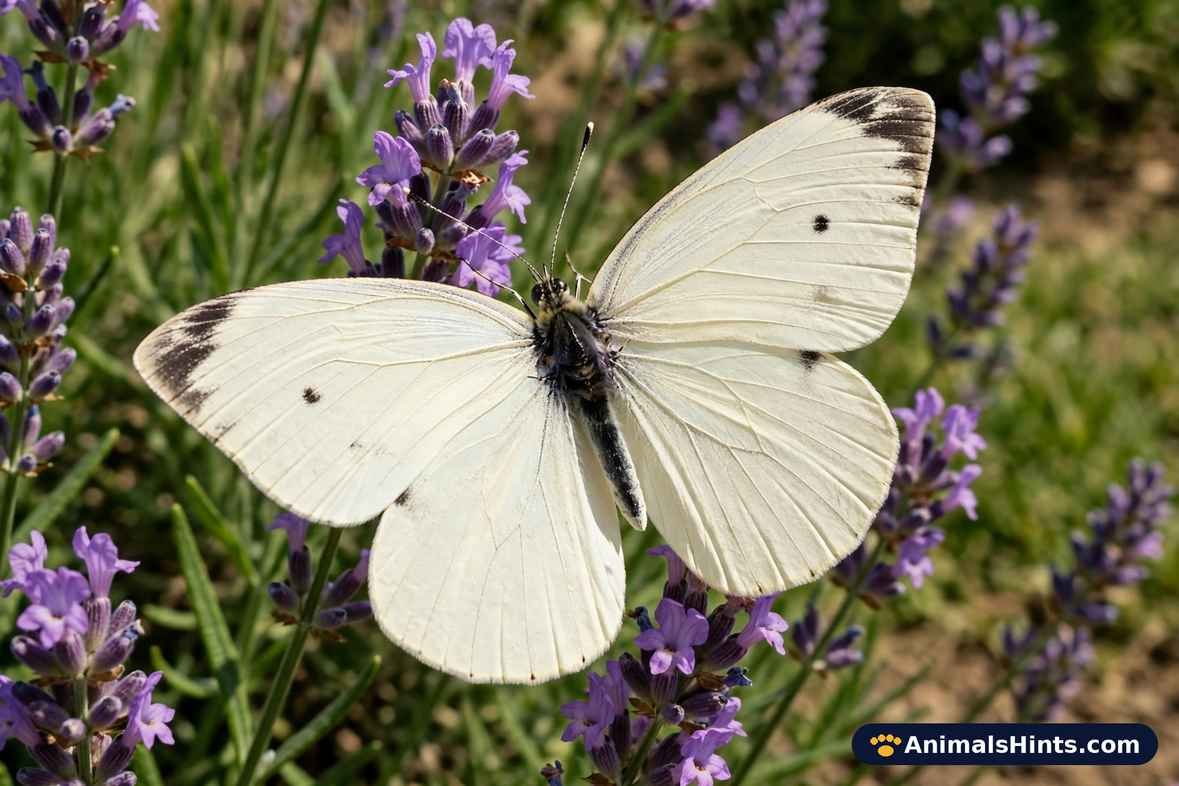
No species answers to the name “white butterfly” on its own. The phrase describes a look, and in North America and Europe that look belongs mostly to the whites of the family Pieridae — day-flying, medium-small butterflies whose wings carry pigments from a chemical family called the pterins. Three of them account for the great majority of sightings behind this search.
The cabbage white (Pieris rapae) is the default. Europeans call it the small white; North Americans know its caterpillar as the imported cabbageworm. The University of Florida’s Featured Creatures account records that it was first observed on this continent at Quebec City in 1860, spread rapidly, and had reached the Gulf Coast and Rocky Mountain states by 1886. Adults span roughly 32 to 47 millimetres. The upperside is creamy white with a dusky patch at the forewing tip; males carry a single dark spot on each forewing, females two. Its green, velvety caterpillars feed on the cabbage family — cabbage, kale, broccoli, cauliflower, collards, horseradish — and gardeners class the species as a genuine crop pest. The white butterfly of the omens, in other words, is very often this hungry little immigrant working a vegetable patch.
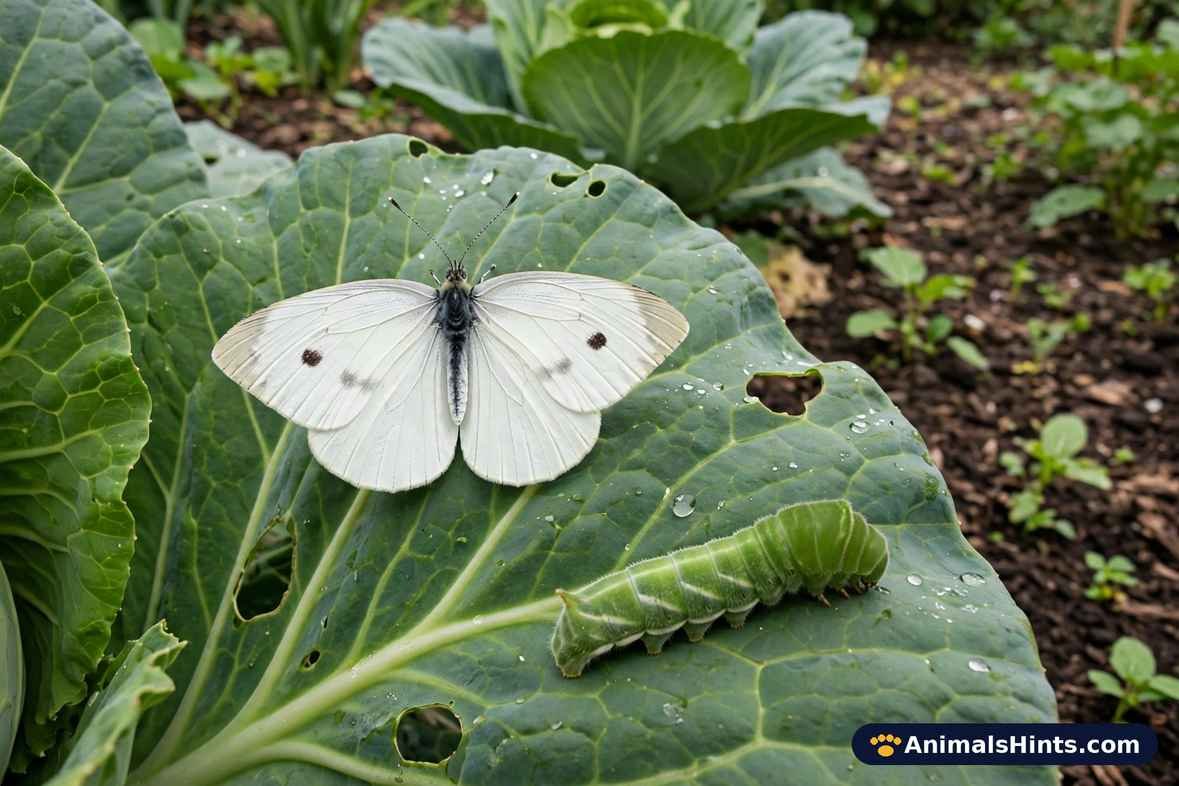
Its bigger cousin, the large white (Pieris brassicae), is a size up in every direction: Butterfly Conservation gives a wingspan of 63 to 70 millimetres, with bold black forewing tips and, in females, two large dark forewing spots. Where the cabbage white lays eggs singly, the large white lays them in batches, and its caterpillars — yellow, black-spotted and hairy — feed in conspicuous groups on the same brassica menu.
The third common species is the one most often misnamed. The green-veined white (Pieris napi) looks almost plain white from above, but turn it over and the hindwing underside carries grey-green scaling dusted along every vein, giving a striped, frosted effect. It prefers damper ground than its cousins — meadow edges, ditches, woodland rides — and its caterpillars lean toward wild crucifers rather than the cabbage patch, so it never earned the pest reputation.
Why are these wings white at all? The colour is chemistry, not bleaching. Research published in the Journal of Insect Physiology established that pierid wing reflectance comes from light scattering through the scale structure combined with pterin pigments stored in granules on the scales. The white species are loaded with one particular pterin, leucopterin, which absorbs only in the ultraviolet — absorbing nothing the human eye can see, it leaves the wing looking white to us. The name itself is a small poem: leucopterin is built from the Greek leukos, white, and pteron, wing. It makes one more appearance, in the final section below.
One correction belongs here, because the whole transformation file leans on it. A butterfly caterpillar does not rest inside a cocoon. It sheds its final skin, and what stands there is a chrysalis: the pupal body itself, its surface hardened into a case. Cocoons are silk wrappings spun by moth caterpillars around their pupae; no butterfly spins one. The competitor page for this topic uses “cocoon” in its fourth meaning, and the slip is worth fixing on the record: every emergence story below is, in the real animal, a chrysalis story — change without a woven shelter, done in the open.
What Does Seeing a White Butterfly Symbolize?
In the shared modern tradition, a white butterfly symbolizes the soul at peace and a life entering a cleaner chapter. White brings its own file to the meeting — light, innocence, mourning in several cultures, the colour of beginnings washed free of what went before — and the butterfly brings transformation, the creature that remakes itself entirely and flies. Set together, the tradition reads the pairing as change without threat: nothing about this visitor is filed as alarming.
That is why sightings cluster, in readers’ accounts, around hospital corridors, funerals, christenings and the first weeks in a new home. The genre’s summary usually settles on four lines:
- Purity. A mind or a chapter unclouded — the headline reading, and the last of the eleven below.
- A soul nearby. The oldest strand on this page: the dead, or the living spirit, travelling on wings.
- Hope during healing. The sighting filed as evidence that recovery, of body or of heart, is genuinely under way.
- Protection. White wings read as a guard posted — a watched-over feeling the tradition attaches to this colour above all others.
Read the four at the strength their holders give them. They are the genre’s grammar, not findings about the insect, and the sections below keep the two registers — belief and biology — in separate columns throughout.
11 Spiritual Meanings of White Butterflies
Eleven readings follow, kept in the sequence the genre gives them. Treat every one as a belief held by somebody, somewhere — not as zoology, and not as a forecast aimed at you.
1. Symbol of Hope
The first reading, and the one claimed at the heaviest moments. A white butterfly arriving while life feels dark is filed as proof that brightness has not been cancelled — only postponed. The guides frame it small on purpose: not a promise that everything resolves, but a reminder that the season a person is in is a season, with another one behind it.
2. Healing Journey
Here the butterfly’s unhurried flight is read against the pace of recovery itself: slow, uneven, mostly invisible from outside. The sighting is taken as a progress marker by readers mending after illness, surgery or grief — evidence, in the tradition’s telling, that the softening of an old wound is real even when it cannot yet be felt. The attached counsel is gentleness toward oneself, forgiveness included, offered as the medium healing travels in.
3. Spiritual Protection
The guardian reading. White wings are filed as a shield raised by whatever a reader’s own framework supplies — angels, ancestors, a watching universe — and the butterfly’s habit of appearing at vulnerable moments is treated as the guard making itself known. Printed as belief, at exactly that strength: the feeling of being accompanied is well attested by the people who report it; its source is a matter of faith, and this page leaves it there.
4. Transformation and Enlightenment
The metamorphosis meaning, and this page’s place for one factual repair. The competitor’s version of this meaning rests the caterpillar “inside a cocoon”; butterflies make no such thing, as the species section sets out — the waiting stage is a chrysalis, the animal’s own body remade into a case. The tradition’s point survives the correction intact: the hidden, motionless stage is where the actual rebuilding happens, and the white adult is read as enlightenment pictured — a mind that has come through its dark room and taken wing.
5. Connection to the Soul and Love
The soul strand applied to the living. In this reading the butterfly stands for the part of a person that travels — in dreams, in thought, in love that distance does not interrupt — and a sighting is taken as a nudge toward the people that soul is tied to. It is the list’s most relational meaning: less about the reader alone than about bonds the tradition treats as unbreakable, including bonds with the dead, which the ninth meaning takes up directly.
6. Divine Connection
A close neighbour of the protection reading, separated by direction. Protection looks down, at the reader being watched; this one looks up, at the reader being addressed. A white butterfly is filed as a brief opening between the everyday world and whatever lies past it — a moment readers describe with words like clarity and alignment, and treat as an invitation to prayer, meditation or simple attention, according to their own path.
7. Sign of Transformation and New Beginnings
The fresh-start reading, distinguished from the fourth meaning by scope: that one is inward, this one is biographical. Jobs, homes, relationships, names — the sighting is claimed at the seams where one arrangement ends and another has not yet hardened. Its counsel in the guides is release: the old form is not carried into the new one, in the insect’s life or, the tradition argues, in ours.
8. Representation of Serenity and Calm
The temperament reading. Watch a cabbage white work a garden — buoyant, unhurried, impossible to startle into speed — and the tradition’s point makes itself: calm filed not as escape from disorder but as a way of moving inside it. Readers claim this meaning during noisy seasons, and its practice is the smallest on the list: pause, breathe, let one thing be simple.
9. Message from Deceased Loved Ones
The meaning this colour owns outright. In the folk record set out in the cultures section below, white butterflies specifically — not butterflies in general — are the ones read as the dead returning: a soul at peace, checking in. Sightings after a bereavement, near a grave or on an anniversary, are filed by their holders as visitations, and the emotional force of the experience is not in dispute. What the visit is belongs to belief; this article reports the tradition, which is old, widespread and documented, and lets it stand at that.
10. Indicator of Spiritual Awakening
The frequency reading: one butterfly is an encounter, but a season of them is filed as a threshold. Readers in the genre describe sharpened intuition, changed priorities and a sense of being re-taught how to look at ordinary things, and they read repeated white sightings as the marker of that shift. Sceptics will note that a person newly attentive to butterflies naturally sees more butterflies; the tradition answers that the attention itself is the awakening. Both sentences are printed, and the reader can keep whichever fits.
11. Symbol of Purity and Innocence
The closing reading returns to the colour itself. White, in this file, is the state before anything has been written on it — honesty, cleanness of intent, the unburdened conscience — and the butterfly is its most innocent available carrier: an insect that harms nothing in its adult life, living on nectar and days. The sighting is read as an invitation to act from that place: plainly, kindly, without the accumulated grime of grievance.
Significance of White Butterflies in Different Cultures and Religions
Five older strands sit beneath the modern list, taken here in the competitor’s sequence and weighed one by one against whatever evidence could be found for them. The soul strands turn out to be the sturdy ones.
In Christianity, begin with a gap: the Bible never mentions any butterfly, white ones included, so there is no verse to quote on this subject. What exists instead is a teaching picture the church developed over later centuries — the caterpillar’s stillness, the sealed case, the winged emergence — used to preach death, burial and resurrection to congregations. A white adult slots into that picture at its most luminous point, and present-day believers read it there as purity and God’s nearness. Named plainly, it loses nothing: later devotional imagery, honestly labelled, rather than a quotation dressed up as scripture.
In Japanese culture, the strand is documented at unusual strength. Lafcadio Hearn, recording Japanese belief in Kwaidan (1904), wrote that a butterfly may be the soul of a dead person as readily as of a living one, that souls take butterfly shape to announce their final departure from the body, and that any butterfly entering a house ought therefore to be treated kindly. Hearn even preserves a hokku asking of a white butterfly on a pink flower: whose spirit is it? His most famous telling is a story rather than a doctrine — a dying old man’s sweetheart, dead fifty years, arriving at his pillow as a great white butterfly and leading his nephew to her grave. Printed at record strength: this is the best-documented white-butterfly soul tradition on the page.
In Chinese tradition, the documented butterfly file concerns love and long life rather than souls: two butterflies together signify married love, a pairing art fixed forever through the Butterfly Lovers — Liang Shanbo and Zhu Yingtai, separated throughout their lives and united, after death, as butterflies. A white pair read through that lens becomes enduring love in its quietest colour. The competitor’s further claim — that a white butterfly in China specifically signals good luck before major events — is the modern genre’s extension of that file, and it is printed at that lower strength, not as record.
In Native American beliefs, butterflies are kept across many distinct Indigenous nations as travelling, wish-carrying figures associated with change and the spirit world — a general butterfly file, documented broadly, whose teachings differ nation by nation and are not one system. The competitor assigns white specifically to peace, purity and healing; that colour-by-colour assignment is present-day genre work laid over the general file, and no single nation’s white-butterfly doctrine is asserted on this page, since none could be verified behind it.
In Celtic symbolism, the foundation is Irish, and it is unusually specific. Irish folk record, retold in folklore collections from Lady Wilde’s Ancient Legends of Ireland onward, holds that butterflies are the souls of the dead — her telling of the first butterfly seen in Ireland has a scholar’s soul leave his body in that shape, after which, the story says, all men knew what butterflies were. The white-specific layer is sharper still: white butterflies were held to carry the souls of dead children, and later folklore summaries record that killing one was forbidden in Ireland into the 1600s. The colour assignment the competitor prints — children, guidance, protection from harm — rests on that documented core; the strand is record, not invention.
What Does It Mean When a White Butterfly Is Flying Around You or Landing on You?
Contact is graded in this lore, as it is for the other colours: a glimpse across a garden counts as one sort of sign, while a butterfly orbiting you, or choosing your hand as a perch, counts as quite another — the general meanings narrowed down to one addressee. Our dedicated guide to what it means when a butterfly lands on you covers the experience across all species; what follows is the white form of it, set next to the plain natural history.
A white butterfly haunting one corner of a garden is generally attending to its own agenda. Cabbage whites work a beat: the males cruise hedge lines hunting mates, the females drift low across brassica beds, sampling leaves with their feet before trusting eggs to any of them. A warm, motionless person inside that circuit may simply be inspected — you happen to occupy the sunny, flower-rich spot the insect had already claimed. The lore, for its part, fastens onto exactly that persistence and reads it as a message refusing to depart unnoticed. Both accounts can be true at once in their separate lanes, and this page keeps the lanes apart.
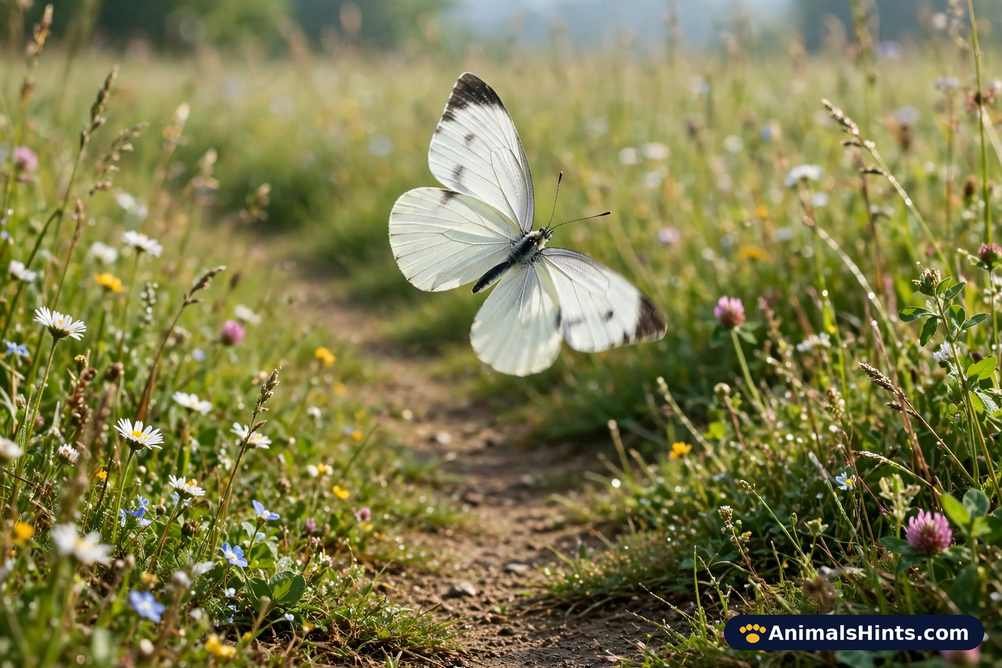
A landing, too, has an unromantic natural account. Human skin is salty: perspiration delivers sodium, which nectar does not, and butterflies seek it out — the same drive that draws them to muddy puddles, where the habit gets its name, puddling. A white settled on your arm may want only minerals, or warmth, or shelter from a gust of wind. The lore reads the identical event as delivery by hand: somebody departed, checking in; or a fresh chapter starting within arm’s reach. Whichever reading you prefer, the etiquette is fixed — hold still, take the visit at its full length, and let your guest depart unhurried. Never close fingers around one; the scales that make those wings white brush off at a touch.
White Butterfly Symbolism in Love, Relationship, and Twin Flame
In love, the tradition reads the white butterfly as the purity emblem: affection without appetite for control. For the single reader, a sighting is filed in the guides as a sign that a gentler kind of connection is possible — one that begins in honesty rather than performance. If you are already partnered, the same butterfly is taken as a forgiveness marker inside an existing bond: old patterns shed, the relationship re-entering the world in a cleaner form, the way the adult insect leaves the chrysalis it no longer needs.
The twin flame framework gives this colour its most exact modern job. Twin flames, in that present-day teaching, are one soul in two halves, and separation between them is read as a season of separate growth; a white butterfly appearing during such a separation is filed as reassurance that both halves are evolving on schedule and that any reunion belongs to its proper timing rather than to forcing. Sightings while thinking of the other person are treated, inside that literature, as confirmation the connection is protected.
None of the above is offered as anything but belief. The twin flame system is a recent construction — nobody inherited it from an ancient tradition, and it describes no verified law of relationships — yet its adherents plainly find the white butterfly a workable emblem for a bond they mean to keep uncontaminated by old injuries. If the system is not yours, the durable sentence in this section still stands: every version of the lore makes this insect the sign of a love that can be approached undefended.
What It Means to Dream About White Butterflies
Dream interpretation takes the daytime symbolism and re-applies it to sleep, weighing the dream’s emotional tone as evidence in its own right. Four scenarios, drawn from the competitor’s page and retold in new words, cover most of what dreamers report:
- A single white butterfly fluttering freely — read as emergence: the dreamer surfacing from a hard stretch into clarity, healing filed as nearly complete.
- Several white butterflies together — harmony in the lore’s shorthand: relationships settling into agreement, or a change arriving that pleases more people than the dreamer.
- A white butterfly lands on the dreamer — comfort received personally: a guardian presence near at hand, reassurance that the path being walked is the right one.
- The butterfly flies away and does not return — release: something whose season has ended being let go, filed as healthy rather than as loss.
One rule governs all four readings in the lore: go by the feeling the dream leaves behind. Peace on waking turns any of these images into encouragement; unease turns them into a prompt about unfinished business. Sleep science accounts for such dreams through memory and emotion processing, which does not compete with the lore — the two frameworks address different needs. And a boundary worth keeping: a single vivid night is only a single night. Dreams that recur and genuinely distress you belong in a daytime conversation — with a doctor, a counsellor or a trusted friend — not in a symbol dictionary.
How the White Butterfly’s Meaning Differs From Other Butterflies
White is easiest to place against its nearest neighbours — the colours whose files sit closest to its own on this site. The comparison runs on two axes at once: what the real insects are, and what the tradition does with them.
| Colour | The real insects behind it | The tradition’s core reading |
|---|---|---|
| White | Cabbage, large and green-veined whites (pierids) | Purity and the visiting soul: comfort, cleansing, gentle beginnings |
| Blue and black | Pipevine swallowtail and its mimics | Healing through the dark: truth spoken out of a hard season |
| Black and yellow | Tiger, black, giant and two-tailed swallowtails | Balance: light and dark carried together on one wing |
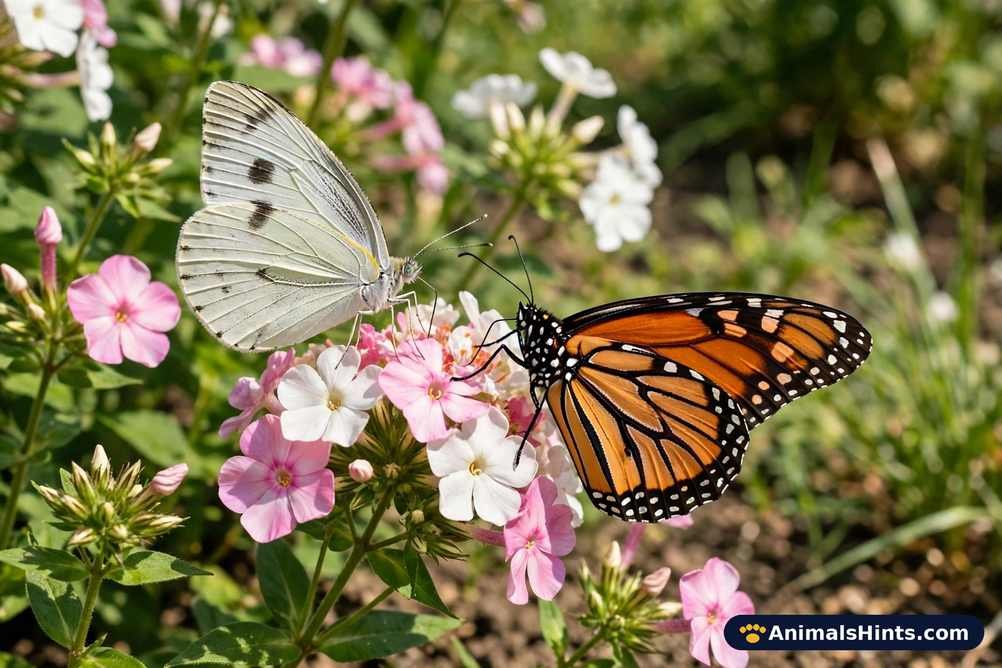
The blue and black butterfly shares white’s family resemblance — the soul file — both pairings are read as word from the far side of a loss — but its register is heavier: grief worked through, not comfort delivered. Nearer in temperature is the monarch butterfly, whose orange file also carries the returning dead, on the strength of a real migration; the white’s version of that reading is local and personal, a single garden visitor rather than a continental arrival.
The single colours sort themselves around it. The blue butterfly is where calm and wishing live, with rarity folded in. The orange butterfly brings heat of a friendly kind — creativity and encouragement. A green butterfly carries growth and luck; a brown butterfly sits at the family’s grounded end, all home and patience. The red butterfly pushes toward passion and urgency, the purple butterfly turns the soul material regal and introspective, and the black and yellow butterfly poses its equilibrium question — can a change’s two halves be borne together? White asks something softer than any of them: not what is changing, but who is near, and whether the chapter opening can be entered clean.
Seeing a White Butterfly: Good or Bad Omen?
Ask the lore and the verdict is unusually unanimous: favourable. Source after source consulted for this article files the sighting under comfort — hope, healing, protection, a beginning — and nothing in the older material files a white butterfly among warnings. The two best-documented soul traditions, the Irish and the Japanese, agree on the etiquette too: receive the visitor gently; fear has no part in it.
One footnote deserves space, for the sake of readers who land here anxious. Precisely because these butterflies stand for the returning dead, an encounter inside raw grief can feel weighty even when its assigned message is loving — and in Japan, where white is also mourning dress, the association runs deeper still. In this file, though, “favourable” is permitted to arrive quietly: at a graveside, along a hospital corridor. Context tunes the reading without reversing it — bereavement hears a visit, convalescence hears progress, a fresh start hears permission to travel light. Beyond the lore, the plain summary stands: a pierid going about its season in country it enjoys, which the lore has always counted as a good start in itself.
What to Do When You See a White Butterfly
Five habits cover the practical side, and the first of them is this page’s identification lesson in disguise: identify the insect before interpreting the encounter. A named species makes any meaning taken from the moment considerably sharper.
- Name the species first. Small, dusky-tipped, one dark forewing spot: a male cabbage white. Two spots: his mate. Far bigger, with heavy black tips sweeping down the wing margin: a large white. Frosted grey-green veins beneath the hindwing: the green-veined white of damp places.
- Watch what it was doing. Cruising a hedge, quartering cabbages, sipping at wet earth, basking flat in sunshine — all routine pierid occupations. Knowing which one you witnessed keeps the wonder honest.
- Never grab one. Scales shed onto skin, and a handled butterfly flies damaged, if it flies. A white riding your sleeve wants the salt on it and will depart unaided once satisfied.
- Log the encounter. Species, plant, place, weather, hour. Jotted in a notebook or photographed into a citizen-science scheme, five seconds of attention becomes a record that survives the day.
- Borrow one prompt, if any. The lore’s suggestions run to a forgiveness offered, a beginning started unencumbered, a quiet minute actually taken. Pick the one the moment genuinely indicates, act on it today, and allow everything else in the symbolism to remain decoration.
How to Welcome White Butterflies to Your Garden
Welcoming these butterflies means gardening backwards: the adults overhead in June were decided months earlier, at the caterpillar stage, by whatever host plants were standing then. With pierids the host list is the cabbage family, which makes this welcome the simplest on the site to arrange — and the only one that asks the gardener to share dinner. The velvety green caterpillar of the cabbage white eats brassicas and little else, so the highest-value planting here is a sacrificial row: cabbage, kale or nasturtiums (a mustard-oil-bearing relative the species also accepts), sown for the insects at a distance from the heads destined for the kitchen.

For the green-veined white, leave the wilder margin alone: wild crucifers along a damp ditch or hedge bottom, unmown until spring is well advanced. Feed the adults from the earliest warm weeks until frost with open, clustered flowers — lavender, marjoram, asters. Spray nothing: no insecticide distinguishes a cabbageworm from a pest you genuinely want rid of. Add a shallow saucer of wet, lightly salted sand in a sunny spot, and the minerals butterflies otherwise harvest from skin and sleeves are available on the ground. Finally, let one corner stand rough through winter. Pierid chrysalises pass the cold months tucked against stems and fences in precisely such untidiness, hanging on in camouflage until the light returns.
Final Thoughts
Taken as a whole, this is the kindest file in the butterfly collection — no warning in it, no riddle, only a visitation: purity, hope and a sense that the dead are near, borne on the plainest wings in the garden. Eleven meanings approach that one idea from eleven sides, and the older cultures behind them — an Irish scholar whose soul took wing, a Japanese sweetheart returning after fifty years — converge on the insect while differing on the interpretation: this is comfort, arriving unannounced.
The insect itself endorses the reading after its fashion. The whiteness is no blank: it is a physical pigment, crammed into the wing scales until the surface throws daylight back at the eye. And the biography underneath performs the emblem without any symbolism at all — the concealed chrysalis, the short bright adulthood, a garden crossed inside a few weeks. The pigment in question is leucopterin, its name assembled, aptly, from the Greek for white and for wing. Symbol and animal fit each other unusually well here: the creature readers take for a soul at peace has, all along, specialised in quiet arrivals.
FAQs
What does a white butterfly symbolize spiritually?
Purity first, in the tradition’s settled answer: a clean chapter, a guarded soul and hope during healing — with the colour’s oldest file underneath, the white butterfly as a departed loved one visiting. It is filed as comfort in nearly every strand that mentions it.
What is the significance of the white butterfly in different cultures?
Two strands stand as documented record: Japan, where Hearn set down the butterfly as a soul — of the dead and the living alike — to be treated kindly indoors; and Ireland, where folk belief made white butterflies the carriers of children’s souls and long forbade killing them. China’s file is love and longevity; the resurrection picture is Christianity’s later teaching image.
What does it mean when you see a white butterfly?
Within the tradition: reassurance pitched to your circumstance — a visit in grief, a progress report in recovery, permission at a beginning. In ordinary natural terms, a pierid is simply working good habitat in season; most sightings are cabbage, large or green-veined whites.
How should I respond to seeing a white butterfly?
Begin with the animal: size, spots and wingtips will generally identify it, using the sorting notes above. Then take the lore at the value its own holders assign — perhaps one forgiveness offered, one beginning started clean, one minute of quiet — and allow the encounter to be marvellous before it is meaningful.