Green Eyes Spiritual Meaning: 15 Meanings, Myths, Personality and the Science
Of all the colours an iris can wear, green is the one people stop for. It is the rarest of the major eye colours, it changes with the light in the room, and for centuries it has collected stories the way a harbour collects ships. The spiritual meaning of green eyes, as the symbolism guides hand it down, gathers those stories into a shelf: intuition, healing, a bond with the living world, and a personality read as calm on the surface and stubborn underneath.
This page follows the guides’ shelf in their own order — the symbol, the facts, the fifteen meanings, the personality lore, the myths, the dreams and the tattoo — with the labels kept honest as it goes. What the guides teach is printed as their teaching, attributed and never upgraded into fact. Underneath the folklore sits a real piece of optics, and that gets its own sections too, because the true story of this colour outruns most of the omens built on it.
One boundary is worth drawing before the shelf opens. An eye colour is not an event. Nobody’s iris flashes green for an afternoon to deliver a message; it is simply the colour a person was born with, set by their genes before they had a say in anything. The tradition on this page is therefore a reading of a permanent feature — folklore about what the colour means, not a forecast about what will happen — and the whole shelf is offered at exactly that strength throughout.
What Does Green Eye Symbolize
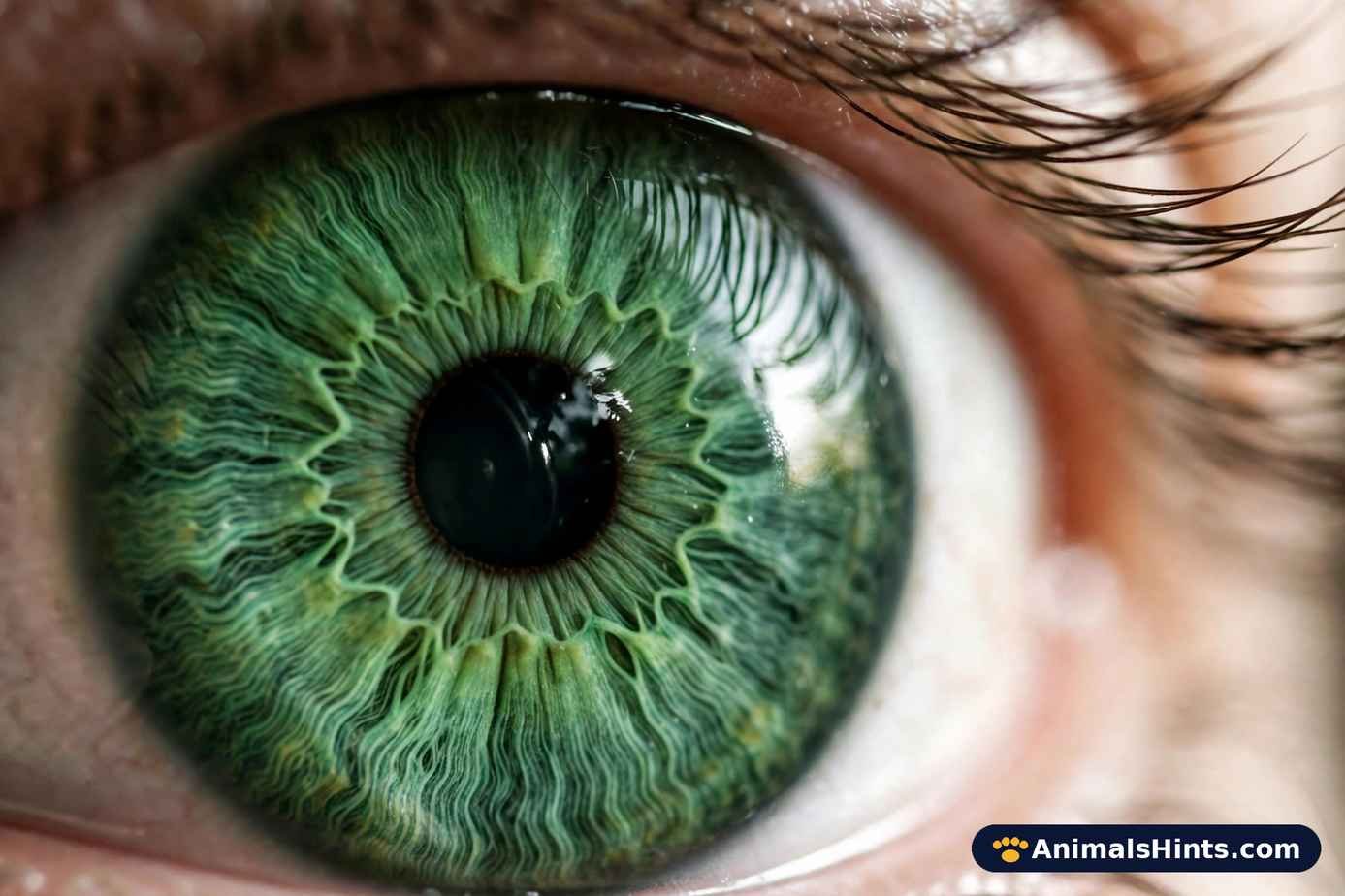
In the guides’ reading, the symbolism starts from the colour rather than the eye. Green is the colour their system assigns to living growth: new leaves, healing, fertility, the year’s renewal after winter. An iris wearing it is therefore read as carrying that register into a person’s face — vitality with a quiet centre, and a bridge, as several guides put it, between the visible world and the unseen one.
From that base the tradition builds its standard portrait. Green eyes are read as the sign of an intuitive person, someone who notices what has not been said yet; as a seeker’s colour, thoughtful and self-contained; and, through the colour’s older associations with love and protection, as a mark of someone whose presence steadies a room. None of this is presented by the better guides as measurement. It is a symbolic vocabulary — a way of talking about a striking feature — and the personality section below keeps it in that frame.
The colour-first method is the one this site applies across its whole colour shelf: it is the reading given to the green spiritual meaning itself, to the yellow spiritual meaning and to royal blue spiritual meaning — the iris simply gives the colour a face to live in. What green means in the system, green eyes are then said to lend to the person wearing them.
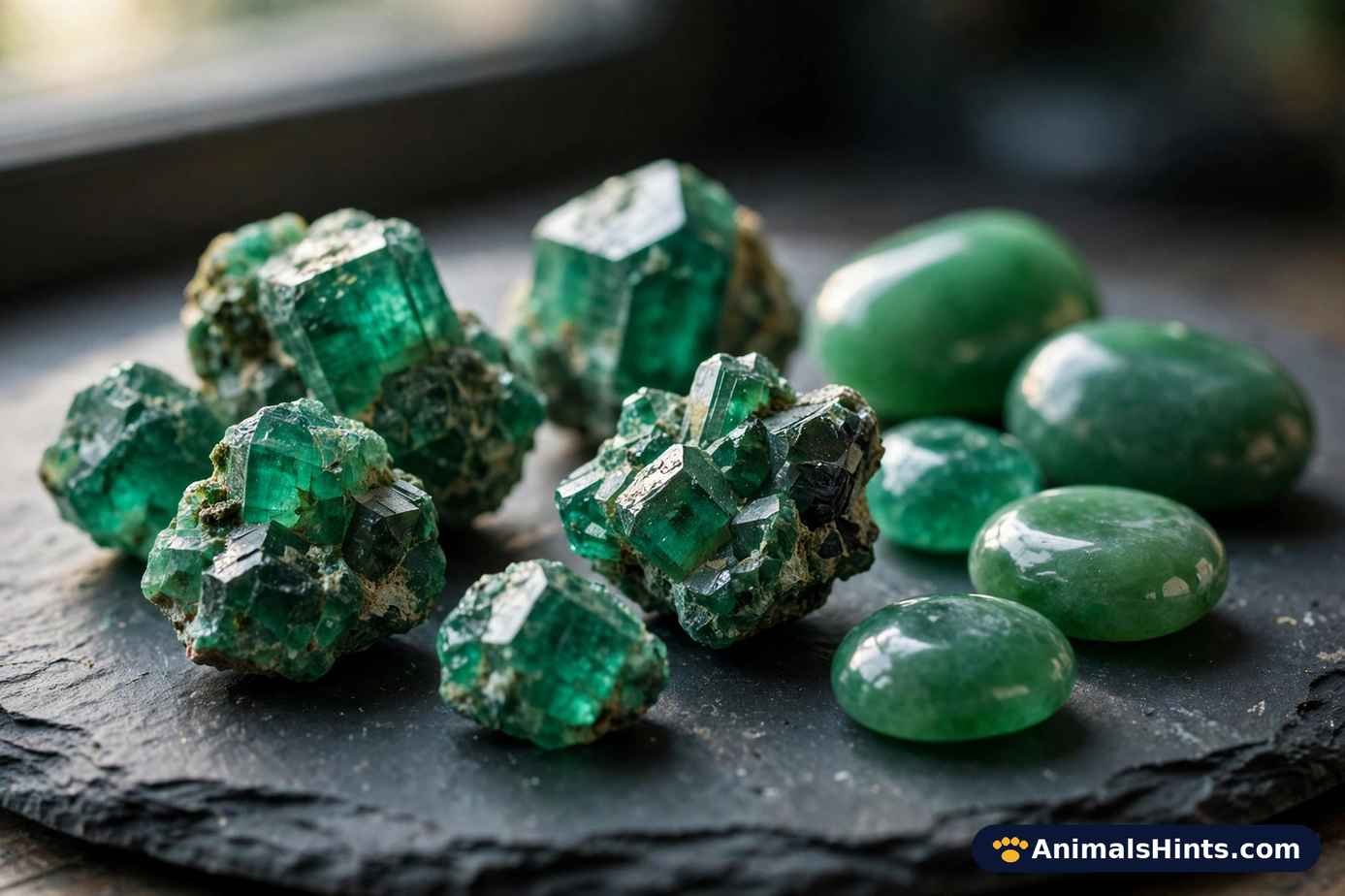
The Real Science of Green Eyes: No Green Pigment, Just Melanin and Scattered Light
Start with the fact the folklore never mentions: there is no green pigment in a green eye. None. The human iris works with a single family of pigment — melanin, the same brown-black and red-yellow pigment that colours skin and hair — and everything else is lighting. The American Academy of Ophthalmology puts the mechanism plainly: green eyes are not explained by the amount of melanin alone, but by how light scatters off the eye. The optical effect of that scattering, over the melanin that is present, is what makes the eye read as green.
The layers matter. At the back of the iris sits a dark sheet of pigment every healthy eye shares. In front of it lies the stroma, a spongy layer of collagen whose melanin load is the variable. Flood the stroma with melanin and the eye is brown, because the pigment absorbs the light outright. Nearly empty it, and the collagen scatters short wavelengths back at the viewer — the Tyndall scattering the physics literature names, a cousin of the effect that makes the sky blue — and the eye reads blue. Green is the middle setting: a low-to-moderate load of melanin, yellowish-brown in thin layers, laid over that scattered blue. Blue light seen through a yellow-brown filter is green. The colour is an outcome of optics, which is why it will not sit still — change the light, the angle or the colour of a shirt, and the same iris slides between emerald, moss and grey.
The genetics are correspondingly untidy. The old schoolbook rule — brown dominant, blue recessive, one gene — is wrong. A 2011 review in the Journal of Human Genetics counts about sixteen genes associated with eye colour, with two neighbours on chromosome 15, HERC2 and OCA2, doing most of the work: HERC2 carries a switch that regulates how much melanin OCA2 produces. Green sits in the narrow band that switch leaves between full production and almost none, which is one reason the colour is rare. The Academy’s figure, widely cited, puts green eyes at about 2% of the world’s population — the rarest of the major colours — concentrated in Northern, Western and Central Europe and uncommon almost everywhere else.
Two neighbours of green deserve their boundaries drawn. Hazel is not a paler green: it carries more melanin, spread unevenly, so the iris runs brown or gold around the pupil and green toward the rim, and it shifts its apparent colour more readily than true green does. And where the two eyes disagree with each other — or one iris holds two distinct colours — the clinical word is heterochromia, which the Academy lists in complete, partial and central forms; it is usually a harmless quirk a person is born with, and it is uncommon, affecting well under one person in a hundred. Neither condition is a shade of green, and the guides’ habit of sweeping both into the green shelf is one of the places their filing outruns the record.
Facts and Characteristic Features of Green Eyes
The guides open their factual shelf with rarity, and on that point the record agrees with them: green is among the rarest eye colours on earth, at the roughly 2% of humanity the Academy cites. Their second standing observation is also fair — the colour genuinely does appear to change, brightening in sunlight and dulling under grey skies, because a structural colour is at the mercy of the light that makes it. Where the guides’ fact shelf needs a correction is the ingredient list: several of them name a yellowish pigment, lipochrome, as a third component alongside melanin and scattered light. The review literature tells it more simply — the yellow cast comes from the melanin itself, thin layers of brown pigment reading yellow-brown — and the science section above follows the reviews. The table below is the guides’ own summary of the feature, carried as they print it.
| Feature | Description |
|---|---|
| Rarity | Among the rarest eye colors worldwide |
| Genetic Factors | Caused by multiple interacting genes |
| Melanin Level | Low to moderate |
| Common Shades | Emerald, olive, jade, hazel green |
| Light Effect | Appears brighter or softer depending on lighting |
Read against the record, the table holds up better than most: the genetics row is right that many genes interact, the melanin row matches the middle-band account, and the light row is the structural colour confessing itself. Only the shades row blurs a boundary the science section drew — hazel green is the guides’ phrase, where the clinics would call most of those eyes simply hazel.
15 Spiritual Meanings of Green Eyes
Fifteen readings make up the standard set the guides attach to this colour, set out below in their order and under their headings. They overlap one another — growth, renewal and nature recur like a chorus — because the set was assembled by many hands from one colour’s symbolism rather than designed as fifteen separate claims. Each is printed as the tradition’s reading, attributed, and none is a finding about any actual person.
1. Symbol of Growth and Renewal
The first reading is the colour’s own biography transferred to a face. Green is what the world wears when it starts again — shoots after rain, leaves after winter — and the guides read an iris in that colour as a sign of a person oriented the same way: growing, recovering, unfinished in the hopeful sense. Holders of the reading extend it to presence, claiming that green-eyed people carry a freshness others can feel, a calm forward motion rather than a restless one. As with every entry on this shelf, the claim is about the symbolism of the colour, offered for reflection; nothing in it is a measurement of anyone’s character.
2. Sign of Wisdom, Peace, and Determination in Cultural Traditions
The second reading gathers the colour’s reputation inside several cultural systems at once. The guides cite the face-reading traditions of China, where green tones are associated with gentleness and a peaceful temperament, and Buddhist-influenced readings where the colour stands for fresh beginnings. Under the calm, the guides insist, sits determination: the green-eyed person of this tradition observes before acting, chooses words carefully, and then pursues a goal with a focus that never has to announce itself. The composite — serene surface, stubborn engine — is the tradition’s portrait, printed as such.
3. Mark of Transformation and Life Energy
Here the guides lean on the colour’s brightness. Young grass and new moss are not subtle colours, and the reading takes green eyes as a mark of life energy in motion — a person who changes, repeatedly, rather than settling into one fixed version of themselves. The tradition extends the claim outward: such a person is said to push others toward their own changes merely by example. An undertow of intensity is part of the portrait too — passion expressed quietly but persistently, curiosity that keeps reopening settled questions. It is the shelf’s most dynamic reading, and it remains a reading: a story the colour tells in the guides’ system, not a biography of anyone wearing it.
4. Deep Connection to Earth and Nature
The fourth reading is the shelf’s most inevitable. An iris the colour of forests and hillsides is read as the sign of someone at home in the natural world — grounded, centred by time outdoors, steady in the way a landscape is steady. The guides describe dependability as the social form of this grounding: support offered without drama, calm that other people borrow in a crisis. A sensitivity to natural rhythm belongs to the same portrait — knowing when to push and when to rest, the way living things do. The reading flatters, as most of this shelf flatters; it is recorded here as the tradition’s claim, at the tradition’s strength.
5. Warning Sign Linked to Jealousy and Envy
The fifth reading is the shelf’s one shadow, and it has a documented literary root the others lack. English has called jealousy green-eyed ever since Shakespeare put the phrase “green-eyed monster” into Iago’s mouth in Othello — the full line is quoted in the myths section below, where the record lives. The guides take the association not as a slur on green-eyed people — they are explicit that it is not one — but as a mirror turned on everyone: the colour as a reminder to notice envy early, in oneself, before it starts making decisions. Read that way, the warning is really a discipline, and the tradition pairs it with its opposite — growth out of comparison into self-acceptance.
6. Deep Connection to Nature, Personal Growth, and Life Energy
The sixth reading restates the fourth in a more personal key, and the guides keep both because their emphases differ: where the earth reading is about groundedness, this one is about appetite. Green-eyed people are said to seek the outdoors the way others seek company, and to come back from it clearer and better balanced. The life-energy strand returns as well — green as the colour of expansion, of seeds becoming trees — applied to a person’s development across a lifetime. Even the dream shelf is pulled in: dreaming of green eyes, in this reading, marks a stage of renewal in the dreamer. It is the tradition repeating its central chord with a different stress, and it is printed as the tradition gives it.
7. Healing, Transformation, Creative Power, and Emotional Perception
The seventh reading bundles four of the colour’s associations into one portrait. Healing comes first: green is the colour that the modern chakra system and a shelf of folk practice tie to recovery, and the guides read green-eyed people as natural comforters whose company cools a heated room. Transformation follows from the colour’s refusal to sit still. Creative power is the guides’ third strand — the imagination fed by a colour that belongs to forests and storms — and emotional perception the fourth: an instinct for feelings before they are spoken, arriving as hunch rather than logic. Four claims, all attributed, none testable as stated; the shelf records what the tradition believes, and this page records the shelf.
8. Growth, Prosperity, and the Renewal Cycle of Nature
Prosperity enters the shelf here, carefully defined by the guides themselves as broader than money: emotional abundance, opportunity, relationships that hold. The mechanism of the reading is seasonal. Forests regrow, grass returns, leaves come back on bare branches — the guides read the green-eyed person as someone built on the same cycle, able to rebuild after loss and to keep growing through difficulty rather than around it. A fondness for spring and early summer, when the world performs the trick at full volume, completes the portrait. As a claim about character it is unverifiable; as a piece of colour symbolism it is at least internally consistent, which is all this page certifies.
9. Connection to Earth Colors, Intuition, Creativity, and Emotional Strength
The ninth reading files green among the earth colours and draws the consequences the guides draw from that filing: steadiness under uncertainty, balance found more easily than most people find it. Intuition returns in its quiet form — an inner knowing described as a nudge or a soft warning rather than a vision. Creativity is fed, in this telling, by the colour’s own imagery: gardens, mountains and fields as a standing prompt to the imagination. Emotional strength closes the bundle — feeling deeply while keeping a centre to return to. The guides present the four as one integrated temperament; the honest label for the bundle is the same as for its parts: attributed symbolism, not psychology.
10. Reflection on Beauty, Perception, and Inner Identity
The tenth reading turns the shelf around and looks at the observer. Rarity does philosophical work here: because green eyes fall outside the common run, the guides say, they force a question about beauty itself — how much of it is standard and how much is simply unfamiliarity wearing a judge’s robe. The reflection is then handed to the wearer: an unusual feature invites its owner to work out what makes them different, and the guides read that search as a road to self-awareness and confidence. Of the fifteen, this is the reading that survives translation into plain terms most easily — unusual features do prompt reflection — and it is still kept as the tradition’s framing rather than a finding.
11. Strong Inner Strength, Imagination, and Magnetic Personality
The eleventh reading is the shelf’s character portrait at full length. Inner strength of the unspectacular kind comes first — persistence, emotional depth, steadiness when a situation deteriorates — supported, in the guides’ telling, by intuition and careful judgment. Imagination follows, stocked by the colour’s landscapes, and credited with storytelling, problem-solving and original work. Magnetism closes the entry, and the guides are specific about its source: not charm performed for an audience but authenticity, a calm confidence that draws people without courting them. It is a flattering composite, and like all composites on this shelf it describes the tradition’s ideal reader of the colour — not a diagnosis of the next green-eyed person you meet.
12. Hope During Difficult Times and the Promise of New Beginnings
Hope is the twelfth reading, built from the same seasonal imagery as the growth entries but aimed at a different moment: not flourishing, but endurance. First leaves after winter and grass after rain are the guides’ chosen pictures — evidence, in their framing, that a hard season is a season and not a verdict. Green-eyed people are cast in this reading as carriers of that evidence for others: the friend whose steadiness or encouragement helps someone else regain clarity. The claim is about the comfort the tradition finds in the colour. Whether any individual actually comforts anyone is a question about that individual, and there this page leaves it.
13. Ability to Attract Transformation and Life Changing Experiences
The thirteenth reading makes transformation something that happens around the green-eyed person rather than inside them. In the guides’ telling, such people notice patterns and openings others walk past, and that awareness draws them into situations — relationships, work, encounters — that end up reshaping them. Life arrives in waves: rapid learning, then deep reflection, then change again. The mature form of the pattern, the tradition says, is the person who has been through enough cycles to guide others through theirs. It is the most narrative reading on the shelf, a plot rather than a trait, and this page prints it as the story the guides tell, nothing more.
14. Heart Chakra Connection, Love, Compassion, and Emotional Openness
The fourteenth reading runs through the modern chakra system, in which green is the colour assigned to the heart centre — the same colour system this site meets on its aura shelf, where the blue aura gets the neighbouring treatment. From that assignment the guides derive the entry’s whole content: love expressed steadily rather than theatrically, loyalty and vulnerability valued together, compassion shown in small unglamorous ways — listening without judging, noticing the unspoken thing. Forgiveness belongs here too, as the heart centre’s other portfolio: releasing old pain, rebuilding trust. One honesty note belongs inside the entry, and this page prints it wherever the chakra colours appear: the one-colour-per-centre rainbow scheme is a modern standardisation, younger than it is often presented as being, and the classical texts picture the centres differently. The reading is the modern system’s, and it is labelled accordingly.
15. Natural Healing Energy and the Call to Open the Heart
The fifteenth reading closes the set where the seventh began, with healing — but pitched as a message rather than a trait. The guides describe the healing energy as mostly emotional: a calm presence, stress eased in company, communication slowed down until it works. The call attached to it is the shelf’s final instruction: open the heart — soften rather than close off, choose honesty and vulnerability where closing would be easier. Green-eyed people, in this telling, receive the instruction repeatedly across a life, landing, again and again, in moments that ask compassion or forgiveness of them. The set thus ends as a piece of advice dressed as a description, which is a fair summary of the whole shelf — and it is printed, like the rest, as the tradition’s teaching rather than as fact.
Personality Traits of Green Eyed Individuals
The guides consolidate the fifteen readings into a single temperament, and it is worth meeting in one place — labelled, as it must be, as the tradition’s composite rather than a psychological profile. Sensitivity and strength are its headline pairing: passionate but patient, calm on the surface and expressive underneath, able to stay steady and able to push, as the moment requires. Creativity runs through it — an imagination that sparks easily, a feel for symbolic meanings, an eye for the detail everyone else walked past — and so does a particular social shape: the excellent listener, slow to trust, then loyal past the point of reason, protective of an inner world that opens only where it feels safe.
Confidence, in the composite, is rooted in self-awareness rather than display; charm is authenticity’s side effect; playfulness and appetite for new territory sit alongside a preference for meaningful conversation over small talk. The shadow side is admitted too — emotions that run strong enough to tip into moodiness, intensity that intimates feel even when it is not shown. The next section gives this portrait its necessary counterweight: what happened when researchers actually went looking for connections between eye colour and the person behind it.
What Science Has Actually Tested: Eye Colour and Personality
The honest answer is short enough to state plainly: no credible scientific evidence links iris colour to personality. Not to intuition, not to creativity, not to calm, magnetism or stubbornness. The fifteen readings and the composite portrait above are folklore — a tradition of interpretation — and psychology has never found the traits travelling with the colour.
What researchers have studied is the neighbouring question: not what green-eyed or brown-eyed people are like, but what other people perceive them to be like — and even there, the colour itself failed its best test. In a study published in PLoS ONE in 2013, Kleisner and colleagues had photographs of eighty students rated for trustworthiness; brown-eyed faces were rated more trustworthy than blue-eyed ones. But when the researchers digitally recoloured the eyes in the same photographs and ran the ratings again, the effect vanished. Their conclusion was that the impression was carried not by iris colour but by the facial features that happened to accompany it. An earlier study by the same group, on perceived dominance, reached the same shape of result. Perception research measures the beholder, not the beheld — and even as perception, it was the face, not the colour, doing the work.
That is the whole of the tested record available to stand on, and it points one way. Eye colour is a fact of optics and ancestry. Personality is a fact of a life. The guides’ shelf connects them by symbolism, which is a real cultural activity with a long history — and it is a different activity from evidence, which is why the two are kept in separate sections on this page.
Superstitions, Myths and Folklore Associated with Green Eyes
Underneath the modern guides sits older material, and it is wilder. The folklore record the guides inherit casts green-eyed figures as people with gifts: protectors who sense danger before it arrives, heart-readers, seers of what is beyond the physical. European story stocked its borderlands with them — healers and herb-wise women, witches in the cautionary tellings, woodland spirits and keepers of holy places in the kinder ones — and a parallel strand made the colour an emblem of enchanting beauty, the eyes that attract love without effort. Shapeshifter tales complete the set: beings who walk between worlds, wearing green eyes as the visible sign of the crossing.
Two cautions keep this section honest. The first is that what survives here are story-registers, not ethnography: the tales rarely sort themselves by named culture and dated source the way the guides imply, and this page repeats them at the strength they can bear — as the folklore motifs they are. The second is that the record is not uniformly admiring. Rarity made some communities suspicious of what they could not explain, and the witch strand of the folklore carried real danger for real women in its centuries. The guides mostly keep the admiration and drop the fear; the fuller record has both.
The one piece of this shelf that can be pinned to a page and a date is literary, and it is the source of meaning 5’s shadow. In Othello, Act 3, Iago warns the man he is destroying: “O, beware, my lord, of jealousy; / It is the green-eyed monster which doth mock / The meat it feeds on”. Shakespeare did not invent green’s link to envy from nothing — he had already written “green-eyed jealousy” in The Merchant of Venice — but the monster is his, and it is the reason English speakers still reach for the colour when they name the emotion. A playwright’s metaphor, four centuries old, is doing more documented work in this topic than any omen on the shelf.
What the Bible Actually Says About Eyes — and Why No Eye in It Is Green
Guides on this topic sometimes reach for scripture to weight the colour, so the record is given in full below — and it can be given completely, because it is a record of absence. In the King James Version, the word “green” returns 44 verse results (BibleGateway census; three topical entries besides). Read them and a pattern closes quickly: green herbs, green ears of corn, green trees, green pastures, a green olive tree, green hangings in a palace, a plague spot that is greenish. The word names vegetation, freshness and one dyed fabric. It never — not once — describes an eye, or any part of any person.
Nor does any other colour take its place. The Bible describes eyes constantly and colours them never. Leah’s whole portrait is an eye remark — “Leah was tender eyed; but Rachel was beautiful and well favoured” (Genesis 29:17) — and tender is a quality, not a colour. David is introduced as “ruddy, and withal of a beautiful countenance” (1 Samuel 16:12), a complexion, not an iris. The Song of Songs reaches for simile — “His eyes are as the eyes of doves by the rivers of waters, washed with milk, and fitly set” (Song of Solomon 5:12) — imagery of brightness and setting, still not a colour. The one eye feature this site has read at full length, the birthmark in eye meaning, meets the same boundary from the other side: marks, like colours, are simply never read as signs anywhere in the text. Green eyes’ spiritual shelf is a later, extra-biblical construction — folklore and modern symbolism — and it is more honest, not less interesting, for saying so.
Interpretations of Dream About Green Eyes
The dream shelf reads green eyes the way the waking shelf does, at one remove. In the guides’ dream lore, a person with green eyes appearing in a dream points the dreamer toward renewal or toward feelings not yet dealt with; the figure may stand for curiosity, for a truth the dreamer is circling, or for intuition waking up. A growth period is the commonest gloss — the subconscious, in this telling, flagging healing or an opening — and a protective or guiding presence is the second: the eyes as clarity arriving in person. Where the dream runs intense, the tradition reverses the direction and reads the eyes as a mirror: attraction, fear or longing the dreamer has not expressed awake, wearing the colour of the shelf that specialises in unspoken things.
Dream interpretation is the softest shelf in this whole genre, and this page prints it at that strength: these are the meanings the tradition assigns, offered as its vocabulary for a striking image, with no claim that a dream has been decoded. What a dream of green eyes most reliably documents is that the colour had already taken hold of the dreamer’s imagination while they were awake — which, given the colour, needs no supernatural machinery to explain.
Green Eyes Tattoo Meaning
The tattoo shelf takes the colour off the body it was born on and makes it a chosen emblem, and the guides read the choice through the same fifteen readings. An eye rendered in green is chosen, most often, as a statement of intuition or of a watchful spirit — a guardian image, in the protective strand of the folklore, set to keep negative energy at a distance. The colour adds its own register: life, balance, the renewal cycle. Others choose the design for the colour’s other face — mystery, passion, transformation, especially where the eye is drawn among leaves or animals — and a third group carries it as a memorial, the eyes of a specific person whose influence the wearer wants kept visible. The guides note, correctly, that the symbol’s flexibility is the point: a tattoo means what its wearer has loaded into it, and green simply gives the loading a rich shelf to draw from.
How to Read Green-Eye Meanings Honestly
Four checks, gathered from the sections above, are enough to read this whole topic at its true strength. First: the colour is optics. No iris anywhere holds a green pigment; there is melanin in a middle quantity and light scattering over it, and the colour’s famous shifting is physics, not mood. Second: the personality shelf is folklore. It is attributed belief with a long cultural history, and the one time researchers tested the neighbouring claim properly, the effect belonged to faces, not irises. Third: the Bible shelf is empty. Scripture’s green is grass and trees; no text colours an eye or reads one. Fourth: a colour is not an event. The signs this site usually reads — a left eye twitching spiritual meaning, an itch, a twitch — are things that happen to a person and stop; an iris colour is a thing a person is, set before birth. The tradition that reads it is doing something different from omen-reading: it is building a portrait out of a colour’s symbolism, and it is best enjoyed, and most honestly used, when that is understood.
None of this empties the topic. A colour carried by roughly one person in fifty, made by light rather than pigment, freighted by Shakespeare and by four centuries of story — it does not need omens to be worth a page. It needs only to be looked at accurately, folklore and physics each in their own labelled place.
Final Thoughts
Green eyes hold their fascination honestly at both ends of the record. At the physical end they are a narrow accident of dosage — enough melanin to tint the scattered light, not enough to hide it — that only about two people in a hundred carry, and that Northern and Central Europe kept while most of the world went brown. At the cultural end they are a screen four centuries of storytellers have projected onto: Shakespeare’s monster, the folklore’s seers and healers, the modern guides’ fifteen readings of growth, healing and quiet strength. The screen is not the eye, and this page has kept them separate on purpose; but a screen that size tells its own truth about the people doing the looking.
If the colour has a lesson that survives the separation, it is the one hidden in its rarest variation. Line up every iris shade the genes can deal and the strangest hand is not green at all — it is heterochromia, the two eyes dealt different colours, or one eye dealt two, a reminder that even the body’s most fixed features are dealt by a process with more combinations than categories. The guides were right about exactly one thing without knowing why: this corner of human variation really does reward a second look. It just rewards it with optics and history, which turn out to be enough.
FAQs
1. What is the spiritual meaning of green eyes?
In the guides’ tradition: intuition, healing, growth and a deep bond with nature, carried by the rarest of the main iris colours. It is attributed symbolism built on the colour green — scripture never colours an eye, and science finds no personality travelling with the iris.
2. What personality traits are associated with green eyes?
The tradition’s composite: sensitive yet strong, creative, observant, slow to trust and deeply loyal once trust is given, with intensity that can tip into moodiness. Those are the folklore’s claims, printed as its claims — tested research has found no link between iris colour and personality.
3. Are there myths about green eyes in different cultures?
Yes — the folklore record casts green-eyed figures as healers, seers, forest guardians and, in the cautionary strand, witches, with suspicion shadowing admiration wherever the colour was rarest. The one fully documented source is literary: Shakespeare’s “green-eyed monster” fixed the colour to jealousy in English for good.
4. Are green eyes rare, and does that affect their meaning?
Yes to the rarity: roughly two people in every hundred worldwide, on the American Academy of Ophthalmology’s widely cited figure, with the colour’s stronghold in the north and centre of Europe. The rarity plainly drives the meaning — the tradition loads significance onto the colour largely because so few people carry it — but the load is symbolism, and this page has labelled it as such throughout.