Raccoon Crossing Your Path: Spiritual Meaning, the Real Animal and the Honest Record
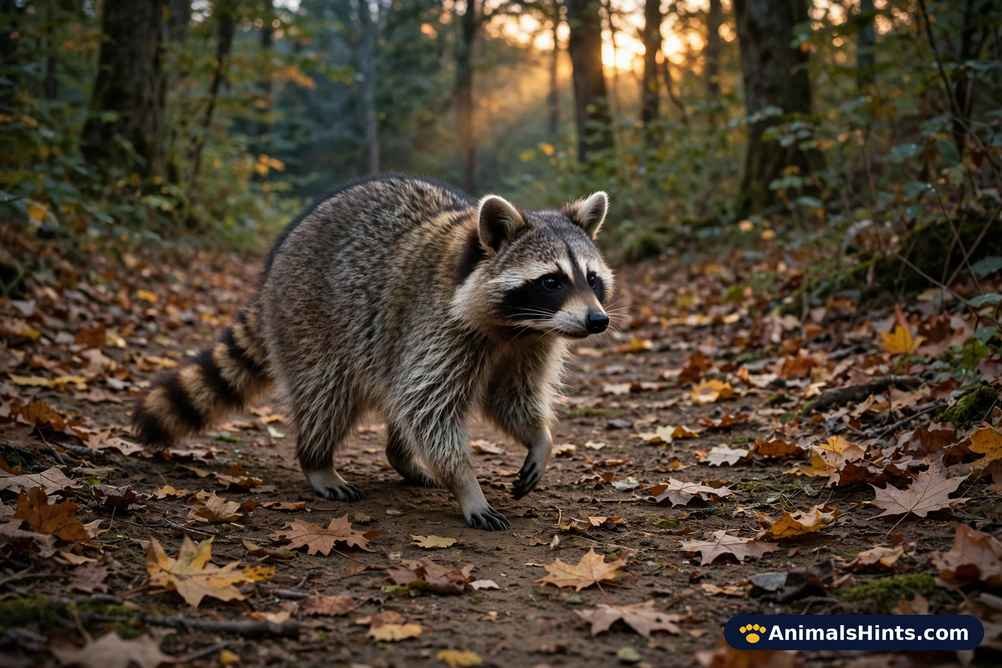
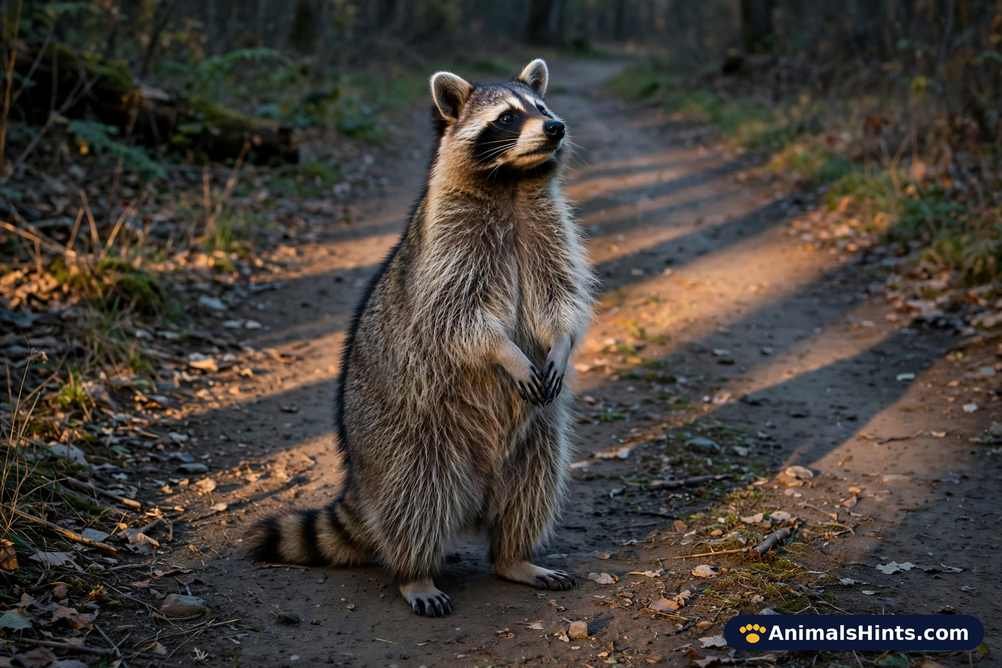
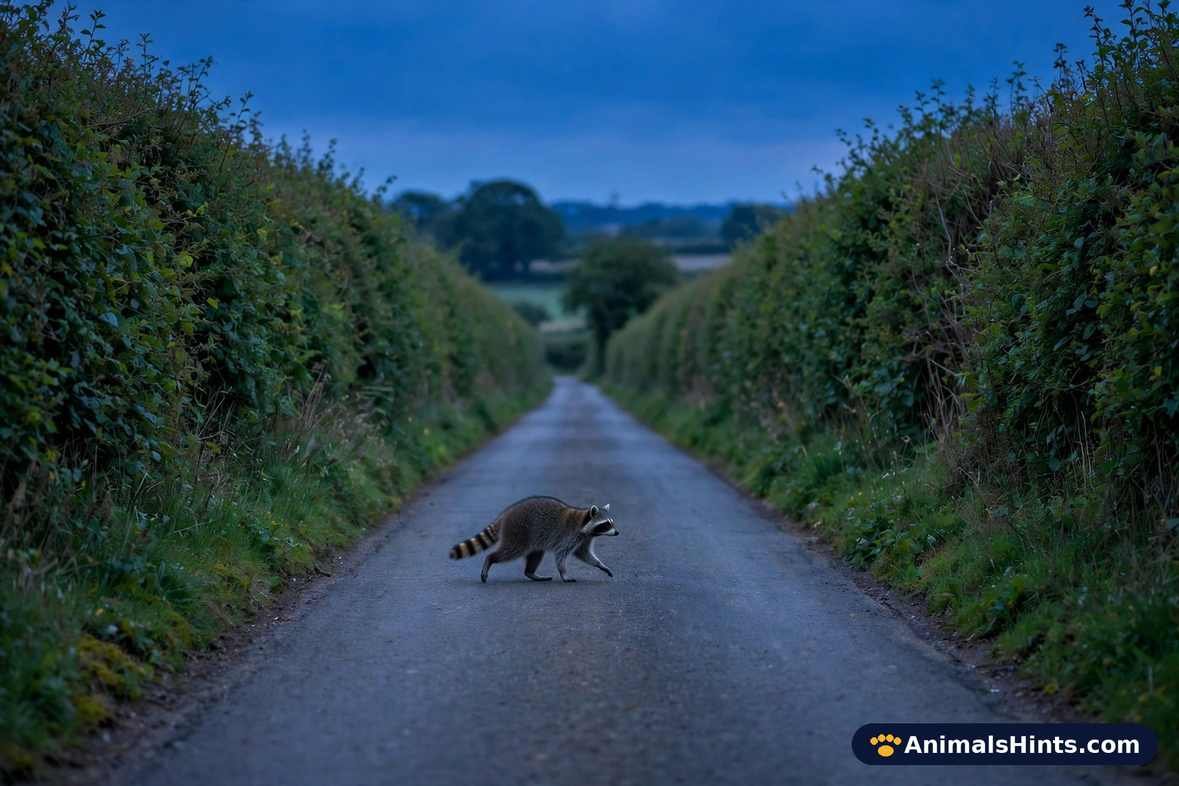
It usually happens at the edge of the light. A grey shape detaches itself from the hedge or the treeline, crosses in front of you at an unhurried amble, and — if it notices you at all — rises briefly on its hind legs for a better look before going on about its night. The spiritual meaning of a raccoon in your path, in the form the animal-sign tradition hands it down, is built from exactly that demeanour: adaptability, quick wits, and a masked face that asks what you might be hiding behind your own.
The source guide for this topic gathers the reading generously — eleven separate meanings, a refinement by the hour of the meeting, a strand for love, a strand for the yard, a biblical strand and a verdict on luck. All of it is set out complete in the pages below, and presented for what it is: a body of belief that its holders find useful, reported here without this page pretending to have proven any of it.
Then there is the animal itself, which repays attention on purely factual grounds — a creature that reads the world through its hands, remembers how a lock works for years, and carries risks that deserve plain statement rather than symbolism. So the real raccoon gets its own space below: its rounds, its senses, its diseases, the correct way to behave around one, the places where old writings genuinely contain it, and the places — scripture first among them — where it demonstrably is not.
What Does Seeing a Raccoon in Your Path Symbolize?
The tradition’s portrait of this animal rests on three qualities, and the first is sheer survivability. A raccoon is at home in a marsh, a cornfield, a city alley and a suburban attic, and the guides take that range as the core of the sign: the encounter stands as a reminder that adjustment is a skill, not a surrender — that the masked visitor in front of you has made a living in every landscape it has ever been offered, largely by refusing to specialise.
The second quality is the one the animal wears. No other common mammal goes about with its face painted like a burglar’s disguise, and the symbolism shelf makes heavy use of the mask. In the guides’ handling it stands for the unseen layer of things: motives not yet declared, knowledge not yet shared, and — turned inward — the parts of yourself you present to nobody. A crossing, on this strand, is an invitation to audit both directions: what might be concealed around you, and what you are concealing, and whether either concealment is still earning its keep.
The third quality is intelligence of a particular, manual kind. This is an animal that investigates the world by handling it, and the guides read the encounter accordingly — as a nudge toward curiosity, toward testing the latch instead of accepting the locked door, toward tackling the task in front of you with the tools already in your hands rather than waiting for better ones to arrive.
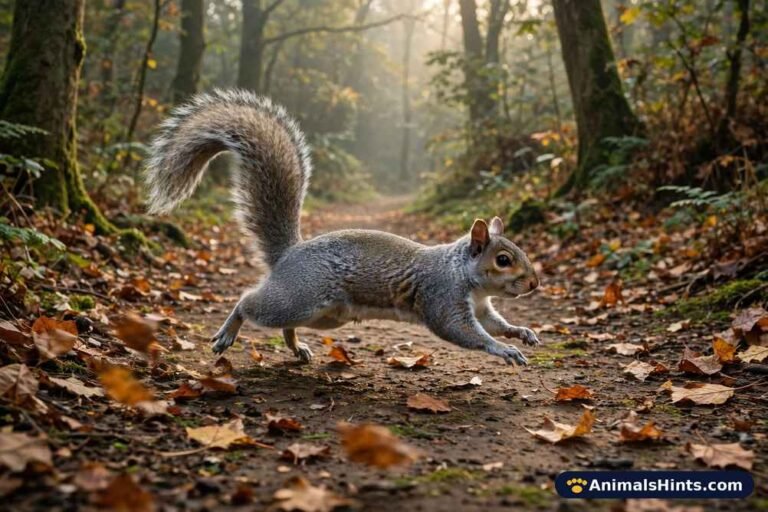
The shelf this site keeps for crossings lets the raccoon’s character sharpen against its neighbours. The skunk crossing your path material concerns an animal whose whole policy is a warning backed by a weapon; the raccoon carries no weapon worth the name and relies on wit instead. The squirrel crossing your path pages admire a planner that insures itself by storing; the raccoon stores nothing and trusts its ability to improvise supper out of whatever the night provides. And the dog crossing your path article deals with a domestic companion meeting you on shared ground; the raccoon is nobody’s companion — a wild neighbour whose interest in you is brief, practical and entirely on its own terms.
The Real Raccoon in Your Path
The mammal first — because a crossing reads very differently once you know what is actually doing the crossing. The animal is Procyon lotor, the largest member of the procyonid family, a stocky forty to seventy centimetres of grey-brown fur with a pointed muzzle, rounded ears, the famous dark mask across the eyes and a tail ringed in alternating bands. It is native to North America and at home from southern Canada deep into Central America, in forest, marsh, farmland and — increasingly, and on its own initiative — the city.
Its night is a working round. The raccoon is an omnivore with a catholic appetite: measured across the year, its diet runs to roughly forty percent invertebrates — crayfish, insects, worms — a third plant matter, and the rest small vertebrates, eggs and whatever else the territory offers, including, in town, the contents of all but the most secure rubbish bins. It dens in hollow trees, in burrows dug by other animals, in brush piles and occasionally in somebody’s chimney or attic, and it works a home range whose size depends on the richness of the ground. It is not built for speed — short legs under a compact body top out at a brief sprint — but it climbs superbly, swims well, and descends a trunk headfirst by rotating its hind feet backwards, an acrobatic trick very few mammals its size can manage.
What governs the whole performance is touch. A raccoon’s eyes serve it adequately at dusk and poorly at distance, and its world is therefore read by hand: the forepaws are hyper-sensitive, tipped with whisker-like vibrissae that can identify an object before contact is even made, and almost two-thirds of the sensory area of the raccoon’s cerebral cortex is given over to interpreting what the paws report — a larger share than in any other animal yet studied. The mask’s black banding may cut glare and sharpen the face’s expressions for other raccoons, but the eyes are not the main instrument. The hands are.
That is also the truth behind the animal’s most famous habit. A raccoon dabbling at a shoreline, rolling a morsel between its palms in the water, is not washing its food. Water softens the thin horny layer over the paws and heightens their sensitivity, so the dabbling is an examination — the animal feeling its supper in high resolution. Captive raccoons carry the motion to the food bowl as a fixed pattern left over from shore-foraging; the older theory that they lack the saliva to eat dry food has been discarded. Even the scientific name is a monument to the misunderstanding: lotor is Latin for “washer”, and the French and German names — raton laveur, Waschbär — repeat it.
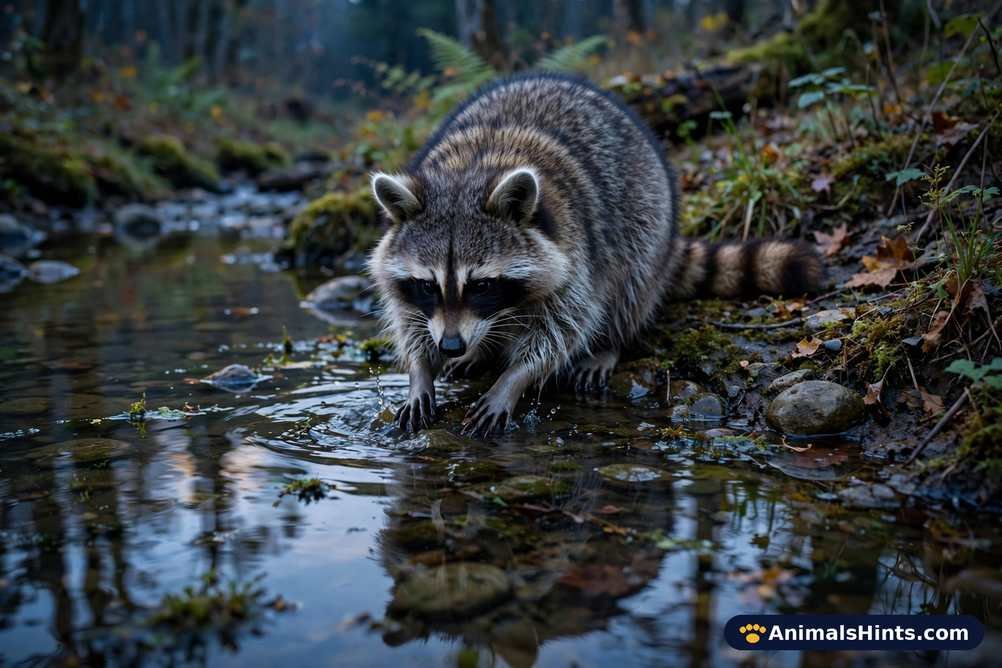
The intelligence the folklore admires is, unusually, a measured fact. In a 1908 study, raccoons opened eleven of thirteen complex locks in fewer than ten attempts each, and repeated the performance when the locks were rearranged or inverted; later work found they can hold the solution to a task in memory for at least three years. Set against that competence is a short wild life — a year and a half to three years is the usual span, against twenty or more in captivity — with vehicles and hunting the largest human causes of death, and disease, as the practical sections below set out, the largest natural one. A raccoon crossing your path is, in plain terms, a young, busy, touch-led professional at the height of its powers, halfway through a shift it runs every night of its life.
11 Spiritual Meanings of a Raccoon Crossing Your Path
The source guide counts eleven meanings for this encounter, and eleven is what it delivers — the full set is carried below, each stated the way its holders state it. Read them as a shelf of reflections rather than a set of findings; the raccoon in front of you, meanwhile, was thinking about none of them, which is why the real-animal sections of this page sit where they do.
1. Adaptability
First on the guide’s list, and the easiest to ground in the animal: circumstances change, and the raccoon is the tradition’s standing proof that change can be met without panic. Read this way, a crossing arrives when your own ground has shifted — a job, a home, a plan that no longer fits — and its counsel is that flexibility is not the consolation prize for people whose first choice failed. It is the first choice, practised nightly by a creature that eats from tide pools and tower blocks with the same equipment.
2. Cleverness
The second meaning honours the quality every observer of this animal ends up respecting. In the tradition’s handling, a raccoon crossing marks a problem that will not yield to force and is waiting, instead, for ingenuity — the side entrance, the patient test of each latch, the solution assembled from parts nobody else thought were connected. The folklore is flattering itself here, but only just: as the record above shows, the locks are real, and so is the animal’s habit of remembering how they opened.
3. Resourcefulness
Cleverness finds the way in; resourcefulness makes dinner afterwards. This strand of the reading concerns stock and supply — the unglamorous art of getting full value from what is already within reach. The guide applies it to money, time and materials alike: before acquiring more, inventory what you hold. A raccoon works a territory the way a good quartermaster works a store-room, wasting almost nothing, and the crossing is read as an endorsement of that discipline over the more exciting strategy of acquisition.
4. Protection
Fourth comes guardianship, though of an unsentimental kind. The tradition does not picture the raccoon as a shield; it pictures it as an auditor — an animal perpetually checking its surroundings, testing what is sound, aware of what moves in the dark around it. Applied to a life, the meaning is protective in the practical register: review the perimeter, notice who has access to what, and let awareness do the work that anxiety usually volunteers for and performs badly.
5. Fearlessness and Dream-Chasing
For a mid-sized animal with no venom, no armour and no great speed, the raccoon is strikingly willing to be out in the open, and the guide’s fifth meaning draws the obvious moral. Read this way, the crossing speaks to postponed ambitions: the project deferred until conditions improve, the application never sent. Its counsel is not recklessness — the animal is bold, not careless, and it retreats from genuine danger without a flicker of shame — but a recalibration of what counts as danger in the first place.
6. Transformation and Spiritual Growth
Sixth comes a strand built on the animal’s double life: one creature in the daytime den, another on the night round, and a masked face mediating between the two. The tradition reads a crossing at a threshold in your own life — the end of one arrangement, the unformed beginning of another — as company for the crossing you are making yourself. Growth, on this strand, is not a single dramatic moult. It is the nightly willingness to come out of the den as a slightly different animal than the one that went in.
7. Curiosity and Wonder
Seventh is the meaning closest to the animal’s actual neurology. A raccoon investigates the world because investigating is what its hands are for, and the guide takes the encounter as permission — or instruction — to recover that posture toward your own surroundings: handle the unfamiliar object, ask the naive question, follow the interesting smell off the planned route. Wonder, on this strand, is not a mood to wait for. It is a behaviour, and like all behaviours it can be scheduled.
8. Letting Go and Acceptance
The eighth strand is quieter. An animal that stores nothing and defends no larder becomes, in the tradition’s hands, a small sermon on release: the grievance carried past its usefulness, the plan mourned past its season, the account of events you keep re-litigating. The crossing is read as a suggestion that acceptance is not agreement and not defeat — simply the decision to travel at the weight you actually are, the way everything wild does.
9. Releasing Resentment and Setting Boundaries
Ninth, the guide pairs two ideas that are usually separated: letting resentment go, and fencing what remains. The mask does the symbolic work again — discernment about who sees what of you, and when. Forgiveness, in this strand, is not the reopening of a gate; it is the removal of a weight, entirely compatible with keeping the gate exactly where it is. The animal itself models the combination without effort: peaceable at a distance, unambiguous when crowded.
10. Introspection and Uncovering Hidden Truths
Tenth comes the night shift’s own meaning. A creature that does its real work in darkness, guided by senses finer than sight, becomes the tradition’s emblem for the interior examination — the motive underneath the motive, the feeling underneath the schedule. The crossing is read as an appointment with that layer: time alone, honestly used, in which the things you have been efficiently not-noticing are given their chance to be noticed, at your pace rather than at a crisis’s.
11. Authenticity
The list closes with the mask turned the other way. Every strand above treats disguise as something the world wears; the eleventh asks what your own face is doing. In the guide’s handling, the raccoon’s painted face is not deceit — it is simply the animal’s true face, worn openly, in every company, at every hour. The crossing points toward the same arrangement: fewer costumes, changed less often, until the face you show the night is recognisably the one you wake up in.
Meaning of Seeing a Raccoon During the Day Versus at Night
The guide this article follows refines the encounter by its hour, and its logic follows the light. A raccoon met in daylight is read as a matter coming into the open — something concealed reaching the point of visibility, a truth surfacing where it can finally be dealt with in plain view. The guide also attaches wakefulness and clear sight to the daytime meeting: the reading is about seeing accurately, including seeing yourself, and about acting on what the light shows rather than on what the dark suggested.
The same animal met at night draws the opposite register. Night is the raccoon’s native element, and the guides read the nocturnal crossing toward the hidden side of things: intuition over evidence, the subconscious over the stated, the slow work — sometimes called shadow work — of examining what you keep out of your own daylight. Neither hour is graded better than the other in the source; they are two doors into the same house, one marked look and the other marked listen.
The animal, as usual, has its own footnote, and on this topic it matters. A raccoon abroad in daylight is not, by that fact alone, a sick raccoon. Healthy animals — nursing mothers above all, who must feed themselves and a litter on a tight schedule — forage in the day as a matter of routine, and the U.S. Forest Service guidance repeated in the standard references is explicit that daylight activity is no reliable sign of illness. Judge by behaviour, not by the clock. One that staggers or circles, drags its body, calls out strangely or seems unaware of its surroundings is an animal to keep away from and to report to animal control, at noon exactly as at midnight. What the clock tells you about a raccoon is mostly what the clock tells you about yourself — which shift you are on, and which of the animal’s two worlds you happened to be standing in when your paths intersected.
Reading the Raccoon in Front of You: Behaviour Before Symbolism
Whatever the encounter means to you later, in the moment it is a piece of animal behaviour, and it can be read accurately with a little of the record in hand. Start with the stand. A raccoon that rises on its hind legs in front of you is not rearing up in threat; it is doing what its build requires — lifting its modest eyes and good nose above the grass line to examine you properly, forepaws held ready at its chest. Plantigrade and short-legged, it surveys the way a person stands on a chair to see over a fence. You are being assessed, not challenged, and the politest reply is to hold still or step back and let the assessment conclude.
What follows sorts itself into a few legible outcomes. An animal that drops back to all fours and resumes foraging has filed you as scenery and found you harmless. One that freezes and watches at length is undecided, and will usually resolve the question by withdrawing to cover once you stop advancing. One that turns and ambles off has simply priced the encounter at zero and gone back to work — raccoons are busy, and most crossings are commutes, not messages, even to the raccoon. The comparison with the site’s other crossing subjects is instructive: the deer in your path reading concerns an animal whose whole strategy is the freeze and the stare, and the rabbit crossing your path pages an animal whose answer to surprise is disappearance. The raccoon’s answer is inspection. It stays, it looks, it handles the evidence, and then it decides.
Two cautions complete the reading. The first concerns the animal that does not withdraw — that approaches, or stands its ground at close quarters, or seems oddly indifferent to your presence. In town, generations of life alongside people have genuinely blunted the species’ fear of us, and scientists who study urban raccoons attribute most tameness to that adjustment rather than to disease. But sickness is the other candidate explanation, and since the two cannot be told apart at a glance, the rule is written for the worse one: never touch, never feed, keep pets back, and let distance do the work. The second caution concerns the mother. Spring and summer crossings may involve a female with kits stashed nearby — mothers keep apart from other raccoons while the young are small — and a parent of any species deserves a wider berth than a bachelor. Give the whole area, not just the animal, and she will almost always take the opening.
Raccoon in Your Path Meanings for Love and Twin Flame
The source guide devotes a strand of the reading to relationships, and its organising image is, once more, the face. In love, the raccoon stands as the emblem of emotional candour: the meeting is taken to mark a point where what is shown and what is felt have drifted apart — in you, in a partner, or in the space between — and where the relationship’s next stage depends on closing that gap rather than decorating it. The animal that wears its mask openly becomes, in the guide’s handling, an argument for wearing yours less.
The twin-flame vocabulary of the genre is applied in the same direction. There, the crossing is read as a mirror moment: the other person reflecting back the parts of yourself you have kept backstage, with the raccoon’s talent for uncovering what is hidden taken as the sign’s core. Alongside the unmasking, the guide sets a quieter strand about method — this is a creature that obtains what it needs by patience and ingenuity rather than by pursuit — and applies it to the pace of a bond: strategy and attentiveness over intensity, the heart guarded by discernment rather than by walls. It should be said plainly, as this page says of all modern genre vocabulary, that “twin flame” is a contemporary term of the spirituality shelf, with no older record behind it. It is reported here because the guide makes it, and it stands or falls as present-day belief.
Spiritual Meaning of Finding a Raccoon in Your Yard
Move the encounter from the path to the property line and the guide’s reading changes its centre of gravity. The yard, in this strand, is the border country between home and world — close to the home, not yet inside it — and a raccoon found working that border counts there as a sign that something near the centre of your life wants attention: a domestic matter deferred, a boundary at the edge of the household left unexamined, an energy leak in the place you are supposed to be off duty. The guide also carries a guardianship strand here, attributing to some Native American traditions a view of the raccoon as a clever protector of the spaces it frequents; that attribution is examined against the documented record in the record section below, where the genuine lore — which is real, and more interesting — is set out with its evidence attached.
The practical paragraph the tradition usually skips belongs here, because a yard is where the animal’s night and your morning actually overlap. A raccoon in a yard is almost never sightseeing. It is auditing — for water, for food, for a den — and what it finds is a report on your housekeeping: the bin whose lid a pair of hands can lift, the pet food left out after dark, the fallen fruit under the tree, the loose board over the crawl space. Read the visit as the animal intends it and it is the most useful omen on this page: a free inspection, conducted nightly, by the most qualified inspector in the neighbourhood. The responses that inspection calls for are set out in the What to Do section below; the one response it never calls for is a food offering, which converts an inspector into a tenant.
What the Record Actually Shows: Raccoons in Older Lore and Scripture
This animal’s documentary record begins, fittingly, with its hands. The English word raccoon descends from the Powhatan term recorded by John Smith in Virginia as aroughcun — “animal that scratches with its hands” — from a Proto-Algonquian root for the one who rubs, scrubs and scratches with its hands. The Aztec name tells the same story in another language: Nahuatl mapachtli, “the one who takes everything in its hands”, survives as the Spanish mapache. A continent’s peoples, naming the animal independently, reached for the same feature a modern laboratory measures — and the mask, the paws and the ringed tail are, in the standard encyclopedia’s summary, recurring themes in the mythologies of the Indigenous peoples of the Americas.
Within that lore, specific pieces are documented at proper strength, and they are better than the genre’s generalities. A Tuscarora tale, “How raccoons catch so many crayfish”, is built on the animal’s foraging skill — the hands again, working the shallows. In other tales the raccoon plays the trickster, outwitting coyotes and wolves. The Dakota are recorded as holding that the raccoon carries natural spirit powers, because its mask resembles the two-fingered swashes of black and white painted on faces during rituals for connecting with spirit beings. And the Aztecs are recorded as linking supernatural ability especially to female raccoons, whose fierce commitment to their young they associated with the wise women of their own society. That is the real shelf: particular nations, particular stories, a recognisably consistent animal. Against it, the smooth portfolio the modern guides sometimes offer — the raccoon as a generic “clever protector of sacred spaces” across an undifferentiated “Native American tradition” — is a recent codification wearing older clothes. Hundreds of nations kept hundreds of relationships with this animal; no single one of them is the tradition, and the documented pieces above need no inflating to be worth reading.
For the rest of the world, the chronology is decisive. No ancient writer of Europe, Asia or Africa ever saw a raccoon, because until the modern age there were none to see outside the Americas. The species reached Europe only in the twentieth century, as an introduction: two pairs of pets released at Germany’s Edersee reservoir in April 1934, a second population founded by fur-farm escapees in 1945, and from those beginnings a spread that has since put the animal on the European Union’s list of invasive species of concern; Japan acquired its population the same modern way, through escapes and releases. Any website offering you ancient Egyptian, Celtic or classical raccoon symbolism is offering you a forgery dated by its own impossibility.
Scripture is the clearest case of all. A fresh search of the complete King James text for this draft returns raccoon: zero — run against control words that reproduce this site’s standing census exactly (white 75, blue 50, purple 48, grey 1, red 53, glass 9, nail 8), so the nil is measured, not assumed. The biblical world — the Levant, Egypt, Mesopotamia — lay an ocean away from the animal’s entire range, and no translation can find what geography never supplied. What that zero means for the next section is simple: a “biblical meaning” for this encounter can only be an analogy drawn by modern writers from verses about other things. Two of the verses the guide uses are genuine and worth having — as long as they are labelled honestly.
Biblical Meanings of a Raccoon Crossing Path
Let the boundary be stated without apology first: the Bible contains no raccoon at all, and no verse contemplates one crossing a path. The source guide’s biblical section is therefore best understood as devotional reflection — modern believers setting two real texts beside a modern experience and letting them illuminate each other. Done openly, that is an honest exercise; it only becomes misleading when the reflection is dressed as a finding.
The first text is a discernment text, and it suits the masked animal better than most analogies manage. “Beloved, believe not every spirit, but try the spirits whether they are of God: because many false prophets are gone out into the world.” (1 John 4:1, KJV.) In its own context the verse instructs its readers to test claims rather than receive them at face value — and it is quoted here strictly as the guide’s chosen resonance for the raccoon’s great theme: that faces, including spiritual ones, should be examined before they are trusted. Notice, too, that the verse, applied consistently, also governs how this page asks to be read.
The second is the guide’s path text. The competitor renders it in modern wording; in the King James form it reads: “Thy word is a lamp unto my feet, and a light unto my path.” (Psalm 119:105, KJV.) The psalm is about guidance for a road travelled in the dark — which is, at least, the raccoon’s exact working condition, and the devotional point makes itself: the light a night-traveller needs is not a floodlight over the whole journey but enough for the next few steps of it. Around these two anchors the guide gathers its remaining strands — adaptability as trust in provision, the night round as diligence in unseen work — all of them analogy, all of them labelled as such here, and none of them diminished by the label.
What to Do When a Raccoon Crosses Your Path
One instruction outranks every interpretation on this page, and it comes first: give the animal its road. On foot, that means stopping where you are and letting the crossing finish, or stepping back the way you came; never advancing on a raccoon to look closer or take its picture, never cornering one, and never — under any reading of the encounter, however benign it felt — offering it food. Feeding is the single act that converts a wild neighbour into a dependent pest, and wildlife authorities caution against it for the animal’s sake as much as for your own. Keep dogs leashed and away: a raccoon is peaceable by policy but fully capable of defending itself when a dog closes the distance, and pets are the most common route by which people and raccoons end up in the same emergency.
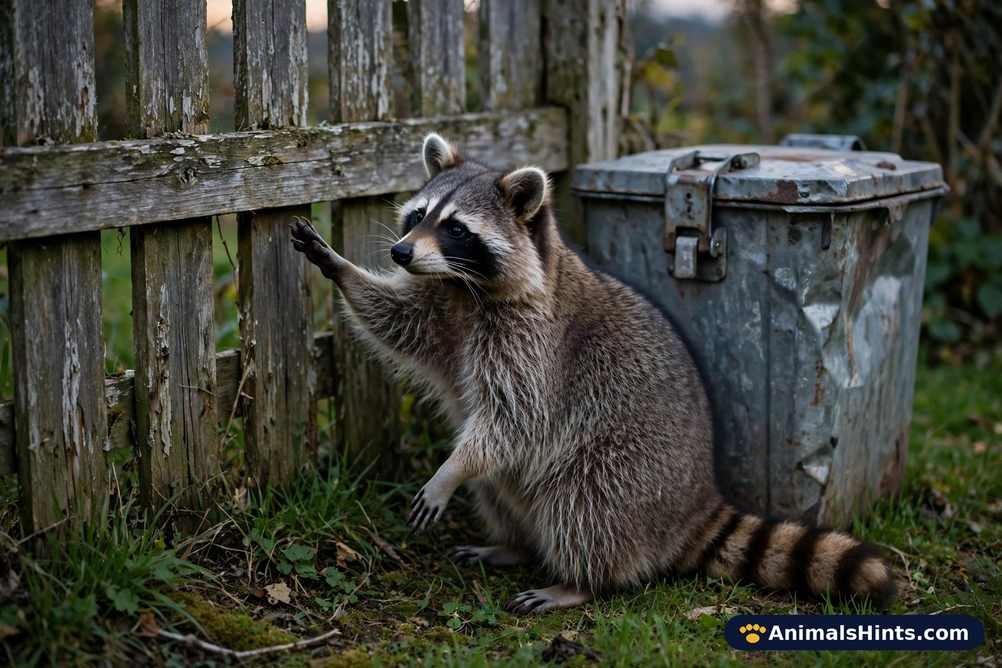
If the crossing keeps recurring at your own address, treat it as the audit described above and remove the invitations: bins with lids the animal’s hands cannot work (they open all but the most secure), pet food brought in at night, fallen fruit gathered, bird feeders reconsidered, and gaps into attics and crawl spaces closed — taking care, in spring and summer, never to seal a space that may hold kits; noise, light and patience will move a mother out on her own schedule, which is the only schedule on offer. None of this is hostility. It is the maintenance of the exact arrangement that makes crossings pleasant: the animal wild, the boundary clear, the meetings brief.
Then the health record, stated as strongly as the authorities behind it allow. The raccoon is one of North America’s rabies reservoir species: the U.S. Centers for Disease Control and Prevention reports roughly 4,000 animal rabies cases a year nationally, more than ninety percent of them in wildlife, with raccoons accounting for about twenty-nine percent, and identifies the raccoon variant as established across the eastern United States from Canada to Florida and west to the Appalachian range — within that zone, about one in ten raccoons that expose a person or a pet tests positive. The signs in the animal — a sickly look, impaired movement, strange vocalisation, uncharacteristic aggression — are unreliable in both directions, since many rabid raccoons show nothing and simply withdraw to their dens. The commoner killer is not rabies at all but distemper, the most frequent natural cause of death in the North American raccoon population, which produces rabies-like neurological signs, cannot infect people, and can infect your dog — one more reason pet vaccinations are part of this section. And the rule that closes the subject has no exceptions and no spiritual reading: any bite or scratch, from any raccoon, apparently healthy or obviously ill, means soap and water on the wound at once, then medical advice the same day — a doctor or a vet — and a report to animal control. Rabies is preventable before symptoms and essentially untreatable after them, and no interpretation of an encounter is worth gambling against that arithmetic.
If the path in question is a road and you are behind a wheel, the protocol is the driver’s version of the same courtesy. Raccoons cross low, slow and mostly at night, and a pair of eyes at bumper height at the road’s edge deserves your brake, applied in your lane, at whatever firmness the traffic behind you allows. Never swerve: the ditch and the oncoming lane are more dangerous than the animal, to you and to everyone sharing the road — the same discipline this site sets out for birds flying in front of your car while driving applies unchanged at ground level. Slow down, let the small professional finish its commute, and drive on.
Is Seeing a Raccoon Good Luck?
The source guide answers yes — and attaches a definition. The luck it describes is not the lottery kind — no windfall is promised, and nothing in the animal’s biography supports one — but the craftsman’s kind: opportunity noticed early, problems that turn out to have handles, protection understood as the habit of checking. On that definition the verdict is consistent with everything else on the shelf: an animal that makes its living by attention confers, in the reading, the luck that attention tends to produce in people too. The sceptical version of the same sentence is available and this page prefers it stated: luck is the name the reading gives to a reminder, and a raccoon crossing reminds unusually well.
Set on this site’s shelf, the raccoon’s fortune sits at the opposite pole from the dead bird material, where the encounter is read through grief and endings. Nothing here is an ending. The tradition’s raccoon arrives mid-shift, tools in hand, entirely uninterested in your past, and the guides’ consensus — reported, as ever, as belief rather than finding — is that meeting one is a small credit entry: not a promise that things will go well, but a suggestion that they are more workable than they looked.
Final Thoughts
What survives every check on this page is a genuinely interesting animal wearing a genuinely interesting set of stories. The stories divide cleanly once examined. The Indigenous record is real and specific — tales of the crayfish-catcher and the trickster, a Dakota teaching about the mask, an Aztec honouring of the mother — and it was made by the peoples who actually lived alongside the animal. The eleven meanings, the day-and-night refinement, the love strand and the luck verdict are modern devotional furniture, assembled recently, and they lose nothing by being labelled so; a reflection does not need to be ancient to be worth an evening’s thought. And the biblical shelf, honestly audited, contains no raccoon at all — only two fine verses about testing what you are told and lighting the next stretch of road, which turn out to be excellent advice for reading pages like this one.
Underneath the whole shelf, meanwhile, the night shift goes on. Somewhere within a mile of wherever you read this, a raccoon is ambling a round it has run a hundred times — down the fence line, along the water, through the gap in the hedge — reading a dark world by touch alone with the most sensitive hands in the mammal business, in a life that the record measures at a very few years and that ends, more often than any omen admits, by traffic, by hunting, or by canine distemper, the virus that empties whole neighbourhoods of raccoons in a bad season without ever touching a human being. It will cross somebody’s path tonight. It will not know, and it would not mind. The meaning, as always, is ours to make — and making it accurately, with the animal left exactly as wild and as wonderful as it is, seems the least a good omen can ask.
FAQs
What does it mean when a raccoon crosses your path spiritually?
In the animal-sign tradition it stands for adaptability, cleverness and resourcefulness — and, through the animal’s masked face, as a prompt to examine what is hidden, in a situation or in yourself. The reading belongs to belief, not to evidence; the animal itself was most likely commuting.
Is a raccoon crossing your path a sign of good luck?
The guides say yes — of a particular kind. The luck attached to this animal is opportunity and ingenuity rather than windfall: the good fortune of noticing the opening and having the wit to use it. Nothing is promised; the tradition offers a reminder, not a guarantee.
What does it mean if a raccoon crosses your path at night?
Night is the raccoon’s own element, and the reading follows it inward: intuition, the subconscious, and the hidden side of a question — the strand the guides associate with shadow work and uncovering truths. Practically, a night crossing is also simply the likeliest kind, since the animal is nocturnal.
How should I respond to a raccoon crossing my path?
Plainly and briefly: stop, keep your distance, keep dogs back, and let it finish crossing. Never approach or feed it. If it staggers, circles or seems unaware of you, leave the area and report it to animal control. Wash any bite or scratch at once, and get medical advice the same day.