July Spiritual Meaning: Symbolism, Significance and the Month Caesar Renamed
July spiritual meaning begins with a paradox: no month in the year carries a more human name, and none was ever named by scripture at all. July is Quintilis renamed — a numbered Roman month that took a man’s name in 44 BC — and the Bible, whose calendar is Hebrew, never mentions it once.
What the month does carry is position. July is where the year turns: the solstice just behind it, the harvest ahead of it in the north, mid-winter in the south, and the year’s second half opening under it. The traditions gathered here — rest, review, abundance, freedom — grow out of that position, and this article keeps them labelled as what they are.
It also keeps the record straight underneath them. Where a popular claim about July fails a check — a festival placed in the wrong month, a “seventh month” argument borrowed from the wrong calendar — the correction is printed beside the claim, because a meaning that cannot survive its own facts is not worth keeping.

What Does the Month of July Symbolize?
July symbolizes the fullness of the year at its turning point. In the northern hemisphere it is, on average, the warmest month of the year, summer’s second month — growth at its peak, light still long though quietly shortening since the solstice. In the southern hemisphere those same weeks are winter’s second month, the coldest stretch of the year across much of that half of the world, and July there mirrors a northern January. Any honest account of the month’s symbolism has to hold both pictures at once.
Within that frame, the traditions agree on a handful of themes. July stands for abundance and vitality — fields, gardens and markets at their most productive in the north. It stands for self-expression and warmth, the month most associated with being outdoors and among people. It stands for rest deliberately taken at the year’s height rather than at its end. And it stands for review: the year is half spent, and July is where people take stock of the first half before committing to the second.
The number seven is often woven into this, because July is the seventh month of the modern calendar, and seven carries a long symbolic history of completeness. That association is a convention of the Gregorian count, and a pleasant one — but it belongs to the calendar, not to the month itself, and the Bible section below shows exactly where the line falls. Read as invitations rather than facts, the month’s traditional calls are simple ones: receive what the season is offering, express what has been growing in you, rest before the harvest work begins, and let the second half begin on purpose.
July, Verified: Quintilis, Caesar and the Month That Changed Its Name
Start with the name, because July’s name is the best-documented thing about it. In the old Roman calendar, which began its year in March, this month was Quintilis — simply “the fifth month,” a number for a name, like September, October, November and December after it. The number was already out of date by Caesar’s time: once January and February moved to the front of the year, Quintilis sat seventh while still calling itself fifth.
In 44 BC, after Julius Caesar’s assassination, the month was renamed Iulius — Julius — in his honour. It was his birth month, and the renaming recognised the calendar reform he had forced through the year before, the Julian calendar that still underlies the one the world uses. The ancient record credits the change to a law carried by the consul Mark Antony, Caesar’s lieutenant, and the Senate’s honour to its murdered dictator. English softened Iulius into July over the centuries that followed.
Two things make the renaming remarkable. The first is that it stuck: a generation later the Senate renamed the next month for Augustus, and those two renamings — July and August — are the only ones that survived. Other emperors tried to put their own names on months and every attempt died with its author. The second is what it means for the symbolism. June carries a goddess’s disputed name; July carries a verifiable event. The month’s deepest layer of meaning is not a myth but a documented act of public memory: a civilisation deciding that this stretch of summer would bear a man’s name forever. The march spiritual meaning of the old year-start explains how Quintilis came to be fifth in the first place, and the number-names that never changed — the october spiritual meaning among them — still show the count July escaped.
10 Spiritual Meanings of the Month of July
Ten readings follow, in the order the tradition usually gives them. Each is framed as what it is — an association built on the month’s season, name or number — and the ones that lean on the number seven are marked as calendar convention where they do it.
1. Completion and Rest
July’s first traditional meaning is completion, and its root is the week’s oldest pattern: work crowned by rest. The creation account ends its work in six days and rests on the seventh, and devotional reading has long connected that rhythm to the seventh month — a time to stop striving and let what has been made stand. The connection is an analogy, not a calendar fact: the seventh month of the Bible’s own year is an autumn month, as the Bible section below shows. Kept honest, the meaning still works. July is where the northern year reaches the top of its arc; the planting is done, the growth is visible, and the month invites a pause that is earned rather than empty — rest taken in sight of the work, the way the seventh day was.
2. Mid-Year Review and Prophetic Realignment
The year’s second half commences in July — that is plain calendar arithmetic, and it makes the month the natural checkpoint of the year. The tradition reads it as a review: what did the first half actually produce, and what needs to change before the year runs out? Some devotional writers call this a prophetic realignment, and the word Selah — the psalm word usually rendered as a pause, though its exact sense is honestly disputed among scholars — is quoted for it. Stripped of prediction, the practice underneath is sound and old: pause at the midpoint, tell the truth about the first half, and re-aim. July gives that pause a fixed date.
3. Gateway to Acceleration
July is also read as a gateway — the point where the year picks up speed toward its fulfilment. As symbolism, the image is of a door at the year’s height opening onto the harvest months. The honest counterweight is worth keeping beside it: astronomically, July is where the daylight starts its long, barely noticeable retreat. The days after the solstice shorten even while the heat builds. A gateway reading that ignores that is decoration; one that holds both — momentum gathering while the light quietly turns — describes the month as it actually is, and describes most real thresholds with it.
4. Spiritual Reflection and Nourishment
The fourth meaning pairs reflection with nourishment, and the season supplies both halves. In the north, July is when gardens and fields begin returning food in quantity — the year’s first full feeding. In the south, the same weeks are winter’s depth, when reflection turns inward and nourishment is whatever was stored. The tradition takes the pairing as a discipline: reflect on what is feeding you, and on what you are feeding. July’s abundance, where it exists, is not presented as an achievement but as a provision to be noticed — rain in its season, work blessed in its time — and the reflective half of the meaning is simply gratitude with its eyes open.
5. Growth, Abundance, and Inner Illumination
Growth is July’s most visible northern fact: the warmest month, the longest growth, hedgerows and crops at full stretch. The tradition extends the picture inward — illumination as the inner counterpart of the outer light, the season when things hidden come into the open and can be seen clearly. The extension is a metaphor and is labelled as one; no text promises anyone an awakening on a date. But metaphors earn their keep by fitting, and this one fits the month’s physics: July is when the northern world is most lit, and when the year’s growth is easiest to inspect. What the second half needs is usually visible by now, in the field and in a life alike.
6. Spiritual Symbol of Freedom and Hope
July is the calendar’s great month of independence days, and that is a matter of record rather than symbolism: Canada Day falls on 1 July, the United States marks its independence on 4 July, and France keeps Bastille Day on 14 July, with a long roll of other nations’ founding and liberation days spread across the month. The tradition reads the cluster spiritually — freedom as the month’s gift, and hope as its forward face. The reading is an association built on real dates, and it is at its strongest kept that way: July does not bestow freedom, but no month commemorates it more often, and a commemoration is itself a spiritual practice — a people choosing, yearly, to remember that they were once unfree.
7. Divine Recalibration
Recalibration is the modern devotional word for the mid-year correction: the sense that July is where a life, like an instrument, gets checked against its standard and adjusted. The image is contemporary — it belongs to the language of navigation and engineering rather than to any ancient text — and it is filed here as exactly that, a modern framing of the older review in the second meaning above. Its usefulness is practical. A recalibration is small, specific and unembarrassed: it assumes drift is normal and corrects it without drama. July, sitting at the year’s hinge with the harvest still ahead, is a natural month to perform one.
8. Spiritual Rest and Rejuvenation
Rest returns as the eighth meaning, deepened from completion into rejuvenation: not only stopping, but being restored by stopping. The northern tradition takes it from high summer itself — long evenings, holidays, the year’s warmest pause — and the southern hemisphere gives the same meaning a different and equally honest form, since July there is mid-winter, the season when fields, vines and animals genuinely rest and rebuild. The two hemispheres arrive at the same teaching by opposite roads: the middle of the year is for recovery. Rest in July is not the year’s end reward; it is maintenance, taken in time to matter.
9. Connection with Nature and the Universe
The ninth meaning is the month’s most direct: July puts the northern world outdoors. The warmest weeks, the latest light, water warm enough to enter, insects at their loudest and birds raising second broods — the season removes the barriers between people and the living world more thoroughly than any other month in the north, and the tradition reads that exposure as connection. South of the equator the connection runs the other way, through winter stars and cold clear nights. Either way, the meaning needs no machinery: it is the claim that sustained attention to the non-human world is itself a spiritual practice, and that July, at whichever extreme, makes that attention easiest to give.
10. Spiritual Awakening
The list closes with awakening — the tradition’s largest word for what July’s light, review and rest are supposed to add up to. It is printed here as the tradition’s claim, not as this article’s promise: no month can schedule an awakening, and any page that guarantees one is selling something. What can honestly be said is narrower and more useful. July concentrates the conditions the traditions associate with waking up — light at its longest, a checkpoint at the year’s middle, rest with the work in view — and a person who uses the month for the first nine meanings on this list has done everything the tenth one has ever practically meant.
Cultural and Religious Significance
Ancient Festivals and Traditions
July’s ancient festival record needs one correction before it needs anything else. The midsummer festival of Litha — the modern Wheel of the Year name for the summer solstice celebration — belongs to the solstice itself, around 20–21 June, not to July. July inherits the weeks after the peak: the light at its longest plateau, the heat building as the days begin, almost invisibly, to shorten. The older Roman record for the month is its own: Quintilis stood under the guardianship of Jupiter, with sacrifices particularly to Neptune and Apollo, and ten days of games in Caesar’s honour closed the month once it bore his name — a festival layer created by the renaming itself. The popular claim that the veil between worlds is thin in July travels with the misplaced solstice; moved back to its proper date, it is a June claim, and July’s own character — fullness, heat, the turn — needs no borrowing.
Eastern Perspectives
The Eastern strand most often attached to July is Japan’s Obon, the Buddhist festival honouring the spirits of the ancestors — and here too the date needs care. Obon was traditionally kept on the fifteenth day of the seventh month of the old lunar calendar. When Japan adopted the Gregorian calendar in the Meiji era, the regions settled it differently: most of Japan now keeps Obon in mid-August, while Tokyo and parts of the east keep Shichigatsu Bon — “Bon in July” — in mid-July, and some regions still follow the lunar date. So July genuinely holds Obon for part of Japan, and the festival of the returning dead, with its welcoming fires, grave visits and dances, belongs to this month’s record — for Tokyo. July also holds Tanabata, the star festival kept on 7 July in much of Japan, when the Weaver and the Cowherd stars are said to meet once a year. Between the ancestors welcomed home and the lovers allowed one night, July’s Eastern face is reunion.
Modern Celebrations
The modern month is a patchwork of national birthdays — the independence days already counted in the sixth meaning — layered over older seasonal customs that survive without official help: harvest suppers, midsummer’s drawn-out northern evenings, the first swims and the last of the light nights. In Catholic tradition July is kept as the Month of the Most Precious Blood of Jesus, a devotional dedication of the whole month that predates the modern holiday calendar. None of these observances agrees with the others about what July means, and that disagreement is the honest picture: the month is a container, and each culture pours its own midsummer — or mid-winter — into it.
Astrological Significance of July Month
July is divided between two signs in the convention astrology uses: Cancer — cardinal, water, and Moon-ruled — governs the month until 22 July, and Leo — fixed, fire, and Sun-ruled — takes over from 23 July. The dates are the ones commonly published; the exact cusp shifts slightly by year and by the table used. Everything in this section is that convention, printed as the tradition holds it — astrology’s account of the month, not a set of findings.
Cancer Season: The Depth of Emotion
Cancer season covers the first three weeks of July, and the tradition describes it as the year’s inward, tidal stretch: home, family, memory and protection, the crab carrying its house on its back. The fit with the month is the fit of early July itself — the solstice just passed, the light at its height but turning, a natural moment for the inward stocktaking the second meaning above describes. Read as the tradition intends, Cancer’s July is the month’s emotional depth charge: feeling first, before the year’s public second half begins.
Leo Season: The Fire of Expression
Leo season opens on 23 July, and the tradition hands the month over to fire: expression, visibility, generosity, the lion and the Sun that rules the sign in astrology’s scheme. Where Cancer’s weeks turn inward, Leo’s turn outward — performance, celebration, the self shown rather than sheltered. The pairing gives July its astrological arc, from the crab’s shell to the lion’s open ground, and the arc is a tidy match for the month’s own movement from review to harvest. It remains, like everything in this section, a convention — one of the oldest and most durable filing systems people have used for the year’s character.
July Meaning and Symbolism in the Bible
The Number Seven in Scripture
This is the section where July’s most repeated claim has to be taken apart, because it joins two different calendars and hopes nobody checks. July holds seventh place in the Gregorian calendar. The Bible does not use that calendar. In the Hebrew year, the seventh month is Tishrei, an autumn month the King James Version calls Ethanim — the month of the Feast of Tabernacles. The Hebrew month a modern July usually overlaps is Tammuz, the fourth month, and Tammuz appears in the King James text exactly once, in a scene of judgement: “Then he brought me to the door of the gate of the LORD’S house which was toward the north; and, behold, there sat women weeping for Tammuz” (Ezekiel 8:14).
The count underneath is complete, not sampled. A fresh full-text count of the King James Version for this article finds the word “July” exactly zero times — the Bible never names the month at all. The control words counted alongside it reproduce this series’ established record exactly — white 75, blue 50, purple 48, grey 1, red 53, glass 9, nail 8 — so the nil is a property of the text, not of the counting.
None of this makes the number seven small in scripture; it makes it something else. Seven is the Bible’s own number of completion, set at the very beginning: “And on the seventh day God ended his work which he had made; and he rested on the seventh day from all his work which he had made” (Genesis 2:2). Sevens run from that verse through the feasts, the lampstand, and the seven churches, seals and trumpets of Revelation. That weight is real. It is simply not a fact about July: it belongs to a week, a festival calendar and a theology that never heard the month’s name. The june spiritual meaning of the month before argues the same case from the solstice’s other side.
Themes of Renewal and Abundance
What the Bible does offer July’s readers is a set of texts that fit the season honestly when they are labelled as devotional reading — verses chosen because they match the month’s weather, not because they mention it. The abundance text is Deuteronomy’s promise of seasonal rain: “The LORD shall open unto thee his good treasure, the heaven to give the rain unto thy land in his season, and to bless all the work of thine hand” (Deuteronomy 28:12). Read devotionally in July, at the height of northern growth and in the middle of southern winter alike, it frames the month’s provision as gift rather than guarantee — rain “in his season,” which is precisely what a farmer in either hemisphere is waiting on.
Reflection and Praise
The reflection text is the first verse of Psalm 19, and it is quoted here in the King James wording because popular versions of this article print a modern rendering as if it were the text: “The heavens declare the glory of God; and the firmament sheweth his handywork” (Psalm 19:1). In July the verse needs no commentary — it is the month’s longest days and brightest skies, described. The light text is John’s Gospel: “Then spake Jesus again unto them, saying, I am the light of the world: he that followeth me shall not walk in darkness, but shall have the light of life” (John 8:12). Both verses are offered the way this series always offers them: as devotional reading for the month, chosen by readers, with no claim that the text is about July — because, as the census above shows, the text is not.
Spiritual Symbolism of July Gemstone, Color, and Flower
July Birthstone: Ruby
July has one birthstone, not a list: the ruby. On the modern birthstone list administered in the GIA’s account, July’s stone stands alone — a variety of the mineral corundum coloured red by traces of chromium, and at 9 on the Mohs scale the hardest gem family after diamond. The GIA records its ancient Indian name, the Sanskrit ratnaraj, “king of precious stones,” and the finest stones still come from Myanmar’s Mogok valley, their colour softened by a glowing red fluorescence. The traditions hung on the stone — courage, vitality, protection, love at full strength — are associations built on that colour and that hardness, and the modern claim that the ruby ignites a heart chakra belongs to a recent stone-to-centre scheme; no classical chakra text assigns a stone to any centre. The ruby needs none of it: a red that survives the hardest wear is symbol enough.

July Color Symbolism: Red and Gold
July’s colours follow its stone and its sun. Red is the month’s first colour — the ruby’s red, and behind it the full symbolism the colour carries everywhere: blood, life, courage, warning and celebration at once, set out in full in the red spiritual meaning of the colour itself. Gold is the second — the colour of the sun at its most generous in the north, of ripe grain, of the light that fills the month’s long evenings. Together the pair describes July’s temperature: red for its intensity, gold for its light. In the southern hemisphere the same colours do winter work — hearth-fire red and low gold sun — which is why the pairing travels better than most month symbolism: both hemispheres have fire and light in July, even if only one of them has heat.
July Flower: Larkspur and Water Lily
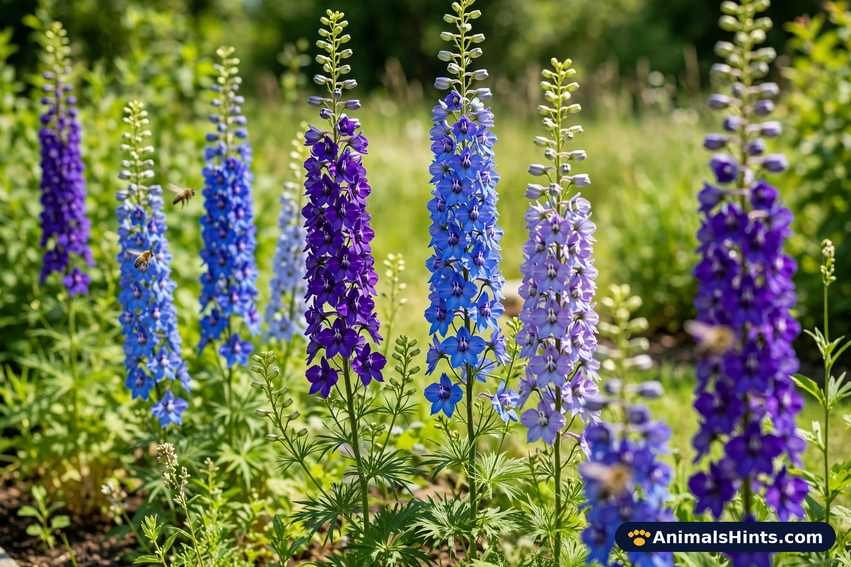
July’s flowers are two, and the Old Farmer’s Almanac names both: the larkspur, and beside it the water lily. The larkspur — tall spikes of blue, violet, pink or white, covering the closely related delphiniums as well — carries the Almanac’s meanings of positivity, love and dedication, and Kate Greenaway’s 1884 Language of Flowers gives it the lighter reading of lightness and levity. The Almanac also carries the practical warning this article repeats plainly: every part of the larkspur is poisonous to people and animals if eaten, beauty notwithstanding. The water lily is its opposite in almost everything — a flower that lies on still water rather than standing against the sky — and its meanings run to purity, innocence and rebirth in the Almanac’s list, purity of heart in Greenaway’s. The pairing is July in miniature: the spike and the floating flower, the garden and the pond, standing up in the light and resting on the water.
Is July a Lucky Month? An Honest Verdict
No authority ranks the months by luck, and July’s file, checked, contains nothing that could: a renamed Roman month, a nil in the Bible’s census, a set of festivals that mostly belong to other dates or other regions, and a birthstone whose reputation is colour and hardness. What the file does contain is position — the year’s hinge, the north’s warmest weeks, the commemoration month of half the world’s independence days — and position is what every “lucky July” claim is actually made of. The verdict of this series is the same one it gives every month: July is not lucky. It is well placed. A month at the top of the year, with the light long, the first half reviewable and the second half unwritten, does not need luck to be the right month for a decision; it needs to be used as what it is. The september symbolism of the harvest quarter ahead is where July’s choices come due.
July in the Animal World: Cicadas, Fireflies and the Second Broods
July has a sound in the north, and it is the cicada. The annual cicadas of North America are called dog-day cicadas outright, named for the dog days they sing through — the season of Sirius, the Dog Star, whose rising the ancient world blamed for the heat. Hesiod heard the same chorus twenty-seven centuries ago and put the singing cicada at the centre of the wearisome summer. Fireflies own the other end of the day: in many northern regions their display peaks in the first half of July, the meadow’s own brief fireworks, done by dark. Birds are at the month’s second shift — second broods in the nest, the earliest fledglings dispersing, swifts screaming over rooftops in the long evenings. Nothing in the northern July animal world is beginning; everything is at full operation, which is the month’s character exactly.
South of the equator, invert all of it. July there is the quiet middle of winter: breeding seasons stalled or waiting, the bush and the garden at their stillest, the year’s animal energy banked rather than spent. The two pictures are not a contradiction in the month’s meaning; they are the meaning, stated completely. July is the year’s summit in one hemisphere and its floor in the other, and the animals — who keep no calendars — are the ones who report which is which without error.

How to Mark July: Simple Ways to Observe the Month
Do the mid-year review on paper. One page, two columns: what the year’s first half produced, and what the second half is for. July’s checkpoint meaning is the oldest practical tradition on this page, and it works whether or not any symbolism is attached to it.
Take one dawn on the water. A lake, a river, a pond with lilies — July’s mornings are the year’s best, and the month’s flower opens on still water in the early light. Go once, early, without a phone, and let the month show its working face.
Eat something the season grew. In the north, July is the first month that feeds a table from a garden or a local field in real quantity. Marking the month at a table is older than every text quoted here; in the south, the same practice becomes a stored-harvest meal, winter food eaten with attention.
Rest where the work is visible. The seventh-day pattern the tradition borrows is specific: rest in sight of what has been made, not away from it. A July rest taken beside the garden, the project, the half-finished year, restores differently from an escape.
Close the month with the light. On the last evening of July, watch the sun go down and notice — honestly, perhaps for the first time — that it sets a little earlier than it did. The turn of the year is not a metaphor in July. It is a measurement, and august spiritual meaning is where it leads.

Final Thoughts
July is the month the record and the tradition agree about least — and that is what makes it worth reading carefully. The record gives a numbered month renamed for a murdered dictator, a Bible that never names it, festivals that belong to June or August, and a seventh-month argument borrowed from a calendar that is not the Bible’s own. The tradition gives rest, review, abundance, freedom and light. Held apart, each side is thin; held honestly together, they make the month’s real meaning: a well-placed stretch of the year whose symbolism works precisely because it does not need to invent its facts.
So take July as it is. Do the review. Take the rest in sight of the work. Eat what the season grew, stand in the long light while it lasts, and let the year’s second half start on purpose. And when the heat settles in and the cicadas start up — the old dog days, named for a star the ancients blamed for the weather — remember that the month has been carrying other people’s names and meanings for two thousand years, and carries yours just as well.
FAQs
What does July symbolize spiritually?
July symbolizes fullness at the year’s turning point: abundance, vitality, rest and review in the northern summer, and quiet restoration in the southern winter. Its name is a documented event — Quintilis renamed for Julius Caesar in 44 BC — and its famous seventh-month symbolism is a convention of the modern calendar, not a biblical fact.
What is the significance of July in spiritual traditions?
Its significance is positional. July opens the year’s second half, holds the north’s warmest weeks and the south’s mid-winter, carries more independence days than any other month, holds Obon for Tokyo and Tanabata for Japan, and is kept in Catholic tradition as the Month of the Most Precious Blood. The Bible never names it — a fresh King James census finds “July” zero times.
How can I use July’s spiritual energy in my life?
Use the month’s actual structure: review the year’s first half on paper, take deliberate rest with your work in view, eat what the season produces, and spend time in the long light or the winter quiet, depending on your hemisphere. Those practices are the whole practical content of the month’s traditions.
What spiritual practices are good for July?
A mid-year review, a dawn visit to still water, a meal from the season’s growth, rest taken deliberately at the year’s top, and attention to the natural world at its loudest in the north or its stillest in the south. None of them requires believing anything about the month — July rewards use, not belief.