Indigo Spiritual Meaning: 10 Meanings, Shades, the Dye and the Bible
Ask indigo spiritual meaning — or ask it the way the sheet behind this topic asks it, what does indigo represent — and the replies agree with unusual consistency for this shelf: intuition, inner sight, the deep end of thought. Indigo is the colour the modern symbolism genre stations at the border of seeing and knowing, and this topic’s guide builds his entire page around that border post.
Two real things stand behind the colour before any meaning is hung on it, and both stay in view throughout what follows. The first is a dye — one of the oldest colouring substances humans have ever used, traded across the ancient world and valuable enough to name. The second is a line in a spectrum: indigo owes its seat among the seven rainbow colours to a decision Isaac Newton published in 1704, and colour science has been politely arguing with that decision ever since.
The pages below follow the guide section by section, headings intact — ten meanings, three shades, cultures, dreams, chakra — and set against his account the four records that can be opened and read directly: the dye’s documented history, Newton’s own text, the classical chakra description, and a fresh count of the King James Bible, where the word indigo turns out never to occur at all.
What Does the Color Indigo Symbolize?
The guide opens with the night sky. In his telling, indigo is the colour of the deepening hour after sunset and of the space above it, and the symbolism he builds on that ground runs in one direction: downward and inward, toward understanding rather than display. Truth, integrity and spiritual awareness are his headline words; wisdom and intuition stand behind them.
His second strand is discipline. Indigo, in the symbolism he reports, is not a drifting colour but a devoted one — the shade of people who keep a practice, hold a moral line and prefer a examined life to a loud one. The seeker is his recurring figure: someone drawn to what lies under surfaces, willing to sit with a question longer than is comfortable.
His third strand is emotional weather. Indigo is said to slow the room down — to invite breath, contemplation and a temporary truce with noise. Meditation spaces, spiritual art and sacred symbols are his exhibits, and the claim made for each is identical: this colour, wherever it is placed, is treated as a standing instruction to turn attention inward.
Read the three strands at no greater strength than they can bear. They are the modern symbolism genre’s settled portrait of the colour, repeated across its literature with very little variation, and the sections below report that portrait faithfully. But a portrait is not a measurement, and indigo happens to be a colour with an unusually well-documented material life — a dye, a trade good, a physicist’s bookkeeping entry — against which the portrait can be laid. The article’s own first added section takes up that material life, because a colour that was ground out of leaves for six thousand years earned its reputation somewhere, and the record of where is more interesting than the reputation.
One link in his opening deserves separate notice. The guide places indigo between blue and violet, and the family’s neighbouring shade — the saturated heraldic blue whose own record runs through pigment prices and royal dress — keeps its separate page at royal blue spiritual meaning. Indigo is not a paler or darker blue in the genre’s handling; it is treated as the point where blue stops describing the sky and starts describing the mind.
The Dye That Named a Colour: Indigofera, Woad and Six Thousand Years of Blue Cloth
Most colour names describe a thing in the world. Indigo’s name describes a trade route. The word travels from the Greek indikón — “the Indian [substance]” — through the Latin indicum into English, and it preserves the geography of the ancient dye trade: India was the earliest major centre of indigo production the Greek and Roman world knew, and the dye arrived in the Mediterranean as a luxury import, priced like one.
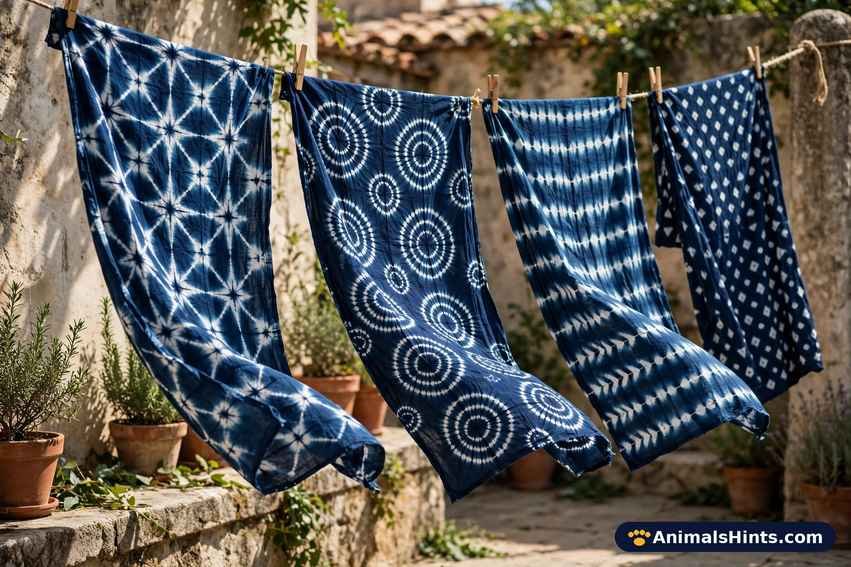
The plant behind the name is Indigofera tinctoria, a tropical shrub whose leaves carry a colourless precursor that dyers learned to ferment, oxidise and fix into the deepest fast blue the pre-chemical world possessed. The craft is old beyond easy imagining. The oldest known fabric dyed with indigo, dated to roughly six thousand years ago, was excavated at Huaca Prieta in Peru — which means the dyeing was perfected independently on more than one continent, and that wherever people found the chemistry, they kept it. Indigo-dyed cloth has been recovered from ancient Egypt; a Neo-Babylonian tablet of the seventh century BC already gives a recipe for dyeing wool blue. Few manufactured substances of any kind can show a working life that long.
Europe, for most of that history, made do with a local understudy. Woad — Isatis tinctoria, a hardy plant of the mustard family — yields the very same dye molecule as its tropical cousin, in weaker concentration, and it was western Europe’s only blue dye until true indigo imports undercut it in the seventeenth century. The two plants between them coloured the working clothes of two hemispheres, and their shared molecule still does: the blue of denim, the most worn fabric on earth, is indigo’s colour, laid on warp threads exactly as dyers laid it centuries ago.
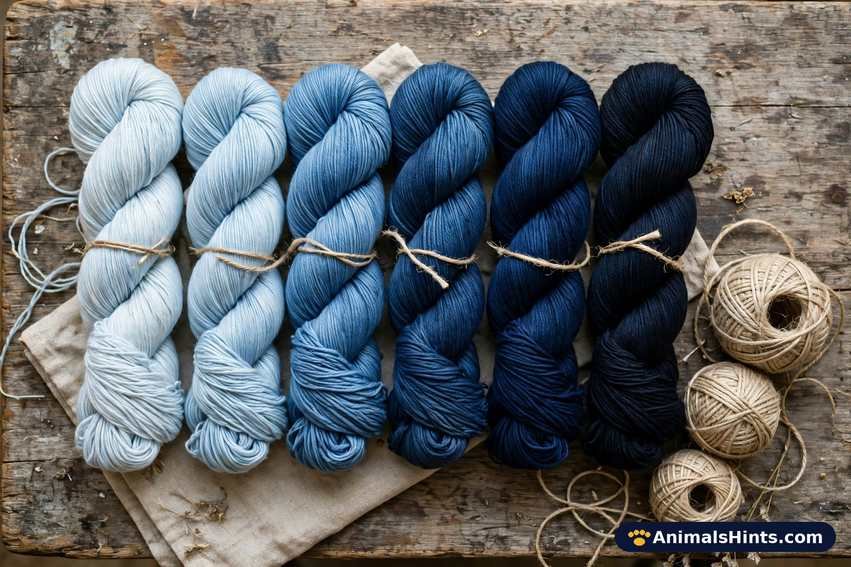
Hold that record against the symbolism section above and a pattern worth noticing emerges. The genre calls indigo the colour of depth, patience and hidden knowledge. The dyers’ record gives those abstractions a material shadow: indigo is literally a colour that hides — the cloth leaves the vat yellow-green and turns blue only in the air, in front of the dyer’s eyes — and it rewards patience, deepening dip by dip, shade by shade, exactly as the graded skeins in any dyer’s workshop still show. None of that makes the symbolism true. It does explain why this colour, of all colours, was available to carry it.
Psychology of Color Indigo, and Personality
The guide’s psychology section blends two inheritances and says so in its own terms: from blue, steadiness of mind; from violet, imagination and mystery. The blend is his formula for indigo’s psychological character — a colour, he writes, for minds that are at once creative and analytical, and for rooms where an overactive head needs slowing rather than stimulating.
His personality portrait follows the same blend. People drawn to indigo are described in his pages as intuitive and visionary, quick to register what others walk past — an emotional undertow, a hidden pattern — while keeping enough detachment to judge it coolly. Truth and integrity are named as their ruling values; service and the uncovering of spiritual truth as their characteristic ambitions. The portrait has a shadow side, which he also prints: reserve that can read as aloofness, seriousness that can curdle, and — when the colour’s inward pull is overdone — overthinking, withdrawal and a drift into spiritual escapism. Balance is his own closing prescription.
Two bounds belong on this section, and they are the same bounds this site has had to set on every colour page in the run. The first is about evidence. Colour psychology as a research field works almost entirely on broad hues — blue, red, green — tested as categories; no experimental literature this article could find isolates indigo as a stimulus and measures what it does to thought or mood. What can honestly be said from research is about the family, not the shade: blue is the most preferred colour in survey after survey across cultures, and blue-family environments are the ones the literature associates with calm appraisal. Indigo-specific psychology, as printed in the guide, is the genre’s extrapolation from that family record — coherent, widely repeated, and untested at the level of the shade.
The second bound is about the personality portrait. A drawn-to-a-colour profile of this kind is a mirror the genre holds up to its readers, not an instrument anybody has validated; no consulted study sorts people by favourite colour and recovers the intuitive, truth-ruled seeker the guide describes. Printed as the genre’s portrait — which is how the guide offers it and how it is carried here — it does the work such portraits do, giving readers a vocabulary for a temperament. Printed as psychology, it would claim a standing the record does not give it.
10 Spiritual Meanings of Indigo Color
His ten readings follow in his order, each under the heading he gave it. Where one leans on something checkable — a gland, a garment, a chakra text — the checking is done in later sections rather than argued inside his list; the list itself is carried whole, at the full strength his tradition claims for it.
1. Intuition and Inner Voice
His first meaning is the colour’s signature. Indigo is presented as the shade of the gut feeling that turns out to be right — of perception that arrives before evidence and is vindicated by it. The third eye is the seat he assigns it, and the practice he attaches is trust: listen inward first, audit afterwards. Discernment is the meaning’s working half — the colour is said to help its owner separate a genuine inner signal from the noise of wish and fear, and to favour the decision that survives that separation.
2. Creativity and Inner Peace
Second, the colour as a studio condition. Indigo is said to quiet the mental weather enough for work to happen — inspiration drawn up out of stillness rather than chased. The guide’s reasoning runs through the blend again: blue steadies, violet imagines, and indigo holds the two in one room. Artists, writers and practitioners are his named beneficiaries, and the meditation space and the creative studio are his named settings; the colour is used in both, he reports, precisely because it lowers the volume without lowering the light.
3. Wisdom and Connection to the Unconscious
Third, wisdom — not the accumulated kind but the dawning kind. Indigo is linked in his telling to the moment understanding arrives from below consciousness: the answer that surfaces in the shower, the dream that reorganises a problem overnight. He calls the colour, in a phrase his tradition repeats, the colour of the inner teacher. Dream interpretation and symbol-reading are the skills he attaches to it, and self-discovery the project it serves.
4. Spiritual Awakening
Fourth, awakening — the meaning in which his page’s only mention of the aura occurs. When indigo starts appearing in a life, he writes — in dreams, in preferences, in the colours a reader suddenly reaches for — his tradition takes it for a phase change: perception widening, illusions thinning, a self beginning to be seen from outside its own habits. The awakening he describes is deliberately undramatic, a dawn rather than a lightning strike. Readers who want the aura system this aside belongs to will find its best-documented colour treated at blue aura meaning; the aura framework itself is examined, with its test record, in the chakra section below.
5. Symbol of Wisdom and Inner Vision in Fashion
Fifth, the colour worn. In fashion’s symbolism as the guide reports it, indigo clothing is a statement of quiet confidence — intelligence and sincerity signalled without ornament, the dress of thinkers rather than performers. One documented garment does stand behind the general claim, though it is a humbler one than his mystics and philosophers: indigo’s great historical garment is workwear, the dyed cotton of labourers on several continents, which became denim and then the most democratic cloth in the world. The colour of contemplation and the colour of the work shirt are the same colour; the record supports the shirt beyond argument, and the contemplative reading rides on it as the genre’s interpretation.
6. Mysticism and Introspection
Sixth, the mystic’s colour outright. Indigo is presented as the aid and emblem of the inward journey — the shade meditators picture, in his account, when they want the senses quieted and the inner eye opened. His governing question for the meaning is the mystic’s own: who is underneath the roles, the thoughts and the memories? The colour’s work, in this reading, is subtraction — ego barriers dissolving, silence doing what instruction cannot.
7. Devotion, Justice, and Fairness
Seventh, the colour’s moral register. Devotion is his first word for it — commitment to a truth held over time — and justice and fairness follow as devotion’s public form. Teachers, healers and guides are his exemplars; cosmic law, the principle that actions ripple outward and return, is his frame. The night sky does the illustrative work: a deep indigo heaven holding its stars in order becomes his picture of a soul holding its decisions the same way.
8. Higher Knowledge and Spirituality
Eighth, knowledge at the top of its range. Indigo is cast as the colour of metaphysical study itself — of the mind that has stopped asking only how things work and started asking why. Philosophy, sacred geometry, astrology and the healing arts are the studies he names as the colour’s natural curriculum, and his closing distinction is the meaning’s point: learning ripens into wisdom, in his telling, only when the heart has understood it — mere accumulation is not enough.
9. Mystery and Higher Mind Functions
Ninth, mystery — with a definition attached. The mystery indigo governs, in the guide’s account, is not illusion or trickery but the remainder: the part of existence that stays unexplained after honest inquiry, and that the higher faculties — imagination, discernment, pattern-sight — are built to contemplate rather than to solve. Dreams, symbols and archetypes are his listed territories. The colour is offered as a doorway rather than a destination: an invitation to stand in the unexplained without either fleeing it or pretending it away.
10. Psychic Ability and Cosmic Consciousness
Tenth and last, the list’s ceiling. Indigo is presented as the colour of psychic development itself — clairvoyance, heightened sensitivity to synchronicity, vivid dreaming — and beyond those, of cosmic consciousness: the reported dissolution of the boundary between self and whole. One anatomical claim travels inside this meaning and needs its label on it. The tradition he reports links the colour’s frequency to the pineal gland, the small midline gland Descartes made famous as the seat of the soul. That linkage is the modern tradition’s, printed here as its claim; anatomy knows the gland as an endocrine organ that secretes melatonin on a light-dark cycle, and no record consulted connects it to any colour. The cosmic-consciousness reading stands as the genre’s highest claim for the colour, and it is carried as exactly that.
Meanings of Different Shades of Indigo
The guide divides his colour three ways, and the division is carried here in his own arrangement — his shades as headed paragraphs, his readings attached to each. A dyer would recognise the logic instantly: the three shades are three depths of the same vat.
Dark Indigo. His deepest shade stands for the subconscious at full strength — maturity, mystery, the buried material of a life. It is the shade he assigns to meditation and contemplation, and to the work of bringing hidden truths and unexamined emotions up into the light where they can be dealt with. In the vat’s terms it is the many-dipped cloth, the one that has been down and up until the blue is nearly black.
Medium Indigo. His middle shade is the balance point — the tone he associates with spiritual art and religious dress, where intellect and intuition are meant to sit in equal chairs. Creative work that needs analysis and imagination at once is his assigned use. It happens to be, not coincidentally, the shade most eyes mean when they say the word indigo at all: the classic denim blue, dark enough to read as depth, light enough to read as colour.
Light Indigo. His palest shade softens the whole system — clarity, peace and spiritual communication are its assigned register, and mental and emotional healing the work it is said to help with. Where the dark shade burrows, the light one opens: divine inspiration and higher guidance are his phrases for what it admits.
The family’s dark pole deserves its pointer. Dark indigo approaches the boundary where blue gives out into black, and that boundary colour keeps its own full record — its meanings, its Bible count and its animal wearers — at black spiritual meaning. The shades above stop where the guide stops; the neighbour’s page starts where his darkest shade ends.
A Colour by Decree: Newton’s Seventh Band and the Spectrum That Never Split
Every schoolchild who learns the rainbow learns indigo’s name in a list of seven — and the seven, it turns out, were chosen, not found. The spectrum is a continuum; it has no seams. The seams were drawn by Isaac Newton, and his reasons for drawing seven of them are documented in his own book.
In his early optical work Newton, like Boyle before him, named five colours in the spectrum: red, yellow, green, blue and violet. By the time Opticks appeared in 1704 the list had grown to seven — orange and indigo inserted — and Newton divided the spectrum’s bands in proportions he explicitly matched to the intervals of the musical octave, the seven notes of the scale. The analogy was the argument: if sound harmonised in sevens, light, in a universe built on proportion, should too. Indigo’s seat in the rainbow is therefore a piece of music theory wearing a colour’s name — a documented historical choice, made by the greatest physicist of his age, for reasons that were never optical.
Later science has never quite known what to do with the inheritance. In 1802 the chemist William Hyde Wollaston, examining the spectrum more closely, concluded the eye distinguishes six colours in it, not seven, and proposed indigo’s removal. Modern colour science states the position more bluntly: the visible spectrum is a continuous distribution of wavelengths with no natural break where indigo is supposed to sit, the band assigned to it is narrow and hard for the eye to separate from its neighbours, and Newton’s own colour words have shifted under us — what he called indigo is close to what most people now call blue, and what he called blue is closer to today’s cyan. By the early twentieth century, scientists and teachers were widely dropping indigo from the rainbow’s list, even as the mnemonic kept it in every classroom.
None of this demotes the colour; it locates it. Indigo the dye is six thousand years old and entirely real. Indigo the spectral band is three centuries old and largely conventional — a tribute the spectrum still pays to a musical analogy. A colour can survive being a convention; most of the meanings in the guide’s list were attached to it long after Newton, by people who met it in cloth and sky rather than in a prism. But a reader deciding what indigo is deserves both halves of the record: the leaf it came from, and the decree that seated it among the seven.
Cultural and Religious Significance
The guide’s cultural survey is carried in his order, each strand weighed against whatever evidence stands behind it.
The Eastern frame. His survey opens in the East, where he presents indigo as a colour of insight, devotion and raised consciousness, and its dye as a treasure historically reserved for royalty, for spiritual leaders and for ceremony. The treasure part is documented fact — indigo was a high-value trade good across Asia for centuries, taxed, monopolised and fought over by colonial powers. The insight part is the genre’s framing of that value, and it is carried as framing.
In Hinduism, his strand assigns indigo to Ajna, the brow chakra, and reads the colour as the awakening of inner vision. That assignment is real — as the modern chakra system’s assignment, which the chakra section below examines against the classical text, where the same lotus is described in very different terms. The strand stands here as he states it, its examination deferred to its own section rather than repeated in both.
In Buddhism, his strand reports indigo robes worn by monks as a sign of detachment from materialism and of truth sought within. This one must be bounded harder than the rest, because the record does not hold it up: the monastic robes of the major Buddhist traditions are documented in the saffron, ochre, maroon and brown family — dyed, in the earliest rules, to make the cloth worthless for theft or vanity. No source consulted for this article documents an indigo-robe tradition in Buddhism, and the strand is therefore printed as the guide’s claim only — a modern symbolism writer’s attribution, not a practice this page can verify.
In Western traditions, his strand gives indigo authority, integrity and moral depth, with artists and mystics using its pigments to render the vastness of spirit. The documented Western record is more workmanlike and, in its way, more impressive: the West’s indigo is Newton’s band in the spectrum, the dyers’ vat in every port town, and eventually the blue of the working uniform that became blue jeans. Authority the colour certainly acquired — but it acquired it in cloth and in physics before it acquired it in mysticism, and the order matters to an honest account.
In African cultures, his survey closes with indigo dyeing as a sacred art standing for life, fertility and protection. Here the documented core is strong and specific. Indigo dyeing has been practised across West Africa for centuries, and its best-documented form is àdìrẹ, the resist-dyed indigo cloth of Yoruba women in south-western Nigeria — cloth tied, stitched or painted with starch resist, then dipped in fermented indigo vats, traditionally prepared and always dyed by women, as the Victoria and Albert Museum’s account of the craft records. Cloth of that labour and beauty certainly carried meaning for its makers and wearers; the specific triad of life, fertility and protection is the guide’s summary of that meaning, printed as his summary, over a craft record that needs no embellishment.

What the Bible Actually Does With Blue
The guide’s page lets the colour’s sacred reputation imply a scriptural one, as the genre’s colour pages generally do. The implication can be tested, and for this article it was tested — against the complete text of the King James Bible, counted word by word with the same instrument this run has used on every colour page. The result is the cleanest gap in the run’s colour series.
The word indigo occurs in the King James Bible exactly zero times. So does its neighbour violet — also zero. The colour the Bible does use, constantly, is blue: fifty occurrences, and almost without exception they are about dyed cloth. Blue thread, blue lace, blue cloth, the blue of the tabernacle’s hangings and the high priest’s robe — the fifty blues of Scripture are a textile inventory, the record of a prestige dye at work in sacred manufacture. Its companion dye-colour purple stands at forty-eight on the same count. Between them, blue and purple are the Bible’s colours of costly cloth; neither is ever a colour that settles on a person as a sign, an aura or a message.
The materials list itself can be quoted, and is quoted here as resonance — the neighbourhood indigo’s admirers are reaching for when they reach for Scripture: “And blue, and purple, and scarlet, and fine linen, and goats’ hair,” (Exodus 25:4, KJV) — the opening of the inventory of offerings for the tabernacle, where blue stands first among the dyed stuffs. The Hebrew word behind the Bible’s blue, tekhelet, names a dye as much as a hue; its exact shade and even its source creature have been debated by scholars for centuries, and this article asserts no equivalence between it and the dyer’s indigo of the trade routes. What can be said is narrower and sufficient: the ancient world’s prestige blues were dye-stuffs of enormous value, the Bible’s blue is one of them, and indigo — for all its equal antiquity as a dye — is a word the biblical text never uses.
So the honest summary for the colour’s scriptural standing is a gap, stated without apology. No verse grades indigo, promises by it, warns by it or clothes a vision in it. Readers who meet a biblical meaning for indigo anywhere are meeting a modern writer’s bridge between the colour and the Bible’s blue — a bridge this article declines to build, because the two banks, examined closely, were never joined by the text itself.
Interpretations of Dreaming About the Color Indigo
The guide’s dream section is carried in his arrangement, as a set of strands. Dreams are folklore’s home ground, and the framing note this site attaches to every dream section applies here in full: no fixed dream dictionary exists in any record that can be checked, the readings below are the modern genre’s, and they are printed as that genre’s property.
Seeing indigo in a dream, in his general reading, marks intuition strengthening — a sleeper being guided, as he puts it, toward higher understanding, with the dream itself offered as evidence that the inner faculty his meanings describe is switching on.
Wearing indigo in a dream he takes as self-awareness growing: readiness to explore a spiritual purpose, alignment with an inner truth, in some tellings the first stirrings of the psychic development his tenth meaning describes.
An indigo sky or ocean. This is his most settled dream image — peaceful transition, emotional healing, divine protection; a movement from confusion toward clarity, from doubt toward trust in one’s own judgement.
Darker indigo in a dream turns the colour’s depth inward: introspection that can no longer be postponed, hidden truths asking to be faced, honesty and courage prescribed as the response.
His closing verdict is that indigo dreams are rarely ordinary, and within his system that is consistent — a colour he has defined as the sign of inner sight can hardly appear in the theatre of inner sight and mean nothing. The documented position is plainer. Dreaming in colour is ordinary; most dreams are remembered in colour by most sleepers, and no consulted sleep record assigns any hue a fixed meaning. What the strands above genuinely document is the genre’s internal consistency — its dream indigo behaves exactly like its waking indigo — and a reader may enjoy that consistency as symbolism while knowing it is symbolism all the way down.
Color Indigo as a Chakra Color
The guide’s final system is the chakra system, and here his claim is at its most specific: indigo is the colour of Ajna, the third-eye chakra between the eyebrows, governing intuition, insight and everything perceived past the physical senses. A balanced Ajna, in his account, brings clarity, wisdom and trust in one’s own intuition; a blocked one brings confusion, scepticism and disconnection; an overactive one, excessive daydreaming and detachment. Meditating on indigo at the forehead is his prescribed remedy, and the whole scheme is presented, as the genre always presents it, as ancient.
The examination this site owes every chakra claim can be made precisely here, because the classical text survives and can be read. The Ṣaṭ-Cakra-Nirūpaṇa, the sixteenth-century Sanskrit description of the chakras that stands behind the whole modern system, describes Ajna at verse 32 in Arthur Avalon’s translation: “The Lotus named Ājñā is like the moon, (beautifully white). On its two petals are the letters Ha and Kṣa, which are also white and enhance its beauty.” The classical brow lotus is a white, two-petalled, moon-like lotus, the seat of mind — it carries no colour of its own in the rainbow sense at all, and indigo is never mentioned. The rainbow of chakra colours familiar today — red at the base climbing the spectrum to violet at the crown. The scheme is a modern construction, put together in the twentieth century and standardised long after the classical texts were written. Within that modern scheme, indigo genuinely is Ajna’s assigned colour; the guide reports his own system correctly. What the system cannot claim is the classical text’s authority for the assignment, because the text gives the lotus moonlight instead.
The same discipline covers the aura. Indigo appears in the modern aura literature as a colour some people are said to carry around their bodies, with the personality of the psychology section attached. Stated plainly, once, as this run states it on every aura page: no scientific record supports the existence of auras or of aura colours — controlled tests of aura-reading have repeatedly failed, and the one photographic process ever offered as evidence, Kirlian photography, is documented as corona discharge — an electrical phenomenon, not a field of meaning. The tradition’s claims are carried in this article as the tradition’s, in the sections where the guide makes them; this section is where their standing is recorded.
A neighbouring case sharpens the point. Not every colour the modern aura literature treats even holds a chakra seat — the grey aura meaning page records a colour the tradition reads entirely without one — which is a reminder that the system is a living modern construction, assigning and withholding seats by its own logic, rather than a transcript of anything the old texts contain.
How to Use Indigo’s Meaning in Everyday Life
The guide’s fourth question — how the colour’s meaning is to be used — deserves its own practical section, and the uses below keep to what can honestly be done with a colour: wear it, live among it, and borrow its discipline as a prompt.
Wear it where steadiness is wanted. Indigo’s one indisputable social fact is denim: the colour already reads, worldwide, as unpretentious and durable. Beyond the jeans, indigo dress — a deep blue-violet shirt, scarf or jacket — carries the genre’s intended signal of quiet thoughtfulness, and pairs without friction against the family’s softer members; the considered pairings are the neutral ones, indigo over grey spiritual meaning in dress, and indigo cloth against the warmth of color pink spiritual meaning in a room, where each colour keeps the other honest.
Put it where thinking happens. The psychology section’s one defensible residue is practical: blue-family rooms are the ones people reliably choose for study and rest. An indigo cushion, throw or curtain panel in a reading corner borrows that family effect at the shade the genre prefers for inward work — no stronger claim is needed, and none is made.
Use the practice, labelled as the practice. The tradition’s own exercise — sitting quietly, picturing indigo light at the brow, attending to whatever surfaces — is a meditation, and meditation needs no colour’s permission to be useful. Readers who keep a dream journal will find the colour a serviceable prompt for the genre’s favourite question: what did the night say that the day has not yet heard? Held as a prompt, indigo earns its keep. Held as a mechanism, it promises what no colour can deliver.
Final Thoughts
Indigo turns out to be two colours wearing one name, and the honest article has to keep both in frame. The first is material and magnificent: a dye drawn from a tropical leaf, old as agriculture’s memory, traded like treasure, still colouring the world’s most common garment. The second is symbolic and modern: the genre’s colour of intuition and inner sight, seated by Newton in a rainbow it may not naturally belong to, seated by modern teachers at a brow lotus the classical text describes as white as the moon.
Neither colour cancels the other. The symbolism is genuinely the symbolism — millions of readers meet indigo first as a meaning, and the meanings, attributed to the tradition that made them, are reported in full above. But the meanings are young, and the colour is old, and a reader who knows both facts holds the colour more accurately than a reader who holds either alone. The dye was deepening in its vats for six thousand years before anyone called it the colour of the third eye; it will presumably go on deepening, dip by dip, long after the current vocabulary of meanings has been replaced by another.
That patience is, in the end, the most defensible lesson the colour offers, and it comes from the material record rather than the symbolic one. Europe dyed blue for millennia with woad before the richer leaf arrived from the tropics, and the two plants yield the selfsame molecule — the colour never cared which leaf it came from, and neither, in the long run, did the cloth. What indigo represents, before any system assigns it a meaning, is what it demonstrably is: the deepest blue the natural world makes, got by steeping and waiting. A reader who lets it represent exactly that — depth arrived at slowly — has hold of the one interpretation no record will ever contradict.
FAQs
What does the color indigo symbolize spiritually?
In the modern symbolism tradition: intuition, inner vision and wisdom — the colour stationed at the third eye, standing for sight that goes past surfaces. The older records give it a different biography: an ancient, precious dye, and a seat in Newton’s seven-colour spectrum that he assigned by musical analogy.
How does indigo affect our psychology?
The genre credits it with calm focus, deepened reflection and steadied creativity. Research, more narrowly, supports claims about blue as a family — the most preferred colour across cultures — and no study consulted isolates indigo itself. The shade’s psychology is the tradition’s extrapolation, printed as such.
What does liking indigo say about your personality?
In the genre’s portrait: that you are intuitive, truth-ruled and introspective, with a rich inner life and a low appetite for noise. It is a portrait, not a measurement — no validated instrument sorts personalities by favourite colour — and it stands here purely as the tradition’s mirror, nothing more.
How can I use indigo’s spiritual meaning in your life?
Wear it (denim already does the quiet work), place it where you read and think, and borrow the tradition’s exercise — quiet sitting, attention turned inward — as a prompt for reflection. The practical section above sets out the uses at the strength each can bear.