Mirror Spiritual Meaning: Ten Readings, the Bible’s Eleven Glasses and the Laboratory Record
No household object gets stared into the way this one does, and few collect as much meaning per square inch. Most people who search mirror spiritual meaning are not really asking about glassware. They want to know why an ordinary sheet of silvered glass has been treated, for thousands of years, as something more than furniture — a thing that shows the soul, opens doors, protects a house, or, broken, costs seven years.
The guides answer with a full catalogue, and the whole catalogue is presented below at exactly the strength its own tradition claims for it. Their page offers a symbolism section, a psychology section, ten spiritual readings from self-awareness to transformation, rulings on a mirror facing the bed and on breaking one, a survey of cultures, a biblical section with verses, and a closing file of myths and superstitions.
Beside that catalogue stand three shelves that can be checked. There is the object itself — what a mirror physically is, and what it has been made of across eight thousand years. There is the laboratory, where mirrors have been put in front of chimpanzees and in front of human volunteers in dim rooms, with results stranger than most folklore. And there is the biblical text, counted word by word for this page, which allows one finding to be stated at the outset: the King James Bible never once uses the word “mirror”. Its mirrors are called glasses, they number eleven, and none of them is an omen.

What Does a Mirror Symbolize?
The guides begin with the plainest reading: a mirror stands for truth and self-awareness, because it hands back what is in front of it without editing. On their account you cannot negotiate with a reflection. What is there is shown, and that unedited quality is why so many spiritual paths treat the object as an instrument of honesty — a surface in front of which pretence is difficult to maintain.
Their second strand is a tension. A mirror shows the outside of a person and nothing else; the inner life stays invisible. In the guides’ telling, symbolism grows in that gap between appearance and reality: growth is pictured as the slow work of bringing the seen self and the unseen one into line with each other, and the mirror is the tool that keeps reporting the distance between them.
The third strand is the oldest and the least domestic. Because a mirror holds a second version of the room — same furniture, reversed, unreachable — cultures have treated it as a threshold: a gateway or portal between this world and another one. The guides note that this is the strand behind the mirror’s long career in ritual, divination and folklore, and it returns throughout their page, in the portal reading among the ten meanings and in the myths near the end.
What a Mirror Actually Is: Polished Stone, Silvered Glass and One Law of Light
Underneath the symbolism sits a piece of physics simple enough to state in one sentence. Light that strikes a mirror leaves it at the same angle it arrived — angle in, angle out, measured from the surface’s perpendicular. That behaviour is called specular reflection, and it is the whole trick. A wall also reflects light, but its microscopic roughness scatters each ray in a different direction, so no image survives the bounce. A mirror’s surface is smooth at a scale finer than the wavelength of light itself, so the rays keep their order, and the order is the picture.
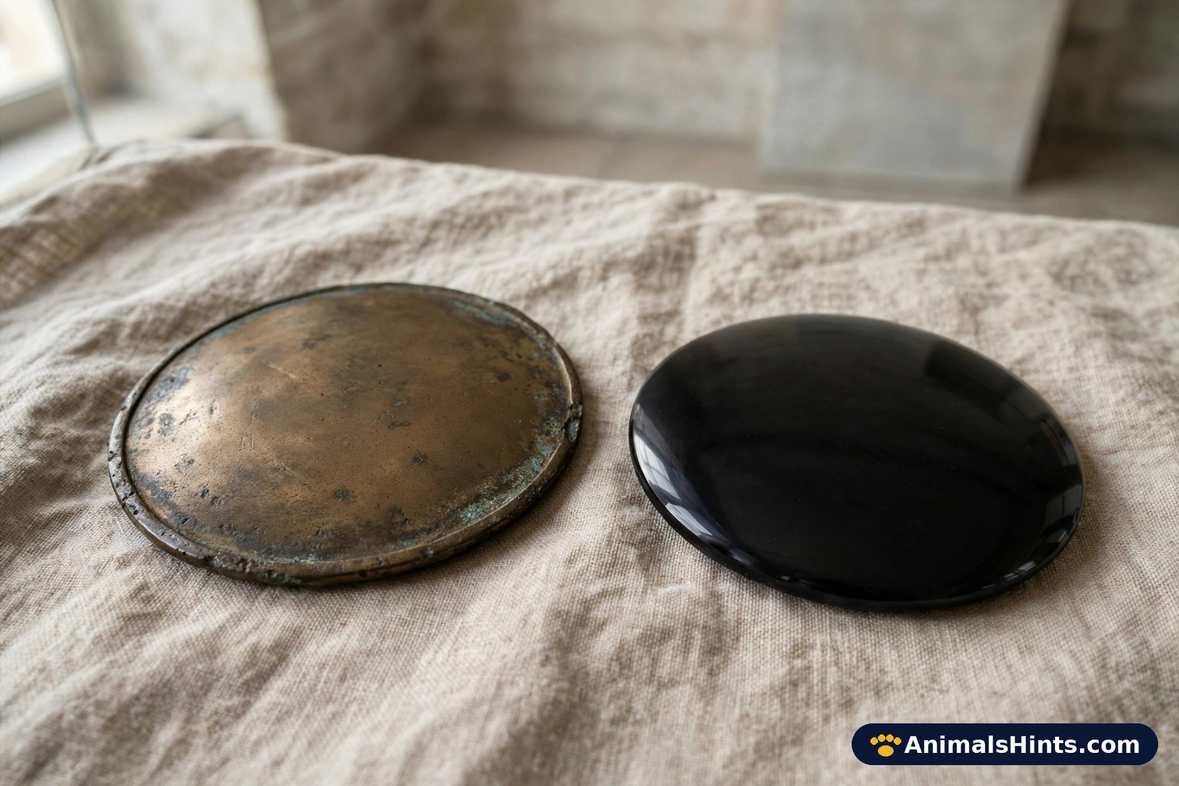
The materials took longer to settle than the law. The first manufactured mirrors were polished stone: discs of obsidian, a natural volcanic glass, made at Çatalhöyük in Anatolia around 6000 BCE. Polished copper followed in Mesopotamia by about 4000 BCE and in Egypt by about 3000 BCE, and through the Bronze Age and long after, the standard mirror was a disc of bronze, copper or silver, polished by hand. Speculum metal — a hard, bright alloy of copper and tin — served into the age of telescopes; Isaac Newton’s reflecting telescope of 1668 used it.
Metal mirrors carried a defect that matters for this page. They tarnished, they yellowed the image, and even freshly polished their reflectivity was poor — a bronze mirror returns a dim, darkened face. Hold that fact for the scripture section: the most famous mirror sentence in the Bible, Paul’s “through a glass, darkly”, is not a poet reaching for gloom. It is an accurate product review of the only mirrors his world had.
Glass mirrors came late and stayed expensive for centuries. Roman artisans at Sidon were coating glass with metal leaf in the first century CE, but the images were small and distorted. Venice industrialised the craft in the sixteenth century with a tin-and-mercury amalgam backing, guarded the secret for a hundred years, and charged accordingly — one French countess was reported to have traded an entire wheat farm for a single Venetian mirror. The modern object dates to 1835, when the German chemist Justus von Liebig worked out how to deposit a thin film of metallic silver directly onto glass; today’s mirrors use silver or aluminium, laid down thin on a smooth glass sheet. Eight thousand years of materials, one law of light underneath them all.
Psychological Power of the Mirror
The guides’ psychology section grants the symbolism a partial receipt from the mind’s side. Looking into a mirror, they observe, is a double act: you process your own identity — that is unmistakably me — while simultaneously watching yourself as an object, the way you would watch a stranger. Self-reflection in the literal sense and self-reflection in the mental one happen in the same glance.
Because of that doubling, they say, feelings people normally keep at a distance tend to arrive quickly in front of a mirror: guilt, confidence, fear and pride are their list. The moment is given weight in what they call spiritual psychology precisely because it is unscripted — there is no audience, no role being performed, only the confrontation with who is actually standing there. Mood and awareness, on their account, are directly worked on by the object, which is why so many practices are built around it. The laboratory’s own version of this claim is measured, in the section that follows, rather than asserted.
The Mirror in the Laboratory: Self-Recognition and Strange Faces
Science has brought mirrors into the lab twice over, once facing animals and once facing people, and both times the object behaved less simply than furniture should.
The animal work is the famous half. In 1970 the psychologist Gordon Gallup Jr. placed full-length mirrors in front of four young chimpanzees that had presumably never seen one. Across eighty hours the animals’ behaviour travelled a documented route: first social responses, treating the image as a stranger and threatening it; then inspection, including looking behind the glass; then repetitive testing, pulling faces and watching the result; and finally self-directed behaviour — grooming parts of their own bodies they could not see without the mirror, picking their noses, blowing bubbles at their own faces. Gallup then anaesthetised the animals and painted an odourless red dye on an eyebrow ridge and the opposite ear, where it could only be seen in a mirror. With the mirror present, the chimpanzees touched the marked spots four to ten times in half an hour; without it, once. The mark test was born: touch the mark you can only see in the glass, and you are counted as recognising yourself.
The list of animals that have since passed is short and strange: the great apes (about three quarters of young adult chimpanzees in the record), bottlenose dolphins, killer whales, one of three Asian elephants in a 2006 study, and — in 2008, the first non-mammal — the Eurasian magpie, scratching at a coloured sticker on its throat that only the mirror could show it. The failures are as instructive as the passes. Dogs, whose world is built from scent, ignore their reflections but pass an equivalent test built from their own odour. The test’s critics, and primatologist Frans de Waal among them, caution that self-awareness is not a switch the mark test flips: failing the glass version proves only that the glass version was failed. What the mirror measures in animals is real but narrow — one species’ doorway into the self, not the self itself.
The human experiment is quieter and, for this page’s myths, more pointed. In 2010 the psychologist Giovanni Caputo sat fifty healthy young adults in a dim room, lit by a single 25-watt bulb behind them, and asked each to gaze at their own reflected face from forty centimetres for ten minutes. The reports, written down afterwards, were not of steady self-recognition. Two thirds of the participants saw their own face undergo huge deformations. Nearly half — 48 percent — saw fantastical or monstrous beings. Twenty-eight percent saw an unknown person; 28 percent an archetypal face, an old woman, a child, an ancestor; 18 percent saw a parent’s face, living or dead; 18 percent saw an animal. In a companion study the apparitions arrived at a rate of roughly two a minute under very low light and lasted seconds each. Caputo’s proposed machinery is perceptual, not spiritual — features fade under a fixed stare, and the visual system reassembles what is left — and a 2023 review of the whole strange-face literature states plainly that the mechanism is not established. What is established is the phenomenon: sit a healthy person before a mirror in near-darkness, and the face in the glass reliably stops being theirs. Every tradition that warns against mirrors in dark rooms and at night was, whatever else it was doing, describing a real property of eyes and dim light.

10 Spiritual Meanings of Mirror
The ten readings are taken in the guides’ own sequence, each rendered as its own tradition renders it. Where a reading leans on ground the checked shelves cover — the shadow, the portal, the broken glass — the record’s word comes in the sections the guides themselves devote to those subjects, and in the audit sections this page adds.
1) Self-Awareness
The catalogue opens with the mirror as an instrument of attention. At first the reflection shows only features, the guides say, but sustained looking starts to surface the machinery underneath: patterns of thought, habits of reaction, emotional weather that usually runs unnoticed. The questions they picture arriving are plain ones — who am I beneath the habits, why do I respond the way I do — and the practice they prescribe is observation without distraction, letting expression, posture and eye contact report what the mind has been skipping. Over time, on their account, that watching becomes a foundation: awareness of how inner beliefs steer outward actions is where conscious choice replaces automatic reaction, and growth begins quietly, in the steadiness of the looking itself.
2) Truth and Honesty
The second reading takes the mirror as raw truth. It does not soften, flatter or disguise; the face in the glass is the face that exists, in that moment, unedited. The guides turn that optical fact into a spiritual discipline: self-honesty as the road to integrity and healing, practised in the one place with no audience to impress and no role to perform. Denial, they say, has nowhere to sit in front of a mirror, and many traditions treat the confrontation as sacred for exactly that reason — truth acknowledged becomes truth that can be transformed, while progress stalls wherever honesty is postponed. In reflective practice the mirror is used for sitting with discomfort instead of detouring around it; weaknesses surface, and the exposure is filed not as diminishment but as the beginning of wholeness, the trust built with oneself extending outward into relationships and decisions.
3) Illusion and Perception
The third reading reverses the second. A reflection can look exact and still be depthless, and the guides make the mirror a standing lesson in how perception is built: what is seen depends on angle, light and expectation, in the glass and in life alike. Beliefs and biases shape the appearing world the way lighting shapes a face. Spiritually, this reading is aimed at the ego — an invitation to question assumptions instead of accepting them on first sight, and to practise discernment, looking beneath surface impressions rather than judging by them. Projections, once recognised as projections, loosen their grip; the clarity the tradition promises grows on the far side of that recognition, where truth is allowed to live beyond the obvious.
4) Soul Reflection
The fourth reading deepens the object from surface to essence. In the mystical traditions the guides draw on, a mirror is believed to reflect the soul and not merely the body — a route toward buried wisdom, the memory of ancestors, or guidance from above. Soft, extended gazing is their method: emotions rise uninvited, memories surface, desires and fears show themselves, and the process is described as a connection between conscious awareness and the subconscious, insight flowing where the two meet. In ritual settings the mirror becomes a tool of communication, helping the seeker reach intuition and higher guidance; what it finally shows, on this account, is not who you appear to be but who you are becoming — physical identity bridged to spiritual purpose, with alignment between them as the goal.
5) Inner Shadow
The fifth reading is the catalogue’s Jungian entry. The mirror, the guides say, is credited with dragging the inner shadow into view — the suppressed emotions, unacknowledged fears and socially disapproved traits that Jungian psychology files as the hidden side of the psyche. The discomfort of facing a reflection is explained by its cargo: vulnerability, anger, envy and grief can all be looking back. The tradition’s instruction is not to look away. Looking away feeds the shadow; looking steadily is what thins it, and integration — recognising the light and dark aspects together — is what replaces inner conflict with balance. Flaws are to be learned from rather than rejected; wholeness, in this strand, comes from acceptance rather than perfection, and it arrives only when nothing in the self is left unlooked-at.
6) Spiritual Awakening
The sixth reading places mirrors at turning points. During meditation or in vivid dreams, the guides say, gazing into a mirror can signal a shift in awareness: the dreamer or meditator begins to see past habits, roles and old labels, and starts questioning who they are underneath. A clear reflection is read as inner alignment — thoughts, emotions and actions moving in one direction, decisions lightening, intuition sharpening. A distorted or blurred one is read as friction: something asking to be released, a fear, an outdated belief, a self that has been outgrown. The intensity of the experience is the point for this tradition — mirrors strip comforting illusions, and the stripping fuels the awakening, until identification with appearances gives way to recognition of consciousness itself.
7) Portal Between Realms
The seventh reading is the one the myths are built from. Across cultures, the guides report, mirrors are widely reputed to stand open between worlds. In scrying practice a seeker stares into a reflective surface waiting for visions or symbolic messages, the surface settling until shapes begin to surface — out of the unconscious, the tradition says, or off another plane entirely. In Feng Shui, mirrors are placed to work on the flow of energy through a room, redirecting what is stagnant or harmful. In mystical traditions more broadly they serve as bridges across which the dead, the ancestors and the guides are said to speak. This belief, the guides note, is what stands behind the widespread custom of covering mirrors after a death — protection for the living, and an unimpeded transition for the soul. Mirrors, in this strand, are not passive objects but active thresholds, connecting what is seen with what is sensed. That claim stands in this section as the tradition files it; what the records can and cannot do with it is dealt with in the omen section below.
8) Karma and Self-Accountability
The eighth reading makes the mirror a moral instrument. What goes out from you comes back to you — that, the guides say, is the blunt centre of the karmic reading, with relationships, challenges and repeated patterns read as the outward shape of inward attitudes and of lessons not yet learned. When life turns confrontational, the mirror’s question is turned inward: where is my own hand in this pattern? Honest self-observation is the mechanism by which responsibility is reclaimed: blame loses power, insight takes its place, and by adjusting thoughts and actions the outcomes themselves shift. The process is admitted to be uncomfortable at first and is filed as freedom anyway. The mirror, in their summary, files no verdict; it instructs — and awareness is what converts karma into conscious choice.
9) Protection or Vulnerability
The ninth reading holds the object double. Mirrors protect: in Feng Shui and energy practice alike they are hung to throw negativity back, a mirror turned toward a harmful direction reflecting destructive energy away like a shield. And mirrors expose: looking deeply drops defences, old wounds come up and the truth gets seen — a vulnerability that feels risky and is, as the tradition files it, the precondition of healing, since growth rarely happens behind armour. A broken mirror intensifies both halves of the reading at once, warning of fractured perception or a shaken identity while also clearing space, illusions collapsing so authenticity can step forward. Protection and vulnerability are filed as partners rather than opposites.
10) Transformation and Clarity
The catalogue closes with a journey: out of confusion, toward understanding. Once a former identity stops serving, the guides say, the mirror is where the strain shows first; breaking from that identity is rebirth rather than loss. Through reflection, intentions sharpen, distractions lose their pull, and purpose comes into alignment; rituals involving mirrors are said to amplify the process because focus multiplies whatever energy is held in awareness. Clarity, on this account, is cumulative — each honest look reveals another layer, until over time the image stabilises and the viewer recognises themselves without distortion. The closing sentence of the tradition is careful about agency: the glass changes nobody. It shows a person who they are in the middle of becoming, and the transformation follows the insight rather than being forced.
Sleeping In Front of a Mirror: Spiritual Meaning
The guides give the bedroom its own warning. The guides give the bedroom its own warning, and most traditions they draw on advise against a mirror facing the bed. The reasoning, as they present it, runs on the object’s supposed round-the-clock activity: mirrors are said to absorb and return energy without pause, and never more consequentially than during sleep, when the conscious mind has relaxed its guard and the soul is held to be at its most open.
A mirror facing the bed, on this account, reflects the sleeper’s energy straight back at them, and the reported results are restlessness, unusually vivid dreams, repeated awakenings and a general emotional heaviness on waking. Mirrors are said to amplify thoughts and emotions, which is why the amplification is unwelcome at night; and the tradition’s remedy is correspondingly simple — turn the mirror away, and peace is reported to follow immediately.
The checked shelves contribute one bound and one silence. The bound is the laboratory’s: the documented mirror-and-darkness effect, Caputo’s strange faces, requires a waking person gazing steadily in dim light; it is a phenomenon of eyes open, not of sleep. The silence is that no clinical sleep record fetched for this page grades the direction a bedroom mirror faces — the restlessness reports stand as the tradition’s reports, carried at that strength, and the peace on turning the glass around stands with them.
What Does a Broken Mirror Symbolize?
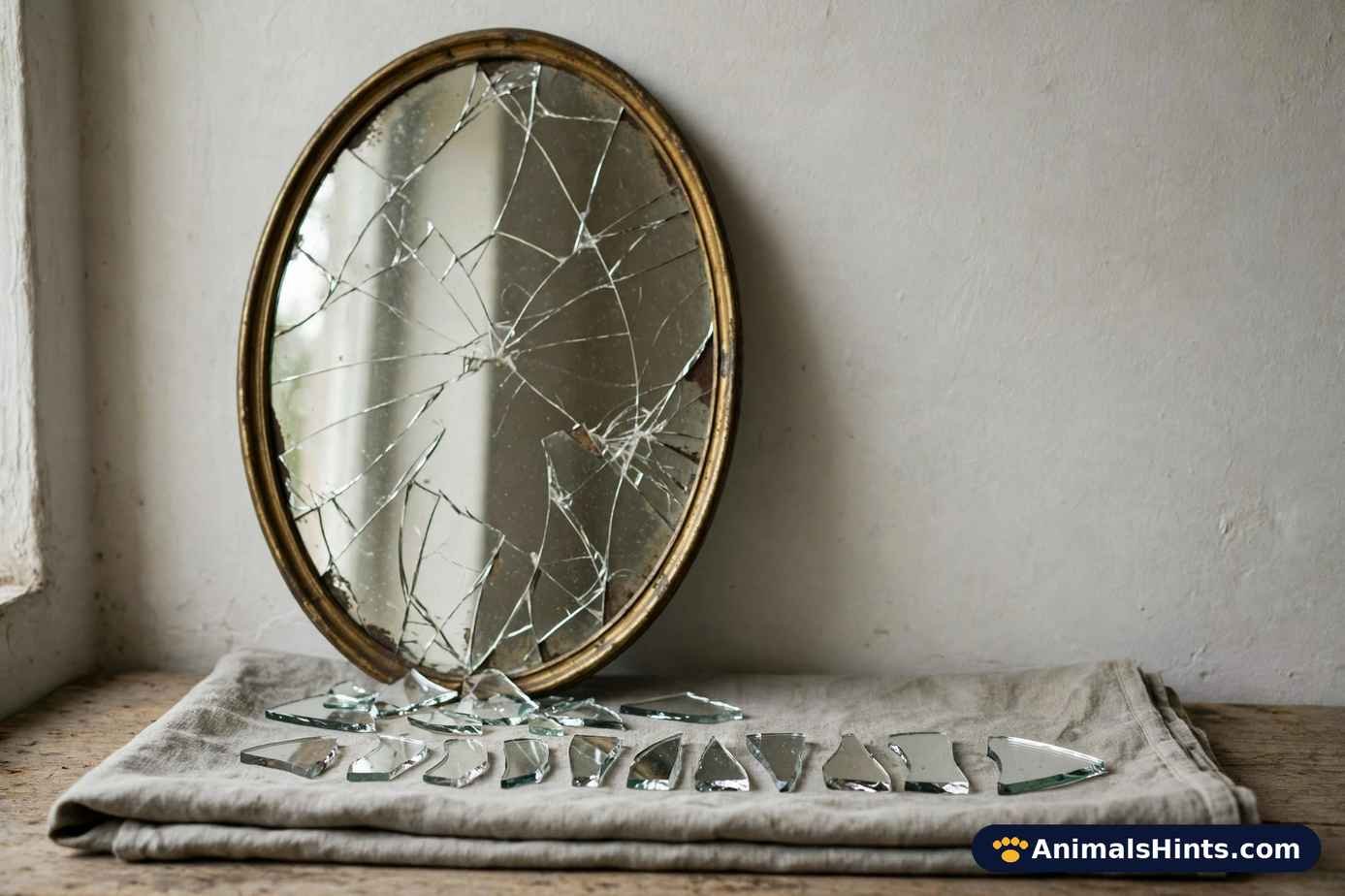
The guides’ first broken-mirror section works in images. A broken mirror primarily symbolises distorted truth: the reflection splits into disconnected pieces, and the state is read as confusion, or as a personal identity fractured into parts that no longer compose a face. It also symbolises an illusion ended by force. A mirror whose image has shattered past reading is, in their account, an event that compels a stop — the end of living inside a false self-image.
Fear is acknowledged in the same breath. Many cultures attach frightened superstitions to broken mirrors, and the guides do not hide them; but their own verdict leans the other way. Spiritually, they read the breakage as a change that had become necessary: a former way of being, or a false way of seeing, is over, and something new has to be built in its place. The seven-year sentence that popular superstition attaches to the event gets its own hearing further down this page.
Spiritual Meaning of Breaking a Mirror
Their second section moves from the object to the act. Breaking a mirror is a startling event, and spiritually, on their account, it is read, often, as the sign of a powerful inner upheaval — built-up emotional stress reaching its limit, or anger kept down too long finally breaking surface. It can also mark a sudden jolt of awareness: a belief about oneself, held for years, cracking in a single instant.
In the fuller version of the reading, the break means the soul is refusing an outgrown identity outright: the familiar reflection has gone, and clearing the old self away opens room for a transformation that is described as necessary. Where common superstition sees only the seven years, the guides’ deeper meaning is growth — growth admitted to be born, always, from discomfort and change.
The factor they weigh most heavily is the response of the person involved. Choosing fear is said to strengthen whatever negative energy surrounds the event; choosing calm reflection opens a path toward healing. Their practical counsel is to interrogate the event — what was it that needed to break? — and then to do the work of piecing together a newer and more truthful self-image. One border deserves marking before the page moves on: a mirror is not the only glass that breaks in a house, and a tumbler dropped on a kitchen floor is a different event with a different file — the accidentally breaking glass meaning in christianity page works that accident through on its own terms.
Do Mirrors Reflect Spirit?
The guides answer their own question with the belief that powers most of the catalogue: in many spiritual traditions, mirrors are held to reflect far more than physical light. They reflect a person’s energy — and, some say, the spirit itself. That single belief, they point out, explains the object’s working life across practices — mirrors turn up in rites that cleanse a room, in divination by scrying, and in protection work, where they are set to deflect harmful intent back toward its source.
Some teachings, they continue, hold that a mirror can show a viewer emotions or spiritual states they had kept hidden; others propose that spirits treat mirrors as doorways they borrow for a while. The reason offered is the object’s neutrality: a mirror does not judge, it only shows what is present. The same neutrality is used to explain why a mirror can feel charged in certain settings: in deep quiet, or in darkness, the mind sharpens, and the air around the glass can feel oddly heightened. The laboratory’s contribution to that last observation is already on the record above: darkness, a fixed stare and a human visual system are sufficient, on the fetched evidence, to make a mirror feel occupied. The traditions’ further claim — that something is actually there — is carried as their claim, here and everywhere on this page.
Mirrors Significance in Cultures and Religions
The guides’ cultural survey runs to five strands, brought over in his sequence, at his own strength — a tour of what each tradition is reported to hold, not a verdict on any of it.
Ancient China: mirrors are reported to symbolise truth, wisdom and protection for the soul, on the reasoning that a surface which reflects reality exactly cannot be fooled, and therefore sees through deception.
Japanese Shinto: mirrors are held to represent divine presence itself, and are housed in shrines as sacred objects — the mirror not as a symbol of a god but as a dwelling-place of the divine.
Hinduism: mirrors are connected with Maya, the veil of appearance the physical world wears; the reflection stands for what the eyes perceive while something deeper waits beneath, and the object becomes a reminder that the visible is not the whole.
African folklore: mirrors appear as instruments of spirit communication and revelation, credited in the stories with the power to disclose truths that stay hidden from ordinary sight.
Western mysticism: mirrors are used as portals and as tools of self-knowledge — gateways to the spirit world on one side, and instruments of honest self-examination on the other.
Biblical Meanings of a Mirror (with relevant bible verses)
The guides’ biblical section is noticeably more restrained than the rest of their page, and the restraint is worth carrying as they state it. In biblical interpretation, they write, a mirror is treated primarily as a tool of self-examination and a symbol of moral clarity, not as a magical object. Its job in the text, on their reading, is to show a person what needs correction.
Two verses carry their argument. James 1:23–24 gives them the man who looks at his face in a mirror, walks away, and immediately forgets what he saw — their lesson being that hearing truth without acting on it is exactly that kind of looking. Second Corinthians 3:18 gives them the believer beholding the glory of the Lord as in a mirror and being changed by the beholding — their lesson being gradual transformation rather than fortune-telling. Their own summary of the whole section deserves to stand as written in substance: the Bible’s mirror language is about clarity and conduct, not about superstition.
What their page does not do is quote either verse word for word or count the Bible’s mirror vocabulary — their renderings are paraphrases, and their census is silence. Both gaps are filled from the text itself, next.
What the Bible Actually Says About Mirrors: Eleven Glasses and No Omens
The audit for this page was run fresh across every book of the King James Bible, and its headline is a word that never appears. Mirror: zero occurrences. Mirrors: zero. The word belongs to later English; the KJV’s vocabulary for the object is the glass family, and that family totals eleven occurrences in every form: glass nine times, glasses once, and lookingglasses once — the count this run already holds from the breaking-glass audit, confirmed here word for word. The verb family is equally silent: reflect, reflects, reflected, reflection and reflections occur zero times in any form. Scripture’s mirrors exist, but they are never called mirrors.
Six of the eleven are actual mirrors — and all six are polished metal, not glass. The first is a furnishing, and a melted one: “And he made the laver of brass, and the foot of it of brass, of the lookingglasses of the women assembling, which assembled at the door of the tabernacle of the congregation.” (Exodus 38:8). The women’s brass mirrors were surrendered and recast as the tabernacle’s washbasin — the text records the donation and the metal, and assigns the objects no meaning beyond their use. The second is not a household mirror at all but a simile for the sky: “Hast thou with him spread out the sky, which is strong, and as a molten looking glass?” (Job 37:18). The third is an item in a wardrobe list, mirrors among finery that pride will lose: “The glasses, and the fine linen, and the hoods, and the vails.” (Isaiah 3:23).
The remaining three are the New Testament’s, and all three are metaphors — about knowing, and about conduct, never about fortune. Paul’s is the famous one: “For now we see through a glass, darkly; but then face to face: now I know in part; but then shall I know even as also I am known.” (1 Corinthians 13:12). The glass here is a mirror of polished bronze, and the darkness is literal before it is anything else: bronze mirrors returned dim, tarnished, poorly coloured images, a defect the standard modern reference on mirrors itself names as the explanation for this verse. Paul’s point is about the limits of present knowledge, not about the object. His second use is a transformation metaphor: “But we all, with open face beholding as in a glass the glory of the Lord, are changed into the same image from glory to glory, even as by the Spirit of the Lord.” (2 Corinthians 3:18). James’s is a conduct metaphor, quoted in full: “For if any be a hearer of the word, and not a doer, he is like unto a man beholding his natural face in a glass: For he beholdeth himself, and goeth his way, and straightway forgetteth what manner of man he was.” (James 1:23–24). The mirror in James rebukes forgetfulness. It does not predict, protect, open or trap anything.
The other five glasses are not mirrors at all. They are the material itself, used four times in Revelation and once in the same book’s visions as a comparison for a clarity beyond earthly manufacture — a sea “like unto glass” before the throne (Revelation 4:6; 15:2), and a city whose gold is “like unto clear glass” and whose street is “pure gold, as it were transparent glass” (Revelation 21:18, 21). Glass in the KJV is either a bronze mirror borrowed for a metaphor, or a standard of purity borrowed for a vision. That is the whole file.
So the absence can be printed plainly, because it is the finding. No verse in the King James Bible assigns a spiritual meaning to a mirror. No mirror in it is broken, is an omen, opens a portal, traps a soul, protects a house or carries a term of luck. The guides’ own biblical section, to its credit, reaches the same destination by its own road — moral clarity, not superstition. The census simply shows the road is the only one the text builds.

Myths and Superstitions Associated with Mirrors
The guides close their survey with the folklore file, and it is entered here for what it is — the beliefs themselves, before the next section puts the most famous of them on trial.
The heaviest custom is the covered mirror of the house of mourning: in many cultures mirrors are covered after a death, on the belief that the soul of the dead person could otherwise be trapped inside the glass. Beside it stand the placement warnings — mirrors should not face a bed or a front door — and the darker strand of the same family, the belief that mirrors can steal small fragments of a soul, which is why some traditions handle them with ceremony rather than casually.
The file’s most famous entry is the broken mirror and its seven-year sentence, the superstition the guides note even while resisting it. Underneath all of it, they observe, the myths share one conviction: mirrors carry emotional and spiritual power, and the rules that surround them — cover, place carefully, never break — exist in the traditions as a protective function, guarding the living from forces the object is believed to touch.
Seven Years of Bad Luck: The Mirror Omen, Answered
The seven-year sentence is the one mirror belief nearly everyone has heard, so it gets a hearing of its own — what can actually be documented about where it comes from, and what, at the end of the documentation, is left of it.
The pedigree, as the folklore summaries tell it, has two roots that met late. The older root is Greek and Roman. The ancients are reported to have held the reflection to be an image of the soul itself — the Greeks practised mirror divination, catoptromancy, with priests called specularii reading polished metal; Pausanias describes the rite in the second century CE — and Roman-era belief, in the standard retelling, added that the gods observed human souls through mirrors, so that damaging a mirror affronted the gods by fracturing the soul’s image. The second root supplies the number: Roman and earlier Greek medical thinking divided life into seven-year cycles, the body and soul renewing themselves every seven years. Place the pair together and the sentence assembles itself — a broken mirror damages the soul’s image, and the damage lasts exactly one renewal cycle: seven years. Histories of superstition that repeat this account are also honest about its limit: the finished formula, broken mirror equals seven years, has no single founding document. It is the folk endpoint of two older, separately documented ideas meeting in oral tradition, and it spread widely only in the late nineteenth century, when manufactured mirrors became cheap enough for ordinary households to break.
That is the belief’s biography, and it should be noticed what kind of document it is. A pedigree of an idea is not evidence for the idea. Nothing in the fetched record — not the scripture census above, which contains no broken mirror and no luck term at all; not the classical sources, which document people believing, never the belief working; not the laboratory record, whose dim-room effects need no curse to explain them — supports the proposition that breaking a mirror sets a term on anyone’s fortune. The omen survives scrutiny as history and fails it as mechanics.
What remains true around a broken mirror is smaller and more useful. Shards are sharp, and the care the old rules demanded around mirrors is real care, owed to feet and fingers rather than to fate. And the anxiety is real too: a person who has absorbed the superstition can spend genuine dread on an accident, which is why the guides’ advice lands kindly: interrogate the breakage, then build the truer image. The neighbouring darkness in this family is filed elsewhere on the site; the black spiritual meaning page — which works the colour shelf the mirror’s night reputation borrows from — arrives where this page arrives: the record first, the omen second, the fear nowhere.
Final Thoughts
The guides end where their catalogue began: with identity, energy and truth. A mirror, in their closing account, shows your identity, registers your energy and reflects your truth back at you, and it goes on asking the same quiet question for as long as you use one — who are you when every pretence has been set down? Used consciously, they say, the object supports growth; left unexamined, it simply goes on showing. Their final position on the symbolism itself is the one this page can endorse without crossing any of its own lines: the meaning of a mirror is not fixed by the glass. It is decided by the response of the person standing in front of it.
The checked shelves leave that response better informed than the folklore found it. The object is eight thousand years old and obeys one law — light returned by specular reflection, angle for angle, which is all a mirror has ever done. The laboratory shows the glass provoking real recognitions and real apparitions, both of them properties of brains rather than of doorways. The counted text gives the mirror eleven mentions, every one a furnishing, a simile or a metaphor about knowing and conduct, and not one an omen. A mirror does not flatter, and it does not condemn. It returns what stands before it — and what that return is worth has always been up to the person looking.
FAQs
What is the spiritual meaning of a mirror?
In the guides’ tradition, a mirror’s spiritual meaning centres on self-awareness, truth and the gap between the seen self and the inner one, with ten readings running from shadow work to transformation. The records checked for this page add their own bounds: the Bible’s mirrors are metaphors about knowing and conduct, and no verse assigns the object any meaning at all.
Why are mirrors used in spiritual protection?
The traditions use them as reflectors of more than light: set facing outward, a mirror is believed to turn harmful energy or intent back toward its source, the same logic behind Feng Shui placements meant to deflect what is stagnant or damaging. The use is carried here as the traditions’ practice; the physics underneath it is light alone.
What does a broken mirror symbolize spiritually?
In the guides’ reading, breakage symbolises distorted truth and an identity in pieces, but also the end of an illusion and the start of a necessary change — the soul, on their account, rejecting an old self-image. The popular seven-year sentence attached to it is folklore with a documented pedigree and no supporting record, as the omen section above sets out.
How can I use mirrors in my spiritual practice?
The practices the guides describe are reflective ones: honest self-observation in front of the glass, shadow work, meditation on the difference between appearance and inner state, and the disciplines of truthfulness the ten readings build on. Their consistent condition is that the mirror is an instrument of attention — it reveals; the practice, and the change, belong to the person.