Black Clothes in a Dream: The Biblical Audit, Ten Readings and the Research Record
You wake remembering the outfit more clearly than the plot: somewhere in the night you were dressed in black from collar to hem, and the colour is the detail that follows you into the kitchen. Most people who search the biblical meaning of black clothes in a dream are asking two questions at once — what does wearing black mean, and does the Bible in particular have anything to say about it?
The guides answer generously. Their page on this dream offers a symbolism section, ten spiritual readings from mourning to spiritual warfare, a section devoted to the biblical meaning, a table of six cultures and belief systems, nine dream scenarios, and a verdict on whether the dream is a good or bad omen. Every part of that account is reproduced below, attributed to the tradition carrying it.
Beside it stand two shelves of checkable material: dream research, which has measured even whether people dream in colour at all, and the biblical text itself, tallied occurrence by occurrence — black, garments, dreams. The count allows one finding to be given immediately: no biblical text describes a dream of wearing black, and no verse interprets one. Where that leaves the guides’ ten readings is the work of the sections that follow.
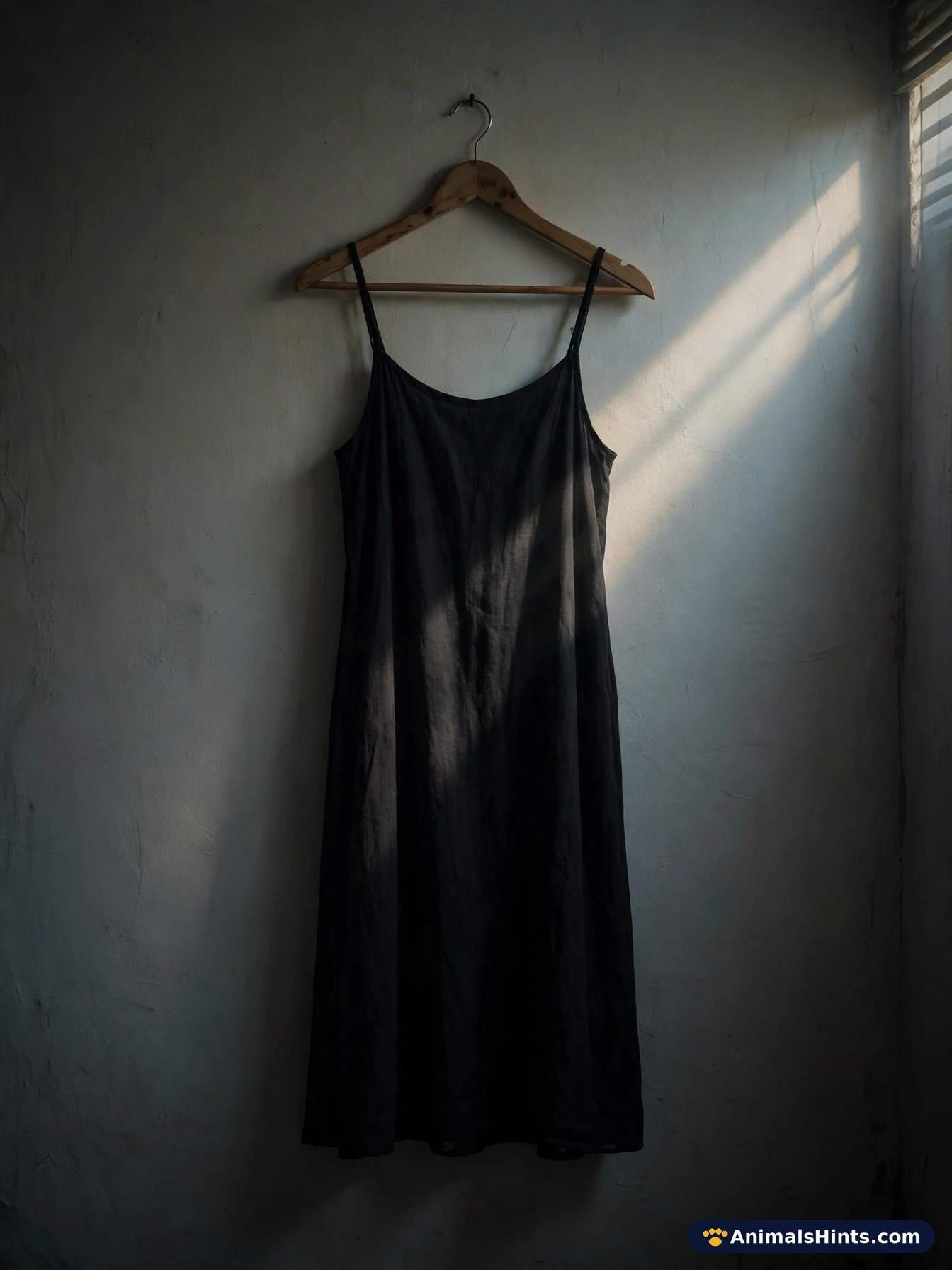
Symbolism of Wearing Black Dress in a Dream
In the guides’ telling, black is the colour that swallows all the others, and what a dreamer wears of it is read as a state of the inner world rather than a fashion choice. Dressed in black inside a dream, a person is pictured as carrying something deep — protection being gathered, energy being hidden, a process under way that has not yet surfaced into waking life.
The tradition loads the colour from both ends at once. On one side stand authority, wisdom and depth: black as the dress of judges, scholars and elders, the colour of someone who does not need to be looked at. On the other stand mourning, endings and secrecy: black as the dress of funerals, of things being closed, of what is deliberately kept from view. The guides hold the two loads together by pointing at the dreamer’s own feelings as the instrument that tells them apart. Confidence inside the black is read as strength, spiritual maturity, a kind of armour worn knowingly. Sorrow or a sense of being trapped inside it is read as emotional heaviness, fears not yet faced. Black worn for an occasion — a funeral, a ceremony — is read as transition, a life closing one chapter in formal dress.
That feeling-first method runs through everything the guides say about this dream, and it is worth naming before the readings begin, because it is both their strength and their limit. A method that grades the symbol by the weather around it can never be contradicted by the dream itself, and the research and scripture sections below exist to show what can be checked from outside it. The colour black carries its own long symbolism on this site beyond any single dream — the black spiritual meaning page works the waking colour in full — while this page keeps to the narrower question of wearing it in your sleep.
What Dream Research Records About Colour, Clothing and Grief in Dreams
Research enters this topic from an unexpected direction: for much of the twentieth century, psychologists were not sure people dreamed in colour at all. In 1942 the researcher Warren Middleton asked American college students how often they saw colour in their dreams, and 70.7 percent answered rarely or never. When Eric Schwitzgebel rebuilt the same questionnaire and ran it again in 2001, the figure had collapsed to 17.7 percent. The dreams had not changed in sixty years; the world around them had. The decades in between were the decades of black-and-white film and television, and the leading explanation of the shift is that people described their dreams in the palette of the pictures they grew up watching.
A 2008 study by Eva Murzyn at the University of Dundee tested that explanation directly, comparing younger adults raised on colour media with older adults whose childhood viewing had been black and white, using dream diaries as well as questionnaires. The older group with black-and-white media in their childhood reported more greyscale dreams, on both measures. Even the presence or absence of colour in a dream — the most basic fact a dreamer could report — turns out to be partly a matter of memory, expectation and the questions asked. Against that background, one limit of the research shelf should be stated plainly: no content-analysis tradition in dream research codes what dreamers are wearing, and no study assigns meanings to garment colours in dreams. The laboratory can say something about colour in dreams. About black clothes in a dream, it has no instrument and offers no reading.
What research can speak to is the dream’s commonest occasion. The guides’ first reading ties this dream to mourning, and dreams in bereavement are among the best-counted dreams there are. In a 2014 survey published in the American Journal of Hospice and Palliative Care, Scott Wright, Christopher Kerr and colleagues asked 278 bereaved hospice caregivers about dreams of the person who had died: 58 percent reported at least one, most described them as pleasant or as a mixture of pleasant and sad rather than purely disturbing, and about 60 percent of those who dreamed said the dreams had affected their bereavement — most often by bringing comfort or a readier acceptance of the death. A 2019 study by Joshua Black and colleagues added the finding that disciplines all the others: the strongest predictor of dreaming about the deceased was simply how often a person remembers dreams of any kind. Grief dreams, on the record, are ordinary events in a grieving life. None of that research grades a dream by its wardrobe — but it does establish the setting in which a mourning dream, in whatever colour, most often arrives.

10 Spiritual Meanings of Wearing Black Clothes in a Dream
The ten readings follow in the guides’ sequence. Each is reproduced the way its tradition states it — no stronger, no weaker. Where one of them strays onto ground the checked records cover, the record gets a word inside that reading’s section.
1. Mourning and Grief
The catalogue opens with the reading the colour is famous for. To dream of wearing black is, in the guides’ account, to be pictured mid-mourning — the soul acknowledging a sorrow that waking life has not given its full time: a death, certainly, but equally the end of a relationship, a role, or a phase of life that is being grieved without a funeral to mark it. The dream is a mirror held up to pain that lingers beneath the surface, and its counsel is room: space to grieve, acceptance, forgiveness extended in both directions.
The guides root this reading in scripture’s mourning dress, and the root is real but narrower than their telling. The Bible’s garment of grief is sackcloth — coarse cloth put on for lamentation and repentance — and the counting section below shows that the text never once gives that garment a colour. The mourning reading itself needs no such support: the bereavement research above records dreams arriving thick and fast in seasons of loss, most of them kind. What neither shelf supplies is a key that reads the mourning from the colour of the clothes.
2. Power and Authority
The second reading turns the colour around. Black is the dress of authority in waking life — of the bench, the boardroom and the formal occasion — and the guides read a dream of wearing it as a mark of someone stepping into their own weight: confidence gathering, leadership being taken up, independence reclaimed. A dreamer composed inside the black is understood to be absorbing experience rather than being overwhelmed by it, the colour standing for completeness and self-command.
The reading carries its own caution in the guides’ hands. Power held in black can isolate; the same dream felt as burden rather than poise is read as the cost side of authority — distance from other people, responsibility carried alone — and the prescribed correction is humility in the exercising of it. The reading belongs wholly to the tradition: it describes a recognisable waking wardrobe and lends the dream its meanings, and no record outside the tradition tests the loan.
3. Spiritual Warfare
The third reading makes the clothing armour. In the strand of interpretation the guides draw on here, wearing black in a dream marks a season of spiritual conflict — faith against fear, light against darkness — and the black attire is the covering a soul puts on to stand in that fight: protection, awareness, a readiness to face challenges that are not visible in daylight. Such dreams are said to turn up in seasons of worry, temptation or a worn-down spirit, and their function is a summons — to prayer, to vigilance, to firmer footing.
The guides are careful to keep the reading from pure alarm. The darkness in it figures not defeat but the shadow side of a covering, the dreamer pictured as sheltered while the battle goes on around them. Printed at that strength, the reading is a pastoral frame for a hard season, and it is set down on this page as the tradition’s account. Nothing on the checked shelves grades dreams as dispatches from a war, and the health section below marks the line where a frightening dream stops being an interpretation problem at all.
4. Transformation and Change
The fourth reading treats black as the colour before beginnings. In the guides’ image, it is a womb-dark, and the dark of good soil: the space in which endings do their work so that something else can start. A dream of wearing black is read as an incubation — an old identity, belief or attachment being shed, the dreamer dressed for the interval between who they were and who they are becoming, with the results not yet visible.
Feeling is again the instrument. Peace inside the black is read as change arriving on schedule and under guidance; heaviness inside it is read as resistance, the fear of stepping into the next phase. Either way the tradition files the dream under transition with a purpose. The image of the seed breaking underground before it grows is theirs, and it is a fair emblem of the reading: darkness as a working condition, not a verdict.
5. Spiritual Purification and Guidance
The fifth reading works the colour’s physics into a cleansing. Because black absorbs, the guides read a dream of wearing it as the picture of a soul drawing negativity out of itself — old energy, stale attachments, thoughts that no longer serve — and making room for clearer guidance. Such dreams are said to come when a person is seeking direction, and the black is a withdrawal into quiet — a place where guidance is pictured as audible precisely because everything else has gone still.
The message the tradition attaches is patience with the process: what feels like confusion is filed as guidance proceeding quietly beneath the surface, and a recent pull toward solitude or reflection is taken as confirmation rather than symptom. It is printed as the guides’ account of their own symbol, nothing more. The records on this page can neither confirm a detox of the soul nor grade one, and they are not asked to.
6. Humility and Submission
The sixth reading dresses the dreamer for surrender. Dark clothing carries reverence in many faiths — the dress of penitents, mourners and monks — and the guides read a dream of wearing black as the subconscious rehearsing a posture of humility: pride being stripped, stubbornness softening, a willingness to submit to a will larger than one’s own and to be taught rather than to insist.
The dream’s feeling divides the reading as usual. Peace inside the black signals a heart aligning with humility and preparing to receive; heaviness signals resistance being asked to let go. The tradition’s summary is that strength begins in surrender, and the dream is its invitation. That is a devotional claim, printed as one; the scripture section below records what the biblical text actually pairs with humility, which is sackcloth and ashes rather than a colour.
7. Mystery and the Unknown
The seventh reading leans into the colour’s oldest association. Black is what cannot be seen into, and to wear it in a dream, in their reading, is to step into an unknown chapter — answers not yet available, a stretch of life that must be walked by faith and curiosity rather than by map. The guides picture the unknown as a void with wisdom hidden in it, and the dream as the sign that the dreamer is being guided through it rather than abandoned in it.
A further strand in their telling ties black to intuition and the receptive, inward side of the soul — the part that knows without being shown. Calm inside the black reads as readiness for the mystery; feeling lost inside it reads as the lesson still being set. The instrument is the tradition’s own, filed as theirs: the records below can describe darkness in scripture and colour in dreams, but no shelf holds a graded scale for the unknown.
8. Shadow Self and Integration
The eighth reading is the catalogue’s psychological entry, and the guides name its source: Carl Jung’s shadow, the unrecognised side of the personality — the repressed emotions, desires and fears the conscious mind keeps out of sight. To dream of wearing black is read as that hidden material asking to be faced and integrated, the dreamer dressed in the very part of themselves they have not acknowledged.
The tradition is explicit that the work is not negative. Wholeness, in this strand, requires the darkness to be admitted rather than defeated; accepting imperfections and forgiving the past is pictured as the route by which the shadow becomes a source of strength. Comfort inside the black signals readiness for the integration; unease signals the conflict still running. The reading is filed as the guides’ use of Jung’s idea — a map of inner work many readers find usable — and not as a finding about what any particular dream contains.
9. Detachment and Renunciation
The ninth reading looks east. In the guides’ summary of Buddhist and related paths, black stands for detachment and renunciation, and a dream of wearing it is understood as a movement toward letting go — of possessions, of outcomes, of the need for approval — in favour of simplicity and peace. Such dreams are said to turn up when the outer life has grown chaotic and the soul is asking for a quieter economy.
The tradition is careful with its own term: non-attachment is not coldness. The freedom it pictures is observational — life watched without clinging — and the dream’s feeling divides ripeness from loneliness as before: serenity reads as maturity, isolation as a reminder to balance solitude with connection. Printed at the guides’ generality, with no doctrine added that their page does not carry.
10. Inner Distress or Difficult Period
The catalogue closes with its heaviest reading. A dream of wearing black can, in the guides’ account, picture a season of emotional or spiritual weight — exhaustion, anxiety, a direction gone uncertain — a time of testing in which old patterns break. They name the pattern with an old piece of spiritual vocabulary: a dark night, endured before a dawn.
The reading refuses to end in the dark. The distress is framed as refinement, the pause as the rebuilding of strength, and the prescribed response is care — rest, slowness, reconnection with whatever the dreamer counts as their light. Where that counsel reaches its limit is a boundary this page draws in its own voice below: distress that persists, in dreams or out of them, belongs to the health section’s territory and not to interpretation at all.
Biblical Meaning of Wearing Black in a Dream
The guides give this dream a biblical section of its own, and their account runs on four strands, carried here in their order. Black in the Bible, they say, is a colour of deep emotion and of judgement — sorrow and sin on one side, repentance and humility on the other — with a quieter strand in which it can stand for depth and reverence before God rather than for anything dark in outcome.
- Symbol of Mourning: Their first strand reaches back to the ancient grief wardrobe: sackcloth and dark dress put on in loss or under judgement, humility worn where everyone could see it. The dream of wearing black is read as that ancient posture surfacing in sleep.
- Representation of Sin or Judgment: Here the colour is made to figure a season of spiritual testing — a soul brought face to face with something buried, a wrong or a regret awaiting cleansing — and the dream is read as that confrontation arriving dressed.
- Sign of Spiritual Depth: Because black absorbs light instead of reflecting it, they read it as the figure of a person absorbing wisdom: entering silence, listening rather than displaying, going deep instead of going loud.
- A Season of Transition: Sometimes, in their account, black marks the end of a chapter — a path or a behaviour closing — and the dream of wearing it is the sign that room is being made for growth.
Their section closes with the one verse it cites: Exodus, where Moses approaches the thick darkness in which God was — offered as proof that darkness in scripture is not always absence, since God’s presence is found inside it. The verse is real, and the next section quotes it word for word. What it is about — and what the whole counted text says about black, garments and dreams — is the audit this page owes the word “biblical” in its title.
What the Bible Actually Records About Black, Garments and Dreams
This section rests on a fresh tally of the King James text, taken word by word from the beginning, and it opens with how small the black shelf is. The word “black” occurs 18 times in the entire text; its whole family — “blacker” once, “blackish” once, “blackness” six times — comes to 26 occurrences. Set beside the garment shelf, the proportions are the first finding: “garments” occurs 103 times, “garment” 86, “clothes” 101, “clothed” 73, “raiment” 57, “apparel” 28. The Bible talks about clothing constantly. It talks about black rarely. And it never once talks about them together: no verse in the text joins a black-family word to a garment word, and no verse joins a black-family word to a dream word — the two families never meet, not in a verse, and not within six hundred characters of each other anywhere in the book.
What black attaches to, when it appears, can be listed whole. It is hair, twice, in the Leviticus rules for a skin disease — black hair in the scall is a diagnostic detail, not a symbol. It is skin: Job’s, black upon him in his suffering; the bride’s in the Song of Songs — “I am black, but comely, O ye daughters of Jerusalem” — blackened, she explains, because the sun has looked upon her; the famine-starved skin of Lamentations, black like an oven, a visage “blacker than a coal”. It is the weather and the sky: the heaven black with clouds before Ahab’s rain, the heavens above made black in Jeremiah’s mourning over judgement. It is a pavement of black marble in Esther’s palace, the black and dark night of Proverbs, faces that “gather blackness” in Joel and Nahum, and horses — Zechariah’s black team, and the black mount in Revelation whose rider holds the scales of scarcity. Once, in Matthew, it is the colour a man cannot make a single hair turn. That is the complete inventory. In 26 occurrences across both testaments, black is never the colour of anything anybody wears.

The mourning wardrobe makes the point from the other side. The Bible’s garment of grief is sackcloth — 46 occurrences — put on for lamentation, repentance and humiliation before God, from Jacob onward: “And Jacob rent his clothes, and put sackcloth upon his loins, and mourned for his son many days.” The text names the garment, names the grief, and never names a colour for it. The single verse in the Bible where black and sackcloth stand in one sentence is about neither mourning nor clothing: in Revelation’s sixth seal, “the sun became black as sackcloth of hair” — the coarse cloth borrowed as a measure of darkness for the sky. Later tradition and history may picture the mourner’s cloth as dark goat’s hair, and the closing section returns to that; the counted text itself leaves the garment uncoloured, every one of the 46 times.
The dream shelf, audited the same way, is just as definite. The Bible’s dreams are famous and specific — Joseph’s sheaves and stars, the cupbearer’s vine, the baker’s baskets, Pharaoh’s cattle and corn, Nebuchadnezzar’s great image, Daniel’s beasts — and not one of them turns on clothing, let alone on its colour. The nearest approach in the whole book deserves naming precisely because it is the nearest: in Daniel’s night vision, the Ancient of days sits enthroned, “whose garment was white as snow, and the hair of his head like the pure wool”. A garment does appear inside one biblical dream-vision — white, not black; worn by God, not by the dreamer; and the interpretation Daniel is given in the same chapter runs entirely on kingdoms and dominion, and never mentions the garment at all. Coloured clothing certainly exists elsewhere in the text — Joseph’s coat of many colours, Mordecai’s royal apparel of blue and white, the purple raiment on the kings of Midian — but all of it is waking narrative, and none of it is read by the text as an omen of anything.
And the guides’ one cited verse, quoted word for word, is this: “And the people stood afar off, and Moses drew near unto the thick darkness where God was.” It stands at Exodus 20:21, on Mount Sinai, in waking life, and it is about darkness — the word is “darkness”, not black — with no clothing and no dream anywhere near it. It supports exactly what it says: that in scripture God can be met in darkness. It does not mention this dream, or any dream, or the colour of anything worn.
The audit can therefore be stated plainly, and it is stated here for the first of two times on this page. The Bible contains no dream of wearing black clothes, no dream about the colour of clothing at all, and no verse that assigns a meaning to either. Everything the guides print under the heading “biblical meaning” is built by association — from mourning customs the text leaves uncoloured, and from a colour the text attaches to hair, skin, sky and horses but never to a garment. Association is a legitimate way to reflect. It is not a report of what the text contains, and it is not filed here as one.
Cultural and Religious Interpretations of This Dream
The guides survey the dream across six traditions, and their table follows as they give it — their account of what each tradition makes of wearing black in a dream.
| Culture/Belief System | Meaning of Wearing Black in a Dream |
|---|---|
| Christianity | Mourning, repentance, or divine discipline |
| Hinduism | Protection from evil spirits or negativity |
| Islam | Reminder to seek purity and guidance from Allah |
| African Spirituality | Symbol of ancestral power and hidden strength |
| Western Psychology | Reflection of suppressed emotions or identity struggles |
| Native Traditions | Transformation or connection to the unseen world |
Different Dream Scenarios of Wearing Black Dress and Their Meanings
Nine scenarios make up the guides’ set. They are given here in his sequence — their titles his, their explanations rewritten.
Wearing a Black Dress at a Funeral — Read as closure: a painful thing — a relationship, a habit, a phase — being formally let go, the dreamer dressed correctly for an ending they are ready to complete.
Wearing a Black Wedding Dress — Read as ambivalence at a threshold: fear of commitment or emotional conflict around a union, or, turned inward, a marriage with the shadow self — the rejected parts of the dreamer brought to the ceremony.
Wearing a Black Dress in a Celebration — Read as poise: self-confidence and personal power worn in public, or a protective covering around the dreamer in a season of strength.
Seeing Someone Else Wearing Black — Read as perception: the dreamer registering another person’s struggle, transition or emotional distance — the other figured as mysterious, strong, or unavailable.
Buying or Choosing Black Clothes — Read as preparation: a wish to feel safe and in charge of what comes next, the dreamer picking out protection ahead of a phase that will ask for strength or maturity.
Removing Black Clothes — Read as release: burdens and negative attachments being set down, forgiveness and healing pictured as undressing from a long internal struggle into light.
Being Forced to Wear Black — Read as weight that is not one’s own: emotional pressure or guilt belonging to other people, and a reminder to clear outside influences and return to one’s own path.
A Torn or Dirty Black Dress — Read as weariness: spiritual fatigue or emotional wounds showing on the garment itself, and a sign that healing and renewal are due.
Wearing a Black Robe or Cloak — Read as covering and office: robes carry authority in the tradition’s eye, and a black one is read as preparation for wisdom, or protection by higher guidance through a hard phase.
Is it a Good or Bad Omen?
The guides meet their own heading with a refusal to split the dream in half. Wearing black, on their account, is a symbol of duality — endings and beginnings in one colour — and its charge is set by the dreamer’s state rather than by the garment. Peace and confidence inside the black make it a positive sign: spiritual maturity, inner power, protection, someone settled, strengthened and prepared for a deeper grasp of things. Discomfort or sadness inside it makes it a warning of the gentler kind — an invitation to let go of what is negative, guilty or feared, and to take up prayer, meditation or reflection where life feels heavy.
Their summary sentence is that the overall meaning depends on the emotions, the surroundings and the spiritual state of the dreamer — and that sometimes mourning is not the subject — growth in faith is. So much for the tradition’s answer, which has now been given in full. What the checkable records contribute is the business of the section after this one.
Good or Bad? What the Records Can Grade, and What They Cannot
Start where the evidence is oldest on this page: the laboratory. Researchers spent sixty years asking whether dreams contain colour at all, and their answers swung wildly — roughly seven in ten students in 1942 said colour rarely or never appeared in theirs; by 2001 fewer than two in ten said so. Nothing about human sleep had altered in the interval. What had altered was the moving pictures each generation grew up with, and with them the way a dream gets described afterwards. A literature that cannot hold steady on so basic a question — was there colour in the dream, yes or no — is in no position to certify what one particular colour signified. What it can certify is circumstance. Dreams cluster in bereavement; in the hospice survey most were gentle or mixed; and whether a grieving person dreams of the dead at all tracks chiefly how much that person dreams, full stop. Those are facts about the dreamer’s season. None of them amounts to a forecast, and the research shelf holds nothing that behaves like one.
The scripture shelf was emptied onto the table in the counting section, and its verdict can be repeated in one breath: black clothing features in no biblical dream, no passage explains what clothing in a dream signifies, and across all 26 of its appearances the colour black is never once something worn. The mourning garment the text does name — sackcloth, 46 times — is never given a colour; the single garment shown inside a dream-vision is white, and the chapter containing it spends its interpretation elsewhere. So the reader hunting for a biblical ruling on this dream is not up against a ruling they dislike. The shelf is bare. The guides’ biblical material is reflection constructed alongside the text, legitimate as devotion, and it misleads only when it is mistaken for quotation.
One fear attached to this dream does its damage at 3 a.m. and earns a paragraph of its own: the folk belief that dreaming in funeral dress announces a death — one’s own, or someone under the same roof. It is entered in this article as what it is — a piece of folklore — and it is answered directly. The guides, for their part, file the funeral scene under closure rather than prophecy. The bereavement studies describe loss-dreams as routine traffic in a grieving mind, and predominantly comforting traffic at that. And neither the counted text nor any laboratory instrument has ever carried advance news of a death out of a dream. Terror in the night testifies to a terrified sleeper, or a grieving one. About the future — anyone’s, in either direction — it testifies to nothing, and no comfort stronger than that is on offer here, because none exists in the record.
So the good-or-bad question meets the same shaped refusal the records have given elsewhere on this site. Neither shelf will sign a verdict of good, and neither will sign one of bad. They will sign something plainer: that this dream turns up in life’s heavy weather, that its colour is borrowed from the most solemn wardrobe the surrounding culture keeps, and that everything checkable about it points back at the dreamer’s present circumstances. The black clothes are not a sentence passed on what lies ahead. They are closer to a weather report from what is already being lived through.
When a Black-Clothes Dream Becomes a Health Matter
For the great majority of dreamers, a night spent dressed in black calls for no clinician at all. The tallies above are the honest comfort available: the image is a common one, grief-dreams are a documented commonplace, and frequency alone makes nothing a symptom. All the same, medicine does fence off a corner of dream territory, and readers who have wandered into it deserve the fence pointed out.
The fence is built of persistence and damage. Alarm is warranted not by one bad night but by a pattern: the same grief-laden dream coming back relentlessly — especially one restaging a death or a traumatic event — until sleep itself becomes something feared, or until the days begin to buckle under lost rest. Nightmares that recur are a recognised feature of post-traumatic stress, and sleep medicine is not empty-handed against them: imagery rehearsal therapy, in which the dreamer rewrites the dream’s ending in waking hours and rehearses the new version, carries the American Academy of Sleep Medicine’s recommendation for nightmare disorder (its 2018 position paper). Recurrence in its own right has a file on this site, the having the same dream twice spiritual meaning page. Grief draws a second fence of its own: mourning that stays raw, and keeps a person from working, sleeping or functioning long after the death, belongs with a clinician or a bereavement service, not with a dream dictionary. Nothing here diagnoses any reader; that work happens in consulting rooms, not on pages.

Final Thoughts
The guides close their page on the colour’s depth. Black, in their final account, is not darkness in the negative sense but mystery and transformation — an invitation to introspection, a reminder that silence and stillness teach, and a set of questions — what is being let go, and what strength is surfacing. Their closing figure is the finest the tradition offers: darkness figured not as light’s absence but as the ground in which light starts.
Against the records, that close holds up in reduced form — and is the better for the reduction. The dream is not arbitrary in the one way evidence can speak to: like every dream, it is fashioned from the stuff of the dreamer’s waking life, and black is the colour a whole culture reaches for when it dresses its heaviest occasions — its funerals, its formalities, its thresholds. Research hears grief and season in it. Scripture, counted honestly, is silent about it, and the silence is itself the finding this page was written to report: the tradition’s ten readings stand as the tradition’s, and no verse stands behind them dressed as their source.
And the guides’ mourning strand turns out to touch solid ground in exactly one place, which is a fabric rather than a dream. The garment the Bible’s mourners actually wore was sackcloth — coarse cloth, usually woven of black goat’s hair in the historical record — put on by Jacob for Joseph, by kings for their cities, by Nineveh for its sins. The counted text never calls it black, and never connects it to a dream; and both halves of the sentence count. But the reader who dreamed of mourning clothes was dreaming of something real: the oldest grief wardrobe in the record, dark in the hand if not in the text. What such a dream means belongs to the shelves above; what the garment was belongs to history, and history has settled it.
FAQs
What is the biblical meaning of wearing black in a dream?
Strictly, there isn’t one on record: the Bible contains no dream of wearing black and no verse interpreting clothing in a dream — its black is hair, skin, sky and horses, never a garment. The guides build their biblical reading by association, from mourning customs and the colour’s gravity; it is carried in full above, as reflection rather than as a report of the text.
What is the spiritual meaning of wearing black in a dream?
In the guides’ tradition: mourning and grief, protection, transformation, or the shadow self asking to be integrated — ten readings in all, graded by how the dream felt. Calm and confidence inside the black read as strength; sorrow inside it reads as heaviness to be worked through. The full catalogue stands above at the tradition’s own strength.
Does wearing black in a dream always have a negative meaning?
No — not even in the guides’ own account, where the same colour carries power, authority, purification and protection alongside mourning and distress. The tradition grades the dream by its feeling and setting, and the records add only this: the dream is common in heavy seasons, and no shelf holds an instrument that makes it a warning about the future.
How should I respond to a dream about wearing black?
The guides prescribe reflection: write down the feeling the dream left behind, and ask which waking matter it keeps gesturing toward — a grief, a threshold, a weight. That much, and no more, is what the records endorse. No record anywhere demands ritual, payment or fear; and if the dream keeps returning with distress, or grief itself is not easing, the health section above is where to look.