Purple Butterfly Meaning: 12 Meanings, Cultures, Dreams and Royalty
The purple butterfly meaning, in the folk and spiritual traditions that hand these readings down, gathers around rarity and depth: spiritual growth, intuition, dignity, and change that happens on the inside before it shows anywhere else. Purple has been the costly color for three thousand years — the dye of emperors — and a butterfly dressed in it becomes, in that reading, a sign pitched at the soul rather than at the calendar: awaken, reflect, trust what you know quietly.
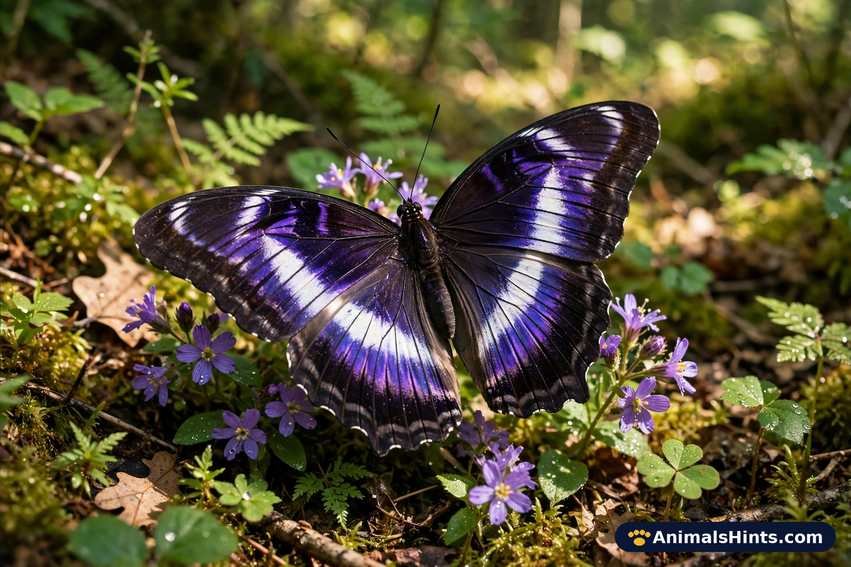
There is also a plainer reason purple sightings feel special: the reason is built into the wing itself. Butterflies almost never make purple from pigment. The violet on a real wing is usually light itself, bent by microscopic architecture in the scales, and it switches on and off as the angle changes — which is why a purple butterfly can look nearly black one second and blaze violet the next. The species that genuinely wear it are few, local, and easy to miss: canopy hairstreaks over oak woods, one great emperor flashing in European treetops.
This guide walks the whole subject in order: what the sighting is taken to symbolize, the real purple species behind it, then the twelve traditional meanings one by one. Cultures and religions follow, then visits and landings, love, dreams, and the omen question, closing with ways to make a garden worth visiting. Checked biology is given as biology; belief is given as belief, with its holders named.
What Does Seeing a Purple Butterfly Symbolize?
In the shared modern tradition, a purple butterfly symbolizes the inward end of transformation. Every butterfly carries the metamorphosis story — a grounded creature rebuilt for the sky — but color decides what kind of change is meant, and purple aims the story at consciousness itself: intuition sharpening, a spiritual life deepening, old grief loosening its hold. Where orange, in this family, shouts its encouragement kindly, the purple one is read as counsel spoken quietly.
Purple brings its own long résumé to the meeting. Because its ancient dye took thousands of sea snails to color a single garment, the hue spent millennia restricted by price and then by law to rulers and high priests, and it still reads as royalty, ceremony and luxury today. Layered under that is the modern spiritual association: in contemporary color symbolism purple stands for imagination, intuition and the life of the mind turned upward. A butterfly in this color is therefore read as dignity in motion — change that does not panic, and self-respect that needs no audience.
The readings this tradition puts first for the purple butterfly gather into five:
- Spiritual deepening — the sighting is offered as a prompt toward reflection, prayer or meditation, and toward trusting inner knowledge over noise.
- Transformation with meaning — change read not as accident but as a chapter turning deliberately, often after loss or a long stall.
- Quiet strength — endurance carried with dignity; the survivor’s reading, and the one grieving readers reach for most.
- Intuition and creativity — purple’s mental color applied to wings: a nudge to make the thing, write the page, follow the hunch.
- Second chances — grace after failure; the belief that a life, like a wing, can open more than once.
None of these is a finding. They are interpretations a living tradition offers for reflection, and this guide presents them exactly that way. The findings — and they are genuinely strange — begin with the animal underneath.
The Real Purple Butterflies Behind the Symbol
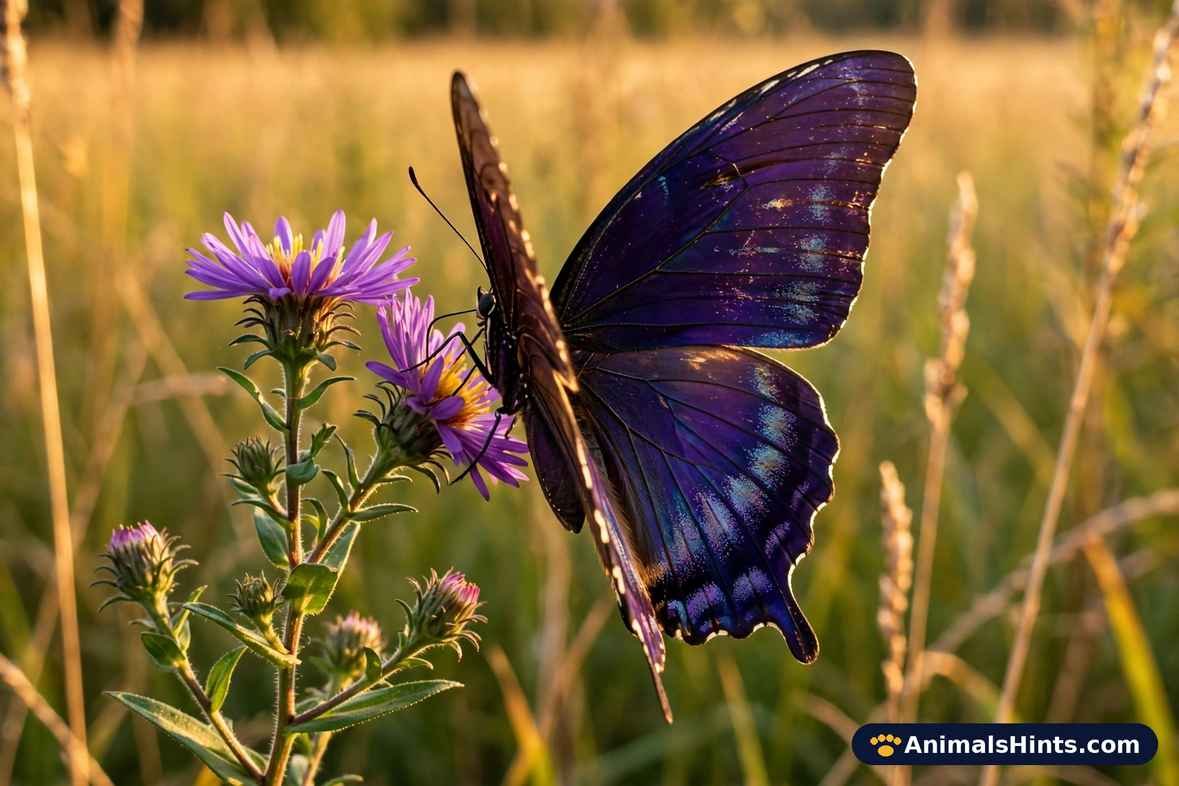
Ask a wing how it makes purple and the short answer is: mostly, it doesn’t. The pigment families butterflies actually manufacture run warm — yellows, oranges, reds, browns, black — and violet sits beyond their chemistry’s reach. So where purple appears on a butterfly, it is almost always structural: the surface scales of the wing are stacked in layers finer than a wavelength of light, and those layers bounce violet wavelengths back to your eye while letting others cancel out. Tilt the wing and the geometry changes, the reflection fails, and the purple vanishes into plain dark brown or black. Researchers who sectioned the scales of the purple emperors under electron microscopes found exactly this — a multilayer structure in the upper scales of the males, producing a brilliant structural color, while the pigment underneath stays dark. A purple butterfly is not dyed. It is lit.
That single fact explains the whole folklore of elusiveness around this color. Purple butterflies do not merely happen to be rare in most gardens; their color is conditional on sunlight and angle, so even a common purple species can pass a watcher a dozen times as an anonymous dark insect before one turn of the wing gives it away. Three species carry most genuine purple sightings, and each wears the color differently.
The purple emperor (Apatura iris) is the heavyweight — a large, powerful butterfly of European woodland, wingspan roughly 75–84 millimetres, on the wing in high summer. The male’s upperwings are dark brown crossed with white bands, and across that darkness, at the right angle to the sun, washes a vivid violet-purple sheen; the larger female carries the same white patterning with no purple at all. Emperors live where they are hard to watch: males gather at the tallest trees of a wood, patrol a treetop territory, and chase off intruders, while females lay their eggs on willows — goat willow above all. Nor do the adults behave like flower butterflies. They feed largely on honeydew and tree sap in the canopy, and males famously descend to the woodland floor for salts — from dung, carrion, road surfaces, even the sweat soaked into a walker’s boots. The most regal-looking butterfly in Europe earns its living at ground level, on exactly the things a crown would avoid.
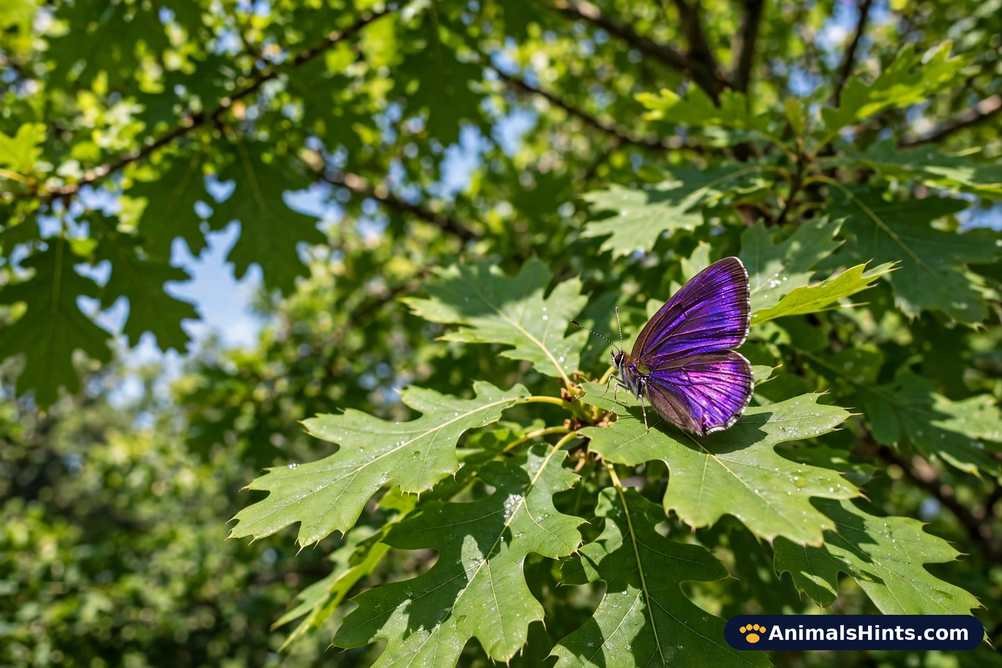
The purple hairstreak (Favonius quercus) is the emperor’s small counterpart, and the purple most British and European readers could actually have overhead without knowing it. It is a little oak-canopy butterfly: the male carries a glossy purple sheen across nearly the whole upperside, the female keeps just two purple patches on her forewings, and both sexes are silvery grey underneath, so a settled hairstreak with closed wings shows no purple whatsoever. The species is bound to oak completely — caterpillars feed on oak buds and leaves, adults drink honeydew in the treetops — and a single mature oak in a park or hedgerow can hold a colony that most passers-by will never once see, because the whole performance happens in the crown of the tree in July and August.
America’s entry teaches the honest lesson this entire section is about. The great purple hairstreak (Atlides halesus) of the southern United States is one of the region’s most striking butterflies — and, as the University of Florida’s entomologists state flatly, it does not have any true purple coloring on it. Its upperside is iridescent blue with black borders, brighter and wider in the male, over a dark underside picked out with orange-gold spots; only a dusky tone below ever suggested purple to whoever named it. Its caterpillars feed on mistletoe growing in trees, and at about an inch and a quarter to an inch and a half across it is the largest hairstreak in its range. A sighting reported as a great purple butterfly in Texas or Florida was very likely this blue one — which does not make the sighting smaller, only better identified.
So the real purple butterflies divide by physics: an emperor whose violet is a trick of layered scales over dark pigment, a hairstreak whose sheen hides above closed silvery wings, and an American namesake whose purple exists mainly in its name. The tradition that reads rarity and hidden depth into this color is, knowingly or not, describing the optics precisely. Purple, on a wing, really is the color that is there only when the light is right.
12 Spiritual Meanings of Purple Butterflies
Twelve readings form the standard set attached to this butterfly, set out below in the order and under the headings used by the tradition’s modern guides. They belong to contemporary spiritual symbolism drawing on older folk material; take them as material to reflect on, not as forecasts. Two threads run through all twelve: a life cycle in which a creature is rebuilt completely, and the one color history saved for kings.
1. Spiritual Journey and Inner Reflection
The first meaning treats the sighting as an invitation to turn inward. A purple butterfly is read as marking a stretch of the spiritual journey where the work is reflection rather than action — examining where you stand, what you actually believe, and which parts of your life no longer fit the person you are becoming. Purple’s long association with contemplation does the heavy lifting here; this is the color of vigils and quiet rooms.
The reading usually arrives, its holders say, with practical suggestions attached: more silence, more time outdoors, a return to whatever practice once kept you honest. Nothing in it demands a dramatic gesture. The tradition’s picture is of growth happening the way it happens in a chrysalis — out of sight, at its own pace, and mostly in stillness.
2. Transformation and Rebirth
The second meaning is the butterfly’s universal one, pitched in purple’s key. All butterflies signify transformation in this symbolism; the purple form is read as transformation at the level of identity — not a new job or address but a new understanding of who is living the life. Endings, in this reading, are treated as the middle of a process rather than its close: what looks finished is the caterpillar stage of something that has not yet shown its wings.
Readers draw on this meaning most after the standard hard chapters — bereavement, divorce, a career collapsing — and its counsel is patience with the unglamorous middle. The tradition does not promise that the winged stage resembles the crawling one. It suggests, more modestly, that judging the story from inside the chrysalis is a known error.
3. Inner Strength and Resilience
The third meaning answers the objection that butterflies look fragile. In this reading the purple butterfly stands for strength of the unspectacular kind: endurance, recovery, the capacity to keep going through a season that offers no applause. Purple’s royal history supports the reading — dignity here is not display but self-possession, the refusal to be made smaller by what has happened.
The real insects lend the metaphor more support than their looks suggest. The hairstreak survives winter as an egg glued beside an oak bud through every frost; the emperor’s caterpillar sits out the cold months camouflaged on a bare twig. The tradition did not know these details, but its instinct was sound: the creatures wearing this color are built to persist quietly through the worst part of the year.
4. Spiritual Enlightenment
The fourth meaning reaches highest. Modern spiritual writing reads a purple butterfly as a sign of awakening — a growing awareness of connection, purpose and the life beneath the surface of things. It is associated with the crown chakra, the energy center modern teaching places at the body’s highest point and links with spiritual understanding, and readers take it as encouragement to keep going with meditation, prayer or study.
One honesty note belongs here, and this guide prints it wherever the chakra colors appear: assigning violet to the crown center belongs to the modern rainbow-colored chakra scheme standardized in the twentieth century. The classical Sanskrit texts picture the lotus centers with their own, different colors and petal counts. The modern scheme is a living system that many practitioners use sincerely — it is simply younger than it is sometimes presented as being.
5. Connection to Higher Power
The fifth meaning is about not being alone. In this reading, a purple butterfly’s appearance is taken as reassurance of a higher power’s attention — God, the divine, or guiding spirits, depending on the reader’s own faith — and as a prompt to respond with trust rather than control. It is the meaning people most often report receiving during prayer, or in the raw weeks after a death.
The tradition frames the encounter not as a message with contents but as a reminder: nothing is being spelled out, but the watcher is being accompanied. Readers who hold this meaning typically answer it simply — a prayer of thanks, a moment of quiet — and the guide tradition encourages exactly that proportion. The sign, as its holders tell it, asks for openness, not interpretation gymnastics.
6. Feminine Energy and Fertility
The sixth meaning gathers the purple butterfly into the symbolism of feminine energy — in this framework, the receptive, intuitive and creative current said to run through everyone, whatever their sex. The sighting is treated as an invitation to honor that current: to trust intuition, to make things, to nurture projects and people, and to treat softness as a form of strength rather than its absence.
Fertility enters the reading on the same terms — sometimes literal, in readers hoping for a child, but more often figurative: the fertility of a mind returning to work, a household entering a growing season, an idea ready to be carried. This guide records the association as the tradition states it; it is symbolism, offered for whatever personal resonance a reader finds in it, and it makes no claim about anyone’s body or future.
7. Joy and Happiness
The seventh meaning is the set’s lightest. Here the purple butterfly stands for joy returning — the first unforced laugh after a grim stretch, delight arriving without being scheduled. Purple keeps this from being a shallow reading in the tradition’s eyes: this is not entertainment but the deeper gladness of someone who has come through something, the happiness with ballast in it.
Its attached practice is gratitude, stated plainly in the guides: name what is good, out loud or on paper, while the feeling is present. Readers report this sighting around reunions, recoveries and ordinary afternoons that suddenly feel sufficient — and the tradition’s explanation is that the butterfly did not bring the joy. It arrived at the moment the watcher became able to notice it.
8. Hope and Renewal
The eighth meaning is hope with a mechanism attached: renewal. The purple butterfly serves as evidence, its holders say, offered to people mid-darkness, that lives restart — that the present chapter’s tone is not the book’s. It is paired in the guides with permission to outgrow: habits, rooms, relationships and versions of yourself that fitted an earlier stage are allowed to be finished.
Here this guide owes the reader one plain correction, because the competitor’s telling of this meaning pictures the butterfly rising from its cocoon — and butterflies do not make cocoons. A butterfly’s pupa is a chrysalis; the silk cocoon belongs to moths. The slip is common and harmless to the symbolism, but the real word is the better one, and it is the word used throughout this article: what the creature rises from is a chrysalis, naked and unhidden, which is arguably the braver image anyway.
9. Opening of the Crown Chakra
The ninth meaning is the fourth’s close relative, stated in the vocabulary of energy work. Among practitioners of the modern chakra system, the crown center — Sahasrara in the Sanskrit tradition — is the seat of connection and unity, and its modern assigned color is violet. A purple butterfly appearing during meditation or a season of spiritual practice is read within that system as a sign that this center is opening: awareness widening, a sense of separation thinning.
The same honesty note from meaning 4 applies with full force here, because this is the meaning where it matters most. The violet crown belongs to that modern scheme, popularized in the last century; the classical texts describe Sahasrara as a thousand-petalled lotus beyond the color sequence of the lower centers. Practitioners who use the modern map know their own tradition’s history to varying degrees — this guide simply keeps the record straight while reporting the reading at the strength its holders give it.
10. Creativity and Imagination
The tenth meaning is purple’s oldest mental association, winged. Long before it was a spiritual color, purple was the expensive pigment of art and ceremony, and in modern symbolism it governs imagination. The purple butterfly arrives in this meaning as a muse’s knock: the book, painting, song or business that has been circling is asking to be started, and believers take the sighting as a reminder that creative work is also spiritual work.
Writers and artists are the readers who claim this meaning most, and its counsel is deliberately unglamorous: begin badly, on paper, today. The butterfly’s contribution to the argument is its flight path — no butterfly crosses a garden in a straight, efficient line, and the tradition reads that meander as the honest shape of making anything: indirect, weather-dependent, and still, in the end, a crossing.
11. Divine Intervention and Spiritual Support
The eleventh meaning is the tradition’s most supernatural, and this section reports it as its holders state it. Butterflies in much folk belief are messengers between worlds — Greek used one word, psyche, for soul and butterfly alike — and a purple one, wearing heaven’s most ceremonial color, is read as a dispatch of unusual weight: help on the way, a prayer heard, a departed loved one checking in. Lingering or circling behavior gets special weight in these tellings.
A reader is free to hold this meaning at whatever depth their own faith sets. This guide’s line is the family’s standing one: the comfort these encounters bring is real and needs no defense, while the mechanism is a matter of belief, not biology. Nothing about a butterfly’s flight — which is governed by nectar, warmth, mates and weather — can settle the question either way, and the tradition, at its best, does not ask it to.
12. Faith and Second Chances
The twelfth meaning closes the set where purple’s church history points: repentance and mercy. In Western Christian practice purple is the color of penitential seasons, of preparation and making amends, and the butterfly adds its own grammar of emergence. Together they are read as the sign of the second chance — forgiveness available, a past that does not get the final vote, faith as the decision to begin again without guarantees.
It is the meaning readers reach for in recovery, after relapse, estrangement or failure, and its tone in the guides is notably un-triumphant. Nobody in this tradition claims the second chance erases the first attempt. The claim is smaller and stronger: that transformation is not a one-time offer, and that a creature rebuilt once from its own dissolved body is a fair emblem for a person doing the same thing more slowly.
Significance of Purple Butterflies in Different Cultures and Religions
The twelve meanings above are the modern synthesis. Underneath them sit older, separate traditions, and they are not all telling one story — this section keeps them separate, gives each its own heading in the competitor’s order, and says plainly where a strand rests on record and where it rests on modern retelling.
1. Christianity
In Christian teaching the butterfly’s life cycle has long served as a picture of resurrection: the creature entombed in its chrysalis emerging winged is preached as an image of Christ’s rising and of the believer’s hope beyond death. A purple one gathers a second strand, because purple is woven through the church’s own year — the color of Lent and Advent in the Western tradition, seasons of preparation, penitence and royalty held together, the hue of both the penitent and the King.
Two boundaries keep this strand honest. The first is that the resurrection reading is a teaching image built on real metamorphosis, not a text: the Bible, in any of its translations, never mentions a butterfly at all. The second is that a purple butterfly at a graveside, which many Christians do report receiving as a comfort after a death, is a matter of personal devotion. The tradition welcomes the comfort; it does not canonize the interpretation.
2. Native American Traditions
Butterflies carry meaning in many Indigenous nations of North America — as emblems of change, beauty, and in a number of tellings as carriers of wishes or messages — and modern guides commonly extend this into a purple-specific reading of healing and ancestral wisdom. This guide prints that extension no more strongly than the record allows: it is a modern synthesis, not a single documented doctrine, since no single Native American tradition exists to be quoted. Hundreds of distinct nations hold distinct teachings, which vary in content and in how freely they are shared.
What can be said without inventing anything is the general shape: in the traditions where butterfly teachings do exist, they cluster around transformation and the soul’s lightness, and a rare-colored butterfly would be received as a notable sighting rather than an ordinary one. Readers who want a specific nation’s teaching should go to that nation’s own sources; the flattened version sold as generic wisdom serves nobody, least of all the traditions it borrows from.
3. Chinese and Eastern Symbolism
In Chinese symbolism the butterfly is an established emblem of joy, summer and long life, and a pair of butterflies together stands for love and a happy marriage — imagery with centuries of art behind it. Purple in the Chinese scheme carries its own dignity as a color of nobility and harmony, so the combined figure, as modern Eastern readings present it, is of blessed and enduring love: affection with rank, joy with staying power.
The Feng Shui strand of this section — butterfly images placed in the home to draw happiness and balance — is printed as what it is: a modern application of a traditional placement practice, offered by contemporary guides. And China’s deepest butterfly text is not a charm at all but a philosophical story, which this guide saves for the dream section below, where it belongs: the thinker who dreamed of butterflyhood and woke unable to say which side of the dream he stood on.
4. Celtic and European Folklore
Across much of old Europe, folklore cast the butterfly as a soul in transit — the form in which the dead might briefly revisit, or in which a soul leaves the body — a belief recorded in Irish, Breton and wider European folk material, with the Greek psyche doubling as its classical root. A butterfly settling near a house or following a person home was received in that world as a visit, and treated gently.
The competitor’s version of this strand adds a claim that old Irish legend made purple itself a bridge linking earth and the spirit world. This guide could not verify that claim in any folklore source at draft time, and it is therefore not repeated as record here — the soul-butterfly belief is documented; the purple bridge, so far as the sources consulted show, is a modern decoration on it. What survives verification is strong enough: in the folk record, any butterfly at your door might be somebody. A violet-flashing one would not have been ignored.
5. Hindu and Buddhist Views
Hindu thought gives this section its contemplative strand. The crown center, Sahasrara, stands in the yogic tradition for the point where individual awareness meets the universal, and modern Hindu-influenced spiritual writing takes the purple butterfly accordingly — as an emblem of transcendence and loosening attachment to the merely material. The color link itself, as flagged twice above, comes from the modern chakra scheme rather than the classical texts, and the reading is presented at exactly that standing.
Buddhism’s contribution needs no color chart at all. Impermanence — anicca, the teaching that everything conditioned arises and passes — is core doctrine, and the butterfly is one of its natural illustrations: a life measured in weeks, visibly rebuilt mid-course, beautiful partly because it does not last. In Buddhist-influenced readings a purple butterfly is therefore received less as a messenger than as a small sermon: hold the moment, since holding it forever is not among the options.
What Does It Mean When a Purple Butterfly Visits You or Lands on You?
The tradition draws the same line here that it draws for every color: a passing butterfly is something witnessed, while one that lands on you is something received — addressed to you personally, with the general meanings narrowed to a single reader. The landing question in its general form gets a dedicated treatment elsewhere on this site, under a butterfly landing on you. The paragraphs below give the purple version.
A purple landing is read, first, as reassurance during a hard passage: the tradition’s gentlest claim, that the watcher is accompanied. It is read, second, as timing — arriving mid-prayer, mid-grief or mid-decision, and taken as confirmation by readers who were asking for exactly that. And it is read, third, in the energy vocabulary as an aura story: the insect drawn, so the telling goes, to someone whose inner weather is shifting toward the reflective, violet end of things. All three are the tradition’s readings, and the middle one — timing — is the engine of most reported experiences, since nobody tells stories about the butterflies that landed while nothing was on their mind.
The natural history is worth its paragraph, because it makes the encounter more interesting rather than less. Butterflies land on people for salt. Human sweat carries sodium and other minerals that flowers do not provide, and butterflies of many species will sip from skin, tears, damp clothing and boot leather — the purple emperor does it from walkers’ boots as a documented habit. A landing is therefore ordinary behavior aimed at an extraordinary animal: you are, briefly, a mineral source with a pulse. The tradition reads meaning into being chosen; the entomologist notes you were chosen for your seasoning. Both can be enjoyed at once, and the second explains why landings cluster on hot, worked, outdoor afternoons.
What to Do When You See a Purple Butterfly
For all the interpretation available, the practical response this guide recommends fits in a short list — and the first item is restraint, because the likeliest purple butterflies are canopy species that were never going to be caught, and chasing helps nobody.
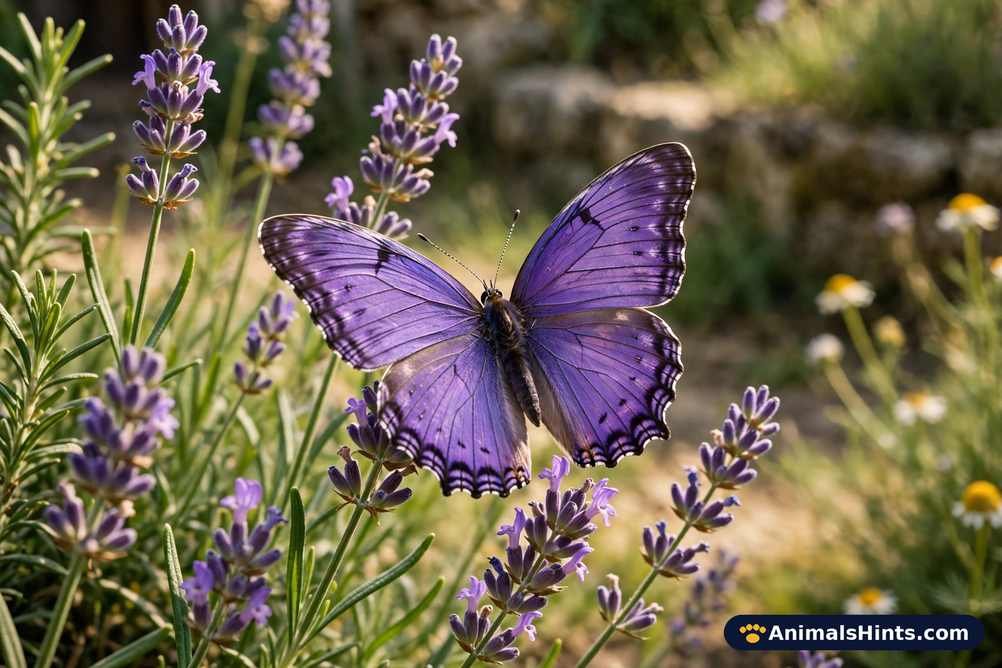
- Stay still and let the angle work. Purple on a wing is directional light; a butterfly that looks plain black from where you stand may flash violet with one step sideways or one turn of its own. Give a sighting ten unhurried seconds before deciding what color it was.
- Do not try to hold it. Wing scales rub off on fingers, and a hairstreak or emperor handled is a hairstreak or emperor harmed. A butterfly that chooses your sleeve will leave when it has finished with your salt.
- Note the facts before the meaning. Species if you can, place, plant, weather, time. The identification habit this guide’s science section is built on — was it an emperor, a hairstreak, a blue namesake? — turns a vague glow of significance into a sighting you can actually learn from, and the learning tends to deepen the glow rather than dispel it.
- Take the prompt, if you want it. The tradition’s uses are reflection, gratitude, a creative start, a forgiven debt. Pick the one the moment genuinely suggests, act on it the same day, and let the rest of the symbolism be decoration.
- Report the good ones. Genuinely purple species — hairstreak colonies especially — are under-recorded precisely because they live in treetops. A dated note to a local recording scheme or a photo uploaded to a citizen-science app gives the sighting a second life in real conservation data.
Purple Butterfly Symbolism in Love, Relationship, and Twin Flame
In love symbolism the purple butterfly is the family’s romantic grown-up. Where the red butterfly is read as desire and the white as purity, purple is taken to stand for the love that runs on recognition — two people meeting at the level of their actual selves, with the spiritual life treated as part of the attraction rather than an afterthought. An existing relationship reads the sighting as a renewal sign: the bond entering its next instar, changed in form, recognizably the same creature.
The twin flame framework gives the color particular work. In that modern teaching, twin flame partnerships are supposed to move both people toward spiritual maturity, and practitioners read the purple butterfly as the emblem of that curriculum going well — passion governed by understanding, intensity that produces growth instead of wreckage. Repeated sightings during a separation or reunion are, in that literature, taken as encouragement that the connection is doing its intended work on both sides.
This guide prints the whole strand as the belief it is. Twin flame teaching is a present-day spiritual framework — neither an old tradition nor a finding about how relationships work; its purple butterfly is a symbol its holders find useful for describing love that feels fated and instructive. Readers inside the framework will know what to do with it. Readers outside it can still borrow the section’s soundest sentence: love, like the butterfly, is expected to change form without ceasing to be itself.
How the Purple Butterfly’s Meaning Differs From Other Colors
Purple is easiest to place with its neighbors on the table, because each color in this family takes the same metamorphosis story and bends it toward a different part of life. White is the family’s threshold color — purity, innocence, and the visits of the departed — the subject of our companion piece on white butterfly symbolism. Blue belongs to calm, truth and healing through honest speech — see the blue butterfly meaning page. Between blue and purple sits the family’s two-tone border country, covered by our blue and black butterfly guide, where the violet end of the spectrum shades toward night.
Warm colors tell warmer stories. Orange butterfly spiritual meaning is fire in its friendliest mood — encouragement, creativity, appetite for life — while red butterfly meaning takes the same fire at full temperature: passion, courage and change that refuses to wait. Green is the heart’s color in the modern scheme, read for renewal and growth at a garden’s pace, in our green butterfly meaning page; and brown closes the ring at the earth end — grounding, patience, humility — in the brown butterfly companion guide.
Purple stands apart from all of them by pointing upward and inward at once. It also has a true color-article neighbor on this site: the deep end of the blue family, where royalty and devotion meet, is treated in our companion guide to royal blue spiritual meaning. Where white asks who has come to visit and red asks what you are waiting for, purple asks the quieter question the others leave alone: what is happening to the person all this is happening to? That is why its readings gather around reflection, enlightenment and second chances rather than events — purple is the color of the witness, not the news.
What It Means to Dream About Purple Butterflies
Dream readings follow the waking ones with the volume lowered: in the tradition’s dream lore, a purple butterfly signals the soul processing change off-duty, and the color directs attention to the dreamer’s spiritual and creative life. China’s classic butterfly text lives here, and it deserves its place — Zhuangzi once dreamed of being a butterfly — fluttering, content, entirely unaware of the man asleep in the world he had left behind. He woke abruptly, himself again, and the doubt stayed with him: had the man dreamed the butterfly, or was the butterfly, even now, dreaming the man? Every purple dream interpretation since is, knowingly or not, a footnote to that uncertainty.
The competitor’s scenario list, recast in this guide’s own words, covers the shapes these dreams usually take:
- A purple butterfly flying freely — read as release: a burden set down, a grief moving, the dreamer ready to let a finished stage stay finished.
- A purple butterfly landing on the dreamer — read as a blessing received personally, or a message the dreamer has been expecting in waking life.
- Several purple butterflies together — read as abundance of the inward kind: good news, company in the work, a season of openings rather than one.
- An injured or dying purple butterfly — read as the shadow entry: change resisted, an apology unmade, an emotional injury asking for attention rather than interpretation.
All four are the tradition’s dream symbolism, offered as such. Sleep science has its own account of why a mind rehearses vivid creatures at night; the two accounts answer different questions, and this guide keeps them in their separate rooms.
Seeing a Purple Butterfly: Good or Bad Omen?
The verdict of the modern tradition is unusually settled: the purple butterfly counts as a good omen, essentially without a dissenting school. It is taken to promise guidance, support and a change resolving in the watcher’s favor — good news pitched, as all this color’s news is pitched, at the inner life first. No strand of the material this guide reviewed reads the purple butterfly as a warning of harm.
Context tunes the reading rather than reversing it. To a grieving watcher it arrives as the loved-one message, comfort rather than forecast. To a stuck watcher it is read as the instruction to release and begin. To a watcher mid-awakening it is confirmation. The one honest qualification is the tradition’s own: an ending can be inside a good omen, since the creature’s whole grammar is that a stage must finish for the winged one to start — so the purple butterfly’s “good” may involve a door closing, and its holders count that as mercy rather than contradiction. This guide’s verdict matches the record it found: within its tradition, good — and outside that tradition, a genuinely uncommon insect that rewards the watcher who stops for it.
How to Welcome Purple Butterflies to Your Garden
The honest preamble is that the true purple species are woodland and canopy insects, and no flower border will summon an emperor down from the treetops on demand. What a garden can do is host the whole butterfly economy — nectar for adults, foodplants for caterpillars, sun and shelter — and accept that in oak and willow country, the purple hairstreaks and emperors may eventually include your trees in their rounds. Even where they never come, the same planting brings the rest of the family.
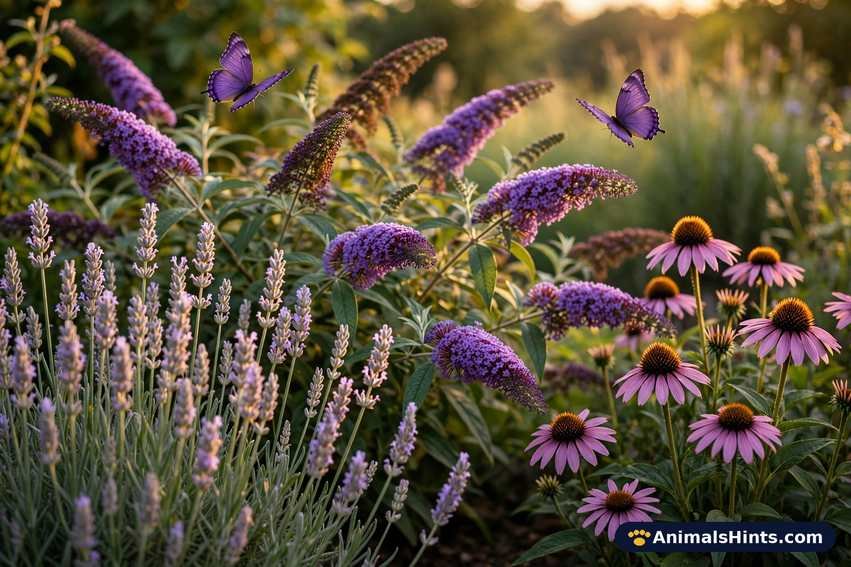
- Feed the adults. Flat, clustered flower heads in long succession — buddleia, lavender, asters, coneflowers — give butterflies a landing platform and a drink at once, from spring through the first frosts.
- Keep a caterpillar host, and tolerate it. Transformation runs on leaves eaten by somebody. Willows suit emperors where space allows; an unsprayed oak is a hairstreak colony waiting to be noticed; and the broader principle is covered in our caterpillar spiritual meanings guide — the unglamorous stage is the one the garden is actually for.
- Offer minerals and sun. A shallow dish of damp, slightly salted sand or soil gives butterflies the puddling station they seek on skin and boots, placed in full sun beside flat basking stones.
- Skip the sprays. Sprays cannot tell a pest from a purple hairstreak; a garden managed without them, weeds and all, is the only kind a canopy species will ever commute to.
- Leave the edges rough. Long grass, a log pile, an uncut corner — shelter and overwintering cover are what turn a feeding stop into a residence.
Final Thoughts
The purple butterfly earns its mystique honestly, which is more than most symbols can say. Its color really is rare in nature, really is conditional — a violet that exists only when layered scales, sunlight and a watching eye line up — and its most famous wearers really do live out of reach, in oak crowns and over willow woods, descending mainly for salt and dung. A tradition that reads hidden depth, dignity and spiritual weather into such a creature is not projecting onto a blank insect. It is responding, in its own vocabulary, to facts.
Use the sighting as this guide has used the subject: with both registers kept straight. Let the biology be exact — the structural color, the emperor’s two-tone sexes, the American namesake with no purple on it — while the meanings stay what their holders say they are, prompts toward reflection, creativity, forgiveness and a second chance taken seriously. A watcher who can hold those together has got the best of both. And the next time a dark butterfly crosses a sunlit ride and, for one step, burns violet, you will know what you are looking at: not a pigment, not quite a message, but light itself wearing wings — iridescence doing in a second what purple dye once took an empire’s fortune to do, and doing it for anyone who happens to be standing in the right place.
FAQs
What does a purple butterfly symbolize spiritually?
Spiritually, in the modern tradition, it symbolizes inward transformation: intuition, reflection, dignity and a deepening spiritual life. Its violet is also the modern scheme’s crown-chakra color, tying the sighting to awakening and higher awareness.
What is the significance of the purple butterfly in spiritual traditions?
Its significance comes from the pairing of metamorphosis with history’s most restricted color — the dye of rulers and penitents. Traditions therefore read it around royalty of the soul: resurrection hope in Christian teaching, impermanence in Buddhist-influenced reading, transcendence in modern Hindu-influenced writing.
What does it mean when you see a purple butterfly?
In the tradition’s reading, you are being pointed at a change already under way inside — a stage ending, awareness widening, a second chance opening. In plain natural terms, you have also spotted one of the least-seen colors in the insect world, which is reason enough to pause for it.
How can I connect with the energy of a purple butterfly?
Its holders suggest the quiet responses: sit with the sighting rather than chasing it, take up the reflection or creative work it seemed to prompt, and keep a note of when it came. The energy, in this tradition, is met by attention — the one offering the butterfly itself keeps making.