Amber Eyes Spiritual Meaning: 15 Meanings, Myths and Personality, Checked Against the Record
Ask the symbolism guides about golden eyes and the reply comes back in the vocabulary of sunlight: wisdom, instinct, a banked inner fire. In that tradition, the amber eyes spiritual meaning is simply the colour’s own meaning — honey, resin and late light — laid over the person who happens to wear it in their irises, who is promptly read as watchful, warm and quietly hard to deceive.
Amber is also one of the rarest colours a human iris can be, and rarity shapes everything on this page. A colour almost nobody has draws omens to itself the way a lamp draws moths: seers, guardians, shamans and wolves all circle it. Where the guides agree with each other, they agree because they are reading the same scarce, glowing shade — not because any of them has studied the people who carry it.
Everything below runs in two accounts, and this page holds them in separate columns. One is the folklore account — the myths, the fifteen meanings, the dreams and the personality portrait — set down as the tradition teaches it, credited to that tradition throughout, and never dressed up as fact. The other is the record account: the pair of pigments that actually mix the colour, the population figures that survive checking, the experiments researchers have actually run, and the single book in which amber shows up three times without once naming an eye. The colour of an iris is settled before birth; it cannot turn up later carrying a message. Hold that line, and the two accounts can sit on one page without contaminating each other.
What Do Amber or Golden Eyes Symbolize?
In the guides’ symbolism, the amber eye is first of all an eye of balance: energy held steady rather than spent, power that stays quiet. Gold is the colour the tradition has always reached for when it wants to picture value that cannot tarnish, and amber adds something gold alone does not have — it is light caught and kept, sunlight stored inside a solid thing. An eye coloured like that is read as an eye that keeps what it sees.
From that root image the branches spread in predictable directions. Instinct and alertness, because the animals humans have watched longest — wolves, owls, hunting cats — carry this eye. Courage and an inner fire, because the shade sits between yellow’s brightness and brown’s weight. Depth and emotional reading, because a gaze this unusual makes the watched feel watched back. This site keeps the colour’s own story on separate pages, and the eye tradition draws on all of them at once: the gold spiritual meaning supplies the untarnishing value, and the yellow spiritual meaning supplies the light.
The tradition also reads the colour through the seasons. Amber is autumn’s shade — leaves at their richest just before they fall, fields ripe, light going honeyed and low. A person carrying autumn in their eyes is read as someone in their harvest years regardless of age: experienced, stored-up, past the green stage of things. It is a flattering portrait, and the flattery, notice, is built into the colour’s calendar position, not gathered from any amber-eyed person’s actual life.
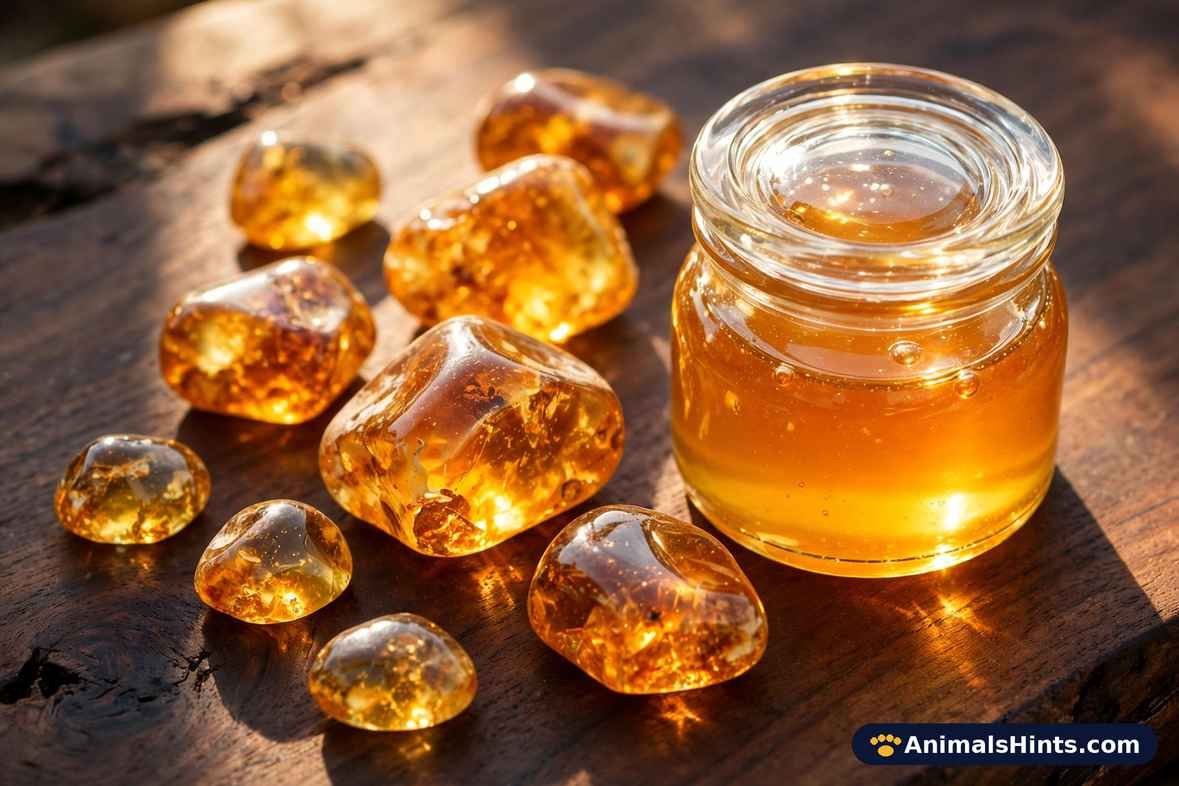
One further layer is the endurance note the guides return to most. Amber the substance is tree resin that outlasted the tree by millions of years; the eye that shares its colour is credited with the same quality — a soul described as tried, seasoned and still translucent. That is the symbol in its strongest form, and everything in the fifteen meanings below is a variation on it: light, kept.
Facts About Golden or Amber Eyes
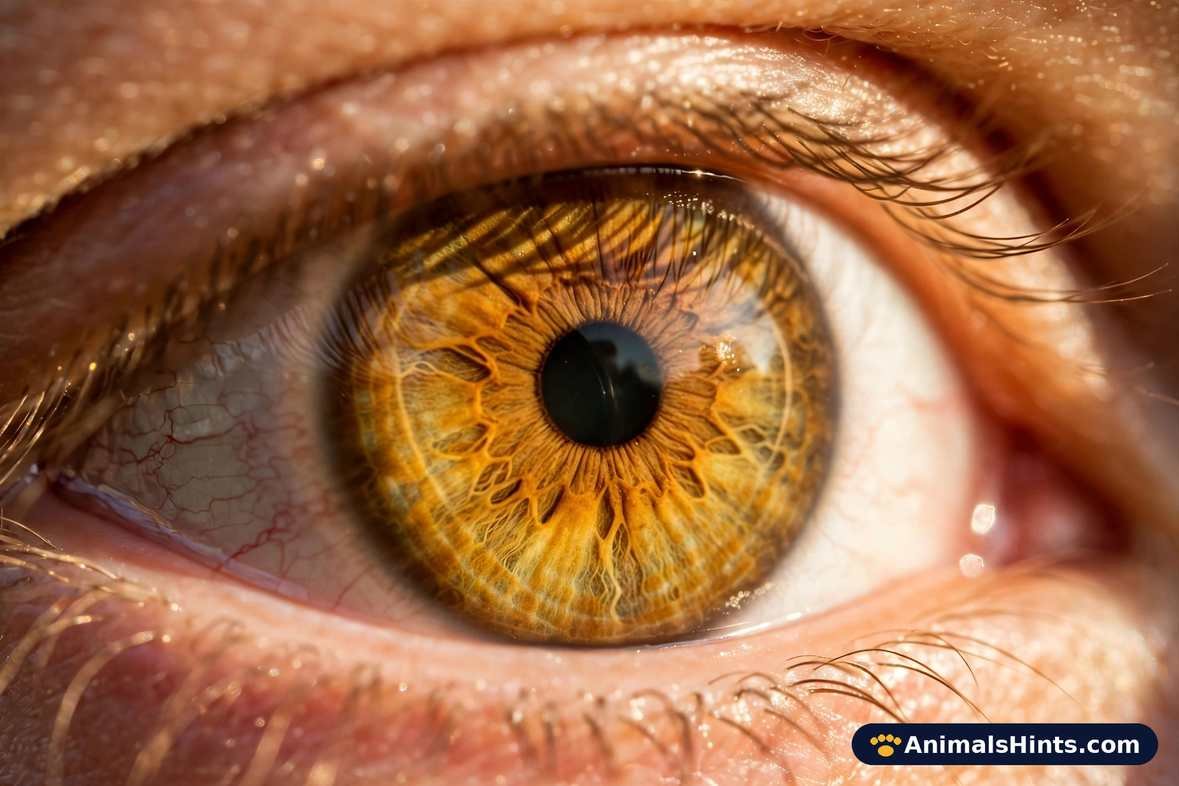
Begin with the definition the clinics and the guides share. An amber eye is a solid one: the whole iris holds a single golden, coppery or yellow-brown colour, even from pupil to rim, with none of the patchwork that defines hazel. It is that evenness, more than the exact shade, that eye specialists use to separate amber from its neighbours — the brown eyes spiritual meaning belongs to a darker, heavier pigment load, and hazel mixes its colours where amber refuses to.
The guides’ fact shelf opens, as it usually does, with rarity, and here the record needs care rather than correction. Amber is genuinely uncommon — every authority fetched for this article agrees on that much. The figure that travels with the colour, roughly five percent of humanity, is repeated across the optical-retail literature, but no amber-specific census stands behind it, other sources put true amber below one percent, and the five percent in the standard eye-colour reference table belongs to hazel. The honest sentence is the shorter one: very few people have these eyes, and nobody has counted them exactly. The pigment science behind the colour gets its own section below.
Their second standing fact is the animal parallel, and here the record backs them completely. Golden and amber eyes are the ordinary equipment of canines, domestic cats, owls, eagles and pigeons — the reference summaries list them in one breath. Human amber is the rarity; animal amber is the norm, and the folklore’s habit of reading these eyes as wild, watchful and slightly untamed is borrowed directly from that company.
A third fact the guides state correctly is that the colour is stable and born, not made. Eye colour is set by inheritance long before birth and, illness and injury aside, an amber iris at forty is the amber iris of childhood, keeping its shade through changes of light that visibly shift the structural colours. What light changes is the impression — full sun fires the gold up, grey weather dulls it — not the pigment itself.
Why Pure Golden Eye Colors Are Rare in Humans?
The guides answer this question with destiny; the record answers it with arithmetic. Pure amber asks for a narrow setting of the pigment dial: enough melanin to keep the eye warm and solid, little enough that the yellow member of the pigment family shows through undimmed, and the dose spread evenly so no second colour breaks the surface. Most human settings miss that window on one side or the other. Turn the dose up and the eye goes brown, the fate of most of humanity. Spread it unevenly and hazel is where the eye ends up, gold surviving only in patches. Turn it down and scattered light takes over, building green, then blue. Amber is what happens in the thin band between those outcomes, and thin bands hold few people.
Inheritance narrows it further. Eye colour is not one gene’s decision — at least sixteen genes play a part, with the pair on chromosome 15, OCA2 and HERC2, doing the heavy work — so the amber setting is an assembly, and assemblies are rarer than any of their parts. The clinical summaries note the colour surfacing more often among people of Spanish descent, and in parts of Asia, South America and South Africa, which is what a multi-gene trait looks like on a map: not a homeland, but pockets where the combination recurs.
The guides add one claim of their own here — that the colour is rare because it is reserved, a mark set aside for particular souls. Nothing in the record supports a reservation system, and the arithmetic above needs none: a narrow window in a many-gene trait is rare for the same reason a particular hand of cards is rare. The rarity is real. The reservation is the folklore ledger speaking, and it is filed there.
Two Pigments, One Dial: What Actually Makes an Iris Amber
Every eye colour is mixed from a family of two pigments. Eumelanin is the brown-to-black member, the heavy absorber; a stroma loaded with it gives the dark eye. Pheomelanin is the red-to-yellow member, lighter in every sense. Vision Center’s clinical summary of this colour states the recipe plainly: a combination of the two melanins produces amber, with the yellow pigment present at higher levels than in its neighbours — enough pheomelanin in the mix to gild the eye, enough eumelanin to keep it solid and warm rather than pale.
Older accounts, the competitor’s page among them, name a third ingredient: lipochrome, a yellowish pigment said to be deposited in the iris. The name survives in the reference literature — Wikipedia’s eye-colour survey uses it for the yellow pigment in hazel and green eyes, and equates it with lipofuscin — but it is not a separate substance alongside the melanins. It is the older label for the yellow end of the same pigment story, the pheomelanin side of the family. This draft follows the clinical summaries: two pigments, one dial, no third ingredient.
Where the dial sits decides the whole warm half of the eye-colour map, and amber’s neighbours mark its borders. At the top of the scale the dose is heaviest and the eye is brown. One step down, spread unevenly, sits hazel — the mixed iris of brown, green and gold that amber is most often confused with, separated by a single test: hazel changes its mind across its own surface, amber does not. Lower still sits the band of the spiritual meaning of green eyes, where scattered blue light mixes with the yellow pigment; below that, the stroma empties out almost entirely and the eye turns blue, or settles into the register the grey spiritual meaning describes. Amber’s warm cousins by colour rather than by pigment — the color orange spiritual meaning — sit nearby on the symbolism shelf, but on the pigment dial amber has exactly one address: the narrow, even, golden setting between brown and hazel.
The animal kingdom keeps its amber at a different scale entirely. What is a thin-band rarity in humans is standard issue in the wild — the wolf watching from the treeline, the cat on the windowsill, the owl on the branch all wear this eye as ordinary equipment. The guides are right to feel the gaze is familiar. It is the gaze the species evolved alongside, returned in a human face.

15 Spiritual Meanings of Amber Eyes or Golden Eyes
The tradition itself supplies all fifteen readings below, in the order it gives them. Each one is offered for what it is — a claim the symbolism guides make about this colour — and each closes at the same boundary: these are readings of a shade, credited to the folklore that teaches them, not findings about any person who has it.
Insight and Higher Wisdom
The list opens with the seer’s claim. Amber eyes are read as the eyes of someone who understands more than they say — insight first, and above it a higher wisdom, the kind the tradition reserves for people it believes see causes rather than events. Gold has pictured stored knowledge in the symbolism system for as long as the system has existed, and the eye coloured like gold inherits the picture whole.
Heightened Intuition and Deep Awareness
Second comes the knowing-without-being-told claim: a heightened intuition, an awareness that runs below the surface of conversations and rooms. The guides describe amber-eyed people as the ones who notice the pause before an answer. It is the animal watchfulness of the colour, translated into a social gift — and it stays a translation, since no test of intuition has ever been sorted by iris colour.
Supernatural Power and Divine Qualities
The third reading reaches highest of all. Because gold is the metal of altars and halos, eyes of gold are credited with a touch of the supernatural — a divine quality, a person partly lit from elsewhere. This is theology conducted by colour: the shade’s sacred history is transferred to its bearer, and the transfer is all the evidence there is.
Warmth, Light, and Uplifting Energy
Here the reading softens from power to weather. Amber is sunlight at its kindest hour, and the tradition says the people who carry it bring that hour with them — warmth that steadies a room, energy that lifts rather than dazzles. Of all fifteen claims this is the one most plainly drawn from the colour itself: nobody reads a hearth-glow shade as cold.
Inner Strength and Resistance to Negativity
The fifth reading borrows the biography of the substance. Amber began as soft resin and survived ages of pressure underground without losing its light; the tradition lends that endurance to the eye, picturing a person who absorbs difficulty the way the stone absorbed time, and who is correspondingly hard to darken — resistant, in the guides’ phrase, to negativity.
Protector Energy and Inner Wisdom
Sixth, the guardian claim. The amber-eyed person is cast as the watch kept over others — protector energy, the guides call it, paired with the inner wisdom to know when watching must become acting. The wolf and the owl stand behind this reading: in the wild, this is the eye that stays open on behalf of the group.
Intuition, Enlightenment, and Cultural Depth
The seventh reading widens the second one across cultures. The guides point to the golden eyes scattered through old story — Greek myth, as the reference record notes, described the sun god Helios and his descendants as golden-eyed — and read modern amber eyes as heirs to that lineage: intuition again, but deepened into enlightenment, a knowing with ancestors.
Healing, Transformation, and Earth Connection
Eighth, the healer’s reading. Honey and amber both sat in the old household medicine shelf, and the colour keeps the association: a presence said to mend, joined to transformation — resin becoming gem is the tradition’s favourite picture of a life remade slowly — and to an earth connection, the groundedness of a shade drawn from soil, sap and leaf-fall.
Wisdom and Illuminating Presence
The ninth reading is the first one brought into company. Wisdom here is not private insight but illumination shed on others — the person whose arrival clarifies a problem, the lamp carried into a room rather than the eye that merely sees in the dark. The tradition distinguishes the two carefully: meaning one knows; meaning nine makes known.
Shamanic Vision and Spirit Realm Connection
Tenth, the list’s furthest reach. The vision guides record that in Native American spirituality amber eyes are associated with shamanic potential — the gift of crossing to the spirit realm and returning with word of it. Printed at exactly that strength: an association the guides report, belonging to the folklore ledger, about a colour the wild world wears more often than we do.
Trust in Intuition and Deeper Perception
The eleventh reading turns the second one inward. Where meaning two trusts the amber-eyed person’s reading of others, this one trusts their reading of themselves — a deeper perception that includes their own motives, and the nerve to act on a signal they cannot yet explain. The tradition treats that self-trust as the mature form of the gift.
Communication, Empathy, and Leadership
Twelfth, the social portfolio: communication that lands, empathy that registers before words arrive, and the leadership that follows when a group senses both in one person. The guides connect the three through the gaze itself — an eye contact this striking, they say, holds a room. The record notes only that the gaze is striking; the portfolio is the tradition’s addition.
Moments of Revelation and Spiritual Clarity
The thirteenth reading is about instants rather than traits: moments when understanding arrives whole, the sudden clarity the tradition pictures as light breaking through resin. Amber-eyed people are said to receive such moments oftener than most, and to recognise them when they come. A claim about a colour’s relationship with light, told as a claim about a life.
Resilience and Transformative Beauty
Fourteenth, the substance’s story told a second way. Meaning five took amber’s endurance; this one takes its beauty — the fact that what pressure made of the resin is lovelier than the resin was. The tradition applies it directly: hardship, in the amber-eyed, is said to finish as attractiveness of character, scars included in the polish.
Protection, Inner Power, and Courage
The list closes where the symbolism began, with the shield. Protection — amber has been carried as an amulet in folk practice for as long as folk practice has records — joined to inner power and to courage, the fire note from the colour’s first reading. The tradition ends its fifteen by arming its subject: the rarest eye, it says, is also the guarded one, and the guarding one.

Personality Traits of Amber Eyes Native
The tradition’s portrait of the amber-eyed native is drawn in confident strokes. Confidence first — a self-possession the guides attribute to the gaze itself, on the theory that a person whose eyes stop strangers learns early to hold a room. Charisma and magnetism follow, then creativity, independence, a streak of mystery, and a warmth that the portrait insists on pairing with intensity: kind, but never mild; generous, but nobody’s fool.
Read as a set, the traits are the fifteen meanings wearing everyday clothes. The wisdom claims reappear as good judgement, the protector claim as loyalty, the shamanic claim as a taste for solitude and deep subjects, the fire claim as ambition. The guides are consistent with themselves, which is the most that can be said for the portrait’s construction: it is the colour, described fifteen ways and then described once more as a character.
It stands here as the tradition’s portrait and nothing more. The section that follows states what happened when claims of this kind were actually tested, and the portrait should be read with that verdict standing next to it.
What the Studies Actually Found: No Iris-Colour Personality on Record
The tested record can be stated in one sentence: no study worthy of the name has ever tied iris colour to personality, and for amber eyes specifically there is not even an attempt on file — no study has ever gathered amber-eyed people and measured their wisdom, intuition, warmth or courage against anyone else’s. The fifteen meanings above have never been near a laboratory.
What research exists on neighbouring questions points away from the portrait rather than toward it. The best-known experiment in this family asked people to rate faces for trustworthiness and found brown-eyed faces scored higher — then recoloured the same faces’ irises in the photographs and watched the advantage move with the face, not the eye: the raters had been reading bone structure all along. That is the pattern wherever iris colour has been put to a test. The apparent signal dissolves into something else — face shape, lighting, the rater’s expectations — and the iris itself explains nothing.
That is the position this site takes with every eye colour, amber included. The tradition’s portrait may still describe a person you know, the way a horoscope may happen to fit a Tuesday; resemblance is not evidence. Amber eyes certify two pigments in a narrow ratio. They certify nothing about the person behind them, and a reader who meets one has learned the rarest thing on this page and nothing else at all.
Glowing Golden Eyes Dream Meaning
The dream shelf of the tradition gives golden eyes a double role. Glowing eyes in a dream are read first as watchfulness — the feeling of being observed in some corner of one’s life, or of finally becoming the observer: a truth noticed at last, pictured as a gaze that lights the dark. When the eyes belong to an animal, the guides read the animal’s own qualities into the visit; when they belong to a stranger or to the dreamer, the reading turns inward, toward awakening perception and knowledge arriving before its proof.
A gentler strand reads the glow as guidance — a protective presence, the guardian claim of meaning six keeping night watch. The darker strand, which the guides include for completeness, reads glowing eyes as a warning of scrutiny: being seen through, by others or by conscience. The tradition holds both strands without embarrassment, choosing between them by the dream’s emotional weather.
The boundary this site draws around all dream lore applies here unchanged. Dreams are the softest shelf in the folklore ledger — a vocabulary for talking about sleep’s imagery, not a decoding service for it. A glowing golden gaze is a striking thing to meet at night; what it announces, no record can say.
Common Myths, Superstitions, and Old Beliefs
The myth shelf gathers around this colour from several directions at once. The oldest strand is descent: golden eyes as the mark of more-than-human parentage, the sun god’s line in Greek story being the fetched example, with the belief travelling downward into folk tales where the golden-eyed stranger is never quite only a stranger. The second strand is the animal one — the wolf’s eye and the werewolf’s, the cat’s gaze that was once suspected of seeing spirits — in which amber eyes mark a person with one foot in the wild world’s way of knowing.
The third strand is the amulet. Amber the substance has been carried against harm in folk practice across centuries — beads, pendants, teething strings — and the belief leaks sideways onto amber the colour: eyes of that shade read as naturally warded, their owners lucky in the specific way of people whom trouble is said to pass by. A fourth, colder strand exists in the wider record and the guides themselves mostly skip it: in some times and places an unusual eye was read with suspicion rather than admiration, the marked gaze treated as evidence of uncanny dealings. Rarity has attracted both reverence and fear wherever it appears, and this colour’s history holds both.
What the shelf does not contain is a single named, dated source for any of it. These are motifs — shapes that stories repeat — printed at motif strength. The tradition tells them as inheritance; the record can only confirm that they are, in fact, told.

Amber in the Bible: A Gleaming Substance in Ezekiel, Never an Eye
Scripture can be checked rather than argued about, so this section reports a count. A fresh full-text search of the King James Bible for this draft returns the word amber exactly 3 times — and all three stand in one book, in one prophet’s visions of glory. Ezekiel, describing the brightness around the throne, reaches for the word as a comparison for gleaming fire: “out of the midst thereof as the colour of amber, out of the midst of the fire” (Ezekiel 1:4); “And I saw as the colour of amber, as the appearance of fire round about within it” (Ezekiel 1:27); “from his loins even upward, as the appearance of brightness, as the colour of amber” (Ezekiel 8:2). Amber in the Bible is a substance a prophet uses to describe light too bright to name directly. It is never an eye, never a person’s feature, never a blessing or a warning addressed to anyone’s gaze.
The surrounding counts fix the scale. The same search returns eye 116 times and eyes 502 times — eyes matter enormously to this book — yet not one of those hundreds of mentions assigns an iris a colour. Gold appears 417 times and golden 66, and across all of it the gold belongs to vessels, altars, crowns and cities, not to eyes. The Bible’s colour words for people are complexion words and quality words — ruddy, tender eyed — never iris shades.
The conclusion is narrow and complete. Any teaching that grounds the amber-eyes shelf in scripture is building on three verses about a gleaming substance in a vision of fire. The verses are genuinely beautiful, and a reader may fairly borrow their imagery — light kept inside a solid thing is Ezekiel’s picture before it is the folklore’s — but the borrowing should be labelled as borrowing. The book itself says nothing about amber eyes, because as far as its text is concerned, there are none.
When Amber-Looking Eyes Are a Medical Matter, Not a Meaning
One confusion is worth clearing precisely, because it runs in both directions. The yellowing that medicine worries about is not in the iris at all. The NHS describes jaundice as the moment “your skin or the whites of your eyes turn yellow” — the whites, the sclera, coloured by bile pigment when the liver struggles, and treated by the service as a sign needing urgent medical help. A golden-brown iris is not jaundice, jaundice does not create one, and a person whose eye-whites yellow has a symptom, whatever colour their irises were born.
The second medical note concerns change. An iris colour is a birth setting; when an adult’s eyes genuinely change — one eye drifting from the other, a new difference between the two, any shift that brings pain, redness or blurred sight with it — the standing guidance is an eye examination, not an interpretation. Meanings are for colours that stay. Changes are for clinicians.
The third note is the colour’s one real physical trade-off. A lighter iris carries less of melanin’s shielding, and the clinical summaries fetched for this article list the consequences at their proper strength: greater sensitivity to sunlight, and an association the eye-cancer literature reports between the yellow pigment and raised risk of uveal melanoma, the eye’s rare internal cancer. Sunglasses with real ultraviolet protection are the whole of the practical response — that, and the ordinary rhythm of eye examinations every clinician already recommends.
Final Thoughts
Two ledgers, kept apart, turn out to describe the same small marvel from opposite ends. The record’s amber eye is a narrow setting of a two-pigment dial — rare by arithmetic, shared with wolves and owls, uncounted by any census exact enough to quote, and silent about the character of its owner. The folklore’s amber eye is a lamp: wisdom, watchfulness, protection and stored sunlight, read off a colour that has carried those associations since long before anyone thought to test them.
Neither ledger cancels the other. The meanings fail as description — no study stands behind them, and the one book the tradition quotes never mentions the eyes at all — but they succeed as evidence of something else: how persistently human beings have looked at this rarest of gazes and seen light that keeps. The folklore is a record of attention, and attention, sustained across centuries, is its own kind of fact.
What the colour itself certifies is simpler and, in the end, more interesting. Behind every amber iris sits the same chemistry that warms a redhead’s hair and gilds a cat’s stare — a sulfur-bearing yellow pigment doing quiet work in the stroma, the pheomelanin that turns a brown eye’s heavy dose into gold. Meanings were assigned to that glow for millennia before the pigment had a name. The name does not extinguish the glow. It just tells you, at last, what is glowing.
FAQs
1. What is the spiritual meaning of amber or golden eyes?
In the symbolism tradition, amber eyes mean stored light: wisdom, intuition, warmth and protection, read off the colour of honey and resin. The record adds its boundary — the meanings belong to folklore, pinned on a shade, and no study links the iris colour to any of the qualities named.
2. What personality traits are associated with amber eyes?
The guides’ portrait runs to confidence, charisma, creativity, independence and loyalty — the fifteen meanings restated as character. It stands here as the tradition’s portrait only: the tested record finds no credible evidence connecting iris colour to personality.
3. Are amber eyes rare, and does that affect their meaning?
Yes — amber is one of the rarest human eye colours, though the famous five-percent figure circulates without an amber-specific census behind it, and other sources put true amber lower still. The rarity plainly feeds the meaning: scarce things collect significance, which is a fact about the collectors as much as the colour.
4. How do amber eyes differ from brown eyes?
By dose and by evenness. A brown iris carries a heavier load of the dark pigment and absorbs its light; an amber iris holds a lighter, more even mix in which the yellow pigment shows through, giving the solid golden colour that brown never reaches.