June Spiritual Meaning: Symbolism, Significance and the Month of the Longest Day
June is the year’s bright hinge, and the june spiritual meaning turns on that brightness: peak light, weddings, growth at full stretch. In the writing that collects around this month, June belongs to the solstice around 20 to 21 June, to a Roman goddess of marriage whose name it still carries, and to gardens and hedgerows at their loudest.
Underneath the symbolism sits a checkable skeleton, and it is a good one. The solstice really does give the northern half of the world its longest day while giving the southern half its shortest. The month really does carry three birthstones, not one, on the list the gem authorities maintain, and two birth flowers, not one, on the Almanac’s list. Those points are set out on their own below, apart from the readings layered over them.
What follows walks through what June symbolizes, the meanings modern writers assign it — eleven of them on the source page, under a heading that promises twelve — its place across cultures, the Gemini-to-Cancer split, the Bible correspondence, and the assigned stone, colour and flowers — fact and folklore in separate piles the whole way.

What Does the Month of June Symbolize?
In modern spiritual writing, June symbolizes fullness: the year no longer promising, but delivering. North of the equator the days reach their greatest length, school terms end, weddings cluster, and the garden stops being a plan and becomes a fact. Writers take that outward peak and read it inwardly, as abundance, vitality and the confidence to act on goals set in the spring.
The solstice is the month’s central picture. Around 20 to 21 June the Sun reaches the northernmost point of its yearly path, daylight in the north stretches to its annual maximum, and from the following morning the light begins, almost imperceptibly, to give ground. The tradition reads that hinge two ways at once: celebration of the peak, and a first lesson in letting the peak go.
The name supplies the second picture. June is traditionally derived from Juno, queen of the Roman gods and patron of marriage and the wellbeing of women, and the wedding season that still fills June weekends is usually traced to her. The derivation has a rival, recorded by the poet Ovid himself, and the verified section below gives both. Either way, the association between this month, unions and beginnings is centuries deep in the record.
Kept at its honest strength, June’s symbolism is a posture rather than a promise. The month stands for using the light while it lasts. Nothing in a calendar can guarantee abundance to anyone, and this tradition, read fairly, claims no such thing: it nominates June as the season for gratitude, commitment and visible growth, with the solstice as its deadline in reverse — everything after it is slowly shorter.
June, Verified: Juno, the Solstice and the Two Hemispheres
First the record, because June’s is unusually testable — a name, an astronomical event and two authority-kept lists, each of which can be checked in minutes.
The name first. The standard account derives June from Latin Iunius, the month of Juno: wife of Jupiter, queen of the Roman gods, goddess of marriage and childbirth and protector of women and of the Roman state. That is the derivation the reference books lead with, and Juno’s marriage brief is the usual explanation offered for June’s long wedding association. But the ancients themselves kept a second candidate in play. In his poem on the Roman calendar, the Fasti, Ovid stages rival claims for the month and records the alternative that Iunius comes from iuniores, “the younger ones,” set against May from maiores, “the elders.” Modern scholars generally treat the Juno derivation as the stronger one and the younger-ones theory as an ancient folk etymology — but the honest summary is that Rome argued about this name two thousand years ago, and the argument is part of the record.
Then the solstice. The June solstice falls on 20 or 21 June in most years, very occasionally the 22nd. At that instant the Sun stands at its northernmost point, directly over the Tropic of Cancer, and Earth’s northern axis leans as far toward it as it ever does. The consequences split by hemisphere, and the split is the whole point. For the Northern Hemisphere the solstice brings the longest day and shortest night of the year and opens astronomical summer. For the Southern Hemisphere the same instant brings its shortest day and longest night, opening astronomical winter. So June does not open summer for the whole planet. A reader in New Zealand, South Africa or Chile meets this month at the bottom of the light, and the roses-and-solstice version of June is a northern inheritance, labelled as such at every use below. The year’s other turning points get the same two-hemisphere treatment in this site’s september symbolism and march spiritual meaning guides.
Two smaller corrections ride along with the solstice, because popular June writing gets both wrong. The solstice is the longest day, but it is not usually the day of the earliest sunrise or the latest sunset — those fall a few days to either side of it, an offset produced by the tilt of the axis and the shape of Earth’s orbit. And the peak of light is not the peak of heat: the warmest northern weeks typically arrive a month or more later, once land and sea have finished storing the solstice’s sunshine. Light peaks in June; temperature lags behind it.
Finally, the lists. June is one of only a handful of months with three birthstones on the modern list the Gemological Institute of America publishes: pearl, alexandrite and moonstone. And the Almanac’s birth-flower list carries two June flowers, the rose and the honeysuckle. Pages that give June a single stone and a single flower are printing a shortened record; the correspondences section below carries the full one.
12 Spiritual Meanings of the Month of June
A note on the count before the list begins: the heading above is the source page’s own, and it promises twelve. The page itself delivers eleven meanings, numbered one to eleven, and then moves on. Rather than invent a twelfth to make the arithmetic look tidy, this guide prints the eleven that exist, in their order, and flags the missing one here and in its notes. Each reading below is offered the way its own tradition offers it: as belief and association, for reflection.
1. June’s Spiritual Connection to Sunlight and the Goddess Juno
The opening meaning fuses the month’s two anchors: the goddess and the light. Juno’s documented brief — marriage, childbirth, protection of women and of the state — is the historical layer. The spiritual reading layered over that record casts June as the month for commitment, for family bonds deliberately renewed, and for beginnings made under a protective patron rather than by luck.
The meaning’s sunlight half reads the solstice as character — maximum light as a picture of clarity, of things seen whole. Writers in this stream use June’s brightness as an occasion to look at a relationship, a household or a plan in full daylight and name what they see. That is an exercise the season genuinely suits, whether or not any goddess is invoked.
2. Numerology of June: The Power of Number 6
June stands sixth in the year, and modern numerology builds a reading on that position: in that system the number six is the caretaker, assigned to home, family, responsibility and love given in balance. Writers pair it with Juno’s marriage brief and read the month as one for tending the household’s emotional accounts — reconciling, providing, showing up.
The bound belongs in the open. Numerology is a modern interpretive system, not a record: no ancient source assigns June a caretaker number, and the sixth month’s position is an accident of where January was placed ahead of March in Rome’s reformed calendar. The reading is printed for what it is — a recent frame that many readers find useful for setting a month’s intentions, and nothing older or heavier than that.
3. June and the Energy of the Summer Solstice
This meaning takes the solstice itself as the teaching. At the peak of the light, the tradition says, stand in it deliberately: acknowledge what has grown since the spring, and notice that the year’s longest day is also the first day of the light’s retreat. Gratitude and realism in a single observance is the strand’s genuine strength.
The fire customs attached to the solstice are real customs, though their ages vary. Bonfires on solstice and midsummer nights are documented across northern Europe for centuries, kept for celebration, for blessing crops and livestock, and for the simple human wish to mark the year’s brightest night outdoors. Modern Pagan practice keeps the solstice as Litha within its eight-festival Wheel of the Year — a twentieth-century framework, sincerely kept, built around a genuinely old seasonal moment.
4. June and the Celtic Goddess Danu
Here the record needs care. Danu is a real figure of Irish tradition — a goddess named in medieval Irish texts as mother of the Tuatha Dé Danann, the supernatural people of the old stories — and almost everything beyond that sentence is reconstruction. The early sources say remarkably little about her directly: no festival, no season and no month is assigned to her anywhere in the surviving material.
Modern Celtic-inspired writing fills that silence by associating her with summer, rivers, fertility and creative flow, and June, as the solstice month, is where the association usually lands. That placement is a contemporary devotional choice, not a recovered ancient calendar, and it is carried at exactly that weight here. Readers who honour Danu in June are keeping a modern practice built on a genuinely old name — both halves of that sentence matter.
5. Zeus and the Power of Light in June
The same care applies here. Zeus is thoroughly documented — king of the Greek gods, lord of sky, thunder and law — but no ancient source ties him to June, a Roman month named from a Roman goddess. The June connection in modern writing is thematic rather than historical: the sky at its brightest invites the sky god, and Father’s Day, kept in June in the United States and many other countries, supplies the modern hook for the father-figure reading.
At that strength the meaning is a fair piece of symbolism: authority answerable to justice, power paired with protection, strength that guards rather than merely strikes. It is a portrait modern writers assemble for June, and this guide prints it as their assembly, not as a Greek or Roman observance anyone can date.
6. June as a Symbol of Fullness, Joy, and Renewal
This is the month’s most grounded meaning, because it rests on what anyone north of the equator can watch: hedgerows in flower, the first soft fruit, evenings that stay usable past nine. Writers read that visible fullness inwardly — gratitude practised while the evidence is in front of you, joy approached as a practice instead of a mood.
Renewal, in June’s version, differs from the spring kind. Spring renewal is a beginning; June’s is a mid-course correction taken at maximum light, with half the year still available to act on it. The tradition’s counsel — celebrate what is working, adjust what is not, do both before the days shorten in earnest — survives translation into entirely secular advice, which is usually the sign of a symbolism in good health.
7. The Oak Tree: Strength, Stability, and Endurance
The oak’s place in this list has genuine roots. Oaks were sacred in several old European traditions: the classical world linked the oak to Zeus and to Jupiter, Celtic and Germanic peoples held oak groves in reverence, and the tree’s sheer longevity — many centuries for a healthy common oak — made it a standing emblem of endurance long before any symbolism page listed it.
Its June tie is the solstice season rather than a date: midsummer gatherings under and around oaks, and oak among the woods burned in solstice fires in the folk record. The spiritual reading follows the tree’s biology honestly enough — growth that is slow, structure that outlasts storms, roots as deep as the crown is wide — and applies it to commitments meant to last. As symbolism goes, this one is load-bearing.
8. The Crab: Symbol of Emotions and Intuition
The crab enters June through the zodiac: it is Cancer’s sign, and Cancer’s season opens at the solstice, so the month’s last third belongs to it. The reading built on the animal — a soft creature in a hard shell, carrying its home, moving sideways toward its goals — is the genre’s picture of emotional self-protection and indirect progress.
The animal underneath the symbol rewards a look. Real crabs do retreat into borrowed and built shelter, do read their world through chemical and tidal cues humans barely register, and many species time their lives to the Moon-driven tides Cancer is said to answer to. Symbolism that starts from an animal’s actual behaviour, as this strand at its best does, is this site’s favourite kind; the green spiritual meaning guide follows the same rule for the colour of June’s own fields.
9. The Triskele: Symbol of Balance and Eternal Cycles
The triskele — three spirals joined in rotation — is a genuinely ancient motif, carved at Newgrange in Ireland in the Neolithic age and recurring in Celtic art ever after. What it meant to its first carvers is not recorded, and every reading of it, including the popular land-sea-sky and life-death-rebirth triads, is later interpretation laid over an old design.
Its June placement is likewise modern. No source ties the triskele to this month or to the solstice specifically; modern Celtic-inspired writing adopts it for June because a symbol of turning cycles suits the year’s great turning point. Printed at that strength — an ancient emblem, a modern assignment — it does the meaning no harm and the reader no deception.
10. The Yin-Yang: Harmony Between Light and Darkness
The yin-yang is the emblem of a Chinese philosophy far older than any June page: interdependent opposites, each carrying the seed of the other, set out in texts that go back well over two thousand years. Nothing in that tradition assigns the symbol to June, and nothing here pretends otherwise.
What modern writers are reaching for, in borrowing it, is the solstice’s own geometry: at the very summit of the light, the dark begins its return — the small dark seed inside the bright half, drawn by astronomy instead of ink. As a cross-cultural comparison the borrowing is intelligible and even elegant. As a claim about June in Chinese tradition, it would be an invention, so it is not made here.
11. June as a Symbol of Personal Growth and Vision
The list closes where the solstice points: forward, with the clearest view of the year anyone gets. June’s growth writers use the long evenings for the annual questions that need daylight — what is actually growing, what has stalled, what deserves the remaining half of the year. Vision, here, is mostly a synonym for looking carefully while conditions for looking are at their best.
And with that, the source page’s list ends — at eleven, under its twelve-promising heading, as flagged at the top of this section. The missing twelfth is the record as fetched; this guide would rather hand you eleven real entries and an honest note than a padded dozen.
Cultural and Religious Significance
June’s observances cluster for the same reason March’s and September’s do: a shared sky. A solstice is a worldwide event with opposite meanings in the two hemispheres, and the northern half built weddings, fires and festivals of gratitude on its half of that event. Each strand below is carried at the strength its own record supports.
1. Ancient Roman Roots
Rome gives June its name and its wedding brief. Juno’s chief festival season fell at the start of July with the Nonae Caprotinae following, but her great temple on the Capitoline hill stood over the city all year, and the month that bore her name gathered the marriage association the tradition still repeats: a wedding under the patronage of the goddess of marriage was read as a wedding under protection. The custom’s long afterlife — June remained a favoured wedding month in Europe and America into the present — is the documented part; the goddess’s blessing is the belief that rode on it.
2. Pagan and Celtic Traditions
The solstice is this strand’s centre. Across northern Europe, midsummer — the days around the solstice, often fixed to the feasts of St John on 23 and 24 June — was kept with bonfires, greenery brought indoors, and herbs gathered at what folk practice held to be their strongest. Contemporary Pagan and Wiccan observance names the solstice Litha, one of the Wheel of the Year’s eight festivals, honouring the Sun at its height and the turn that follows. As with March’s Ostara in this run’s earlier guide, the honest framing is both halves at once: the seasonal moment and many of its customs are old; the wheel that organises them is a modern construction, practised in earnest today.
3. Eastern and Indigenous Beliefs
This strand is the source page’s broadest, and it is carried here in summary only, because breadth is exactly where verification thins. In China, the solstice was an imperial observance of real antiquity — emperors sacrificed at the summer solstice to the earth, as at the winter solstice to heaven — and the festival calendar of the fifth lunar month, which often falls in June, carries the Dragon Boat Festival with its own documented rites. Indigenous peoples of North America likewise hold solstice-timed ceremonies of great age, varying by nation in name, form and meaning. No single “Eastern” or “Indigenous” June doctrine exists to summarise, and none is invented here; the pattern — solstice marked, season honoured — is the verifiable part.
4. Modern Spirituality
The contemporary strand is the one the meanings list mostly belongs to: June kept as a month of manifestation, gratitude practice and mid-year intention-setting, with vision boards and solstice journaling as its characteristic tools. It is a young tradition, assembled from the older strands above plus modern psychology’s language of goals and attention, and it asks to be read as such. Its practical core — review the year at its brightest midpoint, thank accurately, commit deliberately — needs no metaphysics to work, which its better writers are content to admit.
Astrological Significance of June Month
June is split between two signs, and the split falls at the solstice itself: Gemini’s air yielding to Cancer’s water at the year’s brightest point. Date ranges here follow the commonly published Western tropical convention. They can shift by a day from one year or source to the next, so anyone born on the cusp should consult an ephemeris rather than a magazine chart.
Gemini Season: Curiosity and Connection
In the astrological convention Gemini is an air sign, Mercury is named as its ruler, and its season covers June’s first three weeks, running from about 21 May to about 20 June. The tradition casts Gemini as the sign of the twins: doubled perspective, quick exchange, curiosity that would rather sample everything than settle early. Read as a portrait of the month’s opening, it fits the lived season — talk, travel, plans multiplied — and the fit is the symbolism’s whole claim.
Cancer Season: Emotion and Nurturing
Cancer belongs to the water signs, with the Moon named as its ruler. Its season opens on or beside the solstice, because tropical astrology sets Cancer’s first point at that very crossing — an astronomical anchor few astrological claims can offer. The crab is its emblem; home, family, memory and care are its assigned themes. As a piece of symbolism the pairing is neat: Gemini opens the year’s conversation, Cancer gives it a home. Anything stronger would claim more than a convention can carry.
Planetary Energy and Numerology
The source page closes its astrology with the pairing this guide has already bounded in meaning 2: Mercury’s quickness and the Moon’s tides as the month’s two planetary rulers by sign, and the number six as its numerological signature, read in the modern system as harmony, service and the cared-for home. One addition of his deserves its bound stated plainly: tying the number six to one specific energy centre is a product of the recent habit of matching numbers, stones and centres to one another by colour and count; the classical chakra literature makes no such assignments. It stands here as recent practice and nothing older — the same bound this run applied to the stone-and-centre claims in its March and September guides.
Biblical Meaning of the Month of June
No month called June exists in the Bible, whose months are Hebrew months. So every “June in the Bible” page, this one included, is really drawing a later parallel — setting the Gregorian month beside the biblical year’s early summer, the weeks after Passover that hold the wheat harvest and the feast of Weeks, across the Hebrew month overlapping late May and June. This run’s other month guides open with the same caution, and June gets no exemption.
The source page quotes two verses for June. Both check out, and both really do touch the month’s themes, so here they stand exactly as the King James Version prints them. John supplies the light: “Then spake Jesus again unto them, saying, I am the light of the world: he that followeth me shall not walk in darkness, but shall have the light of life” (John 8:12, KJV). Paul supplies the patience under the light: “And let us not be weary in well doing: for in due season we shall reap, if we faint not” (Galatians 6:9, KJV). Neither verse mentions a month, a solstice or any Gregorian season — one speaks of Christ, the other of perseverance — so applying them to June is devotional reading, labelled here as exactly that.
The marriage correspondence his page draws is likewise a correspondence. Scripture does honour marriage richly, and his citation of Ephesians 5:25-27, where marriage figures the union of Christ and the Church, is a real passage fairly summarised. But the line from that theology to June runs through Juno, a Roman goddess the biblical writers never mention; the two traditions stand next to each other in the modern June literature, neither one borrowing the other’s authority, and this guide leaves them standing so rather than fusing them.
Spiritual Symbolism of June Gemstone, Color, and Flower
June’s correspondences divide by quality of evidence. The stones and the flowers come from lists kept by named authorities, which is stronger backing than month-lore usually gets. The colour has no such backing: it is a recent convention inferred from the season and the stones, and it is introduced as one below. One repair from the verified section lands here — the source page’s gemstone heading names the pearl alone, where the authority list names three stones, so the pearl keeps its heading and the other two are carried inside its section.
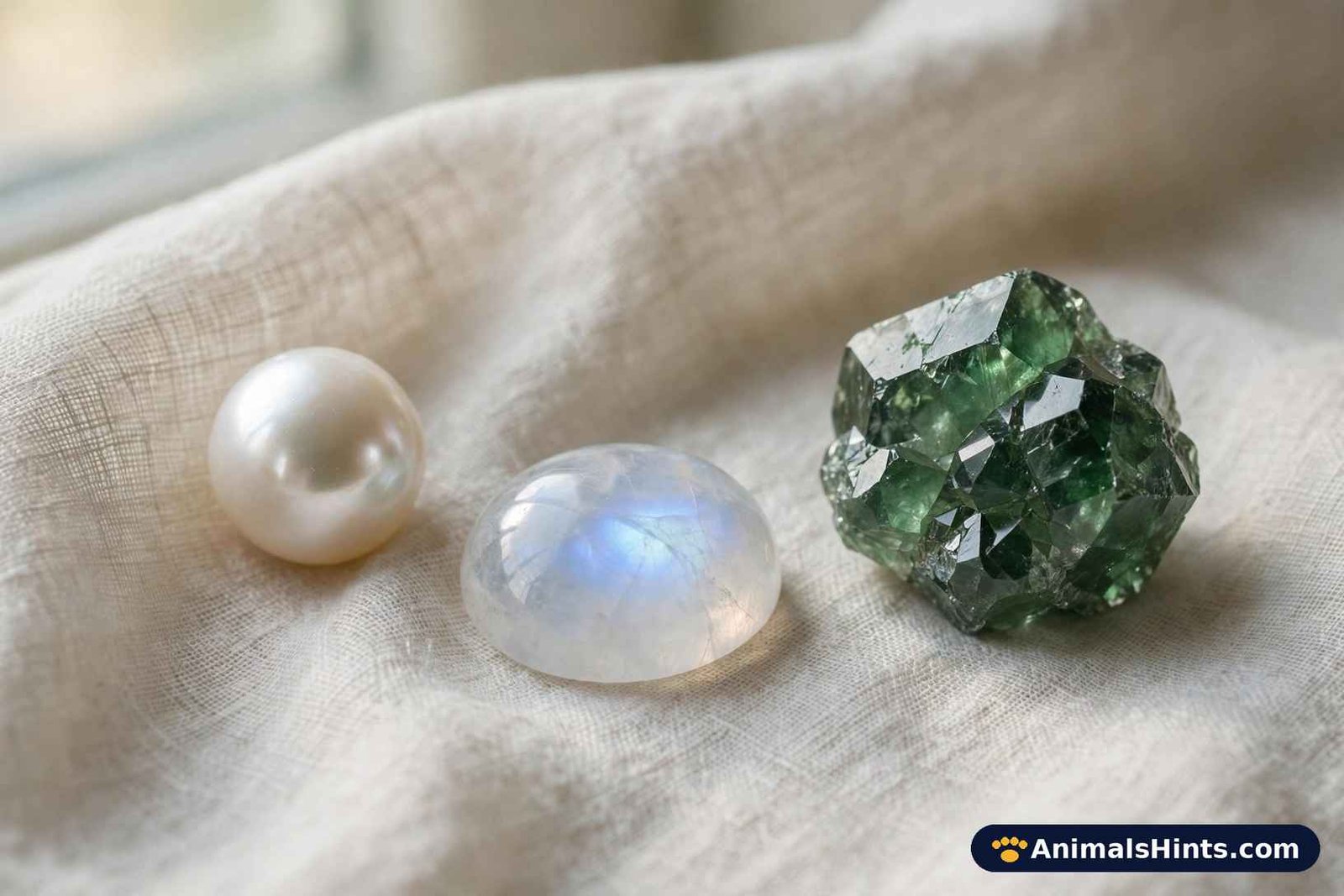
1. June Gemstone: Pearl
The pearl heads the modern list — but the Gemological Institute of America’s published list assigns June three birthstones, not the single one of the shortened pages: pearl, alexandrite and moonstone stand together for the month. The pearl is the traditional lead: an organic gem grown inside a living mollusc rather than mined, soft for a gemstone at 2.5 to 3 on the Mohs scale, and read across many traditions for purity and for beauty formed slowly around an irritation — the symbolism writes itself, and the tradition has never resisted writing it.
Alexandrite is the trio’s marvel: a rare variety of chrysoberyl, first found in Russia’s Ural Mountains in the 1830s and named for the future Tsar Alexander II, which changes colour with the light — green in daylight, red under incandescent lamps — and rates a hard 8.5 on the Mohs scale. Moonstone is the trio’s dreamer: a feldspar whose inner layers scatter light into a floating glow, the effect gemologists call adularescence, at 6 to 6.5 on the scale, tied in Roman and Greek tradition to the lunar deities. Together the three make June the best-stocked month on the entire list — a point the single-stone pages miss entirely.
2. June Color: Light Yellow or Cream
No authority assigns June a colour at all. Light yellow and cream occupy the slot by association — sunlight’s colour and the pearl’s lustre, generalised by modern correspondence tables — while moonstone’s white-blue is offered as the common alternative. Read as symbols, the pair stand for clarity, warmth and unshowy purity. Readers following the light-and-dark thread from the Yin-Yang meaning can pursue its darker half in this site’s black spiritual meaning guide, which treats the night the solstice keeps shortest.
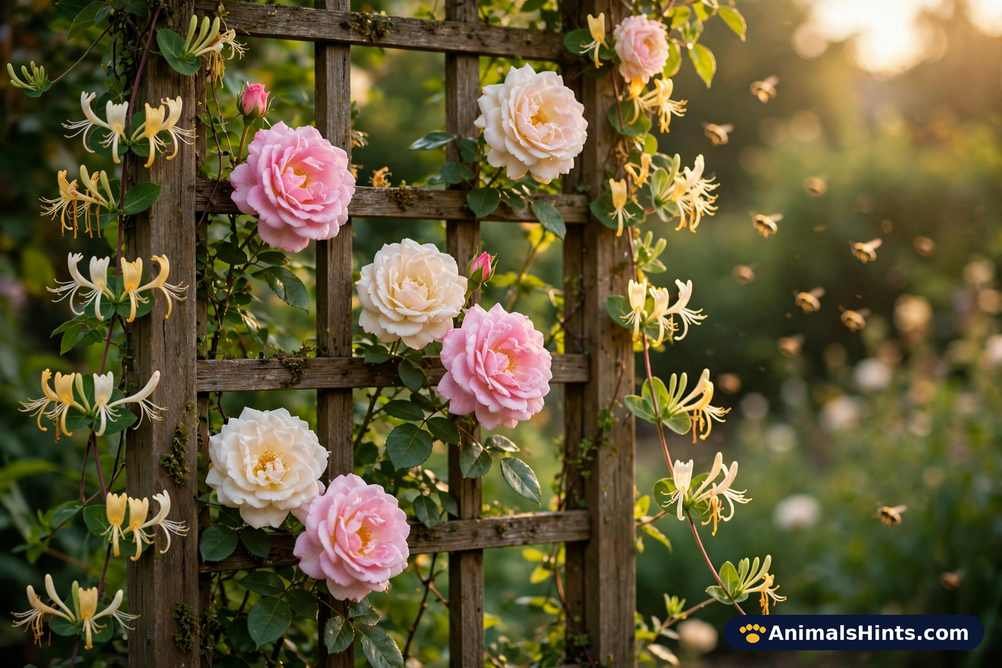
3. June Flower: Rose
The Almanac’s list gives June the rose — and pairs it with a second flower, the honeysuckle: a climber that scents June hedgerows, which the flower-language tradition reads as devoted affection, love’s bond. The rose keeps the headline: love’s emblem in tradition after tradition, tied in Christian usage to the Virgin Mary as the Mystical Rose, and read for love in every register from the human to the divine.
The honeysuckle deserves its sentence of natural history, because June is when it earns the pairing: it flowers at the solstice season, pours out scent after dusk for the night-flying moths that pollinate it, and feeds hummingbirds and bees by day. An emblem of the month chosen by an authority and confirmed by the hedgerow — the correspondence, for once, checks out in both directions.
Is June a Lucky Month? An Honest Verdict
Nothing fetched for this guide ranks the months by fortune, and there is no evidence that June outperforms or underperforms any other stretch of the year. A slimmer claim is the one the record supports. June really does contain the year’s light peak in the north, really does reopen the wedding and garden season at full strength, and really does carry a marriage goddess in its name — and contemporary spiritual writing turns that cluster into an invitation: make the commitment, tend the growth, say the thanks while the evidence is still in front of you.
That is as strong as the symbolism honestly gets: an occasion you choose, never an outcome promised to you. A person who books June as their midpoint review will likely end the month seeing their year more clearly than they began it — and the clarity will belong to the review, not to the calendar. Any page promising that June hands love, money or breakthroughs to favoured signs or birthdays is selling prediction in symbolism’s clothing. This guide carries none of it; the agency stays with the reader, where it does the most good.
June in the Animal World: Fledging Season
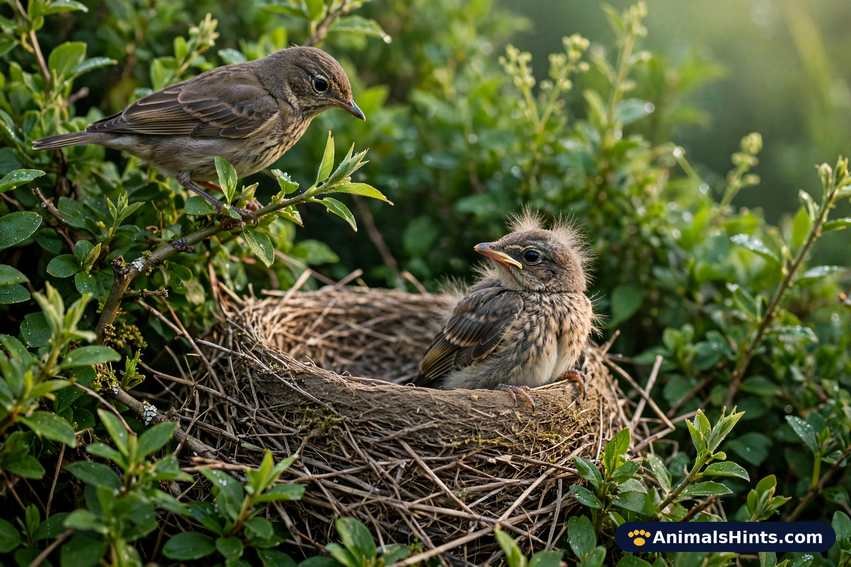
For an animal site, June’s headline is the emptying of the nests. Across the north, the spring’s nestlings reach fledging in a rush — young songbirds leaving the nest hollow and the garden hedge, fed on the wing by parents working the year’s longest days at full stretch. It is peak breeding season made visible: the dawn chorus still loud early in the month, then gradually quieter as singing gives way to feeding.
The rest of the animal calendar runs at the same fullness. Honey bees build toward their midsummer peak, deer drop fawns in the long grass, and the year’s first butterflies are joined by the summer broods over the meadows — the traffic this site’s green butterfly meaning guide follows through the season. South of the equator the calendar inverts: the year’s shortest days, animals in winter economy, breeding seasons shut down or retimed to the dry months. One month, two opposite animal years, running simultaneously.
How to Mark June: Simple Ways to Observe the Month
The four observances below are free, brief and belief-neutral; each converts a single reading from the tradition into a concrete act sized for the year’s brightest month.
Watch the solstice. On the evening of 20 or 21 June, stay out late enough to register how long the light holds — or, in the Southern Hemisphere, mark the shortest day and the turn back toward the light that follows it. Noticing the hinge is the entire exercise.
Do the midpoint review. With half the year visible in each direction, write three short lists: what has actually grown since January, what has stalled honestly, and what deserves the year’s second half. The growth-and-vision reading works better at the scale of a single honest page than at the scale of a wholesale reinvention.
Feed the fledglings. Keep feeders and a shallow dish of water filled through the fledging rush, leave one garden corner uncut for the insects everything else is eating, and give ground nests and new fawns a wide, quiet berth. In winter hemispheres, the same impulse keeps water unfrozen and feeders stocked through the shortest days.
Honour one bond deliberately. June’s oldest association is with unions kept on purpose. A meal, a letter, a kept promise to one person who carries part of your life — the month’s wedding symbolism, practised at household scale, on any day of it.

Final Thoughts
Few symbolism topics stand on ground this solid, which is worth pausing over. The solstice can be timed to the minute. The name preserves a real argument the Romans had with themselves — a goddess or a generation. Weddings and midsummer fires are not metaphors; they happen, this season, in large numbers. And the month’s official lists repay a second look: three birthstones where shortened pages print one, two birth flowers where they print one. The modern readings raised over all this — fullness, commitment, gratitude, vision — are at their most convincing when the verified base is left showing.
So take June at the strength its evidence earns. Let the long days argue you into the postponed midpoint review. Let the three stones stand for the month’s variety, and the rose and honeysuckle for bonds tended in daylight and at dusk alike. Even the moonstone makes the month’s argument quietly: the glow drifting inside it as it turns — its adularescence — is light scattered by internal layers too fine to see, brilliance produced by structure rather than by surface shine. A month built like that never needed inflating.
FAQs
What does June symbolize spiritually?
Contemporary spiritual writing presents June as the month of maximum light and visible fullness: the solstice’s longest day, a wedding season under Juno’s old patronage, and spring’s growth made undeniable at the year’s midpoint. The tradition reflects; it does not forecast anybody’s June.
What is the significance of June in spiritual traditions?
June carries the solstice — Litha in contemporary Pagan keeping, and for centuries the occasion of northern midsummer fires — plus a wedding season seeded by the Juno association, solstice observances of genuine antiquity in China, and a Christian season of ordinary time read through light and harvest texts. Every tradition reads the peak of the year as fullness, each at the strength its own calendar supports.
How can I use June’s spiritual energy in my life?
Treat the month’s energy as a prompt, never as a power: run the midpoint review while the year is fully lit, tend one bond on purpose, name your thanks specifically, and give one long evening to simply registering the light. Fullness, commitment, gratitude and vision — the tradition’s four themes, carried out as actions.
What spiritual practices are good for June?
Practices June’s writers return to most: an evening outside on the solstice watching how long the light lasts, a written review of the year’s first half, thanks spoken aloud to the people it belongs to, and slow time among the season’s signals — fledglings spilling from the hedge, honeysuckle sweetening the dusk, early summer butterflies over the meadow. Keep them modest, put dates on them, and repeat them next June.