Itchy Elbow Spiritual Meaning: News Omens, Old Lists and Real Skin Causes
Put itchy elbow spiritual meaning into a search engine and the answers come back sorted neatly by side, as if the matter were settled centuries ago. It was not — or not in the way the summaries claim. Ask the oldest itch lists that survive in print what an itching elbow foretells and they answer with something plainer and stranger than money: news. Tidings on the right, bad or mixed tidings on the left, and not a coin changing hands at this joint in either list.
Set that beside the version now circulating — right elbow for prosperity and progress, left elbow for loss, gossip and cash slipping away — and the two accounts only half agree. The polarity matches; the payload does not. Both written lists, one Western and one Indian, park their money entries one joint further down, in the palms, and leave the elbows to carry information. This article keeps both versions on the page, marks which is which, and shows the working wherever the modern telling has quietly upgraded a palm fortune into an elbow one.
One boundary before anything else: this page concerns the elbow alone — its bony point, its inner crease, the skin over both — and itching alone, a surface sensation. A twitching elbow is a different event, run by muscle rather than skin, with omen lists of its own; it gets exactly one section here, clearly fenced, and is never smuggled in as evidence about itches. Dermatology comes early, deliberately: most itchy elbows are explained by skin long before symbolism gets a hearing.
What Does an Elbow Itching Symbolize?
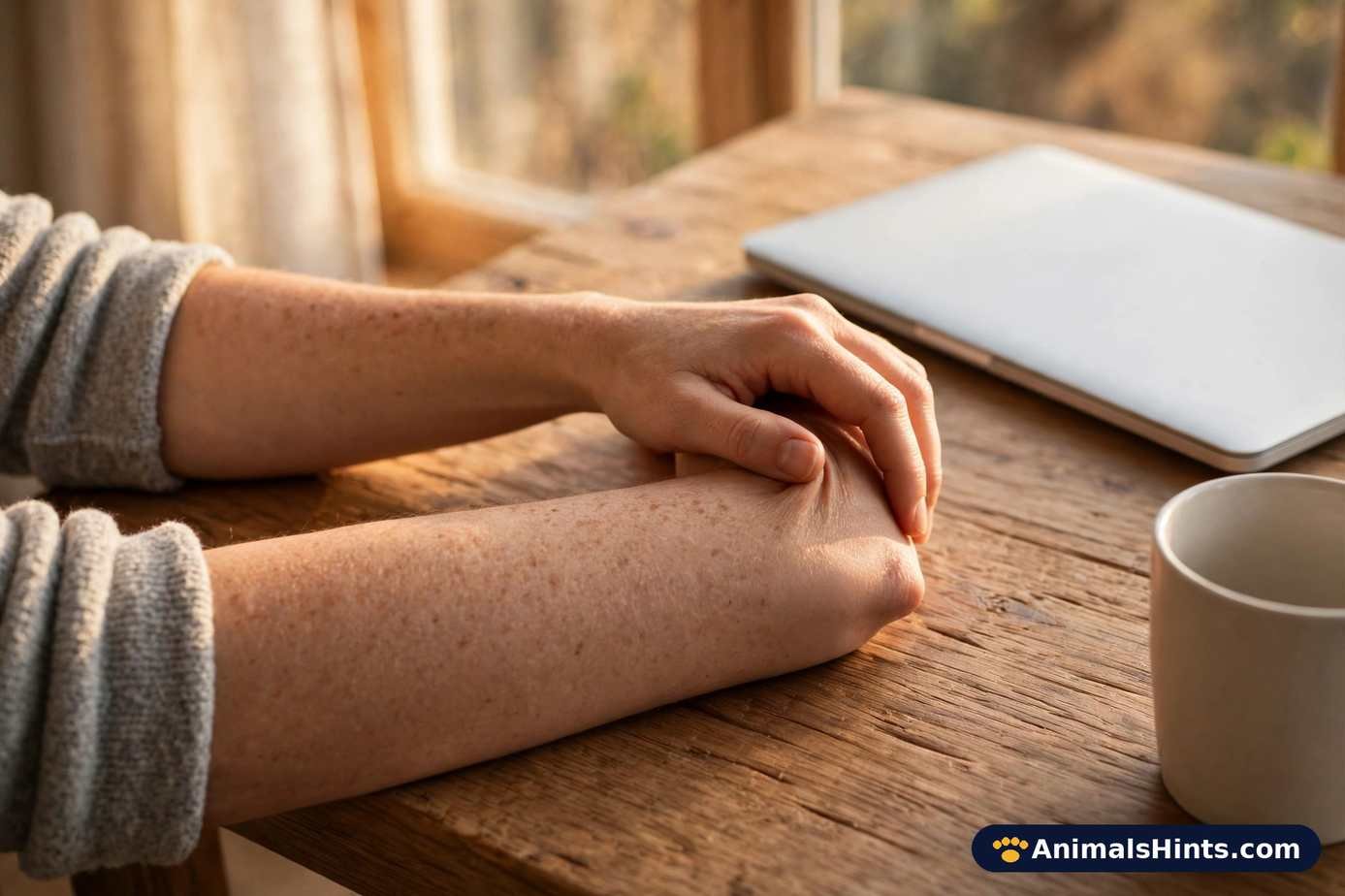
Begin with what the joint does all day. An elbow bends a reach, redirects it, braces it against a desk, pushes a door, carries a bag. Folk symbolism, which builds its meanings out of a body part’s work, reads the elbow accordingly: as the place where effort changes direction. From that single image the genre spins most of its readings — movement, adjustment, flexibility, a plan swerving, energy on its way somewhere else.
A second image competes with the first. The elbow sits midway along the arm, between the shoulder that bears weight and the hand that does the work, and some readings treat it as a checkpoint on that route: an itch there becomes a question about boundaries — how much you are carrying for other people, how far you are stretching, where you should stop. Both images are metaphors, and the article treats them as metaphors; they explain why the folklore says what it says, not whether it is true.
Then comes the fork every version of this topic takes: side. Hand the tradition a right elbow and it predicts outward things — luck, notice, momentum. Hand it a left elbow and it predicts inward ones — caution, release, feelings to sort, resources leaking. The split is presented in the sections below exactly as the compilations state it, and then measured against the two written lists, because the distance between those lists and the modern summary is the single most useful thing a reader can take from this page.
Why Does an Elbow Actually Itch? The Skin Explanation
One joint, two climates. The skin stretched over the point is thick, dry-prone and load-bearing — it props you up at every desk and table, and it thickens in self-defence. The skin lining the crease is the opposite: thin, warm, folded shut, collecting sweat. Nearly every medical explanation for an itchy elbow belongs to one climate or the other. The point dries and takes pressure; the crease stays damp and gets rubbed.
Dryness leads, here as almost everywhere on the body. Mayo Clinic’s survey of itchy skin (pruritus, in clinical language) names dry skin first among its causes, and an elbow point in heated indoor air, washed daily and leaned on hourly, dries faster than most places a person owns. Contact runs it close. Cleveland Clinic describes contact dermatitis as skin reacting to something it has touched, in two varieties: an irritant variety that follows soaps, detergents and cleaners directly, and an allergic variety in which the immune system objects to a particular substance — nickel, preservatives and fragrances head its examples. Around an elbow the candidates are easy to name: a new jumper, washing powder left in a sleeve, a support strap worn for sport, a cream put on after training. Timing gives these away. An itch that starts when a garment or product starts, and stops when it stops, has identified itself.
Beyond the everyday causes sit conditions that pick this joint on purpose, which is why a stubborn elbow itch earns more attention than a passing one. Psoriasis, which Mayo Clinic counts among the causes of itchy skin, builds its raised, scaly patches most often on elbows and knees; Mayo’s psoriasis pages describe the common plaque form as dry, itchy, raised patches under silvery scale, typically on elbows, knees, lower back and scalp. Eczema favours the joint’s other face: America’s Academy of Allergy, Asthma & Immunology observes that eczema frequently appears in the bends of the elbows, the fold where warmth and moisture gather. A third condition, far less common, belongs in an honest account of precisely this spot: dermatitis herpetiformis, the intensely itchy, blistery rash tied to gluten sensitivity, which Mayo Clinic says usually erupts on the elbows, knees, torso, scalp or buttocks, sometimes announcing itself with burning before anything shows. Naming these is not diagnosing anyone — an ordinary dry elbow is none of them — but their existence is exactly why the thresholds in the next paragraph exist.
On sides, medicine is blunt: nothing in dermatology distinguishes a right elbow from a left one. Which elbow itches is decided by which one is drier, harder leaned on, or in contact with whatever is irritating it — by exposure, in short, not by omen. An itch confined to one elbow is genuinely informative, just in a practical register: something touched that arm and not the other. Mayo Clinic’s own thresholds for handing an itch to a professional run as follows: it persists beyond two weeks despite sensible self-care; it becomes intense enough to ruin sleep or derail the day; it spreads over the whole body; it arrives alongside weight loss, a fever or night sweats; or it survives three months of treatment, at which point a dermatologist should evaluate it. Everything beyond this section is folklore, and the rest of the page labels it as such.
10 Spiritual Meanings of Elbow Itching
Ten readings circulate for this itch in present-day spiritual writing, and they appear below in the genre’s customary sequence, each one flagged as belief and credited to the compilations that carry it — not one of them is offered as knowledge about your future. Two entries arrive with a side already attached in the sources: the money warning belongs to the left elbow, the prosperity sign to the right, and each is printed with its side on, with its paperwork examined on the spot.
1. A Sign of Change
First and most load-bearing, the movement reading. Because this joint is where a reach bends, an itch here gets interpreted as life bending too: a job, a relationship, a routine about to alter course. The counsel bundled with the reading is adaptability — hold plans loosely, expect the swerve. Whether the swerve exists is beyond this page’s competence; the reading is the genre’s foundation stone and is recorded as such.
2. Energy Release
The discharge reading. Holistic writers describe vitality — chi, prana, life force, the vocabulary varies — as something that can stagnate under stress or suppressed feeling and then surface at the body’s moving points as tingling or itching while it clears. An elbow itch following an argument, a difficult conversation or a deliberate goodbye is the timing this reading claims as its own. It belongs wholly to the modern energy framework; the written lists further down speak of this joint in far plainer language.
3. Spiritual Awakening
The sensitivity reading. In awakening literature the body supposedly grows more reactive as awareness expands, and minor sensations — a ringing ear, a tingling scalp, an itching joint — get collected as early evidence. Placed at the elbow, the joint of doing, the itch is interpreted as a readiness to act deliberately rather than from habit. A contemporary frame, printed as one: no older list consulted for this article describes an itching elbow in anything like these terms.
4. Incoming Messages
The guidance reading — and, almost alone among the ten, one with documents behind it. Many traditions treat a sudden bodily sensation as a signal arriving from intuition, from ancestors or from guides, and at a joint concerned with action the signal is taken to concern a move or a choice. Strip the modern vocabulary away and what remains is the oldest fortune this joint owns: word is coming. The written lists below deliver the elbows’ news in exactly those terms, and this meaning is best read as their descendant.
5. Warning of Financial Loss or Challenges
The caution reading — the list’s left-elbow entry. As the compilations tell it, an itching left elbow warns that money may shortly leave your hands, through a sudden bill, an unwise purchase or somebody else’s pressure, and it counsels a pause before spending or signing. Two corrections travel with the meaning, printed inside it rather than buried. The written list this warning is traced to actually gives the left elbow “news about meetings and losses”: losses, yes, but framed as news, with finances nowhere specified — the money version is a later narrowing of that line. And in both written lists the true money entries sit further down the arm, at the palms. The full comparison is laid out in the old-lists section; the meaning stands here as the genre teaches it, ancestry amended in plain sight.

6. Sign of Prosperity and Good Fortune
The blessing reading — the list’s right-elbow entry. Across the modern compilations an itching right elbow promises incoming prosperity: effort finally rewarded, finances improving, an opportunity or an unlooked-for gift, with some versions widening prosperity to include peace, fulfilment and creative growth. The correction mirrors the previous entry’s. The written lists award the right elbow news — exciting news in one, good news in the other — and award money to the right palm. Filed accurately, then, this meaning is a modern enlargement of a narrower old fortune: the documents promise the right elbow tidings, and today’s pages have promoted the tidings into treasure.
7. Self-Reflection and Clarity
The mirror reading. On the premise that the body reflects the mind’s condition, an itch at the bending joint becomes a prompt to bend inward: revisit the rushed decision, name the feeling being sat on, listen to the intuition being out-talked. Of the ten, this one leans least on any omen system, since its advice — stop and look honestly at what you are avoiding — retains its value even if the itch signified nothing whatsoever. The genre concedes as much, framing the meaning as an occasion for journaling or stillness rather than a prediction.
8. Spiritual Protection
The guardpost reading. Some traditions interpret sensations along the arms as evidence of protective company — guardian angels, ancestors, guides drawing close during an exposed period — and the elbow, midway between hand and shoulder, gets cast as a checkpoint on the arm’s road. A second strand of the same meaning turns on boundaries: the itch as a signal to clear your space and stop absorbing the emotions of everyone around you. Recorded here as belief, which is what it is: the reassurance is something the tradition offers, not something this page can verify.
9. Divine Guidance and Support
The accompaniment reading, near kin to the fourth meaning with the stress shifted from message to backing. An itch that arrives on the eve of a decision, or hard on the heels of a question asked in prayer or in thought, gets interpreted as confirmation — support is present, the step is endorsed. The elbow’s movement symbolism carries the meaning: the sign blesses a direction instead of delivering information. Its ancestry, like the fourth meaning’s, is the news fortune in the written lists; the divine framing belongs to the modern genre.
10. Encouragement for Introspection and Personal Growth
The growth reading, closing the list. A persistent itch at this joint is interpreted as inner resistance made physical — some part of the self digging in against change, clutching a belief past its usefulness — with the discomfort itself cast as the growing edge, the way scratching lays skin open so it can heal. Where the seventh meaning prescribes a pause, this one prescribes a shedding: outgrown patterns, relationships and fears are to be let go of rather than examined. It is printed, like all ten, as the genre’s teaching — with one boundary stated inside its own section: an itch that genuinely persists has a medical address as well, and the thresholds in the skin section above are the part of this page meant to be acted on.
Superstitions of Left Elbow Itching and Right Elbow Itching
Here lives the tidy rule itself. The compilations’ side entries are given below as they present them — right before left, following their arrangement — with the written record reserved for its own section afterwards. Notice the shape as you read: the modern right elbow is largely a career omen, the modern left elbow largely an emotional one, and money shows up on both sides travelling in opposite directions.
Right Elbow Itching Superstition and Meaning
The fortunate side in the modern telling — the side of doing, giving and pressing ahead — gathers its readings around work and visibility:
- Good luck or blessings coming your way — fortune turning generally: an unexpected gain, a fresh opening, a venture already under way beginning to succeed.
- Receiving recognition or praise — effort noticed: thanks, credit or promotion said to be heading for the person whose work has been overlooked.
- You’re moving forward — momentum: some front of life — job, relationship, private goal — advancing instead of stalling.
- Energetic expansion — reach widening, in the energy teachers’ version: what you do carries further than it used to, and your influence grows with it.
- Positive encounters ahead — company promised: a meeting coming with somebody who brings good energy, or news worth having.
Five phrasings, one fortune underneath: things are moving outward, in your favour. The written record’s response to the package is split — the old lists do favour this elbow, but the favour they grant is narrower than this catalogue, as the audit below shows in full.
Left Elbow Itching Superstition and Meaning
The polarity reverses on the left in the modern telling: the receptive, intuitive, inward side, handled as a caution, a signal to ease off rather than press on. Its readings:
- Emotional turbulence or overwhelm — absorption: too much feeling taken on, your own or other people’s, and the body requesting firmer boundaries.
- Loss or letting go — departure: something — money, a relationship, a possession — on its way out, framed by the gentler versions as room being made rather than disaster arriving.
- You’re holding back — resistance: a habit, fear or conviction clung to past its usefulness, quietly blocking movement.
- Incoming visitors or conversations — contact: folk tradition attaches callers to an itch on this arm — somebody thinking of you, somebody about to get in touch — with the sources adding that the intentions are not always friendly.
One of these four has documentary company, and it deserves marking now: the visitor reading stands closest to the written lists, both of which hand the left elbow news, with meetings named outright in one of them. The side-by-side comparison follows in the next section.
What the Old Itch Lists Actually Say About Elbows
Two itch lists survive in print that can still be checked word for word, and both file this joint. They come from different centuries and different continents, neither owes the other anything, and on the elbow they converge to a degree the summary pages never mention: in the written record, an itching elbow is an omen about news.
Take the Western list first — the traditional catalogue of itching omens that works from the crown of the head down to the soles, still reproduced whole on folklore sites. Its right elbow earns one line: “You will get exciting news.” Its left elbow earns the most double-edged line in the catalogue: “You will get news about meetings and losses.” Register what is absent from both. No prosperity arrives at this joint, and no fortune leaks from it; the list keeps its money where it keeps it everywhere, in the palms — the right palm gaining money, the left palm losing it. The compiler’s parting generalisation about the whole catalogue runs the same way: the body’s left side is typically the unlucky one, the right the lucky. The elbow entries obey that polarity in tone — exciting set against losses — without ever turning into a table of finances.
The Indian list is a printed manual: L. R. Chawdhri’s 1990 manual Secrets of Occult Sciences, whose brief chapter “The Itches” descends the body in twenty-five numbered entries. Entry 14, left elbow: “Bad news.” Entry 15, right elbow: “Good news.” Two words a side, no embroidery — and the chapter’s preface attaches one condition to the entire list, that itching produces its results on a healthy body only, a caveat worth pausing on because it quietly removes every itch with a skin cause from the omen system altogether. Chawdhri’s money, like the Western list’s, is filed at the palms and ankles: expenditure on the left, gain on the right. Two lists, two traditions, one filing system — elbows carry tidings, palms carry cash.
| List or source | Right elbow itching | Left elbow itching |
|---|---|---|
| Western traditional itch list | “You will get exciting news.” | “You will get news about meetings and losses.” |
| Chawdhri, “The Itches” (1990) | “Good news” | “Bad news” |
| Modern compilations | Prosperity, recognition, progress, blessings | Financial loss, gossip, letting go, visitors |
Measured against that record, the modern rule proves to be neither pure invention nor honest descent. Its skeleton is genuinely old: favourable right, unfavourable left is precisely the polarity both lists print. Its flesh, though, is new. The documented left elbow deals in bad news and meetings-with-losses — a fortune about information and company, in which money rides, at most, unnamed inside the word “losses”. The documented right elbow deals in exciting, good news — a fortune about tidings, in which prosperity never appears at all. The current version, under which the right elbow pays and the left elbow charges, is most plausibly explained as the palm entries migrating one joint up the arm, helped along by that word “losses” already sitting in the left elbow’s line, waiting to be specialised. The modern meanings stand in their own sections above, labelled as the genre’s teaching; this section is the audit, and both halves of the page are needed.
Neighbouring joints on this site are documented from these same two lists. The itchy knee spiritual meaning article draws the knees’ entries from both — journeys in the Western list, news again in Chawdhri’s — while the left foot itching article works through the Western list’s journey fortunes for the soles, and the belly button itching page records an instructive filing problem: the earliest entry for its spot turned up in a twitch list rather than an itch list, which is the very distinction the section after next exists to police. For elbows, finally, note two things no fetched list contains: any splitting of the omen by sex, and any entry for both elbows at once. The written record gives this joint two lines a side and stops there. The gender layer that follows is therefore labelled accurately — a modern way of organising the material by audience, not a tradition recovered from documents.
Elbow Itching Superstitions for Females and Males
The gender layer grows out of the genre’s side symbolism — right coded masculine, active and giving; left coded feminine, intuitive and receiving — and then, oddly, reads each sex’s elbows partly against that coding. It is reproduced here under its correct description: a present-day organising scheme. No itch list examined for this article divides an elbow omen by sex, and nothing in it should be mistaken for recovered tradition.
For Females
For a woman, the genre reads an itching right elbow as fortune and attention arriving together: praise on its way, an unspoken admirer, credit for her work — plus a romantic variant in which a new attachment is forming or somebody’s feelings are quietly deepening. Her left elbow carries the warnings: envy and talk behind her back, or disquieting news on its way. Some Eastern-framed retellings soften that same left entry in two directions — into a counsel about guarding her emotional reserves instead of spending them on everyone, or into something almost positive, an awakening intuition that deserves trusting. One element deserves its footnote: gossip. The written lists attach no gossip to any elbow; talk belongs to their cheek and knee entries, and the gender layer has imported it here from elsewhere in the system.
For Males
For a man, an itching right elbow is read as headway and material success: a deal nearing signature, an effort nearing its payoff — the right arm cast in its traditional role as the working arm, the one that acts and earns. His left elbow carries the caution: disloyalty, money lost, or a let-down from somebody close, with a spiritual variant describing a man estranged from his own feelings and leaning too hard on logic and control. Newer retellings soften the entry further, into a prompt toward emotional awareness — stop and take stock of his relationships rather than brace for betrayal. Of the four gender readings on this page, this one borrows most heavily from the migrated palm fortune: losing money is the palm’s documented entry, and it reaches a man’s left elbow only through the modern compilations, through no list this page could fetch.
An Itchy Elbow Is Not a Twitching Elbow
A single filing rule governs this entire family of topics, and the elbow demonstrates why the rule exists. Itching happens in the skin; twitching happens in the muscle beneath it. Separate sensations, separate omen literatures, compiled by separate hands in separate centuries — and the elbow appears in both, carrying different fortunes in each. An itching article flavoured with twitching entries is not synthesising two traditions; it is misshelving one of them. The page this article is built to improve on makes the slip in its own opening paragraphs, sending readers to an elbow-twitching page as though the two signs were interchangeable. Neighbours on the same arm, yes. Interchangeable, no.
What the twitching shelf holds for this joint repays a look, because it refuses to harmonise with the itching record in either direction. The Sakuna Sastra — the celebrated Indian twitch compilation assembled from Indian and Arabic manuscripts — descends the arm and awards the right elbow the fruits of past deeds and the left elbow a gain of wealth: both elbows favourable, the left one holding the very money fortune the itch lists refuse it. The classical throbbing indications drawn from the Shakunashastra award the elbow joint, sides unsplit, an agreement reached with an enemy — a social fortune, neither tidings nor cash. And an Ekoi list from southern Nigeria, set down from P. Amaury Talbot’s fieldwork, which Notes and Queries printed in 1910, files the hollow of the right elbow together with the right palm: you will be called on to pay a debt or give a gift. The stretch just below the elbow, on either arm, receives the gravest line in that table — word of a death will soon reach you. Debt, wealth, reconciliation, death: as a twitching sign the elbow is busier and darker than it ever is as an itching one, and not a word of it transfers across.
Neighbouring guides here police the same border at their own joints. The itchy neck article keeps the neck’s itching record separate from its twitching one; the right eye itching article likewise declines to import the eye’s famous twitching lore into an itching page; the left eye twitching spiritual meaning page, by contrast, builds directly from the twitching lists on the opposite shelf. Held apart, each record remains coherent. Poured together, both dissolve — and an elbow, of all joints, deserves tidier filing than that.
Cultural and Religious Explanations
The four regional strands are carried here in his sequence and at his strength: these are the genre’s summaries of how parts of the world read the sign. Wherever a strand can be tested against the written lists above, the test result is printed beside it rather than the strand being quietly upgraded.
Indian Beliefs
As the compilations present the Indian reading, the body is a field of omens and the elbow, a joint concerned with movement, belongs to karma and the turning of destiny: an itching right elbow foretells wealth or success — for men especially — or admiration and affection for women, while an itching left elbow warns of difficulties, talk or conflict. Some versions add a current of prana to the picture, energy flowing outward through the right side to draw abundance in, blocked or turned inward on the left. Against that summary this page’s research can set something unusually concrete, because India owns one of the two written lists outright. Chawdhri’s elbow doctrine is news, good and bad, with money filed at the palms. The wealth-at-the-right-elbow version is therefore a modern Indian-facing summary, not the printed Indian record — and the difference is printed here rather than smoothed away.
African Traditions
As the genre presents the African reading, the body serves as a go-between for the physical world and the ancestral one: an itching right elbow means guidance from the ancestors toward an opening, an itching left elbow means somebody or something must be released for the path to stay clear, and the itch overall invites a check on whether one’s life energy is running in balance. The documentary position needs stating plainly. The checkable African elbow record sits on the twitching shelf — the Ekoi list quoted in the separation section, with its debt at the elbow’s hollow and its grave news below the joint — and no African itching list for the elbow stands behind the ancestral frame. The strand is accordingly printed at the strength it has: a modern summary, set beside a documented twitching record that says something quite different.
Western Folklore
The Western strand is where the competitor’s summary and the written record genuinely converge — though he never cites the meeting point. European folklore, he observes, never made the elbow as celebrated as the palm or the nose, yet regional belief held that an itching elbow precedes mixing with new people, at gatherings or in the course of travel; a second variant reads the itch as labour about to be rewarded, the elbow being a working joint. The written Western list hands the elbows news — exciting on the right, and on the left, news about meetings — which is the new-people fortune in documentary dress: company arriving, encoded as tidings. The labour-rewarded variant has no line in that list; it looks like the joint’s working symbolism stretched into a fortune, and it is labelled as an extension accordingly.
Spiritual Symbolism Across Religions
The competitor’s own admission opens this section, and it is accurate: itching elbows appear in no scripture, neither the Bible nor the Quran, and his reading of the joint as a bridge between thought and deed is a modern symbolic gloss, printed here as his. The documentary position can be stated with precision. The King James Bible never uses the word “elbow” anywhere. The one verse other translations render with the word is Job 31:22, which in the King James text reads: “Then let mine arm fall from my shoulder blade, and mine arm be broken from the bone.” That is a curse a suffering man calls down on his own arm — not a sign, not an omen, not a teaching about skin. No biblical text addresses an itching elbow, and this article offers no biblical meaning for one. What the energy systems add — the elbow as a place where flow can stall, in Reiki and chakra framings, the itch as a summons to unblock a feeling or a situation — belongs to those modern systems, and is filed under their names rather than under religion’s.
How to Soothe an Itchy Elbow: Practical Steps That Help
Whatever the folklore claims, an itching elbow is first of all a patch of skin asking for something, and the response dermatology recommends for itchy skin generally will serve it — most of it aimed at the dryness and contact causes the skin section above describes:
- Moisturise the point, and keep at it. Skin over this joint thickens and dries faster than almost anywhere else on the body; a plain, fragrance-free moisturiser worked in after washing and again at bedtime settles the majority of ordinary elbow itches on its own.
- Interrogate the calendar. New jumper, new detergent, new support strap, new cream — if the itch arrived with one of them, withdraw it for a week and let the timing give evidence. Contact causes confess through their dates.
- Interrupt the scratch cycle. Scratching thickens elbow skin further and deepens the very itch it relieves; a cool, damp cloth held against the spot calms the same nerves and does no damage.
- Take the weight off. A cushion under the arm, a sleeve between elbow and desk edge, a swap of leaning side — the point of this joint bears body weight for hours daily, and pressure is a cause that can simply be removed.
- Record the pattern, not the portent. One elbow or both, point or crease, scale or blisters, days or months: the pattern is what a clinician reads, it outweighs any side rule, and it is worth noting down before an appointment.
- Respect the thresholds. Still itching after a fortnight of sensible care, sleep being wrecked, the itch spreading body-wide, or weight loss, a fever or night sweats arriving with it — any of these sends the itch to a doctor, and one outlasting three months of treatment sends it to a dermatologist. A blistery, burning rash across both elbows belongs in that conversation earlier rather than later.

None of this forces a choice between the folklore and the skin. The traditions were assembled by people who had no dermatology to consult; you have both bodies of knowledge, and the sensible order is to settle the itch first and read the omens afterwards, if you read them at all, with the skin already cooling.
Final Thoughts
Few small signs in the body-omen catalogue come with paperwork this good, and the paperwork is ruder than the summaries built on it. The modern version promises a tidy machine — right elbow pays out, left elbow warns — while the two written lists that survive describe something narrower and odder: a joint whose fortune is news. Exciting news on the right in the Western list, good news on the right in the Indian one; meetings and losses on the left in the first, unadorned bad news on the left in the second. The polarity the modern rule runs on is authentically old. Nearly everything hung on that polarity is new, and the money — the headline of half the pages written on this topic — belongs by rights to the palms, one joint down, where both lists filed it from the start.
That does not empty the sign of meaning; it makes the sign readable. Taken at its documented strength, an itching elbow in the old system is a small, social fortune: somebody is coming, something is being said, a letter’s worth of change is on its way — with the left side’s version warning that not all of the news will be welcome, and some of it will concern people. A reader who prefers the modern prosperity-and-protection version may keep it, as a modern belief honestly labelled. What the record refuses to support is dressing that version as ancient, settled or unanimous, when the two lists that survive contradict it in two words apiece.
Underneath the folklore sits the joint itself, which earned its symbolism honestly: the hinge on which every reach you make depends, capped by the point of the ulna — the forearm bone whose Latin name simply means “elbow”, and whose upper end forms the very point your sleeve keeps catching on. The traditions chose a joint of movement and called its itch a sign of things in motion. The skin, more often than not, is asking for moisturiser. Attend to the skin first; the news, if the old lists are right, will arrive either way.
FAQs
What does right elbow itching mean spiritually?
In the modern compilations, a blessing: prosperity, recognition, forward movement. In the two written itch lists that can be checked, something narrower — the Western list gives the right elbow exciting news, Chawdhri’s 1990 list gives it good news. Money, in both lists, is filed at the right palm rather than the elbow.
What does left elbow itching mean spiritually?
The modern reading warns: financial loss, gossip, letting go, visitors with mixed intentions. The written record is plainer — news about meetings and losses in the Western list, simply bad news in Chawdhri’s. Losses genuinely stand in the old entry; the specifically financial version is the modern narrowing of it.
What are the superstitions about elbow itching?
That an itch at this joint foretells arrivals — news, meetings, visitors — the right side read kindly, the left side read as warning. Both written itch lists agree on the news frame and on that polarity; the gender readings, the prosperity version and the protection and awakening meanings are later layers the modern genre has laid over the top.
How should I respond to elbow itching?
Skin first: moisturise the point, check what has been touching it, and get medical advice if it crosses the thresholds in the practical section — a fortnight of sensible care, broken sleep, spreading, or fever and night sweats alongside. After that, read the itch the way the old lists do, if you read it at all: as a nudge to expect news, not as a promise about money.