Green Ladybug Spiritual Meaning: Growth, Healing and the Beetle You Probably Saw
The green ladybug meaning, in the modern symbolism genre that writes these lists, is the gentlest reading on the whole ladybird shelf: growth, healing, renewal and fresh luck, the colour of new leaves laid over a beetle people have treated as a small blessing for centuries. This page gives that reading in full — and it also tells you, before anything else, the thing the symbolism pages leave out: a truly green ladybird barely exists, and the green beetle on your plant is usually something else.
That is not a spoiler; it is the most useful fact on the page. In North American gardens, a green “ladybug” is almost always a spotted cucumber beetle, a leaf-chewing pest wearing a ladybird’s outline. In Europe it is usually a green tortoise beetle. The one genuinely green ladybird in the family is a small metallic species from Australia that most readers will never meet. The genre wrote its twelve meanings for the colour, not for any of these insects, and the two stories — the symbol and the beetles — are both worth having straight.
So here is the whole of it, kept in its separate layers: the genre’s twelve meanings in their usual order, the older luck record the whole ladybird family carries, and then the entomology — which green beetles are real ladybirds, which are look-alikes, and how to tell them apart on the leaf in front of you.
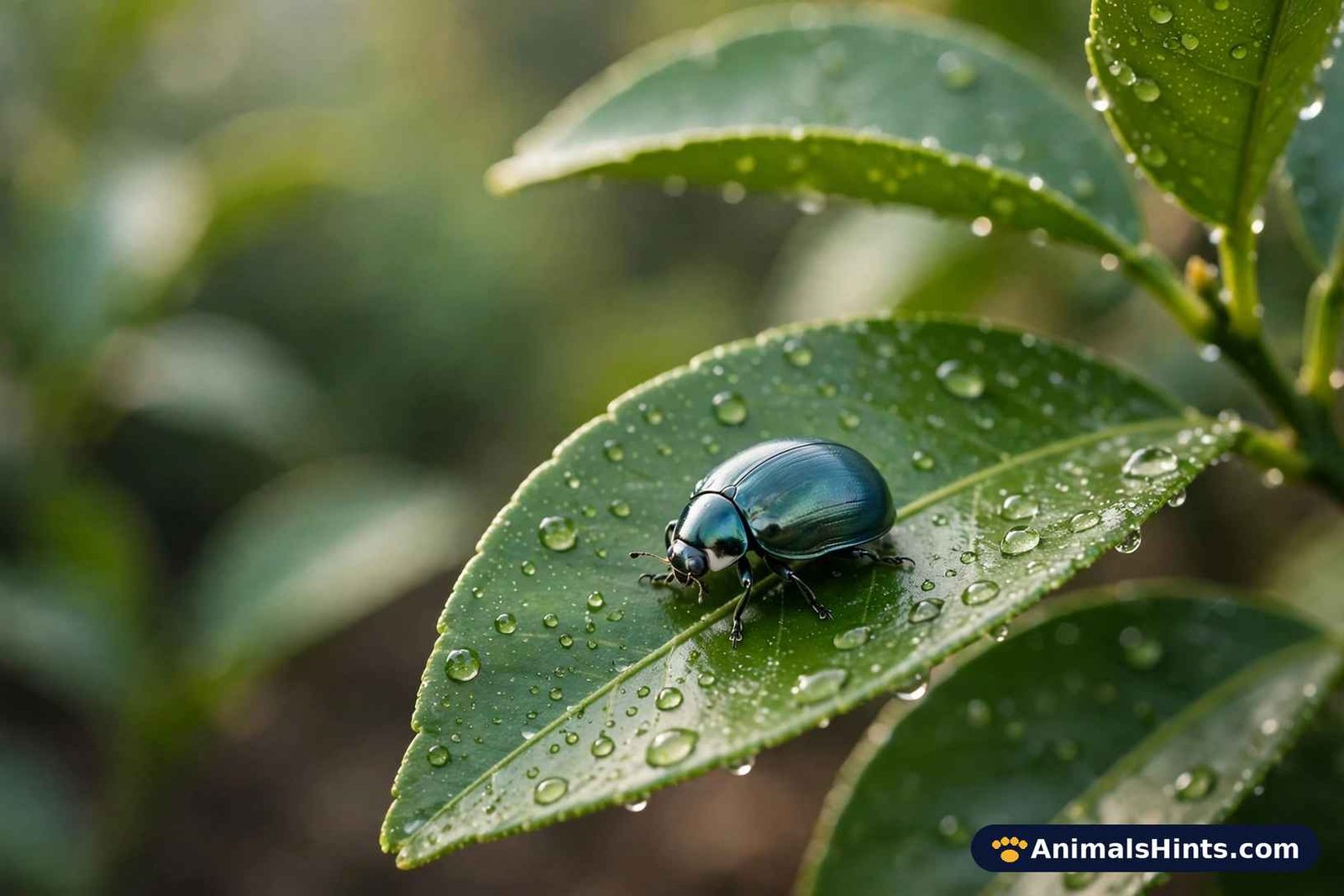
What Does Seeing a Green Ladybug Symbolize?
Start, as this genre always starts, with the colour. Green is the colour of the growing season — of shoots, leaves and everything in the garden that is currently getting bigger — and modern symbolism reads it for growth, renewal, healing and balance. Writers in this tradition also assign green to the heart chakra, the energy centre they connect with love and compassion; that assignment belongs to the modern chakra scheme used by today’s spiritual writers, not to any older text, and it is labelled that way here. The colour has its own full page on this site, at green spiritual meaning, and other small creatures get read through their colour in the same way — the orange butterfly among them.
Onto that colour the genre lays the ladybird itself, and the beetle brings the older half of the symbol. Ladybirds as a family carry one of the longest good-luck records of any insect in Europe: protected by custom, welcomed on crops, counted as fortune when they land. A green one, in the genre’s arithmetic, takes that standing luck and aims it — at recovery instead of romance, at new growth instead of sudden windfalls. The detail writers add is the spots: count them, some say, and the number sharpens the message. The documented custom underneath that detail is plainer and older — country people counted a landing ladybird’s spots as the lucky months ahead of them — and the per-number meanings in circulation now are modern decoration on that custom.
None of this is offered as fact about a beetle. It is a symbolic vocabulary, and like the other colours on this shelf it has a centre most writers agree on — growth, healing, a turn for the better — and edges they improvise. What the vocabulary cannot tell you is which insect you actually saw. For that, the page has to leave symbolism and look at the animal.
What Is a Green Ladybug, Really?
Ask what a green ladybug is, and the first surprise is that the family has almost no use for the colour. Ladybirds — lady beetles, ladybugs in American English — make up the family Coccinellidae, and across its thousands of species the standard colours are red, orange, yellow, cream, brown and black. Green never joined the list. So the green beetle in front of you belongs, in all likelihood, to one of a handful of cases: the family’s single metallic green exception, a green impostor from another beetle family altogether, or an ordinary ladybird snapped in the brief pale window before its adult colours set.
The steelblue ladybird (Halmus chalybeus) is the genuine article — a true ladybird that really does come in green. CSIRO’s ladybird guide describes a small, strongly domed beetle, 3.2 to 4.1 mm long, with no spots at all: the male’s back is metallic blue shading to almost green, the female’s entirely green or blue, with only the head and the front corners of the shield behind it picked out in yellow-orange on the male. It lives along Australia’s east coast from Victoria to northern Queensland and has been introduced to New Zealand, California and Hawaii, where it earns its keep hunting scale insects on citrus and other shrubs. Note the kind of green it wears: a polished metal sheen, blue-green like oil on water — not the flat leaf-green of the beetles below.
The spotted cucumber beetle (Diabrotica undecimpunctata) is the beetle behind most North American “green ladybug” sightings, and it is not a ladybird at all. It belongs to the leaf beetle family, Chrysomelidae. University of California guidance describes the adult as shiny, about a quarter of an inch long, yellowish-green with eleven or twelve black spots and a black head, and warns gardeners directly not to confuse it with the predaceous lady beetle — the giveaway is the antennae, long and thread-like on the cucumber beetle, short and clubbed on a ladybird. The difference that matters is the diet: a ladybird on your plants is hunting aphids, while this beetle is eating the plants — leaves, flowers and fruit of cucumbers, squash and melons above all — and it carries bacterial wilt, a disease that can collapse a melon patch, from plant to plant as it feeds. Its larvae work underground on roots; the southern form of the species is the southern corn rootworm.
The northern corn rootworm (Diabrotica barberi) is the spotless green look-alike. Extension services in the corn belt describe a beetle about a quarter of an inch long that emerges cream to tan and soon turns a plain pale green, with no spots and no stripes to break it up. It feeds on corn silk and on garden flowers — roses, dahlias and sunflowers among them — and turns up in late summer, which is when a plain green “ladybug” with nothing on its back is most likely to be this insect instead.
The green tortoise beetle (Cassida viridis) is Europe’s answer. The Kent Wildlife Trust describes a round, flattened beetle, 8 to 10 mm long and entirely lime green without markings, whose shell spreads out around the body like a shield; threatened, it pulls its legs and antennae in and clamps down flat against the leaf, tortoise-fashion. It feeds on white dead-nettle, hedge woundwort and water mint in gardens and hedgerows across most of Europe, and it has also been introduced into southern Ontario. Flat is the field mark: no ladybird is built like a dropped shield.
The fifth candidate is a ladybird after all — briefly. Every ladybird climbs out of its pupa soft, pale yellow and spotless, and only gains its colour and spots over the following hours as the wing cases harden. Photographed in that first window, sitting on green foliage, a young red-to-be can read as a pale green beetle. By the next day it will be wearing its real colours.
| Beetle | Colour to look for | Where you are most likely to meet it |
|---|---|---|
| Steelblue ladybird (a true ladybird) | Metallic blue-green, spotless, strongly domed | Eastern Australia; introduced to New Zealand, California and Hawaii — on citrus and shrubs, hunting scale insects |
| Spotted cucumber beetle (look-alike) | Yellow-green with 11–12 black spots, black head, long antennae | North American gardens, chewing cucumber, squash and melon leaves and flowers |
| Northern corn rootworm (look-alike) | Plain pale green, no spots, about 1/4 inch | North American corn country and flower gardens, late summer |
| Green tortoise beetle (look-alike) | Flat, entirely lime green, shell edges spread like a shield | Europe (and southern Ontario), on white dead-nettle, woundwort and mints |
| A ladybird in its first hour (any red or orange species) | Pale yellow, soft and spotless | Beside its empty pupa case on a leaf, colour arriving within hours |

The table leaves two morals. One: colour by itself names nothing — identification hangs on the feelers, the curve of the back, the spotting or lack of it, and the plant under the beetle’s feet, which is precisely the evidence a recording scheme wants attached to a sighting. Two: this shelf’s genuine colour classes are species, not shades. There is a brown ladybug entry because real tree-dwelling ladybirds wear tan and maroon, and a red ladybug entry because red is the family’s famous livery — while green, uniquely, is mostly borrowed plumage. The twelve meanings that follow are therefore offered for what they are: a symbolism written about a colour. You now know which creatures actually wear it.
12 Spiritual Meanings of a Green Ladybug in the House
Here, then, is the list this colour gets on the symbolism sites — all twelve meanings, in the sequence those sites use, under two cautions carried down the whole shelf. Caution one: nothing here is old. The list was assembled by symbolism writers of the internet age, and when it says the same thing twice in different words — watch for luck resurfacing dressed as protection, then again as energy — it is a young genre repeating the idea it values most. Caution two concerns the room in the heading. Ladybirds proper do enter houses deliberately, crowding into window frames when autumn turns cold; the harlequin is famous for it. Nobody has recorded the green doubles doing anything of the sort, so a green beetle in your kitchen almost certainly arrived as a stowaway — on a houseplant, say, or among vegetables brought in from the garden. Less poetic, more probable. With both cautions on the table, the genre’s reading of the visit follows.
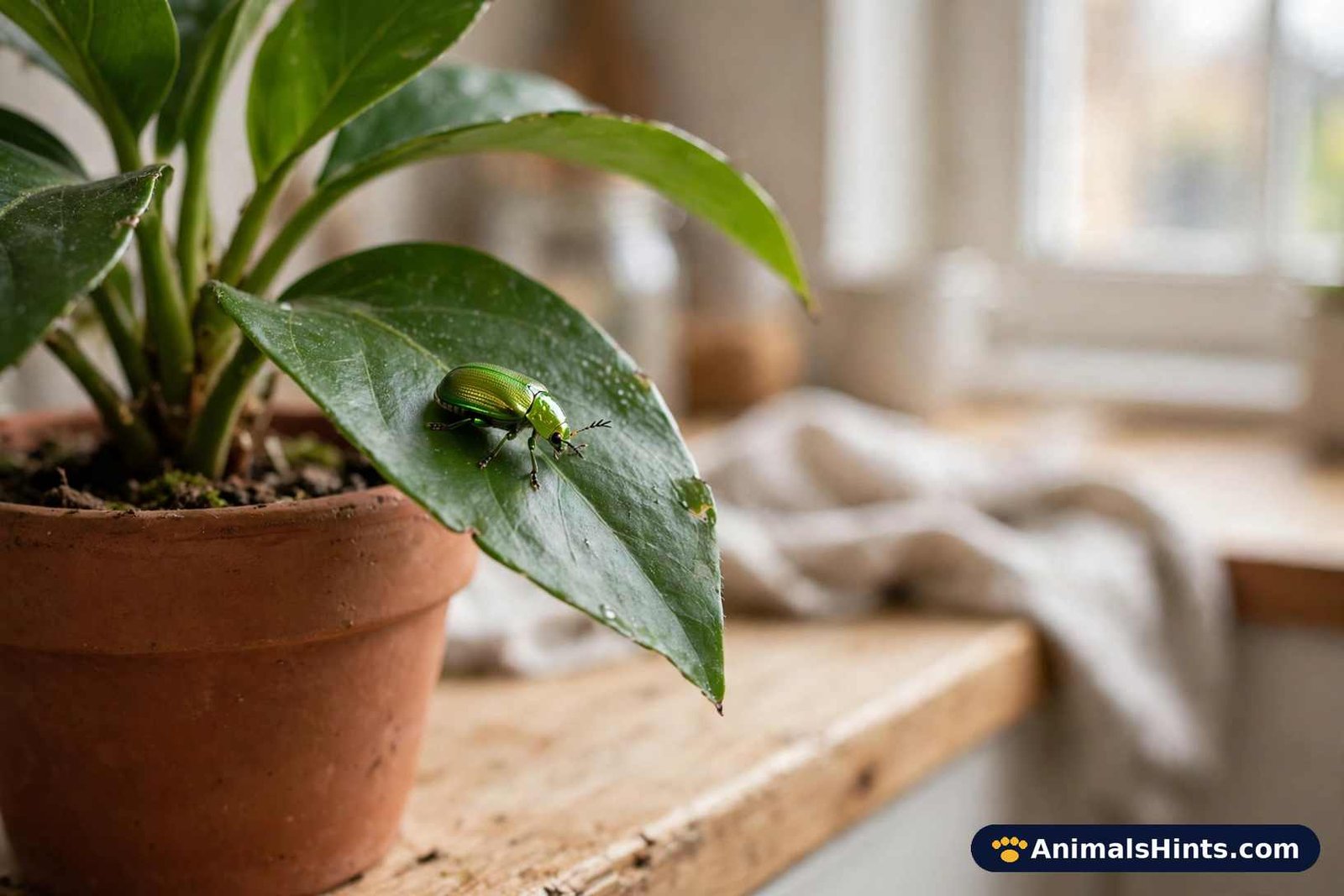
1. Prosperity and New Beginnings
The genre’s headline reading pairs the ladybird’s standing luck with the modern Western habit of reading green as the colour of money and growth. A green ladybug in the house, in this telling, marks a household turning a corner: new income, a new venture, a door opening. The rarity does the underlining — because the sighting is unusual, writers treat the message as emphasised, a beginning that wants noticing. Read it as the genre’s framing, not a forecast: what is documented is the colour association and the beetle’s old luck, and the prosperity wording is the modern join between them.
2. Growth and Fertility
Green is the growth colour, and the genre extends it from gardens to households: new projects sprouting, creative work taking root, a family expanding. Underneath the wording sits one genuinely old association — farmers welcomed ladybirds on their crops for centuries because the beetles protected the harvest, and a creature tied to thriving fields picks up fertility language naturally. The ladybird half of that is documented farming history. The household half — the beetle as a sign your plans will multiply — is the genre’s extension of it, printed as such.
3. Transformation and Awakening
The beetle’s own biography carries this one. A ladybird arrives at its adult shape through a complete rebuild — egg, spiky larva, still pupa, winged adult — and the genre reads a green one, the colour of new growth, as the emblem of a person mid-change: old habits shed, a clearer self emerging. Writers call it awakening when the change is inward as well. The metamorphosis is real, and this page gives it its own section below; the meaning drawn from it belongs to the symbolism, and the two are kept separate there as carefully as here.
4. Luck and Protection
This is the oldest item on the list, and the one part of the twelve with centuries behind it. Across Europe, ladybirds were protected by custom: they were welcomed wherever they settled, and harming one was itself the unlucky act — the surest way to turn your fortune. A green ladybug inherits that standing whole. The genre adds the colour’s gloss — luck aimed at health and recovery rather than windfalls — but the core of the meaning, the small guarded beetle as a household blessing, is the family’s documented record rather than a modern invention.
5. Well-being and Harmony
The self-care entry. Modern writers read green as the balancing colour — the middle of the spectrum, the shade resting eyes seek in a garden — and a green ladybug becomes a prompt to check in with yourself: rest, food, air, a slower hour. As symbolism it is coherent; as anything more it should not be stretched. A beetle carries no medical meaning, and this page prints the reading for what it is — a gentle mnemonic the genre attaches to a calming colour — not as guidance about anyone’s health.
6. Optimism and Hope
Hope is spring’s emotion, and green is spring’s colour; the genre joins them and sends the beetle as the messenger. A sighting after a discouraging stretch is read as the season turning — early, small, but real. Writers lean on the garden for the image: the first green thing is never the whole crop, only the proof that growth has started. That is the meaning in its honest proportions — an encouragement framed in the colour of beginning again, offered by modern symbolism and labelled as such.
7. Positivity and Guarding Energy
The list circles back here, and the repetition is worth noticing rather than hiding: this meaning restates the fourth — luck and protection — in the vocabulary of energy. The genre speaks of guarding your energy the way an earlier age spoke of guarding your luck, and the green beetle is cast as the reminder to do it: keep the hopeful thought, refuse the draining one. Same root, newer words. The root is the family’s old protected status; the energy framing is the modern layer, and this page keeps the seam visible.
8. Sacred Balance
This heading welds a very old word to a very new idea. Old first: calling the beetle a ladybird at all is an act of dedication — the name honours the Virgin Mary, as do its cousins all over Europe — so a “sacred” ladybird is simply the family’s own history surfacing. New second: balance is how today’s writers gloss the colour, the middle shade of the spectrum, neither warm nor cool, and therefore a prompt to level work against rest and giving against receiving. Genre headings often join an inherited word to a recent gloss; knowing which half is which is most of reading them well.
9. Guidance Through Change
Where the third meaning watches transformation from inside, this one addresses the person standing at the fork: a move, a job, a decision with no clear signpost. The genre sends the green ladybug as a guide for the crossing — trust the process, stay curious, let the new season do its work. The natural hook is honest enough: the beetles themselves are creatures of the turning year, emerging as the garden greens. The guidance claimed for them is the genre’s, and it is printed as encouragement, not direction.
10. Divine and Nurturing
This is the list’s one explicitly religious heading, so it is the right place to lay out what the religious record actually contains. A naming tradition, first of all: across Europe the beetle was given to the Virgin Mary — the English called it her bird, the Germans her Käfer, and the pattern repeats language by language. Attached to the naming rides a tale of answered prayer, peasants delivered from a ruined harvest by swarms of the beetles; retellings agree on the shape of it and on nothing firmer, so it stands here as the tale it is. What can be verified is drier and stronger: the names themselves, and the centuries of protection they bought the insect. Scripture plays no part — no ladybird appears anywhere in the Bible — which makes the whole sacred chapter a matter of European devotion expressed as folk custom. The genre’s talk of the divine and the nurturing is that custom, retold in a softer key.
11. Dream Encounter Significance
The dream entry is the list’s youngest layer. No classical or pre-modern dream book gives the ladybird an entry that these checks could find, so there is no old oneiromancy to quote; what exists is the modern genre’s reading, in which a green ladybug in a dream signals healing under way and change approaching, the subconscious dressed in the colour of recovery. This page prints it labelled as the modern reading it is. The fuller dream section below keeps the same honesty about which parts are old (none) and which are the genre’s (all of it).
12. The Power Animal
The closing heading uses the genre’s own term, and the term itself is modern — “power animal” belongs to contemporary spiritual writing, not to any older tradition these checks could document. In that vocabulary, to take the green ladybug as a power animal is to borrow its imagined temperament: small, unhurried, protected by its own warning colours, changing completely when change is required. As an emblem chosen by a reader it needs no defence. As a claim about tradition it has none, and the distinction is the same one this page has drawn under every heading on the list.
From Egg to Beetle: The Change Behind the Symbol
Two of the twelve meanings lean on transformation, so the underlying biology earns a section of its own — and it is a stranger life story than the adult’s round shell suggests. It opens with eggs: small, yellow-orange, stood on end in tight bunches underneath leaves, typically within a short crawl of the aphids the young will need. The hatchling resembles its parents not at all. Out comes a dark, bristly larva flecked with orange or yellow, all appetite and legs, easily mistaken by gardeners for a pest — when in truth it is the hardest-working aphid hunter on the plant, shedding skin after skin as it fattens.
Growth finished, the larva anchors itself by the tail to a leaf or a stem and trades motion for stillness: the pupa, a freckled husk inside which the winged adult is assembled. A week, two at most in cool spells, and the husk splits down the back. What hauls itself out matters to this page more than any other moment in the cycle, because the emerging beetle wears no colour worth the name — soft, pale yellow, utterly bare of spots. Pigment floods in only as the shell cures: reds warm up, black spots strike through, the lacquered dome appears. Green-tinted photographs of ladybirds are, very often, this precise hour caught on camera. Survivors of that first day commonly live on for the better part of a year, dormant through winter in bark, litter or a quiet corner, and stir again when the garden does.
Other shelf creatures carry the same four-act structure, and the caterpillar is the one readers know best — egg, feeding stage, still stage, winged adult, with the middle stages looking nothing like the end. The cucumber beetle runs a different version of the cycle, and the difference is diagnostic: its eggs go into the soil at the base of its food plants, and its larvae live underground eating roots, which is why a plant can wilt in a garden where the only visible insects are small green beetles on the leaves. The impostor’s hidden half is below ground; the ladybird’s whole life happens in the open.

Green Ladybug Symbolism for Love, Relationship and Twin Flame
The love readings follow from the colour assignment the genre made at the top of this page: green belongs, in the modern chakra scheme, to the heart — so a green ladybug is read for the state of the heart. For couples, the standard gloss is patience and honesty: affection that grows like a plant rather than striking like lightning, tended a little every day. For someone single, the same colour is sent as a sign that healing comes before romance — the heart recovering its green before it is asked to flower. These are modern readings in a modern scheme, and they are printed in that frame.
Twin flame is the heading’s third term, and it needs the same plain labelling its sibling pages give it: the twin-flame idea is a contemporary one, popularised by recent spiritual writing, with no older textual tradition behind it that these checks could find. Within that modern frame, a green ladybug is cast as the sign of the healing phase — the period in which two people are supposed to grow separately before any reunion. The one genuinely old element anywhere near this section is the family’s gentleness custom: a ladybird that lands on you is never to be brushed off. The genre borrows that patience for its couples; the custom itself is documented, and the borrowing is the genre’s.
Cultural and Religious Significance
The European record is where this beetle’s real cultural weight sits, and it belongs to the family rather than to the colour. The names tell the first part: Our Lady’s bird in English, Mary’s beetle in German, matching dedications in language after language — a crop-eating countryside naming its smallest protector after the Virgin. The customs tell the second: ladybirds welcomed and protected, a landing read as fortune, the spots on a landed beetle counted as the lucky months to come. No church teaching makes a beetle an omen; the record is folk custom, warm and widespread, and it attaches to red and orange backs far more than to green ones, because those are the backs Europe actually saw.
The farming record runs beside the folklore and explains it. A countryside that watched ladybirds clear aphids from failing crops did not need doctrine to protect them; gratitude was enough. The green shelf has an honest irony here that the symbolism pages skip: the beetle most North American readers meet under this colour is the one farmers fight. The spotted cucumber beetle is a genuine crop pest — a chewer of leaves and flowers and a carrier of the wilt that kills melon vines — so the family’s welcome, extended by colour to its double, protects the wrong insect. Knowing which beetle you have is not pedantry; on a farm it is the whole question.
Eastern traditions are claimed by the competitor page in general terms — insects of bright colour read as signs of transition and renewal — but no named Eastern tradition attached to a green ladybird could be verified for this page: no text, no named custom, no source beyond symbolism sites repeating one another. It is therefore printed at exactly that strength, as an unattributed modern claim, rather than dressed up as an ancient teaching. The same discipline applies to the chakra material: the colour scheme that assigns green to the heart is a modern Western overlay on an older Indian system, whatever the genre’s pages imply.
Modern spiritual practice is the layer where the green ladybug fully lives. Tarot-adjacent journals, crystal shops and symbolism blogs read it for inner healing, renewal and gentle prosperity, and the heart-chakra green is the engine of most of those readings. There is nothing wrong with the layer, as long as it is dated correctly: it is a twenty-first-century symbolism, built on a genuinely old European luck record and a beetle the colour barely clothes. This page’s whole arrangement — genre readings given in full, records labelled by age, look-alikes identified — exists so a reader can hold those layers separately.
What It Means Spiritually to Dream About a Green Ladybug
Dream interpretation is where this page’s honesty rule bites hardest, because there is the least to stand on. The old dream books that give entries to snakes, teeth and falling give none to ladybirds that these checks could find — no classical author, no medieval compilation, no nineteenth-century dream dictionary entry for the beetle in any colour. Everything in this section is therefore the modern genre’s dream-work, printed in its own name.
In that modern reading, a green ladybug in a dream carries the waking list into sleep: healing under way, a renewal the dreamer has not yet noticed in daylight, change arriving gently. A dream of the beetle landing is read as the luck custom dreamt — fortune approaching the dreamer rather than the other way round. One strand is specific to this colour: writers connect the green beetle with relationships being repaired, the heart-chakra green doing its assigned work in the night’s theatre. It is a coherent modern gloss, and some readers will recognise their own dreams in it. What it is not is an old teaching, and anyone who tells you dreamers have read this beetle the same way for centuries is selling you the genre’s confidence without its sources.
Green Ladybug Landing On You or Flying Around You
Of everything on this page, the landing custom is the piece with real age on it. The documented behaviour around a landed ladybird — across the family’s whole European record — is restraint: you do not brush it off. It is allowed to stay while it wants, it may be wished on, and when it flies, it flies of its own accord, carrying the luck with it rather than having it taken. A green beetle gets the same courtesy in the modern retelling, with the genre’s addition that green aims the moment at healing and the heart.
A beetle flying around you draws lighter readings — movement, restlessness, a change in motion — all of them modern glosses without a documented custom underneath. The plain natural note is worth its sentence too: a small beetle circling a person in a garden is usually working, not signalling. A true ladybird quarters plants hunting aphids; a cucumber beetle moves between the leaves it eats; either may cross a warm, still human on the way. The symbolism is there for readers who want it, labelled as the genre’s. The insect is doing its rounds either way.
Is It a Good Luck Sign?
Within the record this page can stand behind, the answer has three parts, and they are not the same size. The largest part is the family’s: ladybirds are a good-luck sign in European folk custom in the fullest sense the phrase can bear — protected by that custom, welcomed by it, read as fortune when they land. Any ladybird, of any true colour, inherits that standing. The second part is the genre’s multiplier: because green is the colour of growth and healing, and because a green one is rare, modern writers read the green sighting as the family’s luck concentrated and aimed. That reading is theirs, and it is printed as theirs.
The third part is the correction, and it is the part the symbolism pages never print. If the green beetle on your plant is a spotted cucumber beetle — and across North America, it usually is — then the creature is not a luck sign or a pestilence either; it is a working garden pest eating your squash and possibly carrying wilt, and the right response is a gardener’s, not a fortune-teller’s. Luck, in other words, attaches to the ladybird family and its customs. The colour green attaches to meanings the genre built. And the beetle in front of you attaches to whichever species it actually is — which is why the next section exists.
Green Ladybug or Cucumber Beetle? How to Tell
Five checks settle most sightings, and none of them needs equipment beyond a phone camera and thirty unhurried seconds.
The antennae decide first. A ladybird’s are short — stubby little clubs that barely clear its head. The cucumber beetles wear theirs long and thread-like, half the length of the body or more, waving as they walk. If the green beetle in front of you has long feelers, it is not a ladybird, whatever its spots say. The dome decides second. A ladybird is a high, smooth hemisphere, round in outline, built like half a pea. Cucumber beetles are flatter and more oval; the tortoise beetle is flatter still, a shield with its edges spread wide beyond the body, and no dome at all.

The spots come third, read carefully: a steelblue ladybird has none. Eleven or twelve black spots on a yellow-green back belong to the spotted cucumber beetle, and a solid, unmarked pale green at the same size is most likely the northern corn rootworm. The plant and its damage come fourth, and they are the most honest witnesses of all: a ladybird’s plant shows hunted aphids and no chewing, while a cucumber beetle’s leaf shows holes, its flowers show notches, and its patch may show a vine wilting from the wilt it carries. Behaviour closes the case — a ladybird that is disturbed plays dead or leaks a bitter yellow fluid from its leg joints; a leaf beetle simply walks or drops. Regional shortcuts help too: a metallic, spotless, blue-green dome on Australian citrus is the real green ladybird; a flat green shield on European dead-nettle is the tortoise beetle; a spotted green beetle on American squash is the cucumber beetle, nearly every time.
How to Respond When a Green Ladybug Finds You
Start with your eyes, because a careful look now decides everything later. Photograph the beetle from above and from the side, plant included; that, plus the date and the spot, satisfies both the identification checks and any recording scheme you care to send it to. Should it be sitting on your skin, grant it the courtesy the old custom prescribes: no flicking it away. Allow the visit to run its course, make your wish if the mood takes you, and when you need to move, offer a fingertip or a leaf edge and let it step across in its own time.
Indoors, the response is a cup and a card, not a jar: coax the beetle in, carry it out, and set it on a sheltered plant. A jar without food or air is a slow end for a creature that hunts or grazes daily, and no shelf on this site recommends keeping one. If your green visitor turns out, by the checks, to be a cucumber beetle in the vegetable garden, the response becomes a gardener’s decision rather than a symbolic one — hand-picking is the usual first answer, and covering young plants keeps the beetles off while they are small. That is a practical matter, and this page leaves it there. What it does recommend, for every green sighting, is the record: photograph, date, place. The true green ladybird is local and the look-alikes are widespread, and sightings logged by ordinary readers are how the maps of all of them stay honest.
Final Thoughts
The green ladybug turns out to be two subjects wearing one name. As a symbol, it is the modern genre’s warmest ladybird: growth, healing, renewal and luck, written for the colour of spring and resting on a genuinely old foundation — the European custom that protected this beetle family, welcomed it onto crops and bodies, and counted its landings as fortune. As an animal, it is mostly a case of mistaken identity: the family’s palette never really included green, its one true green member is a metallic Australian specialist of citrus and scale insects, and the green beetles of northern gardens are leaf beetles and rootworms living a different life entirely.
Holding both subjects at once is not a disappointment; it is the interesting part. The meanings lose nothing by being dated honestly — the genre’s list is a living symbolism, and readers who enjoy it deserve to know which of its bricks are centuries old and which were fired last decade. And the beetles lose nothing either. The next time a green dome catches your eye on a leaf, you will know how to read it twice over: once for what the tradition says, and once for what it is — a distinction worth keeping, since one of these beetles guards your garden and the other can spread bacterial wilt through it.
FAQs
1. What is the spiritual meaning of a green ladybug?
In modern symbolism, a green ladybug means growth, healing, renewal and good luck — the colour of new leaves laid over the ladybird family’s old standing as a protected, fortunate beetle. The readings are the genre’s; the luck underneath them is documented folk custom.
2. What does it mean to see a green ladybug?
The genre reads the sighting as a sign of recovery and fresh beginnings, emphasised because the sighting is rare. In plain biology, what you saw is usually not a ladybird: in North America it is most often a spotted cucumber beetle, in Europe a green tortoise beetle, and only in Australia and a few introduced spots a true green ladybird, the steelblue.
3. Is a green ladybug rare, and does that affect its meaning?
Yes — rarer than the genre realises. Green is effectively absent from the ladybird family’s colours, so a genuinely green ladybird exists in only one common species, the metallic steelblue of Australia. Most “green ladybugs” elsewhere are look-alike leaf beetles. Writers read the rarity as emphasis; the biology suggests checking the antennae first.
4. How should I respond to seeing a green ladybug?
The old custom says never brush a landed ladybird off — let it stay, then walk it gently to a leaf. Indoors, carry it out in a cup to a sheltered plant. Photograph it with the date and place if you can: for a sighting this unusual, the record is the most useful response of all.