What Does Braided Hair Symbolize? The 9 Meanings, the Bible’s Two Verses and the Record
Ask what does braided hair symbolize and the answers arrive from two very different shelves. On one stands the modern spiritual reading, which gives the braid nine meanings — protection, connection, discipline, fate — and treats every plait as a small woven sermon. On the other stands the checkable record: a hairstyle older than the pyramids, and a Bible that mentions braiding exactly twice, both times while talking about something else.
This article keeps the fullest version of the modern reading intact — his page’s own structure, heading for heading, its nine meanings in its order, each credited to the traditions that hold it. Then, section by section, it tests the parts that can be tested. A complete word count of the King James text, the primary myth texts in translation, and the documented history of braiding all get their say in their own sections below.
The short version, up front: no ancient source reads a braid as an omen. The Bible’s only two braiding words sit inside instructions about costly adornment, not inside any symbolism of plaits. And the real history of braiding — a language of identity, age, status and belonging, written on the head for some five thousand years — turns out to be richer than the meanings layered over it.
What Does Braided Hair Symbolize Spiritually?
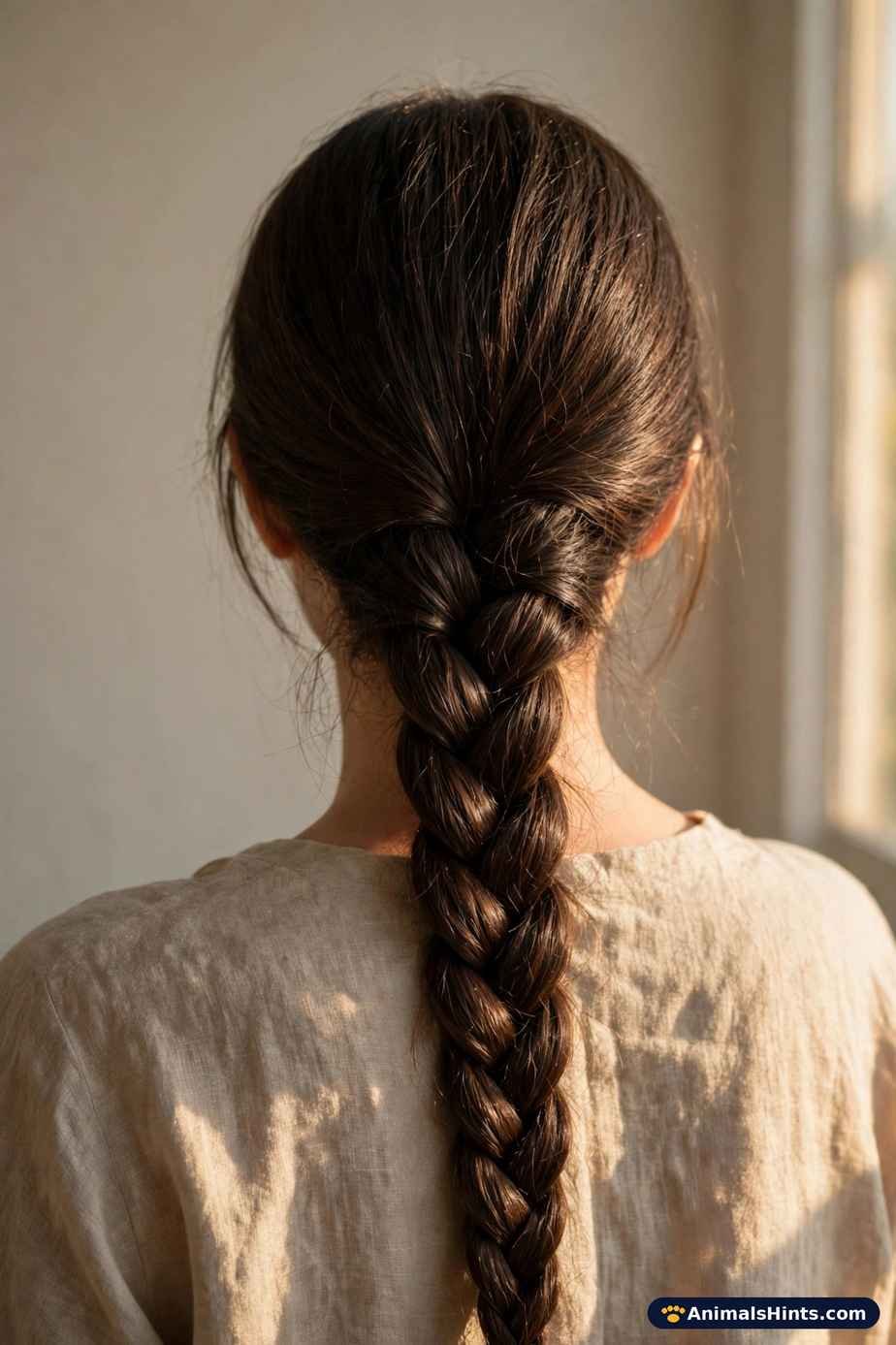
In the modern spiritual reading, the braid’s first meaning is interconnection. Three separate strands, none of them strong in the way the finished plait is strong, are woven into a single cord — and the reading takes that structure as a picture of how a life is held together: the physical self and the spiritual self, the person and their people, the present moment and the ancestors behind it. Unity, in this account, is not something the braid merely decorates. It is something the braid demonstrates, every time it is made.
The same tradition treats hair itself as charged material — an extension of the person that keeps growing after the rest of the body’s visible self has stopped changing, and so a natural carrier for ideas about vitality and the soul. Braiding such material, slowly and by hand, becomes in this reading a deliberate act: attention gathered, intention set into each crossing, the mind settling into the rhythm of the work. His page calls the result a form of alignment — the wearer composed on the outside in a way that is meant to answer an inner state.
Where the reading is at its strongest, it is describing something social rather than solitary. In many African and Indigenous settings, braiding is done by one pair of hands on another person’s head, over hours, in company. Whatever else that is, it is a bond being maintained in real time — and the modern meanings that grow out of connection, heritage and care are best understood as the spiritual vocabulary laid over that documented human fact. The record section further down separates the layers; this section and the nine that follow give the modern reading in its own terms first.
9 Spiritual Meanings Behind Braided Hair
The list below is the competitor page’s own, carried whole: nine meanings, in his order, under his headings. Each is stated as the tradition that holds it states it, and bounded where the checkable record pushes back — the full audit lives in the census and record sections that follow the Bible section.

1. Spiritual Discipline and Learner Status
His list opens in the East. In the Hindu frame his page describes, neatly bound and braided hair belongs to the student and the disciple: hair kept ordered as a sign that the person is keeping themselves ordered — attention governed, vanity set aside, the mind apprenticed to something larger than its own appetites. The braid, in this reading, is a uniform of humility worn on the head.
The goddesses of the same tradition are brought in as the pattern’s other face: Saraswati and Parvati are pictured in popular devotion with long, carefully dressed hair, beauty held under wisdom’s control rather than displayed for its own sake. Read together, the two images make one claim — that discipline and beauty are not opposites, and that the braid is where they are shown reconciled. The claim is carried here as his tradition’s account; depictions of the goddesses vary widely by artist and region, and the older ascetic record of India also honours the opposite arrangement, the matted lock left entirely alone, which the record section notes.
2. Beauty and Femininity
The second meaning is the oldest association on the list: braids as beauty deliberately made. His page ranges it across ancient Egypt, Africa and Europe — the plait as a woman’s craft and signature, a way of presenting identity and pride that could be read at a glance. The spiritual layer his tradition adds is that such beauty is not vanity when it is also care: time spent, skill inherited, a head dressed as an act of self-respect.
The African strand of this meaning is the one the documented record supports most fully. Braiding there has long been a gathering as much as a grooming — women working on one another’s hair for hours, with teaching, news and blessing moving through the room alongside the comb. What his page calls the honouring of lineage is, in the historical record, a literal description of how styles and the values inside them were handed down. The record section below sets out that evidence; the meaning itself stands as the tradition’s own framing of a real practice.
3. Protection
Protection is the list’s centre of gravity — it appears here, and again as the ninth meaning, and again in the protection-braid section further down. In the form his page gives it first: hair is treated in African and Caribbean belief as a receiver, something that picks up what surrounds a person, and braiding is the act of closing the receiver down — personal energy gathered in and held, stray influences kept out. Mothers braiding children’s hair with spoken blessing are his tradition’s emblem of the idea.
His page adds a Celtic strand — warriors and priestesses plaiting before battle or rite as a kind of armour — and a Native American one, in which a loosened or cut braid marks mourning and exposure. The Celtic claim stands here at his page’s strength only: no early source for it appears in the record assembled for this article, and the record section says so plainly. The mourning strand belongs to a wider, better-attested pattern in which hair cutting marks grief; it is carried as the tradition’s account, not as a sourced history of any one nation.
4. Connection of Fate and Spirit
A braid is three paths made into one road, and this meaning reads destiny off the geometry: separate threads — a person’s own line, their family’s, their spirit’s — crossing and recrossing until none of them runs alone. His page anchors the idea in the Norse Fates, the Norns, said in the modern telling to plait the destinies of gods and humans into a single design, and in the ceremonies of the present day, where braiding is used to figure marriage, friendship and partnership.
The anchor needs one correction, given in full in the record section: the Norse texts give the Norns thread-work — a woven web of fate, golden threads fastened fast — and lots scored on wood, but never a braid. The image of fate as something woven is genuinely old; the braid specifically is the modern version of it. The meaning survives the correction as a metaphor. It does not survive it as a citation.
5. A Portal to the Heart
The fifth meaning turns from fate to feeling. In this strand of the tradition, hair is said to keep what a person has lived through — an emotional residue held in the strands — and braiding becomes a way of handling that residue deliberately: gathering what is loose, ordering it, setting it down in a form that can be carried. The slow, repetitive motion is compared to meditation, and the comparison is the meaning’s engine: braiding as a heartbeat-paced act that lets the mind and the heart arrive at the same place.
His page extends the idea to the space between two people: to braid another’s hair, or to sit still while yours is braided, is in this reading an exchange of trust in which care passes hand to head without words. That social fact underneath the symbolism — the hours, the closeness, the permission — is documented wherever braiding is communal, and it is the part of this meaning that needs no belief to be true.
6. Manifestation of Intentions
Here the braid becomes an instrument. In the practice his page describes, an intention is held in mind while the hair is worked — a wish for love, clarity, abundance or protection assigned to the crossings as they are made, so that the finished plait holds the intention the way a knot in a cord holds a reminder. The rhythm of the work is said to anchor the wish in the physical world, and the braid then carries it through the day.
The practice is located by his page in modern Pagan and Wiccan ritual, where hair work accompanies moon ceremonies and spellwork, and a further claim reaches back to ancient Egypt, where women are said to have braided while reciting blessings for fertility and prosperity. The modern practice stands as described, attributed to its practitioners. The Egyptian sentence stands as his page’s claim: the record assembled here documents Egyptian-era braiding in the Nile valley in plenty, but no fetched source ties it to spoken blessing at the braid, and the article does not upgrade it.
7. Symbolism in Mythology
His mythology shelf gathers the divine heads: Athena and Aphrodite in Greek art, their dressed and plaited hair read as wisdom and allure in a single image; Parvati in Hindu telling, her hair compared to the sacred rivers; and above all Sif, the Norse goddess whose golden hair Loki cut away in the night and whose replacement hair, forged by dwarves, restored the world’s balance in his page’s telling.
Two of these need the record’s footnote, supplied in full below. The Greek goddesses’ elaborate hair is a fact of their iconography, though the symbolism read into it is the modern layer. Sif’s story, in the actual text of the Prose Edda, is about hair of gold that grew like living hair — the myth’s wonder is the material, and no braid appears in it at all; the woven retelling, braids included, is later embroidery. What mythology genuinely documents is hair as power, wealth and identity among the gods. The braid enters as the modern reader’s favourite form of that hair, not the myths’ own.
8. Expression of Inner Character vs. Outer Vanity
This is the one meaning on the list with a text underneath it, and the text is quoted word-exact in the census section that follows the Bible section. His page reads 1 Peter 3:3–4 as the tradition’s balancing point: the apostle sets elaborate hair and gold on one side of the scale and “the hidden man of the heart” — a meek and quiet spirit — on the other, and the passage’s weight falls on the second. The braid, in this reading, is not condemned; it is relativised. Adornment kept in its place becomes humility and order; adornment promoted to a person’s whole presentation becomes the vanity the text warns against.
His page adds the historical echo: centuries of devout women keeping hair simple, covered or plainly dressed as a sign of where their treasure was understood to sit, set against braiding done carefully before prayer as an act of dignity rather than display. Both postures claim the same verse, which is itself the honest summary of this meaning — the text governs the intention, and says nothing that settles the hairstyle.
9. Warding Off Negative Influences
The list closes where its third entry began, with protection — here in its most combative form. In the Yoruba and wider West African framing his page reports, unbound hair is open hair: receptive, exposed, available to whatever passes. Braiding, especially with oils, herbs or prayer worked into it, is the closing of that openness — a woven barrier maintained on the head. In the Native American framing he adds, the tightly kept braid holds the wearer’s energy centred and unbroken, an aura kept in repair.
A healing version follows in his account: after cleansing rituals, a person who feels drained or exposed re-braids as an act of renewal, boundaries redrawn strand by strand. Carried here as the tradition’s teaching, with the same note as at the third meaning — the two entries are one belief stated twice, once as keeping harm out and once as keeping self in, and his list’s structure is preserved rather than tidied.
What Does Braided Hair Symbolize in the Bible?
His page’s Bible section is more careful than most of the genre, and its care deserves stating before its overreach. Hair in the Bible, it says, is bound up with glory, devotion and obedience — which the wider record supports, as the census section shows — while braiding itself is discussed only in passing. The passage it puts at the centre is Paul’s, quoted here in the King James wording his own link points toward:
“In like manner also, that women adorn themselves in modest apparel, with shamefacedness and sobriety; not with broided hair, or gold, or pearls, or costly array;” (1 Timothy 2:9)
His reading of the verse is the mainstream one: the target is not the plait but the display — the elaborate, jewel-loaded hairstyles of wealthy first-century women, worn as a announcement of status in the assembly — and the verse’s positive term is modesty, not bare hair. Where his page then goes further is in drawing a symbolism out of the text: braided hair in the Bible, it proposes, can stand for discipline, order and devotion, the organising of loose strands mirroring faith organising a life. That is an interpretation laid over the passage, and it is labelled as one here, because the passage itself assigns the braid no meaning at all. What the Bible’s braiding texts actually say, all of them, is counted next.
Broided and Plaiting: The Only Two Braiding Words in the Bible
For this article the King James text was counted again from the beginning, every form of the braid family included, and the result fits in one sentence: the Bible contains exactly two braiding words, each used exactly once. The modern spellings are absent altogether — “braid” 0 times, “braided” 0, “braids” 0, “braiding” 0. The King James translators reached for the period’s own words instead: “broided”, once, and “plaiting”, once. The count’s controls reproduce this run’s standing record exactly (white 75, blue 50, purple 48, grey 1, red 53, glass 9, nail 8), and the surrounding hair vocabulary is counted with it: “hair” 64 times, “hairs” 15, “locks” 15.
The first of the two texts is Paul’s, quoted in the section above: “not with broided hair, or gold, or pearls, or costly array” (1 Timothy 2:9). The second is Peter’s:
“Whose adorning let it not be that outward adorning of plaiting the hair, and of wearing of gold, or of putting on of apparel; But let it be the hidden man of the heart, in that which is not corruptible, even the ornament of a meek and quiet spirit, which is in the sight of God of great price.” (1 Peter 3:3–4)
Read side by side, the two verses share one structure, and it is not a symbolism. Each sets braided hair inside a shopping list of expensive presentation — gold, pearls, costly clothing, fine apparel — and each then pivots to the inward alternative: sobriety and good works in Paul, the hidden person of the heart in Peter. The braid appears in these texts the way a price tag would: as the visible sign of money and effort spent on being looked at. Neither writer pauses over what a plait might mean. The subject is what adornment costs and what it advertises, and the braid is evidence, not emblem.
One further text completes the file. Isaiah’s judgment on the finery of Jerusalem’s women promises that “instead of well set hair baldness” shall come (Isaiah 3:24) — carefully dressed hair again, and again as pride’s exhibit in a list of luxuries about to be stripped away. Styled hair in the Bible’s courtroom is a symptom of the same condition in all three passages. Set against them, the book’s genuinely warm hair texts are about hair itself, never about plaits: a woman’s long hair is “a glory to her: for her hair is given her for a covering” (1 Corinthians 11:15); the Nazirite under his vow “shall let the locks of the hair of his head grow” (Numbers 6:5) — locks, the King James word throughout, Samson’s famous seven included. Some modern translations render those locks as braids. The King James text this run counts does not, and no verse in it interprets a braid as a sign of anything. That closes the Bible’s entire file on braiding: two instructions about adornment, honestly labelled, and silence where a symbolism would have to be.
Cultural and Religious Importance of Braided Hairstyles
His page’s cultural survey moves across the same map as the meanings list, and is carried here in its own terms. In ancient Egypt, it says, intricate braids belonged to nobility and carried protection with them. In African societies, braided styles were and are a written language of the head — ancestry, age, tribe and standing legible in the pattern. In Native American traditions, long hair is sacred and braiding it is a way of tending the energy it carries, binding thought and intention into order. In Christianity, braiding is no ritual, but his page reads it as inner discipline made visible — orderliness and respect, its moral colour set by the intention behind it. In Hindu practice, the braid after prayer figures a calmed and centred mind, spiritual energy brought under governance.

Each of those strands is the tradition’s own account of itself, and they are not all the same kind of statement. The African strand describes a social system that historians have documented in detail. The Egyptian strand mixes a real material record — braided hair and wigs survive from the Nile valley in quantity — with a protective meaning the artefacts cannot speak for. The survey is best read the way it is organised here: as the map of what braiding has been said to mean, culture by culture, before the next section lays out what of that map the evidence can actually carry.
Five Thousand Years of Braids: What the Record Actually Documents
The documented history begins earlier than any of the meanings. Depictions of women wearing what appear to be cornrows survive in Stone Age paintings on the Tassili Plateau of the Sahara, dated as far back as 3000 BC; similar braided styles appear in depictions of the Cushitic peoples of the Horn of Africa from around 2000 BC; the remains of a young girl buried in Nubia wearing cornrows are dated to AD 550–750; and braided styles are documented in the Nok civilisation of Nigeria, the Mende of Sierra Leone and the Dan of Côte d’Ivoire. Braiding is not a recent fashion with a symbolism pasted on. It is one of the oldest continuously practised crafts on the human head.
What the historical record shows braids doing, above all, is carrying information. Across African societies, hairstyle expressed religion, kinship, status, age and identity, and the act of braiding was itself a social ritual — values passed between generations in the hours the work took, bonds between friends maintained strand by strand. The styles had names: in Yoruba, cornrows are kolese or irun didi, the didi braids of the Nigerian diaspora. Among the Himba of Namibia the code is still worn literally: from puberty a boy keeps one braided plait while girls wear many plaits worked with otjize — a paste of butterfat and ochre that protects skin and hair from the dry climate and gives the plaits their red cast — some arranged to veil the face; a woman married a year or a mother wears the Erembe headdress, sheepskin sculpted over streams of braided hair. In Ethiopia, braided shuruba styles were worn by warriors and kings — Tewodros II and Yohannes IV are depicted in them. In Rome, the Vestal Virgins’ ritual hairstyle, the seni crenes, incorporated two braids resembling cornrows. In the Americas the style took its English name from the crop rows of corn and cane fields, and the famous stories of cornrows carrying escape maps through slavery are carried by the reference record itself as folklore — retold, cherished, and not documented as fact.
The myth shelf audits shorter. The Norns of Norse tradition do work fate with their hands, but the texts are specific about the tools: in Völuspá the three maidens score on wood, lay down laws and allot life; in Helgakviða Hundingsbana they weave a web of fate and fasten golden threads. Thread, web and scoring — never a braid; the plaiting Fates are a modern improvement on the sources. Sif’s case is the same shape: in Skáldskaparmál, Loki cuts off all her hair for mischief’s sake, and the sons of Ívaldi forge her hair of gold that would grow like other hair. The wonder of the story is living gold, not plaiting, and the beloved reading of her hair as a wheatfield is later scholarship — Grimm himself was sceptical of it. And the Celtic warriors said to braid before battle, a staple of the genre’s lists, appear in no primary source fetched for this article; the claim stands as the modern pages’ own, neither confirmed nor documented here. What the record documents is not smaller than the mythology — a five-thousand-year language of identity, worn daily — but it is different in kind: braids spoke about who a person was. They were not read as messages about what would happen to them.
White Braided Hair Spiritual Meaning
White hair braided is, in his page’s reading, the list’s elder: wisdom, purity and spiritual maturity woven together, a whole life’s lessons plaited into visible form. The white itself does the first half of the work — the colour of light, of surrender, of the cycle accepted rather than fought — and the braiding does the second, gathering that whiteness into order instead of letting it scatter. Ancestral energy is the strand his tradition adds: the white braid as a visible link to the forebears, their experience carried forward on a descendant’s head.
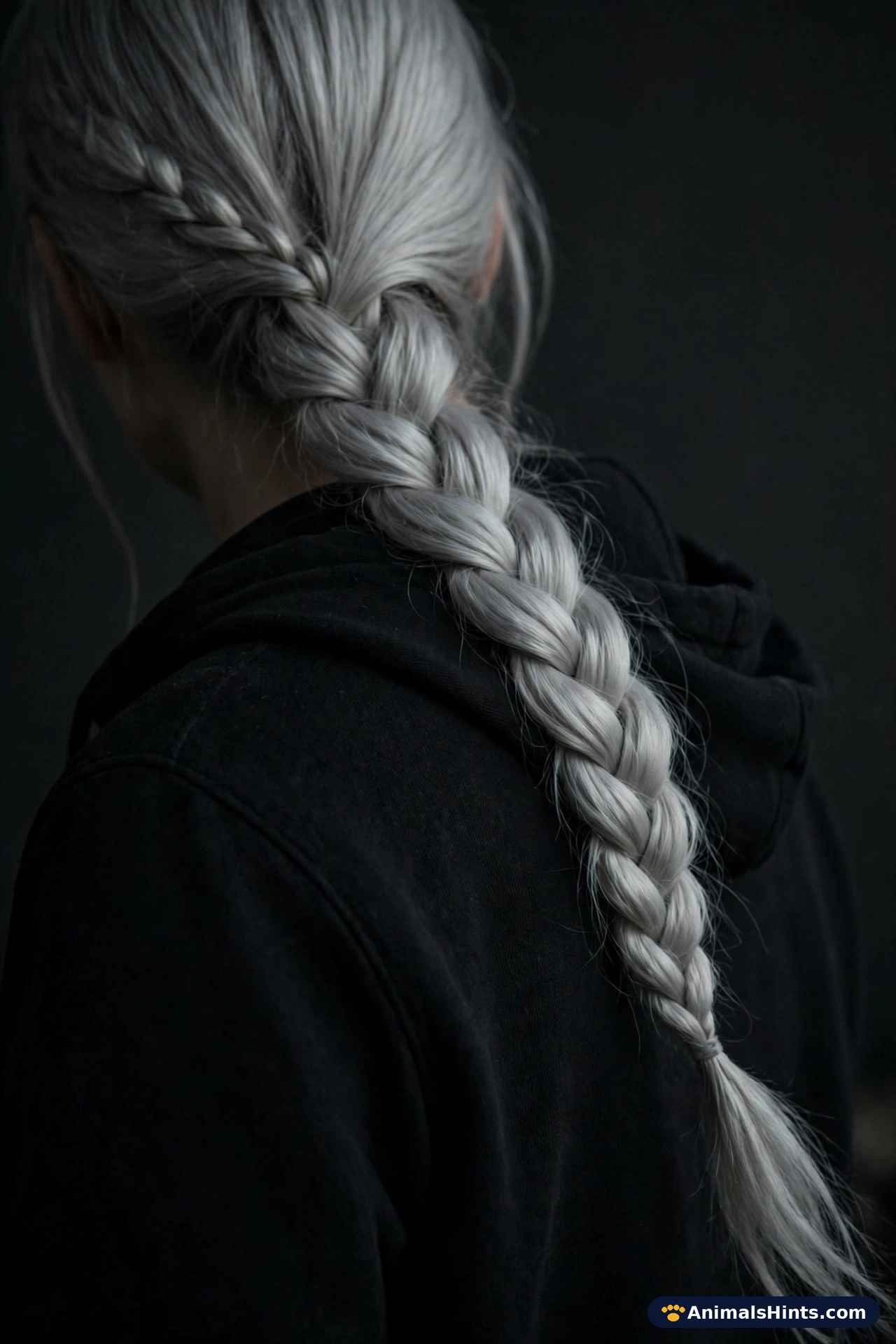
For the older wearer, his page frames the act itself as self-honour — strength in stillness, a journey embraced with grace rather than dyed back into disguise. The colour boundary here is the one this run’s own colour file patrols: between white and the silver that shades into grey spiritual meaning there is no clean line, and the two files share the border deliberately. And a white braid is a head full of white hair arranged — a different subject from the single startling strand of the single long white hair spiritual meaning, where one follicle’s change is read on its own. Carried as the tradition’s reading throughout: the dignity of white hair in old age has one genuinely ancient root — the Bible’s honour of the grey head — and it belongs to the hair, not to the plait, as the census section sets out.
Black Braided Hair Spiritual Meaning
Black braids carry, in his page’s account, the weight of the African and Afro-diasporic traditions that kept braiding at the centre of life. The colour is read as power and mystery — the fertile darkness creation comes from — and the form as grounding: negative energy absorbed by the dark hue, inner strength and ancestral wisdom bound in by the plaits. Armour and art at once is his summary phrase for it, resilience worn as beauty.
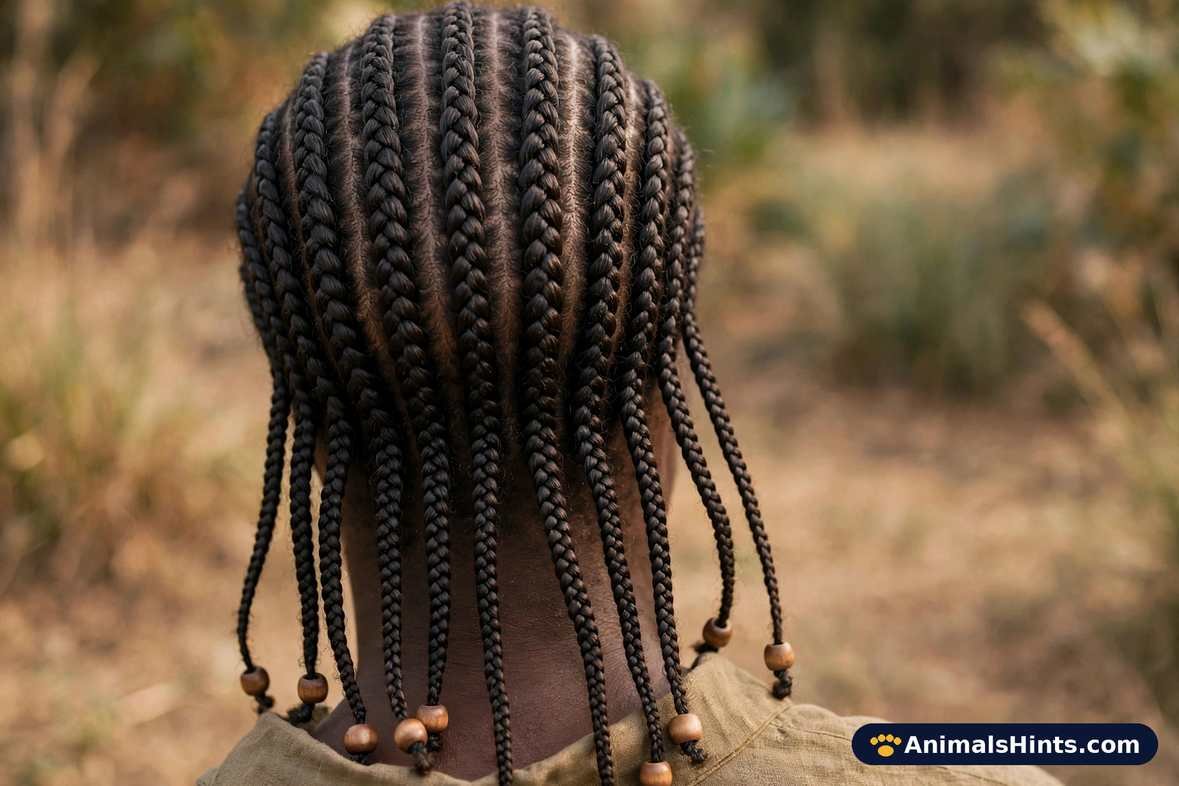
Of all the colour readings on his page, this is the one whose second half the documented record carries without help. That braided hair honours heritage and identity — that it is a living expression of culture carrying stories, struggles and triumphs — is not a mystical claim but the historians’ own summary of what the styles did across Africa and the diaspora, set out in the record section above. The protective half of the reading belongs to the tradition; the heritage half is history. His page sets the colour against the black spiritual meaning file’s wider field, and the link is planted there for readers who want the colour’s whole shelf.
Protection Braid in Hair Spiritual Meaning
The protection braid gets a section of its own on his page, and its distinct claim is intention made explicit: this is a braid worn on purpose, with prayer, as a shield. The three strands are read as the wearer’s threefold self — body, mind and spirit — bound into a single cord for strength, and patterns, charms or colours may be added to aim the protection. The emblematic scene is again the mother’s hands — in African and Caribbean practice, children braided in with blessings spoken over them, the hairstyle doubling as a covering in the older sense of the word: something placed over a person to keep them.
His page reaches for a biblical alignment, and it is worth handling exactly. The psalm he cites promises, “He shall cover thee with his feathers, and under his wings shalt thou trust” (Psalm 91:4) — a real verse, quoted word-exact, and its subject is trust in God’s protection, pictured as a bird sheltering young under its wings. No braid, hair or hairstyle appears anywhere in the psalm. The alignment is his page’s analogy — a braid as a small human covering echoing a large divine one — and it is printed here as an analogy, which is all the text allows. The braid-as-shield belief itself stands as the tradition’s, documented wherever the practice is described; the verse lends it a picture, not a proof.
Spiritual Meaning of Braiding Hair in Dream
The dream shelf of his page reads the act by its stage. To braid your own hair inside a dream is, in this tradition, a picture of ordering: thoughts and emotions being gathered, loose ends tied, patience being practised on something that cannot be hurried. To have your hair braided by someone else reverses the flow — trust, care, or another’s influence being allowed to shape you. A braid tangled or coming undone in the dream is the same system running in alarm: disorganisation, imbalance, a call to realign.
Hair in dreams, his page concludes, figures identity and vitality, and braided hair in dreams figures those things unified — purpose gathered, protection in place, readiness for a beginning. All of it is carried here as the dream tradition’s own symbolism, which is the only status it has: this run’s standing rule for dream topics is that the readings are the tradition’s, printed as such, with no prediction drawn from them and no test of them claimed — none exists. What a dream of braiding most plainly pictures is the thing itself, a mind rehearsing the gathering of loose strands into order, and the tradition and the plain picture are not as far apart as they look.
Is Braiding Hair Considered a Sin in the Bible?
His page asks the question directly and answers it no, and on this the mainstream reading of the texts stands with him — including the evangelical reference his own page cites, which reaches the same conclusion from the same verses. The reasoning, in order: the two passages that name braided hair name it inside lists of costly display, in assemblies where elaborate, jewel-worked hairstyles announced wealth; the apostolic writers’ stated concern is pride and extravagance, not plaiting; and the counter-principle both passages set against display is the state of the heart — the principle his page quotes from Samuel’s anointing: “man looketh on the outward appearance, but the LORD looketh on the heart” (1 Samuel 16:7).
So the sin question, answered at the texts’ own strength: braiding is not condemned anywhere in the Bible; display is warned against in the two places braiding is mentioned; and the same braid can sit on either side of that line depending on what it is for. His page’s closing formulation — that braiding done for care, connection or culture carries no sin, and that humility, not the hairstyle, is what the texts judge — fairly summarises the mainstream position, and it is one of the places where the genre page and the checkable record simply agree.
Is a Braid a Sign? An Honest Reading
Everything above now permits a plain verdict. The nine meanings are a modern synthesis, and their ingredients are of three different ages. Some are documented practice wearing spiritual vocabulary: braiding really is communal, patient, skilled work that has carried identity and teaching for millennia, and the meanings of connection, heritage and care grow straight out of that record. Some are real texts read past their edges: the Bible’s two braiding verses genuinely exist, and genuinely concern adornment and the heart — they become a symbolism of braids only when a reader supplies the symbolism. And some are free invention in old costume: Fates who braid, goddesses restored by braids, warriors plaiting for battle, none of it in the sources the claims lean on.
The pattern this run applies to every permanent feature applies here too. A braid is not an event. It does not arrive unbidden like a dream or a twitch; it is made, chosen and worn, which is why the honest categories for it are the social ones — craft, identity, occasion, intention — and why the nearest neighbour on this shelf, the mallen streak spiritual meaning, draws the same line around a feature the Bible likewise never reads. None of that makes a braid meaningless. It makes its meanings the kind people give things they make: real in the way a wedding ring’s meaning is real, carried by agreement and memory rather than delivered by omen. Braiding someone’s hair with care is a documented human good. The record simply declines to call it a message.
Braiding Without Damage: Tension, Time and the Edges
The practical record is shorter than the symbolic one and entirely checkable. Braiding takes time — cornrows can take up to five hours depending on their number and width — and a finished set can be left in for weeks when the scalp is washed carefully and oiled, which is the maintenance pattern the reference record describes. The same record carries the style’s one documented injury: braids pulled too tightly, or worn for too long, can cause traction alopecia, a form of hair loss driven by sustained tension on the follicle — the finding carried by the BBC’s reporting on braiding and hair loss and stated in the reference summaries of the style itself.
The working fences follow from the mechanism. A braid that hurts, raises bumps at the hairline or cannot be forgotten about is too tight, and the edges — the fine hair at the temples and forehead — bear the tension first and worst. Styles need removal on schedule rather than endurance records, and the hair and scalp need unbraided intervals between sets. Thinning that starts at the hairline or temples in a regular braid wearer is the pattern the record names; it belongs in front of a doctor or dermatologist, not in a meanings list. None of this argues against braiding — five thousand years of wearers are their own testimony — it argues for the same thing the tradition itself prizes: patience, and hands that know when to stop pulling.
Final Thoughts
A braid is never only a hairstyle, and on that much his page and the record are in full agreement — they part company only on what the “more” consists of. For the modern spiritual reading, the braid is a woven sermon: unity, protection, intention and fate plaited into a cord a person can carry. For the documents, it is something older and in its way more remarkable — one of humanity’s longest-running languages, spoken on the head, in which age, status, kinship, faith and belonging have been written and read for some five thousand years.
The Bible’s small part in the story can now be stated without inflation in either direction. It mentions braiding twice, both times to warn against costly display and to point at the heart; it honours hair itself as glory and covering; and it reads no braid as a sign. The myths, audited, give hair the starring role and braids none. What is left when the embroidery is set aside is not a poorer subject but a truer one: a craft of patience and company, in which care is literally worked into another person’s head by hand.
So when you next sit down to a braid — your own hands in your hair, or the settled hours while someone else’s hands do the work — the meanings are yours to bring — the tradition collected above will happily supply them. The oldest documented braid family of all, cornrows, was already carrying identity in its rows when the Sahara was being painted, and it never needed to be an omen to matter. A braid means what five thousand years of hands have meant by it: I am somebody, I belong to somebody, and somebody took the time.
FAQs
What does braided hair mean spiritually?
In the modern spiritual reading, braided hair means unity and connection first — separate strands woven into one strength — and, across the full list, protection, discipline, beauty, fate and care. Those meanings belong to the modern tradition and are attributed to it throughout this article; the older records give braiding a social meaning (identity, status, belonging) rather than a spiritual code.
What does the Bible say about braided hair?
It mentions braiding exactly twice. Paul lists “broided hair” among costly adornments to avoid in favour of modesty (1 Timothy 2:9), and Peter lists “plaiting the hair” among outward adornments set against “the hidden man of the heart” (1 Peter 3:3–4). Both passages are about display and the heart, not about the hairstyle as a symbol.
What are the different biblical meanings of braided hair?
Strictly, the Bible assigns braided hair no set of meanings. Its two mentions share a single frame — braided hair as part of expensive, attention-seeking adornment, contrasted with inner character — and Isaiah adds carefully dressed hair (“well set hair”, Isaiah 3:24) to a judgment list of finery. The varied meanings in circulation come from the modern tradition reading those passages outward, not from the passages themselves.
How can I apply the spiritual meaning of braided hair to my life?
The application his page offers is the unity picture: notice what in your life is separate strands — work, family, faith, rest — and ask what weaving them together, rather than running them in parallel, would look like in practice this week. Add the record’s own application, which needs no symbolism at all: braiding is slow, skilled, communal work, and making time for it is the meaning in action.