Yellow Ladybug Spiritual Meaning: Joy, Clarity and the Beetles That Really Wear Yellow
Most people who look up the yellow ladybug meaning are trying to put a name to something they have just photographed: a small beetle, yellow as a lemon drop, parked on a leaf in the sun. Symbolism sites answer with the sunniest entry in the whole ladybird catalogue — joy, optimism, a head clearing — and the full set of twelve readings is reproduced further down, complete and in order. But a photograph raises a prior question those sites seldom pause over. Which yellow insect, exactly, was in front of the camera?
It matters, because “yellow ladybug” covers several different animals. Three ladybird species hold the colour permanently: a mildew-eating beetle patterned with twenty-two black spots, a chequered aphid-hunter that can shade from cream almost to black, and a beige speck of a beetle that spends winter packed into fence-post cracks by the hundred. Every other ladybird wears yellow too, but only briefly — each newly emerged adult of the familiar red and orange species starts life soft, spotless and yellow, and keeps the colour for a matter of hours. North America adds a fifth candidate that is not a ladybird in any sense: a yellow-green leaf beetle with a black head and twelve spots, resident on cucumber vines.
This article keeps those two topics — the symbol and the animals — in separate compartments from start to finish. The symbolism gets its say first. Then the beetles get theirs. Then the twelve meanings are worked through one by one, with a note at each step saying how old the idea is: some of it rests on a European custom centuries deep, and most of it was written within living memory by the symbolism sites themselves.
What Does Seeing a Yellow Ladybug Symbolize?
Modern colour symbolism gives yellow the brightest brief on the spectrum. It is the shade these writers reach for when they mean sunlight, good spirits, clear thinking and self-confidence — the colour of a morning when everything feels possible. A ladybird, in the same writers’ hands, is a small authorised bearer of luck. Set the two side by side and the resulting symbol needs little assembly: cheerful news, mentally delivered.
One part of the competitor’s account deserves to be singled out, because so much of his interpretation hangs on it. He assigns yellow to the solar plexus chakra, presented as the body’s seat of confidence and personal power, and treats the beetle as a reminder to occupy that power. Whatever a reader makes of chakra schemes, they are no part of this insect’s documented past. Nothing in the older record ties any beetle to any chakra; the connection was drawn by contemporary writers, and it is labelled as contemporary wherever it surfaces on this page.
Below the colour, and far older than it, sits the family’s reputation. Rural Europe looked after its ladybirds for century after century: the insects were welcomed indoors and on the crops, a landing was counted a stroke of fortune, and killing one was how you invited the opposite. Yellow takes that reputation over unchanged, which is why the readings attached to this colour run to encouragement and reassurance, never to threat. The colour’s symbolism in its own right is treated fully on another page of this site, under yellow spiritual meaning. The concern here is narrower: what yellow means when a ladybird — or something easily mistaken for one — is wearing it.
What Is a Yellow Ladybug, Really?
Ask a room of gardeners to picture a ladybird and they will picture red. Yet red is only the family’s public face. Away from the famous species, a whole quieter half of the Coccinellidae goes about in yellow, cream and beige, most of them small enough to escape notice entirely. The Wildlife Trusts, describing the 14-spot, calls it one of just three yellow ladybirds found in the UK; those three account for most genuine yellow sightings in Europe. Two further explanations — a brief life stage, and an unrelated beetle — account for most of the rest, worldwide.
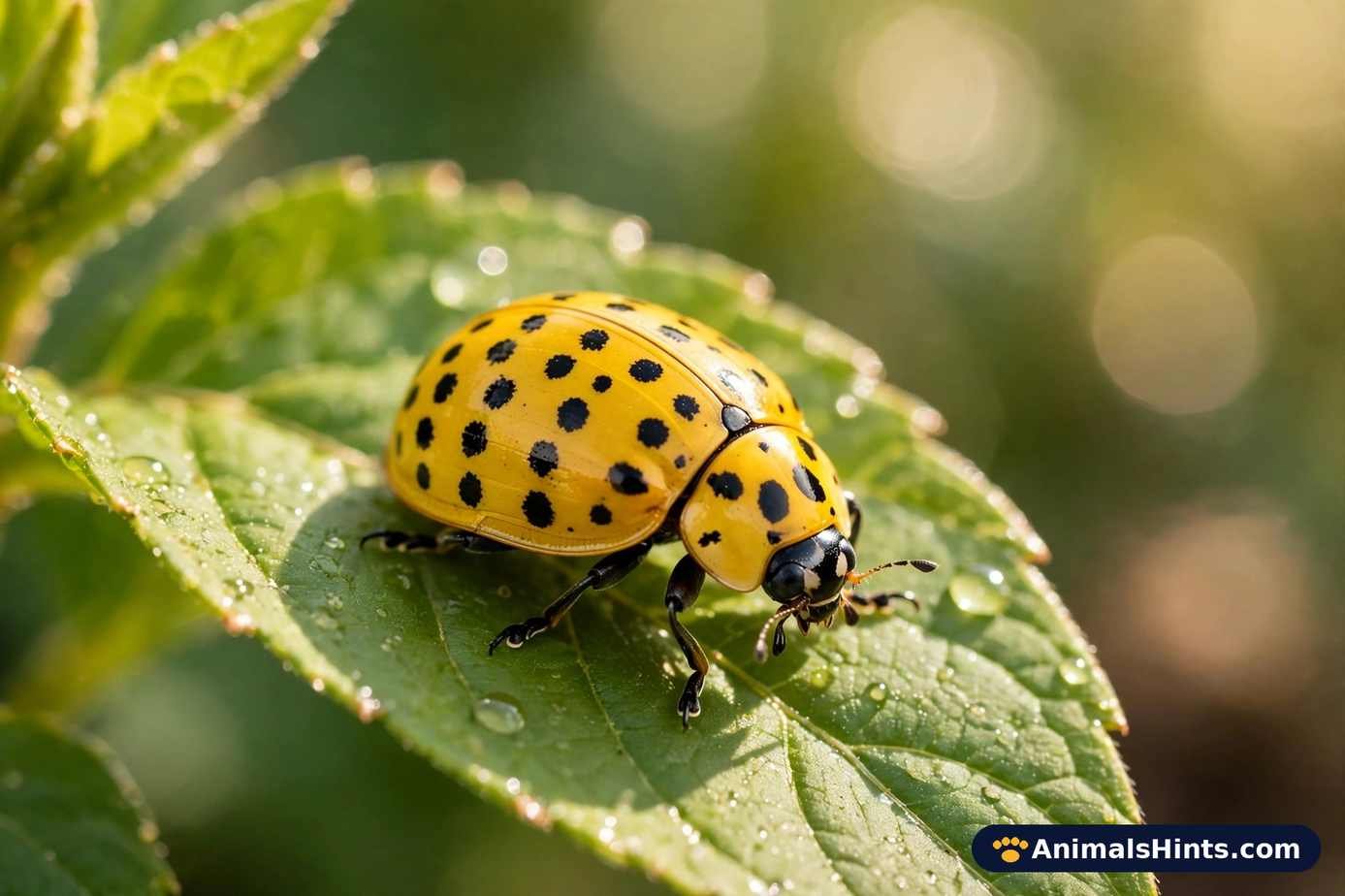
The 22-spot ladybird (Psyllobora vigintiduopunctata) is the one that matches the postcards. It is 3 to 5 mm long, a saturated lemon yellow, and it carries twenty-two round black spots on its wing cases — a count it keeps with a fidelity unusual in this variable family, most individuals showing exactly twenty-two. Behind its head, the pronotum is yellow or white with five black spots. It kills nothing at all. Its food, from first larva to last adult, is powdery mildew: the pale fungal dusting that spreads over hogweed, oak leaves and low shrubs, grazed off the surface hour by hour. Europe is its home, and in England and Wales it is a frequent insect of low vegetation wherever mildew gathers. It also breaks a family habit in a way that helps anyone trying to identify it: its young look like its adults. Larva and pupa are both yellow with black spots, so the species wears one livery from cradle to grave — a courtesy almost no other ladybird extends. (North America has a close relative, the twenty-spotted Psyllobora, which dresses in cream verging on pale yellow and grazes the same mildew; on this site it is treated under the white ladybird, the colour it usually resembles more.)
The 14-spot ladybird (Propylea quatuordecimpunctata) is the family’s great improviser. Adults run 3.5 to 4.5 mm, and the background colour is never red: it ranges from cream through clear yellow to light orange. Fourteen black spots sit on that background, squarish rather than round, and in most individuals several of them merge — into chequered blocks, or into an anchor-shaped mark along the midline. Push the merging to its limit and the beetle turns effectively black with pale spots, the negative of its usual self. More than a hundred distinct colour forms are on record, enough that early naturalists described some as separate species. It earns its living the conventional ladybird way, hunting aphids, and it is common across Europe. It has also colonised a second continent: brought to North America in the 1960s, it is now established through the north-eastern United States and into Canada. Squared-off black markings that look half-melted into one another, on a yellow ground, name this species.
The 16-spot ladybird (Tytthaspis sedecimpunctata), the third of the trio, is the palest and the smallest: about 3 mm, typically cream or beige with a yellow cast, a dark stripe running down the centre seam of its back, and flank spots that often run together into short lines. It eats a mixed diet — mildew and rust fungi, pollen, and tiny prey such as mites and thrips — gathered in grassland, on dunes and in dry meadows across Europe and Asia. Gardeners are likeliest to meet it in winter, because of a habit it performs at a scale its relatives do not: it overwinters in aggregations, sometimes hundreds of beetles wedged together into cracks in fence posts, gaps in bark and similar shelter. A January fence post upholstered in tiny cream beetles is not an infestation. It is this species, asleep in company.
The fourth explanation is a stage every ladybird passes through, whatever its adult colour. Emergence from the pupa leaves the new beetle soft, pale yellow and wholly unspotted. Pigment is part of the hardening process: as the wing cases cure over the next hours, the pattern ghosts in and the ground colour deepens, until a red species is red and an orange one orange. During that window — a few hours of one morning — the commonest ladybird in any garden is, strictly, a yellow ladybug. A good share of the world’s yellow ladybug photographs are seven-spots and two-spots taken during that window by people who quite reasonably named what they saw, a few hours before the beetle finished becoming what it was.
The fifth explanation is an impostor from a different family. The spotted cucumber beetle, known to science as Diabrotica undecimpunctata, belongs to the leaf beetles, Chrysomelidae — cousins of the ladybirds only in the sense that both are beetles. It is about 6 mm long, noticeably elongated, yellow-green in colour, with a black head and twelve black spots on its back. North American gardeners know it as a pest of the cucumber family: adults chew leaves and blossoms of cucumber, squash and melon, the larvae (the southern corn rootworm of farming literature) feed on roots below ground, and the adults shuttle the bacterium behind cucurbit wilt from vine to vine. Its antennae are long and thread-like where a ladybird’s are short. On a North American squash leaf, a yellow beetle with spots is this insect until the evidence promotes it.
| Beetle | Colour to look for | Where you are most likely to meet it |
|---|---|---|
| 22-spot ladybird (a true ladybird) | Lemon yellow, 22 round black spots, usually exactly 22; tiny, 3–5 mm | Low vegetation across Europe, grazing powdery mildew on hogweed, oak and shrubs |
| 14-spot ladybird (a true ladybird) | Cream to yellow to light orange, 14 squarish black spots usually fused into a chequer or anchor pattern; 3.5–4.5 mm | Gardens and grassland across Europe and north-eastern North America, hunting aphids |
| 16-spot ladybird (a true ladybird) | Cream to beige-yellow, dark line down the centre seam, spots often fused into side lines; about 3 mm | Grassland, dunes and dry meadows in Europe and Asia; winter crowds on fence posts and trunks |
| A ladybird in its first hours (any red or orange species) | Pale yellow, soft and completely spotless | Beside its empty pupa case on a leaf, colour and spots arriving within hours |
| Spotted cucumber beetle (a leaf beetle, NOT a ladybird) | Yellow-green, black head, exactly 12 black spots; longer body, about 6 mm, long antennae | Cucumber, squash and melon vines across North America |

One lesson falls out of the table: colour is the weakest clue on it. Round spots against squared ones, a mildew patch against an aphid colony against a cucumber vine, a dome against an elongated oval, a finished insect against one still hardening — each of those separates the candidates more reliably than yellow ever will. The shelf of colour articles this page sits on sorts out the same way. The red ladybug is a true uniform, worn by the family’s best-known species. The brown ladybug is genuine too, the working dress of several tree-dwelling kinds. The green ladybug, checked closely on this site, turned out to be mostly other beetles’ clothing. The white ladybug rests on three species that stay pale all their lives, and the blue ladybug on a single one. Yellow is more fortunate than either: three species hold it permanently, and every ladybird that has ever lived holds it for one morning. The wearers identified, the symbolism can be given its full hearing — as symbolism.
12 Spiritual Meanings of a Yellow Ladybug in the House
Here are the twelve readings, kept in the order the symbolism sites give them, and two health warnings belong at the top. First, age: this list was assembled recently, by web-era writers working from the current vocabulary of colour symbolism, and it circles back to its favourite notions — joy, clarity, self-belief, a lighter mood — under heading after heading. Repetition inside the list says something about the list, not about the insect. Second, the room the heading names: ladybirds do enter houses on purpose, hunting for dry crevices when the cold arrives, and the 16-spot gathers for winter in exactly such places. But a yellow beetle discovered indoors in North America has usually arrived with the groceries, and if its head is black and its back carries twelve spots, it is the cucumber beetle from the table above — a pest sheltering, not a messenger calling.
1. Growth, Positivity, and Transformation
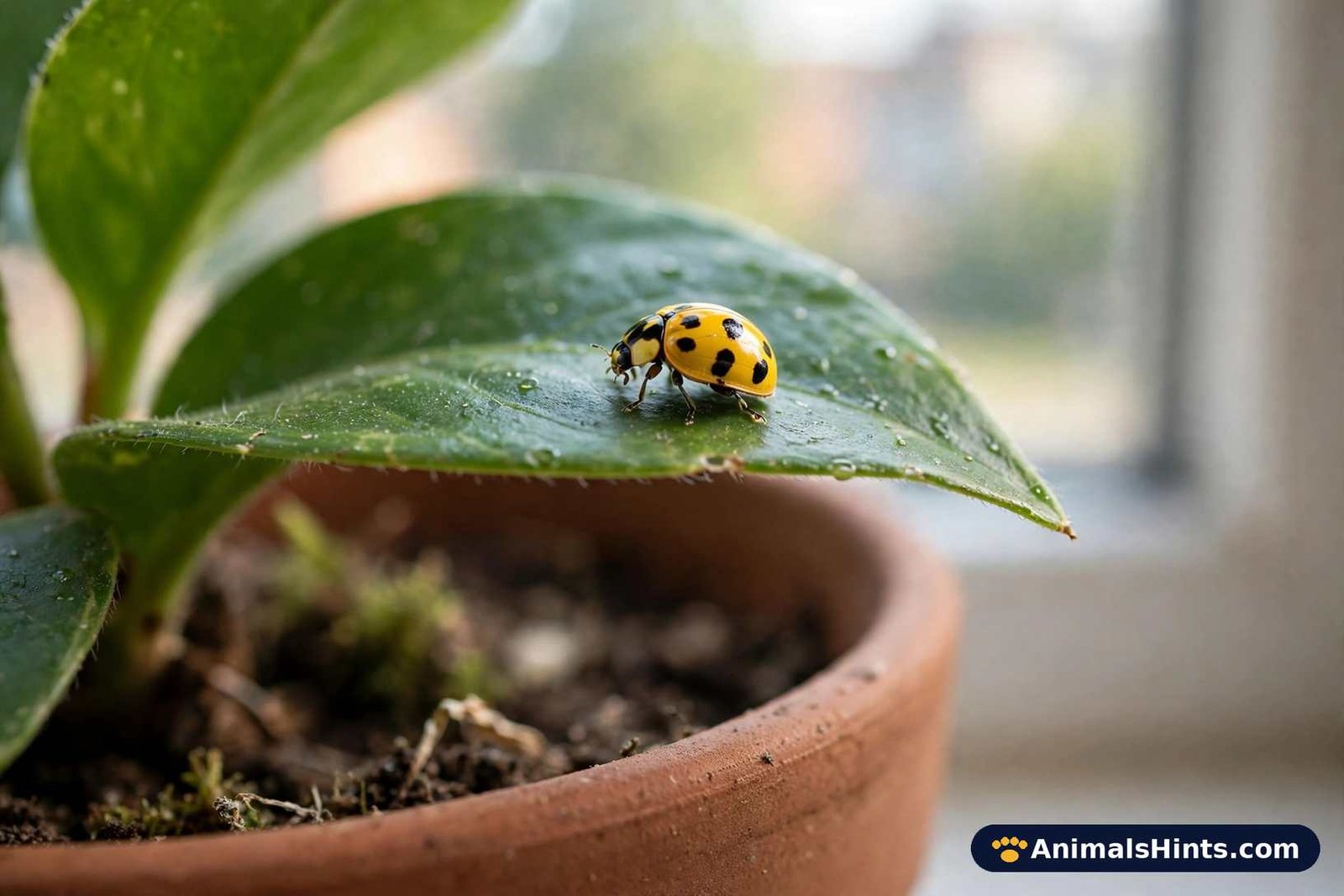
The opening reading leans on the strongest fact available to any ladybird symbolism: the animal really does transform, passing through egg, hunting larva and motionless pupa before it flies. A symbolism of growth built on that life cycle is built on documented ground. The colour contributes the emotional direction — growth imagined as a cheerful process, change met hopefully, small advances celebrated — and that contribution is the modern writers’ own. The life cycle is told in full further down; here it is enough to mark which half of the heading is biology and which half is mood.
2. Authenticity and Self Expression
Next, the genre turns the beetle into advice about identity: shed the disguise that no longer fits, speak and dress and choose as yourself, let yellow stand for the clarity to do it. As symbolism, the idea hangs together; as history, it begins with the websites — no tradition older than the symbolism sites appoints a ladybird the emblem of anyone’s self-expression. The 14-spot, though, offers the reading a curious piece of accidental support. Here is a ladybird that never wears the family red at all, presenting itself in yellow, in more than a hundred patterns, some of them barely alike. A beetle cannot model authenticity. It can only be pointed at, afterwards, by writers — and the pointing is the genre’s work, credited to the genre.
3. Renewal and Joyful Awareness
Where the first meaning rebuilds a life, this one refreshes an outlook: happiness that faded under stress is to be noticed again, moods watched more closely, balance recovered. The vocabulary — awareness, inner weather, lightness — belongs to contemporary writing throughout. Nature, unusually, provides a small working model of the idea. Once in its life, every adult ladybird visibly renews itself: it climbs out of the pupa pale and unfinished, and colours in, spot by spot, over a single morning. Anyone who has watched that happen has watched renewal as a physical process. Turning it into a spiritual one is the genre’s step, and it is labelled as the genre’s.
4. Good Fortune and New Beginnings
This heading stands on the oldest ground in the list. The ladybird’s luck is not a modern invention: it is the residue of centuries in which European farming people protected the insect, welcomed it on crops and clothing, and treated killing one as the surest way to damage your own prospects. Yellow species inherit that standing in full, being ladybirds. What the modern writers add is a narrative — the sighting as confirmation that a fresh chapter is opening, a turning point reached, opportunity on its way. The narrative is theirs. The standing underneath it predates every website by hundreds of years.
5. Inner Strength and Courage
The genre’s argument here runs from size to character: a creature this small, moving this purposefully, must be teaching persistence — strength redefined as carrying on rather than bulk. It is an attractive construction and it should stay in the symbolism column where it was built. The family’s documented record contains no courage emblem; its themes were fortune and protection. What the animals genuinely display is more modest — small predators and grazers working exposed surfaces in a world full of birds, season after season. Any reader who takes heart from that is welcome to it, provided the heart-taking is understood as the reader’s act, not the beetle’s message.
6. Divine Guidance and Protection
Split this heading in two and the halves have different birthdays. Protection is old: it is the folk custom itself, the sheltered insect whose presence on a crop or a sleeve was read as fortune preserved. Guidance, in the form the competitor gives it — unseen support nearby, warmth and clarity as its signature, the whole arrangement wired to a chakra — is new: a recent gloss over an old custom. Both halves are printed here, each with its date showing. Readers who value the second half lose nothing by knowing it is recent; readers checking credentials deserve to know it is recent.
7. Joy, Lightness, and Playful Energy
No heading on the list is more purely a product of the colour chart. Yellow means joy in the modern scheme; therefore the yellow beetle instructs the reader to lighten up, laugh, spread brightness. The older record has nothing to contribute — playfulness appears nowhere in the family’s documented themes of harvests, luck and dedication to Mary. The entry is reproduced because the list is reproduced whole, and it is presented as what it is: a present-day meditation hung on the spectrum’s most cheerful colour. Prompts do not need pedigrees to be timely, but they should not borrow pedigrees they do not have.
8. Emotional Healing and Release
Healing is this colour’s recurring theme, and here it is stated most directly: buried hurts to be released, forgiveness to be attempted, calmer patterns to be built afterwards. The framing is contemporary self-help language from start to finish, and it is filed as such. One member of the cast, though, performs a literal version of the heading’s work every day of its life. The 22-spot eats a blight for a living — powdery mildew, grazed off leaf after leaf until the surface behind it is clean. Nobody is claiming the beetle heals anything but a leaf. It is simply the single point in the list where metaphor and menu coincide.
9. Vitality, Energy, and Forward Motion
Energy, in the genre’s telling, is what the yellow beetle brings: stagnation refused, motivation reclaimed, steps taken. The claim rests on the colour’s assignment in the modern scheme — yellow as life and enthusiasm — reinforced by the animal’s visible industry. The industry, at least, can be verified by anyone with a garden and ten minutes. A 14-spot works an aphid colony stem by stem; a 22-spot covers its daily ration of mildewed leaf; neither species loiters in season. Whether that industry says anything about a human being’s motivation is a further inference, and the inference belongs to the symbolism writers who drew it.
10. Warmth, Clarity, and Enlightened Perspective
Clarity is yellow’s other great assignment in the contemporary scheme — the colour of the thinking mind, of situations seen plainly and decisions made without fog. On the beetle it becomes counsel: overthink less, approach people warmly, trust insight when it arrives. The counsel may be good; its authority is conventional. The link between yellow and clarity is a habit of modern symbolism writing, not a conclusion of any older record, and the vocabulary of enlightenment gathered around it is more recent still. The heading is given in full, with its date — which is all this page asks of any heading.
11. Nurturing and Compassionate Energy
The gentlest reading in the set turns the colour’s warmth into an ethic: rest deliberately, guard your boundaries, extend small kindnesses and let them ripple. It is written entirely in the present-day language of self-care, and none of it descends from the family’s history, which concerned itself with crops and luck. If the heading has any anchor in the record at all, it is a piece of handling etiquette: ladybirds, in the old custom, are to be treated gently or left alone entirely — never brushed off a sleeve, never crushed, moved only by fingertip or leaf-edge. Gentleness toward the beetle is documented. The philosophy of care the genre constructs around it is the genre’s construction.
12. Intellectual Curiosity and Mental Freedom
The list closes by turning clarity toward learning: questions followed, knowledge gathered, doubt loosened as understanding grows. This is the modern layer composing freely — the historical record knows no ladybird of the intellect — and it is printed under that description, as every heading here is. Its one factual ornament happens to be a good one. The 14-spot’s hundred-plus colour forms genuinely did defeat the first naturalists who tried to sort them, and were only untangled by long, patient looking. Curiosity as a method has few better advertisements. Whether a beetle can recommend the method is a claim belonging to the writers, not the beetle.
From Egg to Beetle: The Yellow Hours Behind the Symbol
Since transformation carries two of the twelve meanings, the process itself deserves a plain account — and yellow bookends it. A clutch of eggs opens the story: oval eggs, yellow-orange, standing upright in a tight cluster beneath a leaf, normally within crawling distance of the food the hatchlings will need. The larva that emerges is, in most species, a poor advertisement for its parents — dark, spiny, all appetite, and routinely condemned by gardeners as a pest in the same weeks it is devouring the plants’ worst enemies and growing through a series of skins. The 22-spot is the exception that proves how unusual family resemblance is: its larva is yellow with black spots, its pupa likewise, so that one species spends its entire existence in the same two colours.
Once feeding ends, the larva fixes its tail end against a leaf underside or a stem, and there it pupates. Inside the mottled case, over roughly a week in warm weather, the winged adult is built. When the case splits down the back, what emerges answers the question this article hears most. The beetle is soft. It is pale yellow. It has no spots at all. Colour is not painted on afterwards; it is part of the shell setting. While the wing cases harden, pigment develops through them — markings surface first as shadows, then stand out black, while the ground colour deepens to whatever the species wears. A seven-spot passes from yellow to orange to red across its first hours. A 22-spot, a 14-spot or a 16-spot hardens into yellow and stays there: for them the colour of the first morning is the colour of the whole life.

The working rule follows directly. A pale, unfinished-looking beetle is not a rarity to be announced; it is a youngster to be revisited. Give it a day and it will have completed the identification itself. The species that remain yellow are small, particular and listed in the entomology section above. The one merely travelling through yellow is the most familiar insect in the garden, photographed early.
Yellow Ladybug Symbolism for Love, Relationship and Twin Flame
Love, in the genre’s handling of this colour, is a question of weather rather than intensity. Yellow stands in its scheme for warmth, candour and good humour, so the yellow ladybird is read as commentary on how a relationship feels day to day: for couples, a forecast of lightening — humour returning, talk opening up, old tension set down, reconciliation done patiently. For single readers the same message is aimed ahead — a new chapter emotionally, feelings stated plainly, past fears cleared away before new attachments form. Both are present-day interpretations working inside a present-day scheme, and they are presented inside that frame.
The heading’s third element, twin flames, gets the caution this site prints wherever the term turns up: the concept is recent, propagated by contemporary spiritual writing; no older tradition has been found behind it. Inside the modern frame, the yellow ladybird is made a token of readiness — playfulness recovered after a hard period, two people aligned enough to resume. One genuinely old element does stand near this section, though it concerns conduct rather than romance: the family’s standing instruction never to brush off a settled ladybird. Modern writers borrow that patience and apply it to couples. The patience is in the record. The application is theirs.
Cultural and Religious Significance
The heading promises two subjects, so both are answered directly before anything else. No culture on record built a symbol out of the yellow ladybird specifically, and no religion refers to one. Circumstances were against it: the truly yellow species are small, local creatures that escaped notice for most of history, and the yellow phase of the famous species is over by lunchtime. Two genuine records exist, but they belong to different subjects — one to the ladybird family, one to the colour yellow — and contemporary writers habitually add them together and credit the sum to the yellow beetle. The addition is not done here.
The family’s record is European, and it is devotional in flavour. The insect’s common names are dedications: in German it is the Marienkäfer, the Mary-beetle; in English, Our Lady’s bird; in older French, the good Lord’s little creature. Countryside people handed their smallest ally to the Virgin, and treated it accordingly: protected, welcomed, never harmed. That is documented custom, and precision about what custom means is worthwhile here. It is not church doctrine, and it is not Scripture — and Scripture, on this colour, can be checked to the word. Searching the King James Bible’s full text, “yellow” turns up exactly four times in the entire book. Three occurrences crowd into a single chapter, Leviticus 13, inside the priestly procedure for examining skin disease, where a “yellow thin hair” in a plague spot is a sign the priest is told to look for: the colour as a symptom on a checklist. The fourth occurrence is poetry — Psalm 68, picturing a dove’s wings covered with silver and “her feathers with yellow gold”. Four uses: three diagnostic, one decorative. None attaches yellow to joy, clarity or blessing; none mentions a ladybird of any colour; and no honest reading can build a yellow-ladybug omen on them.
Yellow’s own cultural record — sun, ripe grain, gold, rank and celebration across many societies — is long and real, but it is a record about a colour, not about an insect. The competitor page draws on it directly, crediting Asian traditions with reading the yellow ladybird as a sign of wisdom, cheerful energy and ancestral blessing. These checks found no named tradition, text or practice behind that credit; it circulates from one symbolism site to another without a source arriving with it, and it is reproduced here labelled accordingly. His folk-magic item — catch the beetle, whisper a wish, release it and let the wish travel — is on firmer ground, but the ground is the family’s: the wish belongs to the documented landing custom, and the yellow coat it wears in his telling is a later addition.
What It Means Spiritually to Dream About a Yellow Ladybug
Nowhere does this article’s insistence on sources meet a thinner shelf than in dream interpretation. Dream literature stretches back thousands of years and fills libraries — ancient treatises, medieval compilations, Victorian dream dictionaries — and nowhere in the stretch of it these checks could reach is there an entry for a ladybird, of this colour or any other. Everything below is the genre’s recent dream-work, and it is labelled accordingly.
The genre’s version moves the waking list into sleep with the brightness raised. A calm yellow ladybird appearing in a dream signals, in this telling, an inner life settling — worries quietly discharged. Holding one is read as responsibility accepted, a firmer grip on one’s own emotional direction. One flying is read as freedom wanted, patterns ready to be abandoned. One appearing among sunlight and bright flowers is read as healing well advanced. The readings hang together, and readers may well find their own nights described in them. Antiquity is the one quality they cannot claim: for most of history, dream books simply had nothing to say about this insect, and the interpretation of it begins with the websites that now sell it.
Yellow Ladybug Landing On You or Flying Around You
Amid everything in this part of the catalogue, one item genuinely is centuries old: what you are supposed to do when one lands on you. The family’s European etiquette is restraint from beginning to end. The beetle is not brushed off. It is left in place for the whole duration of its visit, which the beetle itself sets. Wishes are permitted. When it departs, it departs by its own wings, and the luck is understood to travel with it rather than be seized. Present-day retellings keep the courtesy and attach the colour’s reading — a landing as alignment or affirmation, circling flight as growth in progress. The reading is new. The courtesy underneath it is not.
His page also proposes that meaning attaches to how many times the beetle circles you. That proposal cannot be printed as a tradition, because the sources disagree with one another so completely — a difficulty his page itself acknowledges — that no stable version of it exists to print. The natural history is more cooperative. Beetles land on people for unglamorous reasons: a ladybird is searching hunting ground, a 16-spot is moving from one grass stem to another, a cucumber beetle is simply crossing open terrain, and a warm, motionless person registers, from beetle height, as landscape. Anyone who wants the symbolism can have it, with its ownership marked. Anyone who wants the beetle’s own account can have that too — and the ancient advice, to let the visit finish undisturbed, happens to suit both.
Is It a Good Luck Sign?
Yes, with the evidence stated. By the family’s old reckoning, few insects anywhere stand higher: centuries of European custom protected ladybirds, welcomed them wherever they settled, and counted a landing as fortune arriving. Every genuinely yellow ladybird holds that standing equally, because the standing attaches to the family, not to any one colour. Where the genre goes further — tying this colour’s luck to money in particular, or to good news — the further step is its own, and is marked as its own.
His page raises a related claim that can be tested, because it is about spots, and spots can be examined. He writes that a ladybug’s spot count carries set meanings. Spot-counting itself has a folk pedigree: on the common red ladybird, tellings in some districts tallied the spots as lucky months. But a spot count is first of all a species character, and on the yellow species it behaves badly as a text. The 22-spot is the exception — twenty-two, kept faithfully. The 14-spot’s fourteen spots usually melt into a chequer that cannot be counted at all. The cucumber beetle’s twelve belong to a different family that the custom never covered. Reading number-meanings off a yellow beetle extends a red beetle’s parlour custom onto animals it was never about.
Yellow Ladybug or Something Else? How to Tell
Most yellow sightings yield to five checks. All that is required is a phone camera and thirty seconds of attention.
Size is the fastest sort. The genuine yellow ladybirds are all small: 22-spot and 14-spot between 3 and 5 mm, the 16-spot near 3 mm. A yellow beetle approaching 6 mm and plainly longer than wide has left the ladybird shape behind — that is the cucumber beetle’s build. Spots sort the rest, by shape ahead of number. Round black dots in tidy rows on a lemon ground: the 22-spot. Squarish black marks bleeding into each other, chequered or gathered into an anchor along the midline: the 14-spot. A dark seam-line down the back with flank spots running into short lines: the 16-spot. Twelve spots, a black head, a yellow-green ground: the cucumber beetle, whatever the photograph’s caption says.
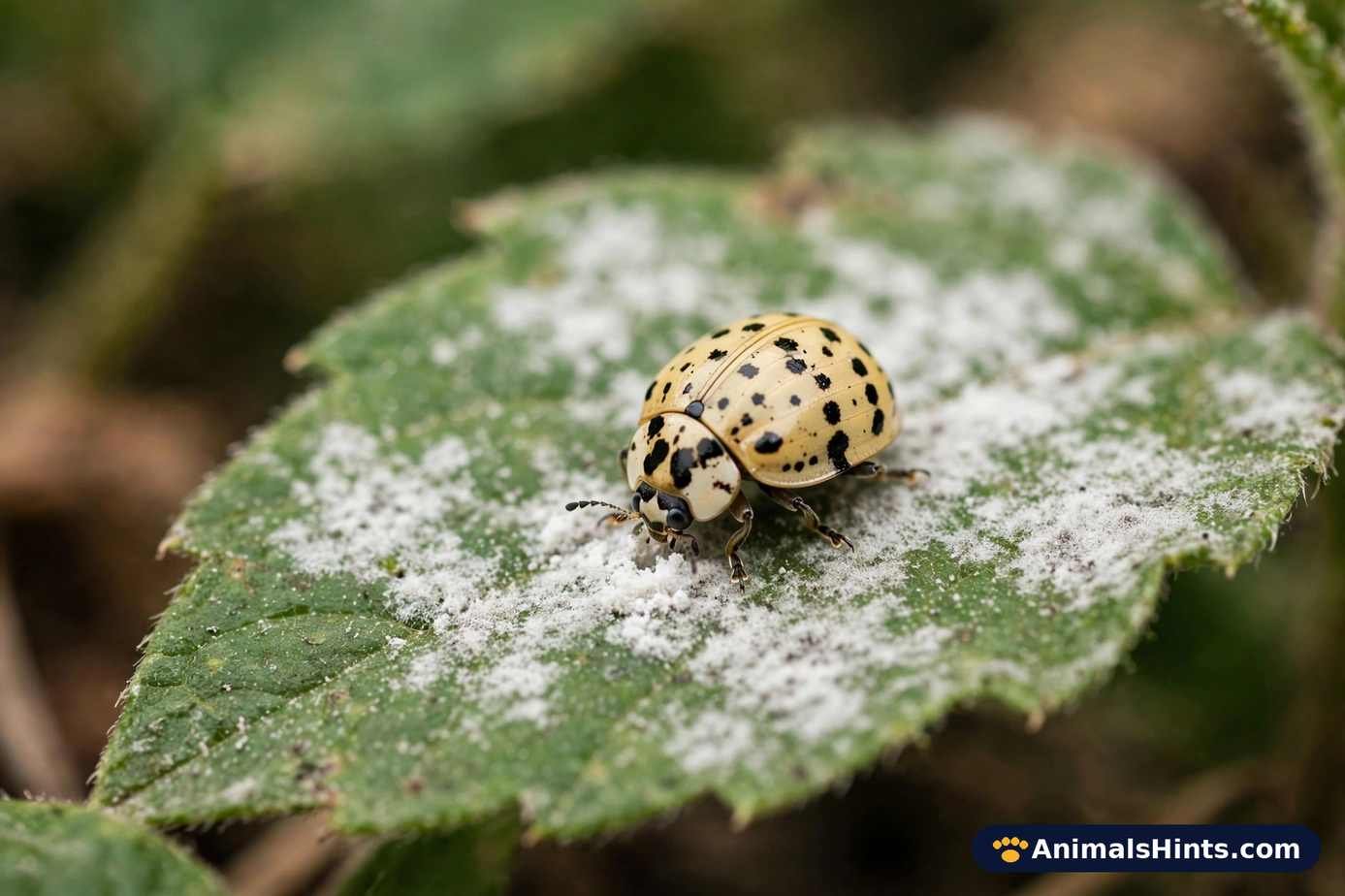
The plant is the witness least likely to mislead. A minute yellow beetle sitting in the middle of a pale, flour-like dusting on a leaf is standing in its own food supply — mildew — and is a 22-spot in Europe or the twenty-spotted relative in North America. A yellow beetle walking a cucumber, squash or melon vine in North America has given its address as the cucumber beetle’s. One picking through an aphid colony is the 14-spot earning its dinner. Build and antennae confirm the family: ladybirds are domes, about as round as long, with short antennae; the cucumber beetle is a stretched oval with antennae like thread, reaching well beyond its head. Waiting disposes of the final candidate. A soft, spotless yellow dome beside a split case is a ladybird that has just emerged; leave it where it is, return tomorrow, and the finished colours will settle the question without argument.
How to Respond When a Yellow Ladybug Finds You
Look first, and look closely, because everything worthwhile that follows depends on the identification being right. Photograph it from directly above, then from the side, with the plant kept in frame, and attach a date and a place. That packet answers the five checks above, and it is also the unit recording schemes run on — schemes whose maps of the 22-spot’s grazing range, the 14-spot’s North American spread and the 16-spot’s winter gatherings are built substantially from finds sent in by the public. For small, easily overlooked insects, a dated photograph is a contribution, not a souvenir. Should the beetle have selected your skin as a resting place, follow the old rule and do not flick it off. Say a wish over it if the mood takes you; otherwise simply let it sit until it chooses to leave; and when you have to move, give it a finger or a leaf edge to walk onto instead, and wait for it to make the crossing.
Indoors, move it the way this site recommends for every ladybird: a cup over the beetle, a card eased underneath, and carry the whole arrangement outside — never a sealed jar, which is a slow sentence for any animal that eats daily. Set it free on a sheltered plant. For a mildew-grazer the best address is a leaf already carrying the white dusting it feeds on: a working lunch, not just a release site. One exception to the tenderness must be stated plainly. If the checks name your yellow visitor as a spotted cucumber beetle working your cucumber vines, it is not a guest under the family’s protection; it is a pest in the act. Gardeners dislodge it, protect seedlings, and manage it as their local extension service directs — and no wish is owed. The old charter was issued to ladybirds. The beetle impersonating them at the vegetable patch never received a copy.
Final Thoughts
Several subjects have been travelling under one name. There is the symbol: the sunniest construction in the ladybird catalogue — joy, clarity, confidence, bright fortune — assembled for the colour of lemons and midday, and resting, at its base, on genuinely old foundations: a countryside custom that protected this family of insects, welcomed it on crops and clothing, and treated its arrivals as luck. And there are the animals: a lemon-yellow grazer faithful to its twenty-two spots; a chequered hunter that runs through a hundred patterns without ever touching red; a beige miniature that sleeps through winter in crowds; plus the two standing sources of confusion — the yellow first morning every red ladybird spends, and a yellow-green leaf beetle at work in North American vegetable gardens.
Nothing is lost by keeping the two apart. Dated honestly, the symbolism can be taken for precisely what it is — a living genre’s readings, some bricks old, most new — and the animals can be enjoyed for what they are, which needs no assistance. The next yellow dome you notice on a leaf will support both kinds of attention at once. It will also, most likely, be small, specific and busy: grazing mildew, hunting aphids, or finishing the hardening it began that morning — unless your garden is in North America and the leaf belongs to a cucumber vine, in which case it may be one of the cucumber beetles, wearing the family’s most cheerful colour on business the family never authorised.
FAQs
1. What is the spiritual meaning of a yellow ladybug?
In contemporary symbolism, the yellow ladybug stands for joy, optimism, mental clarity and confident forward motion — the colour of sunlight, laid over an insect that rural Europe sheltered and counted lucky for centuries. The interpretations are the symbolism genre’s recent output; the luck they are laid over is documented folk custom.
2. What does it mean to see a yellow ladybug?
Symbolism writers read the sighting as encouragement — brighter days ahead, a fresh chapter, confidence returning. Biology answers a different question: what you saw. The candidates are few — a 22-spot, 14-spot or 16-spot ladybird inside their European range (the 14-spot also in north-eastern North America); anywhere, an ordinary red or orange ladybird during its first yellow hours; or, on a North American cucurbit vine, a spotted cucumber beetle, which is no ladybird.
3. Is a yellow ladybug rare, and does that affect its meaning?
Less rare than it feels, and the feeling has mechanical causes. The true yellow species are small — 3 to 5 mm — and stay local, but within their ranges they are ordinary insects: the 22-spot is frequent in England and Wales; the 14-spot is common across Europe. Sightings seem scarce because the large, familiar ladybirds wear yellow for a few hours only, and because a 4 mm yellow beetle on a leaf is easy to walk past. The genre converts rarity into emphasis; that conversion is its own. How often a beetle occurs is a question of distribution, and it has a factual answer.
4. How should I respond to seeing a yellow ladybug?
Begin as custom begins: leave a settled ladybird where it is, for the full length of its stay, then help it onto a nearby leaf. One found indoors can be carried out under a cup and released on a sheltered plant — ideally, for a grazing species, one already dusted with mildew. And make the record: a photograph with date and place. For insects this small and this patchily mapped, the record outlasts every other response.