Right Foot Twitching Spiritual Meaning: Journeys, Warnings and What the Old Lists Actually Print
Ask what the right foot twitching spiritual meaning is, and the answer that comes back is nearly always about a journey: the right foot is said to stir before a trip, a move or a bold step forward, and its twitch is read as the road clearing ahead. That is the modern reading, and this page gives it in full — with every meaning labelled by the side it actually belongs to.
One piece of housekeeping first, because it shapes everything below. This article is about the right foot. The source page behind this topic was written about the ankle, the joint a few centimetres above the foot, and folklore shelves the two together, since a twitch at either place is felt in the travelling limb. The old omen lists, though, print the ankle and the foot as separate lines carrying separate verdicts, so the ankle material below is carried as ankle material, the foot’s own record is printed on its own further down, and nothing is quietly swapped between the two.
The honest note, before the meanings: the oldest lists do not say about the right foot what the modern pages say. One gives its upper side a sorrowful exile and its curve a loan that never comes back; another lays poverty and lost property on its sole while handing distant travel to the left foot instead. Medicine has a calmer finding of its own — on recording equipment, the small muscles of the foot twitch in most healthy people. Both shelves are laid out in full further down.

What Does a Twitchy Ankle Symbolize?
In the symbolism the folklore pages use, the ankle stands for movement itself. It is the hinge the whole body travels on, the joint that turns a standing person into a walking one, so a flutter there is read as the idea of a journey stirring before the journey does — somewhere in the life, something is getting ready to move.
A second strand reads the same twitch from the other side: restlessness, or movement blocked. A joint built to carry you forward, fluttering while you sit still, becomes a picture of a step you are not taking — a decision deferred, a departure postponed, a plan that keeps being rehearsed and never walked. On this reading the twitch is not the road opening but the foot tapping on a closed door.
The third strand is sensitivity. The ankle registers small shifts of weight before the rest of the body notices them, and the folklore borrows that fact as a metaphor: a twitching ankle is said to mark a person picking up changes early — in a household, a workplace, a relationship — before they become obvious. And the fourth strand is simply change: the travelling joint unsettled because the ground under the life is about to be different.
All four strands belong to the ankle as the folklore frames it, and the foot inherits them by closeness — it is the same limb, the same road, the same few centimetres of body. Where a meaning below belongs to one side only, or to the ankle rather than the foot, it is labelled as such rather than smoothed over.
What a Twitching Foot or Ankle Actually Is, Medically
Medicine has a plain name for the flutter itself. A fasciculation is, in Cleveland Clinic’s words, “a visible, involuntary twitching of an individual muscle” — it does not hurt, and it can run for a few seconds, for minutes, or on and off for hours. Around the ankle, the muscles doing the work are the lower leg’s: the shin muscle at the front, the tibialis anterior, lifts the foot and turns it inward, and its tendon crosses the ankle to reach the inner foot, while the calf muscles reach the heel. Inside the foot itself sits a layer of small muscles belonging to the foot alone, and it is usually one of those — in the arch, or on top of the foot — that you can actually watch flickering under the skin.
The feet, it turns out, are one of the body’s busiest twitching sites even in perfect health. In a study published in the journal Muscle & Nerve, researchers put surface electrodes on the small muscles of the foot and hand in 122 healthy volunteers and recorded fasciculation potentials in 77% of them — and significantly more of them in the muscles of the foot than in the hand muscle tested. The arch muscle that flexes the big toe, the flexor hallucis brevis, was among the most active of all. The authors’ conclusion was that fasciculation potentials are “a very common phenomenon in the peripheral muscles of healthy persons” — which is a measured way of saying that a twitching foot, on its own, is usually just a foot.
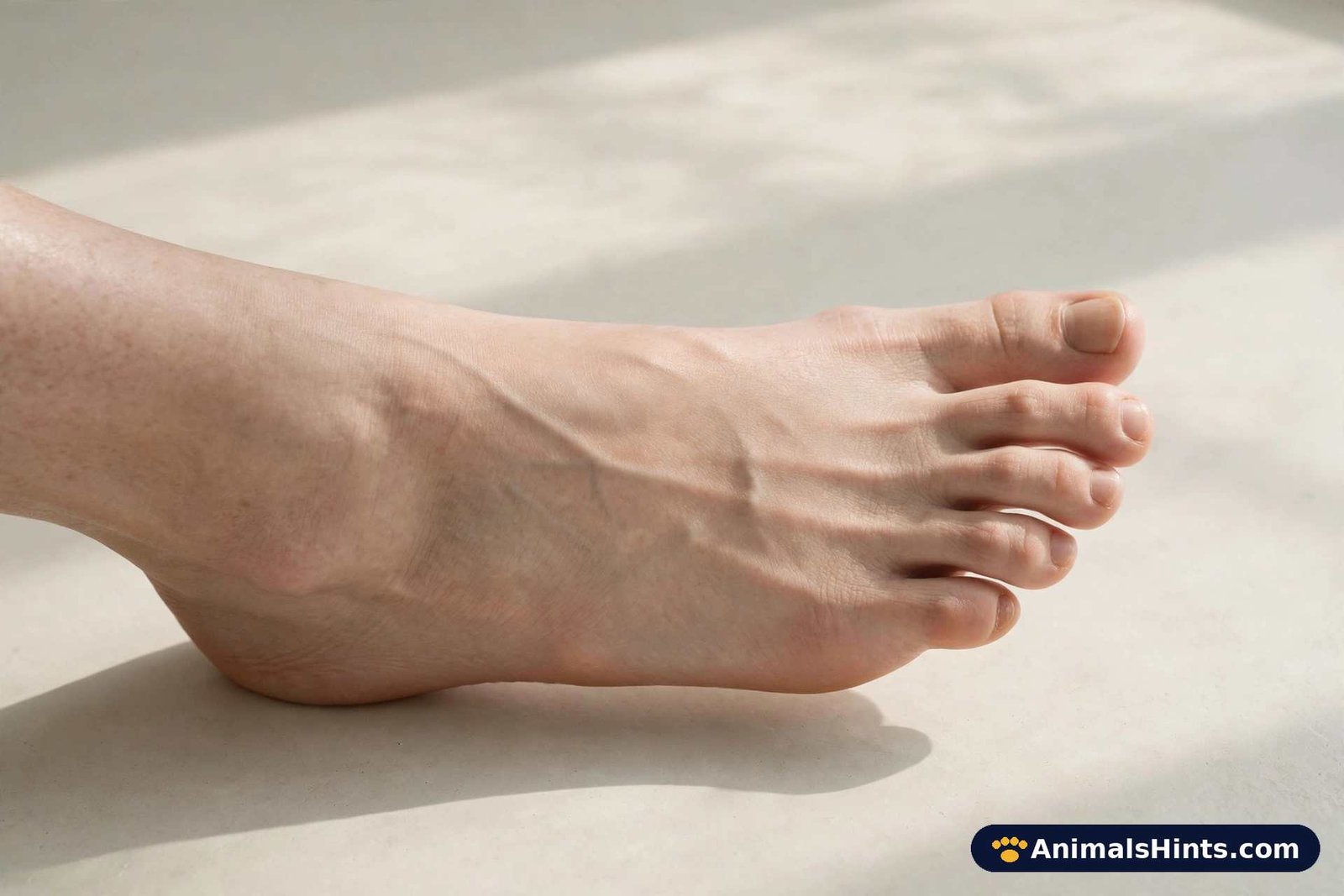
When the twitching is frequent and nothing else is wrong, clinicians call it benign fasciculation syndrome. Cleveland Clinic’s account of it is specific about what “nothing else” means: the syndrome “involves just muscle twitching and no other symptoms”, and in it the twitches “usually occur at a single site in a single muscle at a time”. Benign fasciculations of the ordinary kind are common — the same source puts them in about 70% of healthy people at some point in their lives — while the syndrome itself is relatively rare. The twitches are associated with stress, lack of sleep, caffeine or alcohol, anxiety, strenuous exercise, a recent viral infection and an overactive thyroid; none of those associations turns a twitch into a diagnosis, and this page does not offer one.
The line that matters is the company a twitch keeps. Cleveland Clinic advises talking to a healthcare provider about frequent twitches, and ends its guidance plainly: “If you suddenly develop other symptoms, such as muscle weakness, cramps and fatigue, see a provider as soon as possible.” A twitch still sitting in the same spot weeks later, spreading, or arriving alongside weakness or a visibly wasting muscle is a reason to book the appointment rather than consult the omens — that is an evaluation line, not a diagnosis, and it is the only medical verdict this article hands down.
And a boundary from the other shelf. No biblical text reads a bodily twitch as a sign; Scripture simply does not use the body that way. What the Bible does say about the foot concerns footing on a road, most famously in the pilgrims’ song: “He will not suffer thy foot to be moved: he that keepeth thee will not slumber” (Psalm 121:3, KJV). That is a promise about not slipping on a journey, quoted here at its real strength — it is not an omen text, and it is not evidence for or against any meaning below. The twitch readings that follow are folklore, and they are labelled as beliefs wherever they appear.
9 Spiritual Meanings of Ankle Twitching
The list below is his own, carried whole and in his order — his heading promises nine meanings, and his page does print nine, so the promise is kept. Two things to hold while reading it. First, it is an ankle list: the foot’s own verdicts, from lists that separate the two, are printed in the record section further down. Second, the sides are mixed inside it. Meanings that his text ties to the right ankle are marked as right-side; the ones he ties to the left are marked as left-side and carried because the list is carried whole; the rest make no side distinction at all, and say so.
Upcoming Journey
The flagship meaning, and on the source page it belongs to the right side: the right ankle’s twitch is read as a journey forming — travel plans falling into place, a trip announced or a departure moved closer — while the same twitch on the left is read there as the delayed version, a journey that needs more preparation before it goes well. Worth knowing, before this one settles in: the modern list his page itself leans on as a reference puts the journey on the left ankle instead. The disagreement gets its full printing further down, in the record section; here the meaning stands as its page states it.
Need to Face Challenges
A mixed entry, and worth splitting honestly. On the source page, the right ankle’s portion here is confrontation: obstacles ahead that are to be faced head-on rather than walked around, with growth on the far side of them. The left ankle’s share, in the same entry, is different work — travel and preparation, getting ready rather than fighting. So the right-side reading is a summons to stop deferring a difficulty; the left-side reading is a summons to pack properly. They share a heading, not a message.
Resistance to Moving Forward
This one makes no distinction of sides. A twitch in either ankle is read as hesitation made physical — fear of the next step, reluctance to leave a familiar place or arrangement, the body pausing at a threshold the mind has already reached. Of all nine meanings it is the one that needs no journey to be planned at all: the blockage it describes is internal, and the flutter is treated as the place where the blockage shows.
Energetic Realignment
Also side-blind. In the energy language of the modern pages, a twitching ankle gets read as the body’s currents rebalancing at the joint — flow that was stuck beginning to move, the system adjusting before a change of pace. It is the gentlest entry in the list: nothing is warned against and nothing is demanded; the twitch is simply the sensation of a rearrangement happening underneath ordinary life.
Spiritual Awakening
This meaning belongs, on the source page, to the left ankle, and the label is left exactly there rather than reassigned. There, a left-side twitch is read as heightened awareness arriving — intuition sharpening, a sensitivity to other people’s states, the early stirrings of a more deliberate spiritual practice. It is carried in this list because the list is carried whole; a reader whose twitch is in the right foot should know this particular entry was not written about their side.
Divine Nudging
Side-blind again: the twitch as a tap from whatever a reader takes the divine to be — heaven’s way of pointing at a decision, a person or a direction that has been drifting past unexamined. The nudge reading is deliberately unspecific in the folklore; it claims a direction of attention, not a piece of information, and it asks for reflection rather than action.
Protection and Safety
A right-side meaning on the source page, and among the kindest entries in the list. There, the right ankle’s twitch is read as protection active around the reader — guidance present on the road they are actually travelling, a sign that a feared step is safer than it looks. The same entry gives the left ankle the opposite shade: a flicker of vulnerability, a reminder to take ordinary care. The right-side half is what this page’s readers came for, and it is printed as its source prints it.
Emotional Healing
The second left-side entry in the list, labelled as such. On the source page, a left ankle twitch is read as buried feeling working its way out — old grief, stored stress or an unspoken hurt surfacing through the body while it heals. Nothing in the entry is about the right side; it is carried whole, like the awakening entry above, so that the list the reader may meet elsewhere matches the list printed here.
Warning Sign
The list closes with its caution, and the source page leans it toward the left: a twitching ankle as a signal to ease off and check the footing — a commitment to re-read, a plan to inspect, a person to watch a little more carefully. The right ankle is not exempted in his text, only softened: there, the warning is said to concern obstacles on a path that is otherwise good. Either way the folklore’s own framing is a prompt to look, not a sentence of doom — a distinction the honest-reading section below takes up.
Ankle Twitching Superstitions for Females and Males
His page sorts the superstitions four ways — by side and by sex — and the four entries below follow his order. Behind the sorting sits the old general rule of this folklore, which the classical summary states in one line: generally, the right side of a man and the left side of a woman are the sides taken note of. The four entries below are the modern pages’ working-out of that rule at the ankle; how far the oldest lists themselves go is another matter, answered in the record section — where the lists turn out to print far less about women and ankles than the tidy table suggests.
Right Ankle Twitching in Females
For a woman, the source page reads a right ankle twitch as forward motion blessed: progress in what she is building, travel that comes at a good moment, timing that is working in her favour rather than against her. The advice folded into the entry is to trust her own reading of the situation and take the step — in work, in a relationship, in a plan long parked, waiting for a push.
Left Ankle Twitching in Females
The left side, for a woman, is read there as the reflective side: delays that turn out to be protective, a pause that lets feeling catch up with events, and — the entry’s most distinctive item — a surprise encounter, someone arriving unplanned who matters more than the plan did. The twitch is treated less as a warning than as an instruction to slow down and let the unexpected in.
Right Ankle Twitching in Males
For a man, the right ankle is read as the career side stirring: an opportunity forming at work, motivation returning after a flat stretch, money and standing moving in the right direction. The entry’s counsel is decisiveness — the twitch is treated as the starting signal, and the superstition rewards the man who acts on it promptly over the one who waits for a second sign.
Left Ankle Twitching in Males
A man’s left ankle gets the cautionary entry: reconsider a commitment before signing, expect a temporary challenge rather than a smooth run, and let patience do the work that force would spoil. In the source page’s framing this is a holding pattern, not a defeat — the delay is the superstition’s way of keeping him out of a worse arrangement.
Quick Overview Table
The source page sums its four entries up in a table, and it is set out below with his wording kept in the cells:
| Body Part | Right Side Meaning | Left Side Meaning |
|---|---|---|
| Females | Progress, travel, good timing | Delays, reflection, surprise encounter |
| Males | Opportunity, motivation, success | Caution, reconsideration, temporary challenge |
Two honest footnotes to that table. First, it is a modern construction: the oldest lists were largely written for a man’s body — one of them says so in its own framing — and their only explicit notes about women sit on other body parts entirely, so no old list prints a four-way ankle table like this one. Second, the table is ankle-shaped; the lists that separate the foot from the ankle give the foot different words altogether, as the record below shows. None of that makes the table useless — it is a fair summary of what the modern folklore says — but a summary of modern folklore is all it is, and it is presented as exactly that.
Cultural and Religious Interpretation
Ancient Traditions
The oldest layer of this folklore, as the modern pages retell it, treats the feet and ankles as the body’s point of contact with the earth — the place where a person meets the ground they stand on and the road they will walk. A twitch at that contact point was read as the earth answering: a journey blessed or warned against, a threshold marked, movement between one state of life and another announced at the limb that would do the moving. The retelling is general — no single ancient text is quoted for it on the source page — but the theme it names, feet as the travelling part of a person, is genuinely the oldest idea in this whole article.
South Asian Beliefs
South Asia holds the most developed version of this tradition: angasphurana, the reading of involuntary twitches, in which the side of the body carries the meaning — the right side read as the fortunate side for a man, the left for a woman. Feet and ankles, in that system, belong to the travel family of signs: direction of life, journeys undertaken, ground gained or lost. This is the tradition the old lists in the next section actually come from, which is why their real entries — printed there word for word — matter more than any summary of them, this one included.
East Asian Lore
The East Asian reading, as the source page presents it, runs through energy rather than omen: pathways of flow are pictured running down the legs and through the feet, and a twitch at the ankle is read as that flow catching or clearing — movement in the body’s currents that mirrors movement in the life. Where the flow is blocked, the reading is stagnation; where it stirs, something is about to circulate again. It is the least fortune-telling of the cultural frames and the closest to a description of restlessness itself.
Middle Eastern and African Folk Beliefs
Across the folk traditions the source page gathers under this heading, a twitching foot or ankle is most often a social sign before it is a personal one: travel approaching, visitors on the road, a change in the household’s fortune arriving from outside. The reading is carried by community and intuition together — the twitch is discussed, interpreted against what the family already knows, and folded into decisions about journeys and guests rather than treated as a private verdict.
Western Interpretations
The modern Western frame keeps the twitch and drops the omen: it is read psychologically, as restlessness or anticipation surfacing in the body — nervous energy before a change, excitement that has not yet found its object, a mind already travelling while the body waits. Of all the cultural frames this is the one that sits most comfortably beside the medical account above, and the folklore pages themselves often present the two side by side: the twitch as a feeling with a physiology, whether or not it is also a sign.
What the Old Omen Lists Actually Print for the Foot and Ankle
Everything above is the modern folklore, carried as its pages state it. This section is the older shelf, checked directly. Six sources were read in full for this article: the classical angasphurana indications as summarised by Hindu Blog; the Sakuna Sastra list of body omens; chapter 7 of The Pearl of Wisdom, an English rendering of a Sufi omen compilation; the modern list published by K. N. Tiwari — a reference the source page itself leans on; and both of the body-sign lists in Sardar Gurdev Singh Chawdhri’s Secrets of Occult Sciences (1990). What follows is only what those lists print for the ankle and the foot. Where a list is silent, the silence is reported, not filled.
The classical indications. The angasphurana summary gives the foot exactly one entry, with no division into sides: “Foot – honor.” That is all of it. The ankle receives no entry at all — in the oldest summary available to this article, the joint the modern pages build their lists around does not appear. The summary’s only general rule is its framing sentence: “Generally, the right side of the male and the left side of the female are taken note of.” One word — honour — unsplit by side, is what the classical tradition hands the foot.
The Sakuna Sastra list. This list works its way down the legs — the right leg gets “quarrels with somebody. Travels.”, the left leg “new sustenance.” — and then gives the ankle a single line, for the right side only: “The right ankle: will live in a multiple storied building.” There is no left ankle entry; the list simply does not print one, and the absence belongs in the record. The foot then gets four entries, two per side, and the right foot’s are the opposite of cheering. “The upper side of the right foot: will leave his native land with sorrow. His speech is not liked by others.” And: “The curve of the right foot: The money lent will not be recovered.” The left foot fares no better — its upper side loses a court case to the opponent, and its curve carries “possible indication of a disease”. There are no entries for the whole foot, the sole or the toes. In the oldest list that separates them, the right ankle predicts a house and the right foot predicts exile and a bad debt.

The Pearl of Wisdom, chapter 7. The Pearl is the one old list that treats this part of the body at length, and at the ankle it is generous to both sides: “If the right ankle twitches, wealth is shown. If the left ankle twitches, long life is shown.” Two ankles, two blessings. At the foot, though, the chapter reverses the rule the modern pages teach. “If the sole of the right foot twitches, there will be poverty and loss of property.” The left sole gets everything the modern reading promises the right: “elevation and glory will be manifested, and there will be travel to distant places”, with material benefits and relief from sorrow besides. The chapter goes on to read all ten toes one by one — the right big toe brings “a traveller from a distant land” home again, with happiness — but its foot verdict stands: in this list, the travelling blessing sits under the left foot, and the right sole is the warning. The chapter is written throughout for a man’s body, and it prints no female ankle or foot note.
Tiwari’s modern list. The source page’s own cited reference is the most instructive of all, because it disagrees with the page that cites it. Tiwari prints: “Twitching of the Right Ankle: The need to face challenges.” And: “Twitching of the Left Ankle: Increased chances of going on a journey.” The journey — the flagship meaning of the modern ankle pages, assigned there to the right — sits on the left in the very list those pages lean on. His feet are worse: across his single page the right foot collects at least five different verdicts. Its sole carries “wealth-related worries”; the foot itself is a “sign of pleasant news”; under the right foot there is a “possibility of acquiring wealth and success in business”; the upper part of the right foot has “no specific significance”; the sole reappears under his auspicious heading as a warning to be prepared to face challenges; and in his inauspicious section the verdict is flat: “A twitch in the right foot is considered inauspicious.” No single Tiwari reading of the right foot exists. There are five, and they cannot all be quoted as one.
Chawdhri’s twitching table. Chawdhri’s 1990 compilation prints a twitching table whose lines include §28, the ankles — right ankle, left ankle — and §29, the feet: right foot, left foot, right upper foot, left upper foot, and the underside of the right foot, the sole. The lines exist. Their results, however, reach the printed text as a separate block interleaved with the part-names, and the two cannot be matched line for line with any confidence — the counts do not agree and the order does not hold. So this article quotes no Chawdhri twitch result for the ankle or the foot, and states plainly instead that the pairing cannot be recovered from the book’s layout. A table that cannot be read honestly is reported as unread, not guessed at.
A twitch is not an itch. Chawdhri’s book keeps a second, separate list — “The Itches” — and that one is printed in clean sequence, entry by entry, so its pairings can be quoted. They are itch entries, and they are quoted here as itch entries only: entry 16, “Left palm or left ankle — Expenditure”; entry 17, “Right palm or right ankle — Gain of money”; entry 24, “Left foot — Aimless and unprofitable journey”; entry 25, “Right foot — Profitable journey and success”. Read those last two again. The tidiest line in the modern folklore — right foot, profitable journey — is sitting in a 1990 book as a reading for an itching foot, not a twitching one. The shelves have been mixed somewhere along the copying chain, and the twitch has inherited the itch’s verdict. The itching shelf has its own coverage on this site, including our left foot itching superstitions and, for the same leg, the itchy knee meanings — those pages, not this one, are where an itch should be looked up.
The leg, in fact, is the body part this site has now walked from top to bottom, and the neighbouring records make the same point from different shelves: our left thigh twitching record found the old lists reversing the modern rule at the thigh, our right knee twitching record found the knee’s famous good-news line living on the itch shelf, and our left calf twitching record found the calf’s money-and-guests readings contradicted inside a single modern list. The tradition’s flagship remains our left eye twitching record, where the lists are fuller and the sides better behaved. The pattern across the leg is consistent: the lower the limb, the thinner and more contradictory the old record becomes.
| List or Source | What It Prints for the Ankle and Foot |
|---|---|
| Classical angasphurana indications | No ankle entry at all. For the foot, a single entry with no side division: “Foot – honor.” |
| The Sakuna Sastra list | Right ankle only: “will live in a multiple storied building” — no left ankle entry exists. The right foot: leaving the native land with sorrow (upper side) and money lent that is not recovered (the curve); the left foot fares no better. |
| The Pearl of Wisdom, chapter 7 | Both ankles positive: right ankle — wealth shown; left ankle — long life shown. The soles reverse the modern rule: right sole — poverty and loss of property; left sole — elevation, glory and travel to distant places. |
| K. N. Tiwari’s modern list | Right ankle: the need to face challenges. Left ankle: increased chances of a journey. The right foot receives five different verdicts across the one page, from pleasant news to inauspicious. |
| Chawdhri, twitching table (1990) | Ankle lines (§28) and foot lines (§29, including the upper feet and the underside of the right foot) are printed, but their results reach the text in a separate interleaved block and cannot be paired with them reliably — no result is quoted. |
| Chawdhri, “The Itches” (itch entries only) | Right palm or right ankle: gain of money. Left palm or left ankle: expenditure. Right foot: profitable journey and success. Left foot: aimless and unprofitable journey. |
Is Ankle Twitching a Bad Omen?
When It Is Seen as Positive
In the folklore’s own sorting, a right-side twitch that comes briefly, at a moment of readiness — a plan forming, a journey being weighed, a step already half-decided — is read as the favourable version: timing aligning, the road in good condition, protection on the traveller. Most of the bright meanings in the list above live in this column, and they share a flavour: none of them promises an outcome, all of them bless a beginning.
When It Is Seen as Negative
The same twitch is read darkly when it persists, when it arrives with unease, and in the entries the tradition assigns to the left — delays, obstacles, a commitment that wants re-reading. The warning meaning that closes the list of nine belongs to this column. Even here, though, the folklore’s own language is about footing rather than fate: check the step, not abandon the road.
Neutral Perspective
Most traditions, most of the time, treat a twitching ankle or foot as neither column — a nudge rather than a verdict, a moment of noticing rather than a message. That neutral reading is also, as it happens, the one the evidence supports from every direction this article has checked: the old lists disagree with each other too much to convict anyone, and the medical record says the small muscles of the foot flicker in most healthy people. A twitch can be a prompt to pay attention without being a prediction of anything.
How to Read a Right Foot or Ankle Twitch Honestly
After the checking, here is what is left standing. The symbolism is real and old as a theme: feet and ankles have meant roads, thresholds and departures for as long as these lists have been kept, and a twitch felt there will naturally gather journey meanings around it. The ankle even owns one genuinely old blessing — the Pearl’s wealth on the right, long life on the left — and one genuinely odd one, the Sakuna list’s multi-storeyed house. If the modern pages said only that much, they would be on solid ground.
What does not survive is the tidy right-foot story built on top of that theme. The foot’s own old entries will not hold it up: the classical summary gives the foot a single unsplit word, honour; the Sakuna list gives the right foot sorrow and an unrecovered loan; the Pearl lays poverty on the right sole and the travelling glory under the left; the modern list the folklore pages themselves cite cannot agree with itself about the right foot five times in one page; and the one 1990 table that lists the foot’s twitches cannot be paired with its results at all. The neatest line of all — the profitable journey — turns out to be an itch reading that wandered shelves. And the four-way table of male and female meanings is a modern arrangement: the old lists were mostly written for a man’s body and print no such table.

None of this empties the twitch of meaning; the meaning-making goes back to the reader instead of staying a lookup. The honest way to hold a right foot twitch is as a prompt, not a prophecy: a small bodily event at the travelling joint, inviting a practical question — what journey, plan or step has actually been on your mind, and what would preparing for it properly look like? Held that way, the folklore does what it was probably always for. It gets the traveller to check the road before setting out, and it never has to pretend the foot filed a report.
What to Do When Your Right Foot Keeps Twitching
Start with the facts of the twitch itself, because both shelves — the medical and the folkloric — read particulars, not vibes. Notice which foot it is, where exactly it sits (arch, top of the foot, toes, or up at the ankle), how long an episode lasts and how often it returns. A twitch you can describe precisely is one you can act on sensibly, whichever shelf you end up consulting.
Then give the muscle its ordinary due. Rest the foot after long walks, runs or standing shifts; drink water; cut back the caffeine for a while and watch whether the flutter follows it out of the door — caffeine, poor sleep, stress and hard exercise are the associations the medical sources list first. A gentle stretch helps the machinery feel attended to: press the arch into the floor, flex the foot up toward the shin and hold, then point it and hold. None of this is treatment; it is the basic housekeeping of a hard-working limb.

Keep a short note for a week or two — when it twitches, what the day held, how you slept. Patterns are the one genuinely useful thing a twitch can give you: if it follows long runs, late nights or deadline weeks, you have learned something true about your body that no omen list could have told you. And keep the medical boundary from the section above in view: a twitch fixed in one spot for weeks, spreading, or arriving with weakness or shrinking muscle means a doctor’s appointment, promptly — that appointment outranks every other step on this page.
If you keep the folklore as well, let it do its honest job. Treat the journey reading as a prompt to prepare rather than a promise to relax: check the booking, service the car, make the call, pack the bag properly. A superstition that sends you into a journey better prepared has done you a service whether or not it was ever a sign — and a twitch that sends you to rest, water and an early night has done the same.
Final Thoughts
A twitching right foot gathers big themes onto a small event: the road, the threshold, the step not yet taken. The modern folklore reads it brightly — journey, opportunity, protection — and this page has carried that reading whole, sides labelled and sources named, because it is the reading people come looking for. It has also printed the older shelf beside it, where the foot is honoured in one word, exiled in another list, reversed at the sole in a third, and blessed most tidily by an itch. Both shelves are the tradition; only one of them is usually quoted.
Underneath every reading sits the same small machinery: a hinge of bone and tendon, the talus carrying the whole weight of the leg down into the foot, and small muscles that flicker, on the record, in most healthy people. The folklore asks what the flicker means. The honest answer this page can give is that it means you noticed your own travelling limb — and what you do next, with the road or with the rest, is yours.
FAQs
What does right ankle twitching mean spiritually?
In the modern folklore it is read as a journey or opportunity forming — progress, good timing, a step forward that is safe to take. The oldest lists are less tidy: one gives the right ankle wealth, and the foot itself sterner words, as the record above shows.
What does left ankle twitching mean spiritually?
The left ankle is read as the reflective side: delays that protect, feelings surfacing and settling, inner work to finish before the next move. Some lists give it the journey instead — the sources disagree, and the disagreement is printed above.
Is ankle twitching a sign of good or bad luck?
The folklore sorts it by side and circumstance — right and brief usually reads lucky, left or persistent reads as caution — but in most traditions it counts as neither — just a cue to pay attention, not a verdict of either kind.
What should I do when my ankle twitches?
Stay calm and notice the pattern: rest the foot, drink water, ease the caffeine, and see when it comes and goes. If it stays fixed in one spot for weeks or arrives with weakness, skip the omens and book a doctor.