Yawning Spiritual Meaning: 10 Meanings, Superstitions and the Science
In folk tradition, the yawning spiritual meaning is read as movement: energy shifting, tension leaving, attention turning inward. A yawn arriving during prayer, beside one particular person, or in a chain spreading around a room gets treated in that literature as a small event worth interpreting, rather than a reflex to ignore.
That reading rests on an unusually well-studied reflex. Yawning is normal, brief and contagious across species, and researchers still argue about what it is for. The brain-cooling and state-change accounts are hypotheses with evidence on both sides, and the honest version of this topic keeps the layers separate: what the traditions say, and what the record shows.
This guide works through both. It gives the ten meanings the genre assigns to yawning, the record cultures and faiths have left behind them, the prayer and love readings, and the superstitions about contagious yawning — each held at the strength of the belief it is — alongside the verified physiology, the animal record and a plain health note, so nothing here asks you to choose between folklore and common sense.

What Does Yawning Represent Spiritually?
In modern spiritual writing, a yawn represents release and adjustment. The body opens, breathes deeply and lets go, and the genre reads that sequence inwardly: held tension leaving, a crowded inner state clearing, awareness settling into a quieter register. Practitioners in energy-healing settings report yawning — their own and their clients’ — as one of the commonest responses during a session, and interpret it as the system discharging what a session has stirred up.
Held at the strength the tradition itself can support, the representation is a metaphor with good posture. A yawn really is a reset of sorts: muscles stretch, the breath deepens, alertness shifts. Spiritual writers extend that reset to mood and “energy” — a reading, offered for reflection, not a measurement. This site treats yawning the way it treats every body sign in this series, from the left eye twitching spiritual meaning record onward: the folklore reported whole, attributed to its holders, and never upgraded into a claim about what your yawn predicts.
Why Do We Yawn? What Science Actually Knows
Begin with the reflex itself. A yawn is a fixed pattern found across vertebrate animals: a slow, wide opening of the jaw with a long breath in, a brief peak where muscles stretch — the eardrums included — and a quicker breath out with everything relaxing again. The whole sequence typically lasts around six seconds, and once started it runs to completion; a yawn is difficult to stop halfway, which is why it feels less like something you do than something that happens to you. It clusters around the edges of sleep and around tedious stretches of the day, and is famously set off by watching, hearing, reading about or even thinking about somebody else yawning. If this page has already produced one, that is the reflex working as documented.
What the reflex is for is genuinely unsettled, and the popular answer is the one that failed its test. The schoolroom explanation — yawning tops up oxygen or clears carbon dioxide — was put to experiment in the 1980s: changing the oxygen and carbon dioxide in the air volunteers breathed changed their breathing but not their yawning. Two live hypotheses remain, labelled hypotheses here because that is what their own authors call them.
The first is brain cooling. Andrew Gallup and colleagues at the State University of New York at Albany proposed in 2007 that a yawn works as a radiator for the brain: the deep intake of air and the surge of blood flow around the jaw and face help hold brain temperature inside its narrow working range. Their experiments gave the idea real support — volunteers who breathed through the nose, or held a cold pack to the forehead, caught far fewer yawns from a video of yawning people (in the forehead study, contagion fell from about 41 percent with warm or room-temperature packs to about 9 percent with a cold one). Later work found contagious yawning varying with outdoor temperature as the theory predicts. It is the strongest current account, and still an account under test, not a settled verdict.
The second is state change: a yawn marks and assists a switch in the brain’s mode — drowsy toward alert, one kind of attention toward another — which would explain why yawns gather at transitions. The two hypotheses are not enemies; a reflex can cool and signal at once, and the field generally treats yawning as probably multifunctional.
Contagion gets a paragraph of its own, because the superstitions below grow out of it. Yawn contagion is robust laboratory fact: seeing a yawn, hearing one down a telephone line, or reading the word can trigger the reflex, and suppressing a yawn does not reliably stop the chain. One popular explanation ties contagion to empathy — we catch the yawns of people we are close to more readily, and a well-known 2011 study by Norscia and Palagi found contagion strongest between kin, then friends, then acquaintances, then strangers. But the empathy equation is contested: a 2017 review by Massen and Gallup argued the evidence does not yet justify reading contagion as an empathy meter, and this guide prints the link at that strength. What no study supports is a message passing between the yawners; the chain is a reflex echo, and the folklore built on it is folklore.

10 Spiritual Meanings of Yawning
For yawning, the genre’s list runs to ten standard readings, set out below in the competitor tradition’s order. Each is given as its writers give it — as belief and association — with the record’s bounds kept visible where the record has something to say.
1. Energy Release and Balance
The foundational reading: a yawn is the system venting. Strain, overstimulation and emotional effort leave a residue the tradition calls stagnant or heavy energy, and yawning is one of the routes it exits by — which is why, writers note, yawns arrive in runs after a difficult conversation or a demanding piece of inner work, and the body can feel oddly lighter once the run finishes.
2. Cleansing and Purification
A sibling of the first reading, with the emphasis on washing rather than venting. Breath is the vehicle in most cleansing imagery, and a yawn is breath at its deepest and least voluntary, so the genre treats repeated yawning during prayer or quiet reflection as the inner equivalent of airing a room: what was stale moves out, and the space it leaves is the point.
3. Connection with the Divine
Practitioners report that yawns often arrive at the threshold moments of practice — just as prayer deepens or meditation settles — and read the timing as the body opening a channel: the wide breath and softened attention as a posture of receptivity. The reading belongs to devotional interpretation; nothing in it is testable, and it stands as a way some practitioners make sense of a common experience.
4. Relaxation and Calmness
The softest reading, and the closest to the physiology. A yawn does accompany the shift from effort toward rest, and spiritual writing takes that shift at face value: the yawn as the moment the system stops bracing. Meditation students are often told not to fight yawns for exactly this reason — suppressing them reintroduces the tension the practice is setting down.
5. Spiritual Awakening
In awakening literature, clusters of yawning during reading, teaching or practice are read as adjustment symptoms: the system recalibrating as attention changes, the way eyes water in brighter light. Held honestly, this is a modern genre reading with no older textual root — the classical contemplative manuals catalogued many bodily effects of practice, and yawning is not a standard entry in them. Recent and popular, it asks the yawner for patience with a transition rather than expectation of an event.
6. Release of Emotions
Therapists’ rooms and prayer groups produce the observation the genre builds on: people yawn as held feeling starts to move — after crying, during a hard confession, in the quiet after bad news lands. The spiritual reading calls the yawn the body’s sigh of relief. The physical sequence supports the modest version: yawning does ride along with muscular release and a settling nervous system, whatever else is said about it.
7. Making Space for Divine Light
This reading extends the cleansing image upward: the yawn empties, and what enters the emptied space is figured as light, clarity or grace. It is the most explicitly devotional entry in the set, and functions in its literature as an instruction in attitude — receive rather than grasp — rather than a description of anything measurable. It stands as that: a posture the tradition recommends, in its own imagery.
8. Protection from Negativity
The oldest-shaped reading in the list. Long before the modern genre, an open mouth in yawning was treated in parts of Europe as a vulnerable opening — older folklore held that the soul might slip out or something harmful slip in — and the customs in the cultural section below grew from that anxiety. The modern version inverts the direction: the yawn itself is cast as the defence, expelling heaviness absorbed from crowded rooms and difficult company. Both versions stand here as what they are — folklore, old and new — and the documented customs belong to the older one.
9. Message from Spirit Guides
In guide-and-angel literature, a yawn that lands at a pointed moment — mid-question, mid-decision, on opening a letter — is read as a nudge: attention redirected by a presence the writer believes is near. There is no way to check such a reading against anything outside the belief system that produces it, and nothing here pretends otherwise. Readers who hold the belief will recognise the description; readers who do not can file the same moment under the contagion and state-change record above, which covers the timing without remainder.
10. Sign from the Universe or God
The broadest reading gathers the previous nine into one claim: that a well-timed yawn can be a communication, a reassurance that one is noticed and accompanied. As with the guides reading, it is a matter of faith rather than record, and is carried here at exactly that strength. The experience it answers — a yawn’s strange aptness in a charged moment — is real and common, because yawns cluster wherever attention, emotion and fatigue meet: most of the places human beings pray, grieve, decide and fall in love.
Cultural and Religious Significance of Yawning
Yawning’s folklore is older than its science, and the strands below are the ones that can be tied to a record. Each is stated at the strength its sources support.
The open mouth and the soul. In parts of the older European record, yawning was regarded as a moment of exposure: the mouth open, the guard down, the soul imagined as able to leave or unwelcome things to enter. Covering the mouth — now filed under politeness — has roots in that protective logic, and a stranger custom rode alongside it: Polydore Vergil, writing in the early sixteenth century, recorded making the sign of the cross over the yawning mouth, a habit he connected to plague-era fears of catching death on the breath. The Opies’ Dictionary of Superstitions preserves the account. The competitor tradition assigns the soul-escaping belief to ancient Greece; the fetched record documents it as a wider European belief of later centuries, and it is printed at that documented strength here.
In Islamic teaching, yawning carries an explicit instruction — the best-documented religious ruling on this page. The hadith collections record the Prophet Muhammad teaching that yawning is from Shaytan — associated, the commentaries explain, with the heaviness and laziness that pull a person from worship — and directing believers to suppress a yawn as far as they are able, and to cover the mouth when one comes, especially in prayer (Sahih al-Bukhari 6226; Sahih Muslim 2994). Sneezing gets the opposite valuation in the same teaching: loved by God, answered with a blessing. The ruling concerns conduct and attention in worship, and stands here exactly as the tradition teaches it.
In Hindu practice, the competitor tradition describes yawning in terms of prana, the vital breath, needing to rebalance, and a protective gesture — touching the mouth after a yawn — as customary in some communities. The prana framing belongs to the wider yogic understanding of breath as life-force, within which a yawn naturally reads as the breath rearranging itself; the specific customs stand here as the genre reports them, at attribution strength, since no textual source for a yawning rule was fetched at drafting strength.
In African and Caribbean folklore, as the genre summarises it, a sudden yawn is sometimes read socially — a spirit passing, or talk about the yawner circulating out of earshot — and met with a brief prayer or protective gesture. No named people, text or collected tale was fetched behind that summary, so it stands here as a general attribution and nothing stronger.
What Does the Bible Say About Constant Yawning?
The direct answer is short, and the competitor tradition itself concedes it: the Bible does not mention yawning. No verse describes the act, reads it as an omen, or attaches a meaning to it, in either testament. Any “biblical meaning of yawning” is therefore a construction built beside the text rather than a teaching found in it, and this section keeps the two things visibly apart.
What the text does contain is a neighbouring theme later writers reach for: wakefulness as a spiritual discipline. Paul’s instruction to the Thessalonians runs, in the King James Version: “Therefore let us not sleep, as do others; but let us watch and be sober” (1 Thessalonians 5:6, KJV, quoted word-exact). The verse concerns alertness of life, not a reflex, and applying it to constant yawning is devotional reading — a fair reflection prompt, as long as nobody upgrades a metaphor into a diagnosis of anyone’s faith.
The modern devotional addition — yawning during worship read as cleansing or as the Holy Spirit moving — belongs to contemporary charismatic practice and is labelled accordingly. It has no textual anchor, and the older Christian custom on record points the other way: the cross signed over the yawning mouth guarded against harm entering; it celebrated nothing leaving.
Yawning Around a Certain Person Spiritual Meaning
Almost everyone has met this one: an afternoon of unstoppable yawning in one particular person’s company, on a day when you slept perfectly well. The genre’s reading is energetic — the other person’s mood or “frequency” is said to be absorbed, resisted or answered by your system, with the yawns as the processing cost; beside someone draining, defence; beside someone trusted, two systems settling into step.
The documented record offers a plainer mechanism covering the same observation. Yawn contagion runs on perception: you catch yawns from people you are attending to, and you attend most closely to the people in front of you. The closeness gradient in the contagion studies — kin before friends before strangers — predicts exactly the experience the genre describes, without any transfer of energy: the people whose yawns you catch are the people whose faces you watch. Empaths, in the genre’s term, may simply be attentive watchers. Both accounts stand; the reader can decide which one their own life actually needs.
Spiritual Meaning of Yawning While Praying or During Meditation
This is the setting readers ask about most, because it feels like a contradiction: the body apparently drifting off at the moment the mind is trying to be most present. The traditions split instructively. Islamic teaching, set out above, treats the yawn in prayer as something to suppress — a pull toward heedlessness, countered by covering the mouth and renewing attention. Modern meditation and energy-healing writing mostly reads the same event in reverse: the yawn as release, even — in some teachers’ framing — as a sign that practice is working.
The physiology reconciles the two readings better than either admits. Prayer and meditation are state changes: breathing slows, muscles unbrace, attention narrows. State change is precisely when yawns arrive, on the scientific record, which is why the same yawn can feel like both a distraction and a deepening — it is the sound of the gears shifting, and each tradition grades the shift by its own values. Practically, the camps converge more than they differ: neither tells the yawner to leave, panic or perform; one says cover and refocus, the other says allow and continue.

Superstitions of Contagious Yawning
Contagion is where yawning’s folklore is oldest in print. Erasmus noted the chain in 1508 — “one man’s yawning makes another yawn” — and French proverb sharpened it: one good yawner sets seven more going. The superstitions layered onto that observation are of three kinds. The protective kind treated a caught yawn as an opening: cover the mouth, make the protective cross, say the small prayer, or risk taking in whatever the first yawner’s breath carried — the plague-era fear recorded in the cultural section. The connective kind read the chain as sympathy made visible: people who yawn together are in accord — the folk ancestor of today’s empathy hypothesis, printed above at its contested strength. The social kind was etiquette wearing superstition’s clothes: to yawn uncovered was to risk your soul in the old telling and your welcome in the new one, and either way the hand went up.
One further claim in circulation — that shared yawning lets souls communicate, or marks a shared destiny — is modern genre writing without an older collected source behind it, flagged here rather than repeated as tradition. The chain needs no decoration: it crosses between species, as the animal section below documents, and a reflex a dog can catch from its owner is strange enough at face value.
Does Yawning Mean Someone is Thinking About You?
It is the most repeated yawning superstition in the modern genre, usually stated flatly: an unexplained yawn means a distant someone is thinking of you or talking about you. It belongs to a family of body-sign telepathy beliefs — burning ears for being talked about, itching palms for money moving — and shares their evidentiary position: no collected older source was fetched for a yawning version of the rule at drafting, and no mechanism or study stands behind it. A contemporary folk belief, printed as one.
Its durability is easy to understand without endorsing it. Yawns are frequent — Cleveland Clinic’s clinicians put the adult average at roughly nine a day, with up to twenty normal for some people — and memorable when they land at a charged moment. A belief that attaches meaning to a daily event finds confirming instances daily. The genre’s softer version, that a yawn arriving while a particular person is already on your mind is worth noticing, is unfalsifiable in the same way and equally modern. Notice it if the noticing pleases you; the record cannot grade it as more than a pleasant superstition of very recent vintage.
Yawning Spiritual Meaning in Love, Relationship and Twin Flame
These readings extend the around-a-person reading into romance. In this literature, yawning beside a partner is read as ease — two systems unbraced in each other’s company — or, in the twin-flame strand, as energetic adjustment: mirrored souls said to register each other’s fatigue and emotional weather at a distance, with a sudden yawn as the receipt. The twin-flame framework is a modern spiritual system, a few decades old in its current form; its yawning rule stands as that system’s internal teaching, not as a tradition with a longer pedigree.
The documented record contributes one sturdy plank under the romantic reading and removes another. The sturdy plank: contagion really does run strongest along bonds — the kin-friends-strangers gradient again — so couples trade yawns more readily than strangers do, and a shared yawn is a measurable marker of mutual attention. The removed plank: nothing in that record distinguishes romantic bonds from any other close bond, or supports influence at a distance. What love adds to yawning, on the evidence, is attention — which is not nothing, and is also not telepathy.
Yawning in the Animal World: The Reflex We Share
This site’s home ground puts the human readings in perspective, because yawning is not a human behaviour with animal echoes; it is an animal behaviour that humans kept. The reflex, or its mouth-gaping equivalent, is documented across vertebrates — mammals, birds, reptiles, even fish described gaping for at least three seconds in the pattern’s fish form. Lions yawn hugely before an evening’s activity; primates yawn socially, and in some species the yawn, teeth displayed, doubles as a threat gesture; penguin pairs perform a beak-opening display in courtship. Snakes gape after meals to realign their jaws, a mechanical use of the same wide opening.
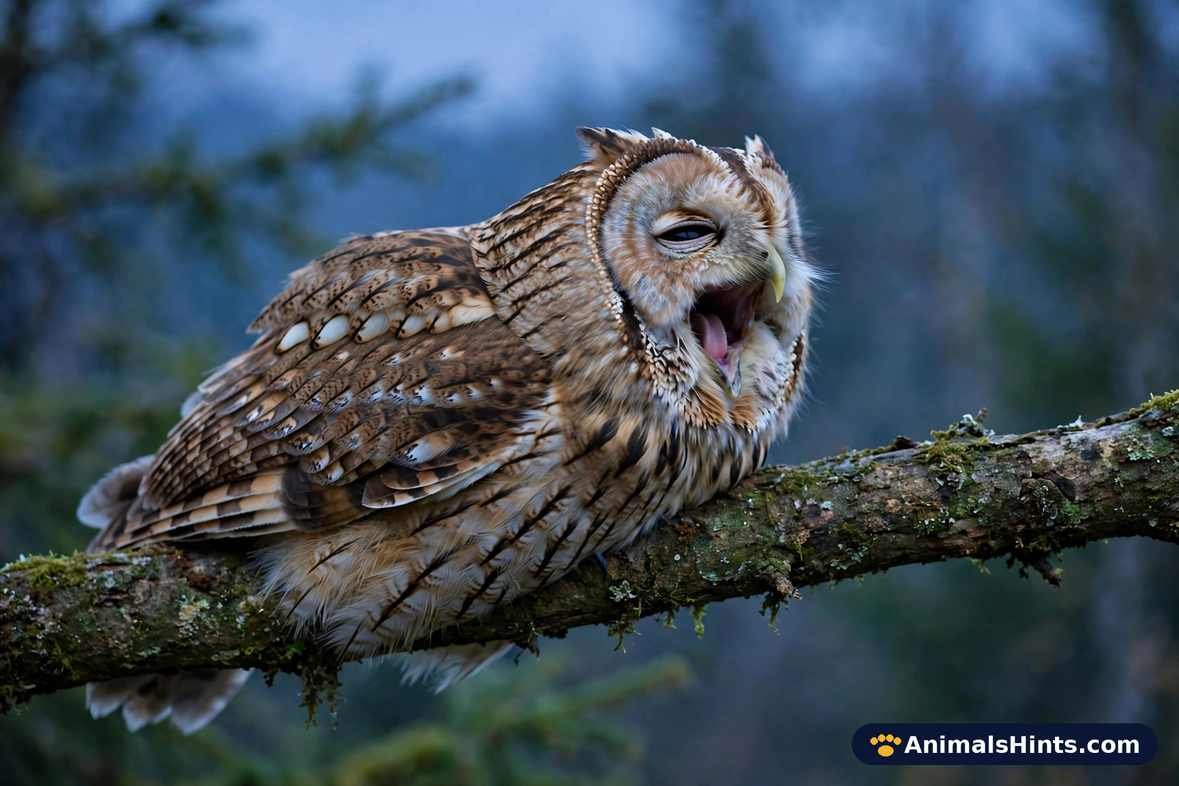
Contagion crosses species lines, which is the animal fact the superstitions never knew they needed. Chimpanzees catch yawns from video of other chimpanzees; budgerigars — social parrots — have shown contagious yawning in experiments; and dogs catch yawns from people: in the best-known study, 21 of 29 dogs yawned after a stranger yawned in front of them, and did not yawn when the stranger merely opened his mouth. Nearly half the dogs in that research also grew visibly relaxed and sleepy, copying the state and not just the gesture. Anyone whose household includes a cat sleeping above your head has watched the domestic version: the pre-sleep and post-sleep yawns of an animal whose day is organised around the transitions the reflex marks. Even the night shift keeps the pattern — the yawning owl of a hundred picture books is a cartoon built on the genuine article.

Good Sign or Bad Sign? An Honest Verdict on Yawning
The traditions do not agree, because they were never answering the same question. Set side by side, the record looks like this:
| The reading | Where it comes from | What the record supports |
|---|---|---|
| Yawning endangers the soul | Older European folklore | The customs are documented (mouth-covering, the signed cross); the danger is the belief, not a finding |
| Yawning in prayer is from Shaytan | Islamic teaching (Bukhari 6226; Muslim 2994) | A documented ruling about attention in worship, with its own remedy: suppress, cover, refocus |
| Yawning releases blocked energy | Modern spiritual writing | The most popular current reading; a metaphor built on the real release a yawn physically performs |
| Someone, somewhere, is thinking of you | Contemporary superstition | No older collected source fetched; yawns are frequent enough to fit any theory daily |
| Contagion proves empathy | Popular science writing | Contested: closeness predicts contagion in some studies; reviewers warn the empathy equation is unproven |
| Yawning tops up oxygen | Schoolroom tradition | Tested and not supported: changing blood gases does not change yawning |
The pattern across the table is the verdict. Wherever a yawning belief can be checked — the oxygen story, the empathy equation, the age of the thinking-of-you rule — the check trims it. What survives is modest and sufficient: yawning is a normal, contagious, still-not-fully-explained reflex that clusters at life’s transitions, and human beings have always decorated their transitions with meaning. Like the itchy neck spiritual meaning record elsewhere in this series, the oldest layers here are thinner and stranger than the modern summaries suggest — one protective custom, one religious ruling — and the elaborate system of signs is recent construction. Recent is not worthless; it works best held as reflection rather than as information about anybody’s future.
A Short, Plain Note on Excessive Yawning
One boundary matters more than any interpretation on this page, stated plainly in the pattern this series keeps for body signs. Ordinary yawning needs no explanation beyond the day that produced it. But yawning that is persistent and excessive — Cleveland Clinic’s clinicians describe excessive yawning as more than three yawns in fifteen minutes, several times a day, sustained over days — or yawning arriving alongside other symptoms, is worth mentioning to a doctor. That is general information, not a diagnosis and not a reassurance: only an examination can say what any individual’s yawning is, and no spiritual reading should be used to postpone that conversation. If yawning of that pattern is yours, book the appointment first and interpret later, if at all.
Final Thoughts
Yawning earns its folklore honestly. It is the most social reflex we have — visible, audible, impossible to fully suppress and liable to sweep a room — and it arrives precisely at the thresholds human beings have always marked: waking and sleeping, gathering and parting, bracing and letting go. Traditions that read it as the soul slipping, a distraction to suppress in prayer, a release to welcome in meditation, or a message to decode are all doing the same thing in different grammars: paying attention to a moment of transition and refusing to call it nothing.
Pay the same attention with the record attached and the yawn keeps its dignity without borrowing anyone’s certainty. It is a six-second reflex older than our species, shared with lions and budgerigars, still unexplained at its centre — and on waking it usually arrives holding hands with a full-body stretch, the yawn-and-stretch reflex whose proper name is pandiculation. Notice your yawns, by all means. Just let the persistent ones be a doctor’s question before they are anyone’s omen.
FAQs
What does yawning mean spiritually?
In folk tradition, a yawn is read as energy moving — release, cleansing or a shift in awareness — and in prayer settings some traditions read it as distraction to suppress while others read it as clearing. These are beliefs about a normal reflex, not findings; science documents the reflex and its contagion without settling what it is for.
What are the superstitions about yawning?
The documented ones are protective: covering the mouth so nothing entered or escaped, and signing the cross over a yawn in plague-era Europe. The popular modern ones — a yawn betrays someone thinking of you, or souls in communication — are recent genre beliefs with no older collected source behind them.
Is yawning a sign of spiritual awakening?
Awakening literature reads clusters of yawning during practice or study as the system adjusting to change. That reading is modern, with no root in the classical contemplative manuals, and it is best held as the genre itself holds it at its most careful: a prompt to patience during a transition, not evidence of an event.
How should I respond to yawning spiritually?
However your own tradition instructs, with the practical floor kept: cover your mouth, let the yawn finish, and refocus — the Islamic ruling and the meditation teachers converge that far. If yawning becomes persistent and excessive over days, or arrives with other symptoms, the response is a doctor’s appointment, not an interpretation.