Northern Flicker Feather Meaning: 12 Meanings, the Real Feather and the Law
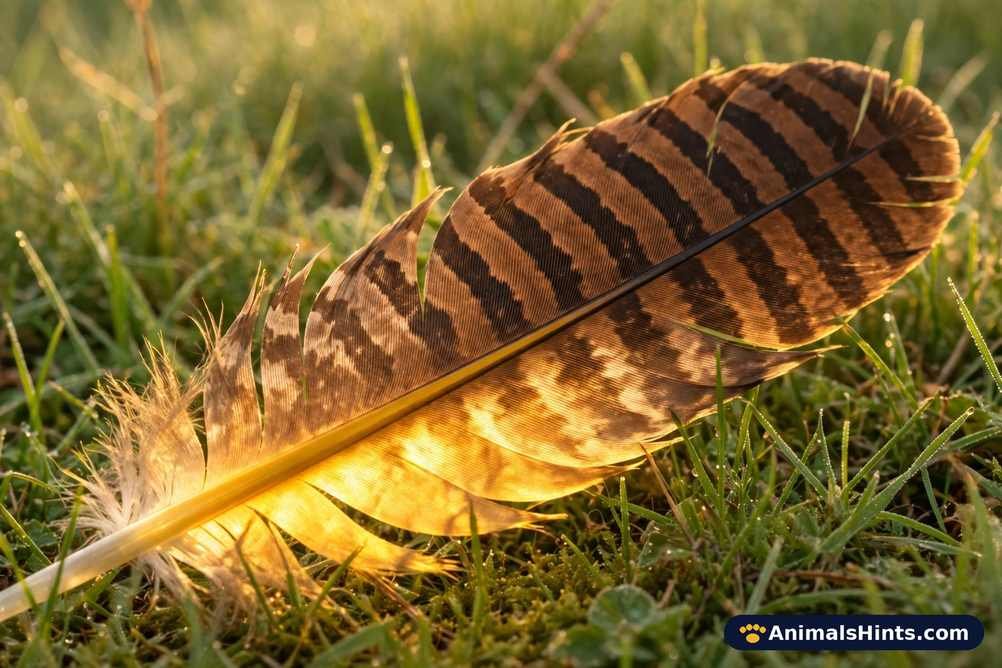
Finding a northern flicker feather meaning anything at all starts, for most people, with a pause on a path: a warm brown feather, barred and spotted, with a shaft that glows yellow or salmon-red when the light catches it. In the modern spiritual tradition that hands these readings down, that pause is the point — the feather is held to signal renewal, guidance through change, protection, and a reminder to settle into your own rhythm, grounded even as you reach.
The bird behind the feather earns some of that symbolism honestly. The northern flicker belongs to the woodpecker family yet spends much of its life on the ground, hunting ants on lawns and in open woods, drumming on trees and occasionally on metal to announce itself, and flashing hidden color — lemon-yellow in the East, salmon-red in the West — every time it flies. Few North American birds carry quite so much contrast in a single body, and the found feather carries a small piece of it.
This guide works through the subject in order: the general reading, a field guide to recognizing the genuine feather, then the dozen traditional meanings, worked through singly, including the responsibility note the subject honestly requires. Culture and the Bible follow, then the good-sign question, simple ways to invite living flickers to your yard, and closing thoughts. Verified natural history is given as fact; the meanings are given as the beliefs their holders hold, named as such.
What Does It Mean If You Find a Northern Flicker Feather?
In the modern tradition most readers share, finding one of these feathers counts as spiritual communication of a grounded kind. Where many feather signs are about messages dropping from the sky, this one is tied to a bird that works at ground level as much as in the trees: it hops across lawns after ants, hammers soil the way its relatives hammer wood, and nests in a cavity it carves for itself. The reading built on that life is about connection in both directions — staying rooted in ordinary life while keeping an inner life awake.
The tradition’s summary meanings gather into five:
- Renewal — a stage closing and another opening, at the pace growth actually takes.
- Guidance — reassurance during a move, a job change, or any passage where the map runs out.
- Protection and luck — the feather as a small emblem of being watched over.
- Rhythm — the drumming bird read as a call to find your own tempo and keep it.
- Joy — a reminder, taken seriously by this tradition, that delight is part of a healthy spirit and not a distraction from it.
None of that is a finding about feathers. It is an interpretation a living tradition offers, and this guide presents it exactly that way — beginning with the part that can be checked: whether the feather in your hand is a flicker’s at all.
The Real Bird Behind the Feather: How to Recognize a Flicker Feather
The northern flicker (Colaptes auratus) is a large, brown woodpecker — the Cornell Lab of Ornithology describes a handsome bird with black-scalloped plumage and a gentle expression. Across its back and wings the feathers are warm brown crossed with neat black barring. The breast and belly are pale and thickly spotted with black, and a bold black crescent — birders call it a bib — sits high on the chest. In flight the bird gives itself away twice over: a bright white patch shows on the rump, and the undersides of the wings and tail flash a color no other common woodpecker wears.
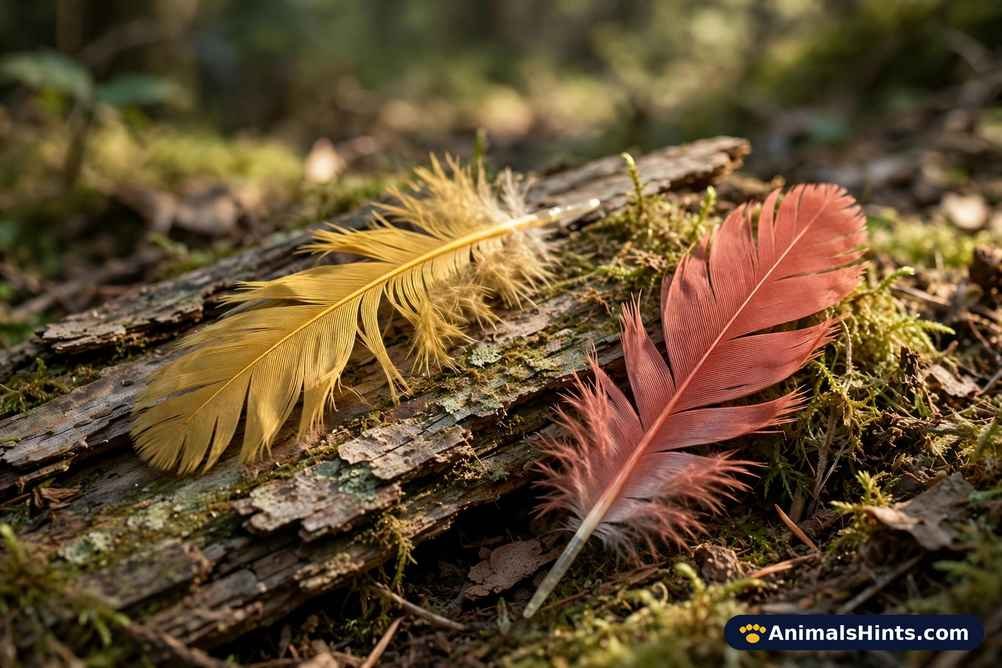
That flash is where the found feather gets its signature, because this single species comes in two forms that were once counted as separate species. The Yellow-shafted form of the East carries lemon-yellow on the shafts of its flight feathers and under its wings and tail; its face is tan, its crown gray, a red crescent marks the nape, and the male wears a black mustache stripe. The Red-shafted form of the West carries salmon-red in exactly those places; its face is gray, its crown brown, there is no red nape patch, and the male’s mustache is red. Where the two ranges meet across the Great Plains, the forms interbreed freely, and an in-between bird — orange shafts, mixed head marks — is an ordinary sight rather than a puzzle.

So a genuine large flicker feather usually announces itself. A wing or tail feather from this bird is warm brown and barred on the upper side, and its central shaft — the stiff spine running down the middle — is colored: clear yellow in an eastern bird, salmon-red in a western one. Smaller body feathers carry the family’s other pattern, pale ground thickly spotted with black, matching the spotted belly the bird shows in life. A plain brown feather with a white or horn-colored shaft may be a fine feather, but it is probably not this one, and the tradition’s reading is best kept for the feather you can actually name.
The habits behind the symbolism are just as checkable. Flickers are the ground specialists of their family — the Audubon field guide tradition notes they are the woodpeckers that habitually feed on the ground, probing with the bill, and ants alone can make up nearly half of what they eat; a flicker will break into an underground ant colony and hammer at the soil to reach the larvae. The famous drumming is communication, not feeding: a bird hammers a resonant surface, wood or metal, as loudly as it can, to hold territory and signal a mate. And like other woodpeckers it excavates its nest hole in dead wood, work that later shelters whole successions of other creatures. Rhythm, persistence, hidden color, and a life split between earth and tree — the folklore did not invent those materials. It selected them.
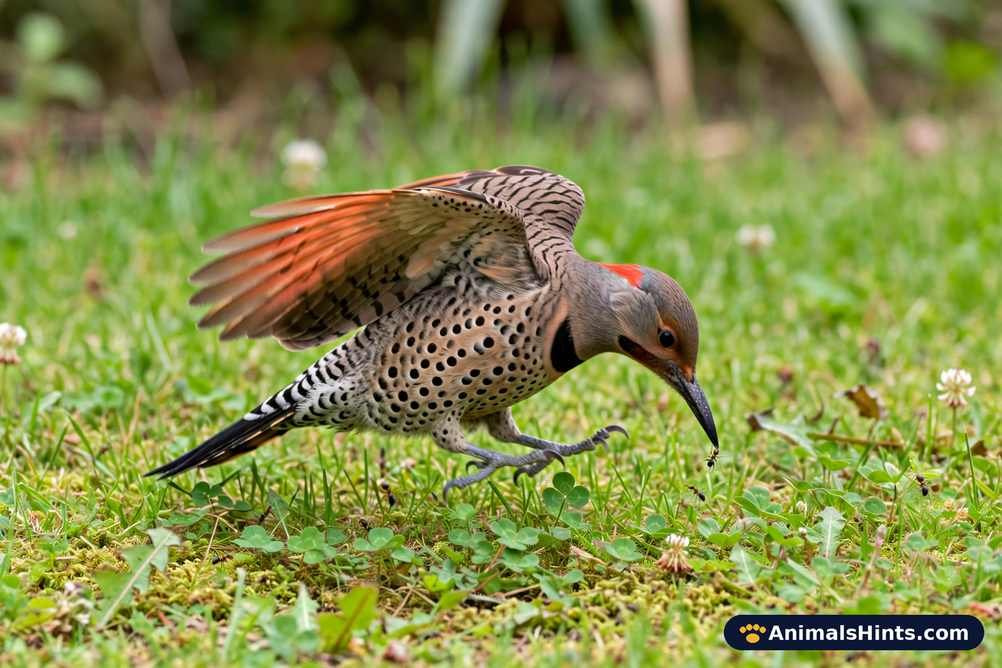
For scale, this is a substantial bird: roughly eleven to fourteen inches long, with a wingspan in the range of seventeen to twenty-one inches. Its flight feathers are correspondingly large, which is one more reason a found one stops people mid-step. It ranges across nearly all of North America, from Alaska and Canada down through the United States, with northern birds retreating south for the winter — one of the few woodpeckers that truly migrate.
12 Spiritual Meanings of Finding a Northern Flicker Feather
The modern guides attach a standard dozen readings to this feather, listed here in their usual sequence. The set comes out of today’s spiritual symbolism, which itself borrows from older folk ways of reading birds; treat what follows as prompts for reflection, never as predictions. A short responsibility note follows the twelve, and on this subject it is not decoration.
1. Renewal and Transformation
The first meaning reads the feather as a marker of personal renewal. The bird’s own year supports the picture in plain terms: plumage is replaced, stage by stage, and the creature that emerges wears the same pattern renewed. In the tradition’s hands, the found feather becomes a prompt to treat change the same way — as something that proceeds in sequence rather than all at once.
Readers reach for this meaning at the familiar thresholds: a move, a recovery, the end of one working life and the uncertain start of another. Its advice is to endure the drab middle stretch of a change, and to trust that letting go of what no longer fits belongs to growth itself — it is no betrayal of the past.
2. Healing and Forgiveness
The second meaning links the feather to healing, and specifically to forgiveness as the mechanism. In this reading, the sighting arrives during emotional recovery — after heartbreak, illness, or loss — and arrives as encouragement to set down grudges and old guilt, not because what happened was fine, but because carrying it is heavy.
Bird feathers have a long folk history as emblems of lightness and release, and this meaning leans on it directly. Its image is of space opening up: what is forgiven stops occupying the room where something better might live. This guide records the reading as strongly as the people who hold it state it; the comfort drawn from it is real, whether or not a reader shares the framework.
3. Trusting Your Intuition
The third meaning makes the feather a nudge toward inner guidance. The flicker’s drumming does the symbolic work here: a repeated tapping at the surface of things until what is hidden is reached, read as a picture of intuition tapping at awareness until it is listened to.
This reading is usually claimed at decision points, when the arguments on both sides have been heard and something quieter is being ignored. Its attached practices are the ordinary ones of the contemplative life — stillness, time outdoors, prayer, a journal kept honestly. The tradition’s claim is not that the feather answers the question. It is that the answer was already present and the sighting is a reminder to consult it.
4. Guidance Through Change
The fourth meaning is the third’s outward-facing twin: reassurance while a change is actually under way. The bird is a genuinely adaptable creature of edges — open woods, fields, suburbs, desert groves where suitable trees stand — and the tradition reads that adaptability as company: you are not crossing this stretch unaccompanied.
Feathers in this meaning tend to be reported at the practical crossings, the house move and the new job and the relationship ending, and they are taken as a steadying sign rather than a directional one. Nothing in the reading claims the path is easy. It claims the walker is resilient enough for it, which the next meanings take up in turn.
5. Connection to the Spirit Realm
The fifth meaning is the most openly supernatural of the twelve, and it is set down here exactly the way its holders tell it. Birds are messengers in a great many folk systems — creatures that move between earth and sky are natural carriers for the idea — and a flicker feather, within this strand, is taken to mean that ancestors, guides, or a departed loved one are near and attentive.
Sightings claimed under this meaning cluster around grief and around prayer, and they are usually described as comfort rather than information: nothing is spelled out, but the watcher feels accompanied. Other bird traditions on this site work the same territory from a different temperament — the crow cawing readings, for instance, lean toward warning and watchfulness where the flicker leans toward reassurance. A reader’s own faith sets the depth at which any of this is held; the biology, as always, is silent on the question, and this guide lets it stay silent.
6. Good Luck and Protection
The sixth meaning is the feather as blessing: good luck arriving and protection in place. In this reading the bird’s alertness is the model — a flicker feeds with its head up between probes, quick to flush at danger — and the feather stands for the same quality transferred to the finder: watched over, and watching.
The luck in this tradition is rarely imagined as a windfall. It is the quieter kind: an opportunity noticed in time, a breakthrough after steady work, a household kept safe. This is also the meaning where the responsibility note below matters most, because luck-and-protection is the reading that most tempts a finder to pocket the feather as a token — and in the United States, as the note explains, the law asks you not to.
7. Creativity and Expression
Rhythm is the seventh meaning’s raw material, read as a creative emblem. Drumming is, in the bird’s life, pure expression: no food is gained by it, no hole dug; it is sound made to be heard, on the loudest surface available. The feather, in this telling, prompts the same move — find your surface, make your sound, stop waiting for a quieter permission.
A creative block is the classic setting for this sighting in the guides, and its counsel is practical: begin the piece of work, in whatever medium, with rhythm doing what inspiration has not. Color supports the reading in a small honest way — this is a bird whose drab-looking back hides yellow or scarlet that only shows in motion, which the tradition takes as a fair picture of a gift that exists only when it is used.
8. Gratitude
The eighth meaning is gratitude, treated as a practice rather than a mood. In this reading the feather arrives when attention has narrowed onto what is missing, and it functions as a small interruption: a beautiful, unusable, legally unkeepable object that can only be appreciated and left — a lesson in enjoying a thing without owning it, delivered by the object itself.
The guides pair this meaning with a concrete habit: naming blessings specifically and out loud, including the lessons carried by hard chapters. Whether a reader frames that as prayer or as psychology, the mechanism the tradition describes is the same one secular gratitude practice describes — attention trained on what is present changes what a life feels like from inside.
9. Resilience and Strength
The ninth meaning answers the fragility a feather suggests. Flickers persist across an enormous range and a long list of habitats, digging their own shelter, raising their young in it, and replacing their plumage year after year. The tradition reads the feather accordingly: strength as endurance and repair, not as force.
This is the meaning claimed most often by people rebuilding — after loss, during a long recovery, in the middle of a season that offers no quick wins. Its emblem within the bird’s life is the nest hole: a home made by patient, repeated effort in hard material, then made again in a new tree when the old one fails. The reading asks for the same unglamorous persistence.
10. Humility and Balance
The tenth meaning is about proportion. For all its hidden color, the flicker is a brown, ground-feeding, ant-eating bird that spends its days in work no one would call glamorous, and the feather, in the tradition’s hands, becomes a reminder to hold gifts and ordinariness together — to know your own worth without needing to prove it on every occasion.
Balance is the meaning’s second strand, and it comes straight from the bird’s posture in the world: a creature of the ground that nests in the air, at home in both, belonging wholly to neither. Readers take it as counsel for the familiar modern split — duties on one side, an inner life on the other, and a livable rhythm owed to each.
11. Adaptability
The eleventh meaning revisits the fourth from a fresh angle: where that one offered company through change, this one teaches a skill for it. In this reading the feather appears when circumstances are asking for a change of approach — not a change of identity, but of method — and it arrives as encouragement to stay curious and light on your feet.
The bird’s record makes the emblem an honest one. Few woodpeckers have colonized as many settings: forest edge and farm, mountain park and city lawn, anywhere that pairs open ground for feeding with dead wood for nesting. The lesson the tradition draws is that the flicker did not survive by being the strongest digger or the boldest flyer, but by being willing to eat what a place actually offers — ants, mostly, a food its more specialized relatives largely ignore.
12. Joy and Playfulness
Delight is where the dozen ends. Flickers are lively birds with a ringing, laughing call, a bounding flight, and a spring display full of bobbing and fencing with the bill, and the feather serves this strand as a recall to that register: wonder, laughter, and small pleasures taken on purpose.
Its setting, in the guides, is the over-serious stretch — the season of duties after duties — and its claim is that joy is a form of resilience rather than a reward saved for after resilience has finished its work. Of all twelve meanings this one asks the least interpretation. A bright thing crossed your path on an ordinary walk. The tradition suggests letting that be enough, and letting it lift the day it landed in.
A Note on Responsibility
This note is kept from the competitor’s own page because it is the most practically important paragraph on the subject, and United States law backs every word of it. The northern flicker is a native migratory bird, and the Migratory Bird Treaty Act makes it unlawful to possess its feathers — or any part of the bird — without a federal permit. The United States Fish and Wildlife Service states the rule at full strength: the prohibition covers all feathers however they were obtained, with no exception for a feather a bird molted naturally or one found beside a path.
So the honest response to a found flicker feather is to admire it, photograph it, and leave it where it lies. Special permit arrangements exist for the use of feathers by Native Americans and for education and research; personal keeping as a souvenir or charm is not among the lawful options. The tradition loses nothing by this. Every meaning in the list above is a reading of an encounter, and an encounter is complete the moment it happens — the feather does not need to come home with you to have done whatever you believe it did.
What to Do When You Find a Northern Flicker Feather
The practical sequence this guide recommends is short, and it respects both the symbolism and the law.
- Look before you touch. Note the shaft’s color first — eastern birds run yellow, western birds salmon-red — along with the barring and the size. That single detail does most of the work of naming the bird, and it is visible without handling the feather at all.
- Photograph it in place. A phone picture keeps everything the moment had to offer: the feather, the setting, the date. It is also, under the law described above, the only keepsake on offer — take a good one.
- Leave it where it lies. Possession of a native migratory bird’s feather without a permit is prohibited under federal law, molted or found. Returning it to the grass is not a lesser response; it is the correct one.
- Check the spot for a window strike. Feathers found in a scatter beneath glass often have a sadder explanation, and the wider subject is covered in our bird flying into a window guide — if a bird is alive nearby, a local wildlife rehabilitator, not a pocket, is the right next step.
- Use the prompt, if it fits. Whichever of the twelve meanings the moment genuinely suggested — a change begun, a grudge set down, a piece of work started — do one small, real thing about it before the day ends, and let the remaining symbolism stay ornamental.
The Cultural Significance of Northern Flickers
One boundary governs this whole section: the northern flicker lives only in the Americas. Every genuine cultural tradition involving this bird is therefore a tradition of the Americas, and any account that places flickers in the folklore of Europe or Asia is describing something else — usually woodpeckers in general, or nothing at all.
In the modern spiritual literature, the flicker is most often presented within Native American frames, as an emblem of rhythm, healing, and following one’s own heartbeat. This guide prints that strand at exactly the strength the record supports. Flickers and their striking feathers do figure in the material culture of a number of Indigenous nations of North America, and birds in general carry messenger and healing roles in many Native traditions; but there is no single Native American teaching about this bird to quote, because there are hundreds of distinct nations with distinct teachings, held with varying degrees of openness to outsiders. The flattened version — one bird, one meaning, attributed to a continent — is a product of modern spiritual publishing, and readers who want a particular nation’s understanding should seek out sources from that nation itself. One legal thread of the real record does deserve its place here: federal law makes specific provision for Native American use of feathers for religious purposes, an acknowledgment that the genuine traditions are living ones with standing the souvenir trade never had.
Beyond that, the honest cultural record is thinner than most guide pages suggest, and this guide says so rather than padding it. The flicker is Alabama’s state bird, under its old folk name of yellowhammer — a piece of documented civic symbolism, earned by a bird common enough in the state’s fields to become an emblem during the Civil War era and after. And in contemporary bird-loving culture the species holds a real place as a gateway bird: big, handsome, findable on a suburban lawn, and strange enough in its habits to turn casual watchers into birders. That is a living cultural significance, even if it is a young one.
The competitor reaches, in this section, for a Celtic strand in which birds that drum are bridge-builders between worlds. It cannot stand as written: no Celtic person ever saw a northern flicker, a species of another hemisphere, and no Celtic flicker tradition exists to draw on. European folklore does give woodpeckers in general honorable roles — the woodpecker was sacred to Mars in Roman tradition and a rain-and-earth bird in various European folk records — but those are the records of other birds on another continent, and this guide keeps them labeled as what they are rather than dressing them in a flicker’s feathers.
Biblical Meanings of Northern Flicker Feather
The Bible does not mention the northern flicker, or any woodpecker, and it nowhere assigns a meaning to finding a feather. What the competitor’s section actually offers — and what this section offers, labeled as such — is a set of biblical images that Christian readers have found the flicker feather brings to mind. That is a legitimate devotional exercise, provided nobody mistakes it for a teaching the text contains.
The strongest of these images is the feather itself as a picture of shelter. Psalm 91:4, in the King James rendering, promises that God will “cover thee with his feathers.” The verse is a metaphor of protection, not an omen about found feathers, and Christian readers who keep it beside a flicker sighting are using it the way the psalm invites — as a picture of being covered and safe.
The second image is the built home. A flicker carves its household out of solid wood by slow, skilled labor, and readers have paired it with Proverbs 24:3 in the King James rendering: “Through wisdom is an house builded; and by understanding it is established.” The pairing is a reflection, not an exegesis — the proverb is about wisdom’s household generally — but it is an apt one for a bird whose home is quite literally built by persistent, knowledgeable work. The tradition’s third thread, the “still, small voice” of 1 Kings 19, is sometimes connected to the flicker’s quieter signals; it belongs to the same category of personal devotion. The comfort is the reader’s. The text’s own claims stay where the text put them.
Is Finding a Northern Flicker Feather a Good Sign?
Within its tradition, yes — unusually unanimously. Every strand of modern writing surveyed for this guide treats the flicker feather as a positive sign: renewal, healing, guidance, protection, gratitude, joy. No school of the tradition treats it as a warning of harm, and the bird’s own character helps explain the consensus, since the readings are built from an adaptable, persistent, ground-and-tree creature rather than from a predator or a carrion bird. Other bright birds gather similarly warm readings — our cardinal and blue jay companion piece tracks two of them — but the flicker’s set is distinctive in how practical it stays: its good news is mostly about rhythm, work, and steadiness rather than about fortune arriving from outside.
Two honest qualifications complete the verdict. The first is the tradition’s own: several of its meanings involve an ending — a stage closing, a grudge released, a method abandoned — so its “good” can arrive wearing the clothes of a loss, and its holders call that mercy, not contradiction. The second is this guide’s: outside the tradition, what you have found is a feather from a protected native bird, beautiful, identifiable, and to be left where it lies. The two verdicts sit comfortably together, and most readers, in practice, hold both.
How to Welcome Northern Flickers to Your Yard
The best answer to a found feather is a living bird, and flickers are unusually welcome-able, because their needs are specific and a suburban yard can meet most of them.
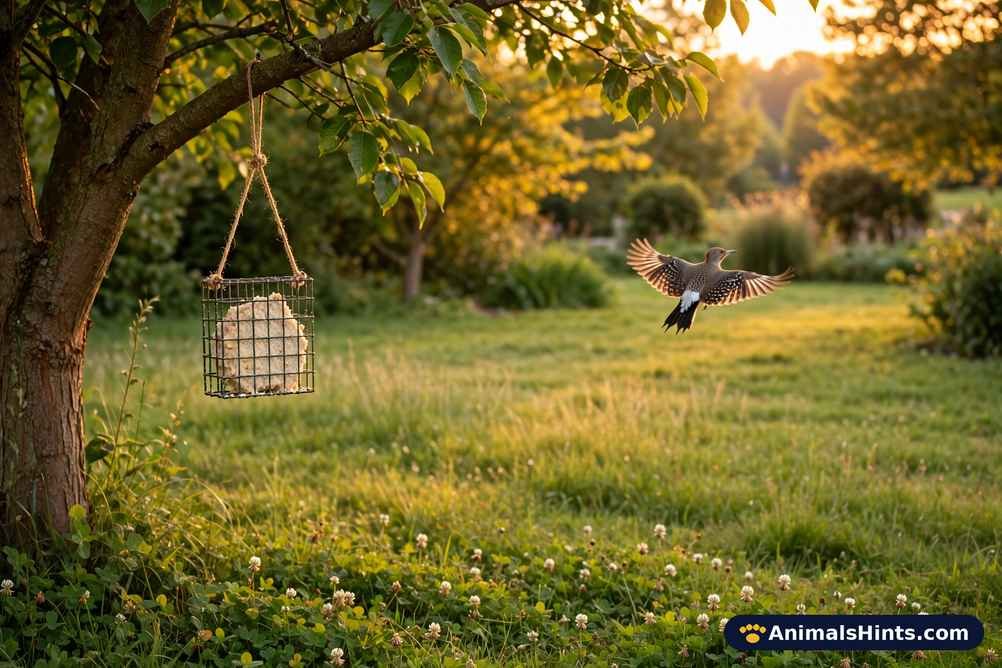
- Leave them their ants. Flickers are the ant specialists of the woodpecker family, and a lawn kept free of broad insecticide is, to a flicker, a stocked pantry. The single most effective welcome is an unsprayed patch of ground.
- Keep a dead tree, if you safely can. Nesting and roosting cavities go in dead wood, and a standing snag that threatens nothing is prime flicker real estate. Where a snag is impossible, a large nest box built to flicker dimensions is the accepted substitute.
- Offer suet in winter. Flickers take suet readily, especially in the cold months when insects thin out; a feeder against a trunk suits their clinging posture.
- Add water and native planting. A ground-level birdbath matches a ground-feeding bird, and native shrubs and trees supply the berries and seeds flickers turn to in winter.
- Let the drums be. Spring drumming on a gutter or a hollow trunk is advertising, not damage, and it stops when the territory is settled. A yard that hosts it is, by the bird’s own accounting, a good address.
Final Thoughts
A northern flicker feather is one of the few found feathers a walker can genuinely name: barred brown above, and a shaft of clear yellow or salmon-red that narrows a whole continent’s worth of birds down to one species and even to one half of its range. The tradition built on it has chosen its emblem well. This is a bird that digs its own home, drums its own announcements, hides its brightest colors until the moment it moves, and feeds close to the ground on the yard’s most ordinary food — and the readings of renewal, rhythm, protection, and joy follow that life instead of drifting loose from it.
Hold the encounter in the manner this guide has tried to handle the subject throughout: the biology exact, the meanings attributed, and the feather itself left lying in the grass where the law and the bird’s own economy say it belongs. Photograph it, record which color the shaft carries, and take whichever of its prompts was honestly yours. Long after the feather has gone back to the soil, the living bird may well be working your lawn at dawn, dressed in nothing more mysterious than its own barred and spotted plumage — its colors, as the Migratory Bird Treaty Act quietly insists, being for witnessing rather than keeping.
FAQs
What does finding a Northern Flicker feather mean spiritually?
In the modern spiritual tradition it stands for renewal, grounding, and guidance — a prompt to settle into a rhythm of your own while staying rooted as you reach. The bird’s split life between ground and tree is the picture the whole reading is built on.
What is the spiritual significance of the Northern Flicker?
Its significance, in the tradition, gathers around resourcefulness and rhythm: an adaptable bird that finds food where others do not look, drums its presence rather than singing it, and flashes hidden yellow or red only in flight. Grounding with aspiration is its standard summary.
What does it mean when you find a woodpecker feather?
In the same tradition, a woodpecker feather generally carries the family’s themes — opportunity found by persistent effort, attention to timing, and staying connected to the physical world while you work. A flicker feather adds its own color code: a yellow or red shaft, which is also how you know the feather is truly a flicker’s.
How should I respond to finding a Northern Flicker feather?
Look closely, note whether the shaft runs yellow or red, then take a photograph — and leave the feather in place, since federal law protects native migratory birds’ feathers from possession without a permit. If one of the traditional meanings spoke to your situation, the tradition counsels a single small, concrete response that same day.