Picture Falling Off the Wall: Spiritual Meaning, the Omens and Why Pictures Fall
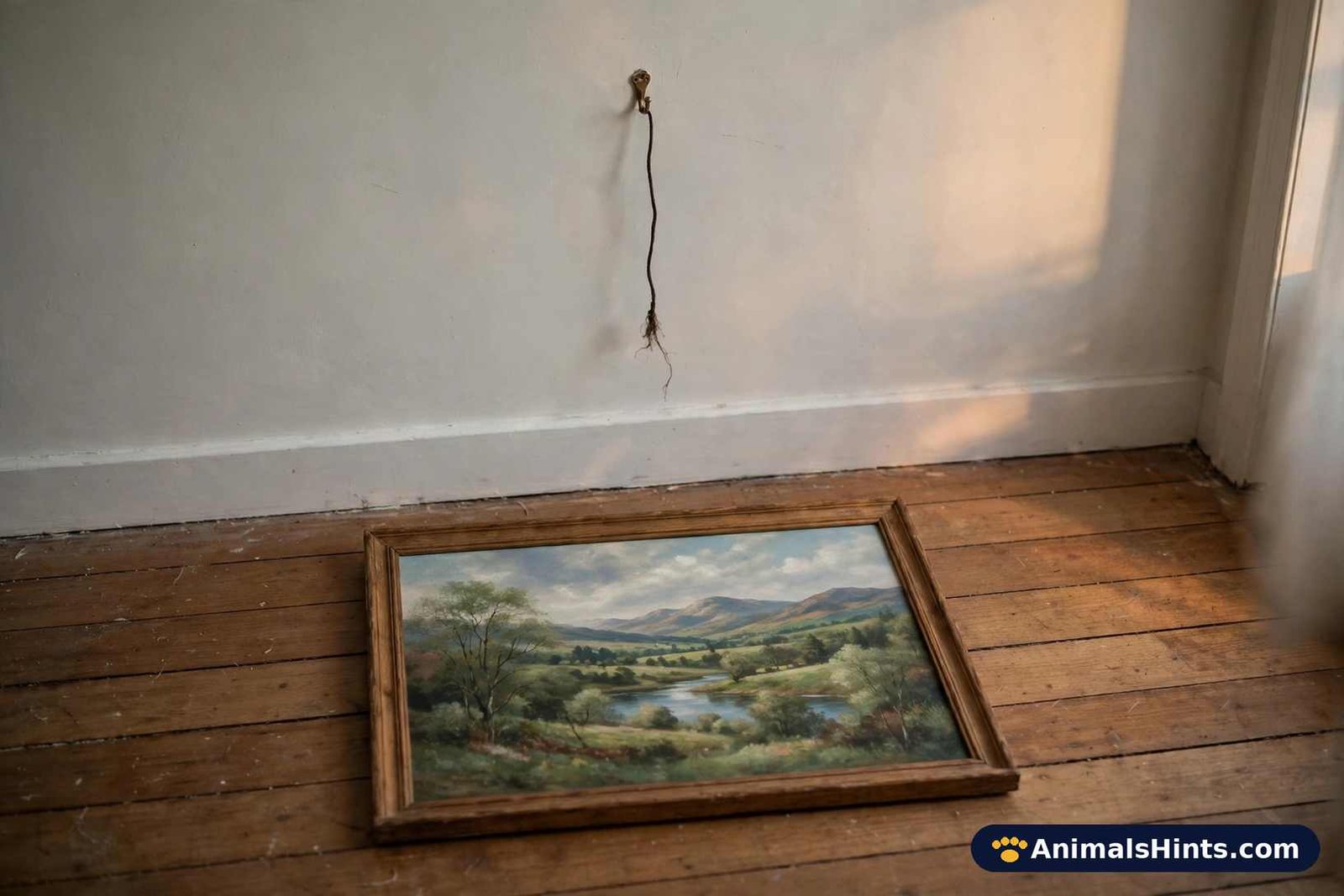
The crash is what people remember: a frame that has hung quietly for years lets go, drops, and lands face-up on the floor with its cord snapped. The picture falling off the wall spiritual meaning, as modern spiritual writing tells it, is a summons to attention — change moving through a life, old attachments loosening, a household being asked to look at itself. That is the genre’s reading, and this guide gives it in full. But two plainer things stand in front of it, and both are set out here with equal care: pictures fall because fixings wear out, predictably and mechanically — and the oldest folklore about a fallen picture is not the gentle modern reading at all, but a death omen that the printed superstition books carried for generations and that no record supports.
The event feels charged for honest reasons. A picture is not furniture in the way a chair is furniture. It holds a face, a wedding, a landscape somebody loved, and it holds them still, at eye level, for years. When the stillness breaks — glass cracking, the frame split, a grandmother’s photograph lying in the hallway — the mind reaches for a message before it reaches for the dustpan. Folklore reached the same way, hardest of all in the Victorian decades, when houses were full of portraits and mourning was a public language.
What follows keeps the three layers separate. First, the tradition’s ten readings, given whole and labelled as beliefs. Then the subject question — whether it matters whose picture fell — and the myths, including the death omen stated exactly as the old books state it and answered head-on. Then the physics: why wires, nails and adhesives actually give up, and a practical section on checking a fixing, handling broken glass safely, and rehanging a picture so it stays hung.
What Does Paintings or Pictures Falling Off the Wall Symbolize?
In the symbolism the genre works with, a hung picture is an anchor. It fixes a moment — a face at a certain age, a place as it once was — and holds it in the present tense, on the wall, where it can be met every day. Walls, in the same grammar, stand for the structure of a life: the arrangements that hold. A picture on the wall is memory given a permanent address inside that structure.
So when a picture falls, sign readers treat the event as the anchor slipping. The reading they build on it runs in a consistent direction: something preserved is asking to be re-examined. A memory may have finished its work. A relationship pictured on the wall may have changed shape since the photograph was taken. The household’s arrangements — the wall itself, in the metaphor — may be under a strain the fall is said to announce.
Held on those terms, the symbolism works less as a verdict than as a prompt, and the better writers in the genre say so themselves: the fall interrupts routine, and interruption is the whole mechanism. Nothing in the event, on the genre’s own best account, specifies what you will find when you look. It only insists that you look. The ten readings in the section after next are the tradition’s standard answers to what people find — and the section immediately below is the one this guide insists on reading first, because a fallen picture also has a mechanical biography, and it is usually a complete explanation on its own.
Why Pictures Actually Fall: Wires, Nails, Damp and Vibration
A picture almost never falls without a cause. It falls without a noticed cause, which is a different thing — and the difference matters, because the old superstition drew its power precisely from falls that seemed to come from nowhere. Work through the hardware, and “nowhere” nearly always turns into a specific, ordinary failure that had been developing for months or years.
The cord or wire gives out first, most often. A hanging cord or braided wire carries the frame’s whole weight on a few strands, and it ages: strands fray where they rub over the hook, old cord rots and dries, wire fatigues where it was twisted tight years ago. Failure is gradual and then sudden — the last strand parts on an unremarkable Tuesday. Notice, too, that the folklore’s own prize anecdotes run on exactly this mechanism: the portraits in the old stories come down because “the cord that held it on the hook, having snapped.” The omen books recorded the snapped cord themselves, and read past it.
The hole grows. A nail or screw in plaster or drywall sits in a hole that widens microscopically with every small movement — doors closing, seasons swelling and shrinking the wall, the picture being lifted off and rehung for dusting. Hardware guidance is blunt about how little a plain nail in bare drywall holds: only a few pounds, five to ten in the usual tables, before the gypsum around it crumbles. Driven into a wall stud, the same nail is good for roughly twenty pounds. A frame that was always slightly too heavy for its nail does not fall the day it is hung. It falls the day the enlarged hole finally lets the nail tilt and slip — which can be years later, at 3am, for no visible reason.
Hooks bend and adhesives let go. Thin picture hooks straighten slowly under a load near their limit. Adhesive strips and pads soften in heat and bathroom humidity and release without any warning at all — the frame simply slides and drops. Vibration works on everything at once: slammed doors, washing machines, heavy traffic, a house settling on its foundations. Each tremor walks a hook a fraction of a millimetre toward the edge of its hole.
None of this requires a heavy frame or a bad wall. It requires only time. Every fixing in every house is on a slow countdown set by its materials, its load and its wall — which is why falls cluster in old hangings, in humid rooms, and in the small hours, when a quiet house makes the crash impossible to miss. Keep this section in mind through everything that follows: whatever else a fallen picture may be read as, it is always, first, a fixing that reached the end of its life.

10 Spiritual Meaning of Picture Frame or Painting Falling off the Wall
Ten readings recur whenever this genre takes up a fallen picture, and they are gathered here on the only terms they can honestly be offered: as beliefs the tradition holds, not as findings about what a falling frame does. Read them on those terms.
1) Emotional Awareness
The first reading treats the fall as an interruption aimed at feelings that have been running unattended. Pictures preside over the emotional life of a house, and the tradition reads their fall as the household’s buried material asking for a hearing: stress filed away, sadness postponed, a mood everyone has been stepping around. The crash, in this reading, is the point — it stops the day’s machinery long enough for a person to notice what they have actually been feeling.
2) Upcoming Change
The second reading is the genre’s commonest. Walls are stability and pictures are the stories fixed to them, so a fall is read as movement arriving: a job, a household arrangement, a belief that once felt permanent beginning to shift. The careful version of this reading calls the fall preparation rather than prophecy: a transition noticed while it is under way, not one foretold.
3) Release of Old Attachments
A wall of pictures is an archive of the past, and the third reading turns on which past it keeps. A fallen image is read as an attachment that has outlasted its usefulness — an old grievance, a finished relationship still given wall space, a version of oneself kept framed long after it stopped being true. The fall is taken as permission to take the picture down in every sense: honour what it records, and stop letting it govern the room.
4) Spiritual Protection
The fourth reading runs the other way from fear: the fall, in this strand, is protective. A guardian presence is said to knock the picture down to draw attention before something worse develops, or the object is said to take a blow meant for the household. It is set down here as a belief — a strand of the tradition that reads the event as care rather than warning — and it is the version quoted most by people who found the experience comforting rather than frightening.
5) Energy Shift
The fifth reading works with the language of household energy. Homes, in this frame, absorb the emotional weather of the people in them, and a sudden fall is read as the moment a build-up of tension, grief or staleness discharges. The practices that follow from the reading are domestic ones — airing rooms, clearing clutter, prayer or meditation — and the fall is treated as the signal that the house’s atmosphere needs attention.
6) Reconnect with Loved Ones
Pictures on walls are mostly pictures of people, and the sixth reading follows the subject: a fall counts, in this strand, as a pointer toward the living person in the frame — a call unmade, a visit postponed, a relationship running on habit. The tradition treats the fallen photograph as the household’s address book reminding its owner which entries have gone quiet.
7) End of a Past Phase
The seventh reading leans on the second, with the emphasis on endings rather than arrivals. A phase of life — a job’s chapter, a child’s years at home, a long arrangement — is read as complete when its picture comes down, and the fall is taken as the full stop that closes the sentence. In this strand the correct response is acknowledgement rather than repair: some pictures are not meant to go back up in the same place.
8) Unresolved Emotions
Where the first reading is about awareness in general, the eighth is about specific unfinished business. A picture tied to a particular memory falls, in this reading, because the emotion stored with that memory has not been processed — grief not finished, guilt not settled, a conversation never had. The fall is treated as the subconscious putting the file back on the desk.
9) Ancestral Presence
The ninth reading is the tradition’s oldest-feeling strand: ancestors make themselves known through the physical house, and a picture moving or falling — above all a picture of the ancestors — is read as presence rather than accident. Quiet moments are named as the usual setting. This is the strand the death-omen folklore grew out of, and it is stated here at the strength its believers give it; the myths section below sets out what the old books actually claimed, and the honest-reading section gives this guide’s verdict on those claims.
10) Restore Balance
The tenth reading gathers the others into a single instruction: something has tilted — work against rest, giving against receiving, the past against the present — and the fallen frame is read as the tilt made visible. Restoring balance, in this strand, is practical before it is mystical: put the room, the schedule and the priorities back on their feet, and rehang the picture level.

Spiritual Meaning of Picture Frame Falling and Breaking
One event in the genre is a frame that merely falls; a frame that falls and breaks is read as a stronger version of it. The frame, in this symbolism, is the boundary — the shaped edge that keeps a memory contained and protected — so a broken frame is read as a boundary giving way: limits built long ago being pushed against, emotional walls thinning, something kept private becoming exposed.
The tradition draws two morals from the breakage, and they pull in opposite directions, which is worth noticing. In one, the cracking of the protection is vulnerability arriving — feelings surfacing that were kept behind glass. In the other, it is freedom: the image no longer confined by its edges, a self outgrowing the role it was framed in. Both are printed here as the genre’s readings, not as findings.
One plain fact belongs in this section before any symbolism, and this guide will not bury it: a broken frame means broken glass on a floor, and that is a household hazard before it is a symbol of anything. The practical section below covers clearing it safely and deciding what should hang over beds, sofas and children’s rooms. Read the breakage spiritually if you wish — after the glass is swept up.
Meaning of Picture Fell Off Wall at 3am and Other Times of the Day
The genre also reads the clock. In its timing tradition, the hour of a fall colours the message: the deep-night hours are treated as the time when the boundary between the seen and the unseen runs thinnest, morning falls are tied to beginnings, and evening falls to reflection and letting the day close. The table below is the tradition’s standard scheme, kept in its own terms.
| Time of Day | Spiritual Interpretation |
|---|---|
| Early Morning (12am–4am) | Messages and presences; heightened awareness |
| Morning (5am–11am) | Beginnings; fresh insight arriving |
| Afternoon (12pm–5pm) | Clarity; something asking to be noticed |
| Evening (6pm–11pm) | Reflection, closure and release |
Two honest notes belong beside the table. First: 3am falls dominate the stories people tell for a mechanical reason — at 3am the house is silent, the hearer is asleep in the next room, and a crash that would be a minor noise at noon becomes the loudest event of the night. Second: a fixing cannot tell the time. The wire that parts at 3am was fraying at 3pm; the hour governs how the fall is experienced, and the genre’s table is a table about experience. Read it at exactly that strength.
Biblical Meanings of Pictures or Paintings Falling Down
This section needs its boundary stated first, plainly: no biblical text mentions a picture or painting falling off a wall, and nothing in Scripture interprets such an event. Wall-hung portraits belong to a world long after the Bible’s. Whatever this section can honestly offer is the material the competitor tradition usually reaches for, quoted exactly and bounded to what it actually says.
The verse most often cited is Proverbs 16:18, and in the King James wording it runs: “Pride goeth before destruction, and an haughty spirit before a fall.” The fall in that sentence is a person’s — the collapse that follows pride — and the verse is a piece of moral instruction about inner posture. It says nothing about objects, omens or walls, and using it to interpret a fallen frame is an application later readers have built on top of it, not a teaching the text contains.
Ecclesiastes 3:1 is the second usual citation: “To every thing there is a season, and a time to every purpose under the heaven:” — a poem about the appointed seasons of a life, which the genre borrows for its change readings. Hebrews 12:11, the third, concerns discipline and its later fruit of righteousness; it is about correction endured, not about signs sent through household objects.
What Scripture genuinely does contain is a strong culture of remembrance: stones raised as memorials, feasts kept as reminders, words written down so they would not be forgotten. A household that treats its photographs as memorials is doing something the Bible’s world would recognise. But the step from “pictures serve remembrance” to “a fallen picture is a message” is a step the Bible itself never takes. Christians who read such an event spiritually are exercising personal reflection, and this guide files it as exactly that — reflection, honestly labelled, with the gap left visible rather than papered over.
Family Picture Fell Off Wall Meaning
The family photograph is the case readers ask about most, and the genre’s reading of it is the gentlest in the set. A family picture concentrates a household’s shared history in one frame, so its fall is read as movement inside that history: roles shifting as children grow and parents age, distance opening between people who used to be in daily contact, a tension nobody has yet said out loud. The fall is taken as the family’s portrait asking for the family’s attention.
In its softer form, the reading is barely an omen at all — it is a reminder with good timing. Photographs of people we love are easy to walk past ten thousand times; a fall forces the picture into the hands, and the hands tend to do what the tradition recommends anyway: look at the faces properly, make the call, plan the visit, say the unsaid thing while it can still be said in person.
There is also a protective version in the tradition, in which the fall draws attention to family wellbeing at a strained moment, with the awareness itself counted as the protection. And there is a harder variant, attached specifically to photographs of people who have died, which belongs to the oldest folklore of all. That variant gets its own full treatment in the myths and honest-reading sections below, because it deserves to be stated exactly and answered carefully rather than blended into this gentler material.
Does It Matter Which Picture Fell? Portraits, Family Photos and Images of the Dead
The genre’s answer is yes — the subject is treated as the point of the fall: whose picture came down is read as where the meaning lands — and the variants are worth separating, because they are not all the same age or the same kind of claim.
A family photograph carries the reading given in the section above: relationships, distance, attention owed to the people in the frame.
A portrait of a living person carries the oldest and darkest variant. In the printed superstition books, a fallen portrait was read as danger aimed at its sitter — the claim is stated in full in the myths section below and answered in the honest-reading section. It is folklore, centuries deep in print, and it is not a finding about anyone’s safety.
A photograph of someone who has died is read two ways in the modern tradition. The older way belongs with the portrait omen: the fall concerns the person pictured. The newer way, common in contemporary spiritual writing, reverses the direction — the fall is read as the dead person’s presence or visit, a sign of nearness rather than of harm. Both are beliefs. Neither is supported by any record this guide could check, and the second, whatever its comfort, should not be allowed to borrow the authority of age: it is a modern reading, and a gentler one, set over a much older and grimmer belief.
A religious image — a saint’s picture, a crucifix — carries, in the southern Italian tradition as it is usually retold, the strongest form of the death omen: such an image falling of its own accord is treated there as an almost undeniable sign of a death coming in the family, met with immediate prayer. It is printed here as attributed regional folklore, the most intense local form of the general portrait belief.
Artwork and landscapes, finally, carry the lightest readings in the genre — the change, release and balance meanings of the ten above, with no person addressed at all. A reader who finds the subject-readings unconvincing can note the pattern honestly: the closer the picture stands to a person, the heavier the folklore hung on it — which says more about what people fear losing than about what frames do.
Myths and Superstitions Associated with Pictures Falling Off the Wall
Around falling objects, folklore has been accumulating for as long as pictures have hung on walls. What follows is the tradition’s own account of itself, strand by strand, each stated as the belief it is.
First among them stands the death omen, and it is not a modern internet invention — it stands in the printed superstition collections of the last century and the one before. Astra Cielo’s Signs, Omens and Superstitions states it without qualification: the falling of a picture from the wall “is universally regarded as a bad omen and frequently foretells the death of the original of the picture in the case of a portrait.” Everybody’s Book of Luck, an American collection of the same shelf, puts it more bluntly still: “If the cord of a picture frame snaps and the picture falls to the ground, it is an omen that somebody is going to die” — and, for a portrait of a living person, that the death foretold is the sitter’s. Slavic tradition, as it is still retold in families from that part of the world, holds the same belief: a fallen portrait warns of a death or of bad news, and shattered glass makes the warning graver.
The belief flourished hardest in the Victorian era, when death was a central preoccupation of the culture — the age of elaborate mourning dress, of clocks stopped at the hour of death and mirrors covered so the soul would not be trapped. Houses full of portraits and minds full of mourning made the falling picture a ready-made omen, and the era’s storytellers supplied it with cases: Cielo relates, as evidence, an English archbishop who found his portrait on his study floor and died shortly after, and a Duke of Buckingham whose portrait came down in the council chamber before his own death. These are anecdotes printed in a book of omens, offered by their author as proof; they are recorded here as what they are — the folklore’s own exhibits, unverified then and unverifiable now.
Softer strands run beside the grim one. In some tellings a fallen picture announces incoming news rather than a death. In others, spirits moving through a house displace objects as they pass. In a third, the fall itself is the protection: the picture comes down in place of the worse thing, spending the harm on itself — the same protective reading that appears as meaning four in the genre’s modern list. Household omens of every kind travel in this family; the questions people bring to a fallen picture are close cousins of the ones they bring to finding a dead bird at the door, and both deserve the same treatment: the folklore stated fairly, and then the record checked.
The record is checked in the next section but one. First, the dream version of the event — because for many readers the picture that falls is one they only dreamed about.
Meaning of Dreams About Pictures or Paintings Falling Off the Wall
In dream-reading, pictures stand for memory and identity — how the dreamer keeps the past, and how they see themselves — so a dream in which a picture falls is read as movement in exactly that territory. The genre’s conventions run in a consistent direction: an image that will not stay fixed is taken to picture a self-image or a settled memory beginning to shift, a fear of losing stability, or a readiness, not yet admitted awake, to let some part of the past come down.
The dreamer’s reaction inside the dream is treated as the telling detail. Calm, in the dream, is taken for acceptance of the change under way; panic, for resistance to it. All of this is offered as the genre’s convention, nothing more — dream dictionaries settle nothing, and the modest version needs no apparatus at all: people dream about the objects their houses and memories are made of, and a dream of a falling picture usually arrives in a life where something pictured — a role, a relationship, a version of oneself — already feels less fixed than it did. This site reads every dream the same way — the teeth dreams and dreaming about your ex included: as the dreamer’s own weather, reported honestly, and never as news about anyone else.
Is It Bad Luck If a Picture Falls Off the Wall?
The short answer the genre gives is no — with a footnote. In the modern readings collected above, a fall is a prompt, a protection or a transition, and none of the ten is a punishment. The bad-luck reading belongs to the older folklore, where the fall was an omen outright; that claim is the subject of the next section, and it does not survive it.
What this section can honestly add is the distinction this whole article rests on: luck is a story told about an event, and this event — a worn fixing letting go — is fully explained before luck is needed. Readers who still feel the tug of the old reading are in plentiful company; the honest section that follows is written for them.
Is a Falling Picture an Omen of Death? An Honest Reading
No. Underneath most searches on this subject sits one frightened question — the genre’s ten gentle readings are what people find, but the old omen is what many of them came fearing — so it gets its answer gathered in one place.
What the folklore claims, stated fairly, is set out in the myths section above: a picture falling without apparent cause foretells a death — of the person pictured, if it is a portrait, or of someone in the household. The claim is genuinely old in print, genuinely widespread, and was genuinely believed, above all in the Victorian decades. None of that makes it true. It makes it a well-documented belief, which is a different thing.
What the record shows is threefold. First, the mechanism: pictures fall because cords fray, holes widen, hooks bend, adhesives soften and houses tremble — gradually, predictably, and in every house in the world. The folklore’s own prize cases run on snapped cords. Second, the arithmetic: a single home may hold dozens of pictures across decades, every one of them on a fixing with a finite life, while deaths — in a wide family, across the same decades — also arrive. Given that many falls and that many losses, some falls will land near some deaths by ordinary chance, and those are the ones that get remembered and retold; the thousands of falls followed by nothing at all leave no story behind. Third, the exhibits: the archbishop and the duke are anecdotes in an omens book, selected by a believer precisely because they fit. A record assembled that way can illustrate a belief; it cannot test one — and no checked source, traditional or modern, supplies anything stronger.
The same discipline this site applies when a death lands on a charged date — the readings gathered around someone dying on your birthday — applies here unchanged: a coincidence can be carried as meaningful by the person it touches, and that carrying is a real and human thing. What it cannot do is predict. A picture falling in your house forecasts nothing about anyone’s death, anyone’s luck or anyone’s safety from fate. It forecasts, with complete reliability, that a fixing needs replacing.
If the omen has frightened you — particularly if the fallen picture was a portrait of someone you love, or of someone already gone — it is worth hearing the plain version once more: frames fall in every house, in every country, every day, and the overwhelming majority of those falls are followed by nothing but a trip to the hardware shop. The fear is the superstition’s last mechanism, and setting the superstition down is allowed to be a relief.
After a Picture Falls: Check the Fixing, Mind the Glass, Rehang It Right
Whatever a fall may mean to you, it leaves three practical jobs behind, in this order.
First, the glass. A fallen frame may have cracked glazing even when it looks intact, and a frame that broke has put shards and splinters on the floor where bare feet, children and pets will find them. Keep people and animals out of the room until it is cleared; pick up large pieces wearing gloves, sweep, then go over the area with a damp paper towel or a vacuum to lift the fine splinters that catch the light at ankle height. Check the picture itself last — glass dust scratches photographs and prints, so lift the artwork out away from the broken pane rather than sliding it across.
Second, the diagnosis. The failed part tells you what to fix. A snapped cord or frayed wire is replaced, never re-tied — the remaining strands are the same age as the ones that parted. A nail that pulled out has left an enlarged hole: rehanging on the same nail in the same hole is scheduling the sequel, so move the fixing, use a proper wall plug or anchor, or find the stud. A bent hook is replaced with a rated one. A failed adhesive strip means the surface, the weight or the room’s humidity beat it — clean the wall properly, respect the strip’s weight rating, and keep adhesive fixings off bathroom and kitchen walls, where heat and steam are working against them from the first day. Where the fall happened matters too: a heavy glazed frame over a bed, a sofa or a child’s room is the one fall that can genuinely hurt somebody, and for those positions the honest advice is to upgrade the fixing well past the frame’s weight — or swap the glass for lightweight acrylic glazing — rather than simply putting the same arrangement back.
Third, the rehang. Match the hardware to the frame’s actual weight, weighed or honestly estimated: a plain nail in bare drywall is a few pounds’ worth of fixing and no more; a nail or screw into a stud carries a picture of twenty pounds or so; heavier pieces belong on rated hooks, wall anchors or toggle bolts, which hardware guidance rates up to around a hundred pounds. Wide frames hang best from two hooks, which share the load and keep the picture level instead of letting it seesaw on one wire point. The heaviest pieces are safest on a French cleat — a bevelled strip screwed across the studs, spreading the weight along the wall instead of concentrating it on a single point. Finish by standing back and doing what the folklore never suggests: give the frame a gentle downward tug. A fixing that survives an honest test pull today is very unlikely to be telling you anything at 3am.

Final Thoughts
A fallen picture sits at a crossroads where three true things meet. It is a piece of household physics reaching its predictable end — a cord, a hole, a hook, worn out on schedule. It is the trigger for one of the oldest printed omens in the house, a belief the superstition books carried in deadly earnest and that the record, examined fairly, does not support for a moment. And it is, undeniably, a jolt: a face or a loved landscape suddenly on the floor has a way of making a household look at itself, and the modern genre’s ten readings exist because that jolt is real and people want language for it.

Hold the three in their proper order and none of them has to be surrendered. Let the readings do the work they are good at — prompting the call, the visit, the honest look at what has shifted — and let the folklore be what it demonstrably is: a record of how frightened people in mourning-heavy centuries explained a crash in the night. What no reader owes the event is fear. The human mind is a pattern-making instrument, and psychologists have a name for its overreach — apophenia, the habit of perceiving connections and meanings in unrelated events — which is worth knowing about precisely because the habit is universal, ordinary and no respecter of intelligence.
So sweep the glass, look at the picture properly while it is in your hands — perhaps for the first time in years — and hang it back on hardware that deserves it. If the moment also moves you to ring the person in the photograph, the tradition and this guide agree on that much: it is the one message a fallen picture reliably delivers.
FAQs
1. What does it mean spiritually when a picture falls off the wall?
Modern spiritual writing takes it as a summons to attention — change under way, old attachments loosening, or emotions asking to be faced. The older folklore read a fallen picture as a death omen; no record supports that claim, and physically the fall means a fixing has worn out.
2. Does the type of picture that falls matter spiritually?
In the genre, yes: family photos are read toward relationships, portraits toward their sitter, images of the dead toward presence, and artwork toward change in general. The subject certainly changes how a fall feels. It does not change what caused it — that is always the wire, the nail or the wall.
3. What should I do if a picture falls off the wall in my home?
Clear any broken glass first, keeping children and pets away until the floor is safe. Then check what failed — cord, nail, hook or adhesive — replace that part rather than reusing it, and rehang on hardware rated for the frame’s weight, ideally into a stud or on two hooks.
4. Can multiple pictures falling be a significant spiritual sign?
The genre reads repeated falls as a message repeated — a theme demanding attention. The household record suggests checking the pattern first: several falls usually share one cause, such as the same ageing cords, one humid wall, or vibration from a door or appliance. Fix the pattern, and the “signs” reliably stop.