Spiritual Meaning of a Bee Landing on You: Blessings, Real Reasons and Staying Calm
The spiritual meaning of a bee landing on you, in the traditions that read animal encounters as signs, is unusually warm: a blessing settling on your life, patience about to be repaid, protection drawn close. A bee that merely passes is filed as a reminder; a bee that chooses you as a landing strip is filed as a delivery — favour arriving by hand, in the genre’s telling, from a creature famous for turning effort into sweetness.
The animal underneath the omen is doing something far plainer, and this page keeps the two accounts side by side. A bee that settles on skin is almost never attacking. It is far more likely collecting salt from your sweat, pausing over a scent it mistook for a flower, or stopping to rest on the warmest surface in its flight path. The lore and the natural history agree on the correct response, at least: stay calm, and let it leave in its own time.
What follows walks through both registers in full. First, the real bees behind the landing — which species actually touch down on people, and what they are after. Then the flying-around meanings and the five landing meanings in the order the tradition gives them, the placement lore for hand, shoulder and head, the cultural record audited strand by strand — Egypt, Greece, Christianity, Islam, the telling-the-bees custom, Hindu imagery and a necessary correction about Native America — then dreams, the warning question, a naming guide for telling a bee from a wasp, and the practical steps for the moment itself.
The Real Bees Behind the Landing: Why a Bee Touches Down on a Person
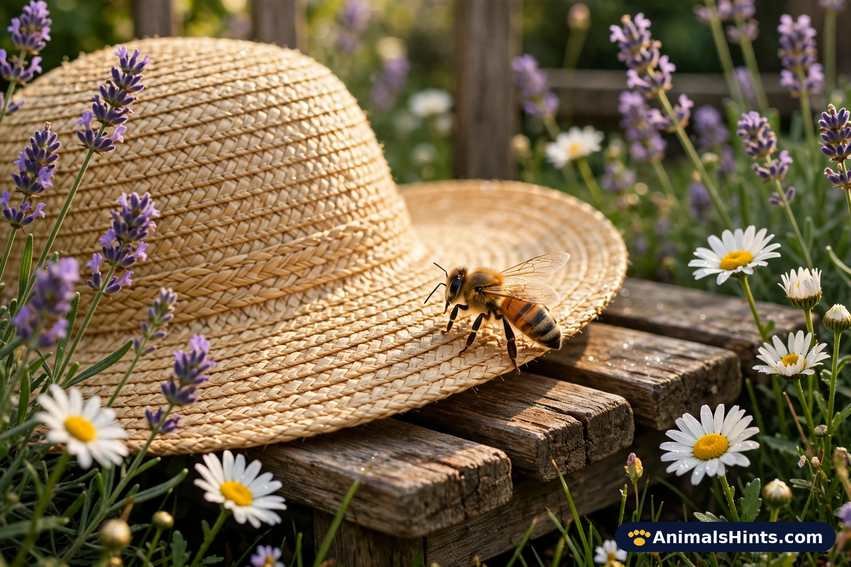
Start with the likeliest visitor. Most bees that land on people in North American gardens are honey bees — Apis mellifera, the western honey bee, amber-brown and black-banded, about half an inch long, hairy enough to carry pollen in baskets on her hind legs. Every forager you will ever meet is female: workers gather the nectar, pollen and water, while males — drones — do not forage and cannot sting at all. The second likeliest visitor is smaller and easier to miss: a sweat bee, one of the family Halictidae, a quarter to half an inch of dull black, brown or metallic green that specialises in exactly the behaviour this article is about.
The sweat bees explain the classic landing. University of California writers, quoting California Bees and Blooms, put it plainly: the smaller sweat bee species earned the family nickname from their habit of alighting on skin and lapping up perspiration “for both its moisture and salt content.” The University of Florida’s extension account agrees — these are non-aggressive insects that use the salt in human sweat for their nutritional needs — and the Texas Apiary Inspection Service adds that a landed sweat bee is “just looking to absorb some nutrients.” Nectar is poor in sodium; skin, on a warm day, is a mineral source that flies. When a small bee settles on your forearm and seems to lick it, that reading is not folklore. It is lunch.
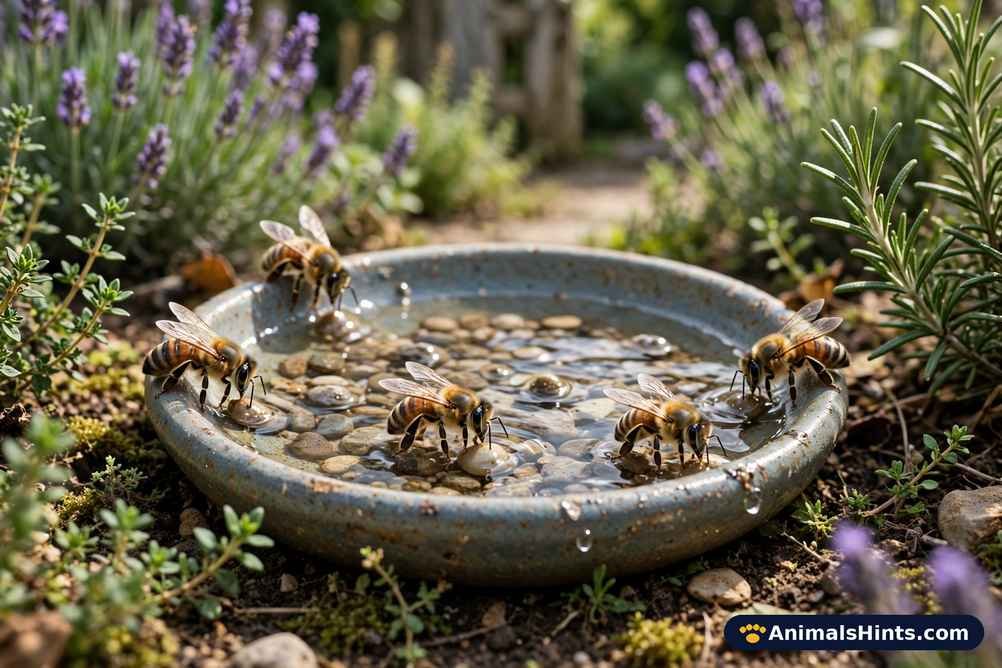
Honey bees arrive with a colony errand instead. A hive runs on collected water: foragers haul it home to dilute thick honey into food the larvae can swallow, and on hot days they spread droplets through the nest and fan their wings so evaporation cools the brood — the colony’s air conditioning, in the University of California’s telling, holding the nursery near the temperature development demands. Britain’s National Bee Unit notes that bees are drawn to water carrying low levels of salts such as sodium and magnesium, which is why pools, damp soil and sweaty skin all make their list of stops. Add the mistakes — a floral perfume, a bright shirt read as a bloom, a sweet drink’s rim — and the pauses any tired flyer takes to rest and groom, and nearly every landing a person experiences is accounted for without a single omen. Other gentle visitors work the same trade: the white butterfly settles on skin for the minerals in sweat, and our dedicated guide to what it means when a butterfly lands on you covers that softer encounter in full.
The sting question deserves its own paragraph, because it decides how the moment feels. A bee’s sting is colony defence equipment, not a hunting weapon, and a forager out on her rounds is away from everything the sting exists to protect. Extension guidance from Cornell puts bees as robust, hairy and “generally non-aggressive unless provoked,” against wasps’ smooth bodies and readier temper. The situations that do draw a sting are mechanical, not temperamental: a bee trapped against skin by clothing or a closing hand, a bee stepped on, a bee swatted at and pinned. The honey bee’s equipment underlines the point — her stinger is barbed, tears free when it lodges in mammal skin, and kills her, which makes stinging a last resort written into her anatomy. Bumblebees carry a smooth stinger and can use it more than once, yet the extension record still files them as reluctant, stinging rarely and mostly around the nest. A landed bee, in short, is not an attacking bee. It is a working bee on a stopover, and it will treat you as scenery unless you turn yourself into a trap.
What Does It Mean When Bees Are Flying Around You?
Before the symbolism, the scene-setting every honest page owes you: bees circling a person are usually working a patch. You may be standing between a forager and her next flower, wearing a scent she is investigating, or picnicking near a colony’s flight line. The insect is navigating by smell, colour and memory, and a human being is mostly an obstacle that smells interesting.
The tradition reads the same circling differently, and its reading is consistent across the modern guides. Bees stand, in that file, for community, disciplined work, concentration and a well-ordered life — creatures that waste nothing and always know their task. A bee that keeps returning to your airspace is therefore read as a prompt aimed at your own structure: a productive stretch opening, priorities asking to be sorted, effort about to compound. Some writers add an energy vocabulary — the bee responding to your state the way it responds to scent and motion — and that vocabulary is printed here as what it is, present-day genre language laid over the animal’s real sensitivity to its surroundings. Nothing in the circling itself is filed as threatening by any strand of the lore; threat, in this file, has a different signature, and the warning section below takes it up.
7 Spiritual Meanings of Bees Flying Around You
Seven readings make up the standard list for bees in orbit, kept here in the sequence the genre gives them. Every one is a belief held by its writers, printed at that strength — none of them is a finding about the insect.
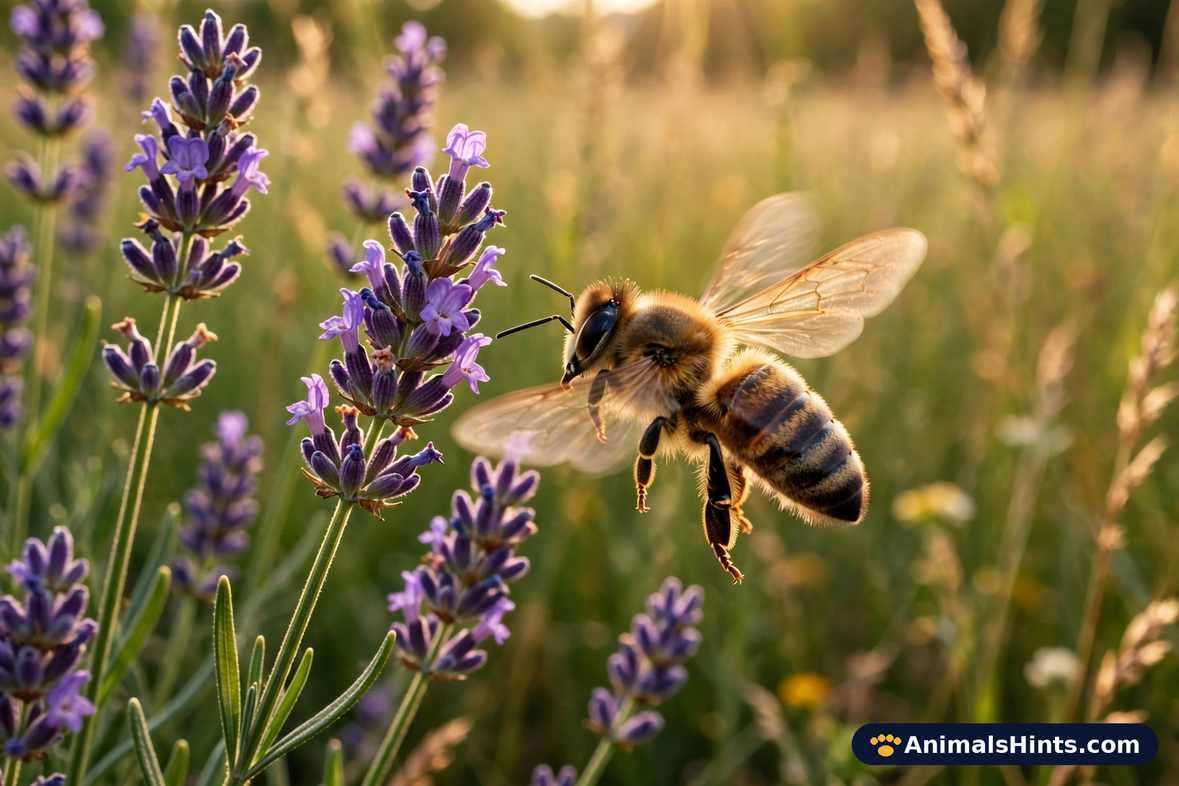
1. A Season of Productivity Is Beginning
The headline reading. Because a bee’s whole visible life is purposeful motion — out, gather, return, repeat — a bee that takes up around a person is filed as the starting gun of a fruitful period: projects demanding attention, ideas surfacing, earlier work approaching the point where it pays. The prosperity-minded versions of the lore add encouragement rather than prediction: effort already spent has not vanished, any more than nectar vanishes on its way to becoming honey. The counsel attached is about aim rather than hours — choose the tasks that matter, prepare, clear the clutter — because the bee in the story is never merely busy. She is busy at the right flowers.
2. You Need Stronger Focus and Discipline
The sterner twin of the first reading. A hive impresses the genre with its division of labour: foragers forage, guards guard, the queen lays, and no bee drifts between callings. A persistent bee is therefore read as a tap on the shoulder of anyone scattering attention across unfinished starts — an instruction, more than a fortune, to simplify the list, build routines and defend working time the way a colony defends its stores. Of the seven meanings, this is the one whose advice survives translation into entirely secular terms: narrow the field, keep the schedule, finish things.
3. Abundance Is Moving Toward You
Honey does the symbolic work here. Across the traditions the genre draws on, stored honey stands for sweetness accumulated honestly — wealth, blessing, nourishment laid by — and Hindu ritual practice, where honey appears among sacred offerings, is the example the guides reach for most. A bee circling is read, in this strand, as resources or openings on their way toward the reader. The genre’s own fine print is worth keeping: nobody’s version promises riches falling from the sky. The bee’s abundance is manufactured drop by drop, and the reading is really about patience becoming visible — a career door, a deepening relationship, a result that arrives quietly before it announces itself.
4. Your Thoughts Are Attracting Opportunities
The manifestation reading, and the most modern of the seven. Its logic borrows the bee’s real equipment — an insect exquisitely tuned to scent and movement — and turns it into a mirror: if the bee is drawn to what you give off, the writers ask, what has your attention been giving off? Repeated encounters are read as momentum made visible, and the prescribed response is an audit — which thoughts have dominated the week, which emotions keep being gathered the way a bee gathers what it seeks. Printed as the genre frames it: a prompt to awareness, useful as self-examination, with no mechanism claimed anywhere in the older record.
5. Community and Teamwork Matter Right Now
No bee survives solo for long, and the genre makes that biology into its fifth reading. The hive thrives on thousands of small cooperations; a bee appearing around a person who has been carrying everything alone is filed as a call back into the group — accept the help, offer yours, let a result be shared rather than solitary. Modern spirit-animal teaching is the main carrier of this meaning, with older Celtic-flavoured material about collective strength cited behind it; at either strength, the reading’s target is isolation, and its season is any stretch where pride or habit has cut the reader off from family, friends or team.
6. Spiritual Messages Are Trying to Reach You
The messenger reading, with the deepest roots of the seven. In the folk record examined in the cultures section below, bees genuinely were treated as couriers between the household and whatever lies beyond it — families formally told their hives about deaths, births and marriages, on the belief that the bees belonged inside the circle of news. A bee that circles persistently, in a moment that feels charged, is read through that history as guidance trying to land: watch for the intuition, the dream, the conversation that follows. This site’s messenger shelf has a heavier end — the dead bird file, where a visit is read as a farewell — and the bee sits at the shelf’s working, everyday middle: not an alarm, an attention signal. The genre’s advice is correspondingly mild. Pause, listen inwardly, and let the meaning stay small unless life enlarges it.
7. You Are Aligned With Natural Rhythms
The closing reading belongs to the eco-spiritual strand: bees as keepers of the turning year, pollinating in season and resting out of it, filed as evidence that a person they circle peacefully is moving with their own seasons rather than against them. Its questions are about rhythm — growth and rest in their proper turns, work timed to energy instead of forced against it. A calm encounter, in this telling, is a confirmation to keep the balance you have: the bee does not hurry winter or resist spring, and the reader is invited to do likewise.
5 Spiritual Meanings When a Bee Lands on You
Contact narrows the message, in this lore as in the other landing files: orbiting is a broadcast, but a landing has an addressee. Five readings make the standard list, in the genre’s order.
1) A blessing is resting on your life
The gentlest reading in the whole file. A bee that settles on a person and stays calm — no sting, no panic, a pause and a departure — is filed across folk tellings as favour made tangible: approval, good fortune, a stretch of grace acknowledged. Honey carries the argument, as a gift humans have treasured for thousands of years, and bees’ standing as sacred workers in parts of the African and European record is cited behind it. The guides are careful about scale: the blessing on offer is rarely a sudden miracle. It looks like steady progress, an opening arriving on schedule, protection holding during a hard season — or simply the reminder, delivered at the moment of doubt, that you have not been forgotten by whatever you believe keeps the accounts.
2) Patience will bring sweet results
Honey again, this time as a timetable. Nectar becomes honey slowly, through collection, ripening and sealing, and a bee resting on you is read as that process wearing a body: your refining stage is not your failure stage. The meaning is aimed at readers mid-wait — building a career, repairing a bond, healing — whose work has not yet turned visible. Its counsel is the bee’s own routine: keep showing up, repeat the small tasks, cooperate where cooperation is offered. Consistency over speed is the whole sermon, and the landed bee, in no hurry at all on your sleeve, preaches it by example.
3) You carry creative energy
The hive as artwork: tens of thousands of near-identical wax cells, built cooperatively out of secretion and geometry, are the genre’s standing proof that bees create order of real complexity from simple materials. A landing is read, in the totem and animal-symbolism literature, as that energy reported active in the reader — ideas circling and ready to take form, a project delayed past its season. The collaborative footnote travels with it, since no bee builds alone: if the work has stalled solo, the sign points toward the people who might help it exist. Underneath the symbolism sits a plainer observation the guides also make — scattered ideas often already carry a structure, and the landing is treated as permission to trust it and begin.
4) A spiritual message requires attention
The landing as interruption. Ordinary flight can be ignored; a bee on your hand cannot, and mystical and intuitive traditions file that enforced pause as the point of the event. Read this way, the bee is a messenger whose message is mostly attend — to the decision being carried quietly, the prayer or wish not yet said aloud, the intuition that surfaces in the days after, whether through a vivid dream or a sentence overheard that suddenly fits. The writers’ method is modest: sit with the moment, write it down, stay observant. Clarity, in this tradition, follows stillness rather than spectacle — which is convenient, because stillness is also exactly what the real bee requires of you.
5) Protection surrounds you
The final reading leans on the hive’s defence: bees guard queen, brood and stores fiercely, yet a forager spends her sting only in extremity — strength held under discipline, which the tradition reads as the shape of protection itself. Christian symbolism is cited in the guides for the cluster of diligence, purity and ordered communal life; at the level of the encounter, the sequence is what matters to the holders of this belief. The bee approached, it rested, it left without harming — read as a sign that troubles may come near without being licensed to damage, and that boundaries, properly kept, hold. Protection here does not promise an absence of problems. It promises company through them, and a structure underneath events that feel, from inside, like chaos.
Where the Bee Lands: Hand, Shoulder, Head and Hair in the Lore
The competitor’s introduction plants a seed the rest of his page never waters: that where a bee lands changes the reading. The placement lore exists in the modern genre as a small, consistent set of assignments, and it is printed here at exactly its real strength — a present-day interpretive habit, not a documented old list. No fetched historical source splits bee fortunes by landing site; what follows is how today’s writers do it, labelled as such.
On the hand, the genre reads action: the hand is the working member, the tool-user, so a bee settling there is filed against work and making — a project blessed, a skill noticed, something you build about to matter. On the shoulder, the reading turns to support and burdens: shoulders carry loads and receive the comforting touch, so the landing is read either as help arriving for a weight you have been carrying alone, or as a reminder that the weight is seen. On the head or in the hair, the assignment is thought: order requested among crowded ideas, a decision asking to be made cleanly, mental noise due for sorting. Readers who collect landing signs will recognise the grammar from the other insects on this site — the red ladybug carries the luck-and-love file, the brown ladybug its grounded, patient cousin — and the bee’s placements follow the same body-part logic those files use.
One landing site needs a practical footnote that outranks its symbolism. A bee in hair, or trapped inside clothing, is the one landing genuinely likely to end in a sting, because it is the one landing where the bee can be pinned without anyone meaning harm. Whatever the lore assigns to a head landing, the natural-history instruction is the same as everywhere else on this page and stronger: do not slap at your own scalp. The stay-calm section below gives the exit routine.
Why Are Bees Attracted to Me or Seem to Follow Me?
His question, answered in his order: the physical side first, then the meanings readers build on it. Physically, the list is short and checkable. Bees investigate floral scents, and perfume, scented lotion and shampoo all qualify as far as an antenna is concerned; bright, flower-coloured clothing draws a look; sweet drinks, ripe fruit and jam are open invitations; sweat offers the salt-and-moisture stop described above; and a garden full of bloom, or a route running between a hive and its forage, will put bees around the same person day after day without any preference for that person at all. Cornell’s extension guidance lists strong and floral scents among the things that draw stinging insects’ attention, which is the mundane headline: if bees keep choosing you, audit your scent and your snacks before your aura.
The genre’s layer sits on top of that base rather than replacing it. Spiritual writers propose that calm people attract calm encounters — slower movement, softer breathing, less of the sudden motion that reads as threat — and there is a behavioural truth buried in the claim, since unhurried people genuinely do get investigated and left alone, while swatters manufacture incidents. Repeated encounters are then read as a mirror of the reader’s own season: building something, working at something, needing the connection a hive embodies. Taken at genre strength, that is a fair piece of self-examination. Taken as entomology, it is not one, and this page’s verdict is the two-lane one: scent explains the visit; meaning is what you do with it afterwards.
Cultural and Religious Significance of Bees Hovering Around You
His seven strands follow in his order, each weighed against the record that could actually be fetched for it. This is the section where the bee file turns out to be unusually well documented — and where its one large error lives.
In ancient Egypt, the strand is record, not romance. The bee hieroglyph stood for Lower Egypt inside the pharaoh’s throne title nsw-bity, conventionally “King of Upper and Lower Egypt” and literally “He of the Sedge and the Bee” — the sedge for the southern valley, the bee for the northern delta — a pairing attested from the First Dynasty onward and carried for some three thousand years. A creation account preserved in the late ritual text Papyrus Salt 825 holds that bees were formed from the tears of Ra, the sun god, as they fell to the earth, which is the myth the competitor retells; behind the symbol sat an industry, with the oldest confirmed beekeeping scene in the world carved in the sun temple of Nyuserre around 2450 BCE. Royalty and divine power, in Egypt’s case, is exactly what the documents say.
In Greek tradition, his summary survives the audit with better names attached. Melissa is simply the Greek word for a honey bee, and the name transferred to priestesses — Smith’s classical dictionary, citing the ancient commentators, gives the priestesses of Demeter above all, then Persephone, then the priestess of Apollo at Delphi, with the scholiasts explaining the title by the bee’s purity. The prophecy strand is real too: the Homeric Hymn to Hermes describes three winged bee maidens on Mount Parnassus who taught Apollo divination and spoke truth when fed honey. His version — bees linked to Apollo, priestesses of Demeter called Melissae, purity and devotion as the point — is the documented core, and it stands here at that strength.
In Christianity, begin with what the book itself contains, because bees genuinely are in it — as weather, not as mascots. The King James text gives Samson finding “a swarm of bees and honey in the carcase of the lion” (Judges 14:8), Israel’s enemies chasing them “as bees do” (Deuteronomy 1:44), and the psalmist’s foes who “compassed me about like bees” (Psalm 118:12). The Bible’s bee, in other words, is sweetness found in an unlikely carcass and the terror of a stirred swarm. The competitor’s strand — diligence, resurrection, honey produced without harming the flower as a figure of divine sweetness — belongs to the church’s later symbolism rather than to any verse: medieval and devotional writers, not scripture, built the bee into an emblem of disciplined communal life and hope. Printed at that division, the strand is honest, and it loses nothing.
In Islam, the strand is the strongest on the page, because the text names the insect outright. The Qur’an’s sixteenth chapter is called An-Nahl, “The Bee,” and its verses 68–69 address the bee directly: in the Maulana Muhammad Ali translation fetched for this article, “thy Lord revealed to the bee: Make hives in the mountains and in the trees and in what they build,” and from the bee comes “a beverage of many hues, in which there is healing for men.” The competitor’s summary — a chapter named for the bee, honey spoken of as healing, the whole read as guidance and divine instruction — matches the verses at the strength he gives them. This article quotes the passage as scripture and makes no medical claim of its own from it; the healing in the verse is the verse’s wording, printed as such.
In Celtic traditions, as he labels them, sits the custom this page’s messenger meaning rests on — and the label needs widening. “Telling the bees” — formally informing the hive of deaths, births, marriages, departures and returns in the keeper’s household, sometimes draping the hive in mourning cloth — is documented as a Western European custom, recorded in England, Ireland, Wales, Germany, the Netherlands, France, Switzerland and Bohemia, and carried to New England, where Whittier’s 1858 poem “Telling the Bees” fixed it in American memory. Ireland is inside that map, so a Celtic thread genuinely runs through it; but the custom belongs to half a continent, not to one culture, and the penalty for silence was consistent across the record — untold bees might leave, stop producing, or die. The custom was still being observed in 2022, when the royal beekeeper told the Buckingham Palace hives of Queen Elizabeth II’s death. As evidence that people treated bees as members of the household entitled to its news, the record could hardly be bettered.
In Hindu symbolism, the competitor’s image checks out in a more specific form than he gives it. Bees do attend the love god — structurally. Kamadeva, god of desire, carries a bow of sugarcane strung, in the standard iconography recorded from Dowson’s classical dictionary to the modern reference accounts, with a line of living bees, and shoots arrows tipped with flowers. Attraction and desire are therefore the documented assignment: sweetness armed with a sting, which is precisely how the tradition pictures longing. His further gloss, the bee as the soul seeking divine nectar, is the modern genre’s devotional extension of that image, printed at that lower strength.
In Native American traditions, the strand must be corrected at its root, because the honey bee is not an American insect. North America held roughly four thousand native bee species when Europeans arrived — bumblebees, mason bees, sweat bees among them — but no honey bees at all: the University of California’s account dates the honey bee’s arrival to hives shipped to the Jamestown colony in 1622, after which feral swarms spread ahead of settlement so reliably that Thomas Jefferson recorded Indigenous peoples calling the insect “the white man’s fly,” a name whose own coinage is contested and may trace to the missionary John Eliot rather than to an Indigenous coiner. An ancient Native honey-bee teaching about hive harmony therefore cannot exist in the form his summary implies — the hive itself was an import within living memory of the telling. Native bee lore belongs to the native species, nation by nation, and no named nation’s bee teaching could be verified behind his sentence; it is printed here as a gap, with the 1622 arrival put in its place.
What Do Dreams About Bees Following You Symbolize?
Dream lore re-applies the waking file to sleep, and his scenarios cover the reports dreamers actually bring. Read them all as interpretation, at the strength their holders give them:
- Bees follow you calmly — read as progress under load: tasks may be chasing you, but in the lore’s telling they lead somewhere, and the buzzing stands for a mind busy in a productive key.
- The bees feel aggressive — the stress reading: pressure being outrun, a duty avoided, the dream filed as the mind insisting on action.
- A single bee — one focused goal, in the shorthand; a swarm — social pressure, or the demands of a team and a season of being needed.
- Honey appears — sweetness after effort, the patience file of the waking meanings carried into sleep.
His closing rule is the one every dream section on this site ends up endorsing: the feeling is the evidence. Fear, peace or joy on waking re-colours every image above, and the interpretation that fits the dreamer’s own season is the one the tradition itself would choose. Ordinary sleep science — memory and emotion being processed overnight — runs in a separate lane and competes with none of this; and the standing boundary applies: a recurring, genuinely distressing dream is daytime material, for a doctor, a counsellor or a trusted friend, not for a symbol list.
Honey Bee, Bumblebee or Wasp? Naming the Visitor Before Reading It
A landing means more once the lander is named, and the commonest misreading in this whole file is taxonomic: people file wasp encounters under “bee” and then wonder why the bee lore promised gentleness. Five look-alikes account for nearly every landing, told apart by silhouette first and temperament second:
| Insect | How to know it | Around people |
|---|---|---|
| Honey bee | About ½ inch; amber-brown with dark bands; hairy body; pollen baskets on the hind legs | Colony forager; stings only when trapped, stepped on or defending the hive; barbed sting, used once |
| Bumblebee | Large and round, densely furry, black with yellow bands; colonies of a few hundred | Docile away from the nest; queens and workers can sting, males cannot; smooth sting |
| Carpenter bee | Bumblebee-sized, but the top of the abdomen is bare, shiny black | Solitary wood-borer; males cannot sting at all; females sting only when handled |
| Sweat bee | Small, ¼–½ inch; dull black, brown or metallic green | The sweat-lapper itself; stings only when pressed against skin, and mildly |
| Yellowjacket (a wasp) | Sleek, smooth, sharply yellow-and-black with a pinched waist | Not a bee; a picnic-raiding predator that can sting repeatedly |
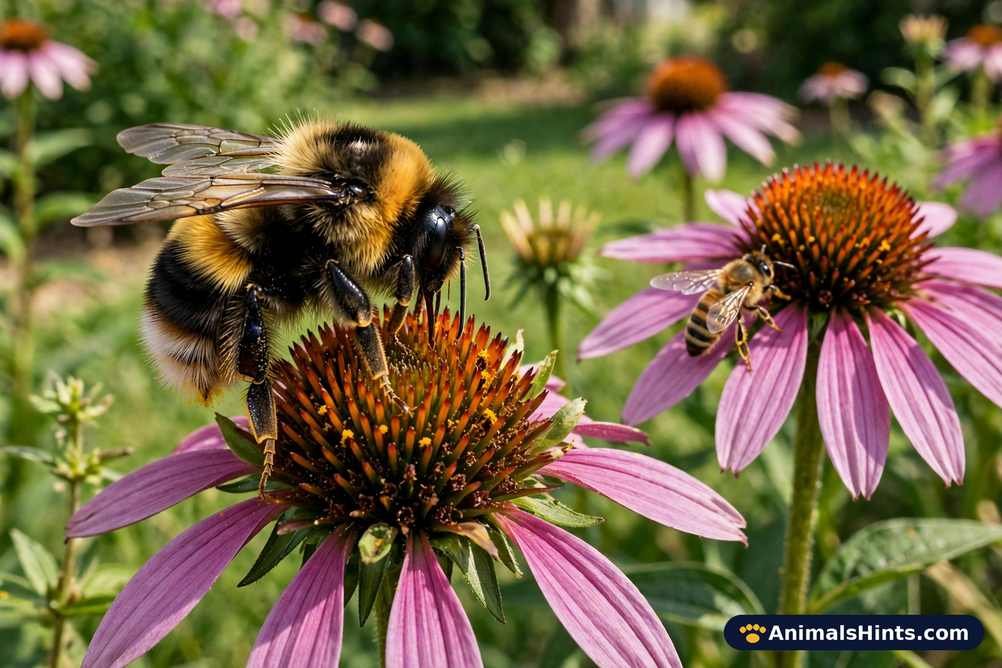
The identification details above follow the extension pattern used by Cornell’s pollinator guidance and the state guides: hair and a pollen load mark a bee, because bees are vegetarians built to carry pollen home, while wasps are smooth-waisted hunters whose young eat meat. Colour alone will not save you — the black and yellow butterfly wears the same warning bands as a wasp without owning a sting at all — but hair, waist and behaviour together sort nearly every visitor in seconds. Name first, interpret second: the whole tradition works better, and so does your afternoon.
Is Bees Flying Near You a Sign of Warning?
Ask the lore and the answer is a qualified sometimes. Bees defend their home fiercely, and a genuinely defensive display — bees orienting on you, bumping, persisting — is read in the genre as a boundary event: something has been crossed, in the garden or, by extension, in your own life, where ignored limits and careless entries are the assigned lesson. Calm bees, by contrast, almost never carry a warning in any strand: they invite awareness instead of alarm, teaching respect and balance in the guides’ phrasing, and fear is named as the thing most likely to cloud a reading.
The natural-history lane reaches a matching conclusion by its own road, which is why this section can afford to be short. Defensive behaviour around a person usually means a nest or hive is near, or a foraging route is being blocked — real information, worth acting on by the simple method of moving away slowly and letting the traffic resume. Bees rarely act without a reason legible to an observer who watches quietly for a moment. Whether you file that reason under omen or under traffic management is the reader’s choice; the behaviour, and the correct response to it, are the same.
What to Do When a Bee Lands on You: Stay Calm, Do Not Swat
The practical section, and the one part of this article where lore and entomology give identical instructions. For the ordinary landing — a forager on your arm, your sleeve, your hat brim — the routine is short:
- Hold still first. Most landings end themselves: the bee takes its salt, its sip or its bearings and lifts off, typically within moments. Stillness is not passivity; it is the whole technique.
- Do not swat, slap or grab. The sting scenarios are mechanical — a bee pinned against skin is a bee that stings — and a swat manufactures exactly that scenario out of a harmless stopover.
- Move slowly if you must move. Walk, don’t wave. A gentle shake of a sleeve once the bee is at its edge, or a soft brush with a leaf or a card’s edge, is the most intervention a landing ever needs.
- Give hair and clothing traps priority. A bee tangled in hair or inside a collar is the exception that needs help: stay calm, keep hands slow, and ease the fabric or hair until the exit is clear rather than striking at the sound.
- If a sting happens anyway, the published first-aid pattern is to get the stinger out promptly — scrape it away with a fingernail or card edge rather than squeezing it — then wash the spot and let the ordinary local ache and swelling run their short course.
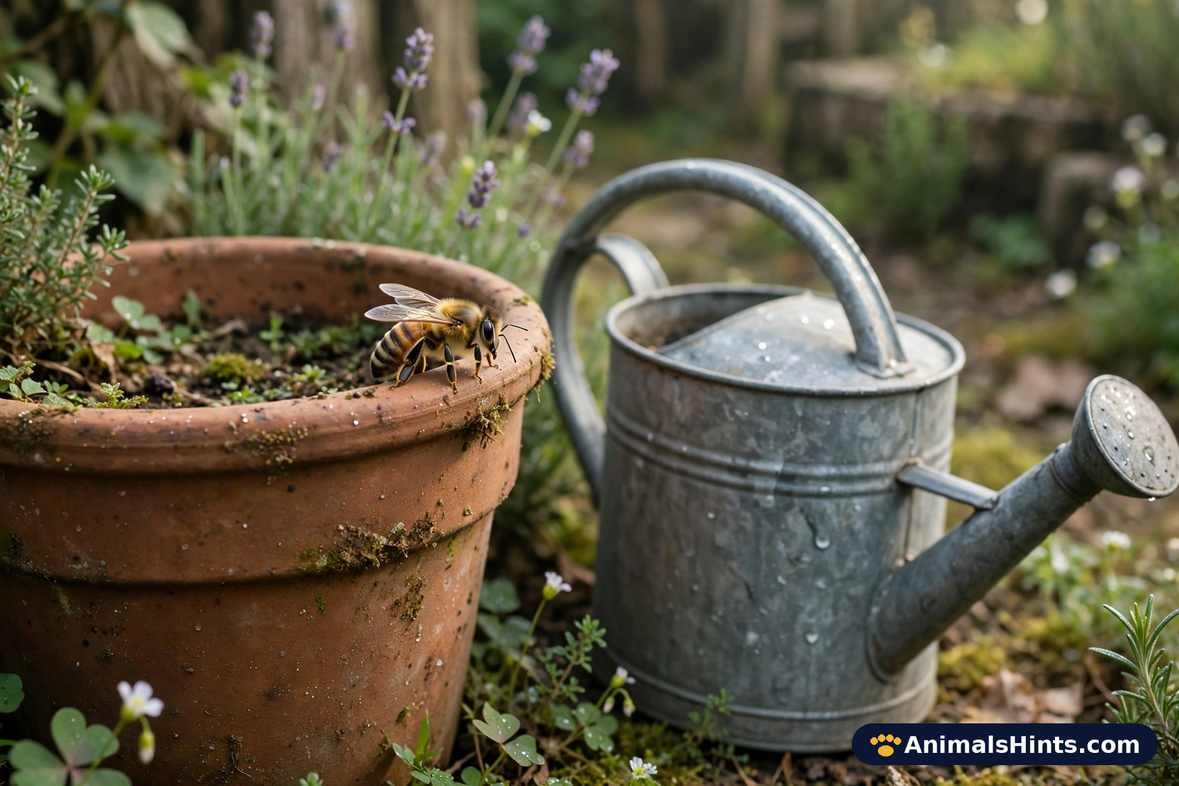
One safety passage, printed plainly and at the strength of the medical guidance behind it. Most bee stings are painful but minor. A small minority of people, however, have a sting allergy capable of producing anaphylaxis, a severe whole-body reaction that the NHS describes as life-threatening and fast: it usually begins within minutes, and its signs include swelling of the lips, mouth, tongue or throat, difficulty breathing or wheezing, and feeling faint, dizzy or confused. NHS guidance is to use an adrenaline auto-injector immediately if the person has one, call the emergency number — 999 in the UK, 911 in the US — and treat the event as an emergency even if symptoms begin to ease. That is attributed published guidance, not a diagnosis of any reader’s sting; anyone who has ever reacted strongly to a sting should carry the conversation to their own doctor long before a bee makes it urgent.
Final Thoughts
Gather the file and it sorts into two honest piles. In the lore’s pile: a creature of work, order and stored sweetness, treated by households across Europe as a member entitled to their news, given a chapter of the Qur’an to itself, written into an Egyptian king’s title and a Greek priestess’s name — and read, when it lands on a person, as blessing, patience, creativity, a call to attention, protection. In the animal’s pile: a female forager working a route, short of salt or water or rest, pausing on the warmest large object in the garden and leaving the moment her errand is done. Neither pile cancels the other. The tradition is genuinely old and genuinely documented in its strongest strands, and the bee is genuinely indifferent, and a reader can hold both facts in one hand without either of them shrinking.
What the two piles agree on is the conduct. Every strand of the lore, and every line of the natural history, lands on the same instruction for the moment itself: be still, be patient, let the visitor finish. The bee’s whole reputation — the sweetness, the order, the guarded hive — is built from exactly that discipline of small efforts completed calmly. The colony even seals its home with a substance mixed for defence, propolis, gathered from tree buds and worked into every gap — protection, in the hive’s own practice, being less a wall than a habit of care. If a bee lands on you this season, you are allowed to enjoy the old reading of it. Just earn it the bee’s way: keep calm, keep your hands down, and let the moment close itself.