Blue Ladybug Spiritual Meaning: Truth, Calm and the One True Blue Beetle
People who go looking for the blue ladybug meaning usually arrive carrying a photograph: a beetle the colour of deep water, sitting on a leaf like a dropped bead. The symbolism sites answer with the gentlest reading on the ladybird shelf — truth, calm, a voice learning to speak — because blue is the colour those sites reserve for honesty and quiet. All ten of those meanings are set out below, in full. This page also asks the question the symbolism pages skip: which insect was actually in the photograph?
Of all the colours on this shelf, blue is the one the ladybird family itself wears least. A single true ladybird spends its whole life in metallic blue — a small scale-hunter from Australia that most of the world will never meet — and nearly everything else answering to the name is a different beetle wearing blue for its own reasons: a fungus-eater the size of a thumbnail, a cobalt leaf beetle glued to milkweed, a jumping flea beetle, or no beetle at all, just a red ladybird recoloured by an image editor. The symbol and the animals are separate subjects, and they are kept separate here.
What follows gives the genre’s account first, then the insects, then the ten meanings with their layers labelled — the old family luck at the bottom, the modern colour vocabulary on top — so a reader can tell which parts of the blue ladybug are documented, which are recent, and which are actual beetles.
What Does Seeing a Blue Ladybug Symbolize?
The genre starts from the colour, and blue is its most inward shade. In the shared language of contemporary symbolism writing, blue stands for truth plainly spoken, for calm after agitation, for depth, trust and the slow clearing of emotional weather. It is the colour those writers assign to the throat and to everything the throat is for: honesty, expression, the sentence finally said aloud. Set that colour on a ladybird — an insect the same writers treat as a small courier of fortune — and the compound symbol writes itself: a message about your own voice, delivered gently.
Beneath the colour sits the insect, and the insect’s part in the symbol is far older than any of the words now used about it. Rural Europe protected ladybirds for centuries: a household made them welcome, a farmer counted a settled one as luck, and harming one was the surest way to invite the opposite. Blue takes over that inheritance intact. Every blue reading is delivered inside a family folklore had long since marked out as favoured — the reason, no doubt, that this colour’s meanings run to comfort and guidance and never to threat.
Blue’s opposite pole on the same spectrum gets its own long treatment elsewhere on this site, at black spiritual meaning; where black is read for endings and depth, blue is read for openness — clear sky, clear speech. Keep the pairing in perspective: the scheme that produces it is a modern one. The genuinely old element is the family’s protected standing. The genuinely unusual element, as the entomology below makes plain, is the colour itself.
What Is a Blue Ladybug, Really?
Begin with the family’s wardrobe. The true ladybirds, family Coccinellidae, dress overwhelmingly in red, orange and yellow, with a supporting cast in brown, black and cream. Blue is nearly missing from the catalogue — nearly, not quite. One species wears it as a permanent metallic finish, and around that single species orbits a crowd of unrelated blue beetles that share nothing with ladybirds except a dome, a shine and a talent for being photographed. Five cases account for nearly every blue ladybug sighting you will ever come across.
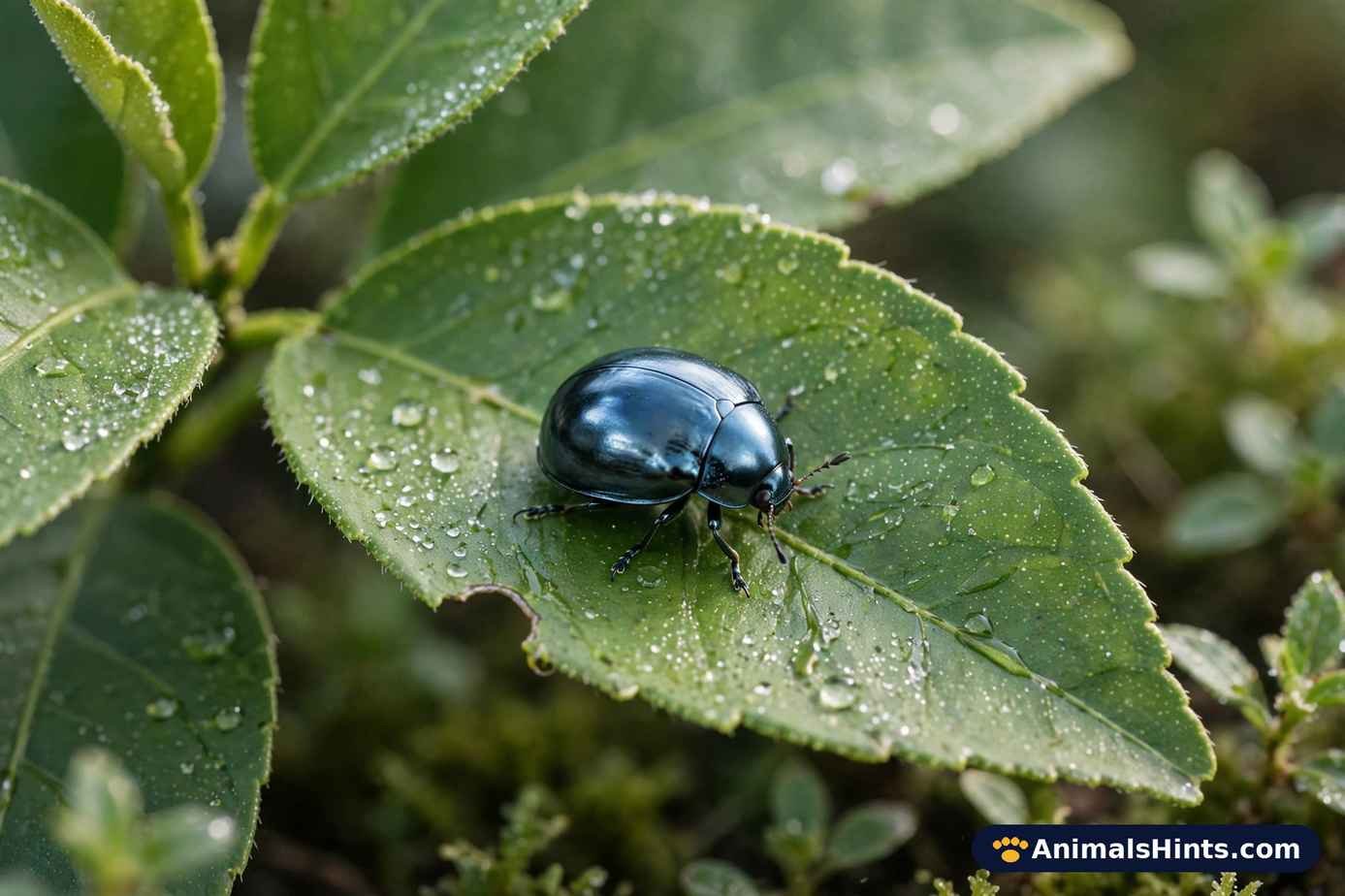
The steelblue ladybird (Halmus chalybeus) — the search for a truly blue ladybird begins and ends with this species. The species account written for New Zealand’s border diagnosticians puts an adult at 3.0 to 4.25 mm long and 2.85 to 3.90 mm wide, coloured “entirely green or blue,” mirror-polished and wholly spotless; a male can be picked out by the orange-yellow wash across his head and the leading edges of his pronotum, a tint the females never show. It is an Australian native, spread along that country’s eastern coast, and a working predator: it eats scale insects above all, with psyllids, whitefly and gall mites also on the menu. People valued that appetite enough to ship the beetle abroad — New Zealand received it from Australia in 1899 and again in 1905, deliberately, to hunt black scale and blue gum scale in citrus orchards, and it is now a common orchard resident in the country’s north; plantings also reached California and Hawaii. Note the shade, because the photographs online usually get it wrong: this is a dark, steely blue-green, nearer to the bottom of a lake than to the top of the sky.
The blue fungus beetle (Cypherotylus californicus) is the impostor of scale. Where the steelblue is a fingernail paring, this beetle runs 1.4 to 1.8 cm — four times the ladybird’s length — with wing covers of blue studded with indented black dots. It belongs to the pleasing fungus beetles, family Erotylidae, and its life is spent on rotting logs in the western United States and Mexico’s Sonora, grazing the bracket fungi that shelf out of dead wood; the larvae eat nothing else. Its blue is home-made pigment, built by the adult after emergence, and it is perishable: the living beetle’s wing covers may read grey, blue or purple from one individual to the next, always with the black dots, and the colour drains toward grey once the beetle dies. A big blue beetle on a log, in other words, is a fungus beetle at lunch — handsome, harmless, and no relation to a ladybird at all.
The blue milkweed beetle (Chrysochus cobaltinus) is the impostor of place. It is a leaf beetle, family Chrysomelidae, 6 to 9 mm long, wrapped head to foot in iridescent cobalt — legs and clubbed antennae included — and it lives exactly where dinner grows — on milkweed and dogbane across the western United States and British Columbia. Both the adults and the larvae feed on those plants, and the plants are loaded; milkweed and dogbane run with toxic compounds called cardenolides, and this beetle, like the monarch butterfly, takes the poisons aboard and keeps them as a defence, advertising the fact in warning blue. It appears in early summer and is gone within about six weeks. A saturated, jewel-blue beetle sitting on milkweed in June is this animal, identified by its dinner as much as by its dress.
The metallic flea beetles (Altica species) are the impostors of size and motion. University of Florida guidance on the genus describes small beetles, 3 to 9 mm, whose wing covers are metallic blue to green over bodies that throw back purple and bronze, with thread-like antennae and — the giveaway — greatly thickened hind legs. The genus name comes from a Greek word for a good jumper, and jumping is what they do: touch the leaf and the blue beetle is simply gone, sprung away like its namesake insect. They are leaf beetles too, plant feeders every one, and the several hundred species are so alike that specialists separate many of them only under a microscope. A tiny metallic blue beetle that vanishes when approached was never sitting still to be a ladybird in the first place.
The fifth case is not a beetle species but a stage and a screen. The stage: every ladybird begins adult life unfinished — the beetle that climbs out of the pupa is soft, pale and patternless, and its true colours arrive only as the shell hardens over the following hours. A newborn photographed in flat light, then captioned by hope, has launched more than one “blue ladybug” post; by the next morning the same insect is wearing red. The screen: identification writers warn plainly that the brightest blue ladybirds circulating online — sky-blue, turquoise, complete with the spotting of some familiar red species — are ordinary ladybirds passed through an image editor. The real blue ladybird is dark, steely and spotless. A neon one is a file, not an animal.
| Beetle | Colour to look for | Where you are most likely to meet it |
|---|---|---|
| Steelblue ladybird (a true ladybird) | Polished metallic blue to blue-green, no spots at all; tiny, 3–4.25 mm; males show a yellowish head | Eastern Australia; introduced to New Zealand, California and Hawaii, mostly on citrus and garden shrubs, hunting scale insects |
| Blue fungus beetle (a pleasing fungus beetle, NOT a ladybird) | Blue to grey-blue wing covers with indented black dots; large, 1.4–1.8 cm | Western US and Sonora, on bracket fungi growing from rotting logs |
| Blue milkweed beetle (a leaf beetle, NOT a ladybird) | Saturated iridescent cobalt over the whole body, legs and antennae included; 6–9 mm | Western US and British Columbia, on milkweed and dogbane in early summer |
| Metallic flea beetles (leaf beetles, NOT ladybirds) | Metallic blue to green, small and elongate, 3–9 mm; thickened hind legs | On their host plants almost anywhere; they jump away when disturbed |
| A ladybird in its first hours (any red or orange species) | Pale cream or yellow, soft and spotless | Beside its empty pupa case on a leaf, colour arriving within hours |

The table teaches two things. To begin with, blueness by itself is evidence of nothing: length rules the fungus beetle in or out at a glance, its dots rule it in again, the host plant settles the milkweed beetle, and a single jump settles the flea beetles — of all the clues on offer, colour testifies last and worst. And the shelf this article belongs to divides, on inspection, into colours that ladybirds genuinely wear and colours they merely get credited with. The red ladybug wears the family’s most famous livery, earned in full. The brown ladybug is the honest dress of tree-dwelling species in tan and maroon shades. The green ladybug turned out, on this site’s own checking, to be borrowed finery in almost every case — its one genuine wearer being none other than the beetle heading this table, a species whose metallic finish slides from blue toward green with the light. The white ladybug earned its entry through three species that keep their white for life. Blue can produce exactly one wearer: small, southern-hemisphere, spotless. With her identified, the ten meanings can proceed — set out for what they are, interpretations written about a colour.
10 Spiritual Meanings of a Blue Ladybug in the House
Here, then, is the list: the ten readings the symbolism sites attach to this colour, kept in their usual order, and prefaced by two cautions the reader deserves up front. Caution one is about age. The list is a recent compilation, assembled by internet-era writers from the contemporary vocabulary of colour symbolism, so the same themes — truth, calm, honest speech — will resurface under heading after heading in fresh wording. Caution two is about the room named in the heading. Ladybirds genuinely do move indoors when cold weather comes, wedging themselves into window frames for the winter — but the single truly blue species among them lives on citrus and garden shrubs in the southern hemisphere, plus a handful of warm outposts, and nobody records it as a house-haunter. A blue beetle found inside a home in, say, Ohio will have ridden in on a plant, or else belongs to one of the look-alike rows in the table above. Cautions delivered, the genre’s version of the visit follows.

1. The Emblem of Calm Communication
The first reading welds together the colour’s twin assignments — blue as truth, blue as calm — into a single emblem: speech with its temperature lowered. On this account the beetle stands for the conversation held honestly and without raised voices, and its arrival invites the reader to speak plainer and softer at once. Accept it strictly as labelled. The whole apparatus connecting blue to throats and truth-telling belongs to contemporary symbolism; no older source appoints this beetle, or this colour, the patron of anybody’s voice. History’s sole contribution is the family’s protected standing — an insect that generations declined to hurt makes a natural emblem for gentleness, and everything beyond that is the genre building on a plausible foundation.
2. The Messenger of Loving Abundance
This reading draws on the oldest credit the family holds. Long before ladybirds were symbols of anything, they were working allies of the farmer, consuming the aphids that consumed the crop — and thankfulness for that service is the documented root beneath every prosperity interpretation on this shelf. The blue version steers the abundance toward the heart: affection on its way, tight resources easing, love understood broadly. The steering is contemporary work. The thankfulness under it is genuine history; the prediction layered over it belongs to the genre, and is credited to the genre here.
3. The Herald of Positive Change
Of all ten readings, change is the one the beetle’s actual biography supports with the least strain: a ladybird passes through egg, hunting larva, motionless pupa and winged adult, four forms with nothing in common, so a symbolism of transformation has only to point at the facts. The blue retelling adds the colour’s customary codicil — change that arrives gently, a life rearranged without anything being smashed. The codicil is ornament. The biography is documented fact, given a section of its own below, where fact and ornament stay in separate compartments, as they do in this paragraph.
4. The Shield of Divine Protection
Protection, as a heading, splits into an old component and a new one. The old component is custom pure and simple: an insect everyone sheltered, whose arrival — on a crop, on a coat sleeve — was read as fortune kept safe, and whose killing was understood to be the one dependable method of throwing fortune away. The new component is the colour’s reworking of that custom — blue recast as a shield, calm reimagined as armour, the shining shell taken as evidence of a guard nobody can see. Same root, two vocabularies, centuries apart. This page shows the join rather than polishing it invisible, and credits the divine component to the contemporary layer that composed it.
5. The Catalyst for Personal Transformation
Transformation’s second appearance on the list, turned from circumstance to self: old patterns released, new beginnings embraced, the reader cast as the pupa’s tenant. The colour contributes its usual rider — evolution at a walking pace, growth without drama. Candour about the recycling is owed and given: the genre returns to metamorphosis under several headings because metamorphosis is the one genuinely remarkable thing its subject does. The life cycle itself is documented further down. The self-improvement programme hung on it is the modern layer’s, entire.
6. The Anchor of Harmonious Balance
Contemporary writers treat blue as the colour of rest — deep water, clear sky — and set the beetle to prompting a personal audit: work weighed against rest, talking against listening, what the world loads on you against what you carry inside. As symbolism, the construction holds together. It must not be promoted into anything stronger. No beetle doubles as a diagnosis, and none as a treatment; the reading is best filed as a gentle prompt pinned to a soothing colour, worth whatever a reader finds the prompt worth, when it lands at the right moment.
7. The Guide to Inner Contentment
The most inward-looking entry on the list, written entirely in the language of enough: contentment generated from inside, worry laid aside, the road you are already walking pronounced the correct one. The older record knows nothing of this idiom — its vocabulary ran to crops, luck and the Virgin’s name — so the entry appears here for what it plainly is, a contemporary meditation. Its one solid foothold is a behaviour of the single genuinely blue beetle: the steelblue hunts at a crawl, working scale colonies on citrus bark at whatever pace prey that cannot flee dictates. Sermons erected on that unhurriedness belong to whoever preaches them, never to the beetle.
8. The Beacon of Joyful Fortune
Luck makes its second appearance here, and the border between its old and new components is easy to draw. The old component is the family charter one more time — protected beetle, welcomed landing, gratitude for the saved harvest — custom documented across centuries. The new component is the colour’s commentary on it: fortune reimagined as steady improvement instead of a sudden windfall, happiness delivered in instalments. The commentary is the genre’s arithmetic. The charter beneath it is the portion holding the documents, and each portion is credited to its owner on this page.
9. The Invitation to New Opportunities
The genre reads a rare sighting as a door left ajar: new paths presenting themselves, advancement signalled, the reader urged not to walk past an opening. The rarity premise deserves its correction in plain sight. A blue ladybird is rare the way a kangaroo is rare in Kansas — the one true species simply lives somewhere else, on another hemisphere’s citrus, and its absence from your garden is geography, not destiny. Readers outside Australia and New Zealand who meet a blue beetle have met one of the table’s other animals, each common in its own place. The invitation is the genre’s. The geography is the map’s.
10. The Reminder of Steadfast Faith
The closing reading is encouragement under difficulty: hold on, keep faith, better times ahead. Nothing in the family’s documented record appoints any ladybird an emblem of endurance — the custom was about luck and protection, not perseverance — so this heading stands as the modern layer’s own composition, end to end. What the record can honestly lend it is a small southern fact: the steelblue stays active on its orchards through the year wherever it was established, present in every season’s counts. Steadfastness, of a strictly beetle kind. The sermon is the genre’s; the attendance record is the insect’s.
From Egg to Beetle: The Change Behind the Symbol
Two of the ten meanings rest on transformation, so the transformation itself earns a telling — and the real sequence is odder than the placid adult dome hints. It opens with eggs: a tight cluster of yellow-orange ovals stood on end beneath a leaf, positioned, as a rule, within a short crawl of whatever the hatchlings will eat. What hatches resembles the famous adult not at all. The larva is dark, spiny and splashed with orange or yellow, essentially an appetite on six legs; gardeners regularly condemn it as a pest during the very weeks it is performing the plant’s most valuable pest control, shedding its skin repeatedly as it grows.
Then motion stops and construction starts. The grown larva glues itself tail-down against a leaf or stem and turns into a pupa, a mottled capsule inside which the winged adult takes shape. Give it a week — nearer a fortnight when the weather is cold — and the capsule splits along its back. The creature that hauls out explains a large share of this shelf’s mistaken identities, because the new adult is effectively unclothed: soft, pale, unmarked, its armour still setting. Colour is a consequence of hardening. As the shell cures, pigment floods in, markings declare themselves, and the polished dome finishes assembling. So the proper response to a washed-out, half-finished beetle is a diary entry rather than awe: look again tomorrow, and the insect will have completed its own identification papers.
The steelblue performs the identical sequence on the other side of the planet, and its end-state is the colour this whole page exists to discuss: the adult setting hard on an Australian citrus leaf comes out polished, spotless and blue-green, then starts work on the scale colonies it was imported to destroy. The northern doubles keep their own calendars — milkweed beetle grubs feed at and below the plant before the cobalt adults show for their brief summer run, while fungus beetle larvae develop inside the very brackets the adults graze. Everywhere the lesson is the same: colour follows a timetable as much as it follows a uniform, and an identification made without consulting the timetable will name the animal wrongly.

Blue Ladybug Symbolism for Love, Relationship and Twin Flame
These love readings follow the assignment fixed at this page’s start. Because the genre’s blue stands for truth and calm, its ladybird is interpreted as a comment on a relationship’s spoken health rather than its passion. Established couples receive a forecast of honest weather: the withheld sentence finally spoken, and spoken gently; friction easing; listening outranking reaction. Single readers receive the identical message aimed forward — candour ahead of commitment, clarity about what is actually wanted. Both are contemporary interpretations within a contemporary scheme, presented strictly inside that frame.
The heading’s third term, twin flames, carries the warning label this site attaches to the concept at every appearance: the doctrine is a modern invention, propagated through present-day spiritual writing; no older tradition could be found standing behind it anywhere these checks could reach. Within that modern frame, the blue ladybug is made the emblem of an interval for honesty — two people intended to clear the air and grow separately before a reunion held in candour. One element adjacent to this section does possess genuine age, and it is behavioural rather than romantic: across the family’s record, a ladybird that has settled on you is left alone, never brushed off. That patience is what the genre borrows, passing it on to its couples. The patience itself is documented custom; the borrowing arrangement is the genre’s own.
Cultural and Religious Significance
Culture and religion are what the heading advertises, so the honest answer comes first, before any building starts: no recorded culture ever made a symbol of the blue ladybird, and no religion so much as mentions one. A tradition could hardly have formed — the single genuinely blue species passed its history on Australian trees, invisible to the folklore-making centuries of Europe and Asia, and arrived in the wider world only in 1899, shipped as working cargo. Two separate records exist, one belonging to the family and one to the colour. The genre’s habit is to merge them; this section’s habit is to refuse.
What the family does possess is a European record, and a devotional one. Its very name is a dedication: the English called it Our Lady’s bird; German speakers called the insect Marienkäfer, Mary’s beetle; old French called it the good Lord’s little beast — farming peoples handing their smallest ally over to the Virgin Mary. Both the naming and the protective custom that accompanied it are documented. But devotion expressed as village custom amounts to neither church doctrine nor biblical text, and on the biblical text the position can be stated exactly: ladybirds do not appear in the Bible at all, in blue or in any other colour. No verse names one, describes one or presses one into service as a sign, so nothing stands available to quote under this heading. Any page suggesting scriptural support for a ladybird omen is decorating, not documenting.
The colour’s own record runs older and wider — blue standing for sky and deep water, for truth in one tradition and heaven in another — but that record belongs to pigments, gemstones and weather, not to any beetle. The contemporary genre consolidates the family’s account with the colour’s and spends the combined sum on the blue ladybird. Readers deserve that consolidation labelled accurately: a recent construction, resting on a medieval naming custom, a modern colour scheme, and an Australian scale-hunter that almost nobody alive has seen. Each floor of the structure carries its label here, so that nobody at the top mistakes the altitude for bedrock.
What It Means Spiritually to Dream About a Blue Ladybug?
Here the page’s insistence on sources runs into the emptiest cupboard. The literature of dreams is ancient and vast — classical treatises, medieval dream-books, Victorian dream dictionaries — and in everything these checks could reach, not one entry anywhere is given to a ladybird, blue or otherwise. What follows is therefore modern genre dream-work from end to end, and it is signed as such.
The genre’s dream version imports the waking list wholesale: tranquillity on its way, a healing in progress, a truth getting ready to surface. A blue ladybug on the wing is read as hope climbing and burdens loosening; one that lands carries the old luck custom into sleep, fortune travelling to meet the dreamer for once; one sitting still is taken to counsel patience. The reading is internally consistent, and many readers will recognise their own nights in it. What it cannot claim is age. Nobody spent centuries reading this beetle in dreams, for the simple reason that before the symbolism sites existed, nobody was reading it in dreams at all.
Blue Ladybug Landing On You or Flying Around You
Of everything in this neighbourhood, the landing custom alone carries genuine centuries. The etiquette the family’s European record preserves is restraint at every point: the settled beetle is never brushed away; it remains exactly as long as it pleases; a wish may be placed on it; and when it leaves, it leaves by its own power, the luck travelling with it rather than being grabbed at. Contemporary retellings grant a blue visitor the identical courtesy and append the colour’s gloss — the moment read as calm descending, intuition waking, a thought worth attending to. The gloss is contributed by the genre. The courtesy it decorates predates that genre by centuries.
Plain natural history deserves its sentence here too. Garden beetles that land on people are, in the ordinary way of things, at work rather than on a mission: the ladybird is quartering hunting ground, the milkweed beetle is commuting between food plants, and a warm, still human body is simply terrain to be crossed. The symbolism awaits readers who want it, credited to its owner. The beetle, meanwhile, is about its rounds — and the old advice, to leave those rounds uninterrupted, serves the symbol-readers and the beetle equally.
Is It a Good Luck Sign?
Yes — on the evidence available, and in the family’s sense of the word. Few insects stand higher in European folk custom: protected by that custom for centuries, welcomed wherever they chose to settle, and counted as fortune from the moment one landed. Blue ladybirds, in the single case where a blue ladybird is a ladybird at all, inherit the identical charter. The genre’s additional claim — that this colour’s rarity concentrates the luck — is arithmetic of its own invention, and is credited accordingly.
The honest footnote belongs to the geography. The charter attaches to the family, and the family’s blue member holds it on citrus bark in Australia and New Zealand, in California and Hawaii — not on a windowsill in Manchester or Ohio. A blue beetle met elsewhere is one of the table’s other animals, and their luck, such as it is, is the ordinary good fortune of a garden with its predators and pollinators intact. That is not a small thing. It is simply not an omen, and this page prints the difference.
Blue Ladybug or Something Else? How to Tell
Five quick checks settle the great majority of blue sightings, none demanding more than a phone camera plus thirty seconds of attention.
Size comes first, because this colour’s candidates barely overlap in scale. A blue beetle-shape longer than a centimetre is the fungus beetle until contrary evidence appears — no ladybird anywhere reaches that size in blue. A specimen measuring 6 to 9 mm, too large for a shirt button and too saturated for steel, falls inside milkweed-beetle range. The genuine blue ladybird is the smallest adult under discussion: 3 to 4.25 mm, easily hidden under a fingernail. Spots come second. The real one carries none at all — a polished dome without a mark on it — whereas the fungus beetle’s blue is pitted with sunken black dots, and any blue “ladybug” displaying the familiar black spotting of a red species has passed through an image editor rather than a meadow.

The plant comes third, and it is the most honest witness of the five. A cobalt beetle found on milkweed or dogbane has effectively announced its own name: no other blue candidate dines there. A blue-grey beetle grazing the bracket shelves of a decaying log is sitting in the fungus beetle’s dining room. A metallic dome on citrus or a garden shrub in Australia or New Zealand is the steelblue at work, betrayed by its prey — the scale colonies infesting the bark nearby are its entire reason for attendance. The jump test disposes of what remains: a small metallic blue beetle that disappears the moment it is approached, launched on outsized hind legs, is a flea beetle, and ladybirds simply do not jump like that. Waiting clears the last case. A soft, pale, unfinished-looking beetle resting next to its split husk is a ladybird in its first morning; leave it in peace, come back tomorrow, and its completed colours will have settled the identification for you.
How to Respond When a Blue Ladybug Finds You
Start by looking, and look well, because everything useful that follows depends on the quality of that first examination. Photograph the beetle from overhead and in profile, keep its plant inside the frame, and note date and place; that small packet answers the identification checks above and satisfies any recording scheme you submit it to. Blue records are exactly what those schemes lack — the steelblue’s introduced range is still being drawn, and the look-alikes are constantly misreported as ladybirds — so the photograph is less a keepsake than the most useful single thing a finder can produce. And if the beetle has selected your skin as a perch, observe the old etiquette and do not flick it away. Let the visit run its own course, put a wish on the visitor if the fancy takes you, and when movement becomes unavoidable, offer a fingertip, or the edge of a broad leaf, and let it walk across under its own power.
Indoors, the approved transport is a cup lowered over the beetle with a card slid underneath — never a sealed jar. Carry it outside and put it down upon a sheltered plant; for a steelblue, the ideal address is the very shrub it came from, where its scale prey lives. A sealed jar — no air, no food — kills slowly any animal that must hunt or feed every day, and keeping one is advised nowhere on this site. If the checks identify your blue visitor as a milkweed beetle, its correct destination is the nearest patch of milkweed or dogbane, and the correct further intervention is none at all: a native insect about its lawful business, toxins included. For blue sightings generally, the standing recommendation is documentation — photograph, date, place — because this is the least-charted colour on the shelf, and sightings sent in by ordinary readers are how its maps get corrected.
Final Thoughts
One name has been doing duty for several different subjects all along. The symbol — the genre’s most inward-looking ladybird — is truth, calm, candid speech and unhurried luck, all composed for the colour of deep water, though resting on a foundation with genuine age: a European custom that guarded this beetle family, welcomed its members onto crops and clothing, and read their landings as fortune. The animal, in the singular, is a small polished scale-hunter out of Australia, blue-green and without a spot, shipped across the world in 1899 to defend citrus orchards and still at that work. Arrayed around her are the doubles: a dotted fungus-eater on its logs, a cobalt leaf beetle on its milkweed, a leaping flea beetle, and a crowd of recoloured photographs.
Separating the subjects costs nothing and buys clarity. The symbolism stands up perfectly well once dated; the list of a living genre can be enjoyed in full awareness of which bricks were fired in centuries past and which ones left the kiln last decade. The beetles stand up to it too. Next time a blue dome on a leaf catches your eye, you will be able to read the sighting in two registers simultaneously — the tradition’s register and the animal’s register — and the distinction repays maintaining, because the genuine blue ladybird passes her days in an orchard on the planet’s far side, working through scale insects colony by colony, wearing a shell the colour of deep water: the one blue on this entire shelf that no editor had to invent.
FAQs
1. What is the spiritual meaning of a blue ladybug?
Contemporary symbolism reads the blue ladybug as truth, calm, candid self-expression and a quiet kind of blessing — the colour associated with clear speech, laid over a beetle family that custom long protected and counted fortunate. The readings themselves are the genre’s work. The fortune underneath them is folk custom, and folk custom has documents.
2. What does it mean to see a blue ladybug?
In the genre’s reading, the sighting is guidance and a prompt toward more honest communication, with the sighting’s rarity turned up as emphasis. In plain biological terms, the animal before you belongs to a short list: the steelblue ladybird, if you happen to be standing inside its Australian or introduced range — or, much more probably anywhere else, a blue fungus beetle, a blue milkweed beetle, a metallic flea beetle, or an ordinary ladybird photographed in its first pale hours.
3. Is a blue ladybug rare, and does that affect its meaning?
The rarity is real but geographical, and the distinction matters. The one genuinely blue ladybird is common enough on the citrus of its home range; it is absent from most of the world because it never lived there, not because it is vanishing. The genre reads rarity as emphasis, and that reading is its own. A sighting’s meaning is a matter for the reader; its rarity is a matter for the map.
4. How should I respond to seeing a blue ladybug?
Custom’s answer begins with leaving a landed ladybird alone — let it sit out its visit undisturbed, then move it gently onto a nearby leaf. If it appeared indoors, carry it outside under a cup and put it down upon a sheltered plant. And take the photograph, date and place attached: for a colour this localised, this thinly mapped, the record is worth more than any other response.