Spiritual Meaning of Mushrooms: 12 Meanings, Colors, Fairy Rings and What They Symbolize
Few sights in nature feel as quietly magical as mushrooms — pale caps pushing up through leaf litter after rain, standing for a few days, then gone. The spiritual meaning of mushrooms has been read for centuries as a language of hidden life: growth in the dark, sudden change, and worlds just out of sight. This guide gathers the twelve meanings spiritual writers give them, the colors and cultures behind them, and the real fungi underneath the symbol.
Across traditions, mushrooms carry weight far beyond their size. Siberian ritual specialists worked with the fly agaric, Chinese emperors prized the lingzhi as a mushroom of immortality, and European villagers both feared and honoured the fairy rings that mushrooms draw on grass. Modern spiritual teaching adds its own layer of readings on top of that record, and this article keeps the two apart — documented tradition on one side, modern interpretation on the other.
The twelve meanings come first, then mushrooms appearing in your house, the meaning of each color, and the cultural and religious record. A final stretch separates folklore from fungi, so you can enjoy the symbolism with your feet on the ground. Nothing here treats any wild mushroom as food: many are toxic, and none should ever be eaten without expert identification.
What Do Mushrooms Symbolize Spiritually?
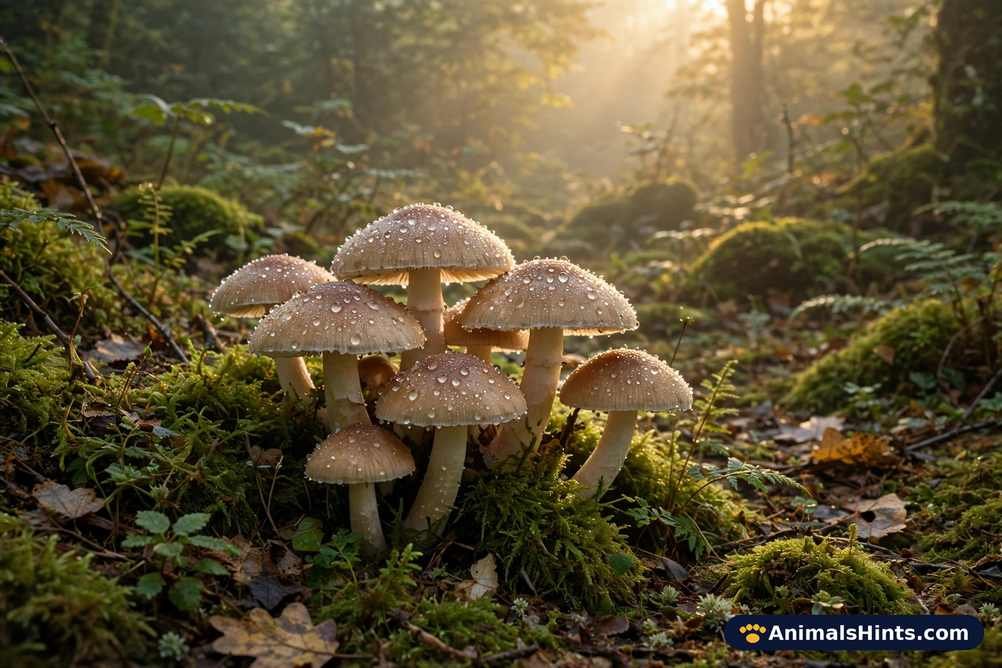
Mushrooms spiritually symbolise the meeting point of the visible and the invisible. The cap you see above the soil is only the fruit of the fungus — a brief, spore-scattering flare from an organism that otherwise lives hidden. The real fungus is the mycelium, a web of fine threads running through soil and wood, feeding quietly for years. Spiritual writers return to that split again and again: what shows is small and temporary, while what matters is vast, patient and out of sight.
Because mushrooms rise where something else has ended, they also symbolise renewal — life returning out of loss. The colour of that return is green, and our companion guide to the green spiritual meaning follows renewal within colour symbolism itself. The mushroom’s version is grittier: its new life comes out of decay rather than spring rain, which is why the symbol speaks so strongly to people rebuilding after a hard season.
Mushrooms further symbolise resilience and hidden work. They fruit overnight, in darkness, in places nothing else wants — rotting logs, dung, deep shade — and ask for no credit while they do the forest’s least glamorous job. And they symbolise interconnectedness: a single fungus can spread beneath acres of ground, trading with tree roots as it goes. Humility, balance between death and life, and trust in unseen processes complete the core symbolism.
The Real Fungi Behind the Symbol
Before the meanings, the organism deserves a hearing of its own, because the facts underneath this symbol are stranger than most of the folklore. Fungi are not plants. Biologists place them in their own kingdom, and on the tree of life they sit closer to animals than to plants — both lines descend from the same ancient group, the opisthokonts. Their cell walls are built from chitin, the material of insect shells, rather than the cellulose of plants, and they feed by digesting their food outside the body, secreting enzymes into wood or soil and absorbing the results.
That feeding makes fungi the planet’s great recyclers. University biology sources note that fungi are the only organisms that can efficiently digest lignin, the tough polymer that gives wood its strength — white-rot fungi are the reason fallen forests do not simply pile up forever. The mushroom itself is only the fruiting body, the equivalent of an apple on a tree. The organism is the mycelium below, and it can reach a scale no other symbol in this series can match: a single honey fungus, Armillaria ostoyae, growing in Oregon’s Malheur National Forest covers an estimated 2,385 acres (965 hectares), and scientists put its age somewhere between roughly 2,400 and 8,650 years. By area, it is the largest single living organism known.
Many fungi also trade with trees. In a mycorrhizal partnership, fungal threads wrap or enter tree roots and exchange soil nutrients for sugars the tree makes in sunlight. A landmark 1997 study in the journal Nature, led by Suzanne Simard, used isotope tracing to show carbon moving in both directions between paper birch and Douglas-fir through their shared fungi — the finding that launched a thousand “wood wide web” headlines. Honesty requires the second half of that story: a 2023 review by Karst, Jones and Hoeksema in Nature Ecology & Evolution found the popular version substantially overstated, noting that claims about “mother trees” deliberately provisioning their own seedlings have no published peer-reviewed evidence behind them. The network is real, and carbon really does move through it. The conscious, communicating forest of the headlines is a metaphor laid over a passive process — and the symbol of interconnectedness is stronger, not weaker, for being told straight.
One more fact belongs at the front, because it governs everything this article will not do. The death cap, Amanita phalloides, is responsible for roughly 90 percent of mushroom-related deaths worldwide, and its amatoxins are heat-stable — cooking or freezing does not make it safe. As little as half a cap is estimated to hold enough toxin to kill an adult. So the rule printed here, and repeated wherever it matters below, is absolute: never eat a wild mushroom without expert identification. This article is about meanings, folklore and biology. It contains no identification guide, no preparation steps and no encouragement to forage for the pot.
12 Spiritual Meanings of Mushrooms
Different writers count the mushroom’s meanings differently. The twelve below are the set most often given, and each is read here in the light of the tradition — or the fungus — that produced it.
1. Hidden Knowledge and Magic
Mushrooms appear where eyes rarely look: under logs, in deep shade, in the night hours after rain. Folk imagination made such things keepers of secrets, and gave the mushroom a second name soaked in suspicion. The word toadstool arrives in the late 14th century as “tode-stole” — apparently a toad’s seat, coined in an age when toads themselves were regarded as poisonous — and since about 1800 it has been popularly restricted to poisonous or inedible fungi, as the Oxford English Dictionary’s record, quoted by Etymonline, puts it. There is no scientific difference between a mushroom and a toadstool; both are the same fruiting bodies, and the split between the wholesome word and the sinister one is pure folklore. The toad lends the fungus its oldest English nickname, and the hidden-knowledge reading endures because the organism itself is genuinely hidden — a whole life lived underground, surfacing only to scatter spores.
2. Spiritual Growth and Awakening
A mycelium can grow for years before it fruits once. Spiritual teachers lean on that patience: the inner work comes first, invisibly, and the visible change — the awakening — is only the moment long-hidden growth breaks the surface. In this reading, a mushroom found on a walk is a reminder that a quiet season is not an empty one. The fungus was working the whole time.
3. Life Cycles and Renewal
Mushrooms feed on the dead and make soil for the living. As the science section above records, fungi are the only efficient digesters of lignin on Earth, which makes them the hinge of the whole forest cycle: no fungi, no recycling, no renewal. The caps themselves live for days and rot where they fall, returning their own substance to the ground that made them. Few symbols of the life cycle are this literal — birth, fruiting, decay and return, all in a single organism, all in a single week.
4. Transformation and Change
English still says a thing “sprang up like mushrooms” when it appears overnight, and the transformation reading grows from that speed. What looks sudden, of course, is only the surfacing: the mycelium prepared the change for months underground. Fairy rings make the same point at the opposite timescale — a ring of mushrooms on a lawn is a colony expanding outward a little each year, its centre exhausted, its edge still feeding. Change, the mushroom suggests, is either very slow or very sudden, and usually both at once.
5. Connection to Other Worlds
In European folklore, the fairy ring was a threshold. The ring marked where fairies or elves had danced in a circle, and stepping inside could be dangerous — the stories tell of mortals forced to dance until rescued, or carried off altogether. German tradition called them Hexenringe, witches’ rings, said to be revealed on Walpurgis Night, and Scandinavian folklore knew them as älvringar, elf rings. Modern spiritual writers extend that old lore into talk of portals and thin places between worlds; the language is modern, but it grows out of genuinely old stories about a circle of mushrooms as the edge of somewhere else.
6. Discernment and Spiritual Awakening
A mushroom asks to be read carefully. Some fungi are harmless, some are deadly, and lookalikes deceive even experienced eyes — the death cap’s record, set out above, is the standing proof that appearance is no guide to safety. Spiritual writers turn that fact into a teaching about discernment: growth is not just opening up, it is learning to tell nourishment from poison, in teachings as much as in forests. The practical half of the lesson is not symbolic at all. Never eat a wild mushroom without expert identification.
7. Prosperity and Abundance
One cap can release millions of spores, and a single log can fruit in clusters after one night of rain — abundance is the mushroom’s natural arithmetic. In Chinese tradition, prosperity wears a mushroom’s shape: the lingzhi, a woody Ganoderma fungus, became an emblem of wealth, rank and long life combined, carved onto sceptres and embroidered onto robes, a story the cultures section below tells in full. Some modern Feng Shui and nature-tradition writers also place mushroom shapes in the home as wealth symbols; that is a contemporary framing rather than a documented classical doctrine, and it is printed here as such. The older, quieter prosperity reading needs no placement rules at all: real growth multiplies underground first.
8. Safety and Protection
The cap is a roof. Small creatures shelter beneath mushrooms in rain, and folklore furnished whole villages under them for the forest’s little peoples. Protection in the mushroom world also works by advertisement: the fly agaric’s scarlet cap warns every grazing animal away, a danger signal worn openly rather than hidden. The protection reading, at its most practical, is the one this article keeps repeating — respect the warning colours, observe, and leave wild mushrooms uneaten.
9. Longevity and Immortality
If any living thing has earned the longevity reading, it is the Oregon honey fungus: one organism, thousands of years old, still expanding beneath a national forest. Human tradition reached for the same idea in the lingzhi, the “mushroom of immortality” of Chinese medicine and art, revered for over 2,000 years and detailed in the cultures section. The symbolic logic is simple and, for once, the biology cooperates — the mushroom’s true body does not die each season. It persists, fruits, and persists again.
10. Resurrection and Afterlife
A perennial mycelium fruits, rots back, and fruits again the next season — return after apparent death, written into a life cycle. Later mystical and devotional writers have laid a resurrection reading over that cycle, and it is printed here with its honesty note attached: no mushroom is named in the Bible, and no scripture teaches it. The resurrection meaning is an interpretation drawn from watching fungi return, not a doctrine drawn from any text.
11. Divine Symbolism
Mushrooms arrive unplanted. Nobody sows them; they appear after rain like a gift, which is how several traditions came to read them as signs of grace or divine provision rather than human effort. Nature adds its own marvel: mycologists have now catalogued more than 130 bioluminescent fungi, whose mycelium glows green in rotting wood — the old “foxfire” or “fairy fire” of dark forests. Light with no lamp, fruit with no sowing: the divine-symbolism reading is folklore’s way of honouring both.
12. Sacred Introspection and Shamanic Rituals
Two mushroom traditions are documented history, and both are printed here as history and nothing more. In Siberia and the Russian Far East, the fly agaric — Amanita muscaria, the red cap with white spots, named from the old practice of using it to stupefy flies — was used as a ritual entheogen by indigenous peoples including the Koryak, Chukchi, Khanty and Evenki. In western Siberia its use was largely restricted to shamans; in the east, shamans and laypeople alike took part. Its active compounds, ibotenic acid and muscimol, are precisely what make it poisonous, and it remains a dangerous fungus, not a sacrament for outsiders.
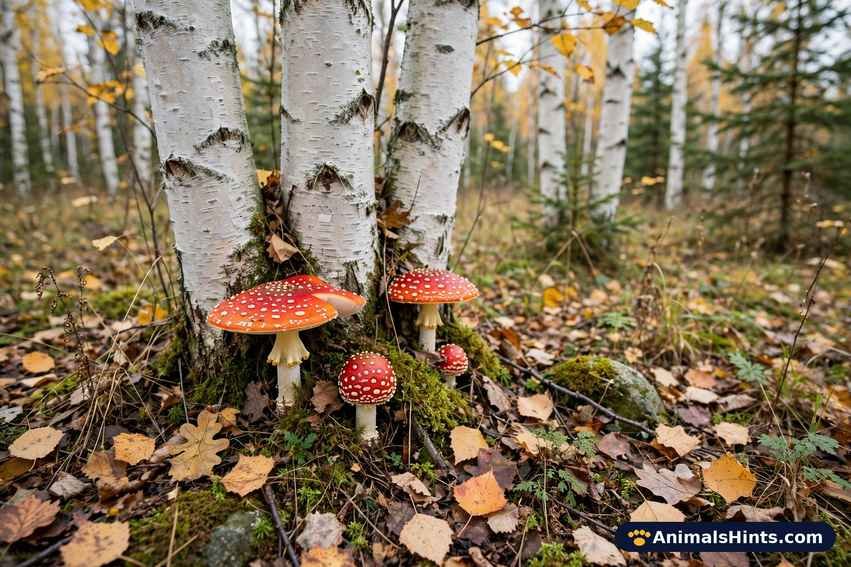
Half a world away, the Aztecs of Mexico knew sacred Psilocybe mushrooms as teonanácatl — “flesh of the gods” — a tradition the Franciscan Bernardino de Sahagún recorded in the 16th-century Florentine Codex before colonial authorities suppressed it as idolatry. The Mazatec people of Oaxaca preserved the ceremony, the all-night healing velada, and it was at a velada led by the curandera María Sabina in 1955 that the banker-turned-mycologist R. Gordon Wasson took part; his account, “Seeking the Magic Mushroom,” reached the world in Life magazine in May 1957. These are documented religious histories, described as an anthropologist would describe them. This article offers no instructions and no encouragement for any such use — the fungi involved are poisonous or controlled, and the rituals belong to their own cultures and laws.
Spiritual Symbolism of Mushrooms in Your House
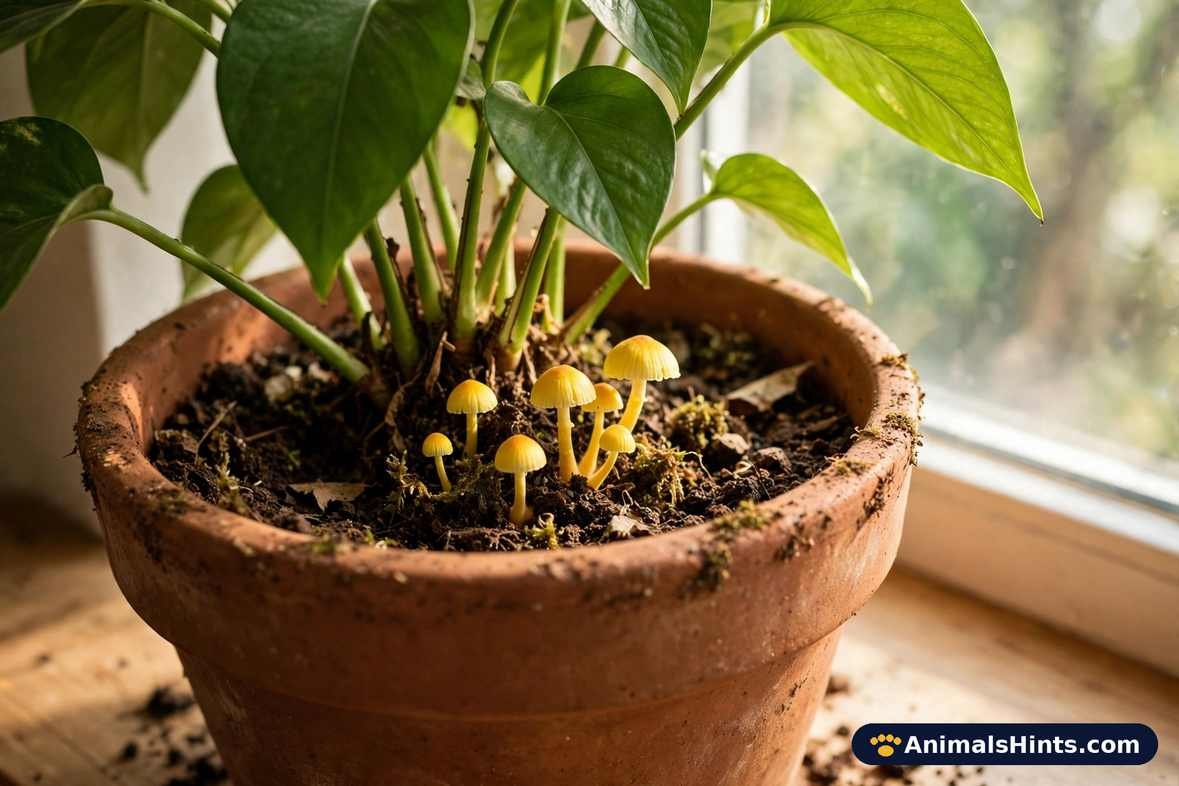
Mushrooms in the house carry a double meaning, and this article gives the practical half first. Indoors, a fungus is information about moisture. The little yellow parasol that appears in houseplant pots is almost always Leucocoprinus birnbaumii, the yellow houseplant mushroom: university extension services at Iowa State and Penn State identify it as the usual species, a decomposer that feeds on the bark and peat in potting mix, does not harm the plant, and is poisonous if eaten. Its real message is that the soil is staying wet — let the pot dry more between waterings, and lift the caps out if children or pets share the room. Fungus spreading on walls or timber says something more serious: damp is feeding decay somewhere in the building, and the fix is ventilation, repair and cleaning, not symbolism.
The spiritual reading sits on top of that record, not instead of it. Modern writers take a mushroom in the home as a sign of hidden processes surfacing — energy, change or old matter finally being broken down — and there is a fair metaphor in it, since the house fungus is literally digesting what was buried in the soil. Read it, by all means. Then check the watering can and the bathroom sealant, because the fungus is keeping honest books about both.
Symbolic Meanings of Different Colored Mushrooms
A mushroom’s color is chemistry before it is symbolism, and the readings below keep both in view. Where the competitor’s page set the colors out as bold lead-ins rather than subheadings, this article does the same.
White mushrooms symbolise purity, innocence and a clean, unshowy humility. White is the mushroom with nothing to prove — no warning colours, no glow — and modern readings connect it with modesty, spiritual innocence and, in some traditions of interpretation, with mourning and remembrance. White carries the same purity reading across this whole family of symbols: our guide to the symbolism behind seeing a white butterfly follows it on wings rather than caps.
Red mushrooms symbolise passion, courage and life force in modern colour readings — and in nature, the most famous red mushroom is a warning. The fly agaric’s scarlet cap, flecked with white, advertises a poisonous fungus whose compounds can stupefy and harm. Spiritual writers read red as energy and vitality; the forest reads it as keep away. Both readings are really the same one: red is power, and power is not tame.
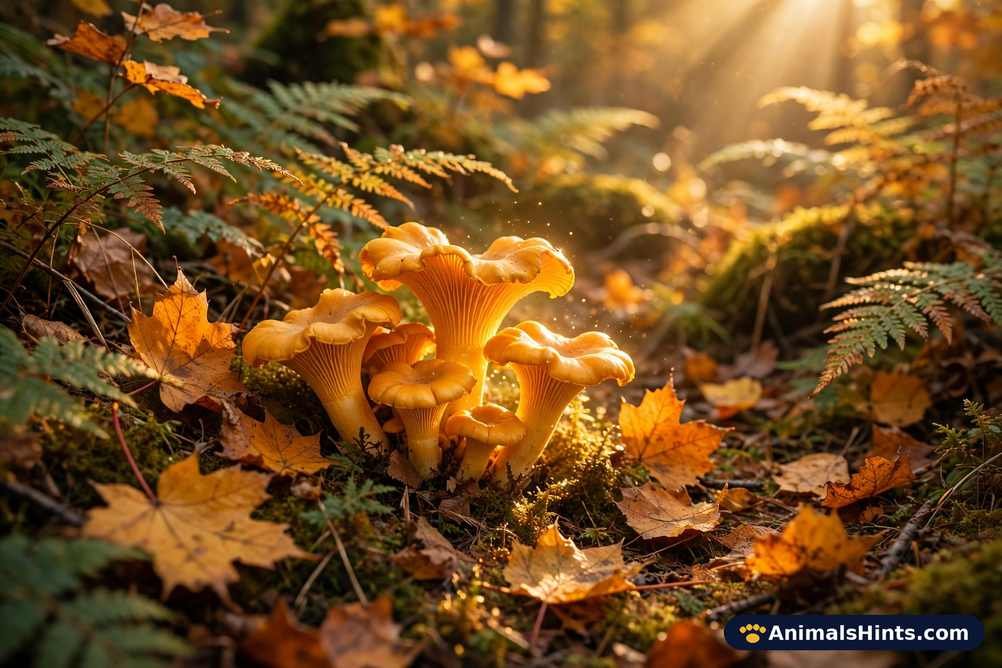
Golden or yellow mushrooms symbolise wealth, optimism and sunlight stored in the forest floor. Golden fungi are among the most photographed sights of autumn woods, and the little yellow houseplant mushroom of the section above wears the same colour indoors. The prosperity reading here joins the lingzhi’s long Chinese career, told below: gold is the colour of value recognised slowly.
Blue mushrooms symbolise rarity, intuition and the far edge of the imagination. Blue is genuinely rare in fungi, but it is real: the blue pinkgill, Entoloma hochstetteri, native to New Zealand, is azure from its cap to its stem, coloured by azulene pigments, and known in Māori as werewere-kōkako, after the blue wattle of the kōkako bird. The indigo milkcap of North and Central America wears the same improbable colour. Modern chakra teaching links blue mushrooms to the throat and third-eye chakras; that mapping belongs to the modern chakra system and is printed as such. Blue wears rarity everywhere it appears — our guide to the blue butterfly meaning traces the same scarcity in a very different creature.
Brown mushrooms symbolise grounding, humility and the earth itself. Brown is the working colour of the fungal kingdom — most forest fungi wear it, their caps coloured by melanin pigments — and it belongs to the decomposers who turn the forest floor back into soil. The brown reading is the mushroom’s most honest one: value without display, and strength that stays close to the ground. Brown wears the same grounded reading on wings; see the brown butterfly spiritual meaning guide for the colour’s other half.
Cultural and Religious Explanations of Mushrooms
The cultural record is where this symbol stops being a mood and becomes history. Four strands dominate the competitor’s page and the wider literature, and each is given here with its evidence — including the places where the evidence runs out.
In ancient Siberian and shamanic traditions, the fly agaric held a real ceremonial place. Ethnographers documented its ritual use across the Russian Far East and Siberia among the Koryak, Chukchi, Khanty, Evenki and other peoples, and the Koryak told an origin story to match: the creator Big Raven, struggling to send a captured whale back to the sea, ate the wapaq — the fly agaric — at the Earth spirit’s direction, gained the strength to lift the whale, and ordered the plant to grow on Earth forever so his children could draw the same strength. In 1968, R. Gordon Wasson proposed that the fly agaric was also soma, the sacred drink of the ancient Vedic hymns. That is a famous hypothesis with both followers and detractors, not a settled finding, and Wasson’s further suggestion linking ambrosia to mushrooms has won no comparable scholarly support — this article prints the first as a hypothesis and leaves the second out. A modern theory also ties fly agaric to the Santa Claus legend of flying reindeer and chimney visits; historians treat it as recent speculation layered over the Siberian material, not as part of that tradition itself.
In Eastern traditions, one fungus towers over the rest: the lingzhi of China, a woody Ganoderma species — the Chinese mushroom is now distinguished as Ganoderma lingzhi and G. sichuanense, though older Western books call it G. lucidum. Revered for over 2,000 years as the “mushroom of immortality,” it was classed among the top-grade substances in the Shennong Bencao Jing, the foundational Chinese materia medica, which said that protracted taking of it “may make the body light, prevent senility, and prolong life so as to make one an immortal.” Its very name carries the meaning — ling signifies the spiritually efficacious, zhi the longevity fungus. Wild lingzhi was rare and reserved to elites, and its silhouette became a longevity emblem across Chinese art, carved on sceptres and painted onto robes; Japan knows it as reishi.
In Celtic mythology and the wider European folklore around it, the mushroom’s great monument is the fairy ring. English and Celtic tradition held the rings to be places where fairies or elves had danced, dangerous for a mortal to enter and sometimes lucky to find; neighbouring cultures kept their own versions, from the German Hexenringe hung on Walpurgis Night to the Scandinavian älvringar. Other regions blamed the rings on the devil or on dragons rather than dancers. The folklore is genuinely old and genuinely documented — and, as the next section shows, the fungus underneath it is just as remarkable.
In Christian symbolism, honesty comes first: no mushroom is named anywhere in the Bible, and mushroom symbolism is not a scriptural teaching. What exists is later interpretation — mystical and devotional writers who saw, in a fungus returning from decay each season, an echo of resurrection hope, and modern readers who keep that reading alive. It is a meaningful interpretation for many people. It is not a doctrine, and this article does not dress it as one.
Fairy Rings: Where Folklore Meets Fungus
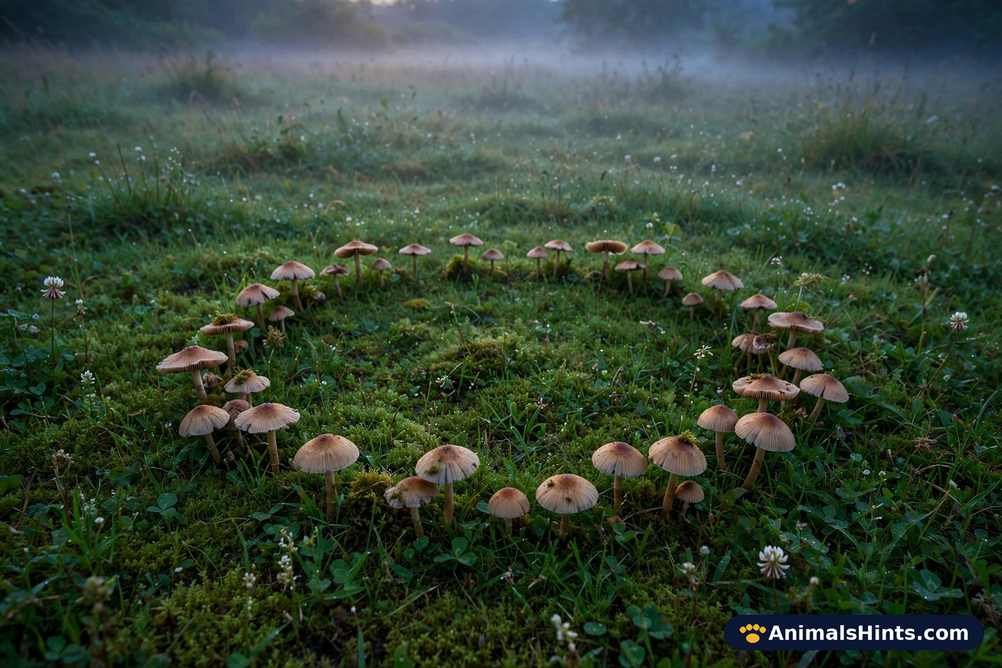
No mushroom sight carries more story per square foot than a fairy ring, and unusually, the science needs no deflating. A ring begins as a single colony: a mycelium grows outward from one point through the soil, feeding as it goes, until the food in the centre is exhausted and only the expanding edge is still active. When the colony fruits, the mushrooms stand in a circle — the visible rim of an invisible, growing disc. Around 60 mushroom species can form such rings; the best known is Marasmius oreades, called simply the fairy ring mushroom. Some rings outlast civilisations: one near Belfort in France, formed by Infundibulicybe geotropa, measures about 600 metres (2,000 feet) across and is estimated at more than 700 years old. The dark, lush grass inside the ring is the fungus’s signature too — nitrogen released as the mycelium feeds greens the turf above it.
| What you see | The folklore says | The fungus is doing |
|---|---|---|
| A circle of mushrooms standing on grass | Fairies, elves or witches danced here in the night | A mycelium is fruiting at the living edge of its colony as it grows outward |
| A ring of darker, taller grass | The ground inside the ring is blessed, or cursed | The feeding mycelium is releasing nitrogen, which greens the grass |
| The ring is wider than it was last year | The dancers’ circle grows stronger each season | The colony expands outward once the centre’s food is used up |
Read the two columns together and the old fear makes sense. A perfect circle appearing on grass, greener than its surroundings, widening year after year, really does look like the trace of something that visits in the night. The folklore mistook the dancers, but it read the wonder correctly.
Is Seeing a Mushroom a Good Sign?
In the balance of the traditions gathered here, yes — a mushroom is read far more often as a good sign than a bad one. The favourable readings are consistent across cultures: growth after hardship, renewal out of decay, abundance arriving quietly, and luck of the fairy-ring kind for those who find a ring without breaking it. Chinese tradition put its luck in a fungus for two thousand years, and the Siberian stories treat the fly agaric as a gift of strength — given by a god, in the Koryak telling, precisely so that people could learn from it.
The cautions are real but specific. Folklore warns against stepping inside the ring, not against seeing one. The death cap’s whole existence warns against eating the unknown, not against admiring it. And the house-mushroom record warns about damp, not about omens. So the honest verdict is this: seeing a mushroom is a good sign in nearly every tradition that has one, and the only bad outcomes in this entire record come from ignoring the two practical rules — do not step carelessly into old stories, and never eat what you cannot identify.
How to Observe Mushrooms Safely
The safe way to enjoy mushrooms keeps every part of the wonder and none of the risk. Look closely, kneel, photograph — a phone camera at ground level shows the gills, the ring on the stem and the texture of the cap better than any picking. Handling a mushroom is not itself the danger; mycologists are plain that the danger is eating one. Still, wash your hands after handling fungi you cannot name, and teach children the naturalist’s rule from the start: wild mushrooms are for looking.
Leave every mushroom where it stands. The cap you leave is food or shelter for insects and small animals, and it is the spore-bearing fruit of an organism that may have been growing under that spot for years — a fairy ring, for centuries. In houseplant pots, the one exception, lift the yellow caps out and let the soil dry if children or pets share the room, since that species is poisonous if eaten. Everywhere else, the whole discipline is three words long: observe, enjoy, and never taste.
Final Thoughts
The mushroom earns its symbolism honestly. It is the visible tip of a hidden organism, a recycler that turns death into soil, a trader wired into the roots of forests, a circle-drawing elder older than most nations, and — handled carelessly — one of the most dangerous organisms a walker can meet. Twelve meanings is almost too few for a creature that is genuinely all of those things at once.
What the traditions agree on, from the Koryak Raven story to the Chinese court to the English fairy ring, is that the mushroom rewards attention and punishes presumption. It asks to be noticed, wondered at and left standing — a teacher whose curriculum is patience, interconnection and respect for what grows in the dark.
So the next time you find mushrooms after rain — a cluster under a tree, a yellow guest in a flowerpot, or a fairy ring holding its circle on the grass — slow down before you walk on. The ring will still be widening when the caps are long gone: a fairy ring is the visible edge of a patience measured in centuries, and the mushroom’s oldest lesson is that the most important growth is the kind nobody sees.
Frequently Asked Questions
What do mushrooms symbolize spiritually?
Mushrooms symbolize hidden growth, transformation, renewal and the connection between the visible and invisible worlds. Because the true fungus lives underground as mycelium, they also stand for patience, humility and inner work done out of sight.
What is the significance of mushrooms in spiritual traditions?
Documented traditions give mushrooms real roles: fly agaric in Siberian shamanic ritual, the lingzhi as China’s mushroom of immortality, teonanácatl in Aztec and Mazatec ceremony, and fairy rings across European folklore. Modern spiritual teaching adds its own readings of growth, intuition and abundance on top of that record.
What does dreaming about mushrooms mean spiritually?
Modern dream interpretation — a contemporary practice rather than an ancient one — reads mushrooms in dreams as growth happening beneath the surface of your life, or as decay that needs clearing away. A thriving cluster points to quiet progress; rotting mushrooms suggest something finished that should be released.
How can I use mushrooms’ spiritual meaning in my life?
Use it as a lens, not a tool: notice mushrooms on walks, photograph them, and let their patience with hidden seasons steady your own. Keep the practical rule that governs this whole article — observe wild mushrooms, enjoy the symbolism, and never eat one without expert identification.