Six-Pointed Star Spiritual Meaning: Balance, the Hexagram Record and the Star of David
Two triangles cross, and a star appears: one points up, one points down, and where they overlap a small hexagon sits at the centre. Six-pointed star spiritual meaning is what readers make of that crossing: balance between above and below, protection drawn in geometry, and the hope that opposing forces can hold together inside a single figure.
That reading has a dated history underneath it, and this article keeps both layers in view. The star is genuinely old and genuinely widespread — carved in India, set into synagogue stone, struck on Islamic coins, worn as an amulet — but its most famous identity, the Star of David, became an emblem far later than most retellings suggest. The lore follows in full further down, keeping the source page’s own section order, and the record is set out beside it, dated wherever the sources allow a date.
Below are the ten meanings tradition assigns to this star, the cultures that carried it, the occult uses that made it famous and feared, and an honest account of the Bible’s silence about it. What the geometry can tell you is real. The rest — what was added later — is labelled as later.
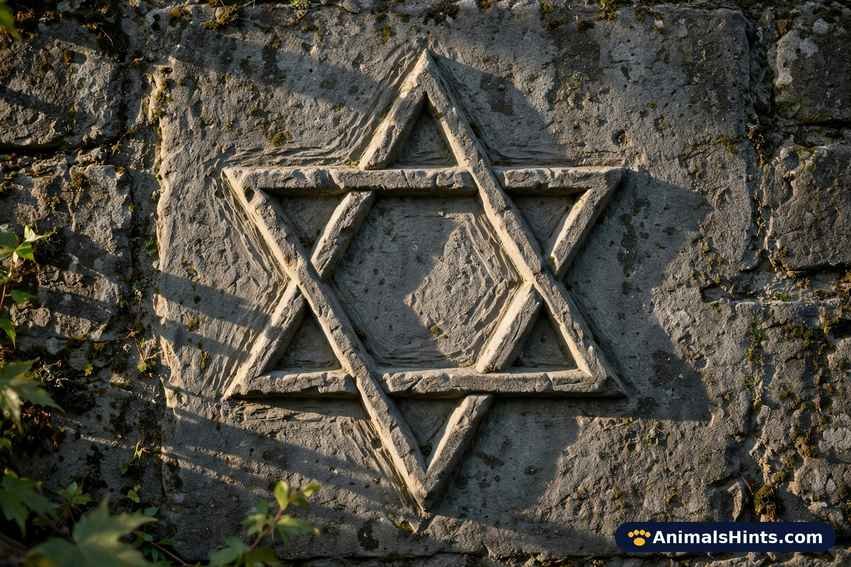
Two Triangles, One Figure: How the Hexagram Is Built
Start with the drawing itself, because every meaning in this article hangs on six lines. A hexagram needs nothing but a compass and a straight edge. Draw a circle, keep the compass set to its radius, and step that radius around the rim: it lands exactly six times, marking six evenly spaced points. Join alternate points and the first triangle appears; join the remaining three and the second triangle crosses it. The figure that results — six points outside, a regular hexagon where the triangles overlap — is the whole of the construction. Nothing is measured and nothing is guessed; the sixfold division falls out of the circle on its own.
That self-dividing quality is part of why the shape kept being reinvented. Two overlapping triangles are simple enough that unrelated cultures could arrive at them independently, and the record below suggests several did. The figure also has a second form the source page mentions in passing: drawn in one unbroken line rather than two separate triangles, it becomes the unicursal hexagram, a variant modern occult orders took up precisely because the pen never leaves the page.
Nature builds on the same sixfold plan, though it builds hexagons rather than stars. Water freezing into ice locks its molecules into a lattice of hexagonal rings, and a snow crystal grows outward on that lattice, which is why snowflakes carry six arms and six-sided symmetry (the physics is set out plainly by the Met Office and by university explainers of ice structure). Nobody carved the star into the snowflake; the six is in the crystal. What people did — across at least three thousand years — was notice the sixfold pattern, draw its boldest version, and start reading meanings into the crossing point.

What Does a Hexagram or Six-Pointed Star Represent?
The source page’s answer, and the tradition’s answer generally, begins with the two triangles read as a pair of opposites. The upward triangle is assigned to fire, to the masculine, to spirit climbing toward the divine. The downward triangle is assigned to water, to the feminine, to spirit descending into matter. Locked together, the pair is read as the union of opposites: heaven and earth, consciousness and body, held in one balanced design rather than set at war.
Part of that reading has a documented pedigree, and part is modern framing, and the two are worth separating. In alchemy the elemental reading is genuinely old: the upward triangle served as the written glyph for fire, and the downward triangle as the glyph for water, so a combined figure really was available to alchemists as a shorthand for the two elements reconciled. The fuller scheme — each triangle also standing for a gender, a direction of spiritual travel and a half of the self — is the work of later esoteric writers elaborating that shorthand, and it is offered here as their reading, sincerely held and widely repeated, rather than as an ancient doctrine that can point to a text behind it.
The shield reading belongs to the same section. The source page describes the hexagram as a protective emblem, an enclosure against negativity, and that too has a real strand in the record: forms of this star were carried as amulets, and the Jewish name for it, Magen David, translates literally as Shield of David. When the shield idea entered the star’s history, and how late, is a story the dated record below tells in full.
10 Spiritual Meanings of the Hexagram or Six-Pointed Star
1. As Above, So Below
The first meaning borrows the most quoted sentence in Western esotericism. The phrase descends from the Emerald Tablet, a short alchemical text attributed to the legendary Hermes Trismegistus; its oldest surviving versions are Arabic, from the eighth or ninth century, and it reached Latin Europe in the twelfth. The Tablet’s own sentence runs longer than the slogan — that what is below is like what is above, and what is above is like what is below — and the tidy four-word epigram is a much later condensation of it. Read against the star, the idea is that the two triangles mirror one another: the pattern above repeats below, the large world reflects the small one, and neither is complete without its reflection. As a meaning it is genuinely centuries old in the alchemical tradition. As a slogan it is younger than it sounds, and this article dates it rather than pretending otherwise.
2. Balance & Harmony
Strip the first meaning down to its geometry and this one remains. The star is symmetrical along every axis a ruler can test: turn it a sixth of a circle and it lands on itself. The tradition reads that literal equilibrium as a picture of the balanced life — effort against rest, intellect against feeling, the outer world against the inner one — and uses the figure as a reminder that balance is a maintained position, not a permanent achievement. Nothing in the record contradicts the reading, because the reading makes no historical claim; it is an interpretation laid over a shape that really is balanced, and it is reported at exactly that strength.
3. Duality & Oneness
The third meaning presses the paradox harder: the figure is made of two opposed shapes and is nevertheless one figure. Dawn and dusk, birth and death, the lit half of the pattern and the dark half — the dark side of the pair, which the black spiritual meaning tradition takes as its entire subject — are read as expressions of a single source rather than as enemies. Modern writers in this genre often route the idea through psychological language, light self and shadow self learning to share a house. That vocabulary is contemporary, and the article labels it so; the underlying picture, two contrary triangles composing one star, is simply what the drawing shows.
4. Creation & Creative Energy
Here the lore treats the crossing triangles as the meeting that generates life: consciousness and energy, idea and material, joining to produce something neither holds alone. One popular extension counts the points against the creation week — six working days around a centre that stands for the seventh day of rest. That extension should be weighed honestly — it is a later devotional reading, not an ancient teaching, and no early source draws the star as a diagram of the creation week. A documented modern version of the same upward-and-downward reading exists in the work of the Indian teacher Sri Aurobindo, who used the interlaced triangles on his books for humanity aspiring upward and the divine descending in answer. The meaning, in short, is a living interpretation with named modern teachers behind it, and it needs no invented antiquity to stand.
5. Talisman for Protection and Spiritual Power
This meaning, alone among the ten, rests on objects you can still handle. In the later Middle Ages, Jewish practitioners of practical Kabbalah carried the Shield of David on amulets as a defence against evil spirits, in parallel with the Seal of Solomon’s reputation, and the seal itself — in five- and six-pointed forms — was engraved on signet rings and struck on coins across the Islamic world, where legend held that Solomon’s ring commanded the jinn. Later occult literature kept the employment going: one standard history of magic calls the six-pointed star the talisman of Saturn and gives workshop instructions for making one. People still wear the star as a pendant for protection today, and the wearing is a fact, whatever the reader concludes about the protection. The record shows the use, continuously, for centuries. What the record cannot show is an effect, and this article claims none.

6. Symbol of Divine Union and Balance of Elements
Alchemy gives this meaning its documentary base. In the alchemical scheme the upward triangle glyphs fire and the downward triangle glyphs water, and their combination was read as the reconciliation of the two great opposites of the art; refined versions drew all four elements from the pair, adding barred triangles for air and earth, and the combined figure could also stand for the quintessence, the fifth element beyond the four. The gold the alchemists chased sits inside this symbolism rather than beside it — the wider gold spiritual meaning tradition works the same territory of transformation and worth. The source page’s language of lead becoming gold is metaphor in the modern retelling, but the elemental geometry underneath the metaphor is real period material, printed in alchemical books while the art was still practised.
7. Connection to the Divine Feminine and Masculine (Shatkona)
The Hindu form of the star carries its own name and its own theology, and it is older in continuous use than most of the star’s other careers. Shatkona, “six-cornered” in Sanskrit, names the figure in Tantric diagrams called yantras, where the upward triangle stands for Shiva and the downward for Shakti — consciousness and energy, the masculine and feminine principles whose union the diagram celebrates. The same figure is glossed in the reference literature as Purusha, the supreme being, joined with Prakriti, mother nature. It is also called Shanmukha, the six-faced, after Kartikeya, the six-faced child of Shiva and Shakti, and it is still drawn on thresholds across India in the floor decorations called rangoli. None of this is borrowed from the Jewish star or lent to it; the two traditions arrived at the same six lines by their own roads, which is itself the most interesting fact in this section.
8. Representation of the Spiritual Journey and Inner Self
Read as a map rather than an emblem, the star becomes an itinerary: six points to travel, a centre to arrive at. The source page assigns stages to the points — awakening, purification, integration, illumination, transcendence, unity — and that staging is a modern teacher’s scheme, presented here as such. The inward reading itself has respectable company. Sri Aurobindo’s documented use of the figure, aspiration rising and grace descending, belongs to this family of interpretation, and the broader habit of treating a balanced diagram as a picture of the self runs through twentieth-century spiritual writing, including the Jungian fondness for centred geometric figures as images of wholeness. Carry the meaning as the genre offers it: a framework for introspection, helpful to the people who use it, making no claim on history.
9. Esoteric Meaning of the Unmanifested Seventh Point
Count the star’s furniture and a remainder appears: six points, and then the hexagon in the middle where the triangles cross. Esoteric writers call that centre the seventh point — unmanifested, in the source page’s word, the still place the six directions surround. The idea has a foothold in the documented ritual literature: in Rosicrucian and Hermetic magic the seven traditional planets are assigned to the hexagram’s angles and to its centre, so the middle position really is worked as a seventh station in that system. Beyond the ritual books, the centre-as-source reading is contemplative rather than historical — a way of saying the figure organises itself around something it does not draw. As geometry that is simply true: the hexagon is the single part of the figure nobody outlines on purpose. It appears because the triangles cross.
10. The Hexagram’s Historic Occult Use and Warning
The last meaning is the shadow the fifth one casts. A figure trusted to protect was also trusted to command: in medieval magical tradition the Seal of Solomon, drawn as a five- or six-pointed star, belonged to the art of binding spirits, and the grimoires — the Key of Solomon tradition above all — built procedures around seals of this family. The source page attaches a warning to that history: the symbol is safe, in its telling, and the misuse of it is not. This article carries the history and declines the warning’s premise. What the record verifies is employment, not power — people used the star in rituals, wrote manuals for it, feared and revered it — and a drawing’s documented career needs no supernatural claim in either direction. Discernment, the virtue the source page ends on, is good advice for reading about symbols as much as for using them.
The Dated Record: When the Six-Pointed Star Actually Became an Emblem
Most retellings of this symbol run its history backwards, projecting a famous modern emblem into an ancient past. The dated evidence, assembled by Britannica and by Gershom Scholem’s classic 1949 study of the star, tells a slower and more interesting story — long centuries as decoration and magic sign, then a remarkably late promotion to emblem.
The figure itself is old beyond argument. The oldest known artefact bearing a hexagram is a dagger from Verin Naver in Armenia, dated to the third millennium BCE. In Jewish contexts the earliest surviving example is a seal from Sidon, seventh century BCE, carrying the name Joshua ben Asayahu — a personal seal, not a communal badge. Around the fourth to sixth centuries CE a hexagram was carved on a synagogue frieze at Capernaum, in a row of ornamental designs that also includes a pentagram and floral work; scholars do not read a religious meaning into it. Scholem’s caution from 1949 is worth quoting at the strength he wrote it: the symbol “is not to be found at all in medieval synagogues or on medieval ceremonial objects, although it has been found in quite a number of medieval Christian churches — not as a Christian symbol but only as a decorative motif.”
The name arrives in the Middle Ages. Hexagrams decorate the carpet pages of the Leningrad Codex, the oldest complete Hebrew Bible manuscript, finished in Cairo around 1008, without yet carrying a special title. The first explicit naming of the figure as the Shield of David appears around 1300, in the Kabbalistic work Sefer ha-Gevul. From there the star’s Jewish career is magical before it is national: practical Kabbalists used it on amulets, alongside the Seal of Solomon, and the two star forms shared that seal’s name for centuries — Scholem notes that the name “Seal of Solomon” itself apparently originated among Muslims, who systematised the occult sciences early.
Emblem status comes later still. Prague’s Jewish community put the Shield of David on its banner around 1490 and made it the official emblem of the Jewish town in the 1530s — the first documented communal adoption anywhere. In 1656 a Vienna signpost set the shield beside a Christian cross to mark the boundary between the city’s Jewish and Christian quarters, often cited as the first clear use of the star as a sign of Judaism itself rather than of one community. The nineteenth century made it general: European Jews adopted the star widely as a visible emblem of Judaism, in part as an answer to the cross’s clarity as a sign of Christianity. Zionism took it up in the flag designs of 1885 to 1897; the Nazi regime then forced it onto badges from 1939 to 1945, an imposed use that Scholem, writing in 1949, argued had charged the symbol with a depth no congress could have given it. In 1948 it became the centrepiece of the flag of Israel.
Two popular claims fail against this record and should be retired kindly. There is no evidence that hexagrams were painted on the shields of King David’s warriors, and none connecting the star to the Bar Kokhba revolt of 132–135 CE; Britannica files both under disputed histories that current scholarship regards as conjecture. The star’s Jewish story needs neither claim. A decoration that became a magic sign, then a town’s emblem, then a people’s flag is a full enough biography for six lines.
Hexagram Symbolism in Different Cultures and Religions
Jewish tradition. Under the name Magen David, Shield of David, the star’s Jewish meanings gather around protection and identity: the shield that guards, and the sign that says who you are. Later interpretation reads the two triangles as the traffic between God and humanity, one reaching up and one reaching down. Those readings are given here as the tradition itself states them, with the timeline above kept in view — the identity meaning is real and hard-earned, and it is also, in the long view, recent.
Hindu tradition. The shatkona’s home is the yantra, the geometric diagram used in Tantric worship, where the star figures the union of Shiva and Shakti and, in the chakra system, sits at the centre of Anahata, the heart chakra, drawn inside a lotus of twelve petals. Hindu usage is not a footnote to the star’s Western career; it is an independent, living tradition of the same figure, older in its textual framing than the Shield of David’s name.
Islamic tradition. In Arabic the figure is Khātem Sulaymān, the Seal of Solomon, and also Najmat Dāwūd, Star of David. Medieval Anatolian beyliks — the Karamanids and the Jandarids — flew it on their flags, the corsair admiral Hayreddin Barbarossa carried it on his banner, mints struck it onto coins from Aleppo to Morocco, and it is carved on mosques and worked into artefacts across the Islamic world to this day. In this tradition the seal’s charge is Solomon’s God-given authority over the jinn, a story the Qur’an’s reverence for Solomon as prophet and king sustains.
Christian tradition. Hexagrams ornament some of Europe’s oldest churches: the cathedral at Etchmiadzin in Armenia, built in 303, is decorated with them, and Nikolaus Pevsner noted one in the choir-stall canopies of Winchester Cathedral from around 1308. In Christian usage the figure is sometimes called the star of creation. The Church of Jesus Christ of Latter-day Saints uses it in temple architecture, reading it as God reaching down and humanity reaching up. In most of these settings the star worked as honoured decoration and loose symbolism rather than as a defined doctrine, which matches Scholem’s observation that churches displayed it before synagogues did.
Buddhist tradition — a correction. The source page credits Buddhism with the star as an emblem of harmony resting on six elements. Checked against the record, that needs softening to near-vanishing. Buddhism’s own geometric language is the mandala, not the hexagram; the one famous Buddhist book appearance of the figure, in some editions of the Bardo Thodol, was put there by the work’s modern publishers, and the genuine Tantric tie — a hexagram at the centre of the goddess Vajrayogini’s mandala — is a borrowed Indic diagram, not a Buddhist doctrine of the star. The six elements themselves are real doctrine in Japanese esoteric Buddhism, but their emblem is the five-ringed gorinto pagoda, not a six-pointed star. The honest sentence is that Buddhism largely did not take this symbol up, and a symbol’s biography is allowed its quiet chapters.
The ancient-world claim — a second correction. The source page sends the star travelling “from Egypt to Mesopotamia” as a temple carving of cosmic order. No source fetched for this article documents hexagrams carved into ancient Egyptian or Mesopotamian temples; the verifiable early trail runs through an Armenian dagger, Indic diagrams, a Phoenician-city seal and Mediterranean decoration. Cosmic order is what later readers saw in the figure. The carvings, where they can be checked, are ornament first.

Uses of the Six-Pointed Star in Occult Practice
The occult career is the best-documented of all the star’s lives, because its practitioners wrote manuals. In the Hermetic and ceremonial-magic traditions, the hexagram serves as a working diagram: the Greater Ritual of the Hexagram assigns the seven traditional planets to its angles and centre, and invokes or banishes planetary forces by tracing the figure in prescribed directions. The elemental construction belongs to the same literature — fire and water triangles combined, air and earth added with their barred forms, the doubled figure called the double hexagram. One widely used magical history prints workshop instructions for making the star as a talisman of Saturn, materials included.
Freemasonry took the figure as decoration and declined to fix its sense: Albert Mackey’s Encyclopedia of Freemasonry describes the interlaced triangles as the union of active and passive, male and female, darkness and light, and Masonic usage leaves the deciphering to the individual, non-dogmatic by design. The Theosophical Society, founded in 1875, set the star in its seal alongside the swastika, the ankh, the aum and the ouroboros — a deliberate gathering of world symbols into one emblem. In astrological circles the figure picked up the nickname “King’s Star,” from a theory tying it to the chart of David’s birth; the theory is astrologers’ lore, carried as such.
The source page also places the hexagram inside Kabbalah as a key to the Tree of Life, and that placement needs its usual dating care. Kabbalah’s documented bond with the star is the naming of the Shield of David around 1300 and the amulet practice that followed; arrangements of the ten sefirot in the star’s shape are an eighteenth-century interpretation read back into earlier masters, as Britannica’s account notes. Modern energy work and meditation have since adopted the figure as a visualisation — a balanced shape to hold in the mind — which is a use anyone may make of six lines, requiring no lineage to be honest about itself.
Symbolism of the Hexagram in Dreams
No validated dictionary stands behind dream interpretation — professional psychology endorses no fixed table of what an image means — and within that honest limit, the genre’s reading of this dream is consistent. A six-pointed star appearing in sleep is read as reconciliation under way: two sides of a life, or of a self, being fitted together. A bright or glowing star is read as awakening and order arriving; a broken or incomplete one as the opposite, an imbalance the dreamer already half-knows about. The dream grammar is the same one this site meets across its symbol topics — the blood moon meaning tradition reads a changed moon as a picture of a waking situation, and the dreaming about your ex spiritual meaning tradition reads a returning person the way the rotten teeth dream spiritual meaning tradition reads a damaged mouth: as the mind’s image of something already under way, not as a dispatch from outside it.
The source page ties the dream star to the heart chakra, and unusually for dream lore, that tie has a document behind it. In the Hindu chakra system the shatkona is not merely associated with the heart centre; it is drawn there, two triangles crossing inside the twelve-petalled lotus of Anahata, figuring the union of Purusha and Prakriti at the body’s midpoint. A dream reader borrowing the association is borrowing something real about the symbol’s placement in a living tradition — which is more than most dream symbols can offer, and still not a diagnosis of the dreamer.
Importance of the Hexagram in Sacred Geometry and Feng Shui
Sacred geometry is the modern name for an old habit: treating certain shapes as pictures of how the world is put together. Inside that practice the hexagram’s brief is correspondence — the small pattern repeating the large one, the six points answering to the directions of space — east and west, north and south, above and below — with the centre as the still seventh place the directions organise around. As a description of how practitioners use the figure, that is accurate; as a claim about the cosmos, it is the practice’s own framing, and this article carries it in the practitioners’ voice rather than its own.
Nature’s contribution to the section is narrower than the source page suggests and stronger for being narrow. The star does not grow in gardens, but sixfold order genuinely does: ice crystallises in a hexagonal lattice, snowflakes inherit the six, and Kepler thought the fact worth a small book in 1611. A shape people keep drawing and a symmetry nature keeps using are cousins, not twins, and the resemblance is a fair part of the figure’s charisma.

Feng Shui’s use of the star, in the form the source page gives it — placed in a home to harmonise chi and settle a room’s energy — is a modern practitioner practice rather than a classical doctrine this research could verify; classical Feng Shui works with the bagua, the compass and the five phases, and the hexagram enters through contemporary eclectic practice. Readers who place the star for calm are in plentiful modern company. The placement is a preference with a tradition-shaped story behind it, and it is filed here at exactly that weight.
Is the Six-Pointed Star in the Bible? What the Text Actually Says
No — and the negative is unusually well documented, which makes this the section where the record speaks most plainly. Britannica states it without hedging: the Star of David is not mentioned in the Hebrew Bible, and the Bible nowhere associates a hexagram with King David. No verse describes the figure, names it, or puts it on a shield, a banner or a ring. The name Shield of David does occur in the Babylonian Talmud, completed around 600 CE — but there it names God’s protection of David, a concept in a blessing, not a drawn symbol anyone carried.
Two verses are routinely conscripted into the argument, and both deserve to be read rather than rumoured. Amos, rebuking Israel for idolatry, writes:
But ye have borne the tabernacle of your Moloch and Chiun your images, the star of your god, which ye made to yourselves. (Amos 5:26, KJV)
Stephen, retelling the same charge in Acts, gives it as “the star of your god Remphan, figures which ye made to worship them” (Acts 7:43, KJV). Neither verse describes a shape. A star of a god, in the ancient world, could be a drawn emblem, a carried image or the planet-god itself — Saturn is the usual scholarly candidate behind Chiun — and nothing in either text counts the points. The identification of these verses with the hexagram is a later polemical claim, pressed hardest by writers arguing against the symbol, and it has no evidence underneath it: no ancient source draws the star of Remphan as six-pointed. The verses are quoted here because they genuinely bear on the popular debate, and what they establish is the opposite of what they are usually quoted for — the Bible’s star language never becomes a hexagram.
Solomon’s side of the story follows the same pattern. The Talmud mentions a ring of Solomon’s that could ward off demons; the notion that its seal was a star of five or six points, with magical powers, developed afterwards, in medieval Jewish and Islamic lore, where the Seal of Solomon became an amulet, a coin design and a legend of command over the jinn. Scripture gives Solomon wisdom, wealth and a temple. The star-shaped ring is the Middle Ages’ gift to him, and the honest article returns it to them.
Wearing and Using the Star Today: Jewellery, Flags and Everyday Marks
Walk the symbol’s modern round and it turns up in registers its medieval amulet-makers would recognise and a few they would not. As jewellery it does double duty that the record fully supports: for Jewish wearers the Star of David is a statement of identity and belonging, worn on necklaces and rings in the open; for wearers from the broader spiritual marketplace the same pendant is bought as a protective talisman, meaning 5 with a chain through it. Both uses are continuations of documented history — the emblem and the amulet are the star’s two oldest jobs.
On flags it carries nations. The blue star on Israel’s flag, adopted in 1948 over a design carried by the Zionist movement since the 1890s, is the famous case; the colonial flag of Nigeria flew a green hexagram around a crown from 1914 to 1960, and the Anatolian beylik banners and Barbarossa’s ensign did the same work centuries earlier under the Seal of Solomon’s name. Everyday marks are humbler and older than most people guess: in southern Germany the hexagram is the Bierstern, the brewer’s star, hung at taverns as the guild sign of the beer tap, and a small six-pointed star has served for centuries as a proof mark on fine swords — still required, remarkably, on official British and American military blades, a fossil of the age when the mark certified Damascus steel.
One courtesy is owed here, because the star’s modern weight is unevenly distributed. To most of the world the figure is a geometric ornament with a rich file of meanings. To Jewish readers it is a living emblem of identity, carried through a century that includes its forced wearing as a badge of persecution. Both facts are in the record above, and the second is why the symbol deserves the care with facts that this article has tried to give it.
Final Thoughts
Lay the lore and the dated record next to each other one final time. The lore’s record: two triangles read as fire and water, spirit and matter, a shield, a seal, a map for the inner journey, ten meanings deep. The dated record: a figure drawn since the Bronze Age, named for David around 1300, carried on amulets and coins, promoted to a people’s emblem in the nineteenth century and a nation’s flag in the twentieth. The lore is not the record’s enemy. Most of what the lore says about this star, some community really did believe, practise or wear — the meanings are genuine as meanings, and their dates, where this article could fix them, are printed beside them.
What the star finally symbolises may be the habit itself: human beings cannot leave a perfect shape alone. Given six lines that balance exactly, we have projected onto them everything we most want balanced — heaven and earth, self and other, the world above and the one below. Sit with the figure the way its practitioners have always sat with it, as a mandala is sat with: not as an answer, but as a well-made question, drawn in two triangles, that has kept good company for three thousand years.
Frequently Asked Questions
What does the six-pointed star symbolize spiritually?
Balance and union, in the tradition’s reading: two opposed triangles — spirit and matter, above and below — locked into one figure. It is also read as protection, after its long career on amulets, and as divine connection.
What is the spiritual significance of the six-pointed star in different traditions?
In Judaism it is the Shield of David, protection and identity; in Hinduism the shatkona, Shiva and Shakti in union; in Islamic tradition the Seal of Solomon, authority and protection. The balance reading runs through all three.
Is the six-pointed star a symbol of protection?
Yes, in the record as well as the lore: it was carried on amulets in medieval Jewish practice, engraved as Solomon’s seal on rings and coins, and is still worn as a protective pendant. The use is documented for centuries; the effect is a matter of belief.
How can I use the six-pointed star’s spiritual energy in my life?
The practical answer is reflective: meditate on the figure as a picture of balance, wear it as a reminder of the opposites you are trying to hold together, and let the centre stand for the still point you are aiming at. No ritual is required.