Born with Grey Hair Spiritual Meaning: 10 Meanings, the Congenital Record and the Bible’s Silence
Most grey hair announces itself late, a strand at a time, after decades of colour. A newborn’s silver hair reverses the order entirely: the grey is there at the very start, before any life has been lived to earn it. The born with grey hair spiritual meaning is the name for the question that follows — what can it signify when the emblem of old age arrives in the cradle?
Two very different records answer. The spiritual guides read the newborn’s grey as a soul arriving already old: a divine purpose, a child chosen for guidance, wisdom carried in rather than built up. The documented record is quieter and stranger — a small family of congenital pigment conditions, headed by piebaldism, in which pigment cells are simply absent from patches of hair and skin from birth, present on day one and, in the usual case, unchanged for life.
This page gives the tradition its full hearing first — the ten meanings, the symbolism, the Bible section, the cultural readings, the young-age file and the dreams — and then sets the documented record beside the lore: the full count of Scripture’s grey-hair texts and the baby they never mention, what medicine documents about hair that starts grey, the few signs that belong to a doctor, and an honest reading to close.

What Do Grey Hairs Symbolize?
The guides’ symbolism makes grey hair the visible signature of a life in transition. It stands where one stage gives way to the next, and the traditions read it as the soul’s maturity showing on the body — not decline, but development made visible. Where ordinary thinking files grey under age alone, the spiritual reading files it under everything age is supposed to have taught.
The strands themselves become a ledger in this telling. Each silver hair is a difficulty survived and a lesson kept; gathered across a head, they are said to stand for patience that held, endurance that did not break, and faith that outlasted the circumstances testing it. The symbol works because grey is an in-between colour. The grey spiritual meaning maps that middle territory — neither the dark of beginnings nor the white of endings, but dusk, ash and weathered calm — and a head of it reads, to the tradition, as a person who has learned to live in that middle ground. Against the black spiritual meaning, where black files under depth, mystery and the unseen, grey reads as experience brought up into the open: the hidden years made legible at a glance.
All of that symbolism, though, was built for hair that greys across a lifetime. This page’s subject runs the symbol backwards — grey first, life afterwards — and the sections below keep those two files apart: the lore on its own terms first, and then the record of what a newborn’s grey hair verifiably is.
10 Spiritual Meanings of Grey Hair
The guides give ten readings, taken here in the order his page sets them out, one by one. Each is theirs — a teaching of the tradition, not a claim this page makes about any real person, newborn or otherwise.

1) Wisdom Gained
First and oldest of the readings: silver hair as knowledge that experience, not study, deposits. In the guides’ telling, the grey-headed have been educated by joy and loss alike, and the colour is the certificate — a calm pattern-recognition that younger heads have not yet had the years to build. Applied to a child born grey, the reading inverts itself into prophecy: the wisdom is treated as cargo the soul brought with it, rather than a harvest it has still to gather.
2) Spiritual Maturity
The second reading concerns the inner life rather than the intellect. Maturity here means the slow release of ego-driven wanting — the shift from chasing surface success toward peace, acceptance and judging what to keep and what to release. Grey hair is read as that shift made visible: the spirit outgrowing illusion, needing less to prove and less to compete, its calm showing first at the temples.
3) Divine Protection
Many of the guides read grey hair as carrying divine protection — not a promise of a trouble-free life, but of strength supplied during trials. Its bearer is said to walk closely with higher guidance, and the grey itself becomes a kind of shielding: lessons survived, direction received, a soul kept through uncertainty. That is a claim about unseen things, and it is printed as a claim; what holders actually report is the reassurance it gives them.
4) Honor in Traditions
Across cultures, the fourth reading runs, grey hair commands honour. Christian teaching is cited for its crown-of-glory image; Hindu culture for the reverence owed to grey-headed elders and their discipline; Indigenous traditions for the grey-haired storyteller keeping a people’s sacred memory. The common thread the guides draw is trust: a community hands its memory, and much of its judgement, to the heads that have gone silver.
5) Karmic Completion
Traditions that teach rebirth read grey hair as karmic completion — the major lessons of the soul fulfilled, old cycles dissolved, burdens set down. The reading is applied to early greying as readily as to late: a soul of advanced age, in this frame, may show its completion ahead of schedule, the body’s silver reflecting an inner account already settled. The reading lives inside the traditions that teach karma and rebirth; nothing in the classical material gathered for this page states any doctrine of hair at all.
6) Ego Detachment
The sixth reading treats grey hair as a quiet teacher of detachment. It challenges vanity first — the mirror becomes an argument — and then, in the guides’ telling, loosens the grip of appearance altogether: attention turns from how one looks to what one is, humility replaces comparison, and self-respect stops depending on youth. Grey hair, in this reading, symbolises freedom from a false identity built on attraction.
7) New Life Phase
Grey hair is also read as a doorway between chapters — one closing, another opening — the new one often tied to guidance, reflection and a more deliberate pace. The person pauses more, reviews the past, reassesses the future, and lets the review realign their actions with their values. The tradition insists on the direction of the symbol — transition, not decline — and on acceptance as the posture that turns the change into growth.
8) Worldly Balance
Grey is the midpoint colour, belonging fully to neither black nor white, and the eighth reading makes it the colour of balance itself: harmony between body and soul, material duty and spiritual awareness walked at once. Responsibilities still matter, but they no longer consume; insight deepens without detaching from ordinary life. Grey hair, on this account, teaches the middle path — moderation over extremes, earthly duties and inner truth each given their due.
9) Mortality Reminder
The ninth reading is the sober one. Grey hair announces time’s passage, and traditions — Buddhism is the one the guides name — treat that announcement as spiritually useful: a reminder, always in view, that life does not last, which pushes the mind toward mindfulness, meaning over distraction, and gratitude for the present moment. Faced rather than fled, the reminder is said to soften fear and sharpen compassion.
10) Longevity Blessing
The list closes with longevity read as blessing. A long life, in this frame, is extended time to gather wisdom and to hand it on; many cultures are said to honour it as endurance and inner strength walking together. The grey-headed elder becomes the community’s teacher and support, and the silver itself the sign of readiness for that role — life lived with awareness, depth and vitality in the same frame.
Cultural and Religious Significance of Grey Hair
The cultural record the guides assemble is, at its core, a record about age. In the Eastern traditions they cite — cultures formed by Hinduism, Buddhism and Confucian teaching — grey-haired elders stand near the centre of community life: consulted in uncertainty, listened to closely, their authority resting on patience and mistakes survived rather than on power. Age and wisdom are treated as travelling together, and the silver head is read as moral strength and self-command; younger generations mark the respect physically, bowing the head before the heads that went grey before them.
African and Indigenous traditions receive the same shape from the guides: the grey-haired as keepers — of stories, of memory, of the community’s account of itself. The pattern across all of it is consistent enough to state plainly: wherever grey hair is honoured culturally, it is honoured as the receipt for years. The colour certifies time served, and the honour follows the time.
That is exactly why the newborn case sits awkwardly inside the cultural file, and this page is not going to pretend otherwise. A baby born grey carries the colour with none of the years the colour everywhere else certifies. The traditions that read the newborn’s hair as an old soul are, in effect, honouring the certificate while waiving the years — a move the lore makes gladly and the record, examined below, never makes.
What Does the Bible Say About Grey Hair
The competitor’s Bible section reads Scripture as speaking with one respectful voice about grey hair: never weakness, never decay, always honour. Its centrepiece is Proverbs 16:31, where the grey head is a crown of glory when it is found in the way of righteousness — the crown standing for honour, the glory for divine approval, the whole image making a faithful life leave a visible mark. Proverbs 20:29 stands beside it, tying the splendour of old men directly to the grey head: not surface beauty, in his reading, but inner richness — understanding that only a lifetime spent walking with God is said to shape.
That is his section’s account, and the verses it leans on are real. What the section does not do is count the whole file — how many grey-hair texts the Bible actually contains, whom every one of them is about, and whether any of them comes within reach of a newborn. The next section runs that count in full, because on this page’s question the count is the whole argument.
What the Bible Actually Says About Grey Hair — and the Baby It Never Mentions
The King James text was searched in full for this article (Project Gutenberg eBook 10; the run’s control counts reproduce exactly — “white” 75, “blue” 50, “purple” 48, “red” 53, “glass” 9, “nail” 8). The grey file is remarkably small. The word “grey” standing alone occurs exactly once in the entire Bible: Proverbs 20:29, “The glory of young men is their strength: and the beauty of old men is the grey head.” The American spelling “gray” occurs five times, and every instance is the phrase “gray hairs” on the head of an aged man: Jacob, three times, fearing his gray hairs will be brought down with sorrow to the grave (Genesis 42:38; 44:29; 44:31); the “man of gray hairs” in Deuteronomy 32:25; and Hosea 7:9, where gray hairs are “here and there” upon Ephraim, “yet he knoweth not.” Add the compounds — “greyheaded” once (Psalm 71:18), “grayheaded” twice (1 Samuel 12:2; Job 15:10) — and the older word “hoary” four times, of which two concern hair at all (Leviticus 19:32; Proverbs 16:31) and the others are frost and the sea. “Hair” itself occurs 64 times and “hairs” 15, across every kind of head; the grey file is this small corner of it.
Sorted, the texts fall into the two registers the run’s grey file always finds. Honour: “Thou shalt rise up before the hoary head, and honour the face of the old man” (Leviticus 19:32); “The hoary head is a crown of glory, if it be found in the way of righteousness” (Proverbs 16:31); the beauty of old men in Proverbs 20:29; and the psalmist’s plea, “Now also when I am old and greyheaded, O God, forsake me not” (Psalm 71:18). Sorrow: Jacob’s gray hairs, three times, always in the same dread of grief. Even the two great white-haired figures of vision are aged, not young: the Ancient of days, whose “hair of his head” is “like the pure wool” (Daniel 7:9), and the figure of Revelation whose “head and his hairs were white like wool, as white as snow” (Revelation 1:14).

Now the boundary, stated as plainly as the census allows. Every grey, gray, hoary and white-hair text in the file is about the far end of a life — old men, an aged psalmist, a patriarch fearing the grave, a visionary figure whose very name is Ancient. No verse describes a baby, a child, or any person born with grey or white hair, and no verse interprets such a birth. The Bible’s grey hair is a crown precisely because it is earned across decades; the text never transfers that crown to the cradle. A reading that finds a newborn’s silver hair in Scripture is importing it — the honour the tradition lends the newborn is borrowed from the old man’s file, and honest treatment has to say so.
Spiritual Meaning of Grey Hair at Young Age for Females and Males
Between the cradle and old age sits the file the competitor opens next: grey hair arriving young, in childhood or early adulthood, read spiritually as a soul maturing ahead of schedule. The soul, in this telling, has passed through intense lessons quickly and shows maturity before its time — emotional depth, heightened awareness, a person who feels deeply and observes quietly, the body mirroring lessons the soul supposedly learned long ago.
His page then splits the reading by sex. For females, early grey is read as intuition and emotional intelligence: a nurturing wisdom, an ability to sense emotional shifts in others, empathy carried naturally, strength exercised gently rather than by force. For males, the reading runs to responsibility and leadership: the early-grey man as one marked out early for weight-bearing roles. Both halves are the genre’s claims, printed as claims; the medical record has its own, quite different account of hair that greys young, laid out in the medical section below — the two files answer different questions, and neither is a substitute for the other.
Born with Grey Hair Spiritual Meaning in Christianity
This is the section the row was commissioned for, and the competitor’s answer can be given nearly whole. Births with grey hair are rare, his page says, and Christianity — as he presents it — receives the fact as evidence of a divine purpose: the badge of an old soul. Children born so are said to carry a calm, grounding energy, wise past their years from the start; in his Christian symbolism the condition marks someone picked out to guide or to serve, living patiently and humbly, unhurried, a listener before a speaker. Grey at birth is therefore no defect in his account — it is a sacred sign, proof that a calling need not wait upon a human timetable.
Every clause of that is his page’s teaching, and it deserves to be labelled precisely: a modern devotional reading, not a doctrine any text supports. The census above is the reason for the label. Christianity’s own book contains no born-grey child, no interpretation of one, and no old-soul teaching of any kind; its grey hair belongs to Jacob, to the psalmist and to the old men of Proverbs. A family may still find the reading comforting, and nothing here mocks the families who hold it — but comfort and record are different things, and the record is what the next section is for.
Born With Grey or White Hair: What the Medical Record Actually Documents
Hair colour is made before a hair is seen. Inside each follicle, pigment cells load the growing shaft with melanin as it forms, so every hair surfaces with its colour already decided; the part above the skin is dead tissue and cannot alter later. A baby born with grey or white hair is therefore a baby in whom some follicles never coloured their hair at all — and medicine has a documented family for exactly that, under the clinical name poliosis: a localised patch of white hairs, a sign rather than a diagnosis, arising where the bulbs of one group of follicles hold too little melanin, or none of the cells that make it.
The congenital shelf — present at birth — is headed by piebaldism. MedlinePlus Genetics describes a condition defined by the absence of pigment cells from certain areas of skin and hair: about 90 percent of affected people have a white section of hair near the front hairline, the white forelock, often with unpigmented skin beneath it and pale patches elsewhere on the body. In most cases those areas are present at birth and do not increase in size or number. The condition is inherited (the KIT and SNAI2 genes), is sometimes mistaken for vitiligo — which MedlinePlus is careful to separate, since nobody is born with vitiligo; it is acquired later — and, apart from sunburn risk on the unpigmented skin, it has no effect on the affected person’s health. Waardenburg syndrome stands on the same shelf: its record pairs a white forelock — present in roughly 45 percent of type 1 cases — and pale skin patches with hearing loss that is itself present from birth, which is why the forelock-plus-hearing combination, and no other, earns its own line in the doctor section below. The wider dermatology record (DermNet’s poliosis summary) files the same inherited family — piebaldism, Waardenburg, tuberous sclerosis, Tietz syndrome — and notes that a congenital patch of this kind may simply remain stable.

Three shelves must not be blurred, because this site keeps a page on each. Born with is the congenital shelf above: pigment absent from the start, usually a defined patch or forelock, stable. Greying young is a different shelf — premature canities, colour lost across childhood or the teens rather than absent at birth; the paediatric literature treats greying that spreads through childhood as worth evaluating, with documented associations including vitamin B12, iron and vitamin D deficiency and thyroid disorders, alongside plain family inheritance. And the single strand is the smallest shelf of all: the single long white hair spiritual meaning belongs to one follicle, while the mallen streak spiritual meaning belongs to a patch of neighbouring follicles — the same patch, in its congenital form, that this section has been describing. A whole head of silver at birth sits closest to the congenital shelf’s far end; the shelves share a mechanism, not a meaning, and no reading earned on one shelf transfers to another.
When Hair That Starts Grey Deserves a Doctor
Nothing in this section diagnoses anybody; it lists the few combinations that clinicians — not omen lists — treat as worth a visit, at exactly the strength the sources above support.
A white forelock or pale patches together with any hearing concern is the clearest case: Waardenburg’s hearing loss is present from birth, so a newborn’s hearing checks matter more, not less, when the forelock is there. Pale patches of skin alongside the hair belong on the same visit’s list — they are part of the piebaldism picture, and unpigmented skin burns easily, so sun care for those patches is the one practical instruction the record itself gives. Greying that arrives or spreads through childhood, rather than sitting unchanged from birth, is the paediatric review’s case for evaluation — deficiencies and thyroid trouble are findable and treatable, and a defined patch that is new, or white regrowth after patchy hair loss, is a dermatology presentation in its own right (the acquired shelf of the poliosis record: vitiligo, alopecia areata and their company).
Against those, the record’s own limit deserves equal print: a congenital patch that simply sits there, unchanged, is what piebaldism usually does, and MedlinePlus records no effect on health beyond the sunburn point. That sentence is a description of the condition’s documented course — it is not a clearance for any individual child, which is a paediatrician’s job and no article’s.
Dream Meanings of Grey Hair
The competitor closes his lore with dreams, and his readings are these. Grey hair seen on your own head in a dream points, in his telling, toward growth and transformation: a readiness to carry responsibility, and growing spiritual insight, an encouragement to trust your own judgement. Grey hair on someone else shifts the meaning toward guidance entering your life — carried by a person, an idea, or circumstances — and invites openness and patience. Grey hair appearing suddenly inside a dream carries urgency in his reading: change approaching, met not with fear but with calm decision-making, wisdom rather than speed leading the way forward.
These are the genre’s dream keys, printed as his page prints them. The dream discipline this site keeps on every dream row applies here too: no text examined for this article interprets dreams of grey hair, no study fetched for it certifies a meaning, and a dream — of silver hair or anything else — forecasts nothing about the dreamer’s child, health or future. The readings above are what the tradition says; that is the whole of their authority.
Born Grey, Not an Omen: An Honest Reading
The honest reading begins with a distinction this site has drawn on every permanent-feature row. An omen, in the lore’s own logic, is an event — something that happens, arrives, crosses a path — and events can be read for timing. A feature a child is born with is not an event. It precedes every choice, every act, every circumstance it could supposedly comment on; it forecasts nothing because there is nothing before it for it to follow. The forelock was there at the first breath. It is a starting condition, not a message delivered along the way.
What the record supports saying is plainer and, in its way, kinder. A newborn’s grey or white hair is a documented, named, usually stable variation in how pigment cells were distributed before birth — uncommon enough to draw every eye in the room, ordinary enough to have textbook entries. The old-soul reading tells us something true about the adults doing the reading: confronted with the emblem of a finished life on a life just beginning, people reach for a story that makes the reversal mean something. The story is theirs. The hair is the child’s — to be dyed, grown out, worn silver or ignored, exactly as its owner eventually decides, carrying no more verdict about their soul than the colour of their eyes does.
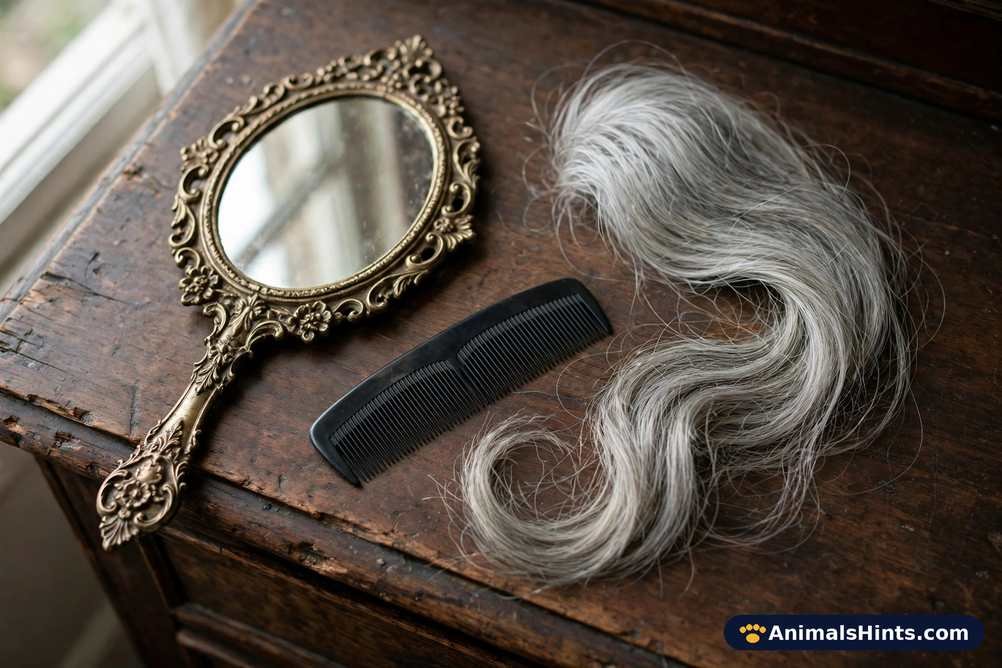
Final Thoughts
Every file this page has opened — symbolism, the ten meanings, the cultural honour, the dreams — treats grey hair as more than appearance, and the tradition’s instinct to respect it rather than rush to hide it is the thread running through all of them. The record, given its turn, respects it differently: by describing it accurately. Scripture crowns the grey head of the old man and never mentions the newborn; medicine names the newborn’s silver a pigment pattern settled before birth, most often stable, occasionally a signpost worth one doctor’s visit and no more.
Both files agree on the one point that matters for the family actually holding the child: the hair is not a flaw. Where they part is over what it announces — and on the evidence fetched for this article, it announces nothing. It is melanin that never arrived, distributed by melanocyte cells that were never there to make it, in a pattern older than any of the stories told about it. A child born grey is not an omen, not a warning and not a prophecy. The child is a child, with unusual hair — and the hair, like the child, gets to simply be what it is.