Baby Alligator Dream Meaning: New Beginnings and the Real Guarded Hatchling
The baby alligator dream meaning, as the dream guides frame it, turns on scale. The creature in the dream is small, newly arrived and easy to underestimate; in the guides’ reading it stands for something in your life that has only just begun — a venture, a habit, a bond, a worry — which looks harmless at its present size and will not stay that size. The competitor’s own scenario for the baby anchors the whole reading: a beginning that holds a chance and a hazard in the same small package, a thing that seems innocent at its current size, with real power or real risk waiting inside it if nobody handles it wisely.
A baby also changes the dream’s emotional key, and the change deserves naming before any list of symbols. A grown alligator in a dream is read almost entirely through fear — patience, concealment, threat under still water. A hatchling carries a second current the adult never does: being guarded. In the waking world, the young of this species are defended by their mother for years, in a reptile family not known for tenderness, and the gentler readings the guides give the baby — vulnerability watched over, instinct standing guard — grow out of that picture, whether the guides know it or not.
What follows gives the competitor’s page first, entire: his psychology, his eleven meanings, his ten scenarios with the baby set among them, his attack reading and its table, his Bible section, his four cultures and his luck verdict. Four sections are this site’s own additions: the real hatchling’s documented life, what dream researchers have actually recorded about animals appearing in dreams, an honest answer to whether this dream amounts to a warning, and plain steps for the reader whose baby alligator keeps returning. Every reading below belongs to the tradition offering it. The animal facts, the scripture counts and the studies are stated no more strongly than their records allow.
What Does an Alligator Dream Symbolize Psychologically?
The competitor’s psychology begins below the surface. An alligator spends its life mostly submerged, eyes and nostrils riding at the waterline, and his page takes that posture as a portrait of the mind’s lower storeys: feelings pushed down, memories not yet dealt with, anger kept under. On his account, the animal surfaces in sleep when something buried is ready to be looked at, and its stillness is the point — the material has been waiting, patient as the hunter itself.
His second strand is Jungian. In that school, animals appearing in dreams are taken for fragments of the dreamer’s own psyche, and the alligator is assigned to the shadow: the instinctive, unsocialised part of a person that daylight keeps leashed. Meeting it in a dream, on this reading, is an appointment with whatever has been avoided longest, and the encounter is framed as overdue rather than dangerous.
His third strand is plainer and more practical. A creature built for survival, surfacing in the dreams of someone who feels unsafe — at work, at home, in a relationship gone watchful — is read as the mind’s own alarm drill: stay alert, guard yourself, notice the water you are swimming in. And his page closes the section on the animal’s one admirable habit, its patience. An alligator waits motionless for the moment that justifies movement, and his page reads the dream, in that register, as a portrait of strategic timing — a mind holding still because the moment to act has not yet come.
The Real Baby Alligator: Six Inches of Stripes Under Heavy Guard
Before the symbol list, the animal itself — because a baby alligator is not a scaled-down adult, and its real life is stranger and more instructive than most of the dream books suggest. The record here is the Smithsonian’s National Zoo account of the American alligator, with Florida’s wildlife agency (the Florida Fish and Wildlife Conservation Commission, FWC) alongside it.
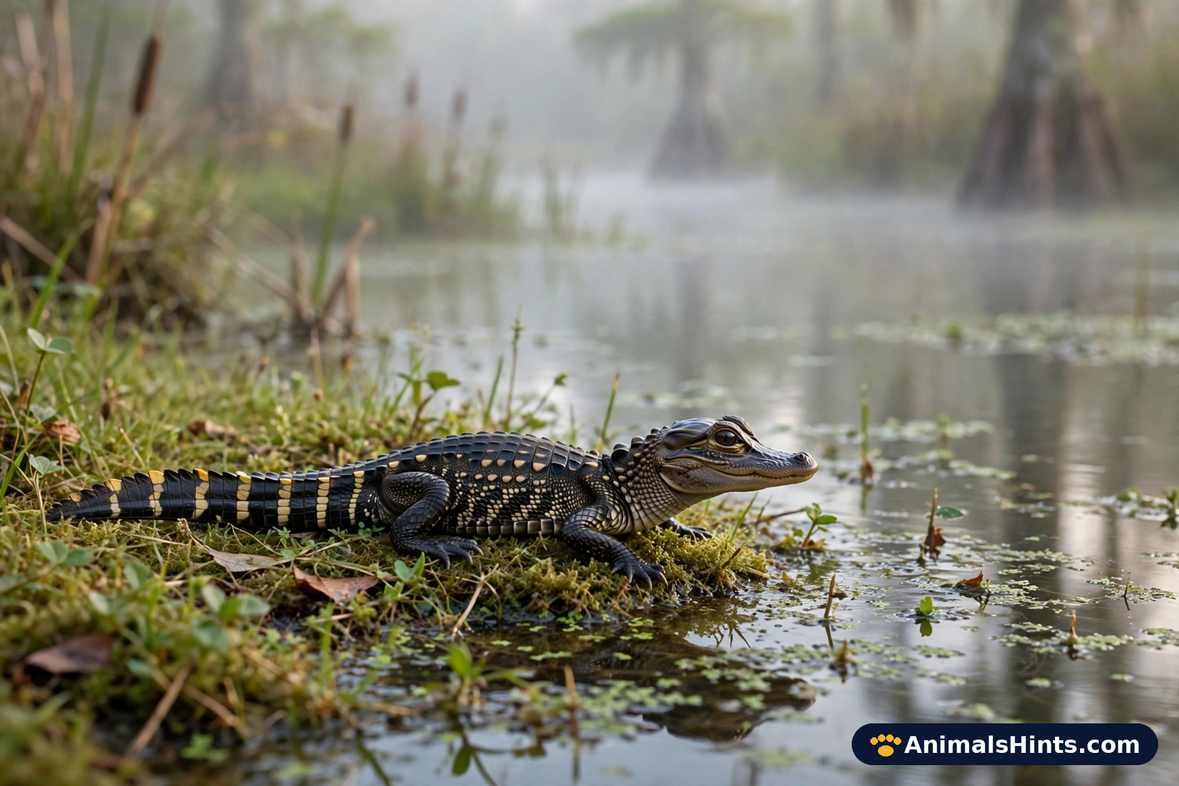
A female builds a mound nest of vegetation and mud and lays her eggs in early summer — the Smithsonian gives a clutch of 35 to 50 eggs; FWC’s average is 38, from a range of 32 to 46. Incubation runs about 65 days on the Smithsonian’s account, 63 to 68 on FWC’s, and the nest’s temperature decides the sex of the young. Toward the end of August the hatchlings begin calling from inside the shell — high-pitched noises that tell the mother the moment has come to strip the nesting material away. What emerges measures about 6 to 8 inches long (15 to 20 centimetres), dark, with bright yellow stripes banding the tail: a predator the length of a hand, wearing warning colours it did not choose.
The young live their first seasons in loose groups called pods, and the arithmetic of their survival is brutal. The Smithsonian puts it plainly: some 80 percent of young alligators fall to predators — herons and other wading birds, raccoons, bobcats, otters, snakes, large bass, and bigger alligators. FWC’s version of the same ledger estimates that of the eggs in a surviving nest, roughly 24 live hatchlings emerge and only about 10 are still alive at one year. What a hatchling eats is scaled to its size: mostly insects, amphibians, small fish and other invertebrates, on FWC’s account, and a juvenile grows at roughly a foot a year.
Against those odds stands the fact that makes this animal’s childhood genuinely unusual. The Smithsonian notes that crocodilians are one of the only orders of reptiles that offer maternal care at all — and the American alligator’s version of it is not brief. The female aggressively defends her young through their first years; the young stay in the waters where they hatched, under her protection, and only leave after two to three years. The dream tradition’s favourite baby reading — something small and new that survives because it is watched over — turns out to have a precise biological original.

The safety record belongs in this section too, because the guarded hatchling has a guarded mother. FWC’s public guidance is short and absolute: never feed an alligator, keep your distance when you see one, swim only in designated areas during daylight, and keep pets on a leash and away from the water’s edge. A female with a pod nearby is the most defensive animal on the bank, and the species is protected and managed precisely because it is both valuable and dangerous. The waking rule and the dream reading rhyme, and neither needs exaggerating: small, new and wild is a combination to respect from a distance, in a swamp or in a life.
11 Spiritual Meanings of Seeing Alligators in Dreams
The competitor’s eleven meanings are written for the alligator generally, and they are carried here whole, in his order, each rendered as strongly as he states it. Where the dream’s animal is a baby rather than an adult, the shade of the reading shifts — smaller, newer, more easily mishandled — and that shift is noted where it genuinely applies. His own baby reading waits in the scenarios below, where he placed it.
1. Symbol of Spiritual Power and Intelligence
His first meaning pairs power with brains. The alligator’s strength, in his telling, is never spent carelessly: the animal is stillness, timing and purpose, and the dream is held up as a mirror to the dreamer’s own capacity to stay composed in uncertain weather and move only when movement counts. He adds the animal’s two addresses — water for the emotional and intuitive life, land for the physical and reasoning one — and reads the creature that holds both as an emblem of balance ripening into wisdom. Power, in this first meaning, is explicitly not aggression; it is restraint with muscle behind it.
2. Hidden Fears and Threats
His second meaning is the list’s darkest, and the one most readers arrive carrying. The animal under the surface stands, in his reading, for fears and emotional threats the dreamer has been stepping around — some of them external, many of them internal: self-doubt, guilt, old injury. What is suppressed does not dissolve; it waits, and his warning is that unattended material tends to surface suddenly, the way the animal itself does. The black spiritual meaning keeps this site’s own file on that darkness — the unseen and unprocessed, rather than anything evil — and a fear-dream of this kind belongs on the same shelf. His stated purpose for the meaning is not fright but inventory: name what is down there, and it loses the advantage of surprise.
3. Sign of Spiritual Danger or Deceit
His third meaning moves the threat from inside to alongside. A presence in the dreamer’s life — a person, an arrangement, an atmosphere — is read as calm on top and motivated underneath, and the alligator’s quiet approach is the portrait of how deceit actually behaves: subtle, patient, in no hurry. The prescribed response in his telling is discernment rather than accusation: look past the surface, trust the unease that has no tidy explanation, and let reflection do the work that confrontation cannot yet do safely.
4. A Trigger for Transformation
His fourth meaning casts the dream as a change-agent: it arrives, he writes, during passages of personal or spiritual transition, and it pushes the dreamer to release habits, beliefs and attachments that have stopped serving. One piece of his reasoning, though, needs correcting in passing, because the animal deserves accuracy. He grounds the renewal image in alligators shedding their skin as they grow. Crocodilians do nothing of the kind. There is no whole skin slipped off and left behind, snake-fashion; the outer scales wear and are replaced individually, a scute at a time, across the animal’s whole life. The growth underneath his symbol is entirely real — a hatchling adds roughly a foot a year — but it is growth, not a discarded skin, and the transformation reading stands cleaner on the true fact: nothing is cast off in a night; everything is outgrown gradually, under armour that renews itself piecemeal.
5. Cleansing and Emotional Purification
His fifth meaning follows the water. Because the animal belongs to rivers and swamps, he reads its appearance as an emotional process under way: resentment, guilt, old anger or sadness being worked loose and carried off, the way current clears a channel. The reading turns gentler here — the dream, on his account, often arrives near the end of a hard emotional cycle rather than at its start, and the alligator is cast as the force escorting the dreamer through the last of it. The courage required is not combat but immersion: a willingness to go down into the feeling instead of skirting its banks.
6. Symbol of Gossip and Vulnerability
His sixth meaning is social. The watched feeling of the dream — an animal nearby, attention fixed on you — is read as exposure in waking life: the sense of being talked about, judged, or confided in the wrong direction. His counsel is custodial: guard what you share, choose confidants slowly, and build the kind of inner steadiness that other people’s commentary cannot reach. He closes the meaning on the turn: a dreamer who confronts the animal in the dream is, on his account, someone beginning to reclaim confidence, standing in their own account of themselves regardless of the audience.
7. Warning of Danger or Deceptive Enemies
His seventh meaning overlaps the third and says so by its shape: where the third is about sensing deceit, the seventh is about acting on the sensing. The animal’s eyes riding above the waterline become, in his reading, an emblem of seeing what others overlook, and the practical sequels are caution with commitments, signatures and confidences, and a refusal of impulsive decisions while the picture is unclear. He is careful to frame the warning as equipment rather than dread: the dream, read this way, does not predict a strike; it certifies an early-warning system already working.
8. Awakening of Hidden Spiritual Gifts
His eighth meaning reaches highest of the eleven, and its trigger is specific: an alligator that is white, golden or unusually calm. Such a dream announces, in his reading, the stirring of capacities the dreamer has not yet used — sharpened intuition, a healing bent, dreams that seem to carry information, a feel for other people’s states. The animal’s two worlds become the dreamer’s two: the seen and the unseen, with traffic beginning between them. His tone here is welcoming but unhurried — the awakening is described as a beginning that may feel strange before it feels clear, and the gift named most often is not spectacle but self-awareness.
9. Guardian of Knowledge and Wisdom
His ninth meaning makes the animal a keeper. Decades of life, long patience and quiet strength are read as the qualities of a guardian of old knowledge, and the dream is taken to signal that the dreamer is entering a season in which study, prayer or meditation starts yielding things it did not yield before. A mentor figure, living or ancestral, sometimes stands behind the animal in this reading. His closing note is about tempo: what the guardian guards cannot be rushed, and the dreamer’s task is the alligator’s own discipline — wait, watch, and let what is hidden arrive in its season.
10. Instincts and Unseen Threats
His tenth meaning returns to instinct, now as the faculty to be trusted rather than the threat to be feared. The animal strikes only when necessary and is still the rest of the time; the dream, in his reading, asks for the same economy — heed for the small signs and the gut’s reports, no rushing into decisions taken without a look around. He frames the creature, finally, as a bridge straddling the conscious and subconscious minds, and the lesson as calibration: hear what the inner voice reports before reacting to what the outer world shows.
11. Emblem of Spiritual Abundance and Courage
His eleventh meaning closes the list on the survivor. The alligator endures in difficult country, adapts, and outlasts; his page takes the dream for an omen of abundance and courage, in that order — courage first, as the price, and abundance after, defined by his page as much in wisdom, peace and strength as in anything material. A dreamer who felt calm or empowered inside the dream is, on his account, looking at a mirror: the energy already aligned, the struggle already turning into the credential. For a baby alligator the meaning condenses to its smallest form — abundance not yet arrived, courage not yet grown into, both genuinely begun.
Alligators in Dreams: Different Scenarios and Their Meanings
The competitor’s scenario list promises ten situations, and his page delivers ten; here they come with his H4s raised to the house H3 and his order kept. The fifth is the reason this page exists. The water-creature shelf is a small one on this site — the neighbouring file is the dream about fishing spiritual meaning where the creature is the one being waited for rather than the one doing the waiting — and the two dreams repay being read side by side: in one, you hold the line; in the other, something holds still for you.
1. Seeing an Alligator in Water
His first scenario is the animal in its own element, moving quietly under the surface. The reading is concealment: emotions or threats present but not yet visible, and the counsel is to look beneath appearances and let intuition have its say before any large decision is taken.
2. Dreaming of an Alligator on Land
His second scenario takes the animal out of its cover. On land the alligator is exposed, and the dream is read the same way: hidden problems coming into the light, and a clearer view of who around the dreamer is genuine and who has been performing.
3. Dreaming of an Alligator Chasing You
His third scenario is pursuit, and his reading of it is avoidance wearing scales. Something the dreamer lives with — a truth, a feeling, a conversation — is being outrun, and the dream stands as a sign that the situation now requires confrontation and courage rather than another season of flight.
4. Killing an Alligator in a Dream
His fourth scenario is the fight won. Defeating the animal is read as overcoming fear and regaining control of a difficult situation — a victory, in his framing, over darkness or toxic influence that had been pressing on the dreamer’s path.
5. Baby Alligator Dream Meaning
His fifth scenario is the subject of this page. The guides read baby alligators as beginnings that hold a chance and a hazard together: a thing in the dreamer’s life, innocent-looking at its present size, which may grow powerful — or turn risky — where the handling is careless. It is the only scenario in his ten where the animal’s size is the meaning, and it is worth pausing on how exactly the reading fits the animal.
A real hatchling is a beginning with a large future folded inside it: six inches of striped, calling, soft-shelled newness that is on its way to becoming one of the continent’s great predators, at roughly a foot a year, if it survives. And survival, on the record, is the guarded part. Most hatchlings do not live out their first year; the survivors are the defended ones — a pod, home water, a mother who stayed for years. Read against that record, the tradition’s baby is not a warning about babies — it is a parable about beginnings generally: what is new is not yet dangerous and not yet safe; it is undecided, and what decides it is the quality of the guarding. A beginning watched, fed and kept at the right distance becomes strength. A beginning ignored does not stay small. That is his reading, and the animal’s own biography refuses to improve on it.
6. Alligator Biting You
His sixth scenario is the bite, and his reading is betrayal or emotional pain arriving through trust: someone taking advantage of the dreamer’s openness. The prescribed response is boundary work — protect your energy, firm up the edges, notice where access has been granted too cheaply.
7. Multiple Alligators in a Dream
His seventh scenario multiplies the animal, and the reading multiplies with it: overwhelming fear or chaos, a dreamer ringed by stressful energy or difficult people. His counsel is environmental — cleanse the space, ground the self, return to prayer or meditation as ballast.
8. Friendly Alligator Dream
His eighth scenario is the calm animal, and the reading is self-acceptance: a dreamer making peace with their own instincts and emotions, the higher and lower selves in unusual harmony. For this page’s subject the scenario has a natural baby form — a hatchling that approaches without menace is the tradition picturing a beginning the dreamer is ready to welcome rather than merely watch.
9. Dreaming of a Dead Alligator
His ninth scenario closes the animal’s life, and his reading closes a chapter with it: rebirth and renewal, a hard phase ending, peace or clarity arriving after fear has been overcome. The dead alligator is transformation certified — the thing that stalked the water is finished, and the water is quieter for it.
10. Feeding an Alligator
His tenth scenario is the strangest and, in his telling, among the most hopeful: feeding the creature means nurturing a hidden part of the self — courage or ambition, most often — and learning to work with the shadow rather than suppress it. The dreamer is no longer fleeing the wild thing or fighting it; they are keeping it, deliberately, which his page reads as the mature relationship to one’s own instinct.

What Dream Research Records About Animals in Dreams
The tradition’s readings are one kind of record. There is another, and a reader deserves both on the same page. What follows is what researchers who count dreams, rather than interpret them one at a time, have actually found — given at the studies’ own strength.
The largest relevant count is Schredl and Blagrove’s UK library study, published in 2021: 4,849 participants aged from 6 to 90, contributing 2,716 most-recent dreams. Animals appeared in 18.30 percent of the dreams — nearly one report in five. Children reported animal dreams more often than adolescents and adults. The most frequent animals were not exotic: dogs first, then horses, then cats, and about a fifth of the dream animals were the dreamers’ own pets. Roughly 30 percent of the animals showed bizarre features, and most interactions between dreamer and animal were negative — being chased, threatened, watched. The authors read their own findings as support for the continuity hypothesis, the framework running from Hall and Nordby’s work in the early 1970s: dream content is continuous with waking life, its concerns and emotions carried into sleep and restaged there, usually with the volume turned up.
The neighbouring water file makes the same point from its side: the spiritual meaning of flood in a dream draws, on the record, on the water a life actually contains — weather, rivers, news, memory — and researchers find the same sourcing wherever they test a theme: the dream is built from the dreamer’s own material, days to a week old, not delivered from outside it. A swamp dream, on this record, is most honestly read as a swamp the dreamer already carries.
The one famous theory that gives threatening animal dreams a deeper job is the threat simulation theory, put forward by Antti Revonsuo in 2000: dreaming as an evolved rehearsal space in which the brain practises perceiving and escaping danger. It is a serious proposal with real support, and it is also contested, and both halves belong in print. Scored loosely, threatening events do appear in a majority of everyday dream reports. Scored strictly — asking whether the threat was a realistic survival danger of the kind an ancestor faced — Malcolm-Smith’s group found such threats in fewer than one dream in five, and successful escape in fewer than one in fifty. Typical-theme studies, counting what dreamers most often report, place being chased among the three commonest themes of all — but many of the other commonest themes are pleasant or plainly current-life, and the clearly ancestral dangers are not especially prevalent. The honest summary is that why we dream has no settled scientific answer; the rehearsal theory explains some of the record and strains at the rest.
And then the gap, stated as plainly as the studies: no researcher has counted alligator dreams. The animal appears in no headline frequency list; there is no laboratory file on hatchlings in sleep. What the record supports is the frame — animals in dreams are common, skew young in childhood, lean negative in interaction, and track waking life — and inside that frame, a single vivid dream remains a single night’s material. Nothing in the research record turns any reading on this page into a prediction, and this page asks no more of it than that.

Meaning of Dream of an Alligator Attacking You
The competitor gives the attack its own section, and his framing is a contest inside the dreamer: higher consciousness against primal instinct, the attack standing for emotional struggle, guilt, or the fear of being governed by one’s own impulses. Fighting back, in his reading, signifies spiritual strength and readiness; being unable to defend yourself signifies negativity or deception gaining the upper hand. His table of details is carried complete:
| Dream Detail | Spiritual Interpretation |
|---|---|
| Alligator attacks you suddenly | A hidden issue or betrayal may surface soon |
| You escape the attack | You are gaining control over fear or temptation |
| You get injured | Emotional pain caused by someone’s deceit |
| You kill the attacking alligator | Victory over darkness or toxic energy |
| You save someone from an attack | You are acting as a protector or spiritual guide |
Two bounds belong under the table. The first is about genre: this is the tradition’s table, a reading device, not a forecast — no row of it has been tested against outcomes, and the research section above records what has been tested, which is the frequency of such dreams, not their accuracy as omens. The second bound is almost reassuring: an attack or chase dream is among the most ordinary dreams a human being can have, sitting in the top tier of typical themes across every large count. If the alligator came for you in the night, the commonest fact about your dream is how common it is.
What Does the Bible Say About Alligator Dreams?
The competitor’s Bible section begins with a concession, and the concession is correct: no alligator appears anywhere in the Bible. A fresh full-text count of the King James Version, made for this page with the run’s usual instrument, sharpens his concession into figures. The word “alligator” occurs 0 times. The word “crocodile” occurs 0 times. The word itself could hardly be otherwise: “alligator” is a post-biblical coinage, worn down from the Spanish el lagarto — the lizard — by English speakers in the animal’s own hemisphere, millennia after the canon closed.
What the tradition reaches for instead is Leviathan, and the count there is exact: “leviathan” occurs 5 times, across four passages — Job 41:1, Psalm 74:14, Psalm 104:26, and twice in Isaiah 27:1. The Job passage is the substantial one, a full chapter describing an armoured, fire-breathing creature that no hook can draw out and no covenant can be made with, opening with the challenge: “Canst thou draw out leviathan with an hook? or his tongue with a cord which thou lettest down?” Generations of readers have matched that description to the great crocodilians, and as a resonance — a neighbouring creature, honestly labelled — the match is a fair one. An identification it is not. The text names no alligator, describes no American animal, and interprets no dream; the distance between “Job’s creature resembles a crocodilian” and “the Bible reads your alligator dream” is the whole of the honest gap, and this page leaves it open rather than papering over it.
His page also quotes Psalm 91:13, in a modern rendering — “You will tread on the lion and the cobra; you will trample the great lion and the serpent.” The King James text of the same verse reads: “Thou shalt tread upon the lion and adder: the young lion and the dragon shalt thou trample under feet.” Either way, the verse is a general promise of protection over dangerous creatures; it names no alligator and addresses no dream, and its honest use here is the one his section gestures at — comfort for the frightened reader, not a key for decoding the night.
So the Bible’s file on this page’s subject, stated whole: no alligator, no crocodile, no dream of either, and one magnificent neighbouring creature whose chapter the tradition borrows. A reader told anything stronger than that has been sold something.
Cultural and Religious Interpretations
The competitor’s culture section is a list, and it keeps its list form here — bold leads, his four strands in his order — with the record’s corrections folded into each strand rather than appended as an afterthought.
Ancient Egyptian culture: His strand names Sobek, and the first correction is one of species: Sobek is a crocodile god, formed on the Nile crocodile — Egypt has no alligators. Within that bound, his summary holds up well against the record. Sobek was associated with the Nile, with fertility, with pharaonic power and military prowess, and he served as a protective deity invoked against the river’s dangers; his great cult centres were the Faiyum — its capital called Crocodilopolis, the city of the crocodile — and Kom Ombo. His page’s pairing of power with chaos is also fair: the same god who protected could devour, an accurate portrait of the animal on the bank. And this strand holds the culture section’s most striking baby detail: crocodiles were mummified as offerings at Sobek’s centres with their young preserved in their mouths and on their backs — because the crocodile, almost alone among reptiles, diligently carries and guards its offspring. The Egyptians built the protection reading into their god because they had watched the animal earn it.
Native American beliefs: His strand is general — the alligator as an emblem of survival and of primal, instinctive wisdom, the dreamer guided to trust instinct and stay alert — and general is where this page must leave it. Alligator country is the Southeast and the Gulf wetlands, and the peoples of those wetlands lived alongside the animal for millennia; but no specific tribal teaching was fetched and verified for this page, and printing a named nation’s doctrine without its record behind it would be decoration, not knowledge. His summary stands as his summary.
Chinese symbolism: His strand pairs the alligator with the dragon as spiritual kin, and it is the strand where the record improves on him most, because China has an alligator of its own. Alligator sinensis, the Yangtze alligator, is one of only two living species in the genus — the American animal’s sole close cousin — and it has lived inside Chinese writing since the third century, nicknamed the muddy dragon and associated in some texts with the dragon itself. His protectors-and-transformation gloss is his own summary, but the dragon kinship he asserts turns out to have a real animal underneath it, which is more than most such claims can say. The modern footnote is sobering: the muddy dragon is critically endangered, reduced to a few hundred animals in the wild.
African traditions: His strand speaks of crocodiles as guardians of spiritual gateways, keeping watch over the border between the seen world and the unseen one — and, to his credit, his own text concedes the mechanism: crocodiles, and alligators only by extension. Africa has no alligators at all. The guardianship readings belong to the crocodile’s file, where several river cultures genuinely keep them; they reach this page by the extension he names, and they are labelled with it.
Is It a Bad or Good Luck?
The competitor’s luck section refuses a fixed verdict, and the refusal is the most careful thing on his page. Whether the dream counts as bad or good luck, he writes, depends on how the dreamer felt inside it and what the animal did. An attacking or frightening alligator indicates, in his reading, negative energy or hidden danger and counsels self-protection. A calm alligator, or one the dreamer overcomes, reverses the sign: good luck and growth, the mastery of emotion, challenges being met with wisdom. Behind both verdicts he sets the older standing of the animal itself — strength, longevity, victory — which is why its mere presence can be read as an omen of personal empowerment. His closing instrument is the dreamer’s own feeling: fear points toward lessons in self-protection; peace points toward maturity and balance.
For the baby, his own scenario list has already cast the deciding vote, and it is worth making explicit: the baby reading is the favourable end of his luck scale with a caution folded inside it — opportunity first, danger only as the price of neglect. A dreamer who woke from a hatchling feeling fond has, in the tradition’s terms, been handed the good-luck version. A dreamer who woke uneasy has been handed the same beginning with its instructions underlined.
Is a Baby Alligator Dream a Warning? An Honest Reading
It is the question readers actually bring to this page, and it deserves a straighter answer than either shelf usually gives. The tradition’s answer is yes-with-a-definition: the dream warns the way a smoke smell warns, not the way a prophecy warns. In the guides’ handling, nothing in the baby reading names an event, a date or a person. What it names is a category — the small new thing — and a posture toward it: watch it, handle it wisely, do not assume that because it is small it is settled. Stripped of costume, that is not fortune-telling at all. It is attention, advised.
The research shelf answers the same question from the other side, and its answer is not in conflict. If dreams are built from waking material — the continuity finding that every large count keeps returning — then a hatchling in the night is, most parsimoniously, the dreamer’s own mind handling something genuinely small and genuinely new in their life, with the emotional volume raised. The dream does not import a warning from outside; it reports a concern from inside. Both shelves, read honestly, land the reader in the same place: there is something young in your life that your own judgement already knows needs watching. The dream is the reminder, not the evidence.
What neither shelf can honestly do should also be said once, without flinching. The dream cannot identify a hidden enemy. It cannot date a betrayal, certify a venture, or grade a relationship. A dreamer who acts on those claims — who ends a friendship or signs a contract because a hatchling appeared — has left both the tradition’s careful core and the record entirely. And the reverse discipline holds too: one vivid dream, however it felt at 3 a.m., is one night’s material. It earns a morning’s thought. It does not earn a verdict on a life.
When the Baby Alligator Dream Keeps Coming Back: Plain Steps That Help
A single dream needs nothing but a morning’s thought. A recurring one — the same small animal, the same dark water, week after week — earns a small, plain routine, and the routine is the one this site gives every returning dream.
Put a notebook on the nightstand. Before the day can edit it, set the dream down: the animal’s size, what it did, how you felt — and beside the dream, the day behind it: what began recently, what is small and new and not yet safe. Recurrence usually becomes legible within a few entries, because continuity works in the reader’s favour here: the dream tends to return on the nights after the new thing has been handled, postponed or worried over, and the notebook is what turns that pattern from a feeling into a fact you can check. Then do the daylight version of the tradition’s own advice — handle the beginning wisely, in the open: make the call, set the boundary, book the appointment, put the question plainly. A beginning that is being actively guarded rarely needs to keep sending its portrait at night.
Keep the nights themselves unremarkable meanwhile: regular hours, a dark room, the household’s routines undisturbed — a cat sleeping above your head among them, which has its own literature on this site and obstructs nothing. And hold the boundary where the clinicians hold it. If the dream comes back often, leaves you distressed, or started in the wake of a genuinely frightening event, take the pattern to a doctor or a counsellor, not to a symbol book: clinicians recognise recurring distressing dreams, and they can treat them. That advice costs the tradition nothing. A reading is for meaning; a pattern that is costing you sleep is for daylight help.

Final Thoughts
The competitor’s page ends where this one is content to end: the alligator, feared or befriended, is finally a teacher of attention — to instinct, to concealed feeling, to the things in a life that move quietly and matter greatly. His closing image is the animal balanced between two worlds, land and water, thriving in both. For the adult that balance is the lesson. For the baby, this page would put the lesson one notch earlier in the animal’s life, where the record puts it: before the balance comes the guarding. Nothing about a hatchling is balanced yet. It is all exposure and appetite, and what stands between it and the herons is a mother who does not leave.
That is why the baby, of all his page’s animals, is the one readers remember. The adult in a dream confronts you with what you fear. The baby asks a quieter question: what have you lately begun, and who is watching over it — and is the watching actually happening, or only intended? The tradition answers with its small parable of opportunity and risk. The record answers with a pod in home water, a mother on the bank, and survival odds that improve exactly as the guarding does. The two answers are the same answer, told in the two languages this page has kept separate throughout, and a reader may keep whichever language they trust.
So let the dream keep its size. A hatchling no longer than your hand, calling from inside the egg in the slow water of a bayou, guarded by a mother who will not leave it for years: the tradition’s telling makes that a beginning that deserves watching, and the animal, on the evidence, deserves precisely the same. Beginnings are not omens. They are responsibilities with stripes on their tails — and the ones that are watched, on every record this page could find, are the ones that grow.
FAQs
What is the spiritual meaning of seeing alligators in dreams?
In the tradition’s short answer: concealed strength and concealed threat at once — instinct, patience, hidden fears and the power to survive hard country. When the animal is a baby, the tradition concentrates the whole list into one reading: a new beginning that carries opportunity and risk together, and asks to be handled wisely while it is still small.
What does it mean if an alligator attacks me in a dream?
The tradition reads an attack as betrayal, hidden danger or a confrontation being avoided, and the competitor’s table above gives its detail-by-detail version. The research record adds the calming fact: attack and chase dreams are among the most commonly reported dreams of all. Either way, the dream is a reading or a common night’s theme — never a prediction about a person.
What does it mean to see a calm alligator in a dream?
The tradition’s most favourable adult reading: controlled strength, patience mastered, a dreamer at peace with their own power and instincts rather than at war with them. A calm baby carries the same sign in miniature — a beginning the dreamer is ready to welcome and guard, instead of one that has to be feared or fought.
How should I respond to a dream about alligators?
Write it down, then look at the waking material it was built from — the tradition and the research agree that far. Name the small new thing the dream keeps pointing at, and do one concrete, daylight act of guarding it. If the dream returns often and leaves you distressed, take the pattern itself to a doctor or counsellor; recurring distressing dreams are treatable, and no symbol book outranks sleep.