Black and Yellow Butterfly Meaning: 12 Meanings, Real Species and Omens
The black and yellow butterfly meaning, in the spiritual traditions that read butterfly signs, is balance held on a single wing: yellow for joy, clarity and confidence, black for mystery, protection and the part of a change that happens out of sight. A butterfly wearing both is read as an ending and a beginning arriving together — and as a reminder that neither half cancels the other out.
There is a plainer reason this pairing stops people mid-path. Black and yellow is nature’s loudest colour combination — the striping of bees and wasps — yet here it arrives on an insect that cannot sting, bite or harm anyone at all. Most sightings behind this search are swallowtails: big, tailed, unhurried butterflies whose caterpillars feed in ordinary gardens, and whose pattern has been borrowed, copied and misread for as long as people have watched them.
What follows names the animal before interpreting it. First come the real species that wear this pattern, then the symbolism, then the tradition’s twelve meanings in its own order, the cultures that built them, and the landing, love, dream and omen material readers ask for. Beliefs below are credited, throughout, to whoever holds them; every biological claim was checked against a university or museum source before it was allowed in.
The Real Black and Yellow Butterflies Behind the Symbol
No species is formally called “the black and yellow butterfly.” The name describes a pattern, and in North America that pattern belongs overwhelmingly to one family: the swallowtails, Papilionidae — large butterflies with a tail trailing from each hindwing. Four of them account for nearly every sighting this article is about, and telling them apart is mostly a matter of which colour does the talking.
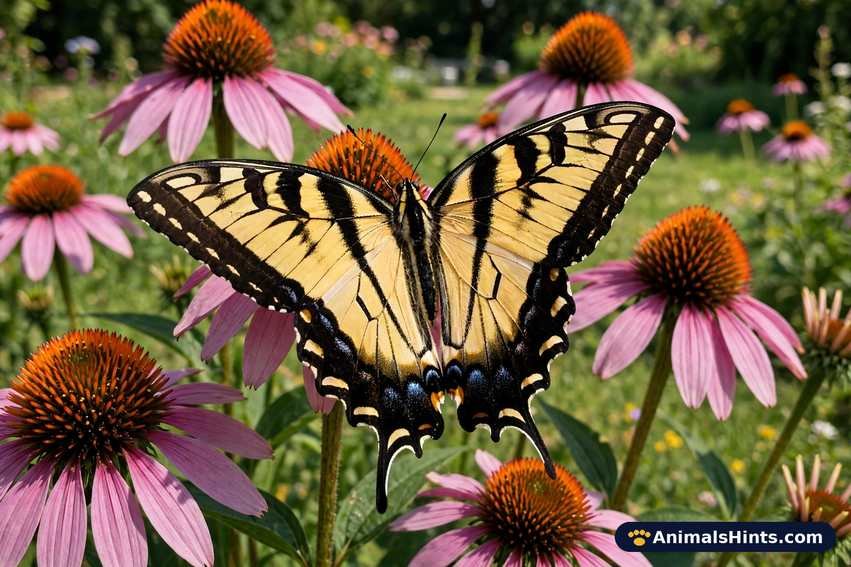
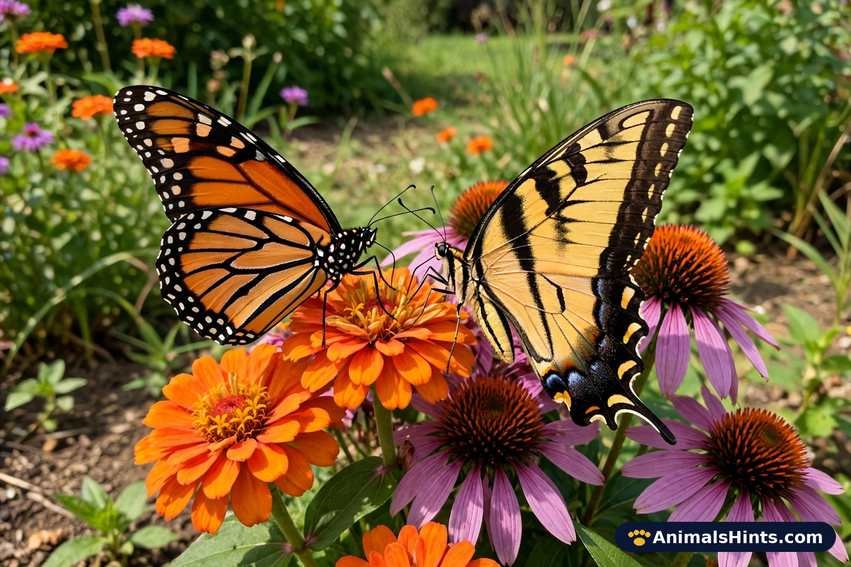
The eastern tiger swallowtail (Papilio glaucus) is the yellow-dominant one, and the likeliest butterfly behind any black and yellow report east of the Rockies. Wingspread, in the Featured Creatures account kept by the University of Florida, runs from 7.9 to 14.0 centimetres (about 3.1 to 5.5 inches). The wings are yellow, crossed on each forewing by four black bands — the “tiger stripes” behind the name — and finished with black margins dotted in yellow. The sexes split in an instructive way. Males are always yellow. Females come in two forms: a yellow form like the male’s, set apart by a broad band of blue along the hindwing, and a dark form in which the yellow is replaced by dark grey or black almost entirely.
That dark female is this page’s most important identification lesson, because she is a documented impersonator. The tiger swallowtail is palatable — birds can eat it safely — but the dark female copies the poisonous pipevine swallowtail, and the University of Florida, following Brower’s classic experiments, classes her as a Batesian mimic: an edible species borrowing a toxic one’s warning dress. Dark females are commonest in the South, exactly where their model is common. So a “black butterfly” over a southern garden may be this species in its second costume, and a black and yellow one may be its first — the same insect, wearing the two halves of this article’s pairing as alternative outfits.
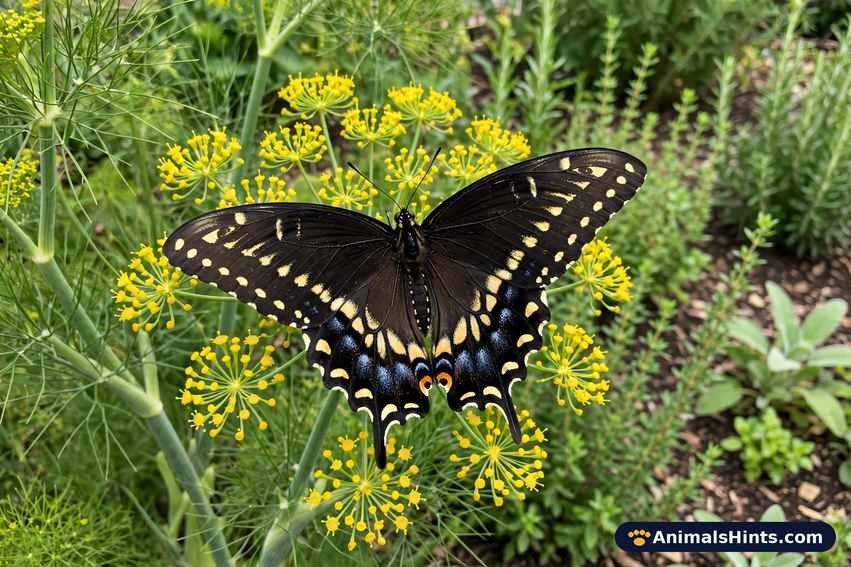
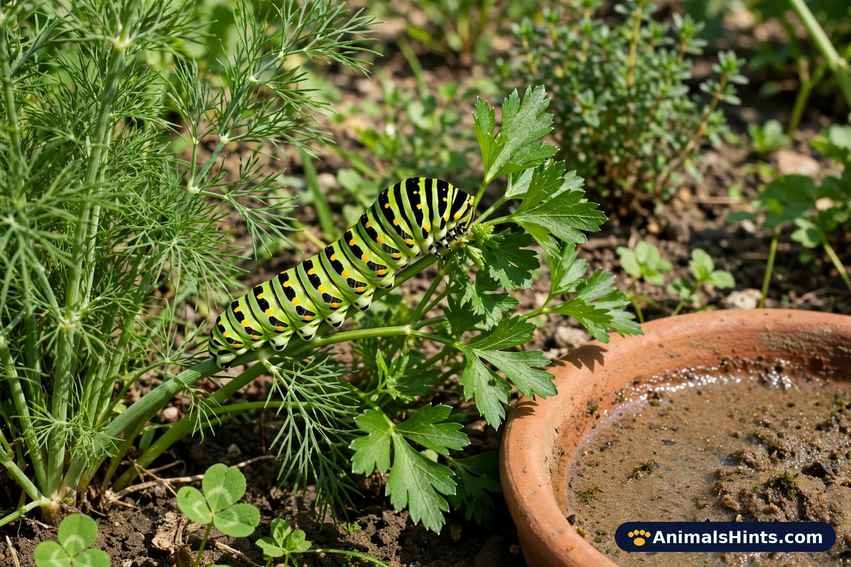
The black swallowtail (Papilio polyxenes) reverses the recipe: black first, yellow as the accent. Its upperside is black with two rows of yellow spots — large and bright in the male, smaller and paler in the female, whose hindwings carry a powdery iridescent blue patch between the rows — and a red spot with a black bull’s-eye at the hindwing’s inner corner. The University of Florida puts its wingspread at 6.9 to 8.4 centimetres. Its caterpillar is the familiar “parsleyworm” of herb gardens, green with black bands dotted yellow, feeding only on the carrot family: parsley, dill, fennel, carrot tops and Queen Anne’s lace. Threaten that caterpillar and it produces the family’s party trick — a bright orange, forked organ everted from behind its head, releasing a foul smell that turns predators away. The organ is harmless to people; it returns, briefly, in this article’s final paragraph.
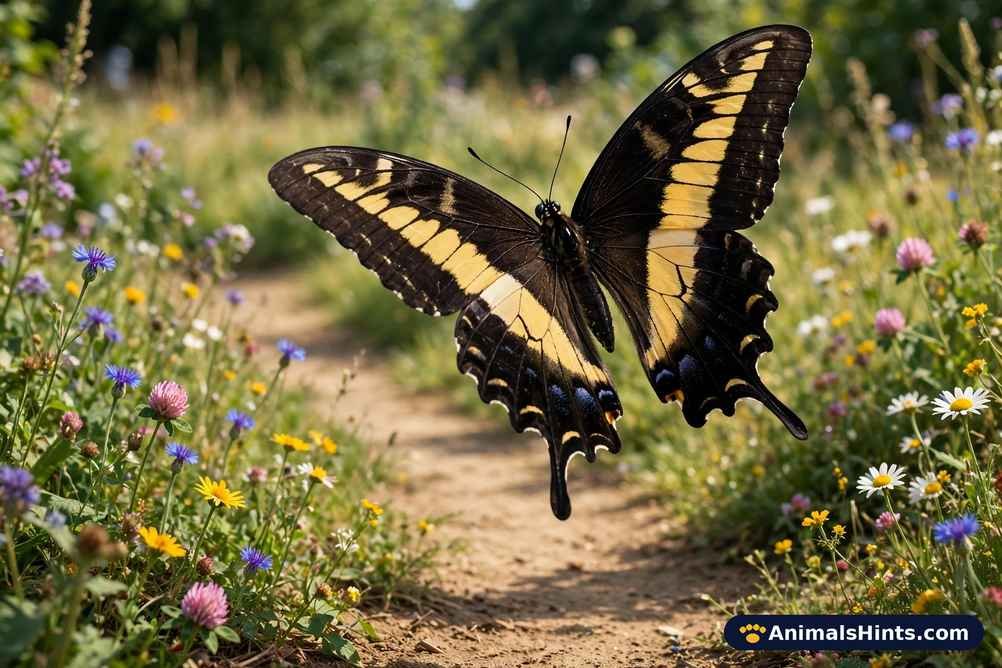
The giant swallowtail (Papilio cresphontes) is the pairing at full scale — the largest butterfly in North America. Females average about 5.5 inches (14 cm) across and males about 5.8 inches, with the biggest individuals approaching 7 inches. Where the tiger is yellow banded in black, the giant is black banded in yellow: a striking diagonal yellow bar crosses the dark forewings, the underside is mostly yellow with black accents, and the whole insect glides long distances on very few wingbeats. Its caterpillar, the “orangedog” of southern citrus groves, feeds on the rue family — citrus, hop tree and prickly ash — and begins life disguised as a bird dropping.
The western member of the set is the two-tailed swallowtail (Papilio multicaudata), a large, pale yellow butterfly with narrower black tiger striping than its eastern cousins and — the field mark that settles every argument — two tails on each hindwing instead of one. Colorado State University’s account gives a wingspan of 3½ to 5 inches and a range through western canyons and cottonwood-lined streams; it is the state butterfly of Arizona. One near-miss deserves a line of its own, because it is misreported constantly: the zebra swallowtail is black and white, its long-tailed wings striped like its namesake animal. Striking as it is, it is not a black and yellow butterfly, and nothing in this article’s tradition was written about it.
A word, finally, about the colours themselves, kept to what the sources actually establish. Black with yellow is the most common warning combination in the insect world: a 2025 survey in the Journal of Hymenoptera Research found that over 73% of Central European bees and wasps are warning-coloured, with black-yellow the single most frequent pairing, advertising a real sting. The swallowtails above are not stingers, and honesty requires the next sentence too: the adults are not, as a group, protected by poisons of their own. Their defence is subtler — the dark tiger female’s borrowed reputation, the black swallowtail caterpillar’s foul-smelling organ and distasteful diet, and a pattern that predators raised on wasps have learned to treat with respect. The warning dress, in other words, is partly an inheritance and partly a bluff, and the bluff works because the colours themselves are believed.
One life-cycle note has to be made here, because everything symbolic below leans on it. None of these butterflies spins anything. A swallowtail caterpillar sheds its last skin and stands revealed as a chrysalis: the pupa itself, its own body hardened into a case and held upright by a silk girdle. Cocoons are spun silk, and spinning them is moth work. Every “transformation” reading in the tradition that follows is, in the real animal, a chrysalis story: no woven shelter, no wrapping — the change happens in the open, disguised as a dead leaf.
What Does Seeing a Black and Yellow Butterfly Symbolize?
In the shared modern tradition, this pairing symbolizes a change that keeps its nerve. Each colour brings its own file to the meeting. Black arrives with the file our black spiritual meaning guide keeps for the colour by itself: mystery, protection, endings, and the productive darkness where things get remade out of view. Yellow arrives from the opposite direction: it is the colour the neighbouring colour guides file under sun, intellect and cheer, a file shared with our companion piece on what the color gold means spiritually. Set side by side on a wing, the tradition reads the two as one sentence: the dark is real; the light inside it is real too.
That is why this butterfly’s sightings cluster, in readers’ reports, at thresholds — the week of a diagnosis, a move, a parting, a new beginning nobody chose. Nobody’s version of this pairing promises the hard season has ended. What it promises is smaller, and most readers find it easier to credit: joy and difficulty sharing one creature, one afternoon, one unfinished life — an ending and a beginning running concurrently.
The short version of the reading, as the tradition’s summaries usually settle it, runs to four lines:
- Balance. Light and dark carried together, neither denied — the pairing’s headline meaning, and the first of the twelve below.
- Caution with confidence. The wasp colours counsel a second look; the butterfly’s gentleness counsels against fear. Proceed — carefully, and proceed.
- Transformation under way. The chrysalis emblem, here with its stages colour-coded: the black of the old form, the yellow of the new one already showing through.
- A message received. Where the lore treats butterflies as souls on the move, a two-tone visitor is read as word from the other side, delivered in daylight.
Modern chakra teaching files yellow under the solar plexus, the centre of will and self-confidence, which is why so many contemporary readings of this butterfly turn on personal power. File that mapping where it belongs: it is current vocabulary, not old record — the neat rainbow ordering of chakra colours was assembled recently — and this article marks it as modern wherever the mapping does any work. The older material underneath, the soul-butterfly and the transformation emblem, needs no chart at all.
12 Spiritual Meanings of Black and Yellow Butterflies
The tradition’s twelve readings for this pairing, in its own order. Each belongs to the folk and spiritual genre that hands these meanings down; none is a finding about the insect, and none is a prediction about the reader. What the list circles, again and again, is one idea in twelve costumes: contrast, carried well.
1. Balance Between Light and Dark
The headline reading. Yellow carries vitality and clarity; black carries depth and the hidden side of things; and the butterfly refuses to choose between them, flying both on the same pair of wings. Readers take the sighting as permission to stop grading their own seasons — to let a difficult stretch and a hopeful one be true at once, the way night and day are both true of a single turning planet.
The practical form of the meaning is acceptance rather than effort. Nothing in this reading asks the watcher to fix the dark half or perform the bright one. It asks only that both be admitted, on the grounds that a creature built of the two together is not a contradiction but a design.
2. Message from the Soul or Spirit
The oldest strand on this page. In Greek, psyche named the soul and the butterfly at once, and the double meaning travelled — through Roman tomb carving, then into the folklore of Europe, where a butterfly turning up near a house might be received as somebody’s soul paying a visit. A black and yellow visitor inherits that whole file, with its colours read as the message’s envelope: the black for the world it comes from, the yellow for the warmth it is said to carry.
In the modern telling, the sighting is most often claimed during grief — taken as reassurance from someone who has died, a sign that the connection survived the change of form. The reading is set down here exactly as its holders give it. That mourners draw real comfort from such moments is well attested; how the comfort arrives is a question of belief, and this article leaves it in belief’s keeping.
3. Personal Growth and Transformation
The butterfly’s universal meaning, pitched by this pairing at the part of growth nobody photographs. The black is read as the hidden stage — the chrysalis season, the old shape broken down, nothing winged yet visible — and the yellow as proof the process terminates in flight rather than in darkness. A sighting mid-upheaval is therefore filed as a progress report: the change is not approaching, it is under way.
Readers claim this meaning most during career changes, recoveries and the long middle of any reinvention, and its counsel is endurance with a specific flavour: the stage that looks like nothing happening is, in the insect’s own life, the stage where everything happens.
4. Hope and Optimism Amid Mystery
A close relative of the first meaning, separated from it by tense. Balance is about the present; this one is about the future — hope maintained specifically while the way ahead cannot be seen. The yellow is read as light that has arrived before the explanation has: cheerfulness not as a conclusion drawn from circumstances, but as a decision taken inside unclear ones.
The sighting is claimed, in this reading, at crossroads — before results, decisions and answers — and its message is that not knowing is a weather, not a verdict. The guides are careful at this point: none of them promises the hidden thing will turn out well. It promises the watcher can carry hope and uncertainty in the same hand, because the butterfly demonstrably does.
5. Encouragement to Trust the Spiritual Path
The trust reading. In this strand, the butterfly appears to readers who are questioning their direction — a practice gone quiet, a purpose gone blurry — and is read as encouragement to keep going without demanding the whole route be revealed in advance. The black stands for the unlit stretches of any serious path; the yellow, for the portions that are lit, offered as evidence that the lighting is real even where it has not yet reached.
Filed honestly, this is a modern devotional reading, not an old doctrine: no fetched tradition attaches a formal teaching to this exact colour pairing. It is the genre’s encouragement, offered at that strength — stay on the path, let it disclose itself in stages, as the insect’s own life does.
6. Symbol of Inner Strength
The resilience reading, and the one the real animal supports most surprisingly. Strength here is not force — a butterfly has none — but continuation: wings that cross gardens and survive storms on a body built of almost nothing. The black is read as endurance, the yellow as the refusal to let endurance turn grim; together they picture strength that keeps its warmth.
It is worth adding what the species section established: the swallowtails wearing these colours are genuinely hard to discourage. Their caterpillars repel attackers with a foul-smelling forked organ, their dark females borrow a poisoner’s reputation, and the family has persisted on every continent but Antarctica. The tradition chose its emblem better than it knew.
7. Reminder to Enjoy Life’s Pleasures
The lightest of the twelve, kept verbatim with its curly apostrophe and all. Against nine solemn readings, the tradition insists on this one: the yellow half of the wing as a standing instruction to take the sweetness that is actually on offer — a walk, a meal, an unhurried hour — rather than postponing all enjoyment until the serious business is finished.
The black half keeps the meaning from shallowness. Pleasure, in this reading, is not distraction from the dark but its deliberate counterweight, chosen by someone who knows exactly how brief the season is. Butterflies live weeks. The tradition reads their unembarrassed enjoyment of every sunny hour as the whole sermon.
8. Call for Life Balance
Where the first meaning treats balance as a state of the soul, this one treats it as a state of the calendar. The tradition files the sighting as an audit arriving on wings: too much work and too little rest, too much giving and too little receiving, thought without action or action without thought. The two colours are filed as the two columns of the ledger — black for duty, planning and inward time; yellow for spontaneity, company and play.
Readers report this one during burnout seasons and after them, and the attached practice in the guides is modest: rebalance one thing this week — a night’s sleep defended, a pleasure scheduled as seriously as a meeting — and let the butterfly’s equilibrium be a direction rather than a destination.
9. Symbol of Healing and Love
The healing reading. Black carries the unhealed material — old grief, the shadow side of a history — and yellow carries warmth, compassion and the return of appetite for life; the pairing pictures the two in conversation rather than at war. A sighting during heartache is taken as evidence that integration, not amnesia, is the shape healing takes: the past carried, coloured, and flown with.
Love enters the same meaning through the side door of self-regard: the guides read this butterfly, for readers re-entering the world after loss, as permission to open again — to let affection arrive from others and to extend it to the person one has been. The dedicated love section below takes the strand further; here it stands as the tradition files it, among the healings.
10. Sign of New Beginnings and Peace
The fresh-start reading, and the natural partner of the transformation meaning. Black closes the old chapter — its darkness read as the period at the end of a sentence — while yellow opens the new one in daylight. Readers claim the sighting at the visible seams of a life: the first week in a new home, the morning after a hard decision, the season a long project finally ends.
Peace is this meaning’s other half, and its quieter claim. The end state this butterfly is said to picture is not excitement but settledness — a life whose endings have been honoured rather than fled, and whose beginnings are therefore allowed to arrive gently instead of desperately.
11. Encouragement for Forward Movement
The momentum reading. Where meaning 5 counsels trust in a path, this one counsels steps on it: begin before the fear has finished, move before the whole map is drawn. The black is read as everything that argues for staying — comfort, habit, the fear of the unclear — and the yellow as the vote for motion, cast by a creature whose entire adult life is travel between flowers.
The guides attach a deliberately small practice to this meaning: the next step only, taken this week, at whatever size honesty allows. Progress in the butterfly’s own biography is never a leap; it is a sequence of stages, each entered without a view of the next.
12. Reminder of the Transient Nature of Life
The closing reading, and the one the insect’s biography states without any symbolism at all. An adult swallowtail’s flying season is measured in weeks; the chrysalis it came from overwintered, in many populations, through months of cold. The tradition reads the pairing as impermanence with its colours showing: the black for the brevity, the yellow for the brightness that brevity somehow fails to dim.
Buddhist-influenced readers will recognise their own doctrine’s favourite illustration here — everything conditioned arises and passes — and the cultures section below gives that strand its place. For the list’s purposes, the meaning is a practice of attention: see the thing while it is here. It will not be here long, and neither, the tradition adds gently, will the watcher — which is offered as a reason for gratitude rather than dread.
Significance of Black and Yellow Butterflies in Different Cultures and Religions
Underneath the modern twelve sit older, separate traditions. They follow below in the order the competitor gives them, each held to what its sources will bear — which means the butterfly-general material is labelled as such, and no culture is credited with a black-and-yellow doctrine it never held.
In Native American beliefs, the butterfly is widely kept as a sacred, travelling figure — carriers of wishes, emblems of change, presences associated with the spirit world — across many distinct Indigenous nations, whose teachings differ from one another and are not one system. Modern guides extend that general butterfly file to this pairing by adding its colours: yellow as the sun’s energy, black as ancestral depth, the two together as change under watchful protection. Printed at exactly that standing: the soul-and-change butterfly is documented across the Americas; the colour-by-colour gloss on it is present-day genre work, and no single nation’s black-and-yellow teaching is claimed here, because none was verified behind the claim.
In Christianity, honesty starts with an absence: Scripture names no butterfly at all, this pairing included, so no verse exists to be quoted for one. What Christianity built later is a sermon picture — caterpillar, sealed chrysalis, winged adult, preached for centuries as death, burial and resurrection in miniature — and modern believers read black and yellow inside that picture as the passage out of darkness into light: the colours of grief and the colours of morning sharing a single wing. Call it what it is and it stays honourable: a devotional reading from the church’s later centuries, not a line drawn from its book.
In Eastern spiritual traditions, the documented core is Buddhism’s impermanence — the doctrine that all conditioned things arise and pass away — for which the butterfly, rebuilt mid-life and gone within weeks, serves readers as a ready-made illustration. China’s own butterfly file is long and specific: joy, summer and longevity, with paired butterflies standing for married love, an emblem fixed in art by the Butterfly Lovers — Zhu Yingtai and Liang Shanbo, kept apart while they lived and joined again, after death, on wings. A black and yellow butterfly read through these lenses becomes a study in held opposites — light and dark, brief and bright — and Eastern-influenced guides file it accordingly, as an invitation to find peace inside change rather than after it.
In Celtic symbolism, the foundation is the broader European folk belief that a butterfly might be a soul on a journey — the shape in which the dead come back briefly, or in which a soul departs a body — documented in Irish and Breton folk material and rooted, classically, in the Greek psyche. In that world a butterfly that settled by a house, or trailed somebody home, counted as a visit and was handled gently. The black and yellow specification — an ancestor or guide reaching out in these colours — is newer cloth cut to that old pattern, and it is printed as such: the visiting soul is record; the colour assignment is today’s reading of it.
What It Means When a Black and Yellow Butterfly is Flying Around You or Landing on You?
The tradition grades contact here, as it does for every colour: a butterfly glimpsed in passing is one kind of sign, while one that circles you, or settles on you, is treated as another kind — the broad meanings contracted onto one person. The full, species-wide treatment of the experience lives in our guide to what it means when a butterfly lands on you; this section gives the black and yellow version, beside the natural account, which is interesting enough to deserve its paragraph.
A swallowtail that keeps working one garden corner is usually on business. Males patrol territories — a sunny edge, a host-plant patch — and rise to investigate passers-by; females quarter low over parsley, dill or cherry foliage, tasting leaves with their feet before laying eggs on the right one. Circling a person, in that world, is often an inspection: you crossed the patrol route, or you are standing in the good place, warm and flower-rich, that the butterfly was already using. None of this cancels the tradition’s reading, which attaches itself precisely to the repetition — a message that will not leave, a change still going around in circles before it settles — but behaviour is behaviour, and the two registers stay separate on this page
A landing also has a plain explanation, and it flatters nobody. People are salt: sweat is loaded with sodium — the mineral nectar lacks — plus traces of others, and butterflies drink them — at mud and damp soil the behaviour is called puddling, and males do most of it, because a male hands sodium to his mate during mating. A landed butterfly might equally be warming itself in sun, or sitting out a gust. The tradition reads a black and yellow landing as the message delivered by hand: protection and blessing in one touch, the watcher personally addressed. The entomologist’s version is that you were selected as a mineral lick. Practical notes only, whichever register you keep: stay still, enjoy the visit, and let the butterfly go when it is ready. Never cup a hand over one; scaled wings tear and rub bald at a touch.
Black and Yellow Butterfly Symbolism in Love, Relationship, and Twin Flame
In love, the tradition reads this pairing as the honest relationship emblem: not the first flush, but the bond that has seen both colours. For the single reader, a sighting is taken in the guides as a sign that a transformative connection approaches — one that will ask something of them, the black promising lessons carried in from the past, the yellow promising that joy is the point of carrying them. For the partnered reader, the same butterfly is filed as a balance reminder inside an existing bond: communication repaired, vulnerability allowed, the hard season and the warm one admitted to be parts of a single history.
The twin flame framework hands this pairing its most exact modern job. Twin flames, in that present-day teaching, are a single soul in two halves — conventionally a bright half and a shadowed one — and the black and yellow butterfly serves its writers as the reunion emblem: both energies airborne together instead of alternating. Sightings that repeat across a separation, or at a reunion, are read inside that literature as signs the bond is performing the work it exists to do.
The section is printed throughout as belief, because that is what it is. Twin flame teaching is a framework of the present day — not an inheritance from any old tradition, and not a discovery about how relationships operate — and its two-tone butterfly is a symbol its holders find genuinely useful for describing love that changes both people. Readers outside the framework can still keep the section’s soundest sentence: the pairing stands, in every telling, for love that does not require either person to amputate the dark half of their story as the price of the bright one.
What It Means to Dream About Black and Yellow Butterflies
Dream lore borrows the waking symbolism and re-grammars it for sleep, treating the feelings inside the dream as part of the evidence. The competitor’s four scenarios, retold here in fresh wording, cover the forms these dreams usually take:
- A black and yellow butterfly on the wing, unhurried and uncaught — release, in the lore’s shorthand: a constraint loosening, a belief being set down, the dreamer halfway out of a stage that had grown too small.
- The butterfly lands on the dreamer — read as comfort received personally: reassurance, acceptance of one’s whole self, strengths and flaws together, or word from a guide or loved one in the strand that treats dream visitors as visits.
- A dead or trapped butterfly — the list’s dark entry: a change being refused, something finished being clung to, growth postponed at a price.
- Two butterflies together — read as harmony between two people, and especially, in this pairing, as two souls learning in parallel: the balance meaning wearing its relationship form.
The tradition adds one rule of thumb to all four: the feeling is the gloss. A dream that leaves peace behind it is filed as encouragement whatever its imagery; a dream that leaves dread is filed as the avoided change asking again. Sleep research explains the same dreams by mechanism rather than meaning, and the two explanations are not rivals; they address different questions. One vivid dream is one night’s story. A dream that keeps returning, and upsets you, deserves daylight handling — a doctor, a counsellor, a friend you trust — rather than a symbol book alone.
How the Black and Yellow Butterfly’s Meaning Differs From Other Butterflies
This pairing is easiest to place against its two nearest neighbours — the other two-tone file on this site, and the orange monarch whose warning colours it is constantly confused with. The three look alike at a glance and mean, in the tradition, almost opposite things:
| Pairing | The real insects behind it | The tradition’s core reading |
|---|---|---|
| Black and yellow | Tiger, black, giant and two-tailed swallowtails | Balance: light and dark carried together; change with its nerve kept |
| Blue and black | Pipevine swallowtail and its mimics | Healing through the dark: truth and calm spoken out of a hard season |
| Orange and black | Monarch and viceroy | Honest warning: poison advertised; fire, boundaries and integration |
With the blue and black butterfly the resemblance ends at the dark wing. Its file leans inward — grief, healing, the thing left unsaid — where black and yellow leans forward, toward balance and motion. Nearer kin is the monarch butterfly and its orange and black dress: a genuinely poisonous insect advertising a real defence, read in its own file as the returning dead and the great migration. The swallowtails of this page borrow that warning language without the monarch’s chemistry, and their tradition knows it — their reading is about poise, not poison.
Against the single colours, briefly. The blue butterfly is the calm file — serenity, rarity, wishes; a white butterfly keeps purity and gentle partings; the orange butterfly runs warm with creativity and encouragement, heat the red butterfly raises further, into passion and urgency. A green butterfly holds the growth-and-luck reading; a brown butterfly anchors the family’s earth end — grounding, home, patience. The purple butterfly aims upward and inward together, at royalty of the soul. The question readers say this pairing puts to them matches none of those: not “what is changing?” but “can both halves of the change be carried at once?” Equilibrium is its whole file.
Seeing a Black and Yellow Butterfly: Good or Bad Omen?
Inside the tradition the answer is about as settled as this genre ever gets: good — with the pairing’s characteristic footnote. Elsewhere in butterfly lore black can carry an ominous file, but set beside yellow it is read, consistently, as the darkness that lends the light its meaning, not as a free-standing threat. Strand after strand in the material reviewed for this guide files the sighting under encouragement: growth, healing, renewal, a message kindly meant. Nothing in that material files this butterfly under warnings.
The footnote belongs to the tradition itself, and it matters to readers who arrive here frightened. “Good,” in this file, is allowed to contain an ending: the insect’s whole life argues that one stage has to close before anything winged can begin, so the blessing on offer may arrive as a door shutting — on a job, a chapter, a former self. Holders of the reading file that under mercy, not contradiction. Circumstance tunes the message without ever flipping it: grief hears the loved-one visit, stuckness hears the order to move, celebration hears permission to enjoy itself unapologetically. Outside the tradition, the honest summary is the species section’s: a swallowtail, in season, in habitat it likes — a state of affairs the lore has always treated as half the omen already.
What to Do When You See a Black and Yellow Butterfly
The practical response is short enough to memorise, and its first item doubles as this article’s identification lesson: name the insect before you interpret it. Half the meaning people take from these sightings sharpens the moment the species does.
- Sort the pattern first. Mostly yellow with black stripes and one tail per hindwing points to a tiger swallowtail — in the West, check for a second, shorter tail, which makes it the two-tailed. Mostly black with rows of yellow spots points to the black swallowtail; a diagonal yellow bar on a very large black wing points to the giant. Black and white stripes, however bold, are the zebra swallowtail, a different insect with a different file.
- Check the sex and the costume. A yellow tiger with a blue band on the hindwing is a female; a near-black “tiger” with ghost stripes is her dark form, the pipevine mimic. The two forms side by side are one species holding this article’s entire colour argument in a single family.
- Keep your hands off it. Scales come away on skin, and a grabbed swallowtail is an injured one. One that settles on your sleeve is drinking salt and will lift off by itself once it has had enough.
- Write the facts down first. Species, plant, place, weather, time. A dated note, or a photo uploaded to a recording scheme or citizen-science app, turns a passing sighting into data that outlives the afternoon.
- Take one prompt, if you want one. The tradition’s uses are balance restored in one small place, a pleasure taken without postponement, a next step walked. Choose whichever the moment is actually pointing at, do it today, and let everything else in the symbolism stay ornamental.
How to Welcome Black and Yellow Butterflies to Your Garden
A garden for this pairing is built in reverse, as every butterfly garden is: the winged adults are earned months ahead of time, at the caterpillar stage, on the narrow set of plants each species’ young can actually eat. For black and yellow swallowtails, the menu splits neatly by the colour recipe. The black swallowtail’s caterpillars — the green, black-banded caterpillar every herb gardener eventually meets — eat only the carrot family, so the single most effective planting on this page is also the easiest: parsley, dill and fennel, grown in a generous patch and left unsprayed, with more sown than the kitchen needs because the caterpillars will take their share first.
The yellow-dominant species ask for trees. Eastern tiger caterpillars feed on tulip tree, wild black cherry and sweetbay magnolia; the giant swallowtail’s orangedogs take citrus and its rue-family kin — hop tree, prickly ash; the two-tailed’s young eat chokecherry, ash and hoptree in the West. A yard with one such tree already owns its swallowtails and simply hasn’t been introduced; a yard without one can still host the black swallowtail completely on herbs alone. Then keep the adults fed across the season — coneflowers, zinnias, asters and other flat, clustered blooms from spring to frost — skip insecticides entirely, since no spray can tell a parsleyworm from a pest, and set out a shallow dish of wet sand with a pinch of salt in full sun: a puddling station, offering on the ground what landing butterflies otherwise come to your skin for. Leave one edge rough and some stems standing into spring; swallowtail chrysalises overwinter in exactly that untidiness, disguised as dead leaves, enduring the year’s dark half in the pairing’s own colours reversed — all patience, no display.
Final Thoughts
Read end to end, this pairing carries the most grown-up message in the butterfly file: not that the dark will lift, but that it can be carried — in the open, beside the brightest colour the garden grows, by a creature too fragile-looking to carry anything at all. The twelve meanings circle that single claim from twelve directions, and the cultures underneath them, from the Greek soul-word to the Chinese lovers, agree on the insect if not the gloss: a butterfly is what change looks like when it is allowed to be beautiful.
The animal underneath keeps the same counsel, in its own register. Its yellow is honest pigment and its black the melanin frame; its warning dress is borrowed confidence over a gentle body, and its caterpillar defends itself not with a sting but with a smell — the forked, orange osmeterium it everts from behind its head when the world gets too close, a small, foul, effective argument for being left alone to become something else. No inventor could have fitted the symbol to the animal more neatly. The sign readers take for balance belongs, on inspection, to an insect that has practised balance all its life: bright and dark, bluff and gentleness, the hidden chrysalis and the open wing — held, without apology, in one creature.
FAQs
What does a black and yellow butterfly symbolize spiritually?
Balance is the tradition’s one-word answer: the yellow half standing for sunlight, mental clarity and self-assurance, the black half for mystery, protection and things ending — the two flown together as change that keeps its nerve. The pairing is also filed as a soul-message and a new-beginnings sign.
What does it mean when you see a black and yellow butterfly?
Within the tradition: a change already in motion — one stage closing, a guarded and hopeful one opening, or a visit out of the soul strand of the lore. In plain natural terms it usually means a swallowtail is working good habitat in season; most sightings are tiger, black, giant or two-tailed swallowtails.
Is a black and yellow butterfly a sign of good luck?
Yes — inside its tradition the pairing counts as a favourable omen almost without exception: encouragement, healing, renewal. Its own footnote stands, though: the good on offer may arrive containing an ending, the way one life stage closes so the next can open.
How should I interpret a black and yellow butterfly sighting?
Start with the insect: stripes and tails will usually name the species, and the guide above sorts them. Then hold the reading at exactly the weight its holders give it — a prompt toward balance, one pleasure unpostponed, one next step — and let the sighting be a wonder first and a message second.