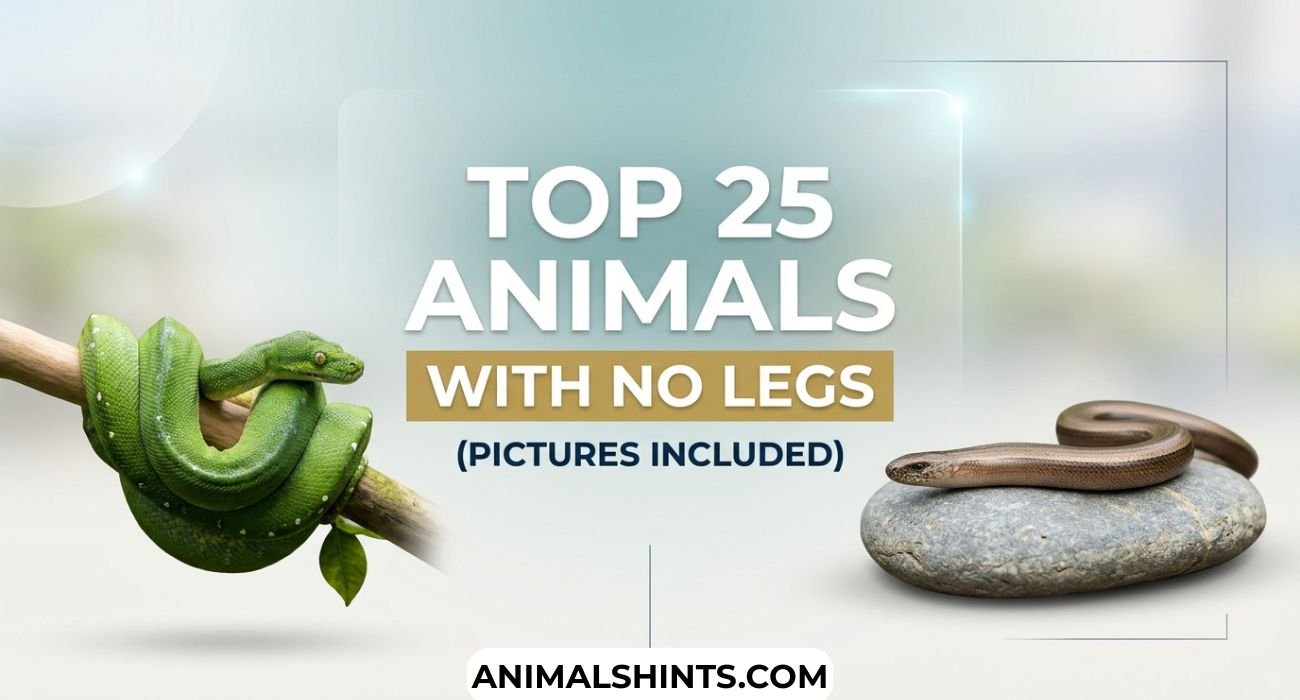
Top 25 Animals with No Legs (Pictures Included)
Animals with no legs are creatures that do not have legs for walking or moving. They use other body parts to travel. Snakes, worms, and some sea animals are examples of these creatures.
Nature has many amazing animals with no legs. They move in unique ways and live in different places. Their special features make them interesting to learn about.
Animals with no legs can live on land and in water. They use muscles, fins, or body movements to move. These animals play important roles in nature.
What Are Animals with No Legs?
Animals with no legs are creatures that have evolved to live without limbs. Some never had legs at all. Others lost them over millions of years through evolution. These legless animals come in many shapes and sizes.
They live in oceans, forests, deserts, and even in your backyard. Some are vertebrates with bones. Others are invertebrates without a skeleton. Despite having no legs, these creatures have adapted in remarkable ways.
Their survival shows us that nature always finds a way. Animal adaptations like slithering, burrowing, and swimming have replaced the need for legs. Let’s explore how these legless creatures thrive in their environments.
Read this too: 25 Chubby animals
List of 25 Animals with No Legs
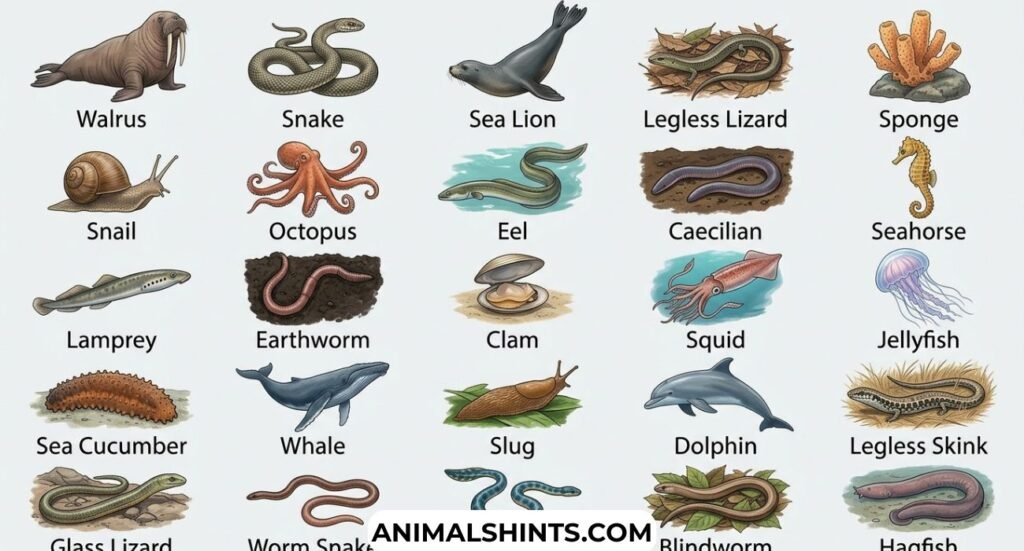
Here is our complete list of animals with no legs. Each creature has unique features and locomotion methods that help it survive. You’ll find marine mammals, reptiles, fish, and many invertebrates on this list.
| # | Animal Name | Category | Primary Movement |
| 1 | Walruses | Marine Mammal | Flipper swimming |
| 2 | Snakes | Reptile | Slithering |
| 3 | Sea Lions | Marine Mammal | Flipper walking/swimming |
| 4 | Legless Lizard | Reptile | Slithering/Burrowing |
| 5 | Sponges | Poriferan | Sessile (non-moving) |
| 6 | Snails | Gastropod | Muscular foot |
| 7 | Octopuses | Cephalopod | Arms and jet propulsion |
| 8 | Eels | Fish | Sinuous swimming |
| 9 | Caecilians | Amphibian | Burrowing |
| 10 | Seahorses | Fish | Prehensile tail |
| 11 | Lampreys | Jawless Fish | Eel-like swimming |
| 12 | Earthworms | Annelid | Muscle contraction |
| 13 | Clams | Bivalve | Burrowing |
| 14 | Squid | Cephalopod | Jet propulsion |
| 15 | Jellyfish | Cnidarian | Bell contraction |
| 16 | Sea Cucumbers | Echinoderm | Tube feet |
| 17 | Whales | Marine Mammal | Tail/flipper swimming |
| 18 | Slugs | Gastropod | Muscular foot |
| 19 | Dolphins | Marine Mammal | Tail flukes |
| 20 | Legless Skinks | Reptile | Slithering |
| 21 | Glass Lizards | Reptile | Slithering |
| 22 | Worm Snakes | Reptile | Burrowing |
| 23 | Sea Snakes | Reptile | Swimming |
| 24 | Blindworms | Reptile | Burrowing |
| 25 | Hagfish | Jawless Fish | Eel-like swimming |
Walruses
Scientific Name: Odobenus rosmarus
Class: Mammalia | Diet: Carnivore
Walruses are large marine animals with no true legs. Instead, they have flippers that help them move through icy waters. These aquatic animals use their hind flippers like a rudder. Their front flippers act like paddles for propulsion.
You can find walruses in the Arctic waters near Alaska. They use their tusks to haul themselves onto sea ice. These animals with no legs are highly social and live in large herds. They communicate through barks and loud calls.
Climate change threatens their sea ice dependence. As ice melts, these legless animals face habitat loss. Walruses show us that evolutionary adaptations can be both impressive and fragile.
Snakes
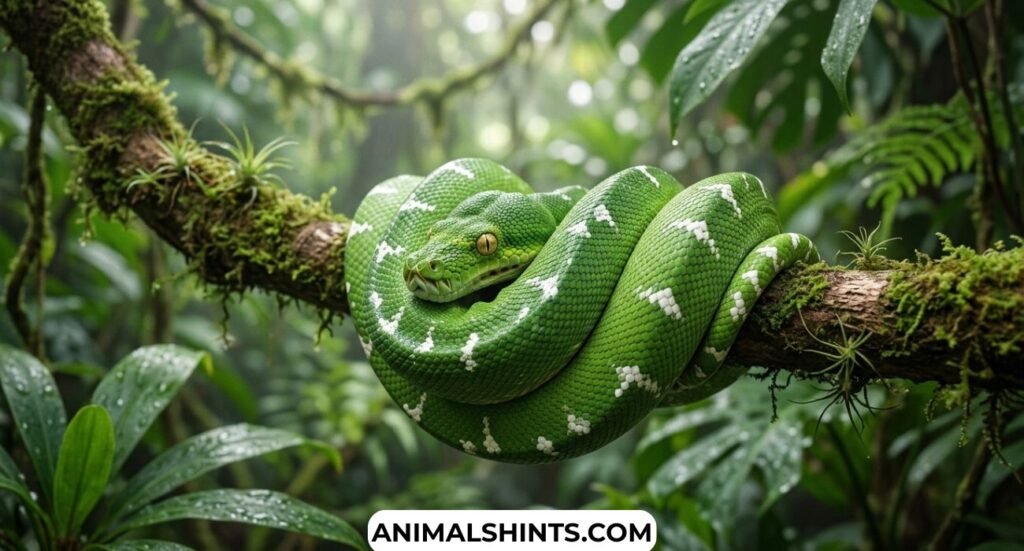
Class: Reptilia | Diet: Carnivore
Snakes are the most well-known legless animals. They belong to the reptile class and have scales covering their bodies. These legless reptiles use a unique slithering motion to move. Their muscle contractions and scales work together to grip surfaces.
Some snakes can climb trees with ease. Others swim through water using wave-like motion. Their elongated bodies allow them to access tight spaces where other predators cannot go.
Heat-sensing pits help some snakes detect warm-blooded prey. This animal adaptation makes them effective hunters. In the USA, you can find snakes in every state. They play a vital role in controlling pest populations.
Sea Lions
Class: Mammalia | Diet: Carnivore
Sea lions are charming marine animals that use flippers instead of legs. Unlike seals, they can walk on their rear flippers. This flipper locomotion allows them to move on land with surprising speed.
These animals without legs are excellent swimmers. Their streamlined bodies cut through water effortlessly. Sea lions often hunt in groups and use coordinated tactics. This hunting cooperation helps them catch fish more efficiently.
You can see sea lions along the west coast of the USA. Their playful behavior and intelligence make them popular attractions. They form strong social bonds and communicate with loud barks.
Legless Lizard
Class: Reptilia | Diet: Mostly insectivore
Legless lizards are often mistaken for snakes. But they have key differences. Unlike snakes, these legless animals have eyelids and external ear openings. This sets them apart from true snakes.
They use slithering and burrowing to move through soil. Their slender bodies help them navigate tight underground spaces. These legless reptiles eat insects and small invertebrates.
In the USA, you can find them in southeastern states and California. Their camouflage techniques help them avoid predators. When threatened, they can drop their tails, a trick called tail autonomy.
Sponges
Scientific Name: Phylum Porifera
Diet: Filter feeder
Sponges are sessile organisms. This means they stay in one place their whole lives. These animals with no legs have a porous structure that lets water flow through them. They are filter feeders that extract food from the water.
These non-mobile animals live in oceans around the world. They come in many shapes, sizes, and colors. Despite not moving, sponges are truly animals. They have specialized cells for different functions.
Sponges can regenerate from small pieces. This regeneration ability makes them biologically remarkable. Some species can live for thousands of years. They play an important role in marine ecosystems.
Snails
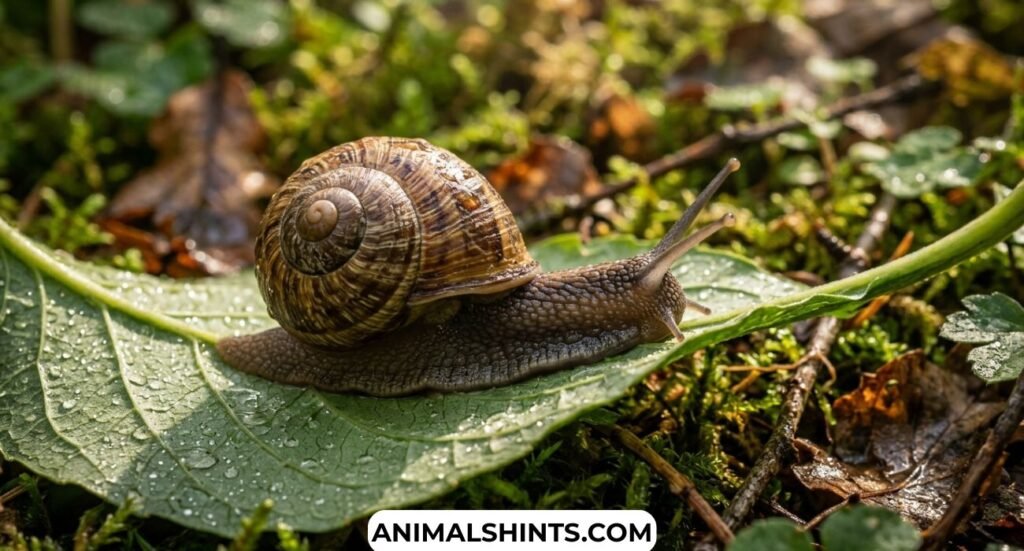
Class: Gastropoda | Diet: Herbivore/Detritivore/Carnivore
Snails are slow but fascinating legless animals. They have a muscular foot that glides over surfaces. Their mucus production reduces friction and protects their bodies. This mucus trail movement allows them to crawl almost anywhere.
Many snails carry a calcium carbonate shell on their backs. This shell provides protection from predators. It also helps with hydration regulation.
Snails are found across the USA in gardens, forests, and water bodies. Some eat plants while others eat decaying matter. These gastropods play a vital role in nutrient cycling. They help break down organic material in the soil.
Octopuses
Class: Cephalopoda | Diet: Carnivore
Octopuses are some of the smartest animals with no legs. They have eight arms covered with suckers. These cephalopods can move by crawling along the ocean floor. They can also use jet propulsion to swim quickly.
Their color-changing ability comes from special cells called chromatophores. This allows them to blend into their surroundings. Their intelligence is remarkable. They can solve puzzles, escape enclosures, and even use tools.
Octopuses live in oceans worldwide, including waters off the USA. Their problem-solving abilities make them fascinating research subjects. They show us that consciousness exists in many forms across the animal kingdom.
Eels
Class: Actinopterygii | Diet: Carnivore
Eels are fish with long, slender bodies. They have no legs and move using undulation movement. This wave-like motion allows them to swim forward and backward with ease.
The American eel lives in freshwater rivers and coastal waters. Some eels migrate thousands of miles to spawn. Their migration patterns are still being studied by scientists. These aquatic animals can also breathe through their skin in low-oxygen water.
Eels are carnivorous and hunt fish and invertebrates. Their flexible bodies help them hide in tight spaces. They are an important part of both freshwater and marine ecosystems.
Caecilians
Class: Amphibia | Diet: Carnivore
Caecilians are legless amphibians that look like worms. They have elongated bodies and live underground. These burrowing animals use their heads to push through soil. Their muscle contractions help them move through the ground.
Caecilians have sensory tentacles on their heads. These help them detect prey in the dark. Some species show parental care. Mothers produce skin secretions rich in nutrients for their young.
While caecilians are not native to the USA, they are found in zoos and research centers. Their unique features make them valuable for evolutionary studies. They represent a fascinating branch of the amphibian family.
Seahorses
Class: Actinopterygii | Diet: Carnivore
Seahorses are one of the strangest animals without legs. They have a prehensile tail that grips onto sea grass and corals. This anchoring helps them stay in place against currents.
These fish swim upright, which is unusual among sea creatures. They use a small fin on their back to move slowly. Seahorses are also famous for male pregnancy. The male carries eggs in his brood pouch until they hatch.
In the USA, you can find seahorses in Florida, Hawaii, and along the Gulf Coast. Their unique appearance and reproductive strategies fascinate people worldwide. They are popular in home aquariums.
Lampreys
Class: Petromyzontida
Diet: Parasitic or filter feeder
Lampreys are ancient jawless fish. They have been around for over 360 million years. These aquatic animals have a suction mouth lined with raspy teeth. Some species are parasitic and attach to other fish for food.
Lampreys move using an eel-like swimming motion. Their elongated bodies help them navigate freshwater and saltwater. In the USA, lampreys are found in the Great Lakes region. They are considered an invasive species there.
Their evolutionary history makes them important for scientific study. They offer insights into the origins of vertebrates. Lamprey blood contains compounds that may have medicinal benefits.
Earthworms
Class: Clitellata | Diet: Detritivore
Earthworms are simple but essential legless animals. They have segmented bodies with tiny bristles called setae. These setae locomotion helps them grip the soil as they move. Their muscle contractions push them forward and backward.
Earthworms are detritivores that eat decaying organic matter. They play a huge role in soil aeration. Their tunnels allow water and oxygen to reach plant roots. This nutrient cycling makes soil fertile for farming.
You can find earthworms in gardens and fields across the USA. They are a sign of healthy soil. Without these burrowing animals, our farms and forests would suffer.
Clams
Class: Bivalvia | Diet: Filter feeder
Clams are bivalves with two hinged shells. These animals with no legs live in sand or mud. They use a muscular foot to burrow into the substrate. This protects them from predators.
Clams are filter feeders. They draw in water and filter out microscopic plankton. This filtration feeding helps keep water clean. Their shells protect their soft bodies from harm.
In the USA, clams are found along both coasts. They are an important part of the seafood industry. Clam digging is a popular activity in many coastal communities. These legless animals are vital to ocean health.
Squid
Class: Cephalopoda | Diet: Carnivore
Squid are fast and agile animals without legs. They use jet propulsion to move through water. Water is expelled from their mantle cavity to create thrust. This allows them to reach high speeds quickly.
These cephalopods have chromatophores for color-changing ability. They can create amazing displays of color and pattern. This helps with communication and camouflage.
Squid are found in oceans worldwide, including USA coastal waters. They are popular as food and are an important part of marine ecosystems. Some squid species can grow over 40 feet long. Their unique locomotion methods inspire biomimicry research.
Jellyfish
Class: Scyphozoa | Diet: Carnivore
Jellyfish are cnidarians with no bones, brain, or heart. They are 95% water and have a gelatinous body. These legless animals move by contracting and expanding their bell-shaped body. This bell contraction pushes water and propels them forward.
Jellyfish have stinging cells on their tentacles. These help them capture prey and defend against predators. Some species produce bioluminescence and glow in the dark.
Jellyfish are found in all oceans, including off USA coastlines. Their populations are increasing due to pollution and overfishing. They are a reminder of how climate change impacts marine life.
Sea Cucumbers
Class: Holothuroidea | Diet: Detritivore
Sea cucumbers are echinoderms with soft, tubular bodies. They have tube feet that help them move slowly along the ocean floor. These legless animals are detritivores that eat organic particles in the sand.
Sea cucumbers have a remarkable regeneration ability. When threatened, they can expel their internal organs. This distracts predators and allows the sea cucumber to escape. The organs grow back later.
They live on ocean floors around the world, including USA waters. Sea cucumbers are important for nutrient cycling. They recycle organic matter and keep the ocean floor clean. Some are used in traditional medicine.
Read also: 25 chill animals
Whales
Class: Mammalia | Diet: Varies (baleen or toothed)
Whales are the largest animals with no legs on Earth. They evolved from four-legged land mammals millions of years ago. Their legs became flippers over time. Today, they use their tail flukes for powerful swimming.
Whales are marine animals found in oceans worldwide. Some are filter feeders that eat krill. Others are carnivorous and hunt fish and squid. Their streamlined bodies make them efficient swimmers.
In the USA, whale watching is popular along both coasts. These aquatic animals communicate through complex vocalizations. Their social bonds are strong and long-lasting. Whales show us how evolutionary adaptation can transform a species completely.
Slugs
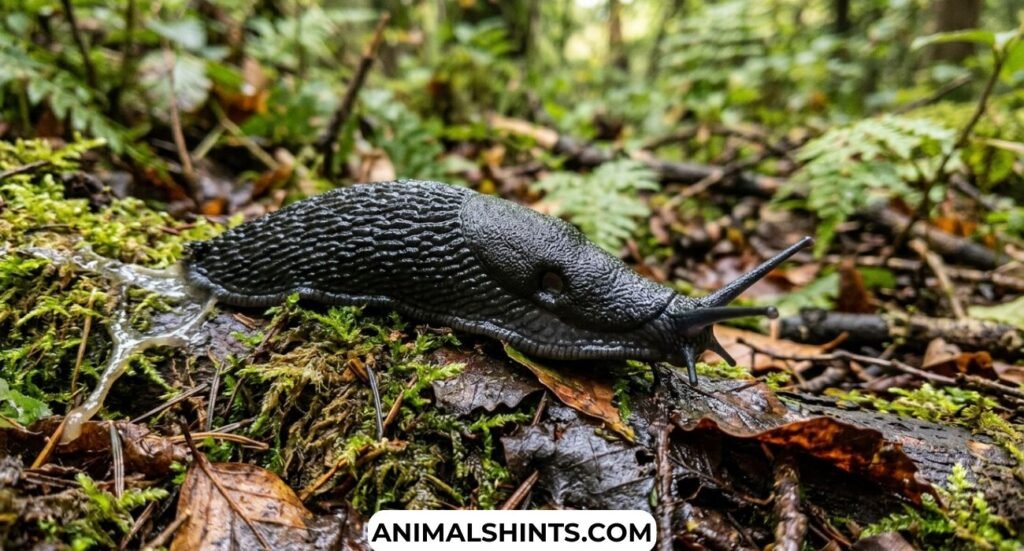
Class: Gastropoda | Diet: Mostly herbivore
Slugs are gastropods without shells. They have a muscular foot that moves using mucus production. The mucus trail reduces friction and helps them slide over surfaces. This mucus trail movement is a key animal adaptation.
Slugs have sensory eyestalks that detect light, taste, and odors. These help them find food and avoid danger. Some slugs display bright colors as a warning to predators.
You can find slugs in gardens, forests, and moist areas across the USA. They help break down plant material. Despite being considered pests, they play an important role in nutrient cycling.
Dolphins
Scientific Name: Delphinidae
Class: Mammalia | Diet: Carnivore
Dolphins are highly intelligent animals without legs. They use tail flukes and pectoral fins to swim. Their streamlined bodies allow for fast, agile movement. Some species can reach speeds of 35 miles per hour.
Dolphins are carnivorous and hunt fish and squid. They use echolocation to find prey. This involves making clicks and listening to the echoes. Their communication methods include whistles, clicks, and body language.
In the USA, dolphins are common along the coasts of Florida, California, and Hawaii. Their playful behavior and intelligence attract tourists. Dolphins remind us that legless animals can be just as social and complex as any other species.
Legless Skinks
Class: Reptilia | Diet: Insectivore
Legless skinks are reptiles that look like snakes but are true lizards. They have eyelids and external ear openings. These features set them apart from snakes. Their slender bodies help them move through grass and leaves.
These legless lizards use slithering to move. They are found in warm regions around the world. In the USA, some species live in the southeastern states.
Legless skinks eat insects and small invertebrates. Their camouflage techniques help them avoid predators. They are fascinating examples of convergent evolution in the animal kingdom.
Glass Lizards
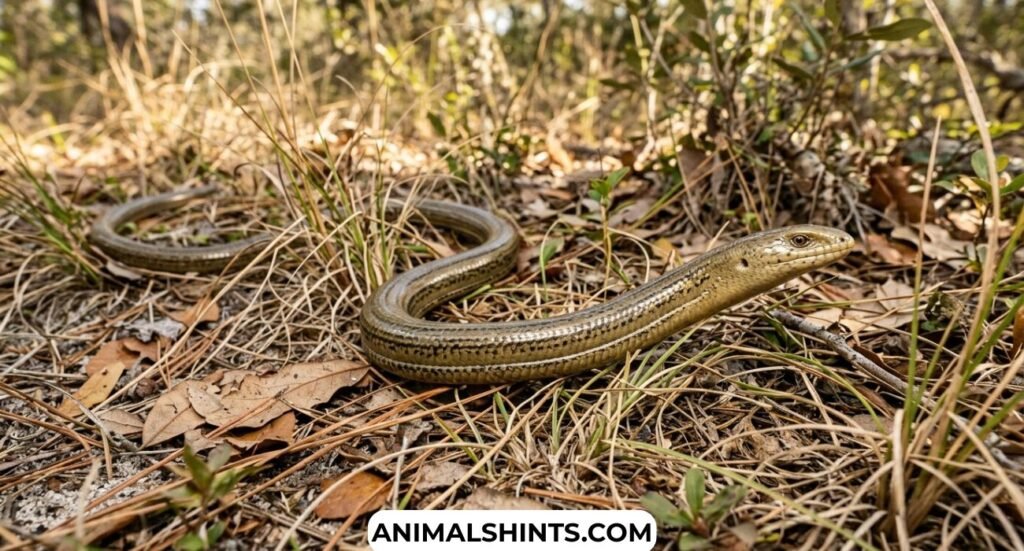
Class: Reptilia | Diet: Insectivore
Glass lizards are another type of legless lizard. They have long, slender bodies and can grow up to four feet long. Their name comes from their ability to break off their tails when threatened.
These legless reptiles are found in the USA, especially in the south. They prefer sandy soils and grassy areas. Glass lizards eat insects, spiders, and small reptiles.
Unlike snakes, glass lizards can blink and have ear openings. They are a great example of how animals without legs can be confused with each other. Their defensive mechanisms are highly effective.
Worm Snakes
Class: Reptilia | Diet: Insectivore
Worm snakes are small, burrowing animals with no legs. They look like earthworms but are actually reptiles. Their slender bodies help them move through loose soil and leaf litter.
These legless animals have smooth, shiny scales. They eat insects and insect larvae. Worm snakes are found in the eastern United States. They are harmless to humans.
Their burrowing locomotion helps them stay hidden from predators. Worm snakes show us that evolutionary adaptations can make animals look very different from their relatives.
Sea Snakes
Class: Reptilia | Diet: Carnivore
Sea snakes are aquatic animals with no legs. They are closely related to cobras and other land snakes. Their elongated bodies are adapted for swimming. Their scales help them move through water efficiently.
These marine animals are found in warm waters around the world. They are highly venomous but not aggressive toward humans. Sea snakes eat fish and eels.
They have a special skin breathing ability. Some species can absorb oxygen directly from the water. This helps them stay submerged for long periods.
Blindworms
Class: Reptilia | Diet: Insectivore
Blindworms are legless lizards that look like worms. Despite the name, they are not worms at all. They have eyelids and ear openings that set them apart from snakes.
These burrowing animals live underground or under rocks. They eat insects, slugs, and earthworms. Blindworms are found in Europe and some parts of Asia.
In the USA, they are sometimes kept as pets. Their slender bodies and lack of legs make them fascinating to observe. They are a great example of animal adaptations for underground life.
Hagfish
Class: Myxini | Diet: Scavenger
Hagfish are primitive jawless fish with no legs. They have been around for over 300 million years. These marine animals are sometimes called slime eels. They produce large amounts of slime to escape predators.
Hagfish are scavengers. They feed on dead and dying fish on the ocean floor. Their raspy teeth help them tear into carcasses. They tie themselves into knots to gain leverage when feeding.
Hagfish live in deep-sea environments. They are found in oceans around the world, including waters off the USA. Their unique biology makes them valuable for scientific research.
How Animals with No Legs Move
Locomotion is how these animals without legs get around. Different species have developed unique locomotion methods. Let’s explore the most common ways legless animals move.
Slithering and Undulation
Many legless reptiles use slithering to move. Snakes, legless lizards, and some fish use undulation movement. They create wave-like motions that push against surfaces. This is an efficient way to move on land or in water.
Burrowing and Crawling
Burrowing animals like earthworms and caecilians use muscle contractions. They push through soil by expanding and contracting their bodies. Setae locomotion helps earthworms grip the soil. This allows them to move efficiently underground.
Jet Propulsion
Cephalopods like squid and octopuses use jet propulsion. Water is expelled from their bodies to create thrust. This gives them sudden bursts of speed. It is a very effective way to escape predators.
Flipper and Fin Propulsion
Marine mammals like whales and dolphins use flipper locomotion. Their tail flukes and pectoral fins help them swim. These streamlined bodies are built for speed and endurance in water.
Gliding and Drifting
Sessile organisms like sponges do not move at all. Jellyfish use bell contraction to drift through currents. These non-mobile animals rely on water flow for feeding and movement.
Evolution of Legless Animals
Why do some animals have no legs? Evolution provides the answer. Over millions of years, some creatures lost their limbs. This happened through natural selection and speciation.
Aquatic animals often evolve away from legs. In water, legs are not as useful as fins or flippers. Whales and dolphins are perfect examples. Their ancestors walked on land but adapted to ocean life.
Burrowing animals also benefit from being legless. Legs can get in the way underground. Caecilians, legless lizards, and worm snakes all show this adaptation.
Some evolutionary adaptations happen because of limited space. Snakes evolved to live in dense vegetation where legs were less useful. Their elongated bodies help them navigate tight spots.
Convergent evolution appears in many legless species. Snakes, legless lizards, and caecilians all look similar. But they are not closely related. This shows how different species can develop similar traits in similar environments.
Why Some Animals Thrive Without Legs
Legs are useful, but not always necessary. Many legless animals have found other ways to succeed.
Access to Tight Spaces
Animals with no legs can enter narrow burrows and crevices. This helps them hide from predators and find food. Snakes can hunt in rodent burrows where other animals cannot follow.
Energy Efficiency
Moving without legs can be energy-efficient. Slithering requires less energy than walking for some species. This is especially true for burrowing animals in soft soil.
Aquatic Advantage
In water, legs are often a disadvantage. Marine animals with flippers and fins move faster than four-legged swimmers. Streamlined bodies reduce drag and improve efficiency.
Camouflage and Stealth
Legless animals are often better at camouflage. Their elongated bodies can blend into leaves, branches, or sand. This predator evasion technique is highly effective.
Importance of Legless Animals in Ecosystems
Animals without legs play crucial roles in nature. They help maintain balance in their ecosystems.
Soil Health and Aeration
Earthworms are essential for soil aeration. Their tunnels allow air and water to reach plant roots. This nutrient cycling makes soil fertile and supports agriculture.
Water Purification
Clams, sponges, and other filter feeders clean water. They remove particles and toxins from the environment. This filtration feeding is vital for ocean health.
Pest Control
Snakes control pest populations like rodents. This helps farmers and reduces the spread of disease. Many legless reptiles are important natural predators.
Food Web Support
Legless animals are both predators and prey. They support complex food web roles. Larger animals depend on them for survival.
Scientific Research
These creatures offer insights into biology and medicine. Regeneration abilities in sea cucumbers could help with regenerative medicine. Venom from snakes may lead to new drugs.
Fun Facts About Animals with No Legs
Here are some amazing facts about legless animals.
- Fastest animal without legs: The black mamba snake can reach speeds of 12 miles per hour.
- Longest animal without legs: The reticulated python can grow over 30 feet long.
- Heaviest animal without legs: The blue whale can weigh over 200 tons.
- Oldest animal without legs: Some sponges have lived for over 10,000 years.
- Smartest animals with no legs: Octopuses and dolphins are highly intelligent. They can solve problems and use tools.
- Strangest defense: Sea cucumbers can expel their organs. Jellyfish have stinging cells that paralyze prey.
Conservation of Legless Animals
Many animals with no legs face serious threats. Habitat loss, pollution, and climate change are major concerns.
Threats in the USA
- Habitat destruction affects snakes, lizards, and earthworms.
- Pollution harms marine animals like whales and dolphins.
- Climate change melts sea ice that walruses depend on.
- Overfishing reduces food sources for larger marine animals.
- Road mortality kills many snakes each year.
Conservation Efforts
- Protected areas help preserve habitats.
- Species protection laws save endangered legless animals.
- Conservation efforts focus on reducing pollution and climate impacts.
- Research and monitoring help track population changes.
How You Can Help
- Support conservation organizations.
- Reduce plastic waste to help marine animals.
- Create wildlife-friendly gardens for snakes and earthworms.
- Make sustainable seafood choices.
- Report sightings to research programs.
Surprising Habitats Where Animals with No Legs Live
You might expect to find legless animals only in oceans or underground. But animals without legs have adapted to nearly every environment on Earth. From freezing Arctic waters to scorching deserts, these creatures thrive in places that would seem impossible. Some legless creatures even live high in rainforest canopies, where they glide between branches using their slender bodies.
In the USA, animals with no legs inhabit diverse locations. Slithering animals like snakes live in suburban backyards. Burrowing animals like earthworms enrich farmland soil across the Midwest. Marine animals like whales and dolphins swim along both coasts. Even in cities, you can find snails and slugs in parks and gardens. These creatures prove that legless animals can succeed anywhere.
See also: Spiritual Meanings of Seeing A Caterpillar
Fascinating Senses and Communication of Legless Animals
Legless animals have developed remarkable senses to survive without limbs. Snakes use heat-sensing pits to detect warm-blooded prey in complete darkness. Dolphins and whales use echolocation to navigate and hunt in murky waters. Octopuses rely on their suckers to taste and feel their surroundings. These animal adaptations compensate for their lack of legs in extraordinary ways.
Communication is equally impressive among animals with no legs. Whales sing complex songs that travel hundreds of miles through the ocean. Dolphins use whistles and clicks to identify each other and coordinate hunting. Snakes communicate through body vibrations and chemical signals. Even earthworms sense vibrations in the soil to detect danger. These survival strategies show that legless creatures are far from helpless.
FAQ’s
Which Animal Has 60 Legs?
A millipede is the best-known animal with around 60 legs, though the exact number varies by species. Some millipedes have exactly 60 legs during certain stages of growth.
What Animals Do Not Have Feet?
Animals like snakes, worms, and many fish do not have feet. They move by slithering, wriggling, or swimming instead of walking.
Which One Has No Legs?
Snakes are the most familiar animals with no legs. They use strong muscles and scales on their bodies to move across the ground.
Which Animal Has 8 Legs?
Spiders have 8 legs, which help them climb, hunt, and spin webs. Scorpions and ticks also belong to the eight-legged arachnid group.
Conclusion
Animals with no legs show amazing ways to live in nature. They move with special body parts and smart actions. Snakes, worms, and some sea animals can travel without feet. These creatures help us learn about the variety of life on Earth. Every animal has unique features that help it survive and grow in its own natural home with care.
Learning about animals with no legs helps children understand nature better. These animals have important roles in the environment and deserve respect. We can protect their habitats and keep nature healthy. Studying their movements and features makes science fun and interesting. Kind actions toward all creatures create a safer world for animals and people. This knowledge builds love for nature.