Spiritual Meaning of a Wasp in the House: Warning Signs, Boundaries and Real Reasons
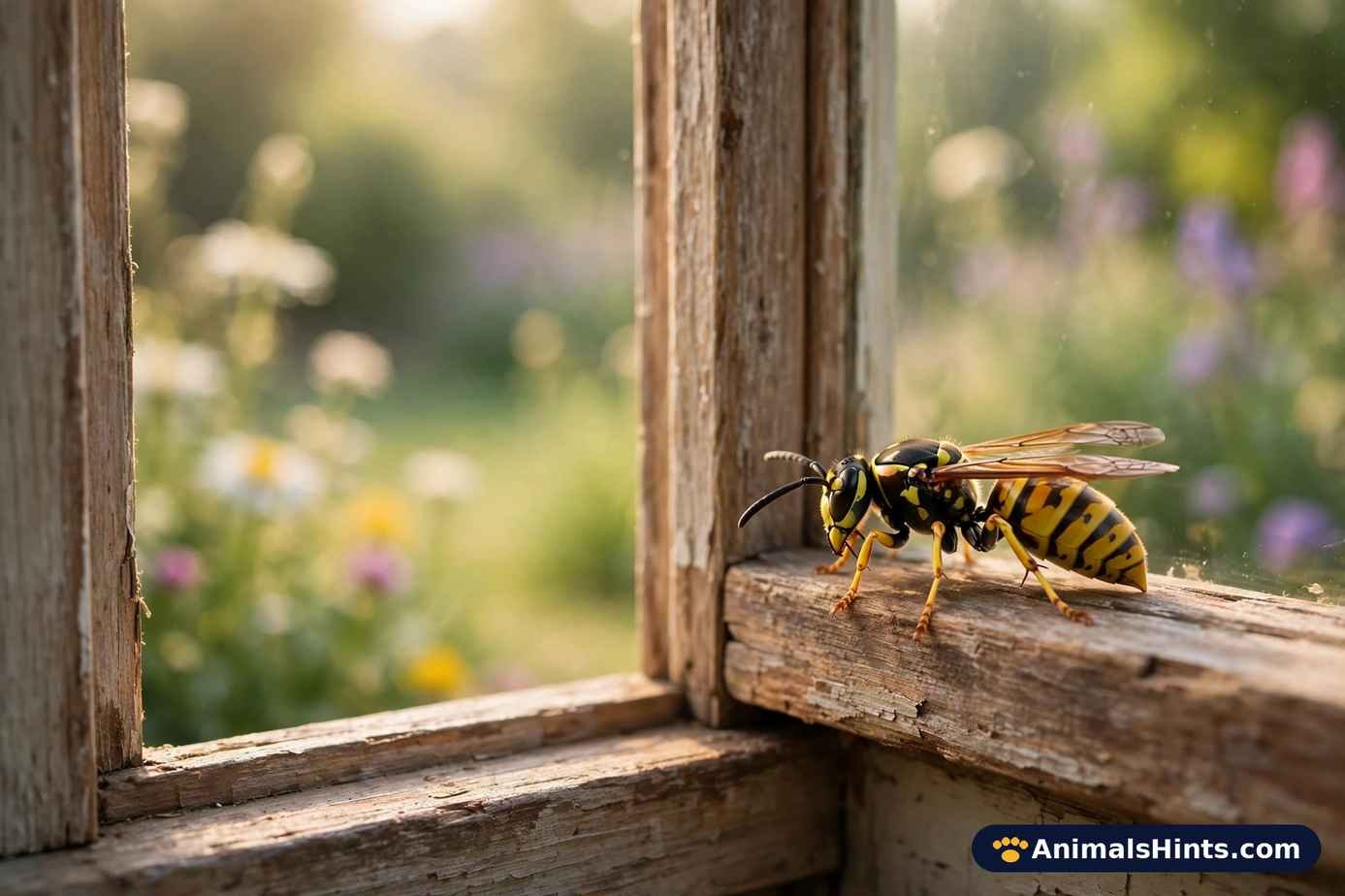
It starts with a sound you feel before you place it: a hard, papery buzzing against the window glass, too heavy for a fly and too purposeful for a moth. The spiritual meaning of a wasp in the house is one of the oldest questions people ask about an indoor visitor, because this one arrives with a sting in its tail and a reputation that precedes it through the door.
The lore reads the visit as a boundary event. A wasp is a creature of defended ground: it builds, it guards, it warns before it strikes, and it keeps its household running on strict order. Traditions that read meaning into animals have long treated a wasp crossing your threshold as a reason to examine your own defences, your temper and your focus — a reading this article sets out in full, under the headings of the page it answers.
But a wasp indoors is also, very often, a wasp with a timetable. It may be hunting sugar in the last weeks of its colony’s life, sheltering from the first cold, or following light down the wrong side of a wall. This article keeps both records side by side: the meanings people have attached to the visit, and what the insect itself is verifiably doing in your home.
The Real Wasp in Your House: Sugar, Shelter and a Colony at Its End
Start with how much of the animal kingdom the word “wasp” quietly covers. University of Illinois Extension puts the described wasp species of the world at over 100,000. Of those, roughly 33,000 are stinging wasps, and only about 1,000 of the stinging kinds live socially, in colonies. The wasp on your windowsill almost certainly belongs to that social minority — a yellowjacket, a paper wasp or a hornet — because those are the species that live alongside people closely enough to end up indoors. The great majority of wasps are solitary, live alone, and almost never trouble anyone.
The social wasps run a one-year household. A single mated queen starts a nest in spring, workers raise it to its peak through summer, and the whole colony is finished by the first hard frosts. University of Minnesota Extension records that the workers and males of social wasps such as yellowjackets, paper wasps and bald-faced hornets die off once hard frosts arrive, and only the newly mated queens survive the winter. That single fact explains most wasps found inside houses, because it puts them there by three different routes.
The first route is appetite. Late in the season the colony is at its largest and its brood-rearing is winding down, so workers turn to sugar: fallen fruit, jam, sweet drinks, anything fermenting or sweet left within reach. University of Georgia entomologist Beverly Sparks notes that the social wasps grow most defensive in autumn, as food becomes scarce and they fight harder to get and protect it. A wasp quartering your kitchen in September is usually a hungry forager from a colony at its peak, following scent through an open window — a worker near the end of her short life, not a scout for an invasion.
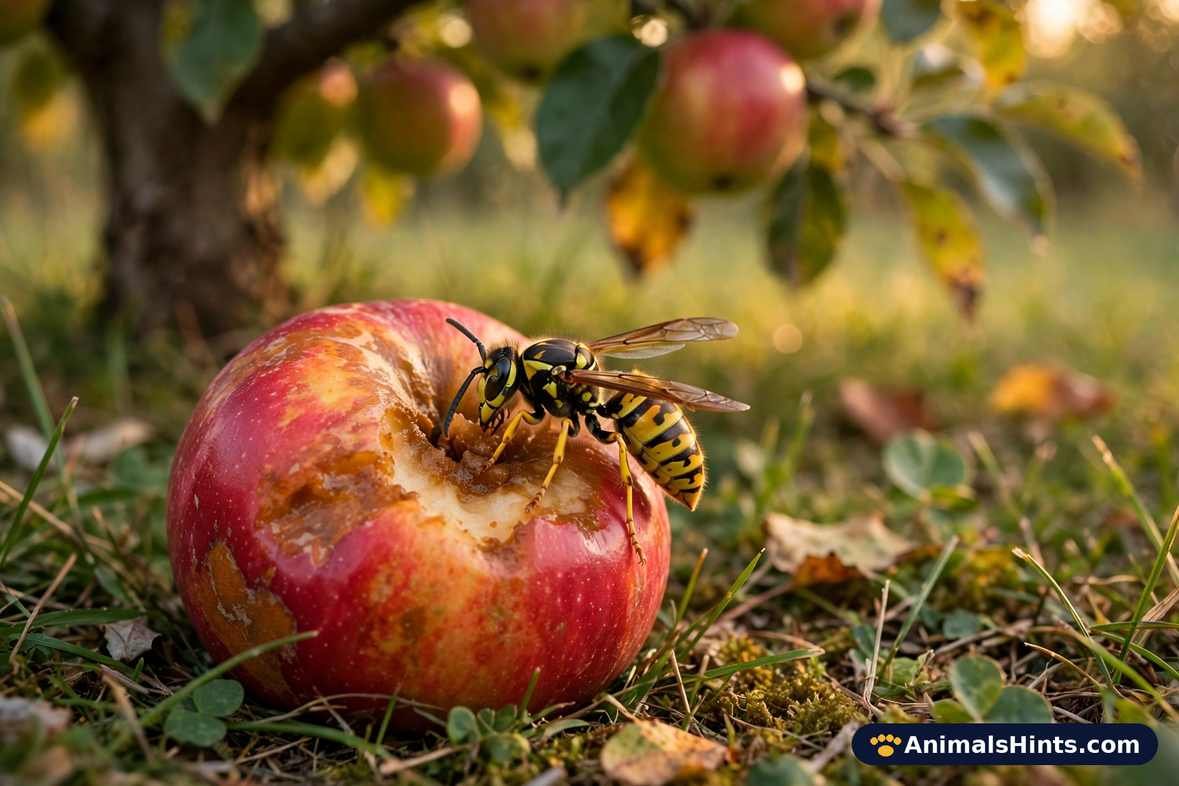
The second route is architecture. Social wasps nest where a house offers a cavity or a sheltered beam: inside wall voids, under eaves, in roof spaces, chimneys and sheds. A nest built into the fabric of the house can put wasps on the wrong side of the plaster all season, and North Carolina State University’s guidance on paper wasps records the mechanism plainly — a wasp sheltering in a wall void or attic navigates by light, and where light leaks through a fitting or a baseboard gap, it can emerge inside the room instead of outside it.
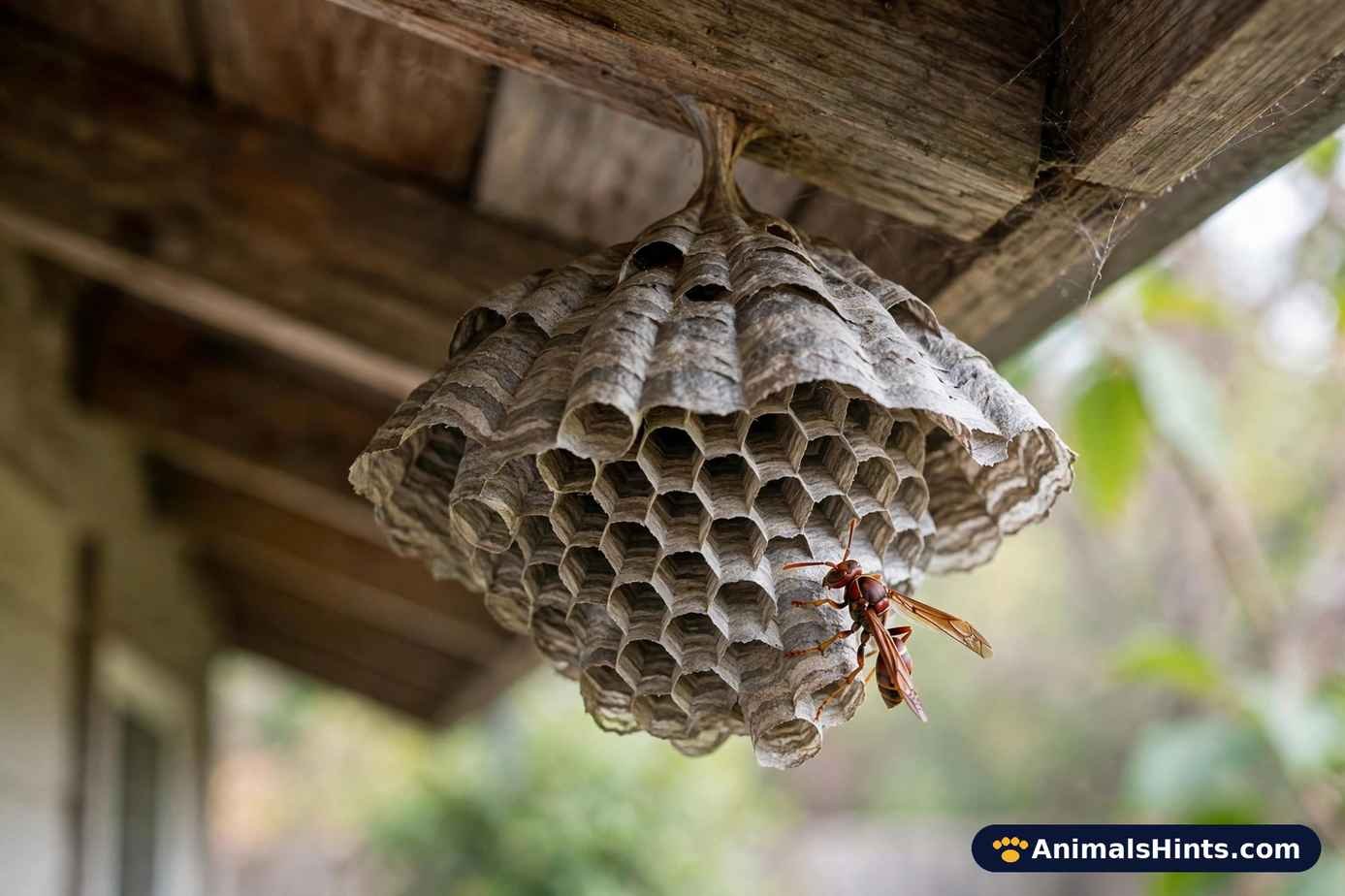
The third route is the queen herself. In autumn the new queens leave the dying colony and look for a protected place to wait out the cold — under bark, in leaf litter, and, as the University of Maryland’s social-wasp guidance lists among the overwintering sites, in wall voids, attics and the sheltered gaps of buildings. A slow, large wasp crawling on a winter windowsill is most often a queen woken early by the warmth of the house, following the light. She is not defending anything. She is trying to survive until spring.
None of this makes the wasp a pest to be dismissed. A 2021 review in the journal Biological Reviews, covering more than 500 academic papers, found evidence of wasps visiting 960 plant species, including 164 species that depend on wasps entirely for pollination. The same review sets out the wasps’ other trade: they are top predators of the insects that eat crops and gardens, hunting flies, aphids and caterpillars and carrying them back to feed their young. The wasp at your window is, in the garden’s accounting, a working predator and a part-time pollinator that has taken a wrong turning.
What Does a Wasp in the House Symbolize?
Across the traditions that read meaning into animal visits, the wasp in the house symbolizes the defended household. It is an insect that draws a line around its home and enforces it, so its appearance indoors raises the household’s own questions: who is allowed in, what you tolerate, and where your patience is wearing thin. The sting gives the symbol its edge. Where a bee’s visit is usually read as sweetness and industry, a wasp’s is read as the same household order with a warning attached — protection that can turn to pain if a boundary keeps being crossed.
The symbolism also runs through energy and temper. A wasp is quick, direct and easily provoked, and the lore treats its arrival as a sign of stirred-up feeling in the house: an argument waiting to happen, irritation being swallowed rather than spoken, or pressure building behind a calm surface. Read that way, the wasp does not bring the tension; it announces it. The third strand of the symbolism is timing. Wasps belong to the turning of the year, busiest as summer ends, and an indoor wasp is often read as a change signal — a season closing, a household arrangement ending, something that must be finished before the cold arrives.
10 Spiritual Meanings of Seeing Wasp in the House
1) Hidden Dangers Alert
The first meaning the lore attaches to the visit is a warning about something small and overlooked. A wasp is easy to miss until it is almost underfoot, and the reading follows that shape: check the hazard you have been stepping around — the loose stair, the frayed cable, the small debt, the symptom you keep postponing. The meaning does not predict a disaster. It points at the minor, hidden thing that becomes a bigger one only because nobody looked at it.
2) Protection and Boundaries
A wasp’s whole life is organised around a threshold it will defend, and its arrival indoors is a lesson in holding your own. The tradition behind this meaning treats the visit as a prompt to say the no you have been avoiding: to close the door that everyone walks through, rest when you are tired, and stop letting your time and rooms be used without asking. The wasp does not apologise for its boundary, and the reading asks why you keep apologising for yours.
3) Upcoming Change Signal
Wasps appear indoors most often when the year is turning — as colonies peak, fail and scatter in late summer and autumn. The lore reads that timing into the visit itself: a wasp indoors is treated as evidence that a change is already under way, even if it has not announced itself yet. A role, a routine or a living arrangement is ending its season. The meaning counsels preparing for the change rather than being ambushed by it.
4) Stay Focused Encouragement
A foraging wasp works a single scent trail with complete concentration, ignoring everything that is not the task. Read as a meaning, the visit becomes encouragement aimed at the distracted: the project half-finished, the goal diluted by ten side paths. The wasp’s focus is narrow to the point of rudeness, and the lore treats that narrowness as the whole point — one target, pursued properly, beats a dozen begun and abandoned.
5) Precision in Action
The fifth meaning follows from how a wasp builds. A paper nest is measured work: every cell a hexagon, every layer placed. As a meaning, it calls for that same exactness in your own undertakings — to measure twice, to place the word, the payment or the decision precisely rather than roughly. Where the focus meaning is about choosing one target, this one is about hitting it cleanly.
6) Ancestors Message
In the strand of the lore that reads animal visits as messages from the dead, the wasp is an unlikely but recognised messenger: an ancestor checking on the household. The reading usually attaches to a wasp that appears at a family moment — a gathering, an anniversary, a room full of memory — and is read as the family’s older generation being near, approving or warning as the occasion suggests. It is one of the gentler meanings on this list.
7) Personal Power Sign
A wasp is a small creature that large animals learn to leave alone, and the lore reads that reputation as personal power: authority that does not depend on size. The visit is read as an instruction to stop understating your own weight — to speak in the meeting, name your price, and let your presence register. The meaning is not about aggression. It is about the confidence of a creature that has never once doubted it would be taken seriously.
8) Deceit Warning
The eighth meaning is the shadow of the first. Where the hidden-dangers reading points at accidents, this one points at people: something in the house or the circle around it is not what it seems. The wasp’s warning colouring is the hook for the reading — nature’s own label that says do not touch — and the visit becomes a reason to look again at the too-smooth offer, the story that keeps changing, or the friendliness that arrives exactly when something is wanted.
9) Energy Cleansing
A wasp is a predator that removes other insects from a house’s orbit, and some strands of the lore read its visit as a clearing: stale, heavy energy being hunted out of the rooms. The meaning usually follows a wasp that appears after a hard period — illness, conflict, grief — and is read as the house being swept, its atmosphere reset. Whether or not you credit the mechanism, the reading’s advice is practical: open the windows, clear the corners, let the place breathe.
10) Instincts Trust Nudge
The last meaning is about the feeling you had before you thought. Most people register a wasp’s presence a half-second before they see it — a change in the air, a sound at the edge of hearing. The lore treats the visit as a nudge toward that same instinct in the rest of life: the first impression of a person, the unease about a plan, the quiet knowing you talked yourself out of. The wasp is taken as a reminder that the alarm was working before the argument started.
Cultural and Religious Significance of the Wasp
Native American. In the Native American readings the competitor collects, the wasp stands for an ordered household and discipline held in common: a creature whose tireless building and strict roles make it a teacher of how a community keeps itself together. The strand is carried here at the strength the genre tells it — a general pattern across many storytelling traditions rather than a single documented tribal teaching.
Japanese. Japanese symbolism, as his page gives it, reads the wasp as courage and determination: a small fighter that does not retreat from larger opponents. The reading suits an insect that will defend its nest against animals a hundred times its size, and it sits alongside the wasp’s older reputation in Japan as a creature of persistence that returns to the same task until it is done.
Celtic. In the Celtic strand the wasp is a guardian of the household: a protector whose sting is a warning posted at the boundary of the home, and a sign of spiritual awareness — the sense that the unseen world notices the house and posts a sentinel at its edge. As with the Native American strand, this is carried as the genre tells it, a broad folk pattern rather than a documented historical teaching.
Christian. The Christian reading in the lore treats the sting as correction: a sharp, deserved discomfort that teaches moral boundaries, and the wasp as an emblem of justice rather than cruelty. That later symbolism should be kept apart from what the Bible itself actually records, because the Book does mention the wasp’s family — under its older name. Hornets are true wasps, the largest of the social wasps, and in the King James Version the hornet is sent ahead of Israel as God’s own advance guard:
And I will send hornets before thee, which shall drive out the Hivite, the Canaanite, and the Hittite, from before thee. (Exodus 23:28)
The promise is repeated as the conquest begins:
And I sent the hornet before you, which drave them out from before you, even the two kings of the Amorites; but not with thy sword, nor with thy bow. (Joshua 24:12)
Deuteronomy 7:20 carries the same sending. In the Bible’s own record, then, the wasp’s fiercest relative is not a curse on the household but a protection sent ahead of it — a detail worth setting beside the far darker meanings the modern lore prefers.
African. The African strand, as his page tells it, honours the wasp for perseverance, patience and work ethic: the builder that carries mud or chews fibre load after load, never finishing because the work is the point. Read together with the other strands, the pattern is consistent — culture after culture looked at the same insect and saw discipline first.
Feng Shui Meaning of Wasp Nest in the House
Feng Shui reads a nest differently from a single visiting wasp, because a nest is not a passing event but a settlement: the house has been chosen. In the competitor’s Feng Shui record, a wasp nest in the home stands for territorial energy mixed with imbalance — the protective, guarded quality of the wasp on one side, and unresolved tension in the household on the other. The nest says the home is defended; it also asks what the defence is costing.
His record reads the nest’s position as well as its presence. A nest toward the north of the house is connected with career and life direction — workplace conflicts and unclear goals are the tensions named. A nest toward the south is connected with reputation and relationships, and the named tensions are misunderstandings and hidden conflicts. These readings are carried here as Feng Shui interpretation, the system his page works in, not as findings of fact.
The practical counsel inside that tradition is notable for its restraint: rather than destroying a nest, Feng Shui advises respectful relocation where that is possible, so the household’s balance is restored without violence done to the creatures that chose it. On the facts side of this article the same conclusion is reached by a different road — a nest in a wall or roof space belongs to a licensed pest controller, as the safety passage below explains.
Different Colored Wasp in House
Yellow wasps. The yellow wasp of the lore is the yellowjacket pattern everyone knows, and its meanings are the brightest on the list: clarity, optimism and guidance. A yellow visitor is read as a light switched on in a stuck situation — the answer becoming visible, the mood lifting, the next step showing itself.
Black wasps. A black wasp is read as protective energy with a shadow in it: hidden threats and emotional depths. The lore treats the black visitor as the most serious of the colours, a sign to look at what is being avoided — the feeling pushed down, the conversation postponed, the threat not yet named. In the real insect world the black wasps are very often the solitary kinds, which sting people least of all; the gap between the omen and the animal is at its widest here.
Red wasps. Red is read as passion and intense emotion: anger, desire and motivation running hot. In this reading a red visitor means the home’s feeling is near the surface and needs somewhere honest to go — expressed rather than stored, because stored heat is what the sting here stands for.
Brown wasps. The brown wasp is the grounding colour: stability, patience and the slow virtues. Its visit is read as a call back to basics — the home’s foundations, the body’s rest, the unglamorous maintenance of a life. Where yellow speeds up and red heats up, brown settles.
Yellowjacket, Paper Wasp or Hornet? Naming the Visitor Before You Read It
Every meaning above assumes the visitor was a wasp, and most indoor visitors are — but the word covers several insects that behave very differently, and the reading improves once the animal is named. The tells are the waist, the finish of the body and the temper. Illinois Extension’s comparison is the reliable one: a honey bee is dull yellow-orange and covered in fine hairs, while a yellowjacket is bright yellow and black and mostly hairless — and if you are reading the meaning of a bee landing on you, the distinction is the whole article in miniature.
| Insect | How to tell it | Around people |
|---|---|---|
| Yellowjacket | Bright yellow-and-black bands, smooth and mostly hairless, about half an inch; nests in the ground, in wall voids and under cover | The picnic wasp: hunts sugar in late summer, defends its nest fiercely, stings repeatedly |
| Paper wasp | Slender, reddish-brown to dark with yellow marks, long legs dangling in flight; open umbrella nest under eaves | The calmest of the social wasps away from its nest; stings mainly when the nest is threatened |
| Hornet | The largest social wasps; the European hornet is brown-and-yellow and over an inch long; bald-faced “hornets” are black-and-white yellowjackets | Nest-defenders like their cousins; European hornets are drawn to lights at night |
| Honey bee (for contrast) | Dull amber-orange, visibly hairy, pollen loads packed onto the hind legs | Not a wasp at all; forages flowers, stings once in defence and the sting is left behind |
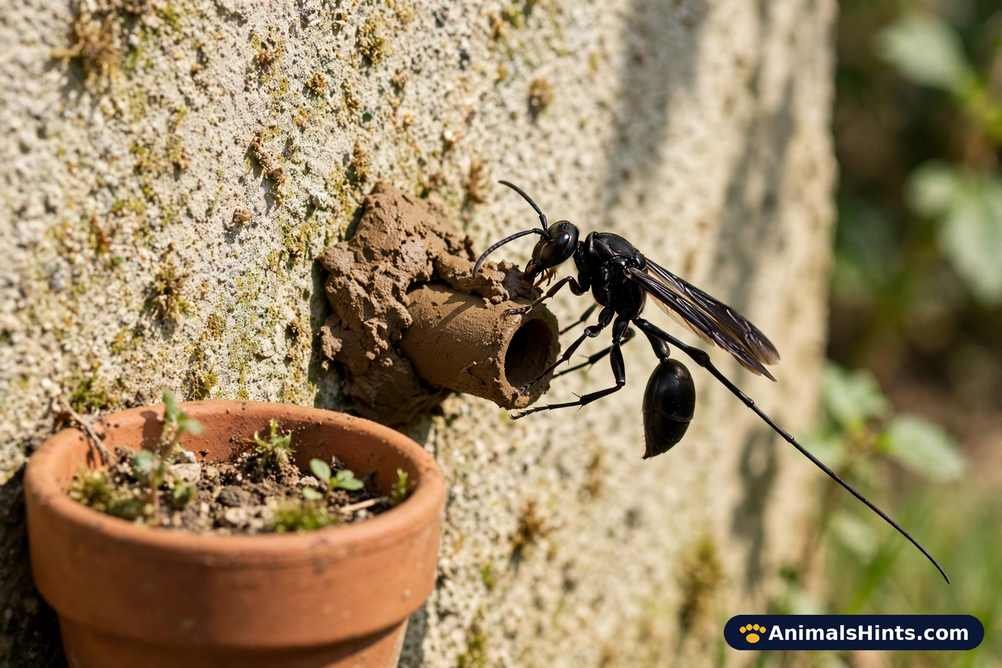
| Solitary wasps (mud daubers and digger wasps) | Thread-thin waist, often black or metallic; work alone, never in colonies | The quiet majority: mud daubers stock their mud tubes with paralysed spiders and almost never sting people |
The sting deserves its own honest paragraph, because it is the reason the wasp’s meanings lean so dark. A social wasp stings in defence of the nest, not in attack on people: a lone forager at a window has no nest to defend and wants only a way out. The equipment differs from the bee’s, too. Illinois Extension’s account of the yellowjacket is that its stinger is smooth and can be used again and again, where the honey bee’s barbed sting can be used only once. That repeatability — not malice — is what makes a disturbed nest dangerous, and it is why the black-and-yellow pattern itself has become nature’s most copied warning label.
What Can You Learn from a Wasp Visit
The competitor closes his meanings with the lessons, and they are worth keeping in his order of importance: boundaries, focus, courage and timing. A wasp visit teaches boundaries because the wasp holds hers without negotiation — she does not sting first and explain later, but she also does not let the nest be handled. It teaches focus because the forager works one trail at a time until the job is done. It teaches courage because the species is small and entirely unimpressed by size. And it teaches timing because the whole colony runs on the season: build in spring, peak in summer, let go in autumn.
Taken together, the lessons amount to a defence of proportion. The wasp is not a creature of constant war; away from the nest it is one of the more peaceable insects in the garden, and its aggression has an address — the doorway of its home. The visit, read as his page reads it, asks whether your own defences are as well-aimed: strong at the threshold, relaxed everywhere else.
Is a Wasp in the House a Bad Omen? An Honest Reading
Here is the honest division this site owes you. The warning weight in the meanings — hidden dangers, deceit, stirred tempers — comes from the sting, and the sting is a defensive tool the animal uses at one address: its nest. Nothing in the entomology record supports the idea that a wasp enters a house because of the household’s mood, its secrets or its future. It enters because the season turned, the sugar was out, or the light leaked through the wrong gap in the wall. The calendar explains the visit completely.
And yet the lore is not worthless, because it was never really a claim about the wasp. It is a framework people built for the feeling a wasp produces — alertness. A house with a wasp in it is a house paying attention, and the meanings are a list of the things attention is good for: the unexamined hazard, the unspoken irritation, the boundary left open. Compare the warmth of the reading given to what it means when a butterfly lands on you: the same human habit, turned toward a gentle animal. The wasp simply gets the sterner half of the tradition.
The oldest written record cuts against the bad-omen reading anyway. In the Bible’s own pages the hornet — the wasp’s largest social relative — is sent ahead of a people as protection, driving out their enemies before they arrive. A tradition that casts the wasp’s family as heaven’s advance guard sits oddly beside the claim that its descendant at your window must be bad news. Take the visit, then, the way this site recommends taking all of them: let the lore prompt your attention, let the facts set your response, and let neither pretend to be the other.
What to Do When a Wasp Gets Into Your House: Guide It Out, Never Corner It
The practical response follows from everything the facts established. A single wasp indoors is almost always a lost forager or a sheltering queen, and it wants the exit more than you do. Stay calm, keep children and pets in another room, and open the nearest window or outside door wide. Most wasps navigate toward light, so darkening the rest of the room and leaving the open window bright usually ends the visit within minutes, unassisted.
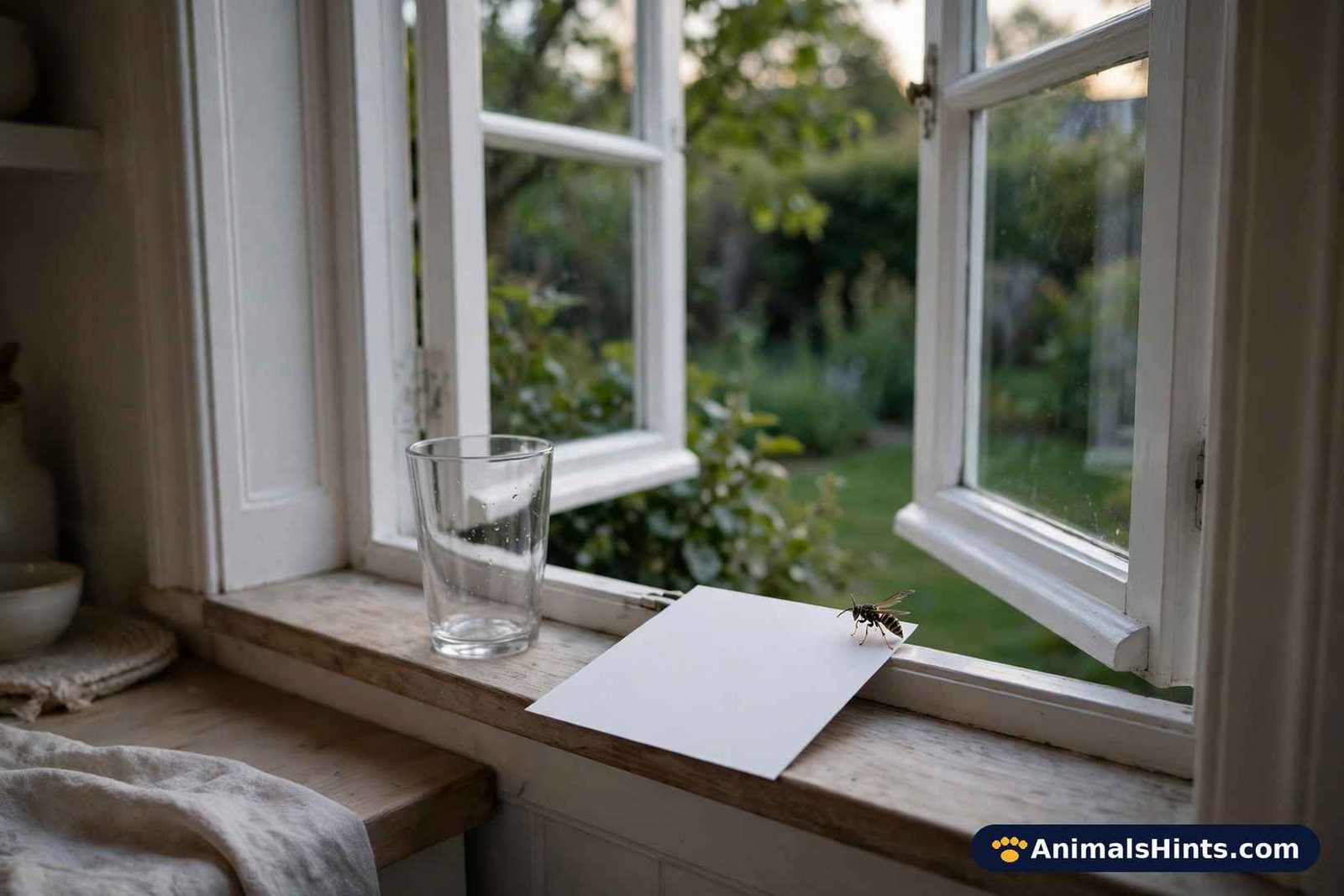
If it settles, the glass-and-card method works exactly as it does for any insect: place a glass over it gently, slide a stiff card underneath, carry it outside and release it away from the door. What not to do is swat at it. Illinois Extension’s warning is specific — a smashed or attacking yellowjacket gives off a chemical signal that draws nestmates to the fight — and even without nestmates, a cornered wasp is the one wasp likely to sting. The slow, heavy wasp at a winter window deserves the same courtesy for a different reason: she is probably a queen, and her spring colony has not been founded yet. Guiding her out loses you nothing.
A nest is a different matter from a visitor, and it changes the answer. Do not seal the hole a nest is using — wasps blocked from their entrance will find another way, often into the rooms. Do not tackle a nest in a wall void, a roof space or the ground yourself. Illinois Extension’s advice to any homeowner who is not comfortable removing a nest, or who is allergic to stings, is to hire a professional — and for nests inside the structure of a house, that advice applies to everyone.
One safety passage, at the strength of the health record and no further. The NHS describes anaphylaxis as a life-threatening allergic reaction that happens very quickly, usually within minutes of a sting, with symptoms that include swelling of the throat and tongue and difficulty breathing — and it directs anyone who thinks they or someone else is having an anaphylactic reaction to call the emergency number at once. Most wasp stings are painful and nothing more; the allergy is the exception. But it is the exception that sets the rule for nests, which is why the nest work belongs to professionals.
Final Thoughts
A wasp in the house is two events wearing one shape. In the record of the animal, it is the end of a one-year colony playing out on your windowsill: a hungry worker hunting sugar in the season’s last warmth, a nest hidden in the wall’s dark, or a queen looking for a quiet corner in which to survive the winter. In the record of the lore, it is a boundary made visible — a small, armed reminder to check the hazard, speak the irritation, hold the line and trust the first quiet alarm.
Both records agree on the response, which is rare enough to be worth noting. Pay attention. Do not panic. Open the way out, and let the visitor leave by it. The traditions that read omens into the natural world were, at their best, teaching exactly that discipline of notice — and few teachers of it are as effective, or as honest about their terms, as the yellowjacket itself.