Grey Spiritual Meaning: Symbolism, Psychology, Shades and Dreams
If you are asking what does the color grey mean spiritually, the short answer from the modern symbolism tradition is balance. Grey is the colour of the middle ground: neutrality held calmly, compromise without surrender, and the wisdom that arrives when a person stops needing everything to be black or white.
Underneath the symbolism sits an unusually honest record. Grey is the one colour with no hue at all, the shade of ash and stone and ageing hair, the robe colour of monks in two religions, and — in the Bible — the colour of the honoured head. Its meanings grew out of those facts, and they hold up better than most.
What follows is a full tour: grey’s symbolism and its psychology, the ten spiritual meanings taken in turn, the four shades, the cultural and biblical record, grey in dreams and in the animal world, and practical ways to use the colour once you understand it.

What Does the Color Gray Symbolize?
Grey symbolises the space between opposites. Every other colour takes a side — warm or cool, advancing or receding, festive or solemn — but grey stands exactly midway between black and white and refuses both. Symbolism writers read that position as neutrality, balance and hard-won calm.
The reading splits from there. Grey’s admirers point to peace, composure and reliability — the patience of stone. Its doubters point to uncertainty, emotional distance, the fog of a decision not yet made. The colour is honest enough to carry both readings at once, and which one a person meets usually depends on the season of life they are standing in.
The shade matters, and the genre is consistent about how it shifts:
- Light gray is read as understanding, diplomacy and patience — the softest form of neutrality.
- Dark gray leans toward mystery, seriousness and, at its heaviest, sorrow.
- Silver-gray is given the most spiritual reading of all: maturity touched with light, experience that has begun to shine.
Above all, grey is the colour of the pause. It is the stillness before a change rather than the change itself — the hour before dawn, the held breath between question and answer — and the tradition treats that pause as sacred rather than empty.
Why Is Grey Grey? The Colour With No Colour at All
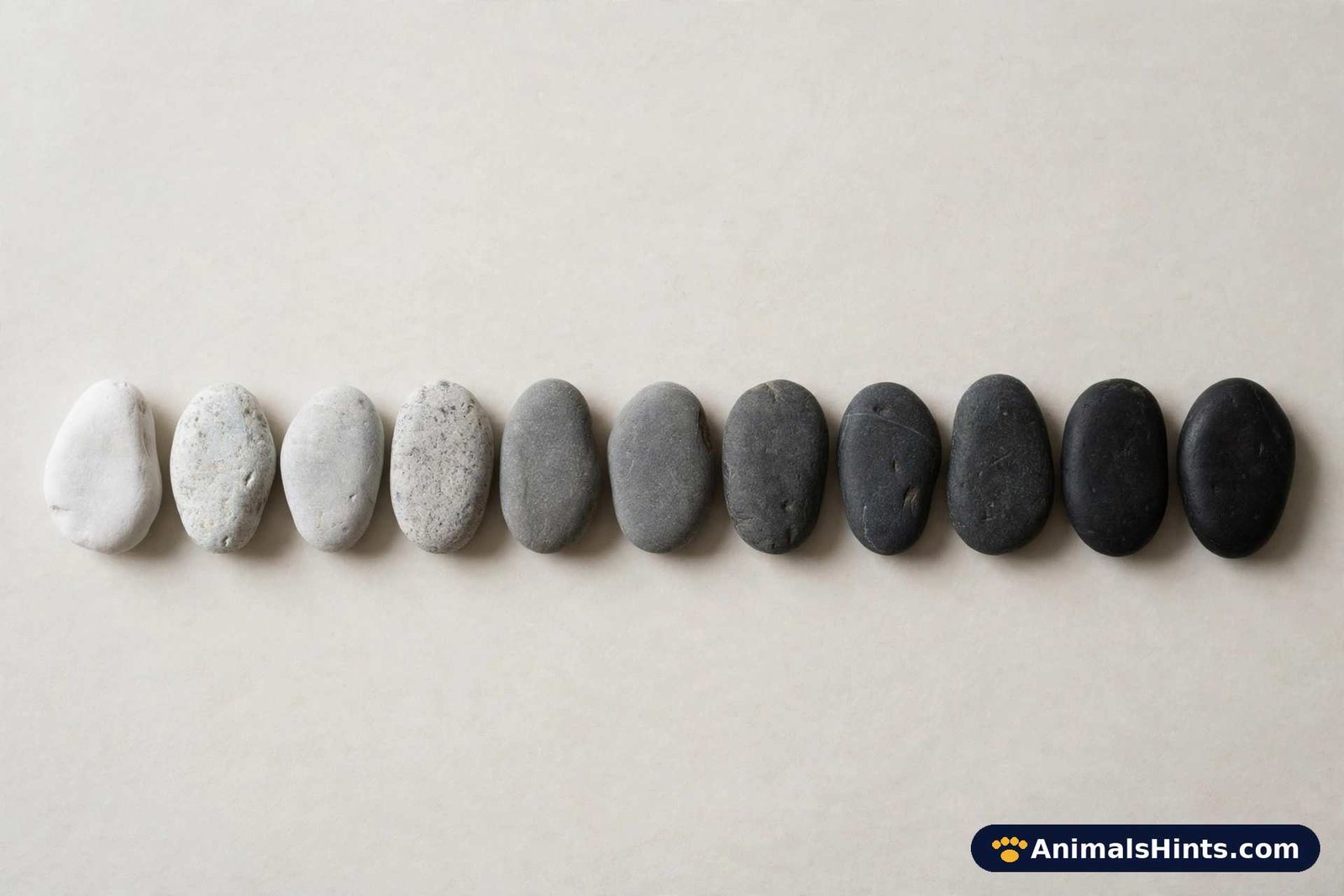
Start with the science, because grey’s science is genuinely strange. Colour scientists class grey as achromatic: the international lighting vocabulary defines an achromatic colour as a “perceived colour devoid of hue”, and names white, grey and black as its examples. A grey surface reflects every wavelength of light in roughly equal measure, so the eye receives brightness with no colour signal attached. Grey is, literally, colour with the colour taken out.
That is why grey is never a single shade but a scale. Mix black and white in any proportion and every result is grey, from the palest dove tone to charcoal — which is why the Munsell colour system arranges greys along its central axis, the spine that every hue hangs from. One end of that scale bottoms out in pure black, a colour with a long record of its own (the black spiritual meaning); grey is everything the scale holds between that darkness and the light.
Perception adds a twist: the eye judges grey only by comparison. The same mid-grey patch looks pale against charcoal and dark against snow, a quirk artists call simultaneous contrast. Grey has no fixed appearance of its own — it borrows its character from whatever surrounds it, which is precisely the quality the symbolism writers later turned into lessons about context and compromise.
Language came to grey late. When Brent Berlin and Paul Kay published Basic Color Terms in 1969, their survey of the world’s languages found colour vocabularies growing in a strict sequence: terms for dark and light come first, red follows, and grey appears only in the final stage, in the company of purple, pink and orange. English holds eleven basic colour terms, and grey is among the last of them. Humanity named the vivid colours first and found a word for the quiet one last.
And the spelling? Grey and gray are the same word, both descended from Old English græg. “Gray” is the standard spelling in American English — it is Merriam-Webster’s headword — while “grey” is standard in Britain and the Commonwealth. They name one colour, carry one meaning, and any source claiming the two spellings mean different things is inventing a distinction that does not exist. Even the King James Bible uses both forms: its translators wrote “gray hairs” in Hosea and “hoary head” elsewhere, sometimes within a few books of each other. This article uses “grey”, the spelling of the question that brought you here; the competitor and the dictionaries use “gray”. The colour does not care.
Gray Color Psychology and Personality
Colour psychology treats grey as the great calmer. In the popular reading, it lowers the emotional temperature of a room and of a conversation: it asks nothing, shouts nothing, and lets the mind slow down. People drawn to it are read as valuing logic, discretion and simplicity over display.
The genre’s standard trait portrait runs like this:
| Trait | Description |
|---|---|
| Calm | Stays composed and level when situations turn stressful. |
| Neutral | Refuses extremes and looks for the balanced position. |
| Reserved | Watches and thinks first, speaks afterwards. |
| Mature | Shows the patience and judgement that experience teaches. |
| Practical | Trusts structure, evidence and clear reasoning. |
Read that table as the genre’s portrait, not a diagnosis. Colour-preference research can show which shades people choose; it cannot certify the character of the person choosing them. What can be said plainly is that grey rarely seeks attention. Its lovers are usually described as private, dependable and loyal — people who would rather be underestimated than misunderstood.
Designers use the same facts from the other direction. Because grey carries no hue, it gives the senses nothing to react against, which is why it fills minimalist rooms and quiet workspaces. The competitor’s own caution is worth keeping: a life wrapped in too much grey can flatten into detachment and indecision. Grey steadies the other colours; it was never meant to replace them.
10 Spiritual Meanings of the Color Gray
Here is the list as the modern colour-symbolism genre gives it for grey — ten meanings, in the order the competitor prints them. They are beliefs — a tradition of reading the colour — and each is framed as such. Where a meaning touches something documented, the document is named.
1. Neutrality and Balance
The first meaning is the root of all the others. Grey sits at the exact midpoint of the scale, and the tradition reads that midpoint as a teaching: truth is rarely found at either pole. To wear, keep or meditate on grey is, in this reading, to practise seeing a situation whole before judging any part of it.
Its balance is active rather than lazy. Grey does not split the difference out of fear; it holds light and dark in one view and lets each qualify the other. The genre calls this the sacred middle ground — the place where a person can grieve without despairing and hope without deceiving themselves.
2. Compromise and Control
From balance, the list moves to conduct. Grey is the colour of the negotiated peace: the meeting where both sides leave with something, the argument that ends in understanding instead of victory. Symbolism writers are careful to separate this from weakness — in their reading, compromise is what strength looks like once it has stopped needing to win.
Control, here, means self-control. The grey temperament in the genre’s portrait answers slowly, spends emotion deliberately, and treats calm as a discipline rather than a mood. It is the diplomat’s colour precisely because it refuses to be hurried.
3. Wisdom and Introspection
Grey hair is the oldest visual shorthand for a life fully lived, and the third meaning grows straight out of it. The tradition ties grey to the wisdom that only experience can teach — the kind that has made its mistakes in private and carries the lessons quietly.
Introspection is its method. Where brighter colours push a person outward into action and company, grey turns attention inward: review the day, examine the motive, listen before speaking. The genre treats this inward turn not as withdrawal but as maintenance — the soul checking its own foundations.
4. Spiritual Growth Journey
Grey is the colour of the in-between, and the fourth meaning claims the in-between as holy ground. A person leaving an old life who has not yet arrived at the new one lives, for a while, in grey — and the tradition insists that this stretch is not a failure of faith but the road itself.
That is why grey is called the seeker’s colour. Dawn does not arrive all at once; the sky passes through grey on its way to gold. The teaching is patience: growth measured in shades, not leaps, and trust that a colourless season is still a season of movement.
5. Detachment and Humility
The fifth meaning has the strongest documentary footing on the list. Renunciation has literally worn this colour: in medieval England the Franciscan friars were known to everyone as the Grey Friars — Greyfriars — from the undyed grey-brown wool of their habits, and ash-coloured dress has signalled voluntary poverty in more than one tradition.
The detachment meant here is not coldness. In the genre’s reading, it is freedom from the need to be seen, praised or enriched — the humility of a person who has put down display the way the friars put down dyed cloth. What remains, the tradition says, is service without theatre.
6. Stability and Reliability
Stone is grey, and the sixth meaning borrows stone’s reputation. Grey is read as the colour of what does not move when everything else does: the dependable friend, the steady hand, the promise kept in bad weather. In the genre’s language, it offers emotional grounding — a floor under the feelings rather than a ride on them.
There is a quiet challenge inside this meaning. Stability, as grey teaches it, is not stubbornness; stone endures because it does not pretend to be something else. The reliable person and the reliable colour share the same virtue — they are exactly what they appear to be, in every light.
7. Diplomatic and Intellectual
The seventh meaning takes grey into the council chamber. Standing between opposing positions is the mediator’s whole craft, and the tradition reads grey as the mediator’s colour: intellect cooled by empathy, argument slowed down until both sides can hear it.
Its intellectual side is discernment — knowing which truths to speak, which to hold, and when silence is the wiser contribution. The genre links grey to fair judgement for a simple reason: a mind that has not already chosen a colour is the only mind that can weigh two of them honestly.
8. Reminder of Transience
Grey is the colour of ashes, and the eighth meaning does not flinch from it. Ash is what fire leaves; dust is what everything becomes. Symbolism writers read grey as a gentle memento mori — not a threat, but a perspective: possessions fade, emotions pass, and even grief changes its shade.
This is also where grey hair returns in its second role. The strands that arrive uninvited are, in this teaching, a built-in reminder that time is moving and that the correct response is gratitude rather than denial. What is temporary deserves more attention, not less.
9. Spiritual Detachment
The ninth meaning sounds like the fifth, and the tradition means something distinct by it: not humility before others, but release from wanting itself. In the Eastern framing the genre draws on, the detached person observes joy and sorrow arriving and departing without being carried off by either.
The documented dress of this idea is real: in Korea, Buddhist monks and nuns wear grey as their everyday colour — the grey jangsam robe — and the Jogye Order, the largest school of Korean Buddhism, formally unified its robe colours in grey in 2004. Undyed-looking, unshowy grey is chosen there precisely because it does not compete for the eye. The genre’s gloss — detachment made visible — is, for once, simply a description.
10. Mature Perspective
The list closes where grey hair began: with maturity. The tenth meaning reads grey as the perspective of someone who has stood on both sides of enough questions to stop being surprised by complexity. Absolutes, in this view, are a young person’s luxury; the mature mind works in shades because that is where the truth usually sits.
Confidence changes its sound at this stage. The genre contrasts the loud certainty of extremes with grey’s quieter authority — humility without weakness, conviction without arrogance, and the settled calm of a person who no longer needs every question closed by tonight.
Cultural and Religious Significance

Eastern philosophies give grey the middle path. In the genre’s framing, it is the visible form of the balance between yin and yang — neither force winning, both held in one view. Feng shui makes the assignment concrete: in that system, white, grey and silver belong to the Metal element, tied to the west and northwest, to autumn, and to clarity, precision and focus. A grey room, in feng shui terms, is a Metal room — orderly, exact, and meant to be warmed by other elements so it does not turn cold.
Western traditions dress grey for modesty and formality. It is the colour of the sober suit, the stone courthouse and the undyed habit; the West reads it as seriousness without splendour, authority that does not need to announce itself. Where bright colours celebrate, grey officiates.
In spiritual practices, grey is tied to ageing read as ascent. The silvering head is treated across many cultures as a credential — visible evidence of years survived and lessons banked — and grey’s spiritual reputation leans heavily on that universal respect for the elder.
In Buddhism, the grey robe is documented fact in Korea, as the detachment meaning above describes: grey chosen for monastic dress because it renounces display. The competitor’s broader claim that grey robes appear across Buddhism generally should be read carefully — saffron, maroon and brown are far commoner in the wider Buddhist world; grey is specifically the Korean monastic colour.
In Christian art, grey and ash tones belong to penitence: the grey-brown of sackcloth, the ash smudge of Ash Wednesday, the undyed wool of friars. Grey is what repentance wears when it wants no decoration — a use the Biblical section below traces to its texts.
For many indigenous cultures, the competitor offers grey as the colour of smoke rising between the physical and spiritual worlds. Smoke does carry prayer in a number of Indigenous traditions of North America — that much is widely documented — but the colour reading itself is the symbolism genre’s gloss, offered here at that strength and no stronger: a modern interpretation laid over a real and older practice.
The Shadow Side of Grey: Dullness, Indecision and the Grey Area
Every colour in this family carries a shadow, and grey’s is written into everyday speech. A grey day is a dull one; a grey mood is a flat one; a grey personality, in the cruel idiom, is one nobody remembers. The genre itself concedes the point: the same neutrality that steadies can, in excess, anaesthetise — calm curdling into detachment, patience into drift.
Language preserves the other shadow in the phrase grey area: a question with no clear rule, where honest people can land on different answers. It is worth noticing that the idiom is not an insult. A grey area is not a failure of the rules; it is the normal condition of real life, and grey’s tradition is the only one that names it without embarrassment.
Two honest limits belong in this section. First, grey holds no place in the modern seven-chakra system — the rainbow scheme taught today assigns red through violet, and grey is simply not among them; writers who give grey a chakra are adding their own layer. Second, grey’s meanings are modern symbolism, not ancient doctrine: no scripture and no classical text hands down a colour code for grey, which is why this article keeps coming back to the places grey genuinely appears — hair, ash, stone and cloth.
Shades of Gray and Their Symbolic Meanings
The competitor prints the shades as a table, and the table is kept — shade names verbatim, the readings condensed faithfully:
| Shade | Symbolic Meaning |
|---|---|
| Light Gray | Clear thinking, compromise and a calm mind; neutral ground where disputes settle quietly. |
| Medium Gray | Steadiness, experience and reflection; the tone of a decision weighed properly before it is made. |
| Dark Gray | Mystery and secrecy; deep inward thought, at times touched by sadness or heaviness of mood. |
| Silver Gray | Awakening and higher awareness under a protective light; the shade the genre ties to the moon and to intuition. |
Read down the table and a pattern emerges: the lighter the grey, the more the genre trusts it with clarity, and the darker it falls, the more the reading turns inward. Silver grey breaks the pattern on purpose — it is the one shade allowed to shine, and the tradition reserves its most luminous language for it: moonlight, intuition, awakening. The prose beneath his table makes light grey the hope inside neutrality and dark grey the inward work before renewal, and that pairing — hope at one end, homework at the other — is the shades system in a single sentence.
Grey in the Animal World: Herons, Wolves and a Parrot With a Scarlet Tail

Animals wear grey for the opposite reason people read meaning into it: not to symbolise, but to disappear. The grey heron is named for the fact twice over — its Latin name, Ardea cinerea, means the ash-grey heron — and its plumage is ashy grey above and greyish-white below, with a white head and a black crest. Standing motionless in grey water under a grey sky, it is close to invisible, which is the entire point.
The grey wolf’s grey is not a pigment but a mixture. A “grey” wolf’s coat is built from thousands of banded guard hairs — black, white, brown and grey hairs side by side, many of them striped light and dark along their length by the agouti pattern — and the eye blends the mixture into grey at a distance. Nature’s most famous grey animal is, on inspection, every colour at once, which the symbolism writers could hardly have invented better.
And then there is the exception that proves the rule. The African grey parrot wears scalloped grey plumage over its whole body — and a tail of bright, unmistakable red. Britannica notes the bird is “named for its distinctive scalloped gray plumage” and that “the tail feathers are bright red”. The grey is the camouflage and the character; the red is the signature. (The species has been listed as Endangered since 2016, a fact worth more than any symbolism attached to it.)
What is the Biblical Meaning of the Color Gray?
The Bible’s grey is not a colour swatch; it is hair and ash, and the texts are specific. The competitor quotes Proverbs 16:31 in a modern translation — “Gray hair is a crown of glory; it is gained in a righteous life”. The King James wording, verified word for word, is older and sterner: “The hoary head is a crown of glory, if it be found in the way of righteousness” (Proverbs 16:31, KJV). The honour is conditional — glory attaches to grey hair found in the way of righteousness, not to age alone.
The command behind the proverb stands in Leviticus: “Thou shalt rise up before the hoary head, and honour the face of the old man” (Leviticus 19:32, KJV). Grey hair, in the Bible’s own handling, is a claim on the respect of everyone younger — the one place where this colour is given something like a doctrine.
The record is not all honour. Hosea uses the same image as a warning — “gray hairs are here and there upon him, yet he knoweth not” (Hosea 7:9, KJV), ageing arriving unnoticed on a nation that will not see itself — while Isaiah hears God’s promise run in the opposite direction: “even to hoar hairs will I carry you” (Isaiah 46:4, KJV). And grey’s other biblical form is ash: Job, repenting, says he does so “in dust and ashes” (Job 42:6, KJV), the grey residue of burning becoming the Bible’s dress for humility.
One correction belongs here. The competitor adds that grey signifies “the middle ground between sin and purity” in biblical interpretation. No verse says that; it is a modern gloss laid over the texts, and it is printed here labelled as gloss. What Scripture actually gives grey is better: respect for age, a warning against unnoticed decline, and the ashes of repentance.
Dream Interpretations of the Color Gray
Dream lore is folklore — there is no fixed dictionary, and the competitor’s four readings are printed as the genre’s, in his order:
- Emotional balance: Grey scenery or objects are read as the mind asking for peace — a wish to step back from emotional turbulence into neutral ground.
- Uncertainty or indecision: A grey sky, fog or mist is the classic image of a matter not yet decided, clarity still on its way.
- Wisdom and maturity: A grey-haired figure is read as a guide — an ancestor, an elder, or the dreamer’s own older and wiser self.
- Protection and neutrality: Wearing grey in a dream is read as the wish to pass unnoticed, protected by not standing out.
Notice how faithfully the dream list repeats the waking one: balance, a pause before decision, the elder, the wish to blend in. Grey dreams, in the genre’s telling, are simply grey’s whole character appearing at night — which is a reason to read them as the mind using a familiar symbol, not as messages with a key.
How to Use Grey’s Meaning in Everyday Life

Begin where feng shui begins: grey belongs to rooms that need clarity. A grey study or workspace is the Metal element at work — focused and uncluttered — and the tradition’s own advice is to warm it: timber, lamplight, and living green. A single plant does double duty there, setting grey beside the colour of growth itself (the green spiritual meaning).
Dress with the same intent. Grey clothing is the genre’s recommendation for decision days — negotiations, difficult conversations, any room where being the calmest person present is an advantage. It signals the mediator before you say a word.
For reflection, use grey the way the meanings suggest: as a pause, not a residence. Sit with the undecided question a little longer instead of forcing it black or white; let a journal page stay unresolved overnight. Grey’s whole teaching is that the middle of a decision is a place, and it can be occupied peacefully.
Pair it deliberately. Grey is the great supporting colour: it deepens beside the warmth of the red spiritual meaning when red is held in reserve for accents, and it glows against the richness examined in the gold spiritual meaning. Used as the ground rather than the statement, grey makes every other colour in the room more itself.
Final Thoughts
What makes grey’s symbolism believable is that nobody invented it in an armchair. It accreted around real things — ash after a fire, stone, undyed wool, hair after a lifetime — and the genre’s language of humility, transience and maturity is those things described a second time, in the vocabulary of the spirit.
That grounding is worth insisting on, because it separates this colour’s record from pure invention. Friars really were called Greyfriars for the colour of their habits. Korean monks really did standardise their robes on grey. A heron really does carry “ash-grey” inside its Latin name. The meanings came afterwards, and they stay believable exactly as long as they stay attached to the facts.
It is fitting that grey’s plainest fact is also its neatest summary. Colour science files this shade as achromatic — possessed of no hue at all — and yet no colour carries more meanings per inch of spectrum. Grey never needed a hue. It had the middle of everything, and it made the middle a meaning of its own.
Frequently Asked Questions
What does the color gray symbolize spiritually?
Spiritually, grey symbolises balance, neutrality and wisdom — the middle path between extremes. The tradition also reads it as maturity, patience and the calm of a mind that can hold two sides of a question at once.
How does gray affect our psychology?
In colour psychology, grey is read as calming and steadying: it lowers emotional temperature and supports clear, unhurried thinking. Too much of it, the same tradition warns, can flatten into dullness or detachment, so it works best balanced with living colour.
What does liking gray say about your personality?
In the genre’s portrait, grey lovers are calm, reserved and practical — people who value balance over drama and think before they speak. Treat that as the tradition’s sketch, not a diagnosis; a favourite colour describes taste, not character.
How can I use gray’s spiritual meaning in my life?
Use grey where calm judgement is wanted: a grey workspace for focus, grey clothing for difficult conversations, and grey as a deliberate pause before big decisions. Pair it with warm or living colours — a plant, a lamp, one bright accent — so its steadiness never turns into flatness.