Blue and Black Butterfly Meaning: 12 Meanings, Cultures, Dream Signs and Omens
The blue and black butterfly spiritual meaning is, in the traditions that read butterfly signs, transformation with peace inside it: the black speaks of mystery, protection and an ending that has finished its work, while the blue speaks of truth, calm and a voice finding its way out. Held together on one wing, the pairing is read as a change that does not have to be feared.
Either colour alone carries a simpler message. The combination is rarer to meet and richer to read, because its two halves pull in different directions — one toward the dark, one toward the open sky — and the traditions treat that tension itself as the meaning: grief and healing, ending and voice, carried by a single insect.
Below you will find the tradition’s twelve meanings for this pairing, what cultures and faiths have made of it, what a landing, a love reading or a dream of one is taken to mean, and whether the sign counts as a good or a bad omen. Because this pairing also belongs to real animals, the page ends with the actual blue and black butterflies you may have met — and with how their impossible blue is made.

What Does a Black and Blue Butterfly Represent?
At its heart, this butterfly represents change that arrives through the dark rather than around it. Most colour signs in the butterfly file promise brightness; this one promises company — a guide-colour for the stretch of a transformation where nothing has opened yet and the old shape is already gone.
The dark half of the wing is the half readers reach for first. In the symbolism kept for the colour on its own — our guide to the black spiritual meaning — black carries mystery, protection and the fertile dark in which things are quietly remade. On a butterfly it also carries the night side of metamorphosis itself: the chrysalis hours, when the insect is neither what it was nor what it will be.
Blue brings the opposite weather. The blue butterfly meaning by itself runs bright and serene — calm, honesty, a spirit at ease — and set against black it keeps that lift while losing the lightness. This is truth spoken out of a hard season rather than an easy one, which is why readers so often meet the pairing at funerals, diagnoses, partings and other thresholds, and report that it felt less like decoration than like accompaniment.
The competitor summaries of this pairing usually settle its message into four lines, and they are worth keeping as the short version:
- Healing after hardship. The wound is not denied; it is simply no longer the whole story.
- Spiritual awakening. A waking that happens because of the dark stretch, not in spite of it.
- Divine communication. A message-colour set on a messenger-insect — the sign readers watch for when they have asked for one.
- Protection through transformation. The dark reads as a guard around the change while the change is still tender.
Modern chakra teaching files blue under the throat, the centre of speech, so a blue-marked butterfly is often read as a nudge about something unsaid. File that mapping as today’s vocabulary rather than ancient fact: the tidy rainbow ladder of chakra colours is a recent arrangement, however old the chakra idea’s own roots run.
The Real Blue and Black Butterflies Behind the Symbol
No species is actually called “the blue and black butterfly.” The pairing is a pattern, and unrelated species in different families wear it — which is why the first honest question about any sighting is not what it means but what it was. In most of North America, the odds-on answer is a single famous insect.
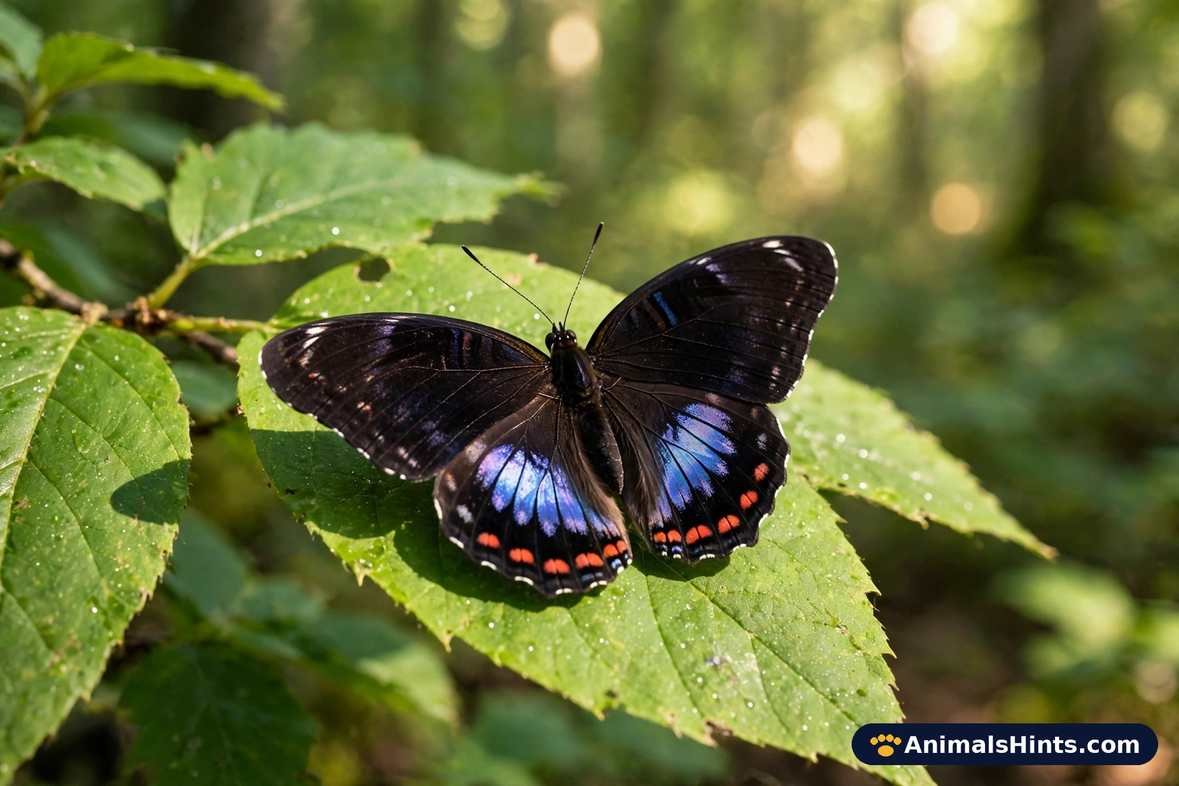
That insect is the pipevine swallowtail, Battus philenor — a butterfly so identified with this pairing that it is also called the blue swallowtail. The University of Florida’s Featured Creatures profile gives a wingspread of 2¾ to 5⅛ inches (72 to 132 mm): the males mostly black with blue to blue-green iridescence spread across the hindwings, the females wearing the same pattern a shade duller. See one from underneath, in a photograph, and the hindwing shows the same blue wash plus a single row of seven bright orange spots.
The pipevine wears those colours honestly. Its caterpillars feed only on pipevines (Aristolochia) and keep the plants’ aristolochic acids stored in their bodies, which leaves larvae and adults alike poisonous to birds that try them — the flash of blue is a truthful warning, not a bluff. The butterfly has become the model of a mimicry ring: the spicebush swallowtail and the dark female eastern tiger swallowtail copy its dress without carrying its poison. One plain note, because pipevine chemistry is sometimes romanticised online: aristolochic acid is a documented toxin, pipevines are wildlife plants rather than remedies, and nothing in this butterfly’s beauty invites handling or eating any part of the plant.
Its most convincing double is the red-spotted purple, Limenitis arthemis astyanax: black above, with broad iridescent blue patches across the hindwings and a wingspread of 3 to 3½ inches by the University of Florida’s measure, while the orange spots its name advertises sit mostly on the underside. It carries no tails — the quickest field mark against the true swallowtails — and the University of Florida classes it as a Batesian mimic of the pipevine. You meet it along woodland edges and park paths from Florida and Texas north to New England and Minnesota.
Florida keeps the family’s jewel. The atala, Eumaeus atala, is the largest and most iridescent hairstreak in the southeastern corner of the state. Folded, its wings read deep black pricked with three curved rows of ultramarine spots; opened, the male flashes an iridescent Caribbean blue and teal-green while the female wears royal blue across the forewings, and both carry a bright red-orange abdomen. Its caterpillars feed on coontie, Florida’s only native cycad, and store that plant’s toxin cycasin, so the atala is chemically defended at every stage of its life. When coontie was dug wholesale for its starch, the butterfly was pushed close to disappearing; it has returned wherever gardeners plant coontie again, and it now holds settled colonies across Palm Beach, Broward and Miami-Dade counties.

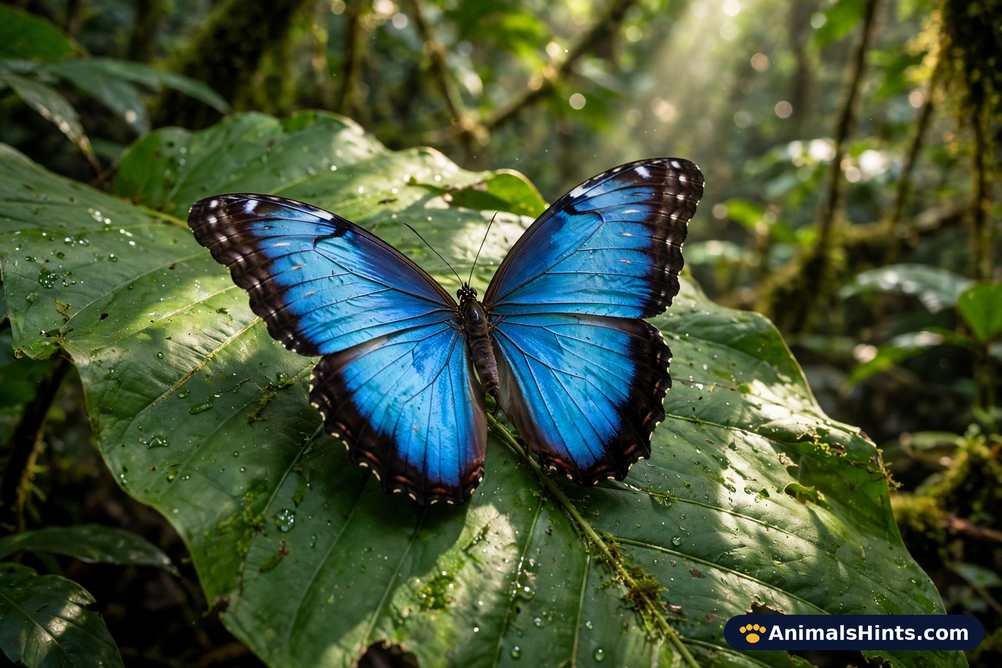
The butterfly in every coffee-table book is the blue morpho, Morpho peleides, of tropical America — and honesty requires a footnote to its fame. Open, it is everything the pairing promises: five to six inches of electric blue closed in a black edge, among the largest butterflies in the Americas. Closed, the same insect is plain brown, its underside carrying eyespots instead of brilliance. The morpho is therefore blue and black only from above, and in flight it strobes — blue, brown, blue, brown — as the wings open and shut, a vanishing act built into the signal itself.
At the other end of the scale sits the eastern tailed-blue, Cupido comyntas, which state field guides put at 0.8 to 1.1 inches across. Males show an iridescent lilac-blue above inside a narrow dark border; females wear grey-brown warmed by a blue wash at the wing bases, the spring females the bluest of all. If the blue and black butterfly in your photograph is tiny, low and busy over clover, it is probably this one — a blue with a dark edging rather than a true blue-and-black, and none the less a real meeting for that.
What makes the pairing possible at all is that its two colours are produced by opposite machinery. The black is a pigment, melanin laid down in the scale. The blue, in nearly every butterfly that wears it, is not a pigment of any kind — it is architecture. Microscopic ridges and layered shelves inside the scale split daylight and throw the blue wavelengths back at the eye, which is why these blues slide toward green as the wing tilts, and why a morpho’s wing, ground to powder, comes out brown: there was never any blue substance in it. Hold that fact; it earns a second mention near the end of this page.
12 Spiritual Meanings of Seeing Black and Blue Butterflies
The tradition’s list for this pairing runs to twelve, and it circles its great themes — change, healing — more than once. Those repetitions are kept and read honestly below rather than smoothed away, because what a tradition repeats is usually what it most wants said.
1. Change and Transformation
This is the headline reading, the one every summary of the pairing leads with. A butterfly is the standing emblem of metamorphosis, and this colouring lets the wing carry both chapters of the story at once: the black of the form that has been left behind, the blue of the open air the new form rises into.
Readers who meet one mid-upheaval — a move, a divorce, a career ending — tend to take it as a progress report rather than a promise: the change is not coming, it is underway, and the dark part of it is a stage and not the destination.
2. Embracing the Unknown
Black is the colour of the unlit stretch of the map, and blue is the colour of staying calm inside it. Together they form the tradition’s counsel of trust: walk into the part of your life you cannot yet see, without demanding that the whole route be lit before you take the first step.
The sighting is read this way most often at thresholds — the night before the results, the week before the move — when the unknown is not an idea but the actual weather, and the butterfly’s calm dark reads like company for it.
3. Wisdom, Imagination, and Inner Power
Blue has always carried the mind’s file in this symbolism: wisdom, imagination, the inner eye. Set into black, that file gains depth — this is not the wisdom of the library but of the well, knowledge that has been underground a while and come up changed.
The reading flatters nobody. It suggests the seer already holds the answer they are circling, down in the dark part of their own knowledge, and that imagination — the blue faculty — is the rope to draw it up with.
4. Symbol of Mystery and Depth
Some signs arrive pre-explained; this one does not. The pairing is the tradition’s emblem of mystery itself — of truths that sit below the surface of a life, visible only as a dark wing with light moving inside it when the angle changes.
Read as an omen, it counsels respect rather than solution: not everything you meet is a puzzle with your name on the answer. Depth is an invitation to look longer, not a threat and not a lock.
5. Peace and Healing
Here begins the tradition’s healing file, and its first tense is comfort: calm arriving while circumstances are still dark. The blue does not wait for the black to leave before it appears; it appears inside the same wing, which is exactly how readers in hard seasons describe the first hour of peace they get.
If you met this butterfly in a hospital corridor’s garden, a cemetery, a rehab’s courtyard — the places readers most often report it — the tradition’s gloss is gentle: healing has started, and it is allowed to start quietly.
6. Spiritual Rebirth and Awakening
Awakening readings cluster around the pairing because its colours stage the event so neatly: the black is the fallow period — the illness, the grief, the years of sleepwalking — and the blue is the first colour of the return, the morning the world looks rinsed.
The tradition distinguishes this from plain change. Change alters your circumstances; awakening alters the one who meets them, and readers who claim this meaning usually date something from the sighting — a practice begun, a forgiveness finished, a life quietly re-founded.
7. Hope and Joy
Blue’s lift inside black’s frame makes this the tradition’s emblem of earned hope — hope that has evidence, not hope that has merely been told to cheer up. The joy in this pairing is a survivor’s joy, and it reads the more credible for the dark it keeps beside it.
Readers claim this meaning most often when the sighting lands on an ordinary good day after a run of bad ones: less a prophecy than a permission slip, signed in two colours, to enjoy the weather while it holds.
8. Protection and Divine Guidance
On the real insects, this colouring is a guard: the pipevine’s blue-black flash tells predators the truth about poison, and keeps the butterfly safe by being believed. Readers extend the biology into the symbol, and take a sighting as a guarded journey — protection that works the same way, by honest signalling rather than by hiding.
As guidance, the pairing is read as the crossroads sign: not an arrow, exactly, but a confirmation that the dark turning, the one that frightens you, is the watched-over one.
9. Trust in the Spiritual Journey
A butterfly does its waiting in a chrysalis, sealed and dark, on no schedule it can read — and the whole of this meaning hangs on that fact of its life. The pairing trusts the process out loud: transformation that cannot be hurried from outside, and cannot be watched from inside either.
Readers mid-way through long, structureless stretches — recovery, grief, a vocation forming — take this sighting as the tradition’s pat on the wall of the chrysalis: the darkness is not evidence that nothing is happening. It is where the happening is stored.
10. Healing and Peace
The tradition gives this butterfly healing twice, at the fifth meaning and again here, and the repetition deserves reading rather than editing. The fifth was comfort arriving; this one is peace staying — the difference between first aid and convalescence, between the first quiet hour and the first quiet month.
Taken together, the pair suggests the tradition thinks healing has stages and wants both on the record: the crisis shade of it, and then the slower, bluer work of becoming someone who lives after the crisis, at peace in a life the black is still part of.
11. Transformation and Rebirth
Transformation appears twice on this list as well, and the second visit is the completion of the first. Meaning one was the door — change begun, the old form cracking. This one is the room beyond it: rebirth, the state of being someone the old life would not have predicted.
The distinction matters to readers who are tired of beginnings. A sighting claimed under this meaning is usually reported from the far side of the change, by someone looking back at the dark stretch and finding, to their surprise, that they would not hand the new wings back.
12. Inner Power and Confidence
The list closes on the seer. Inner power, in this pairing’s dialect, is quiet: the butterfly does not roar, does not sting, does not hide — it carries an honest signal in beautiful colours and lets the signal do the work. Confidence read from it is the same kind, power that does not need an audience.
And because blue is the throat’s colour in the modern teaching, the confidence is specifically vocal: the power to say the true thing, in your own voice, at the volume it deserves. Readers who meet the pairing before a hard conversation tend to need no further interpretation.
Significance in Cultures, Religions, and Mythologies
1. Native American Symbolism
Across many Native American traditions, butterflies carry transformation, joy and the travelling of the spirit, and blue — the colour of sky and deep water — is read in several tellings as the colour of the spirit world itself. Black complicates the file honestly: in some strands it is tied to death and mourning, in others to the fertile dark of earth and night.
What cannot responsibly be claimed is a single tribal emblem for this exact pairing; no documented one exists at that precision. The blue-and-black reading in Native American terms is what the two colour-files add up to inside a broader butterfly symbolism — a spirit-sign travelling between the world of the living and the world above it — and it is stronger, not weaker, for being stated at that honest level of generality.
2. Chinese and Japanese Symbolism
In Chinese tradition the butterfly stands for joy, summer, longevity and love, and its most famous story is a love story: the Butterfly Lovers, Liang Shanbo and Zhu Yingtai, kept apart in life and reunited after death as a pair of butterflies — the tale that fixed the butterfly as love’s emblem across Chinese art. A butterfly wearing light and dark together reads, in that tradition’s balance-minded eye, as harmony held inside one creature: joy that knows sorrow, love that has survived separation.
Japan gives the butterfly a soul. In Japanese folklore, recorded for Western readers by Lafcadio Hearn among others, a butterfly may be the spirit of a living person, or of someone recently dead and visiting. A dark-and-blue visitor in that telling is a soul in transit between states — still wearing the shadow of where it has been, already lit with where it is going.
3. Greek and Roman Mythology
Greek holds the oldest and neatest fact on this page: the word psychē did duty for both “soul” and “butterfly,” and Greek art gave Psyche herself — the soul personified, beloved of Eros in the tale Apuleius tells — a butterfly’s wings. The insect that leaves the chrysalis behind became the Mediterranean’s picture of the soul leaving the body, and the image passed into Roman art, where butterflies appear as emblems of the soul in funerary carving.
A blue-and-black butterfly fits that old file almost too well: the soul figured as a dark wing carrying an unearthly blue, the light of the upper world moving inside the dark that the body returns to.
4. Christianity
Begin with the plain fact: no butterfly appears anywhere in Scripture, so there is no verse about one to quote, for this pairing or any other. What Christianity has is a teaching tradition built after the text — the caterpillar, the sealed chrysalis and the winged insect preached for centuries as a picture of death, burial and resurrection, the most famous nature-sermon in the faith’s folk repertoire.
Within that tradition, the blue-and-black pairing is read by modern believers as faith carried through a dark season into light: the black of Good Friday’s sky, the blue of the morning heaven. That is a devotional reading, sincerely held and honestly labelled — it is the church’s later teaching voice, not a line of the Bible, and the distinction is what keeps the reading trustworthy.
What Does It Mean When a Black and Blue Butterfly Lands on You?
It means, first, something unromantic and rather nice: butterflies land on people for the salts and minerals in sweat, for warmth, and out of plain curiosity, and a blue morpho or a pipevine that chooses your sleeve is usually shopping, not signalling. Let it stay as long as it likes and leave when it likes; a butterfly’s wings are powdered with tiny scales, and the oils on a fingertip are enough to spoil them, so admire it hands-off.
Within the sign tradition, though, a landing is the closest contact the butterfly file offers, and this pairing’s landing is read four ways:
- A message of comfort and reassurance. The healing meaning, delivered by hand — reassurance that does not keep its distance.
- Confirmation of your spiritual path. The sign lands on the person mid-journey, read as a stamp on the route already chosen.
- A reminder to communicate honestly. Blue is the throat’s colour; a landing near the face or shoulder is read as the unsaid thing asking, politely, to be said.
- An ancestral visit. In the strand of the tradition that treats butterflies as the travelling dead, a landing is a visit rather than a sighting — someone checking in, briefly, in person.
The general question of landings has its own full treatment in our guide to what it means when a butterfly lands on you; this page’s narrower claim is about the colours. A blue butterfly landing reads as delight; a black one, to some, as a shadow passing. The pairing lands as neither — it lands as comfort with truth inside it, which most readers, afterwards, say is what they needed.
Black and Blue Butterfly Symbolism in Love and Twin Flame
In love readings, this pairing is the grown-up entry in the butterfly file. Its four themes, in the tradition’s usual order:
- Emotional Healing. Love after damage — two people, or one person re-entering love, carrying the dark wing openly instead of pretending it was never torn.
- Spiritual Connection. The blue file’s soul-recognition, deepened: a bond read as existing at the level of the spirit, not only of circumstance.
- Transformation Through Love. The relationship as chrysalis — the pairing’s central claim, that the right love does not merely accompany your change but causes it.
- Rebirth of Passion. The second-transformation theme wearing evening dress: desire returning after a fallow stretch, in a form the first version would not recognise.
The twin-flame framework that often hosts these readings is a modern one, and inside it the pairing has a precise job: twin flames are described as two halves of one soul, a light half and a shadow half, and a blue-and-black butterfly is read as the emblem of the reunion stage — the moment the dark half and the bright half stop taking turns and fly as one creature. Treat the whole file as the tradition’s map of how love feels from inside, which is what it is good at, rather than as a forecast, which is not a power any butterfly has ever demonstrated.
Seeing a Black and Blue Butterfly in a Dream
1. Emotional or Spiritual Healing
The commonest dream reading, and the gentlest: the sleeping mind rehearsing repair. Blue laid over black, in the dream file’s colour logic, is calm laid over grief — the dreamer is pictured mid-mending, and the butterfly’s calm flight is the felt sense of the mending working.
2. Transformation of the Soul
A chrysalis dream with wings already on it. Where the waking sighting marks change in circumstances, the dream version is read one level down, as change in the soul itself — the deep self discarding a form it has outgrown, in the one theatre where such events can be watched directly.
3. Message from a Loved One
Many readers take a dream visit literally, especially when the butterfly behaves like a visitor — arriving, attending, departing — and especially in the first year of a bereavement. The tradition supports them, and this page simply records the reading with respect: whether the visitor was a messenger or the mind’s own kindness, the comfort drawn from such dreams is real, and regularly reported.
4. Intuition Awakening
Blue’s file again, at night: the intuition stirring. Dream readers gloss this pairing as the inner voice clearing its throat — a truth the dreamer already knows, surfacing in costume. If the dream has a sentence attached to it when you wake, the tradition’s advice is to write the sentence down before the day edits it.
A closing honesty, owed on every dream page: the tradition owns these readings, and none of them is a diagnosis. A single vivid dream is a story the night told; a dream that returns and troubles you deserves a waking conversation — with a doctor, a counsellor or a trusted friend — and not only a symbol book.
Black and Blue Butterfly: Good or Bad Omen?
Why It’s a Good Omen
By weight of evidence inside the tradition, the verdict is not close. Every strand of this pairing’s file leans favourable: healing twice, transformation twice, protection, guidance, rebirth, hope. Black butterflies elsewhere in the file carry the ambivalence; blue’s calm, laid across the black on the same wing, settles the question for most readers before it is asked. A sighting is filed as a good omen — specifically, the good omen of people in transit, the encouragement issued to travellers between a life that has ended and one still assembling.
When It Might Feel Like a Warning
The warning reading exists and should be stated fairly: black’s older file includes death and endings, and a reader in a frightened season may meet this butterfly as a shadow first and a sign second. In the tradition’s own handling, though, the warning is never a doom — it is an alert about resisted change, a suggestion that the transformation being avoided is the one the wings are advertising.
And the standing honesty of this site applies to the whole question: an omen is a reading practice, not a mechanism. The butterfly is not causing or reporting events. What the tradition offers is a way of paying attention — and a blue-and-black butterfly, attended to properly, mostly teaches its readers that the dark they are in has colour moving inside it.
Where and When You Are Most Likely to See One
Start with the pipevine swallowtail, since it accounts for most North American sightings. It flies wherever its caterpillar’s food grows — woodland edges, stream banks, old fields and gardens across the eastern and central United States and in California’s pipevine country — on the wing from late winter in the far south (February into March in California) through autumn, in brood after brood. Walk a sunny edge mid-morning, when the wings have warmed, and look for a large dark swallowtail whose hindwings catch fire-blue as it turns.
The red-spotted purple keeps similar hours in shadier places: woodland edges, trails, orchards and parks, late spring through autumn, often down at damp ground taking minerals. It is the blue-and-black butterfly of the forest interior, where the pipevine prefers the sunny margins.
The atala asks for a Florida postcode: year-round in the frost-free southeast of the state, and intensely local, holding to colonies that stay within a short flight of the coontie plantings its caterpillars need — a neighbourhood butterfly, findable street by street once you know which gardens feed it. The blue morpho, by contrast, belongs to the forest understory of tropical America and flies all year there; everywhere else in the world you will meet it in a butterfly house, which is a fine place to study the strobe effect at close range. The eastern tailed-blue works the low shift everywhere else: lawns, meadows and clover patches, spring to fall, always near the ground.
How This Pairing’s Meaning Differs From the Other Butterfly Colors
Colour pairings in this family each seem to put a question to the reader, and the questions are the quickest way to keep the files apart.
A white butterfly — the subject of our guide to the white butterfly’s meaning — asks about purity and peaceable partings; its file is the gentlest on this site, and carries the departed at their most serene. A brown butterfly, treated in our brown butterfly meaning, asks about ground: endurance, home, the unglamorous strengths, the earth the caterpillar came from. A green butterfly, the subject of our green butterfly meaning, asks about growth — renewal in the growing season’s own colour, luck that is still leafing out rather than ripe.
The nearest neighbour needs the most care. An orange and black butterfly, the subject of our orange and black butterfly meaning, wears warning and fire: the monarch’s honest poison signal, read as integration of the bright and dark selves. Plain orange, kept in our orange butterfly meaning, asks about appetite and joy. The blue-and-black pairing shares the black wing with the orange one and nothing else: where orange-and-black faces outward, all signal and boundary, blue-and-black faces inward, all tide and undertow.
Its own question, the one readers report hearing from it, might be put this way: what is the dark in you protecting, while the blue in you learns to speak?
How to Welcome Blue and Black Butterflies to Your Garden
Butterflies are won at the caterpillar stage, so a blue-and-black garden is planted backwards, starting with food for insects you will not see fly for months.
For the pipevine swallowtail, plant a pipevine — and plant it by its Latin name, with local advice, because the documented catch matters: some tropical pipevines sold for their huge showy flowers, the Dutchman’s pipe of the garden centres, can poison this butterfly’s caterpillars, while the regional native species are the food it evolved with. Florida gardeners planting for the atala plant coontie, the butterfly’s whole world in one slow, handsome cycad. The red-spotted purple raises its young on the cherry and willow family — wild black cherry and willows are its nursery trees, which is one more argument for leaving a wild corner un tidied. The eastern tailed-blue asks least: clovers and vetches, the legumes its caterpillars eat, already live in most lawns that are not sprayed into submission.
Then feed the adults — coneflowers, thistles and milkweed-class blooms in a sunny, sheltered run — skip the insecticides entirely, since a garden cannot poison selectively, and leave one edge unmown for the pupating and the puddling. The caterpillars themselves, the price of every butterfly on this page, have their own file in our guide to the caterpillar’s spiritual meanings; a garden that welcomes the wing has to sign for the worm as well.

Final Thoughts
Taken whole, the tradition’s message in this pairing is unusually consistent: change, carried with honesty. The black refuses to pretend the hard season is not dark; the blue refuses to call the darkness the end of the story; and the butterfly — an animal that has literally been a different creature twice — delivers both refusals in a single glance.
The animal itself keeps the same counsel. Its black is honest chemistry, worn by a genuinely poisonous insect as a true advertisement. Its blue is not a colour it possesses at all — it is structural coloration, daylight rebuilt by the microscopic architecture of a scale, a colour made of arrangement rather than substance. There is a fittingness in that which the tradition could not have invented better: the sign readers take for hope after hardship turns out, under a microscope, to be exactly what it preaches — no new material, just the light you already had, rearranged until it shines blue.
FAQs
What does a black and blue butterfly symbolize spiritually?
Transformation carried through a dark season into truth and calm: the black stands for mystery, protection and the ending of an old form, the blue for healing, honest speech and peace. It is read as the sign of change that does not have to be feared.
What does it mean when you see a black and blue butterfly?
In the tradition, an encouragement sighting — healing underway, a guarded journey, a change already in progress. In the field, it usually means a pipevine swallowtail, a red-spotted purple or, in Florida, an atala is working its patch, and the meaning you take from the meeting is yours to keep.
Is a black and blue butterfly a sign of spiritual healing?
Yes — it is the pairing’s most repeated reading, appearing twice in the tradition’s own list of twelve meanings: comfort arriving while life is still dark, and then peace staying as the slower healing completes. No other butterfly colouring on the file carries the healing theme twice.
How can I work with the energy of a black and blue butterfly?
The tradition’s practical answers are modest ones: name the change you are in instead of resisting it, say the unsaid true thing the blue half points at, keep one honest signal — a boundary, a confession, a decision — visible rather than hidden. And plant its caterpillars’ food; working with this butterfly’s energy begins, in a garden, with a pipevine.