Red Spiritual Meaning: Symbolism, Psychology, Shades and the Root Chakra
The red spiritual meaning is the boldest in the whole colour family: in modern symbolism writing, red stands for energy, passion, courage and the raw life force itself. It is the colour of blood and fire, of the rose given in love and the signal that orders you to stop.
Few colours carry a record this solid underneath the symbolism. Red is the longest light the human eye can see, the pigment behind the oldest drawing ever found, the luck colour of China and the warning badge of some of nature’s most poisonous little animals.
Below you will find what red symbolises, what psychology actually claims about it, the thirteen spiritual meanings one by one, the shades from scarlet to maroon, the cultural record, red in dreams, the root chakra, and grounded ways to work with the colour well.
What Does the Color Red Symbolize?
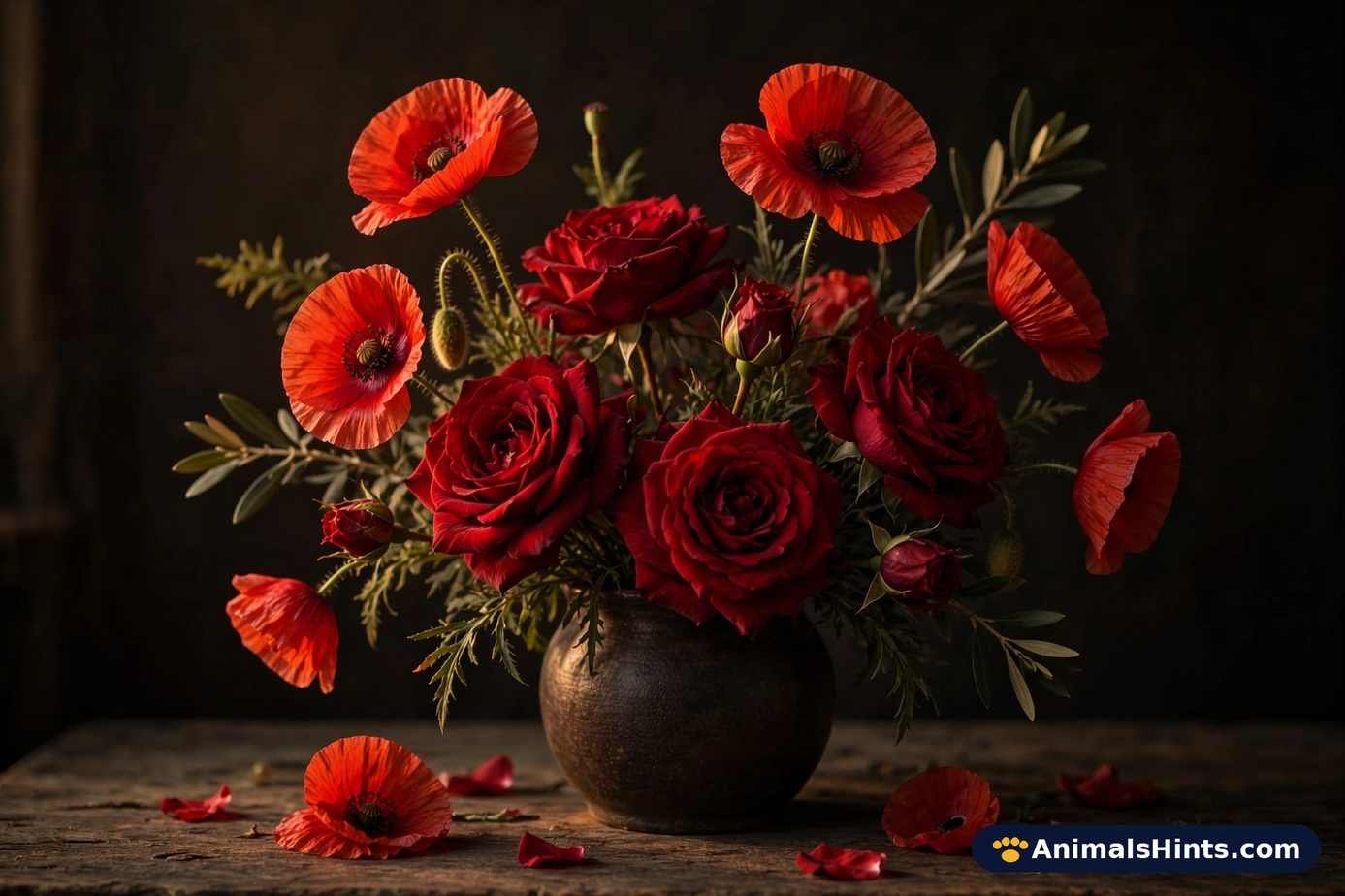
Red symbolises life itself before it symbolises anything else. It is the colour that leaves the body when a person bleeds and the colour that flushes the face when the heart speeds up, so every culture on earth met red first as the sign of being alive, urgent and impossible to ignore.
From that root, the symbolism branches in two directions at once. One branch is warm: love, desire, celebration, courage and good fortune. The other is hot: war, anger, danger and sacrifice. Red never sits politely in the middle, and that is exactly why symbolism writers reach for it when they want to talk about intensity in any form.
It is also the colour of beginnings in a literal sense. Red pigment is humanity’s first paint, red is the first colour word most languages ever coin, and in the chakra system taught today red sits at the very base of the body, the foundation everything else is built on.
It is also, not coincidentally, the colour of rank. In heraldic tradition the tincture called gules — red — stood for the warrior, for courage and for readiness to shed blood in a just cause, and red remains one of the commonest colours in the flags of the world. Long before symbolism websites, red was already the shade that thrones, armies and altars reached for first.
Why Is Red Red? The Light, the Blood and the Oldest Pigment on Earth
Start with the physics. Red light carries the longest wavelengths the eye can register, roughly 620 to 750 nanometres, sitting at the far end of the visible spectrum. Because those long waves scatter less than any other colour, red stays visible over distances where everything else fades — one reason it was chosen for signals, brake lights and warning signs, and why a low sun turns red as its shorter waves are filtered out of the air.
Our eyes are built around this colour pair. Human vision processes red in opposition to green, red’s neighbour across the spectrum, a pairing explored in our guide to the green spiritual meaning — which is why the two colours seem to vibrate when they are placed side by side, and why red advances toward the viewer while cooler colours recede.
Language confirms red’s seniority. In their famous 1969 study Basic Color Terms, Brent Berlin and Paul Kay showed that languages add basic colour words in a predictable order: black and white come first, and red is always the first true colour term to appear, ahead of green, yellow and blue. Wherever a language has only three colour words, the third one names red.
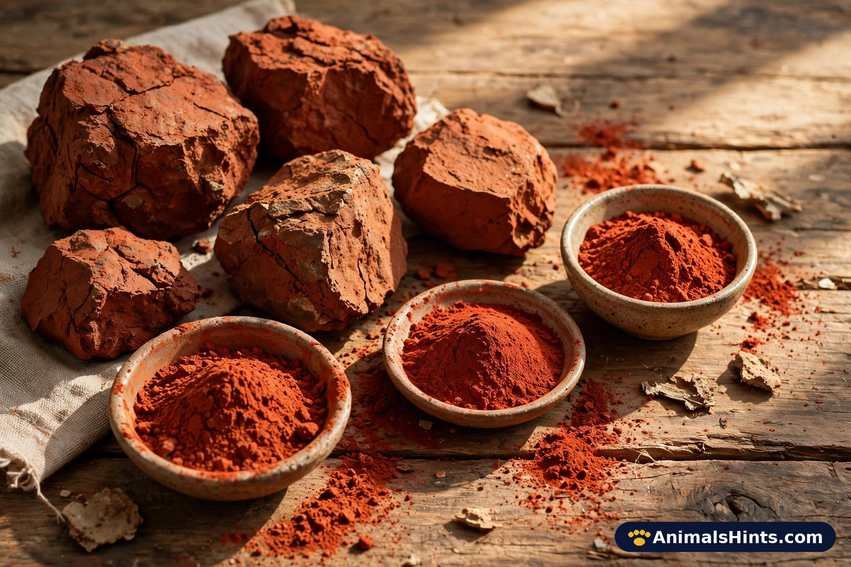
The colour in our veins explains the pull. Blood is red because of the iron carried in haemoglobin, and human beings have marked the connection between red and life for as far back as the record reaches. At Blombos Cave in South Africa, archaeologists found a paint-making workshop about 100,000 years old, with red ochre — an iron-rich earth pigment — being ground and mixed in abalone shells. A drawing made with a red ochre crayon on a flake of stone from the same cave, dated to about 73,000 years ago, is the oldest known drawing in the world.
Later civilisations paid fortunes for better reds. Vermilion, ground from the mineral cinnabar, coloured Chinese ritual ware from the third millennium BC and the faces of generals in Roman triumphs; the Romans dug most of theirs from Almadén in Spain, and the work was so dangerous it was given to prisoners, because cinnabar is a mercury compound and quietly poisonous. Painters guarded it just as carefully: a pigment that costly was spent where it mattered most, on the robes of the most important figures in the panel. Madder, a dye from plant roots used for nearly 5,000 years, gave ordinary cloth its workable red, while the brilliant scarlet of officers’ coats came from an insect dye shipped across an ocean. Red opens the spectrum, and its neighbour orange carries a warmth of its own, as our look at the orange butterfly shows — but red was first, in light, in language and in paint.
Psychology of Wearing Color Red
Colour psychology treats the person in red as the person who means it. In the popular reading, wearing red signals confidence, appetite for attention and a willingness to be judged — it is the colour chosen for first dates, power ties, keynote stages and sale signs, precisely because nobody overlooks it.
Experimental psychology has tested pieces of that reputation. In a widely cited 2007 study, Andrew Elliot and colleagues found that a brief glimpse of red before an achievement task quietly pushed people toward avoidance and lowered their scores. A year later, Elliot and Daniela Niesta reported that men rated women shown against red as more attractive — the so-called romantic red effect. Both findings are printed here as what they are: real experiments with contested afterlives. Replication attempts since have been inconsistent, and the British Psychological Society’s review of the field is blunt that the effects are fragile. The honest summary is that red demonstrably grabs attention, while the stronger claims remain unproven.
Survey evidence is steadier. In Kaya and Epps’s 2004 study of colour preference, blue finished first overall but red sat near the top for both men and women — a favourite colour, not merely a loud one. The practical reading of all this: wear red when being noticed is the point, and choose quieter shades when it is not.
Everyday etiquette absorbed the same lesson without reading the journals. Red is the colour dating advice reaches for and the shade presentation coaches suggest when a speaker wants a room’s eyes without asking for them. The counter-warning is just as conventional: red at a negotiation can read as appetite, and red in a hospital corridor is avoided precisely because it shouts. The custom is consistent even where the laboratory is not — red is worn to be seen, and everything beyond that is commentary.
13 Spiritual Meanings of Red Color
The thirteen readings below are the modern symbolism genre’s standard list for red, kept in the competitor’s order. Treat them as a recent tradition of interpretation — the documented history in the sections around them is far older than the list itself.
1. Energy and Vitality
The genre’s first meaning is the body’s own fire. Red is read as the colour of stamina, circulation and get-up-and-go — the shade writers reach for when a reading is about waking up, recovering strength or pushing through a flat season. It is the least surprising meaning on the list: the colour of blood was never going to symbolise stillness. The prescriptions follow the reading: red clothing on the day energy is needed, red foods on the table, a red object placed on the desk of the project that keeps stalling.
2. Passion and Intimacy
Red is the West’s colour of desire, from red roses and Valentine hearts to the red dress that has launched a thousand songs. In Greek myth the red rose belongs to Aphrodite, goddess of love, its colour tied in the stories to the blood of her beloved Adonis — mythology’s own way of saying desire and danger share a stem. Symbolism writers read it as attraction in its physical, urgent form — love with a pulse. The romantic red experiments described above gave this old association a modern laboratory echo, even if the science is not settled.
3. Power and Action
Red carpets, red ties, the red planet named for a war god: red has dressed authority for millennia. Roman commanders rode in triumph with vermilion on their faces, and cardinals still wear scarlet. The colour still signs off on power in miniature — the executive’s red pen, the staff officer’s red tabs, the ribbon cut at every opening. In the genre’s reading, red is the colour of acting rather than waiting — command, momentum and the decision made out loud.
4. Courage and Strength
The courage reading grows straight out of the battlefield. Red coats marched in formation, the red cross carries aid into war zones under a protective emblem, and in Maasai tradition red is the colour of bravery itself. Symbolism writers use red for the moment before the brave act — the deep breath, not the medal.
5. Root Chakra (Muladhara)
Red is the colour the modern chakra system assigns to the root centre at the base of the spine, the seat of survival and security; a full section below is devoted to it. The classical symbol behind the assignment is a lotus of four crimson petals around a yellow square — red has framed this centre far longer than the modern rainbow scheme has existed.
6. Alertness and Protection
Nature uses red as a keep-away sign, and human tradition borrowed the logic. Red threads and strings are worn as protective charms in folk practice, Chinese households hang red at New Year to frighten off ill luck, and symbolism writers read red at a doorway as a guard colour — alert, watchful and unwilling to let harm stroll in. Chinese New Year doorways carry the idea in paper form: spring couplets written on red stock, pasted up in pairs and renewed each year so the guard never fades.
7. Life Force and Divine Love
In Christian teaching, red is the colour of the blood of Christ, given as an act of love, and of the martyrs who followed. The pattern is older than the Church: in Exodus, lamb’s blood on the doorposts marks the houses that death must pass over — red as life given, and life protected, in a single stroke. Isaiah’s promise turns on this exact colour pair: “though your sins be as scarlet, they shall be as white as snow” (Isaiah 1:18, KJV). The genre folds this into a wider reading of red as life force offered rather than hoarded.
8. Spontaneity and Grounding
This pairing looks odd until you place red between its two elements. As fire, red is the spark — impulse, appetite, the unplanned yes. As earth pigment, the ochre our ancestors ground by hand, red is soil and footing. The genre reads red as spontaneity with roots: act fast, but from the ground up. Its grounding practices follow literally — stand on soil, eat what grows from it, work with clay and pigment, and let the hands do the steadying.
9. Creativity and Warmth
Red is fire in the hearth as well as fire in the blood. Symbolism writers link it to the creative heat of making things — the kiln, the forge, the kitchen at full tilt — and to the warmth of rooms and gatherings that feel alive. A red accent in a workspace is the genre’s standard prescription for a project that has gone cold.
10. Expression of Emotion
Red is the colour emotion wears on the skin. Faces flush with embarrassment, anger and exertion because blood rises to the surface — the body’s feelings made visible without a word spoken. The genre reads strong red imagery as a prompt to let feeling out rather than bottle it, which is why so much love poetry and so many protest banners share one colour.
11. Symbol of Fire
One of the genre’s oldest anchors is elemental: in the Chinese five-phase system, red is the colour of the fire phase itself, matched with the south and with summer. Hindu tradition gives the same element a god — Agni, the fire deity of the Vedas, carries offerings to the heavens, and sacred fire still anchors Hindu weddings and funerals. Fire cooks, warms, forges and destroys, and red carries all four meanings at once — the flame that keeps a house alive and the blaze that takes it.
12. Motivation and Attention
Red is the colour of the deadline, the sale tag and the starting light turning green’s opposite — the signal that says now. Retail learned the lesson without any mysticism: red is the near-universal colour of the sale tag and the countdown timer, because nothing else says “before it’s gone” at a glance. Goal-setting and productivity writers use red as a motivational cue, and the genre follows them: red in a reading usually means the waiting part is over and the doing part has begun.
13. Security and Materialism
The final meaning circles back to the root. Red is an earth colour in the oldest sense — ochre, clay, soil — and money travels in red envelopes at Chinese New Year as a wish for prosperity. The material reading is older than money itself: Palaeolithic burials were dusted with red ochre, and the famous “Red Lady” of Paviland in Wales, buried some 33,000 years ago, was a young man coated in it head to foot — as if the colour of life could be packed for the journey. The genre reads red as the material foundation of a life: home, income, body and the security everything else stands on.
Shades of Red and Their Spiritual Significance
1. Crimson Red
Crimson is red cooled with a breath of blue — the deep, jewel-toned shade dyed for centuries from the kermes insect and worn by royalty and clergy. The genre reads it as dignity within passion: desire that has learned ceremony. It is the red of velvet, old wine in dark glass and cathedral glass at dusk. The insects were gathered by hand from oak scrub, a slow harvest that kept crimson silk beyond the reach of ordinary purses for centuries.
2. Scarlet Red
Scarlet is red at full volume, the brightest and most orange-leaning of the family. It is Isaiah’s word for sin, Hawthorne’s letter of shame and the soldier’s coat of honour — a colour so loud that cultures have used it for both disgrace and glory. The genre reads scarlet as passion without apology.
3. Burgundy
Burgundy takes its name from the wine of France’s Burgundy region, and keeps the character: red slowed down, darkened and given depth. Symbolism writers use it for mature wealth and quiet confidence — the shade of libraries, leather chairs and achievements that no longer need to announce themselves.
4. Rose Red
Rose red is the family’s diplomat, red softened toward pink. The genre reads it as love in its tender register — affection, gratitude and romance without the urgency of scarlet. It is the shade of the flowers most often given to say the gentle version of the thing.
5. Maroon
Maroon, named from the French marron, the chestnut, is red pulled down into brown — the most earthed shade on this list. The genre reads it as endurance and controlled strength: the colour of brick, autumn soil and institutions that intend to last. Where scarlet shouts, maroon stays.
Red in the Animal World: Warning Signals, Suitors in Scarlet and the Honest Color
Animals discovered red’s two great uses long before symbolism writers named them: as a warning, and as a boast.
The warning use is called aposematism, and its textbook case sits in the rainforests of Central America. The strawberry poison dart frog wears a scarlet body — often with blue legs — over skin loaded with alkaloid poisons it collects from the ants and mites it eats. The colour is an honest label: predators that learn it once leave the frog alone for life. The same bargain appears on our own pages in the red ladybug, whose shell advertises a bitter chemical defence.
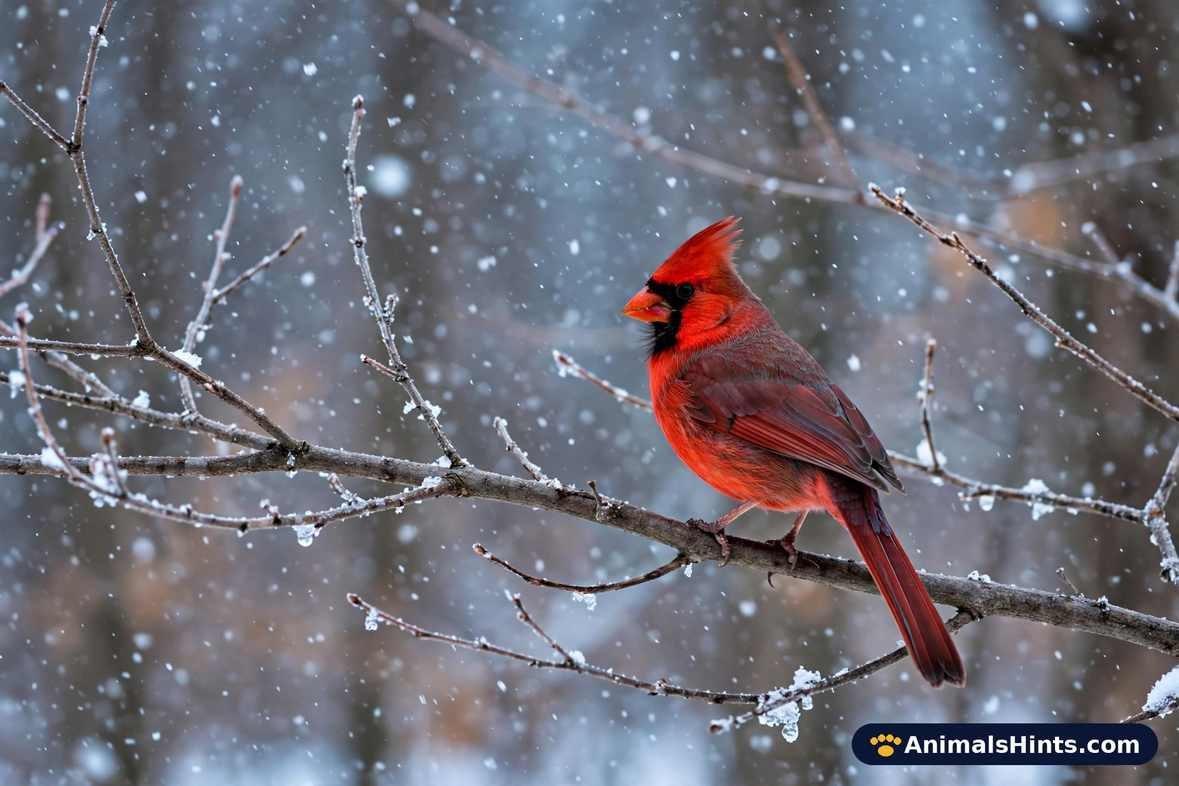
The boast works by the same honesty. A male northern cardinal cannot manufacture his red: the carotenoid pigments must come from his food, berry by berry and seed by seed, and be laid down in his feathers at the annual moult. Cornell’s ornithologists note that the brightest males hold the best territories and show the best condition — the scarlet is a certificate of health that cannot be faked. The female cardinal makes the point by contrast: she is soft brown and olive, camouflaged for the nest, because in her job survival outranks display. The three-spined stickleback plays the same game underwater: breeding males flush red at the throat, and in Niko Tinbergen’s classic experiments that patch of red alone was enough to provoke rival males and draw in females, who reliably choose the reddest suitor. Milinski and Bakker’s 1990 experiments put a measure on the preference — females spent more time with the reddest males on offer.
Between the frog’s “keep away” and the cardinal’s “look at me”, red covers the two messages animals most need to send. The symbolism of courage, protection and desire reads less like invention once you see the colour already doing that work in the wild.
Cultural and Religious Significance
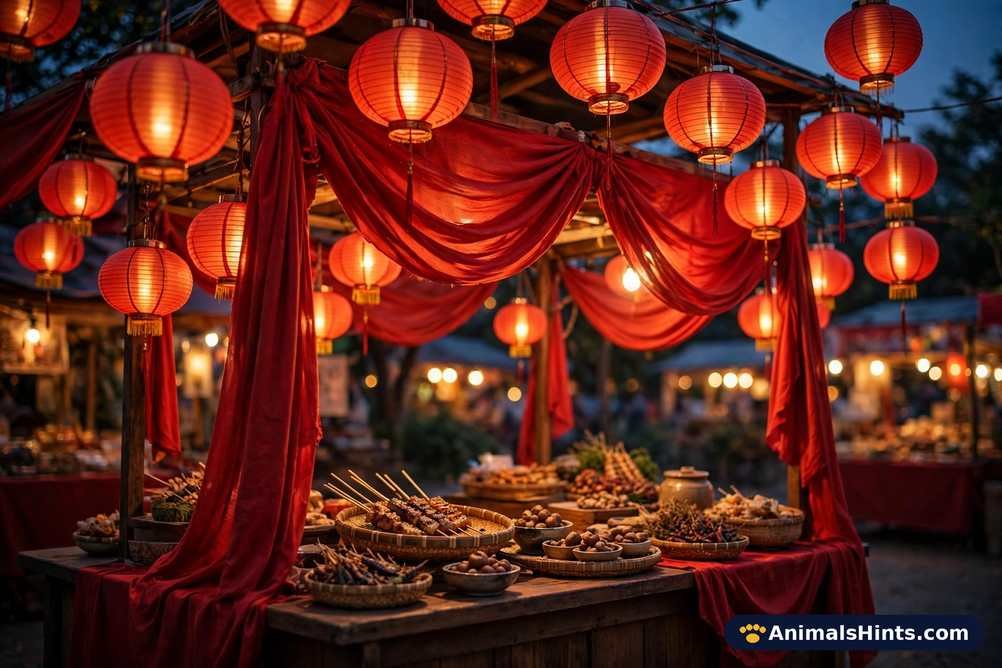
Eastern cultures (China). Red is China’s luck colour — the shade of weddings, New Year decorations and the red envelopes, hongbao, that carry money gifts and wishes with them. Folk legend explains the noise and colour of the New Year festival as weapons against the beast Nian, and the legend is printed here as legend. Underneath the custom sits a formal scheme: in the Chinese five phases, red belongs to fire, to the south and to summer, within the same classical table that gives water, the north and winter to black — the counterpart explored in our guide to the black spiritual meaning.
India. Red is the colour of the bride, of the sindoor worn in the hair parting, of kumkum powder and of the goddess Durga in her strength. Kumkum, made from turmeric and lime, marks foreheads in blessing, and the bride’s red is matched by the wedding fire she circles with her groom. In Hindu practice it binds together ideas the West usually separates: purity and passion, devotion and power, the married state and the divine feminine — one colour carrying the whole of a woman’s honoured life.
Western traditions. The Bible’s reds run from promise to warning: Isaiah’s scarlet sins washed white, and in Revelation a red horse whose rider takes peace from the earth, followed later by a great red dragon. The Church kept red for the blood of martyrs — the reason cardinals wear scarlet to this day is traditionally given as readiness to shed their own. Secular red followed the same logic of rank and notice: red carpets, red-letter days and, eventually, the red of the stop sign.
African and Indigenous cultures. The competitor’s broad claim narrows, in the documented record, to something stronger. Among the Maasai of Kenya and Tanzania, red is the defining colour of dress — the shuka cloth, hides and hair dressed with red ochre — and in Maasai tradition red stands for the blood of cattle, for bravery, strength and unity, and is said to ward off lions. In Aboriginal Australia, red ochre has been quarried, carried over long distances and used in ceremony, art and burial for tens of thousands of years. On two continents, the first pigment became the sacred one.
The Shadow Side of Red: Anger, Alarm and the Color of Stop
Every strong colour casts a shadow, and red’s is the easiest to document. Modern life runs on red’s alarming side: stop signs and traffic lights, fire engines and extinguishers, warning labels and the red of a recording light. The choice is practical, not poetic — red’s long wavelength carries furthest through fog, dust and distance, so the colour of the oldest pigment became the colour of halt.
Language keeps the same ledger. We see red when anger takes us, raise red flags over problems, get caught in red tape — a phrase born when official files were literally bound in red ribbon — and go into the red when the account empties, a memory of losses entered in red ink. The symbolism genre reads these as the colour’s ungoverned form: passion curdled into rage, appetite into impulse, power into domination.
Red also marks the judge. The teacher’s red pen, the editor’s red ink and the referee’s red card — introduced at the 1970 World Cup and still the most feared rectangle in sport — all borrow the same authority: this colour’s corrections are the ones nobody argues with. Even discipline, in red, arrives as a kind of alarm.
The honest way to hold both sides: red is intensity, and intensity is neutral. The frog’s warning, the bride’s dress and the stop sign are one colour doing one job — demanding that you pay attention. What you do with your attention is the part no colour can decide for you.
Interpretations of Dreaming About the Color Red
Dream lore treats colours as weather rather than words: red in a dream is traditionally read as the emotional temperature rising. A field of red flowers or a red dress is the genre’s classic image of desire and confidence arriving in your life; red animals or red skies are read as warning and temper; blood without injury is often read as energy spent or a sacrifice being asked of you.
Context steers every version of the reading. A bride’s red reads nothing like a warning light’s red, and the same dreamer can meet both in a single night. No dream dictionary settles what your red meant — traditions offer associations, not translations, and the strongest readings in every school of dream work come from what the colour stirred in you, not from a table.
The genre’s object readings follow the same temperature logic. A red car is read as drive and ambition arriving; a red house as passion or conflict under your own roof; a red moon as the uncanny version, the familiar colour turned strange. The books disagree with each other freely — one tradition’s lucky red dress is another’s warning — which is why experienced dream workers suggest keeping a journal for a few weeks and letting your own reds teach you their pattern.
Notice, too, that red dreams are the ones people remember. A colour built by evolution and culture alike to seize attention keeps doing its job at 3 a.m. — the dream may fade, but the flash of red is what the morning keeps.
Color Red and the Root Chakra
Muladhara, the root chakra, takes its name from Sanskrit words for “root” and “support”, and sits in tradition at the base of the spine as the foundation of the whole system. Its element is earth, its concerns are survival, safety and belonging, and in the system taught today its colour is red — the link behind the fifth spiritual meaning above.
The classical picture, from the Sat-Cakra-Nirupana as translated in Woodroffe’s The Serpent Power, is more specific than the modern rainbow chart: a lotus of four crimson petals, holding within it a yellow square that signifies the earth element. The full rainbow ordering of the chakras, red at the root and violet at the crown, is a later layer popularised in the twentieth century — an old symbol wearing a modern arrangement, and worth knowing as both.
Working with the root centre, in modern practice, means working with red and with ground: walking barefoot on earth, eating root foods, red clothing or a red stone carried as a reminder, and slow breathing at the base of the spine. Genres of practice describe a settled root as feeling safe in your own life, and an unsettled one as chronic insecurity or restlessness — descriptions offered here as the tradition’s own, for readers who work within it.
Practitioners read the centre through the body as well: restless legs, a permanent sense of hurry and sleep that never settles are the folk signs of an ungrounded root, while appetite, patience and deep rest are read as the ground holding. None of this is medicine, and the tradition itself does not claim otherwise — it is a vocabulary for noticing how safe your life feels from the inside.
How to Use Red’s Meaning in Everyday Life
Begin where the evidence is strongest: attention. A red notebook for the project that matters, a red cover on the phone you keep losing, a red thread on the key you cannot misplace — the colour’s visibility is a tool, and using it deliberately is the oldest trick in this article.
Dress with intent. Red at a presentation or negotiation is the genre’s classic power move and the preference surveys back red as a colour people genuinely like; burgundy and maroon do the same job at half the volume for rooms where scarlet would shout. Save the brightest reds for the days being noticed is the assignment.
At home, treat red as seasoning rather than a base coat. A red cushion, lamp or artwork pulls a room’s energy toward it, which is why symbolism writers prescribe small doses for cold, flat spaces — and warn that whole red rooms can feel like an alarm that never switches off. One strong piece usually does the work of ten.
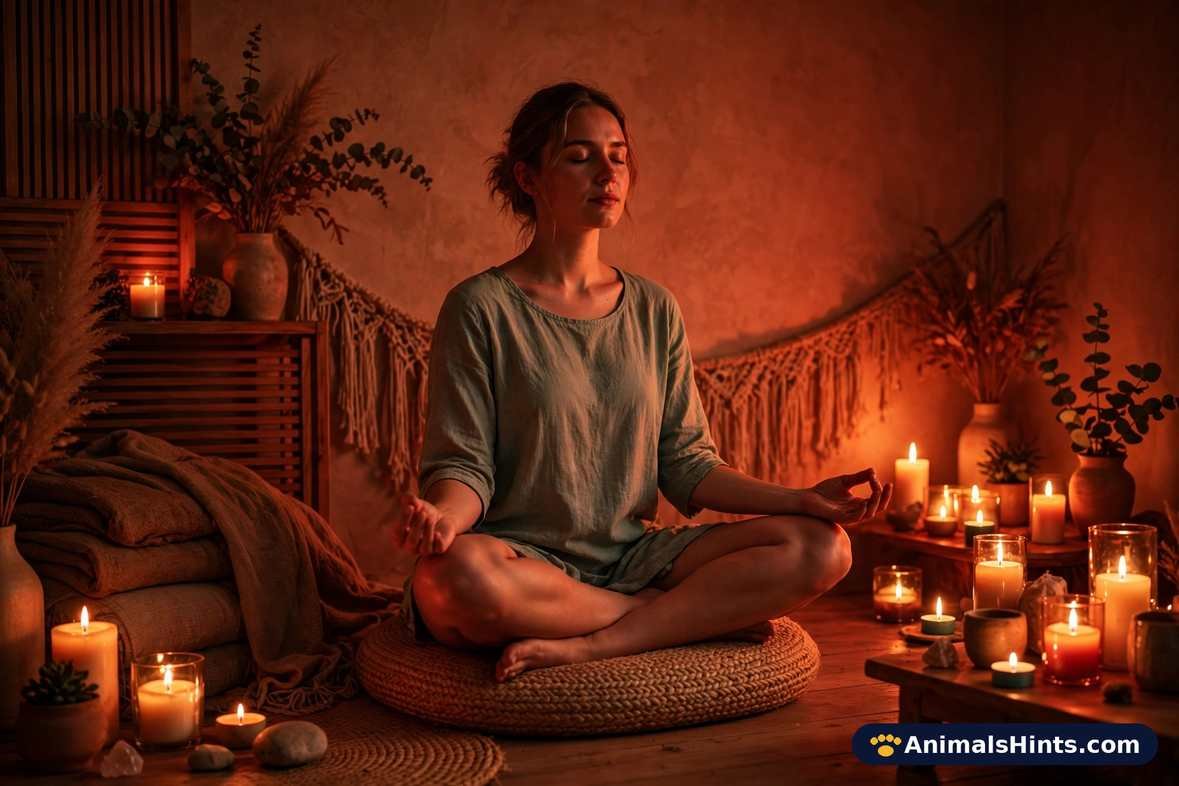
For the root-chakra reading, the practice is grounding rather than decorating: bare feet on grass, heavy food, slow mornings, a red candle lit while you sit still. Whether you take the chakra frame literally or as a useful metaphor, the habits it prescribes — eat, rest, touch the ground, feel safe — are sound ones.
Give red deliberately, too. Roses are the obvious case, but the principle is wider: red wrapping on a gift, money in a red envelope, red candles on a table where a decision will be made. Each borrows the colour’s old associations with luck, love and seriousness, and used with intent the decoration turns into a small ceremony.
Final Thoughts
Red’s spiritual meaning holds together because the symbolism grew out of the substance. This is the colour of the blood in the body, the first paint on the cave wall, the first colour word in language after light and dark — the genre’s talk of life force, courage and desire is a late retelling of very old facts.
Hold the two records side by side and each improves the other. The documented history keeps the meanings honest; the meanings explain why the history matters — why a Chinese bride, a Maasai herder and a Roman general all reached for the same shade of earth and mineral to say the important thing.
It is fitting that even the finest red had to be earned. For centuries the most prized scarlet in the world came from cochineal, an insect dye so valuable it ranked second only to silver among the exports of Spain’s American colonies, colouring cardinals’ robes and soldiers’ coats alike. Red has never been a cheap colour to make or a quiet one to wear — and that, in the end, is its whole meaning.
Frequently Asked Questions
What does the color red symbolize spiritually?
Spiritually, red symbolises life force: energy, passion, courage and survival. It is also the colour of the root chakra in modern teaching, tying it to grounding, safety and the material foundations of life.
How does red affect our psychology?
Red reliably captures attention, and colour-preference surveys rank it among the favourite colours. Laboratory claims that it raises attraction or lowers test scores come from real studies whose replications have been inconsistent, so they are best treated as suggestions, not laws.
What does liking red say about your personality?
In colour-preference writing, red lovers are read as energetic, passionate and direct — people who act first and reflect later. Treat that as the genre’s portrait rather than a diagnosis; preference surveys show red is simply one of the most widely liked colours.
How can I use red’s spiritual meaning in my life?
Use it where attention and energy are wanted: a red accent in a workspace, red clothing on days you need presence, and grounding habits — bare feet, solid food, stillness — for the root-chakra side. Small doses work; red rewards restraint.