Mole on Forehead Meaning: Spiritual, Astrology, Female, Male & Lucky Sign
Few marks are searched as hopefully as a mole on forehead placement. The forehead is the face’s most public real estate — the first ground a stranger’s eye crosses — and the old reading traditions treat it as the face’s opening chapter: the seat of the mind, of ambition and of the years when a life is just beginning. A mole planted there is read, depending on the tradition and the system, as wisdom, as a career blessing, as a warning about family ties, or as all three at once.
The honest difficulty is that the traditions do not agree with each other — and on this placement they disagree more sharply than on almost any other so far. The Indian lists celebrate the center of the forehead as the wisdom spot. The classic Chinese mole chart, read carefully, gives the forehead its hardest general verdict of any placement covered in this series: average luck, thin support from elders and a life spent away from home. Both readings are printed below, side by side, exactly as their sources give them.
This article keeps every reading in its own tradition’s voice, gives the forehead its exact address on the Chinese face map — where it turns out to hold not one palace but several — and then steps out of folklore altogether: what a forehead mole actually is under the skin, the one forehead patch that is routinely mistaken for a giant mole, and the warning signs that should send any mole, on any forehead, to a doctor rather than to a chart.
What Does a Mole on the Forehead Represent Astrologically and Spiritually?
In the reading traditions, a mole on the forehead represents the mind made visible. Astrological and spiritual writers place it on the part of the face they associate with thought, ambition and spiritual insight, so the mark is read as a sign of a person whose inner life runs ahead of their circumstances — someone thoughtful, driven, and watched, for better or worse, by fortune.
The symbolism starts with the forehead itself. Across the systems covered in this series, the forehead stands for intellect and aspiration: it is the panel of the face that carries the brow of concentration, the “third eye” point of modern spiritual writing, and — in Chinese face reading — the whole upper third of the face, the zone of youth, inheritance and heaven’s portion of a life. A mole there is treated as a sentence written across that panel: the traditions below spend this entire article arguing about what the sentence says.
Position is everything, and the traditions split the forehead into four reading grounds: the center, read for wisdom and the inner eye; the right side, read almost everywhere for luck, wealth and career momentum; the left side, read in India for money trouble and in modern spiritual writing for emotional depth — a disagreement this article does not smooth over; and the strip near the hairline, read for foresight, protection and fortune that improves with age.
One theme runs through every system, and it is the theme the mole placement meaning traditions all share: placement readings treat a mole as a fixed point on a map of the life, and the forehead’s territory — mind, ambition, early years, standing with elders and superiors — is the territory every forehead reading returns to, whatever verdict each system reaches about it.
What a Mole on the Forehead Actually Is, Medically
Before any tradition gets its say, here is what the mark actually is. A mole — a melanocytic nevus, in the medical term — is a common skin growth that appears when melanocytes, the skin’s pigment-producing cells, grow in clusters instead of spreading out evenly through the skin. The cluster is what makes the spot darker than the skin around it: more pigment cells in one place, more color in one place.
Mayo Clinic’s reference points, which apply to a forehead mole exactly as they apply anywhere else on the body, are worth holding onto through everything that follows. Most moles appear during childhood and the teenage years, and most people carry between ten and forty of them. Many moles change slowly over time — some fade, some disappear entirely — and texture varies: moles may be smooth or wrinkled, flat or raised, and some grow hairs. On size, most moles are less than about a quarter of an inch (roughly six millimeters) across, about the width of a pencil eraser. A mole bigger than that is not automatically dangerous, but size is one of the things a doctor weighs.
The forehead has one medical feature the other placements in this series mostly lack: exposure. Mayo Clinic notes that moles are most often found on parts of the body that get sun exposure, and lists the face among the classic sites — and the forehead is the face’s most sun-struck panel, the first surface the midday sun reaches and the one a hat’s brim only partly shades. A forehead mole therefore lives in ultraviolet light in a way a chin or cheek mole often does not, which is one more reason the watch-list below matters here.
The forehead also hosts the great mole impostor of the face: melasma. Cleveland Clinic describes melasma as a condition that causes patches of skin to turn a shade darker than the person’s natural coloring — patches that can grow large enough to be mistaken, at a glance, for one enormous flat mole. Melasma appears most commonly on the cheeks, nose, chin, above the upper lip and the forehead; Cleveland Clinic calls the forehead one of its home grounds. It is harmless, it is not a mole at all — no cluster of melanocytes, just pigment switched on across an area, often by sun or hormones — and it cannot be read by any mole chart or treated by any mole remedy. If the “mole” on your forehead is a broad, flat, symmetric patch rather than a distinct spot, melasma is the likelier explanation and a dermatologist can confirm it in minutes.
The warning signs are the same ones family doctors use everywhere, summed up in the ABCDE guide. A is for asymmetrical shape — one half unlike the other. B is for border — edges irregular, blurred or jagged. C is for color — changes in color, or uneven shades of tan, brown, black, red, white or blue within one spot. D is for diameter — larger than about a quarter inch, though melanomas can be smaller. E is for evolving — any change in size, shape, color or elevation, or a new symptom such as itching, crusting or bleeding. Mayo Clinic’s practical instruction is plain: make an appointment with a doctor if a mole looks unusual, grows, or otherwise changes — and examine your own skin, forehead included, about once a month, ideally in a well-lit room after a bath or shower, using mirrors for the hard-to-see places.
One boundary holds for this entire page, and it is stated here so nothing later blurs it: none of the traditions in this article — Chinese, Indian or Western — is a medical system, and none of their readings can say anything about what a forehead mole is doing under your skin. What they offer is meaning, handed down as belief. What a mole is doing biologically is a question only an examination answers.

9 Spiritual Meanings of Mole on the Forehead
The competitor page this article answers gathers the forehead mole’s spiritual readings under nine headings. All nine are kept below, in its order, with each reading given as the traditions present it — and with the disagreements between systems flagged inside the entries they touch, rather than edited away.
1. Wisdom and Spiritual Insight
The flagship reading. A forehead mole, in the spiritual tradition, marks a person whose understanding runs deep early: wisdom beyond their years, a reflective nature, and an instinct for the meaning underneath events. Indian astrology’s version is precise about the center placement — the Times of India’s astrology desk describes a person with a mole in the center of the forehead as believed to be intelligent and intuitive, and the modern spiritual lists agree with it almost word for word.
Hold the reading with one honest footnote, which the Areas section below develops: the celebrated “third eye” point of the classical chakra maps sits between the eyebrows, at the forehead’s lower edge — not in the middle of the forehead panel where most forehead moles actually sit. The wisdom reading is real as a tradition; its address, in the older maps, is a few centimeters lower than the modern lists draw it.
2. Success and Prosperity
The forehead mole’s luckiest reading, and the one with the broadest agreement behind it. The right side of the forehead is read for wealth and forward motion in system after system: the Indian textbook tradition holds that a mole on the right side of a wide forehead denotes wealth, fame and status, and the Times of India gives the right side determination, leadership qualities and success in career or business ventures. Even the normally stern Chinese chart softens on this ground for men, where a well-colored forehead mole is tied to official success and getting rich.
The agreement is genuine but should not be inflated into a guarantee: every one of these sources presents the reading as a disposition, not a bank statement — a tailwind for effort, in the traditions’ own framing, never a substitute for it.
3. Emotional Sensitivity and Struggle
The shadow entry, and the one the modern lists handle most honestly. A forehead mole — on the left side especially — is read in contemporary spiritual writing as the mark of a feeling nature: emotional intelligence and creativity on the gift side, and on the cost side, early-life challenges, karmic imbalances to work through, and lessons that arrive through the heart before they arrive through the head.
The Indian sources are blunter about the left side than the spiritual lists are. Where the modern reading says sensitivity, the Times of India’s astrology summary says the left side of the forehead can signify financial difficulties and obstacles in the career path — a money warning wearing no poetry at all. Both versions are printed in this article because both are genuinely what their traditions say; a reader with a left-side mole deserves to know the reading is contested, not settled.
4. Karmic Mission and Spiritual Capacity
In the Hindu strand of the tradition, a forehead mole links to karma and destiny: it is read as a reflection of accumulated good deeds from past lives, a mark the soul carries into this life as a reminder of work unfinished and capacity earned. The spiritual lists develop the same idea as a calling — the mole as evidence that the person is here with a task, often one that involves guiding, teaching or healing others.
Read carefully, this is the most metaphysical entry of the nine: it depends entirely on a framework — rebirth and karmic accounting — that the reader either holds or does not. The article presents it as the tradition presents it, a belief about why the mark exists, and notes only that it is the explanation the Hindu tradition itself gives, not a claim any chart can test.
5. Leadership and Recognition
The forehead is the face’s command panel in the reading traditions, and a mole on it is read as a leadership mark: natural authority, decision-making confidence, and recognition that comes through being visibly in charge. The Times of India attaches leadership qualities to both the right side and the center placements, and the Chinese system — as the face-map section below shows — quite literally stations the Career Palace, the office of rank and public standing, in the middle of the forehead.
The Chinese chart adds its characteristic grit: a forehead mole can also mean limited support from elders and superiors — leadership, in that reading, achieved without the establishment’s help rather than through it. The two versions agree on the destination and disagree about the road, which is the most honest summary of this entry available.
6. Intuition and Creativity
The companion to the first meaning, pointed at a different faculty: where wisdom is understanding, intuition is knowing without the working shown. A forehead mole is read as the sign of a person with a live sixth sense — strong first impressions, dreams that feel like information, and a creative imagination that works best when it is trusted quickly. The creative half of the reading has Indian support: the Times of India’s center-forehead portrait includes creativity alongside intelligence and intuition.
As with the wisdom entry, the address caveat applies with a light hand here: the traditions that prize intuition place its seat at the brow point between the eyes, and the forehead mole borrows that prestige across the whole panel. The reading is offered as the modern lists give it — a temperament, not a test result.
7. Calmness and Clear-Sightedness
The quietest of the nine meanings: a forehead mole read as the mark of a composed mind — a person who sees situations whole, panics late, and decides in clear weather. The spiritual lists attach this reading particularly to a clear, well-formed mole in the center of the forehead, where the mark is taken to mirror the state it predicts: undisturbed surface, undisturbed judgment.
There is a small traditional echo worth noting. Chinese face reading prizes a broad, smooth, unmarked forehead as the classic sign of an easy, well-supported youth — the calm surface as good fortune in itself. A single clear mole on that surface is, in the modern reading, the exception that proves the rule: one mark, clearly placed, on an otherwise open field.
8. Health and Head-related Issues
This heading is kept because the competitor prints it, and it is the entry where this article’s honesty rule bites hardest. Traditional astrology writing does sometimes attach head-related health hints to forehead placements — the Times of India’s summary, for instance, suggests a mole above the eyebrow might indicate potential health problems related to the head or eyes, and a mole on the temple issues around blood pressure or headaches.
Those sentences are printed here as what they are: traditional associations inside a belief system, recorded because the tradition contains them. They are not diagnoses, they are not risk factors, and no mole’s position on a forehead has any demonstrated connection to headaches, eyesight or blood pressure. Medicine reads a mole as a mole — the ABCDE signs in the medical section above are the whole of its real health content — and anyone with actual head or eye symptoms needs a doctor, not a chart. The tradition is documented; the boundary is not negotiable.
9. Fame and Ambition
The closing meaning, and the most worldly: a forehead mole as the mark of a person built to be seen — ambition with a public destination, and fame read as a realistic outcome rather than a fantasy. The Indian textbook strand supports the pairing directly, tying the right-side forehead mole to wealth, fame and status together; the Vedic-flavored summaries add that a mole on the male forehead marks a person destined for prominence, influencing others through confidence and charisma.
Fame is the reading most flattering to hear and the one the traditions themselves surround with the most conditions — color, clarity and placement all modify it, and the Chinese chart’s general forehead entry (average luck, a hard life, support withheld) stands in this article as the permanent counterweight. Ambition, the sources agree on. The fame is presented as the traditions present it: possible, promised by some, and guaranteed by none.
Mole on the Forehead Meanings for Females Versus Males (Astrology)
The competitor page sets the female and male readings side by side in a table, placement by placement. The table is reproduced here as a native table, in its own terms — the fuller, sourced picture, including where the classic charts contradict this table’s warmth, is in the sections around it.
| Forehead Position | Meaning for Females | Meaning for Males |
|---|---|---|
| Center | Emotional balance, maturity, spiritual wisdom, good fortune | Authority, leadership, powerful intuition |
| Right Side | Prosperity, good fortune, wealth, especially after marriage | Ambition, success, wealth, career growth |
| Left Side | Sensitivity, creativity, leadership with emotional depth | Wisdom gained through struggle, progress through effort |
| Near Hairline | Divine protection, good luck, personal growth | Spiritual awareness, strong intuition, foresight |
Two honest notes on the table. First, its optimism is the modern lists’ optimism: the classic Chinese chart, covered in the face-map section below, reads the center placement for women as wealth luck paired with setbacks in love, and attaches several hard readings to female forehead positions — none of which appear here. Second, the table’s sharpest disagreement with the Indian sources sits in the left-side row: where this table gives women “leadership with emotional depth,” the Times of India’s astrology desk gives the left side financial difficulties and career obstacles for everyone. The table stands as the competitor printed it; the conflict stands beside it.
Mole on the Forehead Meaning for Males
The competitor page gives the male reading its own section, and its entries are kept here in its own arrangement.
Center: This position shows leadership, discipline, and inner strength. A man with a mole here is read as commanding respect and thinking strategically — the authority reading at full strength.
Right Side: This placement indicates ambition and success. Men with a mole on the right side build wealth, achieve high status, and gain recognition in their professional lives — the career reading every system supports.
Left Side: This position reflects emotional and spiritual lessons. Men with this mole face early challenges but gain wisdom through experience — the struggle reading, softened into a growth story.
Near Hairline: A mole near the hairline symbolizes foresight and inner awakening. It shows that the man follows spiritual guidance and senses opportunities before others do.
The page closes the section in the Vedic voice: in Vedic beliefs, a mole on the male forehead marks a person destined for prominence — in business, art or leadership, such individuals influence others through confidence and charisma.
Two sourced footnotes belong under this section. The Chinese men’s chart is more double-edged than the competitor’s arrangement suggests: a red forehead mole is highly auspicious for a man — independence and great career achievement — while a deep black one means confidence and success earned by personal effort but a poor fit for partnership, a man who may forget friendship for profit. And the female reading, which the competitor handles only in the table above, carries in the Chinese women’s chart some of the hardest lines in the whole forehead file — bad luck to parents, bad luck to relatives, marrying far from home among them — attached to numbered chart positions. Both sexes, in the classic chart, get a mixed file. The modern lists give both a glowing one. This article prints both files and labels them.
Spiritual Meanings of Mole on Different Areas of the Forehead
The competitor page’s second placement section walks the four forehead grounds one by one. Its entries are kept here in its order and substance, each followed, where the older maps say something different, by the correction this article owes the reader.
1. Mole in the Center of the Forehead
This area connects to the third eye chakra, which represents insight, perception, and divine guidance. People with a mole here possess strong intuition, deep awareness, and a spiritual calling. This mark identifies a person whose life involves guiding others or uncovering hidden truths.
The honest footnote, promised earlier: in the classical chakra maps, the third eye — the ajna point — sits between the eyebrows, at the very bottom edge of the forehead, not midway up the panel where a true center-forehead mole sits. Modern spiritual writing has slid the point upward to cover the whole center forehead, and the reading above follows the modern placement. The tradition is real; its pin, in the older maps, sits lower. A mole exactly between the brows is the one the classical map is actually talking about — and a mole mid-forehead is read, in the Chinese system below, by a completely different office: the Career Palace.
2. Mole on the Right Side of the Forehead
This placement signifies luck, ambition, and progress. Spiritually, it shows a soul on a mission of achievement. People with this mole succeed in leadership and career and act as wise decision-makers.
Of the four entries, this is the one the independent sources back most strongly: the Indian textbook reading (wealth, fame and status on a wide forehead), the Times of India’s summary (determination, leadership, career and business success) and the Chinese men’s chart (career achievement, official success for a well-colored mark) all point the same way. When three systems that disagree about everything else agree about one placement, the article says so — agreement is evidence too.
3. Mole on the Left Side of the Forehead
A mole on the left side reveals emotional intelligence and creativity. It can also show karmic imbalances from past lives that require healing in this lifetime. Spiritually, such individuals act with compassion and intuition but must learn to balance emotion with practicality.
This is the most contested ground on the forehead, and the contest deserves plain words. The Indian desk summaries give the left side financial difficulties and obstacles in the career path — no emotional-intelligence framing at all. The older Indian textbook adds a character edge: a mole on the left side of a narrow forehead marks a selfish person whom others do not respect. The modern spiritual entry above (creativity, compassion, lessons) and the Indian entries (money trouble, obstacles, selfishness) cannot both be the settled meaning, because they are not the same meaning. They are printed together here so the reader can see the seam: the left forehead is where the traditions openly part company.
4. Mole Near the Hairline
This placement aligns with the crown chakra, which symbolizes spiritual elevation. A person with a mole near the hairline possesses psychic gifts and deep metaphysical insight. It also shows divine protection and a strong spiritual aura.
The same boundary note as the center entry: the crown point of the classical maps sits at the very top of the head, above the hairline, not on the forehead below it — the hairline mole neighbors the crown rather than occupying it, and the reading follows the modern association. The Chinese system reads this exact strip differently and, for once, more gently than its general forehead verdict: the hairline corners are the forehead’s travel ground (the Travel Palace, next section), and popular Chinese mole summaries hold that a mole near the hairline is lucky — the closer to the hairline, and the more hidden, the luckier. Two systems, one strip of skin, two unrelated reasons to call it fortunate.

The Forehead in Mian Xiang: Heaven’s Third, the Career Palace and the Fortune Palace
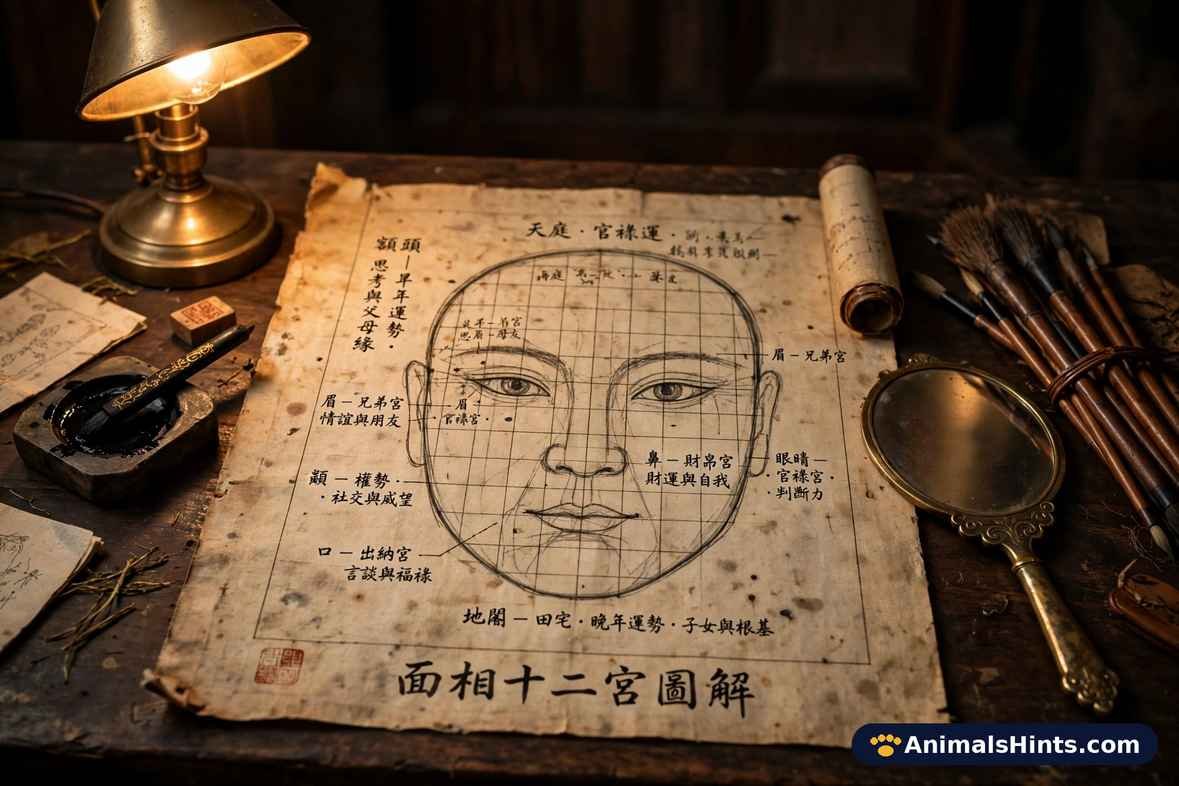
The brief for this article asked for the forehead’s address to be checked against the face-reading manuals before anything was written — and the check changes the picture the competitor page paints. The competitor says that in Chinese face reading the forehead “represents the Heaven’s Palace.” No palace of that name exists on the manuals’ map. What the manuals actually give the forehead is bigger and more specific than one palace, and it is set out here from those sources.
First, the forehead is a whole court. Classical Mian Xiang divides the face into three horizontal courts (the Three Stops, San Ting), and the forehead — from the hairline down to the brow line — is the Upper Court, the Heaven third, governing roughly the years from fifteen to thirty: inheritance, schooling, family background, and everything a person is handed rather than what they build. A broad, even, unlined upper court is the classical picture of an easy beginning. Every forehead mole, wherever it sits, is therefore read first as a mark on the youth chapter of the life — a placement fact none of the spiritual lists mention, and the reason the Chinese readings keep returning to parents, elders and early fortune: those are the Upper Court’s subjects.
Second, the forehead carries several of the twelve palaces, and a mole is read against whichever palace it lands in:
- The Career Palace (Guan Lu Gong, the Palace of Official Rank) occupies the middle of the forehead — the manuals gloss it as office, rank, public standing, and a person’s relationship with superiors, with the forehead points Si Kong and Zhong Zheng at its heart and its years running through the late teens and early twenties. A mole dead-center on the forehead is, in this system, not a “third eye” mark at all. It is a mark on the office of career — read for ambition, promotion and friction or favor with the people above you.
- The Fortune and Virtue Palace (Fu De Gong) sits above the brow tails, along the forehead’s lower side edges — the palace of ease, merit and inherited luck: how lightly a person carries their fortune. Directly beneath that strip, below the brow, sits the upper eyelid and its own Property Palace, whose readings this series covered as the mole on the eyelid meaning — the two addresses are neighbors on the same map, one above the brow and one below it.
- The Travel Palace (Qian Yi Gong) covers the upper corners of the forehead, toward the temples — movement, relocation, and fortune found away from home. A mole at the forehead’s corners is read against travel, which is the map’s own explanation for the Chinese chart’s recurring forehead theme of leaving the hometown.
- The Parents Palace (Fu Mu Gong) covers the two rises of the upper forehead, one for the father and one for the mother — which is why the classic charts keep scoring forehead moles for luck to and from parents.
Third, the mole readings themselves. The most widely reproduced modern statement of the Chinese chart, YourChineseAstrology’s facial mole reading, gives the forehead the hardest general entry of any placement covered in this series so far: a forehead mole suggests average luck, a weak relationship with relatives, a high possibility of living away from the hometown, limited support from elders and superiors, and a hard life. The center placement is its one softening — read there, the mole indicates mental maturity, no shortage of material things, and peaceful, happy later years — but for women the same center mole is said to bring good luck for wealth together with setbacks in love. The sex-split charts add their own entries: for men, a red forehead mole is highly auspicious (independence, great career achievement) and a deep black one means success by personal effort but a poor fit for partnership; for women, several numbered forehead positions carry hard lines — bad luck to parents, bad luck to relatives, marrying far away — that no modern listicle repeats.
Set against the competitor page, the correction is now precise. The competitor presents the Chinese forehead as a zone of “divine energy and ancestral blessings” where a good mole “shows a fortunate and prosperous life.” The manuals and the chart say something narrower and tougher: the forehead is the Heaven third and the years fifteen to thirty; its center is the Career Palace, not a palace of blessing; and the chart’s forehead verdict is the most cautionary in this entire series. The correction is printed openly, as the eyelid and cheek corrections were in this series, because a reader who finds their mole in the Chinese column deserves the Chinese column as it actually reads.
And the map closes where it opens: the forehead is the first court, the youth chapter, read from the hairline down — and the same map ends at the chin, the Earth Pavilion of the later years, whose own mark this series read in the mole on the chin article. Beginning and end of the same face, read by the same manuals, seventy years apart in the map’s own accounting.
Cultural or Religious Interpretations
The competitor page’s survey of the great traditions is kept here, tradition by tradition, with each strand stated as its sources state it.
In Hinduism, it links to karma and destiny. A forehead mole reflects accumulated good deeds from past lives. If it appears on the right side, it connects to Lakshmi, the goddess of wealth and fortune. The Lakshmi connection is the devotional form of the reading the Indian desks state plainly — the right side as the wealth side — and the two strands of the Indian tradition, temple and textbook, agree on it.
In Chinese face reading, the forehead represents the “Heaven’s Palace”. A mole in this region reveals a person’s connection to divine energy and ancestral blessings. A clear and well-shaped mole shows a fortunate and prosperous life. This paragraph stands as the competitor prints it — and the section directly above this one is this article’s correction of it: the manuals know no “Heaven’s Palace”; they give the forehead the Upper Court (the Heaven third), the Career Palace at its center, and a chart verdict far cooler than “fortunate and prosperous.” Both paragraphs remain in the article, labeled, because the gap between them is itself the most useful fact in this section.
In Buddhism, the forehead symbolizes enlightenment. The Buddha’s urna, or spiral mark, represents divine wisdom, mirroring the belief that people with this mark carry spiritual insight and awareness. The statue half of this is solid ground: in Buddhist iconography the urna — a small curl or dot between the eyebrows — is counted among the traditional marks of a Buddha and is carved or painted on Buddha images across Asia, a symbol of wisdom and spiritual sight. Note its address once more: between the brows, at the forehead’s foot — the same lower point the chakra maps use, and the ground a true brow-line mole occupies.
In Western traditions, the forehead mole symbolizes intelligence, ambition, and creativity. Many also view it as a sign of individuality and a destiny uniquely written in the soul. The Western reading is the loosest of the four — character rather than fortune, a bold mind worn openly — and it is the strand that produced the modern beauty-mark framing the verdict section takes up below.
Is a Forehead Mole Lucky or Unlucky? The Honest Verdict
Both — and on the forehead, more than on any placement covered before, the answer depends on which tradition is holding the chart, because this is the placement where the systems disagree at full volume.
In the modern spiritual and Indian readings, the forehead mole is a fortunate mark with one dark corner. The center is celebrated (wisdom, intuition, leadership, with the Indian desks in support), the right side is the most broadly lucky ground on the whole face (wealth, fame, status, career success — agreed by the Indian textbook, the Indian desks and, for men, the Chinese chart), and the hairline is read for protection and improving fortune. The dark corner is the left side, where India reads financial difficulty and career obstacles outright. Even the modern verdict, kept honest, is therefore “lucky, except on the left, where India says otherwise.”
In the classic Chinese chart, the forehead mole is the least lucky placement in this series so far — the general entry (average luck, weak family ties, life away from home, little support from elders and superiors, a hard life) is harsher than the chart’s entries for the chin, the eyelid or the ear, and its softenings are narrow: the center placement matures into comfort late in life, red moles favor a man’s career, and a hidden hairline mole is popularly counted lucky. A reader who trusts the Chinese system and finds a forehead mole gets, from that system, a working-life reading, not a blessing.
So the practical verdict mirrors the one given for the left eye twitching spiritual meaning: the meaning is genuinely hopeful in the traditions that celebrate it, genuinely cautionary in the tradition that charts it coldly, and in every system it is a belief, not a mechanism. Nothing in any chart moves money, rank or health. What the mark can honestly be is what it has been for the people who have worn famous ones — a feature, owned. And where the forehead’s youth-court reading meets the face’s mid-life ground, the neighboring placement tells the opposite half of the story: the mole on the left cheek meaning belongs to the years the forehead’s court has long finished with, and its traditions argue just as hard in the other direction.
Myths and Superstitions Associated with Mole on the Forehead
The competitor page’s folklore shelf is kept here as it stands. Across ancient traditions, people viewed moles as messages from the spiritual realm. Myths often describe them as marks chosen by the soul before birth, serving as reminders of divine promises or life missions.
In several superstitions:
- A mole on the right side brings wealth and good fortune.
- On the left side, it signals a sensitive heart and emotional lessons.
- A mole in the middle of the forehead marks spiritual gifts and higher connection.
- A mole near the hairline represents a blessed destiny and divine favor.
The page’s history shelf adds that in ancient Greece, people saw a mole between the eyebrows as a sign of prophetic power, and that medieval beliefs often treated such marks as symbols of mystical ability or fate-bound lives. The Greek sentence deserves this article’s standard caution: Greek physiognomy is a real ancient discipline, but this specific claim — a brow mole as a prophet’s mark — could not be traced to any ancient source in this article’s research, and it is repeated here only as modern folklore about folklore. The medieval half needs no such caution to be understood in both directions: in the witch-trial centuries, an unusual mark on the skin could be entered as evidence against its owner as readily as it was romanticized — the same mark, the same centuries, opposite verdicts, which is the whole history of mole superstition in one sentence.
Stripped to their working parts, the superstitions are the article’s main readings in folk dress: right lucky, left tender, center gifted, hairline blessed. Folklore simplifies what the charts argue about — that is what folklore is for — and the myths are at their most honest when they are enjoyed as stories a culture told about a conspicuous mark, not as the mark’s dossier.

Removing a Mole on Your Forehead: What Dermatologists Actually Do
The traditions argue about what a forehead mole means; many owners argue with mirrors about whether it stays. The forehead sharpens that decision, because it is the least forgiving skin on the face: flat, taut, sun-exposed, and in the middle of every photograph. Here is how removal actually works, in the order a doctor works.
It starts with an examination, not a procedure. A forehead mole that has changed — the ABCDE signs from the medical section — gets assessed first, and assessment decides everything downstream. Mayo Clinic’s guidance on removal is built around a principle worth stating before any technique: never try to remove a mole at home. Home removal risks infection and permanent scarring — on the forehead, a scar trades a spot the size of a lentil for a mark everyone sees — and it destroys the one thing a changed mole must produce: tissue a laboratory can examine.
The professional routes are two. In surgical excision, the doctor numbs the area, cuts the mole out with a scalpel or surgical scissors, removes a small margin of normal skin with it, and sends the tissue for biopsy; the wound may be closed with stitches or left to heal, depending on size and depth. In surgical shave, the area is numbed, a small blade shaves the mole off level with the surrounding skin, usually no stitches are needed, and the tissue can still be sent for testing. On the forehead specifically, expect the conversation to include cosmetics honestly: which route leaves the flatter mark on taut skin, how the scar will sit relative to the brow lines, and sun protection during healing, since a fresh forehead scar tans unevenly in the very sunlight this placement always gets.
Aftercare is ordinary and worth doing properly: keep the site clean and covered as directed, watch for infection, and attend the follow-up if the biopsy result needs discussion. And one rule outranks every cosmetic wish: if a forehead mole has evolved — grown, darkened, itched, bled — removal is a medical appointment first and a cosmetic one second, in that order, whatever the charts say about the luck it carries.

Is It a Good Sign for Females and Males?
The competitor page’s summary question gets its own summary here, held to what the sources actually support. Spiritually and astrologically, a mole on the forehead represents a positive and auspicious sign for both genders, though its meaning varies slightly.
For females, this mark shows wisdom, grace, and emotional intelligence. Women with a forehead mole demonstrate strong intuition and purpose. They face challenges early in life but find peace, success, and emotional balance later. The Chinese chart’s footnotes belong in this paragraph rather than under it: the center placement carries wealth luck with love setbacks for women, and several of the chart’s numbered female forehead positions are outright hard. The modern answer is yes; the classic chart’s answer is “in places.”
For males, the mole reflects ambition, authority, and mental strength. Men with it emerge as natural leaders who inspire others through confidence and insight. This mark indicates a life filled with progress, recognition, and prosperity. For men, unusually, the classic chart mostly co-signs the modern answer — the career readings for a well-colored forehead mole are among its warmest entries — while adding its partnership caution for the deep black mole.
The color and clarity of the mole can also influence its significance. A clear, symmetrical, and dark mole generally represents good fortune and strong life energy, while a faint or uneven mole might reflect emotional challenges that lead to growth. That color rule is one of the few points on which the modern lists and the Chinese chart genuinely agree — the chart likewise rates round, raised, bright moles in pure red or dark black as the auspicious kind — and it can stand here as the section’s one uncontested sentence.
Final Thoughts
A mole on the forehead is more than an aesthetic mark. It carries layers of meaning connected to destiny, karma, and spiritual wisdom. Whether viewed through astrology, spirituality, or cultural belief, it symbolizes a bridge between the physical and the divine.
For some, it reveals the presence of innate intuition and a higher calling. For others, it stands as a reminder of the soul’s journey through time. Regardless of gender or placement, the forehead mole represents the light of consciousness — the mark of those meant to see beyond the surface and live with purpose.
This page has tried to give that mark its full, honest file: celebrated as wisdom on the Indian and modern lists, charted coldly by the Chinese manuals that place the Career Palace — not a blessing palace — at its center, argued over on its left side, and explained completely differently by the medicine that knows it as a cluster of pigment cells on the face’s most sunlit panel. Hold the meanings as the traditions hold them, as belief and inheritance; enjoy the forehead’s position at the map’s opening, in the court of youth itself. And hold the one duty that outranks every reading: a forehead mole that changes shape, color or feeling is a doctor’s business before it is anyone else’s — the dark skin cancer melanoma is the one forehead story no tradition gets a vote on, and catching it early is worth more than every lucky reading on this page combined.
Frequently Asked Questions
1. What is the spiritual meaning of a mole on the forehead?
A mole on the forehead carries spiritual meaning related to wisdom, intuition, and leadership. The forehead is associated with the third eye chakra in many traditions. This energy center governs inner vision and spiritual insight. A mole here might indicate that the person is naturally intuitive. It could suggest strong spiritual gifts or abilities. Some traditions view forehead moles as signs of leadership. Others see them as indicating wisdom beyond the person’s years. The meaning can vary based on the specific location on the forehead.
2. Does the meaning of a forehead mole differ for females and males?
Yes, the spiritual meaning of a forehead mole can differ for females and males in some traditions. For females, a forehead mole might relate to emotional expression and nurturing. It could indicate strong maternal instincts. For males, a forehead mole might relate to career success and leadership. It could suggest ambition and drive. These differences reflect traditional gender roles in some cultures. However, modern spiritual interpretations often focus on individual characteristics. The specific location on the forehead matters more than gender in many traditions.
3. What does a mole on the center of the forehead mean?
A mole on the center of the forehead carries significant spiritual meaning. This location is associated with the third eye chakra in many traditions. A mole here might indicate strong intuition and spiritual awareness. It could suggest that the person has psychic abilities. Some traditions view this as a sign of leadership and wisdom. The center location suggests balance and harmony. It might indicate that the person is spiritually gifted. Understanding this meaning helps appreciate the significance of this mark.
4. How should I interpret a mole on my forehead?
Interpreting a mole on your forehead involves reflection and awareness. Consider the specific location of the mole. Is it in the center or off to one side? Notice how you feel about the mole and any intuitive messages you receive. Some people find that moles on the forehead indicate strong spiritual gifts. Others see them as signs of leadership or wisdom. Trust your intuition about what the mole might mean for you. Your personal experience matters as much as general interpretations. Understanding the meaning helps you appreciate this unique feature.