Mole on Neck Meaning Female: Spiritual Meanings for Women and Men
In mole-reading traditions, the mole on neck meaning female centres on voice, expression and balance: the neck joins the head to the body, so a mole there is read as a mark on how a woman thinks, speaks and carries what life hands her.
Body signs are always read by side and by sex in these traditions — the same habit that makes left eye twitching a gendered omen — and the neck is no exception. Indian and Chinese readers give the front, back, left and right of the neck very different fortunes, and, as the honest verdict below shows, they do not always agree.
Below, every traditional reading is set out as tradition: the ten meanings, the separate female and male readings, the Chinese body charts, and the places where the sources conflict. The medical facts come last in each part that needs them, and a neck mole that changes always belongs to a dermatologist, not to a chart.

What Does a Mole on the Neck Represent Astrologically and Spiritually?
In Western astrological anatomy, the neck and throat belong to Taurus, the sign ruled by Venus, and that single correspondence shapes almost everything the Western tradition says about a mole here. Venus governs beauty, voice, attraction and comfort, so a mark on Venus’s territory is read as a mark on how a person speaks, charms and enjoys life — a placement tied to expression on one side and to restraint on the other.
The deeper symbolism is positional. The neck is the meeting point of the head and the body — of thought and instinct, of the inner world and the outer one. In the Indian guides, a mole on this bridge is read as a sign of the negotiation between the two: a person who lives in both, translating what she thinks into what she does. Where exactly the mole sits then tunes the reading. A mole on the front of the neck, visible to everyone, is traditionally read as honesty and openness — nothing about the person is hidden. A mole on the back of the neck, hidden under hair and collars, is read the opposite way: mysterious, self-contained, carrying a strength that other people sense without being shown.
Every mole reading on this site starts from the same rule, and the neck obeys it too: placement first, side second, and the person’s sex third, because each layer changes the verdict. The full framework for reading mole placement meaning across the whole body is set out in our placement guide; the neck is one of its most contested territories, because the traditions examined below disagree about it more than they agree.
What a Mole on the Neck Actually Is, Medically
Medically, a mole is a melanocytic nevus: a cluster of melanocytes, the cells that make the pigment melanin. The Mayo Clinic’s guide to moles records that they usually appear during childhood and the teenage years, that most adults carry between 10 and 40 of them, and that they may be flat or raised — some grow hairs, which is normal and not a warning sign in itself. A mole on the neck is the same growth as a mole anywhere else; what makes the neck worth its own medical paragraph is the site, not the mole.
The neck takes more sun than almost any covered-looking part of the body. The front and sides are exposed in nearly every neckline, in every season, and the Cleveland Clinic’s melanoma guidance puts the cause plainly: most skin cancer is caused by ultraviolet light exposure. A mole that lives in daily sunlight deserves the same watching as a mole on the face or the forearms, and sunscreen on the neck — the strip most people forget — is the simplest protection there is.
The neck has two further quirks. The first is that you cannot see all of it: a mole on the back of the neck sits outside your own view, so it cannot be monitored the way a mole on your hand can. Have a partner, a hairdresser or a phone camera check it, and keep a dated photo so change is visible rather than guessed at. The second is friction. Collars, necklaces, seatbelts and — for men — the daily razor pass over the front and sides of the neck, and a raised mole in that traffic gets rubbed, nicked and irritated. Irritation by itself is not danger, but a mole that is repeatedly injured is a mole worth showing to a doctor once, if only to have it removed cleanly instead of caught weekly. A dated phone photograph of the back of your neck, taken in the same light every few months, is the cheapest monitoring system there is: change shows up in side-by-side pictures long before it could ever be felt, and the back of the neck cannot be checked any other way.
One impostor needs naming, because the neck is its favourite address. Many of the small growths people call neck moles are actually skin tags — acrochordons, in the Cleveland Clinic’s term. Skin tags are soft, noncancerous growths, usually the same colour as your skin, that grow where skin folds or rubs: the neck, the armpits, the eyelids, the groin. They often hang on a tiny stalk, they are not moles at all, and most need no treatment; friction from clothing or jewellery can make one sore or bleed, which is a nuisance, not a malignancy. If the mark on your neck is soft, fleshy and hangs slightly, it is far more likely to be a skin tag than a mole — and only an in-person look can say which.

Whatever the traditions say, one set of changes always outranks them. Check any mole against the ABCDE guide used by dermatologists: Asymmetry (one half unlike the other), Border (edges irregular, ragged or blurred), Colour (shades of tan, brown or black, or patches of pink, red, white or blue), Diameter (larger than about 6 millimetres, the size of a pencil eraser — though melanomas can be smaller), and Evolving (any change in size, shape, colour or elevation, or a new symptom such as itching, crusting or bleeding). The Mayo Clinic adds the everyday version of the same rule: see a doctor if a mole is painful, itchy or burning, oozing or bleeding, or changing in any way. On the neck, add one more trigger of your own: a mole you cannot see, on the back of the neck, that someone tells you has changed. That one gets an appointment without debate.
10 Spiritual Meanings of Mole on the Neck
1. Balance of Femininity, Sensitivity, and Inner Strength
The Indian mole-reading guides give the female neck mole a summary that the rest of their readings keep returning to: a balance between femininity, sensitivity and inner strength. The placement explains the formula. The neck carries the head — it literally holds up everything a woman thinks — while belonging to the body, and a mark there is read as the signature of someone who does not have to choose between feeling and resolve. In this strand she is empathetic without being fragile, and firm without being hard.
2. Emotional Depth and Intuition (Left Side of the Neck)
Across the Indian guides, the left side of the body is the receptive side, and a mole on the left of the neck is read as emotional depth with strong intuition. For a woman, this placement is said to mark someone who senses shifts in a room before anything is said, whose instincts about people — especially about what is not being said aloud — are usually right. The neck’s job in the body, carrying signals between head and heart, is the tradition’s own image for it: the mark sits on the wire the feelings travel along.
3. Independence and Strong Willpower (Right Side of the Neck)
The right side is the active side in the same system, and a mole on the right of the neck is read as independence and strong willpower. The Indian guides describe the woman with this mark as ambitious and self-directing — someone who forms her own position and holds it in conversation, which is exactly the quality a neck placement would predict in the tradition’s logic: the mark of someone whose voice does not bend easily. Leadership is attached to this side again and again.
4. Karmic Lessons and Unfinished Tasks
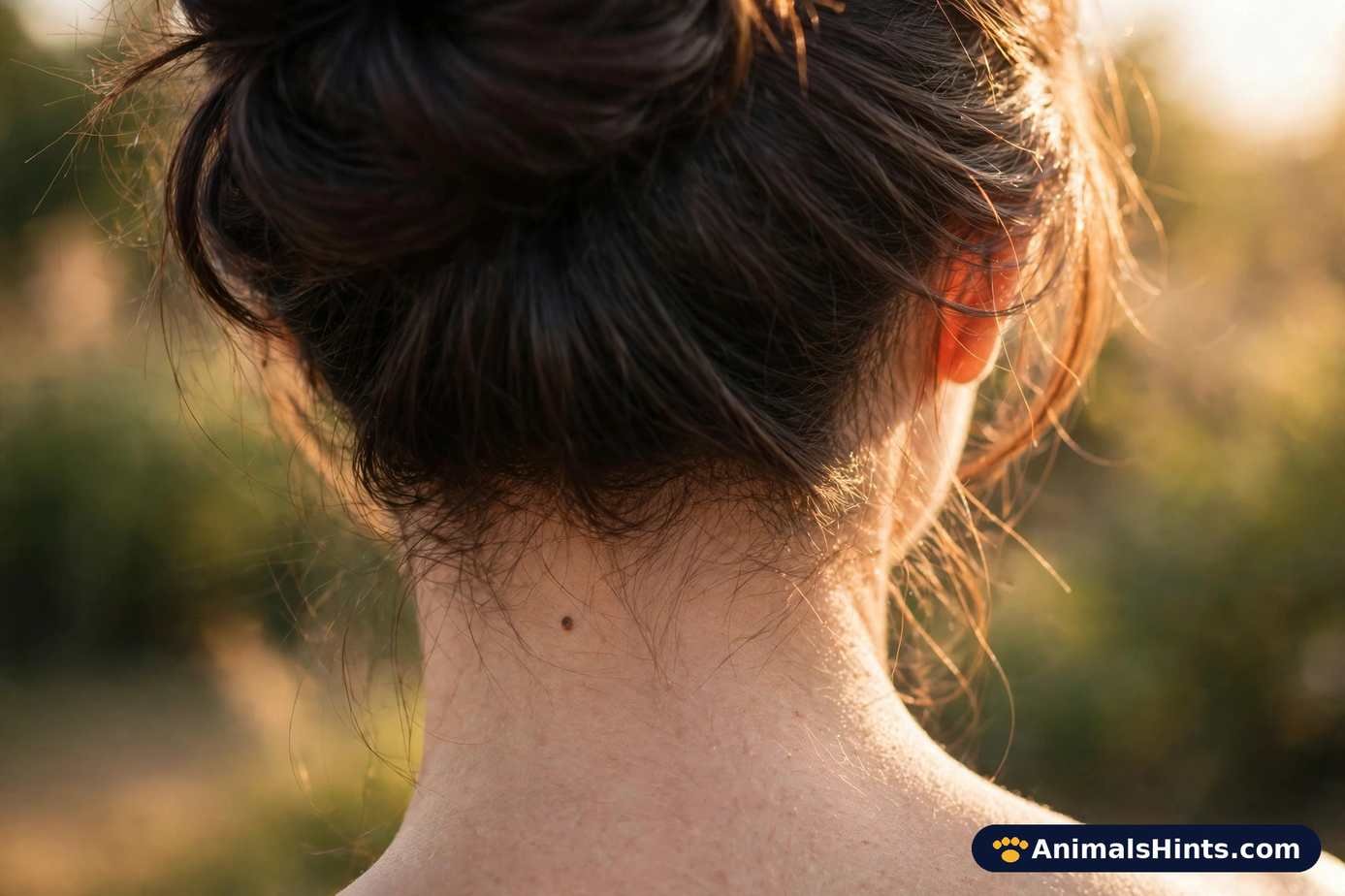
A mole on the back of the neck is the placement the traditions treat most gravely. Hidden from its owner’s own view, it is read in the Indian guides as a karmic imprint: a lesson carried over from a previous birth, usually — in the neck’s own symbolism — a lesson about communication, self-expression or responsibilities accepted and not yet discharged. The reading is not a punishment; it is a debt of growth. The same guides add that back-of-neck placements, for women, gather around family responsibilities carried at the centre of the household, and around a resilience built by carrying them.
5. Protective Mark and Good Fortune
Several strands treat a neck mole as a protective mark — a sign that its bearer is watched over, particularly in speech: protected from the consequences of hasty words, and lucky in negotiations, interviews and every arena where the voice does the work. The Chinese body charts hold one version of this directly: their nape-of-the-neck entry describes a person for whom everything needed is provided, with a real likelihood of comfort and money. Where this reading applies and where it does not is tested properly in the Chinese section below, because the same charts carry warnings the competitor pages leave out.
6. Sign of Authority and Leadership Potential
Because the neck holds the head up, a prominent neck mole is read in the Indian tradition as a mark of someone built to carry weight — authority and leadership potential, especially for the right-side and front placements. The front-of-neck reading adds the mechanism: a person whose mark is visible when she speaks is read as someone whose words land, whose presence in a room registers before she has finished her first sentence. Presence, in this tradition, is not volume; it is the quality of being believed.
7. Artistically Inclined and Soothing Personality
Venus rules the neck in the Western correspondence, and Venus rules art, music and beauty — so the artistic reading attaches to the neck mole in both the Western and the Chinese strands. The Chinese physiognomy charts say of the woman with a front neck mole that her voice is pleasing, her manner cultured and her taste in art good, whatever else those charts warn about the same placement. A soothing voice is the recurring detail: the neck is the instrument of the voice, and the traditions keep crediting its marked owners with voices other people relax into.
8. Challenges in Love and Career (Right Side Negative Aspect)
Honest mole guides keep a shadow reading, and the competitor’s list is right to include one. In the strand behind this meaning, the same independence the right side grants can cut the other way: a will that will not bend meets its tests in love and in work, where bending is sometimes the price of peace. The Chinese charts hold a matching caution for men — their right-side neck entry describes someone not family-oriented, who loves freedom and finds settling hard. The traditions do not call this placement bad; they call it strong, and note that strength is charged for.
9. Harmonious Family and Filial Piety
The Chinese body charts give the front of the neck, at the upper chest, one of their warmest entries: a person entrusted with the care of the family, who does the job marvellously and is rewarded for it in later life — the chart phrases the entry for a woman, and what it describes is filial piety repaid. The Indian guides echo the strand from their side: family responsibilities sit at the centre of the female back-of-neck reading, carried well. Two civilisations, one conclusion — the neck mole and the family’s weight keep being drawn together.
10. Business-Oriented and Lucky Personality
The last meaning gathers the commercial strand: ambition, prosperity and luck in business, attached in the Indian guides to the right side (confidence, ambition, authority) and in the Chinese charts to the nape (provision, a life not lacking money). A mole at the shoulder line adds the responsibility reading — the mark of someone whose work carries others. As with every meaning in this list, it is a traditional attribution, not a forecast; the verdict section below weighs how much of it the sources actually support.
Mole on the Neck Meanings for Females Versus Males (Astrology)
Mole on the Neck Meaning For Females
The Indian guides build the female reading placement by placement. On the left of the neck: intuition, emotional depth and creativity — an empathetic, expressive woman, nurturing by instinct and quick to sense what others feel. On the right: independence, ambition and willpower; the guides call these women natural leaders, decisive and unwilling to be managed. On the front: grace, charm and social magnetism, with powerful communication — the mark of a woman people listen to and remember. On the back: the karmic placement — lessons and family responsibilities carried at the centre of her life, and the resilience that carrying them builds. Over all four sits the summary already met in the meanings list: femininity and sensitivity held in balance with inner strength.
One honest qualification belongs here, because the female file has a second volume. The Chinese physiognomy charts, examined in their own section below, agree with the Indian guides about the right side and the back — and flatly disagree about the front, which they call unfavourable for a woman. Both readings are printed on this page, in full, because printing only the flattering one is how mole guides lose the right to be believed about anything.
Mole on the Neck Meaning For Males
The male file in the Indian guides runs parallel, with the emphasis shifted from expression to authority. A front neck mole on a man is read as leadership, honour and a rise to authority — the visible mark of a man whose word carries weight. The right side gives ambition, confidence and natural authority, the leadership placement again. The left side softens: emotional sensitivity, creativity, and a man who feels more than he shows. The back is the discipline placement — early struggles, responsibilities shouldered young, and success that arrives through perseverance rather than luck. Read the Chinese charts below before settling on any of these, because for men the two traditions part company even more sharply than they do for women.
The Neck in Chinese Body Reading: Below the Face Map
Every Chinese mole article on this site starts with a map check, and the neck’s check produces the most important correction in this article. The famous twelve palaces of Mian Xiang, the Chinese face-reading system, are all on the face — the forehead, the eyes, the nose, the cheeks, the mouth and, lowest of all, the chin and jaw, whose zone governs the later years and the people who support you. The neck has no palace. It falls just below the face map’s edge, in the territory the Chinese tradition reads with a different instrument entirely: the body-mole charts, handed down through almanac tradition, which plot moles across the whole body and read them one by one. Any guide that assigns a neck mole to a face palace has moved the map to fit the article. The readings below are the body charts’ own. (The chin the map does cover — the last face zone before the charts take over — has its own article: mole on chin meaning.)
The charts split the neck into more pieces than the Indian guides do. The front of the neck, read plainly, promises unexpected good fortune. The sides are read bluntly as marking an “unreasonable personality” — the charts are not sentimental. The back of the neck promises an ordinary, simple life, which in this tradition is a contented verdict rather than a dull one. Three finer entries deserve printing exactly, because they are so specific. The base of the neck carries the charts’ sternest warning — a life shortened or ground down by stress — with the tradition’s own advice attached: learn to relax. A mole at the front of the neck and upper chest is the family entry already met in the meanings list: care of the family entrusted to her, the job done marvellously, the reward paid in later life. And the nape of the neck is one of the charts’ genuinely good moles: everything needed provided, a likelihood of being rich, a life not lacking for money. Moles clustered around the Adam’s apple get a social warning of their own — difficulty getting along with family.
Alongside the charts runs a second Chinese strand, the physiognomy readings split by sex, and it is considerably less comfortable. For a woman: a left neck mole means hardship in love relationships and warns of an unhappy marriage; a right neck mole is the wealthy one — abundance, and a blissful, lasting marriage; a mole at the back means she will always meet benefactors who advance her career or business, and describes determination, courage and big dreams; a mole at the front is not favourable — she is said to yield too easily to people with evil intentions, risking financial hardship and entanglement in love, with the centre-front placement adding difficulty in pregnancy — while the same entry concedes her pleasing voice, her culture and her artistic taste. For a man: the left mole means constant financial burdens and a taste for shortcuts to big money, with the tradition’s advice attached — avoid high-risk speculation and gambling; the right mole means a man not family-oriented, in love with his freedom, hard to settle and quarrelsome even married; the back mole means an aggressive nature and a short temper; the front mole, alone of the male entries, is lucky — unexpected good fortune, and wealth its owner does not show off.
A third Chinese voice completes the file, and it is the darkest. The physiognomy writer Simon Wong’s formulation, widely quoted in the body-reading tradition, holds that the neck is the link between the head and the body — between “spirit” and “physical” — and that a mole on that link obstructs the flow of energy and can mean disappointment; a mole in the centre of the neck, in the same strand, represents a wild character who may cause their family grief. Set beside the almanac’s nape blessing and the Indian guides’ protective mark, that is not a nuance. It is a contradiction, and the verdict section below treats it as one.
Spiritual Meanings of Mole on Different Areas of the Neck
The competitor’s summary table, set against everything above it, reads as follows.
| Mole Placement on Neck | Spiritual Meaning |
|---|---|
| Front center | Clear expression, truthful nature, strong communication |
| Right side | Confidence, ambition, prosperity, leadership |
| Left side | Emotional depth, sensitivity, intuition, creativity |
| Back | Past-life strength, determination, hidden wisdom, secretive energy |
| Near the shoulder line | Responsibility, family karma, loyalty |
| Close to the collarbone | Sensual charm, artistic gifts, attraction toward luxury |
Two of these rows deserve a reader’s note. The front-centre row states the Indian and Western verdict; the Chinese charts’ female warning about the same square inch of skin is printed in full above, and a reader is entitled to both. And the back row’s “secretive energy” is the gentle version of the nape file — the Chinese charts split the back into an ordinary-life reading low down and a genuinely fortunate one at the nape itself, so “back” on the neck is really two placements wearing one label. Marks that fall on the face rather than the neck belong to the face map instead — a mole on the nose, for instance, is read by the nose’s own zones, not by anything in this article.
Cultural or Religious Interpretations
In the Hindu tradition of Samudrika Shastra, the Indian body-reading science, moles are karmic imprints — marks carried from previous births — and a neck mole sits on the channel between thought and action, which is why its Indian readings cluster around communication, self-expression and leadership. The luck attached to it is Venus-flavoured: love, luxury, comfort and magnetism, blessings the tradition assigns to the planet of beauty where her influence falls on the body. Its summary of the female neck mole has already been quoted twice on this page because the tradition itself keeps returning to it: sensitivity and strength in one person, in balance.
The Chinese tradition, as the section above shows, is really two traditions sharing a bookshelf: the almanac body charts, with their startlingly specific entries — the stressed base of the neck, the rewarded family carer, the provided-for nape — and the physiognomy writers, sterner and more moralising, for whom the neck’s moles measure how a person handles money, marriage and temper. Running under both is the idea the competitor’s cultural section names correctly: the mark of destiny and of weight — the weight of family and ancestors, carried at the body’s own carrying-place — with dark, prominent moles read as determination and resilience rather than as flaws.
Western spiritual tradition reads the neck as the bridge it anatomically is: the meeting point of the physical and spiritual worlds, where higher wisdom descends into earthly desire and earthly experience rises to be understood. Through the Taurus–Venus correspondence, the Western neck mole gathers the meanings of voice, beauty and attraction; through the modern chakra system, the same spot holds the throat chakra, the centre of honest expression, and a mark there is read as a lesson — or a gift — in speaking truth. These are living interpretive traditions, presented here as what they are: frameworks people read meaning through, none of them evidence.
The Honest Verdict: What a Neck Mole Can and Cannot Tell You
Three separate questions run through this page, and they have three different kinds of answer.
The first — what does tradition say a mole on the neck means? — has a rich answer. The Indian manuals, the Chinese charts, the palmistry and face-reading books and the modern compilations all say a great deal, and they do not always agree: the front of the neck is leadership and burden in one stream, throat-centred power in another, and the back of the neck is hidden wealth in the Indian tradition and hidden worry in some Chinese-style charts. All of that is on this page, attributed to the traditions that actually hold it.
The second — is any of it evidence? — has a short answer. No. No study, in any tradition’s defence or against it, connects the position of a mole to a person’s character, luck or future. The readings are a symbolic language, centuries old and genuinely interesting as culture. They are not measurements, and this article does not present them as more than that.
The third — what should you actually do about a neck mole? — is the only one with a practical answer, and it belongs to medicine rather than to meaning: watch it, photograph it, protect it from the sun — and if it changes, get a professional to look at it. That is the whole of it. A mole can carry a story without carrying a diagnosis, and it can deserve a doctor’s glance without deserving a fortune-teller’s fee.
Having a Neck Mole Removed
Removal is a medical procedure, and this section gives medical information only — no clinic is named, no price is quoted and nothing here is a recommendation to have a mole removed or to keep one.
- Shave excision — the mole is shaved flush with the skin surface. It is the common route for raised moles, and the removed tissue can be sent for laboratory examination.
- Surgical excision — the mole is cut out with a margin of surrounding skin, and the wound is closed with stitches. This is the route used when a sample needs to go to pathology.
- Punch biopsy — a small circular blade removes a core of tissue; it is sometimes used for diagnosis rather than cosmetic removal.
- Laser treatment — offered for some flat, benign moles. Laser destroys the pigment cells rather than removing the tissue, so there is nothing to send to a laboratory — which is why doctors are cautious about lasering any mole that has not been assessed first.
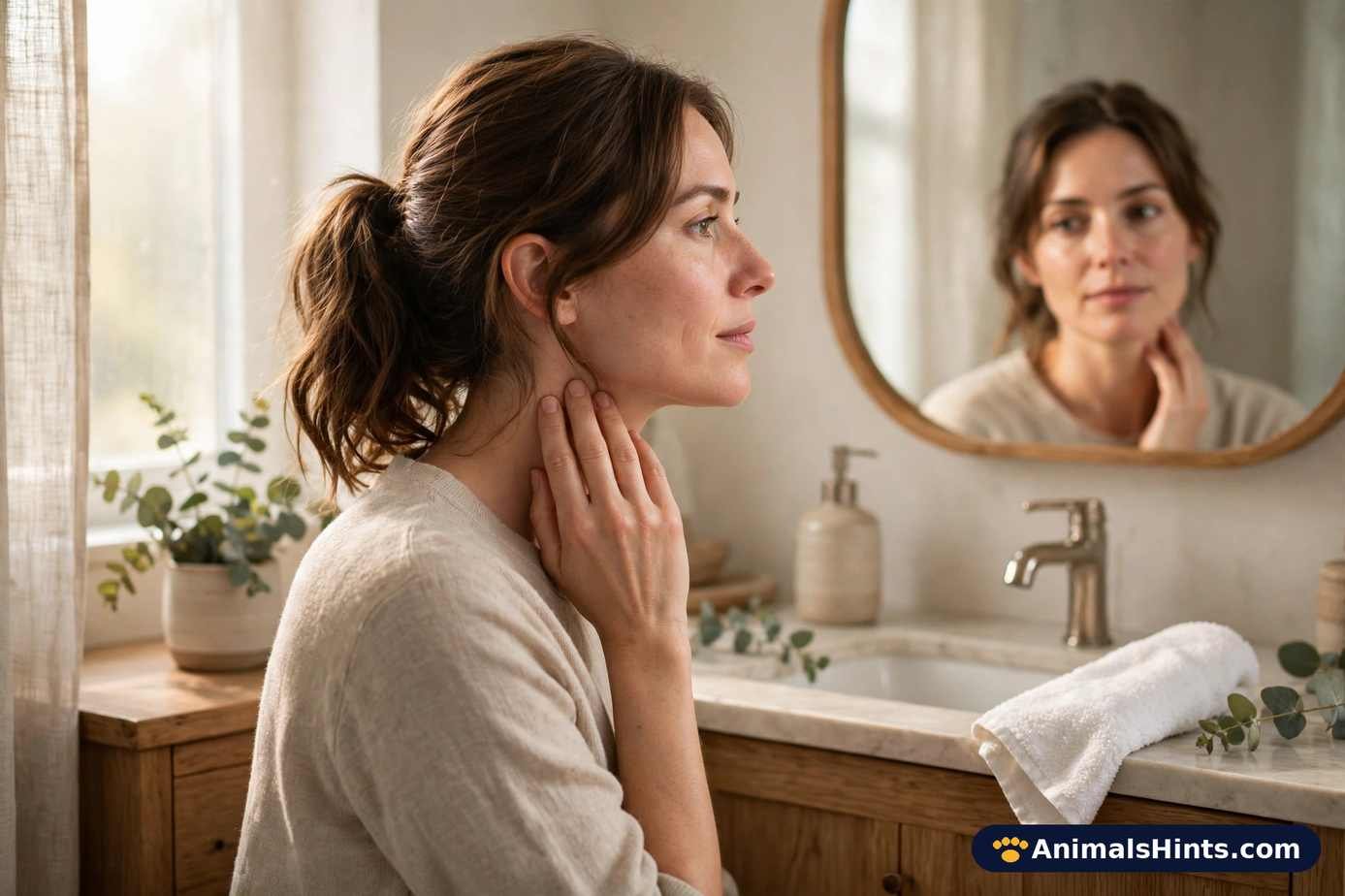
Two rules govern all four routes, and both matter more than the choice between them. First, any tissue that is removed should be examined — a mole that worried you enough to remove is a mole whose cells are worth looking at. Second, removal belongs in a clinic, not at home: home removal kits and creams risk infection, scarring and, worst of all, destroying a mole that needed diagnosis before anyone could see what it was. A mole on the neck sits close to structures a layperson should not be cutting near, and the reason to see a professional first is the same melanoma reason that runs through this whole section.
Final Thoughts
A mole on the neck turns out to be a good test of how to hold two kinds of knowledge at once. The traditions give the mark a character — burden and leadership at the front, hidden fortune at the back, a voice with power in the throat-centred readings — and those readings have been copied, argued over and believed for centuries, which makes them worth recording accurately. Medicine gives the mark a completely different instruction — watch it, and have changes checked — and that instruction is worth following exactly. Neither cancels the other. The story is the story; the skin check is the skin check; and the reader who keeps them in separate compartments, as the traditions themselves mostly did, gets the best of both.
Frequently Asked Questions
What does a mole on the neck mean for a woman?
By tradition, a front-neck mole on a woman reads as leadership, responsibility and a consequential love life; a back-neck mole as hidden provision or hidden worry, depending on the chart. It is a symbolic reading only — no study links a mole’s place to a woman’s character or fortune.
Is a mole on the neck good or bad luck?
The traditions disagree, which is the honest answer: the front of the neck is read as burden in the Indian stream and as power in others, while the back is wealth in one and worry in another. “Luck” here is a story the cultures tell, not a measurement anyone has made.
Should I be worried about a mole on my neck?
Not about its meaning — about its behaviour. A new, changing, bleeding, itching or oddly shaped mole is worth a professional skin check whatever any chart says about it. A stable mole that has looked the same for years is, medically, an unremarkable mark.
Can a mole on the neck be removed safely?
By a professional, routinely — shave excision, surgical excision, punch biopsy and laser treatment are all standard routes, and removed tissue should be examined. Home removal is the unsafe route, and it is discouraged by every medical authority on the subject.