Black Spiritual Meaning: Symbolism, Psychology, Cultures and the Shadow Side
The spiritual meaning of black, in nearly every tradition that reads color, comes down to three words: protection, power and potential. Black is the color of the night that hides and heals, of the soil a seed must be buried in before it can grow, and of the formal dress worn at both weddings’ edges and gravesides. If black keeps appearing in your life, the traditional reading is an invitation to go inward, set boundaries, and let something finish so something else can start.
That reading is not an accident of poetry. Black is what the eye sees when almost no light comes back from a surface, and it is made in living things by melanin, the pigment that colors a raven’s wing, a panther’s coat and human skin. Whole civilizations have built on it in opposite directions: Egypt called itself the Black Land and meant the fertile soil of life itself, while the West made black the color of mourning and formal authority. Even the animals split the verdict — a black cat is a bad omen in American folklore and a lucky one in Britain and Japan.
This guide walks through what the color black symbolizes, the psychology of the people who favor it, and all twelve of its spiritual meanings. It then follows black through the animal world, through the world’s cultures and the Bible, into dreams and the shadow side of the color, and finishes with honest ways to use black’s meaning in daily life. Where research exists, it is named. Where a claim is tradition rather than fact, it is labeled as tradition, so you can hold every part of this color at its proper weight.

What Does the Color Black Symbolize?
At its core, black symbolizes the unseen. It is the color of night, of closed eyes, of the inside of the earth — everything that exists but cannot currently be looked at. Almost every symbolic meaning black carries grows out of that single fact: what is black is present, powerful and hidden.
Spiritually, black is read first as protection and grounding. In the language of color symbolism it is the shield color: the one that absorbs rather than reflects, takes things in rather than sending them back. Traditions that work with energy describe black as a boundary — a way of holding your own ground in a noisy, demanding world — and a full section of the meanings below is devoted to that practice.
Black also symbolizes power and elegance. It is the color of the judge’s robe, the priest’s cassock and the formal suit: authority that does not need to raise its voice. In fashion it is the color of the occasion that matters, of slimming lines and timeless design, the shade that has never once gone out of style.
And black symbolizes endings. In the West it is the mourning color, worn when something — above all someone — has ended. But the tradition is careful to finish the sentence: in symbol after symbol, black’s endings are the kind that precede beginnings, the way night precedes morning and the buried seed precedes the shoot. Black is the only color that means the grave and the seedbed at the same time.
Why Is Black Black? The Science of the Color That Absorbs Everything
Every spiritual meaning in this guide rests on a physical fact, and the fact is worth stating plainly, because it explains why this color, of all colors, came to mean absorption, depth and the unseen.
You see a color because a surface sends some wavelengths of light back to your eyes and absorbs the rest. A red apple reflects red light; a green leaf reflects green. A black surface does the opposite of all of them: it absorbs nearly every wavelength of visible light and reflects almost none. Black is therefore not, strictly speaking, a color of the spectrum at all. It is what vision reports when light does not come back — the achromatic color of darkness itself, the background against which every actual color appears.

This is where a popular claim needs correcting in the open. Spiritual pages often say that black “contains all colors,” and that this is why it is powerful. The physics runs the other way. Mix all colors of light together and you get white, not black. Mix many pigments together and the mixture does darken toward black — but only because each pigment subtracts, absorbs, another band of wavelengths, until almost nothing is left to reflect. Either way, black is not a container of colors. It is their absence from the light reaching your eye — and the traditions that read black as the void, the womb and the unknown are, without knowing it, reading the physics correctly.
Nature’s own black is a pigment, and its name is melanin. The black and brown form, eumelanin, colors the skin, hair and eyes of human beings and the feathers and fur of animals; it is built precisely to absorb light, and it is extraordinarily good at the job, dissipating the ultraviolet radiation it absorbs before that radiation can do damage. The word itself carries the meaning: melanin comes from the Greek melas, black. When a raven gleams or a panther vanishes into shade, you are watching melanin at work.
Even in nature, though, perfect black is rare. An ordinary black feather still reflects a few percent of the light that hits it, which is why ravens shine blue and purple at the edges — a thin structural sheen over the pigment. The animal world has produced one true extreme, and it gets its own passage in the animal section below: feathers that swallow more than 99.9 percent of the light that strikes them, blacker than almost anything human beings have manufactured.
None of this proves the spiritual readings that follow, and this guide will not pretend otherwise. But it does explain their shape. A color defined by taking light in and giving nothing back was always going to collect meanings about depth, mystery, boundaries and the hidden — the symbolism grew out of the optics, and it grew in the same direction everywhere on earth.
Psychology of Color Black, and Personality
What does choosing black say about a person, and what does black do to the people who see it? Color lore and color research give two different answers, and both are worth hearing.
In color psychology’s traditional vocabulary, black is the color of authority, independence and self-protection. People who favor it are described as determined, disciplined and private: people who value depth over display, keep their emotions behind a boundary, and would rather be underestimated than exposed. Like all personality readings in this guide, that is a sketch from the color tradition, not a diagnosis — but it is a remarkably consistent sketch, and it matches the roles black clothing plays: the professional, the formal, the deliberately unreadable.
The research underneath the reputation is more specific, and one study is famous enough to name. In 1988, psychologists Mark Frank and Thomas Gilovich published an analysis in the Journal of Personality and Social Psychology under the title “The Dark Side of Self- and Social Perception.” They found that professional football and hockey teams wearing black uniforms ranked near the top of their leagues in penalties across the years studied — and that when a team switched to black, its penalties rose immediately. Their experiments traced the effect to both sides of the whistle: referees judged the same plays more harshly when the players wore black, and players in black chose more aggressive tactics themselves. Black, in other words, does not just look powerful. It measurably changes how the wearer is judged and how the wearer behaves.
The darker association shows up in the survey research too. In Kaya and Epps’ 2004 study of color and emotion, black was bound up for many respondents with death and menace — the shadow half of the same reputation. Put the findings together and black’s psychology is a genuine double exposure: no color is read as more elegant, and no color is read as more dangerous. Which reading you get depends on the room, the cut of the cloth and the culture doing the reading.
Psychology gives black one more address. Carl Jung used the word “shadow” for the parts of the personality a person represses or refuses to recognize — the fears, appetites and memories kept out of sight. Black became the shadow’s color in the culture that followed him, and much of the modern spiritual language about black — shadow work, facing the darkness, integrating what is hidden — descends from that single metaphor. It is a metaphor, not a measurement. But it is the reason black, alone among the colors, is treated as a psychological depth as well as a surface.
12 Spiritual Meanings of Black Color
Twelve readings of black recur across spiritual traditions, and they are gathered here in one place. Some are near-universal, because they grow out of night itself. Others belong to a single tradition, and those are credited to it. Read them as what they are: the accumulated symbolism of the color of darkness.
1. Mystery and Transformation
Black’s first meaning is mystery, and it is built into the optics: black is the color that returns nothing to the eye, so it stands for everything that is real but not yet visible. Spiritually it marks the incubation stage of a change — the period when the old form has dissolved and the new one has not yet appeared.
The tradition’s favorite image is the seed. A seed does its transforming underground, in total darkness, and nothing about that stage looks like growth from the surface. Black, in this meaning, is the color of trusting a process you cannot watch: the chrysalis stage, the winter field, the night before a decision clears.
2. Absence and the Unconscious
Black is the absence of reflected light, and spiritual tradition reads that absence as a picture of the unconscious mind: the vast part of a person that operates unlit. In this meaning, black symbolizes the inner territory — memories, instincts, unexamined fears — that runs a life from below the floor of awareness.
The teaching attached to it is not fear but acquaintance. Writers in this tradition hold that what stays unconscious controls a person more, not less, and that deliberately turning toward the dark interior — in reflection, in therapy, in honest prayer — is how its contents lose their power to ambush. Black is the color of the door to that work.
3. Protection and Grounding
In many spiritual traditions, black is the protective color. It is worn, carried and placed at thresholds by people who believe it absorbs hostile or chaotic energy the way a black surface absorbs light, and keeps the wearer’s own energy from leaking away. Black stones — tourmaline and obsidian above all — are the standard tools of this practice, and black clothing is its everyday form.
Grounding is the same meaning turned downward. Black is the color of soil and of the deep earth, and in energy practice it is used to anchor: to bring a scattered, anxious or over-stimulated person back into the body and the present moment. These are beliefs and practices, presented as the traditions hold them; what can be said from outside is that the feeling the practice aims at — bounded, settled, unhurried — is the feeling the color itself suggests.
4. Authority and Elegance
Black is the color authority wears when it wants to be believed. Judges, clergy, academics at graduation and mourners at gravesides all wear it for the same reason: black removes the person and leaves the office. It signals that what is happening is serious, that the wearer answers to something larger than fashion.
Its elegance is the same quality in a lighter key. Black flatters because it recedes: it simplifies a silhouette and lets form speak. Fashion made the point permanently in the 1920s, when Chanel’s little black dress — nicknamed “Chanel’s Ford” by Vogue, after the car that came in any color so long as it was black — turned the mourning color into the height of chic. Authority and elegance are one meaning, really: black is power with the volume turned down.
5. Spiritual Power and Occult Use
Practitioners of ritual traditions reach for black more than any other color, and their reasons follow the meanings above. In ceremonial practice black candles, robes and altar cloths are used for protection, for banishing what is unwanted, for endings and for work that requires total focus — the color is treated as an absorber that takes in stray energy and holds a space still.
An honest guide should say plainly what practitioners themselves say: within these traditions, black is not the color of evil. It is the color of night and earth, used by healers and ritualists of many paths precisely because it is read as neutral, absorptive and strong. The sinister reputation belongs more to black’s critics than to its users — a point the shadow-side section of this guide takes up in full.
6. Wealth and Restraint
Black is the color of luxury that does not advertise. High-end goods are packaged in matte black; the most exclusive tier of credit card is famously a black one, available by invitation only. The logic is the logic of the whole color: black implies that nothing needs proving, and in a market of bright claims, restraint itself becomes the status symbol.
Spiritual tradition reads the same quality inwardly, as wealth of a different kind: the richness of a person who is not driven by appetite or applause. Black contains rather than radiates, and this meaning holds that containment up as a discipline — keeping your energy, your money and your attention inside your own borders until you choose to spend them.
7. Deep Esoteric Wisdom
Black is the color traditions give to knowledge that is not public. Mystery religions initiated their members in darkness; monastic prayer keeps its deepest hours at night; and in symbol after symbol, the teaching that changes a person arrives when the lights of ordinary life are off. Black stands for the wisdom that cannot be browsed — only undergone.
This meaning should not be inflated into claims about secret doctrines, and this guide makes none. What is documented across traditions is simpler: darkness is the classic setting for contemplation, because removing sight removes distraction, and what remains is the mind meeting itself. Black’s esoteric wisdom is mostly that: the knowledge available only in the unlit room.
8. Symbol of Loss and Mourning
In the West, black is the color of grief, and the custom is old and traceable. Roman mourners wore a dark toga, the toga pulla, set aside for bereavement. Medieval and early modern Europe kept dark dress for sorrow, and the Victorians built an entire etiquette on it: after Prince Albert died in 1861, Queen Victoria wore mourning black for the remaining forty years of her life, and her court and country followed her into the color for years at a time.
Here this guide must correct the claim, made on many color pages, that black is the mourning color “across nearly all cultures.” It is not. In China, white is the traditional color of mourning and funerals, the color of death and of letting go of the living world. In Hindu India, mourners likewise wear white, read as purity and release. Japan mourns today in formal black, but its older funeral color was white as well. Black mourning is a Western tradition that has traveled widely with Western custom — a large fact, but a smaller one than the myth.
9. Cycle of Life and Death
No civilization read black more hopefully than Egypt, and Egypt’s reading was built into its name. The Egyptians called their country Kemet, “the Black Land,” for the dark silt the Nile laid down each year — the soil in which everything they ate grew. Black, there, was not the color of death. It was the color of the ground life comes from.
The gods carried the same meaning on their skin. Osiris, god of resurrection, bore the epithet “the black one” and was shown with black or green skin — the two colors were interchangeable in Egyptian art for rebirth — and Anubis, god of embalming, was portrayed black-faced: the color of the preserved body and of the fertile mud at once. In Hindu tradition the pattern repeats in another key: the goddess Kali, whose name comes from the Sanskrit word for black — and for time — destroys in order to renew, wearing the darkness that ends one cycle so the next can begin. Across both traditions, black is the hinge color: the place where the cycle turns.
10. Darkness and the Void
Several contemplative traditions give black its largest meaning of all: the fertile emptiness before form. In Buddhist teaching, emptiness — sunyata — is not nothingness but the open, unfilled nature of things, the space in which anything can arise. Spiritual writers on color borrow that frame for black: the void as a womb rather than a pit, the dark in which the stars, and everything else, become visible.
The same image opens the Bible, where creation begins with darkness over the face of the deep before any light is called for. Read across traditions, black in this meaning is potential before it is anything else — the unwritten page, the unplanted field, the held breath. What the void means depends on what a person believes fills it, and every tradition in this guide has its own answer.
11. Evil and Sin
In Western symbolism, black is also the color assigned to evil: the black heart, the black deed, the villain’s cloak. Christian-influenced culture gave the association its widest reach, linking darkness with sin, hell and separation from a God described as light. The reading is real, powerful and centuries deep, and this guide does not pretend it away.
But accuracy requires a flag, and the flag is this: the equation of black with evil is a cultural symbolism, much of it built after the biblical texts were written. The Bible’s own uses of black — examined in full in the biblical section below — are mostly mourning, famine, literal darkness, and, strikingly, a darkness in which God is present. Readers deserve both facts: the tradition that made black mean evil, and the older texts that mostly did not.
12. Personal Power and Sophistication
The last of the twelve meanings is the modern one, and it gathers the rest. In contemporary spiritual writing, black stands for self-possession: the state of a person who knows their own boundaries, keeps their own counsel and does not need an audience. To wear black, in this reading, is to make a small daily declaration — my energy is mine; my attention is not public property.
Sophistication belongs in the same entry because it is the social form of the same virtue. Black is refined because it is restrained; it is powerful because it does not plead. Of all the meanings in this list, this is the one most people who favor the color would name first — and the traditions would say that is fine. Self-mastery was always one of black’s assignments.
Black in the Animal World: Melanin, Night Hunters and Super-Black Feathers
On a site devoted to animals, black deserves its field notes, because in the wild black is not decoration. It is equipment — the most common dark pigment in the living world, put to work for hiding, hunting, warming and showing off.

Start with the pigment. Almost every black animal is black because of eumelanin, the same absorber that colors human skin and hair. A “black panther” is not a species at all: it is a melanistic leopard in Africa and Asia or a melanistic jaguar in the Americas — an ordinary spotted cat carrying so much eumelanin that the coat reads as solid black, until bright light catches it and the rosettes show through, exactly as they do in this guide’s photograph. Biologists read melanism in forest cats as camouflage for low light: a hunter hunting at dusk, in deep shade, does better invisible. The spiritual reading of the panther as a symbol of hidden power is folklore; the hidden part, at least, is plain zoology.
Then there is the blackest black on Earth, and birds wear it. In 2018, researchers reported in Nature Communications that the display feathers of several birds of paradise are “super black”: their barbules grow in dense, tilted arrays that trap light the way a forest traps sound, bouncing it inward until almost none escapes. Measured directly, super-black plumage reflects as little as 0.05 percent of light — absorbing up to 99.95 percent — where an ordinary black feather reflects ten to a hundred times more. For scale, that rivals the blackest materials engineers have made for lining telescopes. And the purpose is pure theater: the male displays against his own impossible blackness so that the colored patches beside it look brighter to the watching female. Nature’s deepest black exists to make color glow.
Ravens and crows carry the family’s everyday version: melanin-dark plumage with a structural sheen that flashes blue, green and purple in sun. Folklore noticed them early and often. In Norse myth, Odin kept two ravens, Huginn and Muninn — Thought and Memory — who flew over the world each day and reported back; across Europe and North America, a crow’s call has been read as an omen for centuries, a tradition our guide to the spiritual meanings behind crow cawing at you follows in detail. The birds’ real distinction is intelligence — corvids are among the cleverest animals alive — and the folklore’s respect for them is, in that sense, well placed.
And then there is the black cat, the single most argued-over animal in this guide. Encyclopaedia Britannica records that the belief in unlucky black cats was strongest in Europe and the Americas between the 14th and 18th centuries, when cats were named in witch trials as witches’ familiars; a papal bull of 1233, Vox in Rama, is the document most often cited as first tying cats to the devil. But the same animal flips sign across borders. In England, black cats are traditionally lucky — British soldiers of the First World War carried black-cat charms into the trenches, and the Science Museum Group still holds them. In Japan, Britannica notes, a black cat is an omen of good fortune outright, and black maneki-neko figures are kept for protection. Our full guide to black cat spiritual meaning walks through that whole divided history. One pigment, two opposite omens: the cat is the standing proof that black’s meanings are assigned by cultures, not carried by colors.
Spiritual Meaning of Black and White
Black rarely means anything alone. Its oldest partner is white, and together the pair forms the most durable symbol system in the world: darkness and light, night and day, the hidden and the revealed, each meaningless without the other.

Chinese philosophy drew the pair into its most famous diagram, the taijitu, the yin-yang symbol. Black carries yin — the receptive, cool, dark, inward principle — and white carries yang, the active, bright, outward one. The detail that matters is the dot: each half holds a seed of the other at its center, because in this teaching neither principle is pure and neither is permanent. Night turns toward day from inside itself; the darkest moment already contains the light’s beginning. Black, in the yin-yang reading, is not evil’s half of the world. It is rest, receptivity and gestation — half of how anything lives.
The pairing runs through the rest of the symbolic world the same way. In our own library, the symbolism behind seeing a white butterfly is read for purity and gentle new beginnings — all lift and first light. Black works the same journey from the other end: the chrysalis rather than the wing, the cocoon’s dark rather than the departure. White begins things in public; black prepares them in private, and a whole life needs both halves of the workshop.
Read together, then, black and white are not a war but a rhythm, and most traditions that use the pair say so. The spiritual task the pair assigns is not to escape the black half but to stop mistaking it for the whole story — to let the dark do its half of the work.
Cultural and Religious Significance
Black’s meanings are not only personal. Whole civilizations have adopted this color, and five traditions and one modern movement show its range.
- The West: Black is the mourning color and the formal color at once — the Roman toga pulla and the Victorian mourning warehouse stand behind the modern funeral suit, and the same wardrobe supplies judges, clergy, orchestras and black-tie evenings. Western black is solemnity industrialized: one color for grief, rank, elegance and night, its meanings sorted by context.
- China and the East: In the Chinese five-element system, black — hei — belongs to Water, and with it to the north and to winter: depth, stillness, endurance and wisdom held in reserve. The classical ritual texts fix the assignment plainly, giving the north to black as they give the south to red and the west to white. Note the boundary of the system, though: at a Chinese funeral, the mourners wear white, not black — black’s eastern dignity is about depth, not grief. In Japan, black carries formality and hard-won experience; it is the color of solemn dress today, funerals included.
- Africa: In Ghana’s kente tradition, black is among the most significant colors in the cloth: it stands for maturity, aging and intensified spiritual energy, and for connection to the ancestors — the black of a person or an idea fully ripened. Black kente is worn at funerals and memorials, and in parts of Ghana red-and-black cloth marks the most intense sorrow, the untimely death. The competitor pages often give African black as “fertile soil”; the documented Ghanaian record is about ripeness and spirit, and the fertile soil belongs to Egypt’s story, told next.
- Hinduism: Black in Hindu tradition is double-edged and honest about it. It is the color of Kali, the great goddess whose name means black — and time — and whose darkness is the dissolution of ego and ignorance, terrifying in form and maternal in function: she destroys what must end. At the protective end of daily life, a small black dot of kajal is still placed on a baby’s cheek or forehead in many Indian families, to turn aside the evil eye — black used as a shield in the most literal, domestic way.
- Ancient Egypt: Egypt remains the civilization that loved black most completely, because it had watched black feed it. The land itself was Kemet, the Black Land, named for the Nile silt; the god of resurrection answered to “the black one”; the god who prepared the dead for eternity wore the color of the mud that made the harvest — and, as the cycle section of this guide records, Egyptian art swapped black and green freely for rebirth, the pairing our green spiritual meaning explores from the green side. In Egypt, black was not death’s color. It was the color death was defeated by.
- Modern spirituality: Contemporary practice gathers the older strands into a working kit: black stones for grounding, black dress for boundaries, dark rooms for meditation, the color kept close by people who feel over-exposed. It is a modern synthesis rather than an ancient system, and this guide has labeled it that way throughout — a living tradition, assembled in the open.
The Shadow Side of Black: Fear, Omens and the Color of “Bad Luck”
An honest guide to black has to spend a section in its own shade, because no color in English carries a darker second reputation. The language itself keeps the ledger: a blacklist, blackmail, a black market, the black sheep of the family, a black day, a black mood. When English wants a word for hidden, illicit or disgraced, it reaches for black by reflex — a reflex trained by centuries of symbolism, not by anything the color did.
The largest entry in the ledger is the Black Death, the name later given to the plague pandemic that swept Europe in the 1340s and killed, by many estimates, a third or more of its population. The name was not contemporary — it attached itself in later centuries — but it fixed black’s association with mass death in the European imagination more firmly than any sermon. Add the older human fear underneath all of it: human beings are day animals, poorly sighted at night, and darkness was for most of our history the hours of predators and danger. Black inherited the fear of the dark itself.
The omens gathered where the fear was thickest. The black cat section of this guide records the worst of it — an animal tried as a witch’s accomplice for looking the color of night. Black birds drew the same suspicion in parts of European folklore, where a raven at the window could be read as a death in the house. These are superstitions with a body count of real cats and real accused women behind them, which is why this guide insists on the word superstition: the fear was real, the omens were not.
Hold the shadow honestly, though, and it shrinks to its true size. Every culture that feared black also revered it somewhere — Egypt buried its dead in the color of resurrection, Ghana ripens its elders into it, Japan dresses its most solemn occasions in it, and the modern West conducts its grief and its glamour in the same black cloth. Black’s shadow is not a defect in the symbolism. It is the receipt for how much meaning the color has been asked to carry.
Interpretations of Dreaming About the Color Black
Dream tradition reads black the way waking tradition does, as a dispatch from the hidden part of the self. These readings belong to folklore and dream interpretation, and they are offered in that spirit: psychology does not validate fixed dream dictionaries, and the most any honest guide can say is that dreamers have read their black dreams this way for a very long time.
Dreaming of black spaces, black clothing or a black landscape is the classic black dream, and it is read as a season of the unknown: a transition not yet resolved, information not yet arrived, a part of life being lived without a map. In the tradition’s telling, such dreams cluster at endings and beginnings — the dream life dressing a threshold in the color thresholds wear.
What wears the black refines the message. Dreaming of a black animal — a panther, a crow, a cat — is read in the tradition as instinct and intuition surfacing: the wild, unlit part of the self asking to be acknowledged rather than feared, often with a note of protection in it. Dreaming of wearing black is read as the dreamer’s own boundary going up — privacy, mourning, or a wish to be taken seriously. Dreaming of black water or a black sky is read through the element and the void: deep feeling, or the fertile emptiness before something forms.
The honest footnote matters most with the frightening versions. A black dream is not, in any tradition this guide could check, a prediction — and in the oldest dream lore it is not even usually a warning. It is the mind using its most available symbol for “what you cannot currently see.” The useful question on waking is not what the black foretells, but what in your life is presently unlit — and whether it needs a candle or simply time.
Biblical Meanings of the Color Black
Black appears in the Bible less often as a symbol than as a fact, and the facts cluster in three places: famine, mourning and the darkness around God. Read in order, they correct the popular assumption that biblical black simply means evil.
The famine color comes first. When the third seal opens in Revelation, the rider on the black horse carries a pair of scales, and the voice prices wheat and barley at famine rates — commentators across the centuries read the black horse as scarcity itself. The prophets use the same palette for the same thing: Lamentations says of a starving city, “our skin was black like an oven because of the terrible famine,” and Jeremiah pictures Judah’s mourning gates as “black unto the ground.” In the Hebrew imagination, black is the color hunger turns people.
The mourning color is woven, literally. Israel’s garment of grief was sackcloth, coarse cloth of black goat hair, and Revelation reaches for it at the end of the world: “the sun became black as sackcloth of hair.” To wear black in the biblical world was to wear your loss where everyone could see it — the same instinct the West later formalized into mourning dress.
And then there is the third cluster, the one that surprises readers raised on black-equals-evil. The Bible repeatedly places God in darkness: Moses “drew near unto the thick darkness where God was”; Solomon says at the Temple’s dedication that “the LORD said that he would dwell in the thick darkness”; the Psalm sings of the God around whom “clouds and darkness are round about him.” Even black as beauty is in the text, in the Song of Songs: “I am black, but comely, O ye daughters of Jerusalem.” Whatever later symbolism did with the color, the Bible’s own black is heavy with grief and hunger — and with a God who is not afraid of the dark. Verses here are quoted from the King James Version.
How to Use Black’s Meaning in Everyday Life
Symbolism earns its keep when it changes a Tuesday. These are the practical forms of black’s meaning, the ones this guide’s research and traditions actually support.
Wear it on purpose. Black is the deliberate choice for the day you need to be believed rather than noticed: the negotiation, the presentation, the funeral, the first meeting. But spend the Frank and Gilovich finding honestly — the same black that lends you authority also makes observers judge your identical actions more harshly. Wear it as the tool it is, with the edge known.
Give darkness back to the night. The best-evidenced advice in this section is the simplest: human sleep is built for darkness, and light at night — especially the bright, blue-leaning light of screens — works against the body’s own chemistry of rest. A genuinely dark bedroom is black used as the traditions always said it should be: protection, restoration, and a boundary the world does not cross.
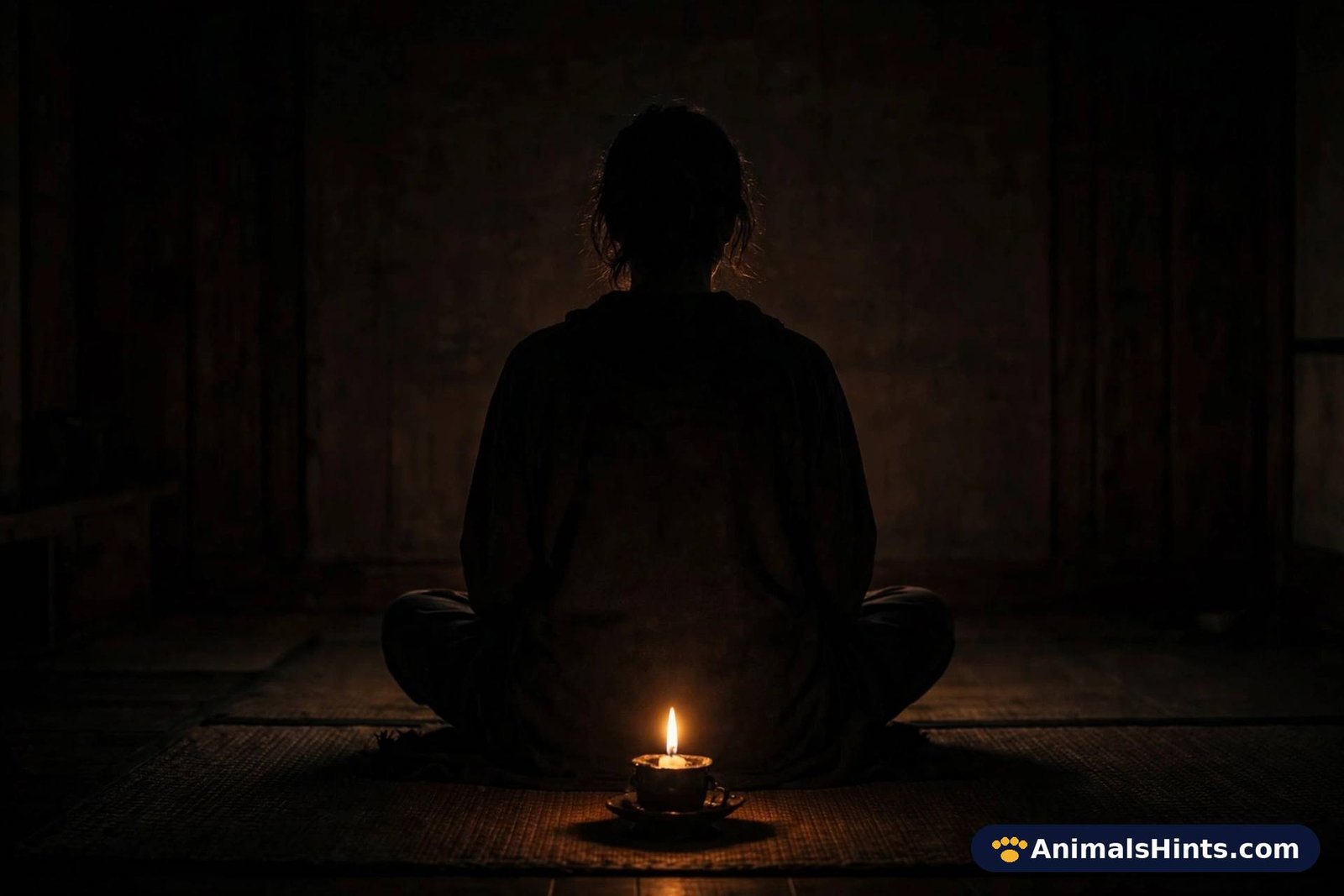
Work with the stones, if that is your practice — in its proper frame. Modern crystal practice keeps black tourmaline and obsidian for grounding and protection, and pairs them with the root of the chakra system. One refinement is worth making, because this guide makes it everywhere else: black is not the root chakra’s color in the system itself. The rainbow-ordered system taught today gives the root center red, and the classical Sanskrit descriptions picture its lotus in reds and golds, not black. Black’s root connection is a modern layer, added by crystal practice because grounding is what black stones are for. Modern practitioners are not wrong to use it; they are using the living version of the tradition, and it is more honest to know that traditions have versions.
And use the color’s method, not only its look. Once in a while, choose the black option in a life rather than a wardrobe: the unlit hour with no input, the question sat with instead of solved, the ending allowed to finish before the beginning is forced. Black’s whole teaching, in every tradition in this guide, is that the dark stage is a stage — with work in it that light cannot do.
Final Thoughts
Black is the one color that needs no invention. Its meaning was written by physics first — the surface that takes all light in and returns nothing — and every tradition in this guide, Egyptian resurrection and Ghanaian ripeness, Roman mourning and the yin-yang’s dark half, the unlucky cat and the lucky one, is a commentary on that original fact. The commentaries disagree about almost everything except the root: black means what is hidden, held and not yet finished.
Read as a whole, the color’s teaching is a single sentence with a shadow attached. Go inward, hold your boundaries, let endings be endings — and watch the fear, because the same darkness that protects a seed has been used to frighten people out of their wits about a cat. The traditions that loved black most were the ones that respected both halves of that sentence.
So when black keeps appearing, in the coat you keep choosing, in the dream that comes back dark, in the animal that crosses your path at dusk, take the tradition’s reading at face value and its advice literally. Something in you is in its unlit season. Tend it patiently, guard it honestly, and let the pigment that paints the raven and the panther, melanin, remind you what darkness has always been for: the place where light is absorbed, stored, and prepared for its next form.
Frequently Asked Questions
What does the color black symbolize spiritually?
Spiritually, black symbolizes protection, power and the fertile unknown: the darkness of soil and night where things are hidden, held and prepared. Traditions also read it as grounding, boundaries and endings that precede beginnings.
How does black affect our psychology?
Research finds black carries a double charge: it reads as elegant and authoritative, yet also as menacing — teams in black uniforms were penalized more, through both referee bias and wearers’ own behavior. Balance black with light, in rooms and in mood.
What does liking black say about your personality?
Color lore describes black lovers as independent, private and depth-seeking: people with strong boundaries who value substance over display. It is a personality sketch from the color tradition, offered as reflection rather than diagnosis.
How can I use black’s spiritual meaning in your life?
Wear black when you want authority and a clear boundary, keep your bedroom truly dark for sleep, and use black stones or a dark, quiet room for grounding reflection. Above all, borrow its patience: let unlit seasons finish their work.