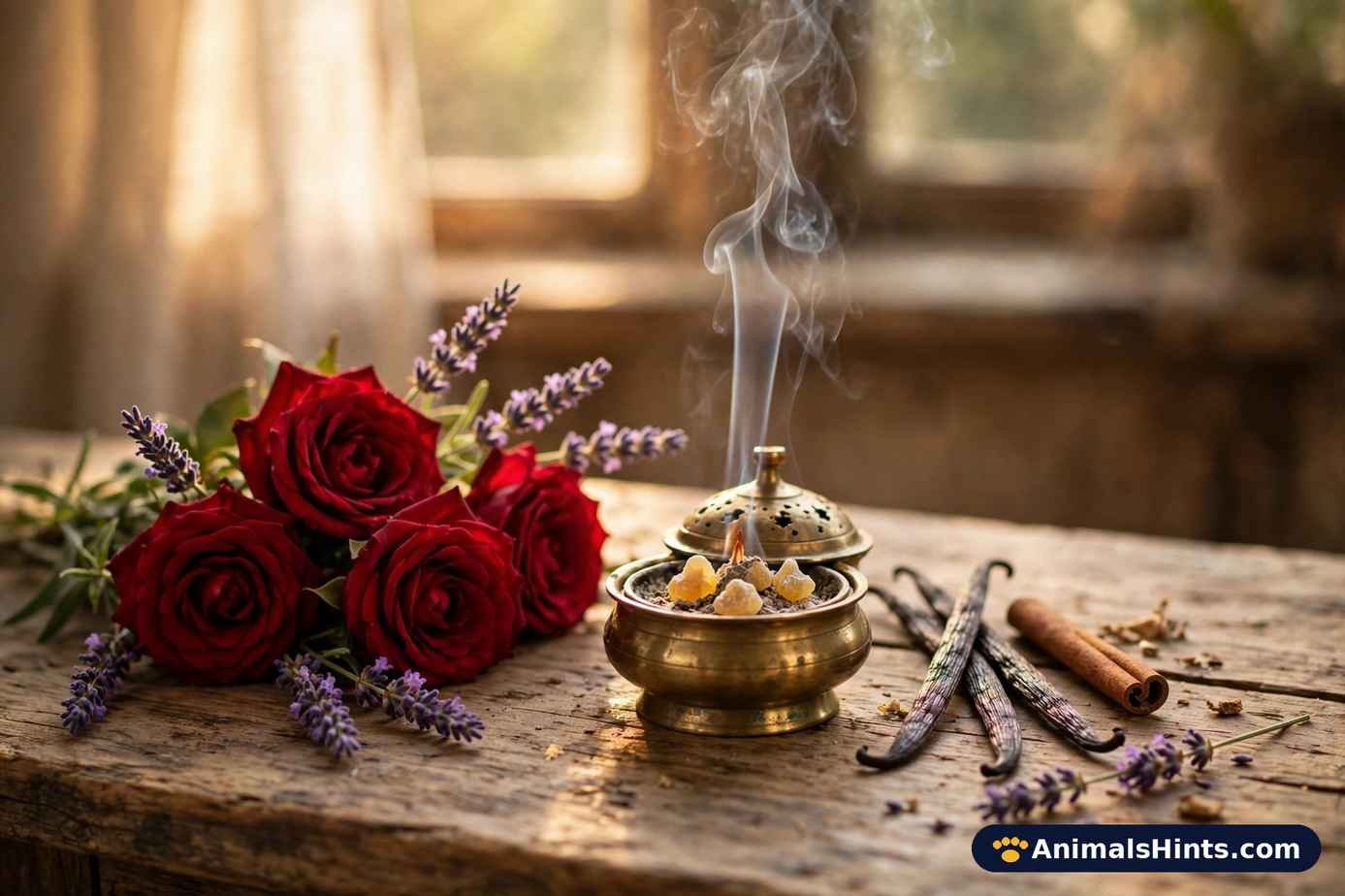
Spiritual Smells and Their Meanings: All 29 Scents, Sweet and Foul
When people search for spiritual smells and their meanings, one odd moment is usually behind it: a fragrance turns up where it has no business being — roses on a stairwell with no flowers in the house, vanilla in an empty kitchen, smoke in a room where nothing has burned — and then it is gone.
The tradition that writes these lists sorts every such scent into two families. Sweet smells are read as comfort: presence, blessing, guidance, a door held open. Foul smells are read as warnings: something hidden, stagnant or dishonest that wants attention. This page gives the full sorting as the tradition hands it down — all twenty-nine entries — and then does the thing the lists usually skip. It sets beside them the two other accounts a sourceless smell can honestly have: a medical one with a name of its own, and a household one that occasionally amounts to an emergency.
So the article runs in layers. First the phantom-smell idea itself and the whole list at a glance. Then the sweet and foul entries one by one, in the order the tradition keeps them. Then the Bible checked verse by verse, dreams, the gift the genre calls clairalience, and the cultural record. Woven through the back half are the reality checks: what doctors say, which smells to rule out inside the house before interpreting anything, and why scent reaches memory faster than any other sense you own.
What Are Phantom Smells?
A phantom smell is an odour your nose reports when nothing in the air is producing it. The experience is brief, oddly specific and hard to prove: one person in a room catches perfume, burning or rot at full strength while everyone beside them smells nothing at all. Medicine gave the phenomenon its name — phantosmia — long before the spiritual lists adopted it, and the borrowing matters, because the same event now lives in two literatures that explain it very differently.
In the spiritual reading, a sourceless scent counts as a signal, not a malfunction. Sweet phantom smells are taken for company: a presence arriving kindly, a blessing acknowledged, guidance offered without words. Foul ones are taken as alerts, the olfactory version of a bad feeling about a place or a person. Writers in the genre weigh three things when they interpret an episode: where you were, how strong the smell was, and what you were feeling in the moment it arrived.
Neither literature cancels the other on this page. What the genre calls a message, a clinic calls a symptom, and a single episode can be carried to either counter. The lists below record the genre’s readings faithfully, labelled as its readings. The medical and household accounts get their own sections further down, and the honest order for any smell that worries you is set out there: house first, doctor second, interpretation last.
Spiritual Smells at a Glance: All 29 Scents in One Table
Here is the whole catalogue on one screen — the twenty sweet entries and the nine foul ones, each with the reading the tradition assigns it, in the order the detailed sections keep. The table is a map, not the territory: every line expands into its own entry below.
| Scent | Sweet or foul | The reading in one line |
|---|---|---|
| Roses | Sweet | Love, comfort and a loving presence nearby |
| Lavender | Sweet | Peace, healing and the permission to rest |
| Jasmine | Sweet | Awakening and quiet guidance |
| Vanilla | Sweet | Warmth, safety and being looked after |
| Frankincense | Sweet | Cleansing and closeness to the divine |
| Sandalwood | Sweet | Grounding, meditation and inner wisdom |
| Cinnamon | Sweet | Protection, energy and movement |
| Myrrh | Sweet | Healing carried through grief and ancestry |
| Lilac | Sweet | Renewal and hope after a hard stretch |
| Gardenia | Sweet | Blessing and settled inner peace |
| Honey | Sweet | Life’s sweetness arriving as favour |
| Orange Blossom | Sweet | Happiness, warmth and creative energy |
| Pine | Sweet | Strength, clarity and purification |
| Rosewood | Sweet | Insight held steady by grounding |
| Bergamot | Sweet | Emotional balance returning |
| Mint | Sweet | Clarity and honest speech |
| Chamomile | Sweet | Rest, patience and harmony |
| Apple | Sweet | Renewal, abundance and meaningful dreams |
| Peppermint | Sweet | Fresh starts and momentum |
| Magnolia | Sweet | Quiet dignity and guidance |
| Rotten Eggs | Foul | Betrayal, deception and danger nearby — household check first |
| Sulfur | Foul | Heavy negativity in a place or situation |
| Burning Plastic | Foul | Disturbance; something artificial or toxic at work |
| Mold | Foul | Neglect and problems left to fester |
| Decay | Foul | Endings, stagnation and blocked movement |
| Rotting Meat | Foul | Betrayal, anger and a warning to take care |
| Smoke Without Fire | Foul | Falsehood and confusion; truth being masked |
| Stale Air | Foul | Lethargy and attachments gone stagnant |
| Fecal Odor | Foul | Corruption and consequences coming due |
Two honest notes belong with the map. The sweet column runs much longer than the foul one because these lists grew out of consolation literature — people write in about comfort more than about dread. And the foul column, uniquely in this catalogue, overlaps with real household hazards, which is why its entries carry their checks in plain sight further down.
Sweet Spiritual Smells and Their Prophetic Meanings
Sweet phantom smells are the entries people write in about. They are reported at charged moments — mid-prayer, in meditation, at a bedside, on the first morning in a new house — and the genre reads them, almost without exception, as good news arriving quietly. Where a foul smell is treated as a knock on the door, a sweet one is treated as someone already inside: company, not warning.
The individual readings differ, but the grammar is shared. A sweet scent is taken to mean that whatever it represents — love, rest, protection, a clean start — is near, permitted, and moving toward you rather than away. Some entries lean on documented ritual history: frankincense and myrrh were burned on altars and carried to graves long before they were list items. Others are modern symbolism built on what the plant already means in ordinary life — lavender from the bath and the pillow, honey from the table. Both kinds are labelled for what they are in the entries below.
List of Sweet Spiritual Smells and Their Meanings
The twenty entries follow, in the tradition’s own order. Each is given as the genre gives it — a reading to hold as belief, not a fact to bank on.
Roses Spiritual Smell Meaning
The rose is the list’s headline entry, and the one with the oldest paperwork. In the modern genre it is read for love, compassion and a gentle presence close by — a scent that turns up at emotionally loaded moments and is received as reassurance that the feeling is shared from the other side.
Older Catholic tradition kept a formal version of the same report. A sweet fragrance noticed around holy people, in life or after death, was called the odour of sanctity, and from the eighteenth century it could be entered as a favourable sign in a canonisation case; roses head the list of scents described. Thérèse of Lisieux, remembered as the Little Flower, was said to leave the smell of roses at her death, and rose scent in particular became linked with the Virgin Mary. The genre’s rose entry is that inheritance, simplified.

Lavender Spiritual Smell Meaning
Lavender is the list’s sedative. The genre reads its calm, soapy sweetness for peace, healing and emotional release — the smell of a nervous system being allowed to stand down. It is placed, in these lists, at recoveries and reconciliations: convalescence, the end of an argument carried too long, forgiveness moving in either direction. Its instruction is the plainest on the page: rest is not a reward paid out at the finish; sometimes it is the assignment.
Jasmine Spiritual Smell Meaning
Jasmine is read as the scent of a threshold. Heavy, sweet and strongest after dark, it is assigned to awakening and guidance in the genre’s scheme — intuition sharpening, dreams carrying more weight than usual, a sense of being steered without being shown the map. Where lavender tells the reader to stop, jasmine tells her to pay attention: something is developing out of sight, and the nose noticed first.
Vanilla Spiritual Smell Meaning
Vanilla’s reading is warmth with the edges padded. The genre files it under comfort, safety and being cared for — the kitchen smell of childhood, arriving in adulthood at moments of exposure or grief. Its message, as the lists phrase it in their different ways, is that support is not always announced; sometimes it is simply ambient. Of all the sweet entries, this is the one most often described in terms of home.
Frankincense Spiritual Smell Meaning
Frankincense is the heavyweight of the sweet list, because its sacred use is not a claim but a record. The resin was burned on altars across the ancient world, it appears in the Bible’s own incense recipe, and it still rises in churches today. The genre reads a sourceless breath of it as purification and contact with the divine: old weight clearing out of a room, prayer landing where it was aimed. When this scent is reported, the lists treat it as the most formal of the sweet signs.
Sandalwood Spiritual Smell Meaning
Sandalwood belongs to meditation in the genre’s sorting: grounding, inner wisdom, the mind settling into its chair. Its ritual use is documented on the Hindu side of the record, where sandalwood paste and incense are everyday offerings, and in Buddhist practice alongside it. A phantom breath of sandalwood is read as an invitation inward — solitude that restores rather than isolates, and answers that were in the building all along.
Cinnamon Spiritual Smell Meaning
Cinnamon is the list’s stimulant. Warm and spiced, it is read for protection with momentum: courage, alertness, energy moving again around work and goals. The genre places it at beginnings that need nerve — applications sent, prices named, doors knocked on. Where vanilla cushions, cinnamon prods; its appearance is taken to mean the situation is about to move, and the reader should be dressed for it.
Myrrh Spiritual Smell Meaning
Myrrh is frankincense’s darker twin: a resin of healing, grief and ancestry. It was precious cargo in the ancient world — one of the three gifts named in Matthew’s account of the Nativity, gold, frankincense and myrrh, and a burial spice of the period besides — and the genre keeps that gravity. A sourceless myrrh scent is read as healing that runs through the family line: mourning done properly, old pain acknowledged rather than bypassed, guidance with grey hair on it.
Lilac Spiritual Smell Meaning
Lilac is spring compressed into a smell, and the genre reads it accordingly: renewal, hope, the first warm evidence after an emotional winter. It is the entry assigned to aftermaths — the weeks after the storm, personal or literal, when life resumes at half volume. The reading is deliberately modest. Lilac does not promise a triumph; it promises that the season has turned, which in the lists’ economy is the larger news.
Gardenia Spiritual Smell
Gardenia’s perfume is rich enough to fill a doorway, and the genre reads it for blessing and settled peace — the scent of a life briefly in alignment. It is placed at moments of gratitude rather than need: the reading, unusually for this list, is not that help is coming but that help has already been received and noticed. Calm, in the gardenia entry, is evidence rather than advice.
Honey Spiritual Smell Meaning
Honey is read for sweetness in the transferable sense: favour, abundance, good things arriving in edible form. The genre connects it to relationships and opportunities ripening, and to the discipline of actually tasting them — gratitude practised while the blessing is still in the room. The image has a biblical root the lists rarely mention: the promised land of Exodus is introduced as “a land flowing with milk and honey”, sweetness used as shorthand for a good place finally reached.
Orange Blossom Spiritual Smell Meaning
Orange blossom is the list’s optimist: brightness, happiness, energy returning to social life. It is read at joyful transitions — engagements, new cities, work that finally fits — and assigned to creativity and warmth between people. In the genre’s weather system it is the smell of a front clearing: nothing solemn is being asked of the reader except to join in.
Pine Spiritual Smell Meaning
Pine is read for strength with clean air in it: purification, clarity, resilience. The genre uses it for mental fog and moral tangles alike — the scent of a forest floor after rain, applied to a decision. Its instruction is upright posture in both senses: stand in the truth you already have, and let the rest fall where it falls. Of the sweet entries, pine is the one most often described as bracing rather than soothing.
Rosewood Spiritual Smell Meaning
Rosewood — a sweet, woody scent drawn from a tropical timber tree — is the list’s entry for insight that stays grounded. The genre pairs it with balance: intuition in one hand, practicality in the other, growth at a pace that does not strip the soil. It is read at planning stages rather than crises, a smell for people deciding how to build, not whether to flee.
Bergamot
Bergamot, the citrus that scents Earl Grey tea, is assigned to emotional balance. In the genre’s scheme it arrives during overload — too many claims, too much weather inside one chest — and reads as the system righting itself: tension easing, proportions returning. Its teaching is the middle path stated as a fragrance: neither numbness nor flood, but feeling at a workable strength.
Mint
Mint is clarity with a cold edge. The genre reads it for mental alertness, stagnant energy clearing, and decisions that get easier once the air moves. It carries a second strand the other herbs do not: honesty — mint is the smell assigned to truth-telling, one’s own included. A sourceless breath of it is taken as a nudge to say the clear thing plainly and let the room adjust.
Chamomile
Chamomile is the gentlest entry on the sweet list: relaxation, harmony, patience. Where lavender is prescribed for a racing mind, chamomile in the genre is prescribed for a racing schedule — rest treated as a necessity rather than an indulgence, calm understood as a form of strength. It is read at the point of diminishing returns, when the next useful act is to stop.
Apple
Apple’s fresh sweetness is read for renewal and abundance, with a strand the fruit entries mostly lack: dreams. The genre links a phantom apple scent to knowledge ripening and to prophetic dreaming — the night shift carrying blueprints the day shift missed. New cycles are its home territory: orchards do their visible work in a rush each spring, and the reading borrows that rhythm.
Peppermint Spiritual Smell Meaning
Peppermint gets an entry of its own in these lists, split from mint on intensity: where mint clears the head, peppermint is read as the starter’s pistol — fresh starts, positive energy, momentum. It is assigned to the clearing of old patterns and to courage at the point of beginning. If mint is a window opened, peppermint is the same window with weather coming through it.
Magnolia
Magnolia closes the sweet list on a note of dignity: beauty, guidance and self-respect in the genre’s reading. It is placed at moments of self-examination — the scent of someone taking stock without self-contempt. The flower itself blooms large on old wood, and the lists borrow the image: what is flowering in you may be growing out of the oldest part of the tree.
Bad Spiritual Smells and Their Prophetic Meanings
The foul list is shorter and sterner. In the genre’s grammar, a bad smell is an alert rather than a sentence: deception somewhere in the room, energy gone stagnant, a problem being politely ignored at everyone’s expense. The readings are about attention — find the thing, name it, deal with it — and they are given below exactly in that spirit.
This page adds a rule the genre usually leaves out, and it is not optional. Several smells on this list are also how real houses announce real dangers: leaking gas, sewer problems, overheating wiring, something dead inside a wall. A spiritual reading is a thing you reach for after the household checks come back clean, never instead of them. The checks themselves are set out in their own section below; the most urgent one is flagged inside the first entry, where it belongs.
List of Bad Spiritual Smells and Their Meanings
The nine entries follow in the tradition’s order. Genre first, house second, in every case.
Rotten Eggs Smell Meaning: Betrayal, Deception, Spiritual Danger
The genre’s reading of a rotten-egg smell is treachery in the immediate circle: deception, hidden dishonesty, intentions being masked. It is treated as the list’s loudest warning — a scent said to arrive when someone nearby is not what they present as, and to call for vigilance, boundaries and a clear-eyed audit of who has access to what.
Before any of that: check the house. Natural gas has no smell of its own. Suppliers add a sulfur compound, mercaptan, precisely so that leaks announce themselves as rotten eggs, and federal pipeline rules require the added scent to be noticeable at a fifth of the concentration that could ignite. If a rotten-egg smell is strong, new or unexplained and your home has gas service, the official advice is to leave without touching switches or using a phone indoors, and to call the gas utility or emergency services from outside. The common harmless cause — sewer gas slipping past a dry drain trap — is a diagnosis for after the dangerous one has been ruled out.

Sulfur: Negative Energy, Demonic Influence
Sulfur is the foul list’s theological entry. The genre associates it with oppressive negativity and, in its stronger versions, with a demonic presence; more practically, it is read as heaviness in a place — anger, resentment or conflict soaked into the walls — and answered with cleansing and prayer in the reader’s own tradition.
The association has an old root. “Brimstone” is simply sulfur under its biblical name, and the fire-and-brimstone passages of Scripture fixed the smell to judgment in the Western imagination long before these lists were compiled. In a real house, meanwhile, sulfur notes usually arrive from drains or hot-water systems — plumbing first, theology second, as this page’s rule requires.
Burning Plastic: Spiritual Disturbance, Toxic Presence
Burning plastic is read as disturbance with a synthetic edge: something artificial or corrupt in the environment, a toxicity that does not belong to the natural order of the house and will not quietly biodegrade out of it. The genre treats its arrival as a prompt for immediate attention — identify what is false, sticky or corrosive in the situation, and remove yourself or it.
The household version is more literal. Plastic and electrical smells are how overheating wiring, failing appliances and melting insulation announce themselves. If the smell is real, traceable and persistent, the correct response is an electrician, not an interpretation — and if you find heat, scorching or a breaker that keeps tripping, stop using the circuit until one has been.
Mold Spiritual Smell Meaning: Neglect, Hidden Problems
Mold is the foul list’s housekeeping entry: neglect made smellable. The genre reads it for the problem left in the dark — the emotion unprocessed, the repair postponed, the cupboard nobody opens — growing quietly stronger for being ignored. Its prescribed response is almost disappointingly practical: clean, open, confront, in whichever order the situation allows.
Mold is, of course, also just mold — a fungus with spores, fed by moisture, and a genuine household problem when it colonises a wall. Fungi have a fuller hearing elsewhere in this catalogue, at the spiritual meaning of mushrooms; here it is enough to say that a musty smell with a leak behind it is a plumbing job wearing a metaphor, and the metaphor can wait until the wall is dry.
Foul Smell of Decay: Ending, Stagnation, Spiritual Blockage
The smell of decay is read as an ending announcing itself: something in the reader’s life has run its course and is being kept past its time — a habit, a role, a version of events. The genre is unsentimental here. Decay is treated not as a punishment but as information: what is finished starts to smell, and the smell is the deadline. Its counsel is release, on the grounds that the space a dead thing occupies is exactly where the next living thing was supposed to go.
Rotting Meat Smell: Betrayal, Anger, Spiritual Warning
Rotting meat is the list’s entry for betrayal with heat in it: anger unresolved, dishonesty close to home, conflict going off in a closed room. The genre reads it as a protective alert — caution in dealings, care with confidences, time taken to cool and reflect before acting on a grievance.
It is also, in the unglamorous majority of real cases, meat: something organic really is decaying somewhere — a forgotten bin bag, a spill behind an appliance, a mouse that died inside a wall. A house search with a torch settles most rotting-meat reports in minutes, and until it has been done, the smell has a mundane suspect in custody.
Smoke Without Fire Smell: Falsehood, Lies, Spiritual Confusion
Smoke with no fire is read as the smell of a cover story: falsehood, confusion, truth being deliberately obscured. The genre’s logic is visual as much as olfactory — you cannot see through smoke — and the prescribed response is discernment: slow down, verify independently, and trust the unease enough to check the facts.
This entry, of all of them, also has a famous second life in the clinic. Sourceless smoke and burning smells are among the phantom odours doctors hear about most often — the medical section below takes up that thread, because a smoke smell that follows you from building to building is a different problem from a smoke smell that stays in one room.
Stale Air: Spiritual Lethargy, Negative Attachments
Stale air is read as stagnation in its mildest form: lethargy, attachments gone airless, growth paused in a room nobody opens. The genre’s remedy is the only one on either list that works literally and symbolically at the same time — ventilation. Open the windows, move the air, resume the interrupted thing. A stale smell that survives a thorough airing, though, graduates to the household list: soft furnishings, drains and carpets hold odours the way they hold dust.
Fecal Odor Meaning: Corruption, Karmic Consequences
The foul list ends with its bluntest entry. A fecal odour is read for corruption and consequence: the bill arriving for patterns that were always going to present one — dishonesty, exploitation, messes made and left for others. The genre’s answer is accountability as purification: own the thing, clean it up, and break the cycle at the point where it is actually yours to break.
In a physical house, the same smell usually means the drains are telling the truth: a dried trap, a blocked vent or a sewer problem. As with the rotten-egg entry, the plumbing explanation is checked first and the cosmic one entertained afterwards.
Biblical Meanings of Sweet and Foul Spiritual Smells
On the sweet side, the genre stands on real ground — scent genuinely is one of the Bible’s working languages. Worship at the tabernacle was built around a commanded fragrance: Exodus gives the holy incense recipe ingredient by ingredient, “stacte and onycha and galbanum, and pure frankincense” (Exodus 30:34), and the Psalms turn the smoke into a picture of prayer itself: “Let my prayer be set before You as incense” (Psalm 141:2, NKJV). After the flood, it is smell that moves the story — the Lord “smelled a soothing aroma” from Noah’s offering (Genesis 8:21). Paul keeps the figure running into the New Testament, calling believers “the fragrance of Christ” (2 Corinthians 2:15) and Christ’s self-giving “a sweet-smelling aroma” (Ephesians 5:2).
The Catholic odour of sanctity grows from that soil rather than from any single verse: a documented tradition in which fragrance reported around the holy — roses above all, and with them violets, honey, frankincense and myrrh — could count in a saint’s favour. It is tradition, carefully recorded, and this page files it as exactly that.
The foul side of the biblical ledger is much thinner than the genre suggests, and honesty requires saying so. Scripture contains no system of smell-omens for houses, no table matching odours to the sins of a room. The two proof-texts these lists circulate do not survive contact with the page. Proverbs 15:27 warns that greed “troubles his own house” — a verse about bribery and household ruin that never mentions smell or decay at all. And Ezekiel 8:17’s famous nose image, “they put the branch to their nose”, describes a ritual gesture inside a vision of idolatry, not an odour or a doctrine about one. What the Bible does with foul smell is use it as an image — of corruption, of judgment — a handful of times, always at the scale of nations and armies rather than living rooms. The sweet side of this section is text. The foul side, as the genre builds it, is construction.
Prophetic Symbolism of Dreams About Spiritual Smells
Dreaming has its own chapter in the genre, on the theory that the sleeping mind deals in symbols full-time. A sweet smell inside a dream is read as the waking reading with the volume raised: blessing, love or favour on its way, reconciliation in progress. Flowers and incense are the dream scents the lists dwell on, precisely because they carry the strongest waking associations.
Foul dream smells invert the sign. They are read as warnings scaled by strength — a faint bad smell for a minor difficulty, an overwhelming one for a serious matter — and the genre advises dreamers to log the details on waking: which smell, how strong, what else the dream contained. Smell rarely performs solo in dreams, the lists note; it arrives as one instrument in an arrangement of image, touch and sound.
The honest label belongs on this section too. Dream interpretation is a folk practice with a long history and no validated method behind it; psychologists do not endorse fixed dream dictionaries. What a dream smell indisputably carries is the dreamer’s own associations — which is why the same roses can mean a grandmother in one life and a wedding in another. The genre’s readings are offered in that spirit: as prompts for reflection, not bulletins.
Smelling Something Out of Nowhere or Clairalience (Clairolfaction)
The genre gives the ability itself a name: clairalience — also spelled clairsalience, and in some lists clairolfaction — the “clear smelling” said to let a person receive scents from beyond the physical room. It is a modern term from psychic practice, not a clinical one, and the lists treat it as the rarest of the “clair” senses, the nose’s counterpart to clairvoyance.
Its most-reported form is also its most human. The classic clairalience story is not incense or sulfur but a person: a dead mother’s perfume crossing an empty landing, a grandfather’s pipe tobacco in a house where nobody has smoked for decades. The lists read such episodes as presence rather than information — the scent is the message, and its content is simply I was here. Whether the reader files that under spirit contact or under the memory wiring described below, it is the experience that brings most people to pages like this one. The nose, incidentally, has a second career in this catalogue as an omen-carrier in its own right — the nose twitching traditions read the organ’s movements the way this page reads its messages.
What Medicine Says About Smells That Are Not There
Medicine’s name for the whole subject of this page is phantosmia: detecting a smell that is not actually there. Cleveland Clinic describes it plainly as a symptom rather than a disease — something many ordinary conditions produce, and occasionally a sign of a brain-related one. It sits in a family of smell disorders alongside parosmia, the related fault in which a real smell arrives distorted, so that coffee or onions come through as chemical or rotten. The two are frequently confused, and the distinction matters: phantosmia invents the smell; parosmia edits it.
The clinic’s version of the catalogue looks noticeably different from the genre’s. The phantom smells patients actually report skew heavily unpleasant — burnt, foul, rotten, sewage-like, metallic and chemical are the descriptions the medical literature collects, with smoke and burning at the head of the list. Sweet phantom smells do occur; the clinical sources are clear that they are the minority pattern. Nobody needs to resolve that tension in either direction here. It is simply worth knowing that the famous reports and the common ones run opposite ways.
The causes medicine lists are mostly unglamorous and mostly treatable. Colds, allergies and infections of the nose, throat and sinuses head the list; beyond them sit nasal blockages such as polyps, head injuries, some medicines, endocrine and nutrition problems, and — further down, less commonly — neurological conditions. Viral illness is a recognised trigger in its own right: the recent medical literature is thick with cases that began during or after COVID-19, which is how many people first met the word phantosmia at all.
The thresholds are clear enough to print. Cleveland Clinic’s advice is that phantom smells lasting longer than a few weeks earn an appointment. MedlinePlus adds the companion rule — a smell problem that continues, worsens, or arrives alongside other unexplained symptoms should be looked at. The workup is ordinary: an examination in and around the nose, sometimes a scan or a scope, sometimes formal smell testing. A single brief episode trailing a head cold is common and usually burns itself out; a phantom smell that moves in, stays, or keeps returning is a symptom asking for its cause, and no reading on this page should be used to talk anyone out of that appointment.

Rule Out the Real Source First: The Household Checks
Before the genre’s readings and alongside the medical ones, a sourceless smell deserves twenty minutes of detective work in the physical house. Run these in order — the list is arranged by stakes, not by likelihood.
- Rotten eggs, strong or new, in a home with gas: treat it as a leak until the utility says otherwise. Leave without operating switches or using a phone indoors; call the gas company or emergency services from outside. This one outranks every other item on the page.
- Sulfur or rotten eggs only around one drain: suspect sewer gas past a dried-out trap. Run water for half a minute in every unused sink, tub and floor drain; a smell that clears within the hour has confessed.
- Rotten eggs only when the hot water runs: the water heater is the usual address — bacteria reacting inside the tank are a known cause, and a tank flush or a plumber is the fix.
- Burning, plastic or electrical, persistent or localised: stop using the outlet or appliance involved and get an electrician. A burning smell with a findable source is a fault, not a phantom.
- Musty and damp that survives airing: follow the water. Mold follows moisture — a slow leak, a cold wall, a blocked vent — and the repair is to the water, not the smell.
- Nobody else can smell it, anywhere you go: a smell that travels with you between buildings has left the household category entirely. That pattern belongs to the medical section above.
A smell that survives all six checks has earned its mystery honestly. Most do not survive them — which is precisely why the checks come before the meanings in any house that wants both.
Connection Between Spiritual Smells and Psychic Abilities
In the genre’s architecture, clairalience rarely travels alone. Writers describe it arriving in company — with sharpened intuition, with vivid or prophetic dreams, with the sense of knowing a thing a moment before it is confirmed — and they treat scent as the most emotionally literate of the channels, the one that speaks in feelings rather than sentences.
The practical doctrine that follows is cooperation between the senses: a dream confirmed by a scent, a scent interpreted by a sudden certainty, each channel cross-checking the others. Sweet smells in this frame are used as amplifiers during prayer and meditation; foul ones as brakes, prompting reflection and protective steps. None of it is testable, and the genre’s own writers vary in how literally they hold it — but as a description of how these experiences cluster in people’s reports, it is consistent, and it is the form in which the tradition actually reaches its readers.
Why Smell Reaches Memory and Emotion Faster Than Any Other Sense
Underneath the genre’s central experience sits a piece of ordinary brain wiring, and it explains more than any list. Every other sense you own is routed through the thalamus — the brain’s relay station — before it reaches the regions that process it. Smell is the exception. Signals from the olfactory bulb project almost directly into the amygdala, which handles emotion, and the hippocampus, which handles memory. A smell is therefore felt and filed before it is ever thought about; it does not queue behind analysis.
This is why a scent can ambush. The famous literary case is Proust’s madeleine, a tea-soaked cake whose taste and smell returned a whole childhood to his narrator uninvited; psychologists still use his name for the effect. A familiar perfume on a landing does not remind you of a person the way a photograph does — it briefly reinstates them, emotion first, biography second. The genre reads that ambush as contact. Neuroscience reads it as architecture. Both agree on the datum: no other sense gets in this fast, or this deep, or with this little paperwork.
Cultural and Religious Significance of Spiritual Smells
For all its modern packaging, the idea that scent mediates between worlds is one of humanity’s older technologies. Incense is burned in Catholic and Orthodox churches, offered in Hindu worship and lit before Buddhist shrines; frankincense and myrrh were temple goods across the ancient Near East. Sweet smell, in practice after practice, is how human beings have marked a space as attended-to by something larger — devotion you can breathe.
The foul side has its folklore too: across cultures, unexplained bad smells attach to haunted places, curses and spiritual imbalance, the sensory signature of a situation gone wrong. The two columns of this page’s table turn out to be very old columns. What is genuinely new is only the format — a searchable list, one scent per heading — laid over a pattern of interpretation that temples, sickrooms and graveyards have run for millennia.
Final Thoughts
A list like this one survives because the experience underneath it is real, whatever its cause: smells do arrive uninvited, and they arrive carrying feeling out of all proportion to their chemistry. The tradition answers that experience with meanings — roses for love, sulfur for warning, vanilla for being held — and this page has recorded those meanings faithfully, in their own order, because they are the reason the page exists.
Hold them in the order this article was built. A rotten-egg smell gets the gas check before it gets an interpretation; a phantom smell that stays for weeks gets a doctor before it gets a doctrine; and a sweet smell that survives every check can be received with the gratitude the genre recommends, no permission needed from either literature. Notice the scent, note the moment, run the checks — and if what crossed your room was a familiar perfume on an empty staircase, let the memory it woke have its minute. The nose reported something. What it reported is yours to weigh.
FAQs
1. What do sweet spiritual smells mean?
In the genre’s reading, they signal a kind and close presence: love, comfort, guidance or blessing, with the specific scent carrying the specific shade — roses for love, lavender for rest, frankincense for cleansing. They are reported most at prayer, in grief and at thresholds, and are received as reassurance.
2. What do bad spiritual smells indicate?
The tradition reads them as alerts: deception, stagnation or a problem being ignored, with rotten eggs and sulfur as the loudest warnings. On this page they also carry a practical rider — several are the smells of real household faults, and the house is checked before the omen is entertained.
3. Why do I smell things that are not there spiritually?
The genre calls the ability clairalience and reads the scent itself as the message, sweet for blessing and foul for warning. Medicine calls the same event phantosmia and produces a list of causes headed by colds, allergies and sinus trouble; a phantom smell lasting more than a few weeks deserves a doctor’s appointment whichever reading you prefer.
4. How should I respond to spiritual smells?
In order: rule out the house, consider the clinic if it persists, then take the meaning. For a sweet smell, the tradition’s response is gratitude and attention — note the scent, the moment and what followed, in a journal if it recurs. For a foul one, clean the space, settle the neglected thing, and let the symbol and the scrubbing reinforce each other.