Right Knee Twitching Spiritual Meaning: Omens, Lists and Real Causes
The right knee twitching spiritual meaning is one of the least settled entries in the entire twitching record. Modern guides call a twitching right knee good luck almost as a reflex, yet the oldest omen lists that name the right knee at all refuse to flatter it: one pairs it with severe anger and a new friend in authority, another with sad news on the way, and only a single list promises gold. The knee the internet calls lucky is the knee the old record treats with caution.
That split is the real subject here. Underneath it sits an ordinary physical event — a muscle in the front of the thigh firing on its own, in a leg modern life loads with stairs, chairs, screens and standing — and medicine, which reads that event the same way on either side of the body, has its own short account of why knees flicker and when one deserves attention.
This page keeps the knee guide’s own structure and carries its nine meanings in full, then sets the documented right-knee entries side by side — the mixed old verdict, the one gold promise, the flattering modern stream, and the honest places where the tradition simply has no knee entry — before the doctors’ account of the event and the steps that calm a twitching leg.

What Does a Knee Twitching Represent Metaphysically?
The guide this article follows builds its reading on what a knee is for. Knees carry the body’s weight, bend it forward and set its direction, so in the metaphysical frame the guide collects, the knee stands for foundation, movement and the course a life is taking. A sudden movement in that joint is read as activity in those themes: something stirring around how a person stands, advances or changes direction.
Within that frame, the qualities the guide attaches to the knees are humility, flexibility and balance. The knee is the joint that bends — in prayer, in respect, in lowering yourself to lift something — and a twitch there is read as pressure building around those virtues: resistance that needs softening, a decision avoided for too long, energy gathering before a change of course. The guide also ties the knees to grounding, the lower energies of safety and stability, so a flicker can be read as the body’s footing asking for attention.
Read those themes as the modern interpretive layer they are. They organise the nine meanings that follow, and they are how most contemporary writing approaches the subject. The older omen lists, examined in their own section further down, are organised very differently — by side, by list and by blunt outcome — and what they record for the right knee does not always match the gentle modern reading. Both layers are set out on this page, each labelled as what it is.
What Causes Knee Twitching? The Medical Explanation
Doctors start from an anatomical fact that surprises most readers: the kneecap itself has no muscle in it. Healthline’s clinical review of knee twitching puts it plainly — the twitches people feel at the knee are usually set off by the muscles of the thigh, not by anything inside the knee. The large quadriceps group on the front of the thigh does the knee’s lifting and straightening, and when a small bundle of its fibres fires without being asked, the movement is felt right at the joint it serves.
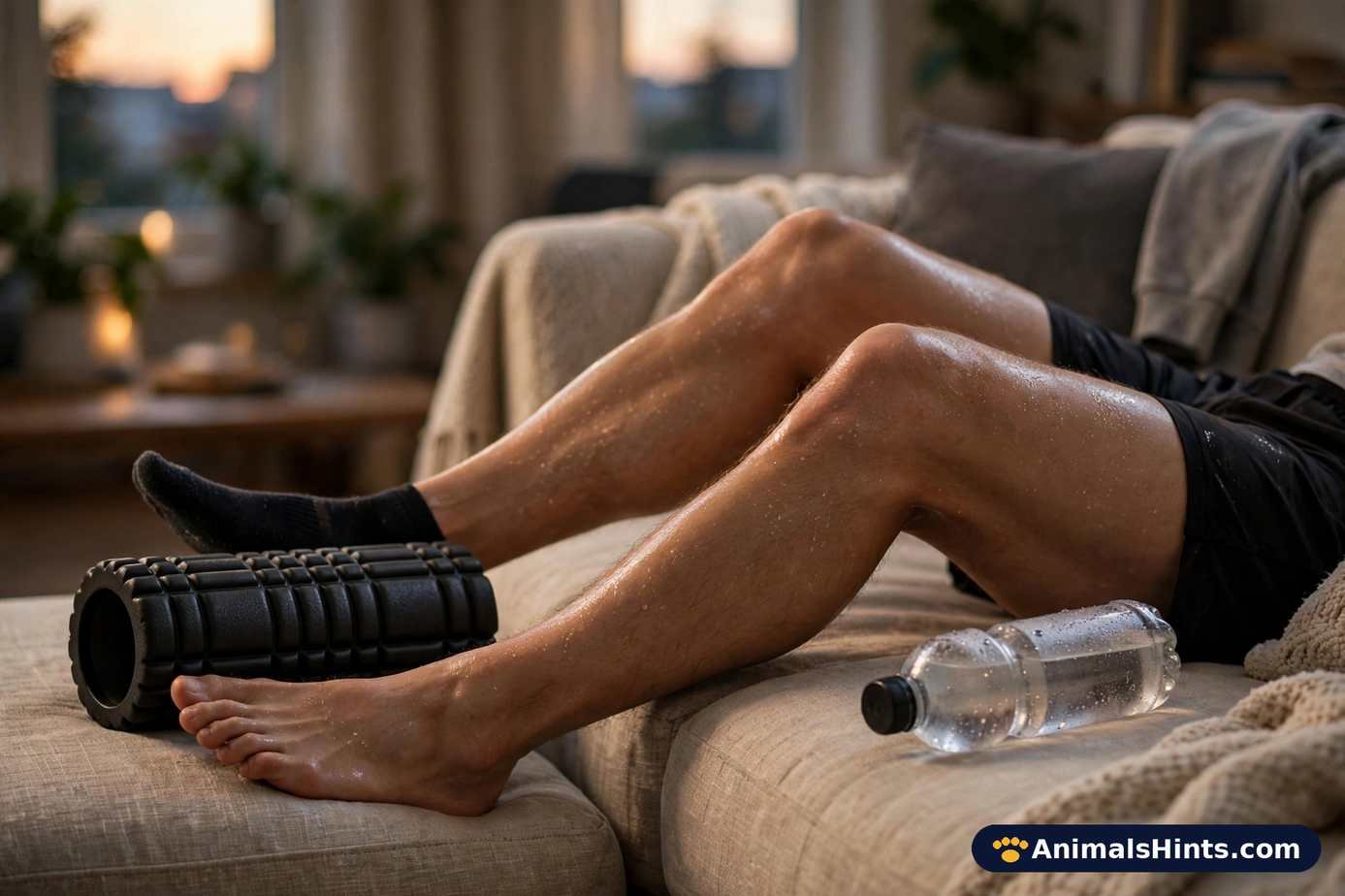
The everyday causes Healthline lists are unglamorous ones. Muscle fatigue and strain lead the list, which is why a knee so often starts flickering after a hard workout, a long climb or an unaccustomed day on your feet. Dehydration and the electrolyte imbalance that comes with it — low calcium or potassium — can set muscles twitching, as can shortfalls of vitamin D, B6, B12, magnesium or calcium in the diet. Some medicines carry twitching as a side effect, diuretics and corticosteroids among them, and stimulants do the same: caffeine and nicotine lower the threshold at which nerves fire. Stress, anxiety and poor sleep work the same way from the other direction, keeping the nervous system keyed up so that small discharges happen on their own.
Where twitches keep returning with nothing else wrong, Cleveland Clinic’s page on benign fasciculation syndrome supplies the name and the reassurance: a single overactive nerve making its muscle jump, a pattern that turns up in a large share of healthy people and usually settles at one site in one muscle at a time. Healthline gives the same event its place on the knee page, alongside the rarer causes a doctor keeps in the background — ALS, and the autoimmune condition neuromyotonia — where twitching arrives as one symptom among others rather than alone.
One point deserves stating flatly, because everything else on this page is organised by side: clinical writing draws no line between a right knee and a left one. No medical source gives the two sides different causes, different risks or different meanings, and a flicker above the right kneecap carries exactly the weight of the same flicker above the left. What earns a consultation is never the side — it is company: twitching that arrives with weakness in the leg, visible thinning of the thigh muscle, cramps that keep spreading, or a flicker that simply will not settle over weeks. A knee that twitches for a few days after hard training, short sleep and strong coffee, in a leg as strong as ever, is the ordinary version, and the steps section near the end of this page is written for it.
9 Spiritual Meanings of Knee Twitching
His meanings come as nine numbered entries, set down here in his order and under his headings. One thing should be said before they begin: his nine are written for the knee in general, not for the right knee in particular — the guide itself splits the sides only in the section after this one. They are carried here as he wrote them, for either knee, and the right side gets its own documented treatment further down the page. Nothing in this list has been quietly relabelled as a right-knee meaning.

1. A Call for Flexibility and Surrender
The guide’s first meaning leans on the knee’s one famous talent: it bends. A twitch there is read as a prompt toward adaptability — a hint that the reader is meeting a changing situation with a locked joint, holding beliefs or expectations past the point where they still serve. Loosening the grip on control, on this reading, is not defeat; it is the joint doing the job it was built for.
2. A Sign of Stubborn Pride or Emotional Resistance
The second meaning is the first one’s shadow. Where flexibility is refused, the guide reads stubbornness: pride gone rigid, an area of life — a relationship, a long-held goal, a belief outgrown — where the reader senses the needed change and resists it anyway. The twitch is cast as the body repeating a message the mind keeps declining to hear.
3. A Message About Grounding and Safety
Because the knees connect the body to the ground it stands on, the guide reads their twitching as news about footing. A period when the foundation feels shaken — money, home, work, the people relied on — is said to register in the legs first, and the flicker becomes a reminder to rebuild whatever has been making the reader feel unsupported.
4. A Reminder of Strength and Submission
The fourth meaning holds two ideas together: the knee is strong enough to carry the whole body, and it is also the joint of kneeling. The guide reads a twitch here as a nudge toward the second of those — an invitation to stop carrying every burden alone, to accept guidance or help, and to treat bowing, even symbolically, as wisdom rather than weakness.
5. A Sign of Unresolved Anxiety or Physical Tension
The guide’s fifth meaning is its most physical. Anxiety is said to settle in the parts of the body that bear weight, and small spasms are read as stored pressure looking for a way out — the muscles trying to let go of what the mind still holds on to. Readers will notice how closely this spiritual reading shadows the medical one above; the two accounts sit side by side in this article without either being asked to do the other’s work.
6. A Reflection of Energetic Blockages
In the guide’s energy frame, the knee counts as a minor centre where flow can stall. A twitch is read as interrupted movement in that region — stagnant emotion or thought gathered around the lower body, momentum lost, inspiration blocked — and the sudden movement as the system attempting to clear the obstruction and get things moving again.
7. A Nudge to Reevaluate Your Life Path
The seventh meaning follows from the knee’s role in forward motion. If the joint that walks you through life starts signalling, the guide reads it as a question about direction: choices being walked through that no longer match the walker’s values, a transition already sensed but not yet faced. The twitch is cast as the body adding its vote to a decision the reader has been postponing.
8. A Symbolic Reminder of Humility
The knee bends in respect and in gratitude, and the guide’s eighth meaning reads its twitching as a call back to humble awareness — a check on ego where it has begun to overshadow empathy, and a reminder to notice the support other people quietly provide. On this reading, the flicker eases as intention comes back into balance.
9. A Sign That Balance Needs Attention
The last meaning gathers the others into one word: balance. The knees stabilise every step, so their twitching is read as imbalance somewhere in the pattern of a life — overwork against rest, effort against recovery, the emotional rhythm running uneven. The remedy the guide implies is adjustment rather than alarm: find the lopsided part and correct it in small ways.
Meaning of Right Knee Twitching and Left Knee Twitching
This is the section where the guide splits the body in two, and it is the section this article exists inside — the sheet keyword names the right knee, so the guide’s right-knee material is carried in full, and its left-knee material alongside it in brief, exactly as the record requires: the comparison only means anything with both sides on the table.
Right Knee Twitching Meaning
The guide reads the right side as the outward side: action, logic, masculine energy, and decisions of the practical kind. On that scheme a right-knee twitch points at responsibilities, plans and the path forward in the external world — progress, opportunities, tasks that require a firm choice, and the need to step forward rather than keep waiting on a delayed decision. The guide also records the luck reading the modern stream is fondest of: in cultures that tie the right side to fortune, right knee twitching is taken as a sign of blessings and positive outcomes, the herald of a new chapter that asks for confidence.
Hold that paragraph for what it is — the modern layer, stated fairly. It is the reading most websites now give, and it is not invented by this guide; it circulates widely. But it is a reading built from the side symbolism, not from the old lists, and the lists are examined in the next section. Readers who want to know what the documented tradition actually recorded for this knee should read on before settling for the blessing.
Left Knee Twitching Meaning
The guide’s left knee is the inward counterpart: intuition, emotion, nurturing energy, the quiet internal world. Its twitching is read as unexpressed feeling, inner conflict, emotional healing under way beneath the surface, or intuition pressing toward a wiser choice — and, in some of the traditions he cites, as a sign that visitors, messages or unexpected news are on their way. The treatment here stays brief by design; the left knee is context for the right, and its fuller record appears in the lists section below.
Comparison Table: Right Knee vs. Left Knee Spiritual Meanings
The guide prints his comparison as a two-row table, and it is reproduced here as he gives it — his scheme, in his terms:
| Side of the Knee | Symbolic Energy | Common Interpretation | Emotional or Practical Focus |
|---|---|---|---|
| Right Knee | Action, logic, masculine energy | Movement toward goals, external changes, opportunities | Practical decisions and responsibilities |
| Left Knee | Intuition, emotion, feminine energy | Emotional processing, internal shifts, intuitive messages | Inner healing and personal awareness |
Right Knee vs Left Knee: What the Old Omen Lists Actually Say
Set the modern scheme aside and ask the older record a direct question — what did the lists that actually contain knee entries write against each side? — and the answer surprises most readers of the modern guides. The documented lists do not line up behind the right knee. They split, they lean cautious on the right, they flatter the left in the one list that covers both, and in two of them the left knee is not mentioned at all. Here is the record, list by list:
| List or Source | Right Knee | Left Knee |
|---|---|---|
| Sakuna Sastra list | Severe anger to face — and befriending a person in authority (mixed) | A relative living abroad visits, grudges are left behind, honour from a person in authority (positive) |
| Pearl of Wisdom, chapter 7 | The right knee-cap: he will hear some sad news (negative) | No entry — the chapter passes from the thigh to the right knee-cap, then to the ankle |
| Tiwari’s twitching lists | Gold or valuable assets may be received (auspicious list) | No entry |
| Chawdhri’s printed table (1990) | A Knees section exists, but its twitch results cannot be paired reliably from the surviving text — nothing is quoted from it here | Same — not quoted |
| Classical angasphurana indications | No knee entry on either side — the list reaches the calves and stops | No knee entry |
| Modern compilations | Good luck, great fortune, a celebration with close friends | Luck and blessing in one stream; displeasure and travelling in another |
The Sakuna Sastra list — a compilation its presenter traces to ancient Indian and Arabic astrological manuscripts — is the fullest of the old lists and the least convenient for the modern reading. Against the right knee it writes, in its own spelling, that the person “will face a sever anger” and will befriend “a person in authority”: a warning and an opening in the same breath, the anger first. Against the left knee it writes the warmest entry either knee receives anywhere in the old record — a relative living in a foreign land will visit, grudges will be put down, and a person in authority will honour the twitcher. Both knees together get their own line about deeds done and the hearts of those in authority won. Whatever else this list is doing, it is not blessing the right knee at the left one’s expense; if anything, it runs the other way.
The Pearl of Wisdom’s seventh chapter, the Islamicate twitching list that closes by crediting “the elders and the Rumis,” is blunter and shorter. Its leg sequence runs thigh, then knee-cap, then ankle, and the only knee it names is the right one: “If the right knee-cap twitches, he will hear some sad news.” There is no left-knee line to set against it — the absence is part of the record, and this article prints it as an absence rather than filling it. The chapter is written for a man throughout, a point that matters when the gender question arrives below.
The one old-stream list that does crown the right knee is the modern Indian compiler Tiwari’s. His auspicious list carries the right knee plainly: twitching there, “you might receive gold or valuable assets,” and a large Indian newspaper’s version of the same tradition repeats the line word for word. Even Tiwari, though, files a second right-knee entry — the knee’s lower part, promising a higher chance of completing your tasks — under his inauspicious heading, where its cheerful content sits oddly against its own filing. And his lists, like the Pearl, simply have no left knee. The famous gold promise is real, documented and repeated; it is also one list’s verdict, not the tradition’s consensus.
Two disciplines govern the rest of this section. The first is the twitch-versus-itch line, which this family of articles never blurs. L. R. Chawdhri’s printed occult table does contain a Knees section in its twitching results, but the surviving text interleaves his two columns so badly that no honest pairing of side to result can be recovered from it, and this article quotes none — the gap is stated rather than papered over. What can be quoted from Chawdhri, exactly, is his separate list of itches, where a right knee itch means “Good news” and a left knee itch “Gossips. Waste of time.” Those are itch entries, printed here only to make a point worth making: the cheerful “right knee means good news” line that circulates today may well descend from an itching list wearing a twitching article’s clothes. The second discipline is about gaps. The Sanskrit verses quoted by Vedadhara’s exponent contain no knee verse at all, and the exponent’s own questioners drew out his dissent — the verses, he maintains, sort the body by neither sex nor side. Talbot’s Ekoi list has no knee entry either; it tingles at the thigh and moves on. The Greek palmomancy tradition — the treatise on twitches ascribed to Melampus, surviving in a fourth-century papyrus epitome — is documented as a genre, but no knee entry from it turned up in the translations searched for this article, so none is quoted. And for China, no knee-specific entry could be verified at all: the gap is stated plainly here, because the modern compilations that print confident “Greek” and “Chinese” knee lines — one gives the right knee a celebration with close friends and the left displeasure from females and a journey — cannot be traced to any older source, and are printed on this page only as what they are, modern compilations.
The gender record is thinner than the modern guides suggest, and it is printed here at its true thickness. The Sakuna list’s single explicit note for a woman sits on the whole left hand entry, not on any knee. The Pearl’s chapter is framed for a man, with no female knee note. Tiwari’s general rules — a man’s right side auspicious, a woman’s left side auspicious and her right inauspicious — are exactly that, general: neither rule names the knee, so the knee reaches women in his system only by inference from the rule, never by an entry. Chawdhri prints his own convention in his sixth chapter — the table addresses a male reader, and its results are to be reversed for a female one — which would flip his knee pair for women if the pair could be read, which it cannot. Anyone who tells you the old lists give a woman’s right knee its own settled meaning is selling you a tidiness the record does not contain.
Readers following the twitching family will find the same list-by-list method at work on the left eye twitching spiritual meaning and the right eye twitching spiritual meaning, where the old lists are fuller and argue louder. The leg’s other documented travellers’ omen, the left foot itching superstitions, belongs to the itching record and is kept separate there, as it is here. The knee’s nearest neighbour in this series, the left thigh, sits directly above it in the same lists. Higher up the same record runs through the left arm and the right thumb — the one body part where every old list agrees — while the left shoulder shows the lists splitting on a single joint all over again.

Knee Twitching Superstitions for Females and Males
The guide gives the sexes separate treatments, and his version is the modern one. For women, he reads a twitching right knee as a sign of movement or travel and of an important change approaching, and the left knee as emotional news and interactions with sentimental weight; because women are traditionally tied to intuition in his frame, a left-knee twitch is treated as the stronger message for a female reader, up to the elders’ saying he quotes — that a woman whose knee twitches has unexpected support or guidance coming to her. For men, his right knee belongs to work, duties, money and decisions, with growth in career or leadership attached, while a man’s left knee is read toward family matters and emotional responsibilities, a guide back toward balance.
That is his layer, and it is set down as he gives it. What the reader should hold alongside it is the documented record from the section above: the old lists give no female knee entry at all, address the knee directly only to men, and reach a woman’s knee, where they reach it at all, through general side rules and one printed flip convention. The confident sex-specific knee readings in circulation today are modern constructions built on the side symbolism — entitled to their place in the modern layer, and labelled there.
Cultural and Religious Interpretation
African Traditions
The guide attributes to some African communities a reading of knee twitching as ancestral communication — the body as a vessel, a twitch as guidance or warning from elders who have passed, the right knee tied to leadership and responsibility and the left to personal matters. That framing is his, and it is printed as his claim. What can be documented from the African record searched for this series is narrower: the Ekoi twitching list recorded by Talbot, one of the few African lists in print, contains no knee entry at all — its leg material tingles at the thigh. The honest sentence is that a named, checkable African knee tradition was not found, and the guide’s general attribution is left standing as exactly that.
Indian Traditions
India is where the checkable record actually lives, and the previous section carries it in full: the Sakuna list’s mixed right knee and warm left knee, Tiwari’s gold promise for the right, the classical indications list that stops at the calves. Against that record, the guide’s own Indian paragraph — right knee twitching as good fortune, especially for men; the left as emotional challenges; a warning to women about unexpected visitors — can be measured, and it matches the documented lists only in fragments. The gold line is real. The blanket good fortune is not what the fullest list says, and the visitors in the Sakuna list arrive, notably, on the left knee’s entry, not in a warning addressed to women.
East Asian Views
The guide reads East Asian interpretation through energy flow: twitches as shifts in qi and in the lower centres of grounding and movement, the right knee suggesting action and forward motion, the left internal adjustment and intuitive alignment. As with his African paragraph, this is printed as his framing. The research behind this article could verify no knee-specific entry in any Chinese twitching tradition — the compilations that do organise bodily twitches by hour and broad location speak of the leg, not the knee — and so the East Asian knee record is entered here as a documented gap rather than a doctrine. A twitch read through qi is a modern, coherent way to frame the experience; it is not a recovered ancient knee entry, and this page will not present it as one.
Middle Eastern Beliefs
The guide’s Middle Eastern paragraph speaks of destiny and fate, a path about to shift, the right side favourable and the left a matter for caution. The documented Middle Eastern layer in this subject is more specific and less comfortable: the Pearl of Wisdom, the Islamicate list preserved in the Sufi study tradition, gives the right knee-cap exactly one outcome — sad news — and no left knee at all. Two bounds belong with it, both printed in this series before: the list is a folk document, not a doctrine, and mainstream Islamic teaching rejects omen-taking altogether, however long the folk lists circulated. Fate, in the one checkable list, does not flatter the right knee.
Ancient Folklore
The guide closes his cultures with European folktales: knees twitching as signs of travel, change and unexpected encounters, the body reacting before the mind senses what is coming, the direction of the twitch shaping the reading. Europe’s genuinely ancient twitch literature is the Greek palmomancy — the treatise ascribed to Melampus, “On Twitches,” known from a papyrus epitome of the fourth century — and it is a real, documented genre that worked the body joint by joint. Its knee entries, however, could not be found in any translation consulted, and so the ancient European knee record joins the Chinese one as an honest gap: the genre is old, the knee lines attributed to “Greek mythology” by modern compilations are not traceable, and nothing here pretends otherwise.
Is Knee Twitching a Warning Sign?
The guide’s own answer is measured, and it is a fair one: the twitch itself is neutral, and the meaning is shaped by the circumstances around it. On his reading, a twitching knee can mirror hesitation or inner conflict — something avoided, whose delay has begun to weigh — or it can mark an important moment approaching, especially for a reader who already senses change. His counsel is not alarm but attention: pause, reflect, ask whether something necessary is being resisted, whether intuition is being ignored, whether the pace has been too hard in one direction or too hesitant in the other.
The documented record adds one colder note to his warmth, and honesty requires it here. In the two oldest lists that name this knee, the right knee does arrive as something closer to a warning — anger to be faced, sad news to be heard — while the list that promises it gold is the youngest of the three. A reader who takes the tradition seriously takes that distribution seriously: warning is not the modern invention here. Neither, of course, is it a medical one, and the section that opened this article sets the boundary that matters most — a knee that twitches alongside weakness, wasting or spread is a doctor’s subject, not an omen’s.
Is Right Knee Twitching Good Luck or Bad Luck?
Everything on this page converges on the question, so it deserves a direct answer: it depends entirely on which layer of the record you ask, and the layers do not agree.
Ask the modern stream and the answer is luck — good fortune, blessings, a confirmation that you are on the right track, in one popular compilation’s phrase. Ask Tiwari’s list and the answer is also luck, of the most concrete kind: gold, or valuable assets, coming your way. But ask the two older lists that bothered to write the right knee down, and the answer changes character. The Sakuna list gives you a quarrel’s worth of anger to face, softened by a friendship with someone in authority. The Pearl of Wisdom gives you sad news, unsoftened. The classical indications do not give the knee anything at all, and the Greek treatise’s knee lines, if they survive, were not found.
So the honest verdict is this: the right knee’s reputation as a lucky twitch is a modern reading resting on one list’s promise, while the deeper record is mixed-to-cautionary — and the knee the old lists actually flatter, when they flatter either, is the left. Read your own twitch in whichever layer you inhabit; just know which layer you are standing in, and know that medicine, standing outside all of them, reads the flicker itself as neither luck nor warning but as a tired thigh muscle asking for rest.
How to Calm a Twitching Knee: Practical Steps That Help

For the ordinary knee — the one that flickers after exertion, short sleep or a wired week — the remedies are the unglamorous ones the medical sources point to, and they work on the thigh, where the twitch actually lives.
Rest the leg first. A muscle that has been loaded hard — stairs, squats, a long run, a day spent standing — earns its flickering honestly, and a day or two of lighter use, with the legs raised when you sit, gives the fibres their chance to quiet down. Gentle stretching of the front of the thigh helps some people; forcing a tired muscle through another hard session to “work it out” generally restarts the cycle instead.
Then audit the inputs the doctors list. Drink water across the day rather than in one rescue litre, especially around exercise, since dehydration and the electrolyte dip behind it are named causes. Check the caffeine honestly — coffee, energy drinks, pre-workouts — and the nicotine, and trim them for a week to see whether the knee follows. Protect sleep for the same stretch of days; a keyed-up nervous system on four hours a night will keep finding muscles to flicker. If the twitching began alongside a new medicine, that timing is worth a conversation with whoever prescribed it, not a private experiment with the dose.
Two habits to drop while you wait: testing the leg — repeated maximal contractions to check whether it still twitches — only fatigues the muscle further, and hourly symptom-checking turns a benign flicker into an anxiety engine, which is itself a listed trigger. Give the ordinary version a fair trial of rest, fluids, fewer stimulants and real sleep. The exits from self-care are the company the twitch keeps: weakness in the leg, a thigh visibly thinning, cramps or twitching spreading to other muscles, or a flicker still going strong after some weeks of doing everything right. Any of those earns a doctor’s appointment, promptly and without apology.
Final Thoughts
A twitching right knee turns out to be a small lesson in how omens actually work. The sensation is one thing everywhere — a bundle of thigh fibres firing uninvited, most often in a tired, dry, over-caffeinated leg — and the meanings laid over it are several, layered by century and by side, and not in agreement. The modern guides bless the right knee. The one list that promises it gold is real but solitary. The older lists that name it speak of anger faced and news regretted, and flatter the left knee instead, when they mention knees at all — and whole traditions, the classical indications, the Ekoi list, the Chinese record as far as it could be checked, leave the knee out entirely.
None of that makes the twitch meaningless; it makes its meaning a choice the reader should make knowingly. Take the gold if Tiwari’s list is your tradition. Take the caution if the Sakuna list is. Take the modern blessing as a modern blessing, honestly labelled. And underneath whichever reading you choose, do the simple physical thing the event itself requests: rest the leg, drink the water, sleep — and let the patella, the little kneecap that lends the knee its name in the anatomical dictionaries, ride quietly on a muscle that has stopped asking for attention.
FAQs
The competitor guide prints its FAQ under this heading with four questions — and a quirk this article flags rather than fixes: all four of his questions are about calf twitching, not knee twitching, an apparent slip on his page. By house rule his questions are kept verbatim; the answers below are short, honest, and answer the questions he actually asked.
What is the spiritual meaning of right calf twitching?
In the modern stream, the right calf is read like the right knee: outward progress, masculine energy, being on the right path. The classical indications list gives the calves an unsplit entry of their own — a kingly position — without dividing the sides.
What is the spiritual meaning of left calf twitching?
Modern guides read the left calf inwardly: reconsideration, a change of approach, intuition asking to be heard. The documented lists searched for this article carry no left-calf entry of their own; the classical line covers the calves together.
What superstitions are associated with calf twitching?
The guide’s own set: the right calf for the right path, the left for a change of direction, and calf twitching generally for a journey coming — a travel reading he attributes to African traditions. The documented lists add the classical indications’ calf entry, a kingly position, and nothing more specific.
How should I respond to calf twitching spiritually?
The guide’s counsel is reflection: pause, consider your direction, ask for guidance, trust your intuition, and journal when the twitching happens and what follows. To which this article adds its usual rider — rest the leg as well; most calf twitches are tired muscle, and tired muscle answers to rest before it answers to meaning.