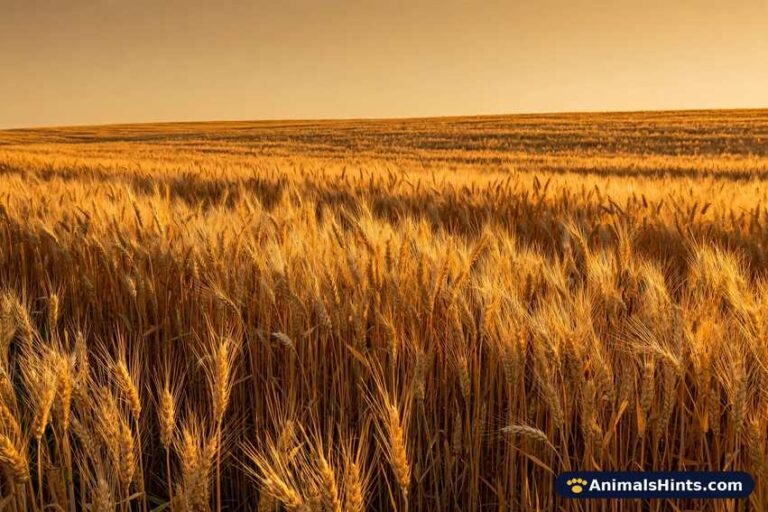
Green Butterfly Spiritual Meaning: 9 Meanings, Cultures, Dreams and Renewal
The green butterfly spiritual meaning, in the traditions that read animal encounters for signs, is growth made visible: renewal, healing and a heart opening after a closed season. Green is the color of living leaves, of spring returning, of everything in nature that is quietly getting better, and a butterfly is the creature of transformation itself. When the two arrive together, spiritual tradition reads the sighting as reassurance with roots in it — change is underway, and it is the healthy kind.
That reading has a real animal underneath it, and the animal is stranger than the symbol. Green is one of the rarest colors in the butterfly world. Almost no butterfly owns a true green pigment; the famous green species build their color out of architecture instead — microscopic structures in the wing scales that bend light until the eye sees green. A thumbnail-sized hairstreak in a European hedgerow and a hand-sized birdwing in a New Guinea rainforest wear the same improbable color, made the same impossible way.
This guide walks through what a green butterfly symbolizes, meets the real green butterflies you are most likely seeing, and then gives all nine spiritual meanings of a green butterfly exactly as the tradition hands them down. It covers what a landing means, the black-and-green form, the love and twin-flame readings, green butterflies in dreams, what the Bible actually does and does not say, and whether a sighting is a good sign. Where biology exists, it is named and checked. Where a claim is tradition rather than fact, it is labeled as tradition, so you can hold every part of this butterfly at its proper weight.

What Does a Green Butterfly Symbolize?
At its core, a green butterfly symbolizes renewal with a pulse: growth, harmony and emotional healing. Every butterfly carries the general symbolism of metamorphosis — the egg, the caterpillar, the chrysalis and the winged adult are the natural world’s standing picture of a life remade — but the color decides the flavor of the change, and green makes it a restorative one. It is transformation pointed at recovery: not change for drama’s sake, but the slow green work of a living thing healing, leafing out and beginning again.
In modern spiritual teaching, green is the color of the heart. The seven-chakra system taught today assigns green to the heart chakra, Anahata — the fourth energy center, seated at the centre of the chest, whose element is air and whose territory is love, compassion and forgiveness. Inside that system, a green butterfly is read as that center’s messenger: a sign that the heart is the place to look, whether the need is forgiving, grieving, loving or letting love back in. The honest framing belongs with it. Chakras are a spiritual framework, not anatomy, and the tidy rainbow of one color per chakra is a modern standardization of older, more varied teachings — practitioners work with it as a language for inner states, and within that language this reading is consistent and precise.
The color underneath the butterfly has a symbolism of its own — growth, balance, fertility, envy and luck among its strands — and our companion guide to green spiritual meaning explores the color itself in full. This page is about the winged version: what happens to those meanings when the color learns to fly. The tradition’s headline readings for the green butterfly gather into five:
- Renewal and healing — the sighting is read as recovery beginning: emotional wounds closing, energy returning, a season of repair.
- Growth and new beginnings — green is the growing color, and the butterfly is read as a sign that something planted in your life is ready to come up.
- Love and the open heart — through the heart-chakra link, the green butterfly is read as love healing, arriving or deepening.
- Abundance and prosperity — in many belief systems green signals fertility and wealth, and the butterfly is read as those things on the move.
- Hope and comfort — a gentle visitor in a hard season, read as reassurance that you are not walking through it unattended.
Like every reading in this guide, those are the tradition’s interpretations, offered as symbolism rather than fact. What is fact is the creature itself — and the creature is remarkable enough to carry them, which is where this guide goes next.
The Real Green Butterflies Behind the Symbol
“Green butterfly” is not one species, and it is not even one trick. Green is the color butterflies find hardest to make. Their ordinary pigment palette — the melanins, ommochromes and pterins that paint wings black, brown, orange, red and yellow — contains no true green, a point the optics literature states plainly: pure pigments cannot produce blue, violet or green in a butterfly wing. So nearly every green butterfly cheats, building the color out of microscopic architecture that manipulates light. Four species carry most of the world’s green-butterfly sightings, and between them they show both ways the trick can be done.
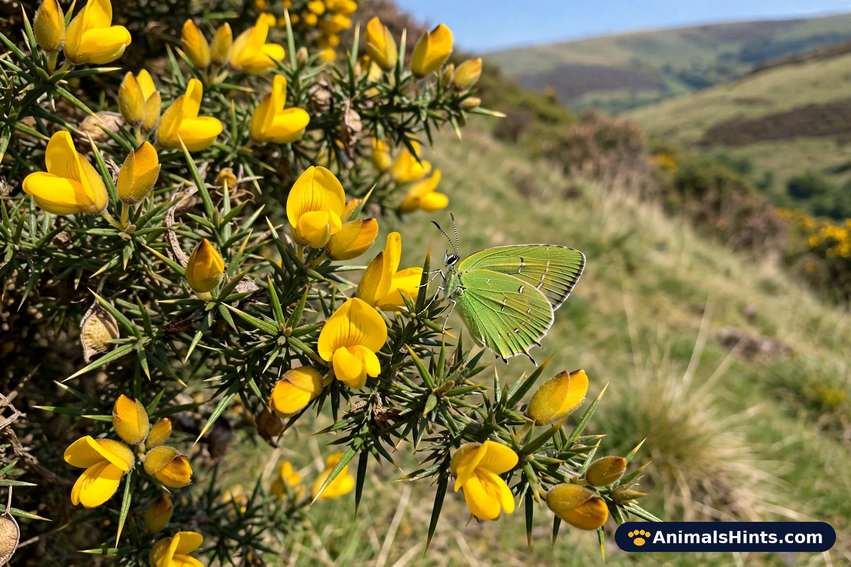
The green hairstreak (Callophrys rubi) is Europe’s green butterfly — the only one on the continent that is plain green beneath both wings. It is small, with a wingspan of roughly 26–30 millimetres, and it is a study in contrast: the upperside is a uniform dull brown nobody notices, while the underside is a bright, matte green with a thin, often broken white line. It almost never shows the brown, resting with its wings closed and the green on display. That green is entirely structural. The underside scales contain gyroid photonic crystals — microscopic three-dimensional lattices of chitin, arranged in tiny domains of differing orientation — and the lattice reflects green light in every direction at once, which is why this green is matte and steady, a camouflage green that matches the leaves it settles on. The work that identified the structure (Michielsen and Stavenga, published in the Journal of the Royal Society Interface in 2010) made this little butterfly a standard exhibit in the science of natural photonics, and its North American cousin, the green juniper hairstreak, carries an equivalent gyroid architecture in its own scales. The hairstreak’s range is one of the largest of any Palaearctic butterfly — across Europe and temperate Asia to Siberia, and into North Africa — through chalk downland, heath, moorland edges, woodland rides and scrubby commons, with caterpillars feeding on an unusually long list of plants: gorse, broom, bilberry, rock-rose, bird’s-foot trefoil, bramble and more.
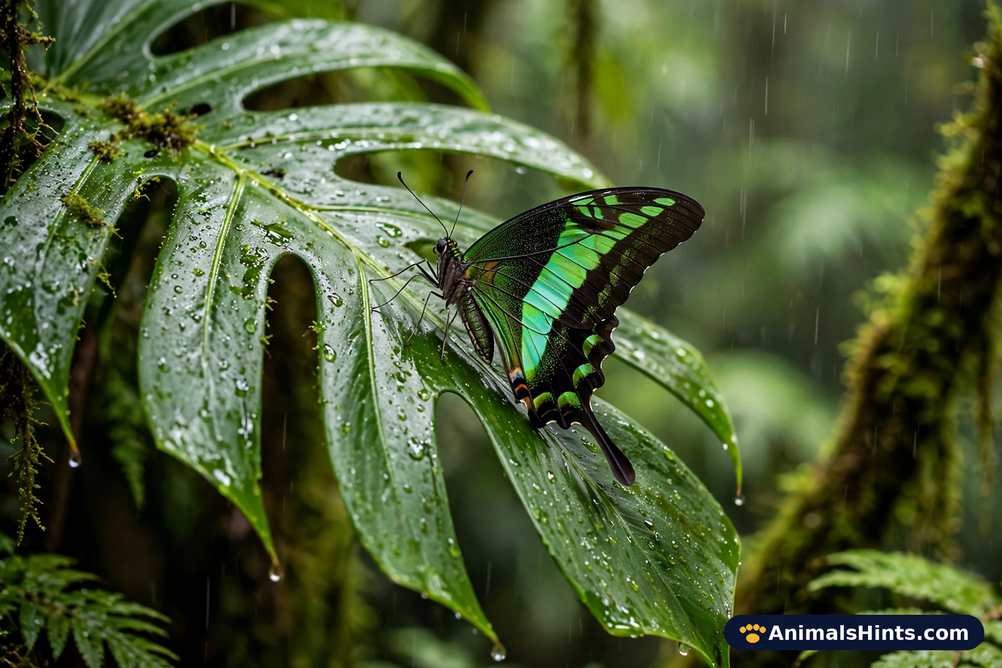
The emerald swallowtail (Papilio palinurus), also called the emerald peacock, is the green butterfly as jewel. A Southeast Asian species with a wingspan of about 80–100 millimetres, it wears broad bands of metallic emerald across dark, tailed wings — and its green is structural too, but built on the opposite principle. Each scale in the green bands is lined with microscopic bowl-shaped pits. The flat bottom of each pit reflects yellow light; the pit’s sloping sides reflect blue; and the two reflections mix in the eye as a single shimmering green — an additive color mixture demonstrated by Vukusic and colleagues in Nature in 2000. Because the recipe depends on angles, this green flashes and changes as the butterfly moves, where the hairstreak’s stays calm. Two structural greens, then, with two tempers: one made to disappear into foliage, one made to blaze.
The common green birdwing (Ornithoptera priamus) works at the other end of the size scale. Birdwings are among the largest butterflies on earth, and this species — found from the Moluccas through New Guinea and the Solomon Islands to north-east Australia — carries males of roughly 12–14 centimetres across, velvet black above with great panels and stripes of iridescent green; the females are larger still and mostly dark brown. The male’s green is iridescent, a structural sheen over black, shifting toward gold or blue-green as the light changes — and on some island subspecies east of New Guinea the same panels run fully blue, which tells you honestly what kind of color this is: not a dye, but a light effect. The species is listed on CITES Appendix II, so its trade is controlled — a green this spectacular has always needed protection from collectors.
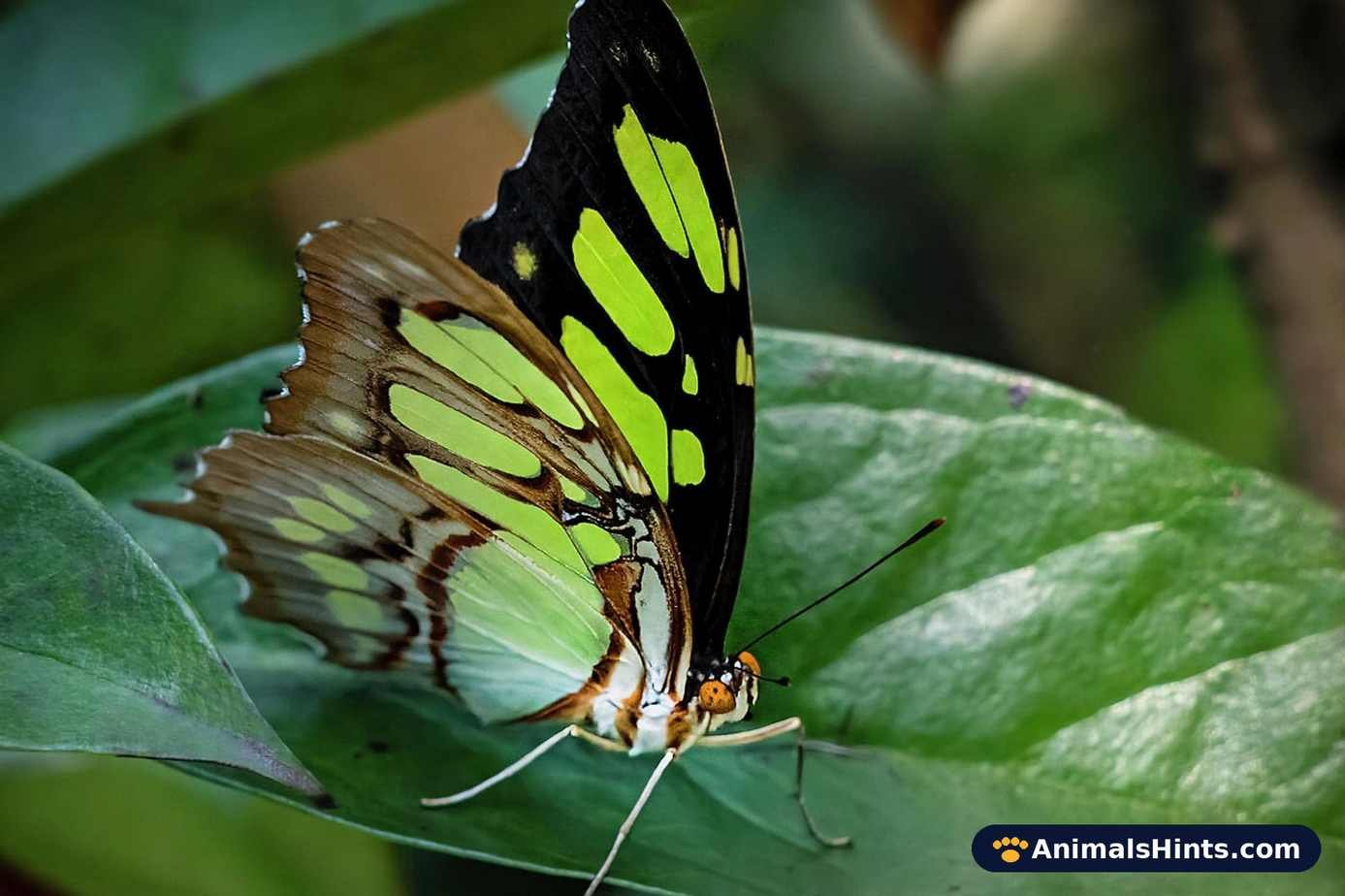
And then there is the exception, the green butterfly that does it the ordinary way. The malachite (Siproeta stelenes) of the American tropics is a large brush-footed butterfly, blackish-brown above with great translucent panels of apple green — named, exactly, for the banded green copper mineral its wings resemble. Its green is pigment, not architecture: it sits in the wing as color, stays the same shade from every viewing angle instead of flashing, and can even fade a little in strong sun, the way pigments do and structures do not. It is one of the most common butterflies through Central America and northern South America down to Brazil, reaches Cuba, and has been a permanent resident of southern Florida since the 1960s, with strays into southern Texas; its caterpillars feed on plants of the acanthus family, the green shrimp plant prominent among them. So the world’s green butterflies divide into the light-builders and the one painter — and the next time a green wing catches your eye, the way it behaves in the light tells you which kind you are looking at.
9 Spiritual Meanings of a Green Butterfly
The nine readings below are the set the modern tradition returns to again and again for this butterfly. They are given here as that tradition presents them — beliefs to reflect on, not predictions — and each is rooted in the two facts that anchor all butterfly symbolism: the metamorphosis, and the color green.
1. A Loved One Who Has Passed Is Sending a Message of Greeting
The first meaning is the one most often received through tears. In the folk traditions that treat butterflies as soul-carriers — an association as old as the Greek word psyche, which meant both “soul” and “butterfly” — a butterfly appearing after a death is received as a visit, and a green one, in this tradition, carries a specific tone: greeting, not warning. The green is read through the heart: this is love checking in, a sign that the person who has gone is at peace and that the bond has changed form rather than ended.
People who hold this reading describe the sightings clustering at the charged moments — anniversaries, hospital corridors, the first spring after a funeral — which the tradition takes as the message’s timing and a skeptic would call grief’s heightened attention. Either way, the reading’s counsel is gentle and the same: receive the comfort as comfort. Love, in this framing, does not end. It transforms, and the green butterfly is its greenest messenger.
2. Restoration of Faith
The second meaning is about trust coming back. A green butterfly sighting is read as a sign that faith — in a path, in a process, in your own judgment, in something larger — is being restored after a season of doubt. The color does much of the work in this reading: green is what returns after winter, the visible proof that a living system written off as finished was only dormant. The butterfly, read this way, is spring arriving in a single insect.
The tradition phrases its teaching carefully: what feels delayed is not necessarily denied. The sighting is taken as encouragement to keep a soft heart through the waiting — to let the evidence of small renewals rebuild, at nature’s pace, the confidence that a hard season spent.
3. Trust Your Feelings
Green, in the modern symbolism this tradition uses, is the feeling color — the heart’s color — and the third meaning follows: trust your feelings. A green butterfly is read as a gentle correction to a mind that has been over-ruling its own heart: your emotions are information, the reading says, not noise. In relationships, career choices and creative work alike, the sighting is taken as permission to weigh what you actually feel at the same table as what you can prove.
The butterfly’s own manner is part of the teaching here. It does not force its way anywhere; it drifts, settles, tests the air. The tradition reads its soft movement as the manner in which heart-led answers usually arrive — not in a shout, but in a settling. Slow down, the meaning says, and let the feeling finish its sentence.
4. Embrace Your Spiritual Transformation
Every butterfly meaning touches transformation, but the green one owns a particular version of it: transformation as healing. The fourth reading takes the sighting as a sign that you are mid-metamorphosis in the restorative direction — shedding an old version of yourself, and doing it the green way, with compassion for the person you were rather than contempt. The color turns the usual change-reading toward recovery: this transformation is not an upgrade. It is a convalescence of the spirit.
One correction this guide makes to the usual telling belongs here, because the transformation deserves its real machinery: a butterfly does not transform inside a cocoon — that is a moth’s structure. A butterfly’s resting stage is a chrysalis, unsheltered and still, and the growth this meaning celebrates happens there, in the open, at a pace that cannot be hurried. The tradition’s patience teaching — growth requires both patience and faith — is written all over the real animal.
5. Healing and Renewal
The fifth meaning is the green butterfly’s home ground, the reading its whole symbolism leans toward: healing and renewal. Green has been the color of recovery in the Western imagination for as long as hospitals have painted with it and spring has followed winter, and the sighting is read — after illness, loss, heartbreak or a long depleting stretch — as the announcement that restoration has begun, including the part of it still happening beneath the surface where you cannot watch it work.
An honest boundary belongs with this one, and this guide states it plainly: the healing reading is a prompt toward care, not a substitute for it. The tradition itself, received whole, points the same way — rest, forgiveness, gratitude, the relationships and practices that genuinely restore a person. A green butterfly is not a diagnosis or a treatment. It is, in its tradition, a green light for the unglamorous work of getting well.
6. New Beginnings and Fresh Opportunities
The sixth meaning is spring’s other face. Where meaning 5 looks backward at what is being repaired, this one looks forward: a green butterfly is read as a sign of fresh starts — a new relationship, role, project or place arriving in its season, and arriving, as green things do, quietly at first. The teaching attached to it is readiness: opportunities in this color do not knock twice or announce themselves loudly. They come up like shoots, and the skill the reading trains is noticing.
The seasonal root of this meaning is observable fact, as so often underneath this family’s symbolism. Green butterflies genuinely are creatures of the fresh growth: the hairstreak flies with the spring, the malachite works the new leaves of the wet season. Generations of watchers met this color at the year’s turning and read it, reasonably by their lights, as beginning itself.
7. Abundance and Prosperity
Green is the money color and the harvest color in much of the world’s symbolism, and the seventh meaning gathers both: a green butterfly is read as a sign of abundance — a season in which what you have planted begins to feed you. The tradition is careful, at its best, about what kind of wealth it means. The reading widens prosperity beyond the material on purpose: emotional fullness, creative flow, a household rich in the things money gestures at. The butterfly’s own prosperity teaching, in this framing, is gratitude and receptivity — attending to the abundance already present as the way of being positioned for the rest.
The earthly anchor is the same one the color’s whole symbolism stands on. Green is the color of the world feeding itself — of leaves at work in the sun — so a green sign, in this system, is read as provision arriving through living processes: grown, not won. Expect the increase, the tradition says, at the speed of a garden.
8. Spiritual Messages of Hope and Comfort
The eighth meaning is the fifth’s companion for the days before the healing is visible. A green butterfly appearing in a genuinely hard stretch — the hospital week, the grief month, the long uncertainty — is read as a message of hope and comfort: reassurance delivered at ankle height, a small green proof that the world’s tenderness has not been withdrawn. Many people who receive this reading describe the same quality in it: not a promise that everything will be fine, but company. You are not alone in it.
That modesty is part of why this meaning lasts. It does not argue with the difficulty; it sits beside it, briefly, in green. The tradition’s counsel for receiving it is simply to let it count — to take the moment of peace as a real thing that happened, and to borrow its calm for the next stretch of the road.
9. Encouragement to Embrace Love and Joy
The final meaning is the heart chakra’s own, and it is the lightest of the nine: an encouragement to embrace love and joy — deliberately, as practices rather than rewards. In this reading, the green butterfly appears when life has become too heavy or too serious, as a reminder that joy is a daily choice and affection a thing to be expressed while it can be. In relationships, the same sign is read as mutual growth: two people greening together, love conducted at the temperature of a garden rather than a furnace.
It is a fitting last word for this color’s set. The nine meanings begin with a greeting from the dead and end with an instruction to the living, and the instruction is the tradition’s whole green teaching in one line: keep your heart open, keep growing, and let yourself be glad on the way.
Significance in Cultures, Religions, and Mythologies
The competitor’s cultures are given here in its own order and framing, as bold strands within this section — the form its page uses — with each tradition reported as it is actually held, and none of it upgraded into fact.
In Celtic tradition, green butterflies were linked to fairies and spirits of the forest. People believed they carried messages from the otherworld or symbolized the souls of ancestors returning to check on their loved ones. The Celts viewed green butterflies as signs of protection and renewal, often appearing during times of transition or healing. The soul strand of this is genuine old folklore — in Irish folk belief especially, butterflies are bound up with the souls of the departed — and the green layer fits it naturally: the fairy folk of those same traditions are the people of the greenwood, the hills and the hidden places, so a green wing reads, in that world, as a messenger from the green country itself.
In Native American spirituality, butterflies are considered symbols of transformation and balance. Green butterflies in particular are associated with Mother Earth and growth. Spotting one was often seen as a message to reconnect with nature or to trust that the universe is aligning events in your favor. These beliefs vary from nation to nation, and this guide reports the general framing as it is commonly offered — as living traditions of story and teaching, not as one single doctrine shared by all Native peoples.
In Chinese culture, green is a color of life, health, and prosperity. A green butterfly appearing near your home or garden was thought to bring good fortune and harmony. Some believed it signified the arrival of positive energy, particularly in financial or romantic matters. Butterflies in Chinese symbolism carry their own long meanings — joy, freedom, romantic love and long life among them — and the green form is read in modern tellings as those blessings wearing the color of health: fortune that grows rather than flashes.
In ancient Greek and Roman mythology, butterflies were connected to the soul’s journey and immortality — the Greek psyche named both the soul and the butterfly, and the image of the winged soul leaving the body is one of antiquity’s most durable. The green butterfly’s vibrant tone adds, in the modern reading, an extra layer: rebirth and the continuation of life after hardship or loss. That green layer is honestly a modern addition to an ancient association — the Greeks left no green-butterfly doctrine — and it is reported here as the living tradition’s extension of their idea, not as a classical text.
What Does It Mean When a Green Butterfly Lands on You?
A green butterfly crossing your path is a sign seen; one landing on you is, in the tradition, a sign delivered. A landing personalizes every reading in this guide — the healing, the renewal, the love — and addresses it to the person touched. The full question has its own page on this site: our guide to what it means spiritually when a butterfly lands on you works through the landing in its own right. The green version of it, in the tradition, runs as follows.
The central reading is blessing with a diagnosis attached: you are, as the tradition phrases it, aligned — your energy settled enough that a wild creature chose it as a resting place — and the specific blessing the green landing is said to carry is renewal entering your own season: past pain loosening, a healing, literal or emotional, under way and now confirmed at close range. Some receive it more specifically still, as the first meaning of the nine arriving in person — a loved one in spirit, visiting at touching distance. The tradition’s handling of the moment is consistent across all its versions, and it matches how the animal must be treated anyway: stay still, do not grasp, let it leave when it leaves. A butterfly’s wings are dusted with the scales that carry its colors, and they rub away under a careless hand.
One natural note belongs here, because it makes the moment more interesting, not less. Butterflies seek out salts and minerals, and skin — especially skin warm and damp from a garden afternoon — is a source of both: the behavior is called puddling, and a landing butterfly is often, among other things, drinking. The tradition has never been embarrassed by the body’s part in its signs, and neither is this guide.
Black and Green Butterfly Spiritual Meaning
Black and green is not a rare variation — it is the uniform of most of the great green species. The birdwing’s green panels are set in velvet black, the emerald swallowtail’s bands cross a near-black wing, the malachite’s apple green is framed and veined in blackish brown — so this section is about the commonest real form of the green butterfly, read with its darkness left in. In the tradition, the black is not a stain on the green. It is the first half of the sentence.
The reading runs like this. Green is the growth: renewal, healing, the heart opening, life returning. Black, in butterfly symbolism, is the night side of transformation — the chrysalis hours, the unknown, endings, what a life passes through while it is being remade. A black-and-green butterfly is therefore read as growth that has come through something: emotional rebirth after darkness, a healing that does not pretend the wound was small. Where the pure green reading suits a gentle season, the black-and-green form is the one people report in the recovering seasons — after the loss, during the rebuilding — and the tradition reads its message as balance: honor the lessons of the dark part, and welcome the green part without hurrying either.
The biology underneath could hardly cooperate better. On the real wings, the black is the frame that makes the green possible to see: dark scales set off the green panels, absorb the stray light the structures reject, and give the whole display its contrast. Two colors, one mechanism, each requiring the other to read at a distance. The tradition reads the black-and-green butterfly as renewal with its shadow included; nature built it as brilliance with its outline drawn in. Both agree that the black is not the opposite of the message. It is what makes the message legible.
How the Green Butterfly’s Meaning Differs From Other Colors
Color is the variable in all of these readings, so it helps to set the green butterfly beside its siblings. In the same modern symbolism tradition, a white butterfly is read for purity, innocence and the visiting spirits of loved ones — our guide to the symbolism behind seeing a white butterfly covers that reading in full. A blue butterfly is read for calm, truth, healing and things that need to be said — our blue butterfly meaning guide gives that reading its own page. An orange butterfly is read for warmth, energy and encouragement — our orange butterfly spiritual meaning guide covers the fire end of the family. A brown butterfly is read for grounding, patience and change at walking pace — our brown butterfly spiritual meaning guide covers the earth end. A black butterfly is more often read for endings, mystery and the shadow side of change.
Green’s territory is distinct from all of them: the heart rather than the hearth or the flame, growth rather than arrival, healing rather than news. If the white butterfly asks who is near, the blue asks what is true, the orange asks what is beginning, and the brown asks what is holding, the green butterfly asks how you are growing — and whether your heart is being tended as carefully as your plans. That is why the green sighting is so rarely received as a warning even by careful readers of signs: of all the butterfly colors, it is the one whose traditional grammar is recovery.
Meaning in Love, Relationships, and Twin Flames
In love, the tradition reads the green butterfly through the heart chakra, and the reading is about love’s health rather than its heat. Where the red of other guides is passion at full temperature and orange is warmth arriving, green is love growing: compassion, forgiveness, the slow repair of trust, two people becoming better soil for each other. A green butterfly appearing around a strained relationship is read, in this tradition, as a hopeful sign with work in it — the connection can heal, communication can reopen, old wounds can stop running the household — provided both people tend it the way the color itself suggests: patiently, honestly, in the open air.
For those looking for love, the reading is encouragement of the green kind: a soulmate connection approaching, not as a lightning strike but as a growth — someone whose presence will feel like the right climate. The counsel attached to it is the color’s own: stay open, stay growing, do not force the season.
The twin-flame reading is the modern spiritual framework’s own, and this guide reports it in that frame: within twin-flame teaching, a green butterfly is read as a sign of the healing phase of the journey — the period, often after separation, in which each partner does the individual growing that reunion is said to require, and the bond is restored at the level of the heart rather than the level of circumstance. It is a contemporary belief system rather than an ancient tradition, and its readings are offered here as its followers hold them. Underneath it sits the smaller, older reading that needs no system at all: green wings near a love are a picture of something alive being cared back into health, and love, at its best, is exactly that.
Dream About Green Butterflies
Dream tradition reads animals the way waking tradition does, with the volume turned up: in a dream, the mind is already speaking in symbols, so a brightly colored butterfly is received as a deliberate image rather than a passing sight. Modern dream interpretation — a folk practice, not a validated psychology; psychologists do not endorse fixed dream dictionaries — works with the green butterfly along the lines the tradition usually gives it:
- A green butterfly flying freely is read as release: old fears loosening, a more authentic version of yourself stepping forward, transformation proceeding at its own healthy pace.
- A green butterfly sitting still is read as the pause before transformation — strength being gathered in the chrysalis stage of some change, a season of quiet that is part of the process rather than a failure of it.
- Several green butterflies together amplify the waking meanings: abundance, support arriving from more than one direction, new beginnings stirring in love or work at once.
- A green butterfly landing on you in the dream carries the waking landing’s meaning inwards: blessing and protection addressed to you personally — and dream readers add one refinement, to notice how you felt. Calm or joy in the dream is read as alignment; anxiety, as resistance to a change the dream itself is recommending.
Across all four, the dream teaching matches the waking one. The green butterfly in dreams is read as the growing messenger: whatever it is doing in the dream is what your healing, your heart or your next beginning is doing in your life, and the dream is asking you to look at it kindly.
Green Butterfly Meaning in the Bible
This section of the competitor’s page begins with a concession this guide keeps, because it is simply true: the Bible does not mention butterflies. Not once, in any translation. What Christian tradition has done instead — for centuries, and openly — is read the butterfly’s real life cycle as a picture: the earthbound caterpillar, the stillness of the chrysalis, and the winged creature that emerges have long been used in Christian teaching as an image of resurrection and new life in Christ. The green butterfly inherits that reading and adds its color: in devotional writing it is taken as a reminder of hope, restoration and God’s renewing work, offered as believers’ interpretation rather than as a biblical text about an insect the text never names.
Green itself, though, is genuinely one of Scripture’s colors — the color of life sustained and pastures of rest. The best-known verse is Psalm 23, in the King James wording generations memorized: “He maketh me to lie down in green pastures: he leadeth me beside the still waters.” Green in the Bible’s imagery is where the flock is fed, watered and kept — provision and peace in a dry land — and it is easy to see why believers reading a green butterfly reach for it. The honest summary is the one this guide gives every tradition: the butterfly reading is a later, living interpretation built on real verses about green and a real insect’s metamorphosis, and it should be held as exactly that — meaningful to those who hold it, and never mistaken for a mention that is not there.
Is Seeing a Green Butterfly a Good Sign?
In this tradition, yes — about as clearly as signs get. The green butterfly collects almost none of the ominous readings that gather around other animal visitors. Its nine meanings run from a loved one’s greeting through healing to love and joy, and even its gravest reading — the soul’s visit — is a comfort rather than a warning. There is no shadow version of this butterfly in the tradition at all, beyond the dream dictionary’s anxious landing, and even that is phrased as self-knowledge rather than prophecy.
Part of the verdict is the color: green reads kindly in almost every symbolic system humans have built, because it is the color of the living world succeeding. Part of it is the creature: butterflies are harmless, beautiful and short-lived, and folk systems tend to read gentle animals gently. And part of it, this guide would add, is scarcity. A genuinely green butterfly is an uncommon sight in most temperate gardens — the hairstreak is a local, hedgerow species that never visits gardens at all, and the great tropical greens live an ocean away — so a green wing, when it does cross a path, arrives with the force of the unusual behind it. Traditions read animals by their natures. This one’s nature, read fairly, is a good sign that had to be built out of light to exist at all.
How to Welcome Green Butterflies to Your Garden
If the readings in this guide have made you want green butterflies closer rather than merely explained, the welcome is mostly a matter of plants and shade. Green butterflies are foliage creatures — their color is camouflage for a life lived among leaves — and a garden can be arranged for each of the real ones.
- Plant the caterpillar foodplants. In Europe, the green hairstreak’s nursery is scrub: gorse, broom, bilberry on moorland soil, rock-rose and bird’s-foot trefoil on chalk. A patch of native shrubs left to grow soft young growth is an invitation addressed to it by name. In the far south of the United States, the malachite’s caterpillars feed on the acanthus family — green shrimp plant and its relatives — and a warm, sheltered corner of them is a malachite nursery.
- The humblest stage has its own page. The whole story — egg, caterpillar, chrysalis, wing — is what a garden is really hosting, and our caterpillar spiritual meanings guide reads the caterpillar stage on its own merits.
- Keep green structure, not just flowers. Hedges, shrubs, a shaded fence line, leaves at every height: green butterflies live in the architecture of a garden, not only at its blooms. The hairstreak holds territories around shrubs; the malachite works forest edges and orchard shade.
- Nectar across the season. Adults still need flowers — hawthorn blossom and bugle for the hairstreak in spring, a long succession of blooms for the tropical species. Flowering shrubs do double duty: nursery below, refuelling station above.
- Skip the insecticides. A garden sprayed for insects is a garden arranged against butterflies at every life stage, egg to adult.
- Leave some wildness. A sunny bank, a scrubby corner, leaf litter under the hedge: shelter, minerals and overwintering cover — the green world the green butterflies are colored for.
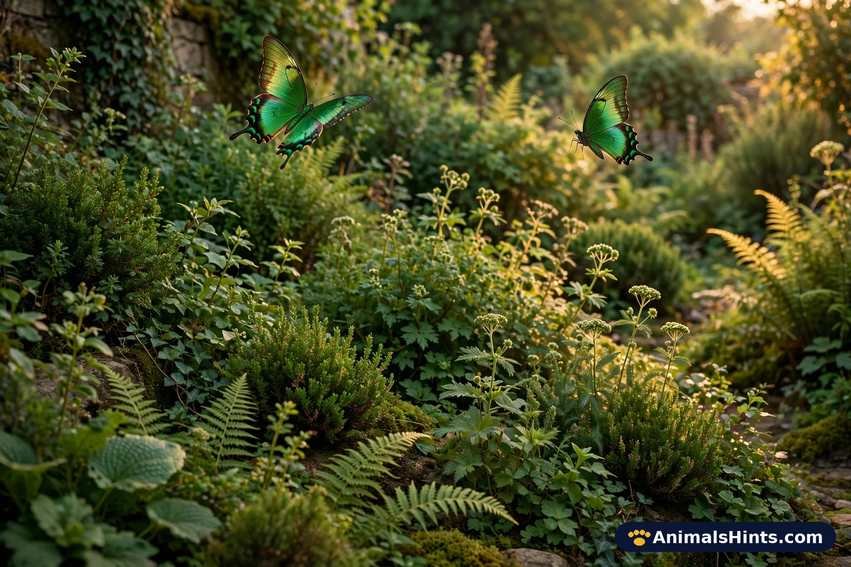
A garden that keeps shrubs, shade and wild green corners has not just attracted a symbol. It has rebuilt, at garden scale, the leafy world that spent millions of years teaching butterflies how to be green.
Final Thoughts
Hold the folklore in its proper place and it earns its keep: as a way of paying attention. The green butterfly’s meanings — healing, renewal, the heart opening, growth resuming — are the tradition’s accumulated reading of a creature that genuinely lives at the green edge of the world, and a sighting used as a prompt to forgive, to rest, to plant, to begin, is a sighting well used. But the deepest fact in this guide needs no folklore at all. The most familiar green butterflies wear no green pigment whatsoever. Their color is architecture: lattices and pits in microscopic scales, grown in the dark of the chrysalis, that sort sunlight until an eye watching sees the color of leaves looking back at it.
So if a green butterfly crosses your path this season, let the tradition say its kind word — and then spare a thought for the two kinds of green that met in that moment. The wing’s green is built from light and structure, borrowed from physics. The leaf it settles on is green the other way, and older: its color is a true pigment, chlorophyll, the molecule that eats sunlight and feeds the world. Between the two of them — the butterfly that imitates the leaf, and the leaf that feeds everything — the whole green teaching of this page is standing in plain sight, exactly where the folklore always said it was.
FAQs
What does a green butterfly symbolize spiritually?
Spiritually, a green butterfly symbolizes growth, healing and renewal — change arriving in its restorative form. The tradition also ties it to the heart: love, compassion, balance and the cycle of life continuing.
What does it mean when you see a green butterfly?
It is read as a prompt to focus on healing and balance: slow down, take care of yourself, reconnect with nature and your own rhythms. The tradition treats the sighting as good news — growth is underway and support is available for it.
Is a green butterfly a sign of healing?
Yes — in this tradition it is one of the clearest healing signs among animal visitors, read as recovery beginning physically and emotionally. It is a symbol, not a treatment: the reading points you toward the real care, rest and repair that healing actually involves.
How can I work with the energy of a green butterfly?
Tradition’s answer is practical: reflect on your health and balance, spend time in nature, rest where you need rest, and practice the self-care the sign is pointing at. Planting the foodplants of the real green butterflies gives the energy a literal home in your own ground.