Orange Butterfly Spiritual Meaning: 11 Meanings, Dreams, Love and Twin Flames
The orange butterfly spiritual meaning, in the traditions that read animal signs, comes down to fire in a gentle form: change, passion and encouragement. Orange is the color of sunrise and autumn leaves, of energy that warms rather than burns, and a butterfly is the creature of transformation itself. When the two arrive together, spiritual tradition reads the sighting as a nudge — something in your life is ready to move, and the movement is meant to be joyful.
That reading has a real animal underneath it, and the animal is remarkable. The most famous orange butterfly, the monarch, wears its color as an honest warning: its caterpillars feed only on poisonous milkweed, and the toxins stay in its body for life, so the orange wings truthfully advertise a poisonous meal. The same species then flies up to 3,000 miles to winter in Mexico. A symbol of change that is also a champion migrant and a walking warning sign was always going to collect meanings about courage, honesty and new seasons.
This guide walks through what an orange butterfly symbolizes, meets the real orange butterflies you are most likely seeing, and then gives all eleven spiritual meanings of an orange butterfly in the house exactly as the tradition hands them down. It covers what a landing means, the love and twin-flame readings, orange butterflies in dreams, the black-and-orange and brown-and-orange forms, and whether a sighting is a good sign. Where biology exists, it is named and checked. Where a claim is tradition rather than fact, it is labeled as tradition, so you can hold every part of this butterfly at its proper weight.
What Does an Orange Butterfly Symbolize?
At its core, an orange butterfly symbolizes transformation with warmth. Every butterfly carries the general symbolism of metamorphosis — the egg, the caterpillar, the chrysalis and the winged adult are the natural world’s standing picture of a life remade — but the color decides the flavor of the change, and orange makes it a hopeful one. In color symbolism, orange sits between red’s passion and yellow’s optimism, and tradition reads it as energy without aggression: enthusiasm, creativity, encouragement and the courage to begin.
Spiritually, the orange butterfly is read as a sign of the soul in motion. The association is ancient at its root: in Greek, the word psyche means both “soul” and “butterfly,” and butterflies have been pictured as souls and soul-carriers in folk belief ever since. An orange one, in the modern reading, is the soul not at rest but alight — growing, warming, heading somewhere.
The tradition’s main readings gather into five:
- Change and transformation — the butterfly’s own life cycle, read as a promise that a current change is natural and survivable.
- Passion and creative energy — orange is the color tradition assigns to fire, appetite and making things; the sighting is read as a call to create.
- Joy and encouragement — a bright, warm-colored visitor is read as good news and as reassurance that you are on the right path.
- Awakening — the sighting is read as a prompt to pay attention to your inner life, a small spiritual alarm clock.
- The soul’s journey — through the old psyche link, the orange butterfly is read as a sign of a soul — sometimes a loved one’s — traveling, changing and continuing.
Like every reading in this guide, those are the tradition’s interpretations, offered as symbolism rather than fact. What is fact is the creature itself, and it earns its symbolism honestly — which is where this guide goes next.
The Real Orange Butterflies Behind the Symbol
Most orange butterflies that drift through a garden or an open door belong to a handful of species, and knowing which one you saw sharpens everything the tradition says about it. Three of them carry nearly all of the sightings in North America and Europe.
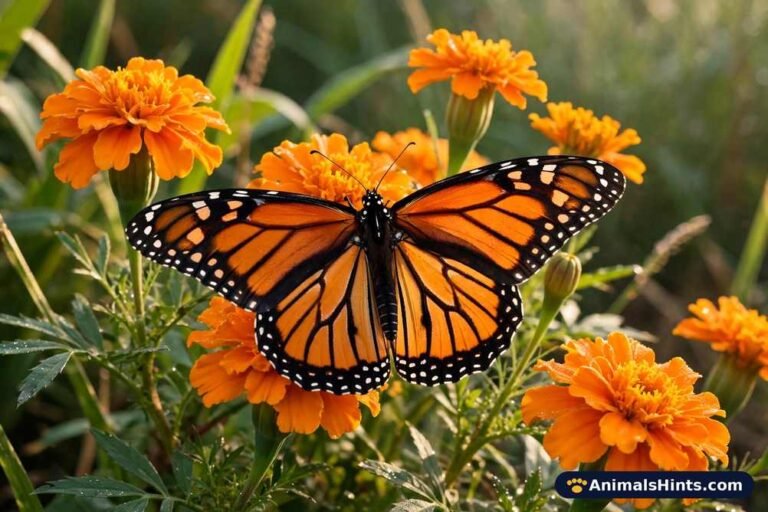
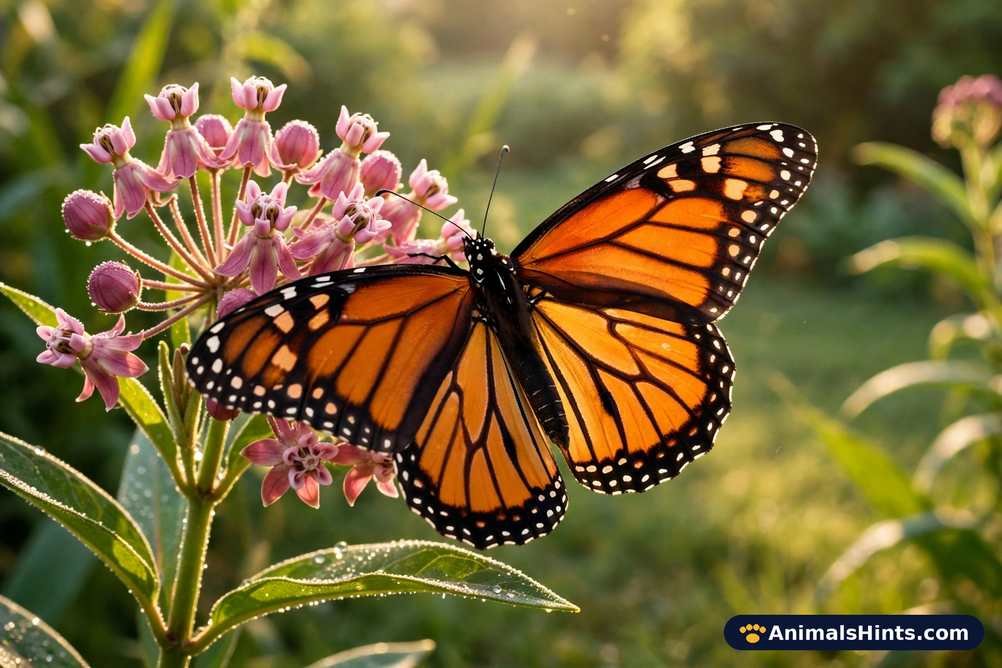
The monarch (Danaus plexippus) is the orange butterfly, the one on the posters. Its wings are bright orange crossed with thick black veins and edged with black borders dotted in white. Monarch caterpillars feed exclusively on milkweed (Asclepias species), and milkweed is loaded with bitter toxins called cardenolides — cardiac glycosides that affect the heart. The caterpillars sequester those toxins, hold them through metamorphosis, and the adult butterfly remains poisonous to birds for life. The orange is therefore a warning, what biologists call aposematic coloration, and it is an honest one. Even the color itself is built from pigment, not light-play: laboratory analysis has identified the monarch’s orange wing pigments as ommochromes, chiefly xanthommatin and its relatives — true pigments laid down in the scales, unlike the blue morpho’s structural blue. And then there is the journey. Eastern monarchs migrate up to about 3,000 miles (4,800 kilometres) each autumn to oyamel fir forests in the mountains of central Mexico; western monarchs travel to the California coast. The migrating generation lives six to nine months, against just two to five weeks for a summer butterfly, and no single monarch ever makes the round trip. The migratory subspecies was listed as Endangered by the IUCN in 2022 and revised to Vulnerable in 2023 after its population models were challenged — a change of method, not a recovery — and the US Fish and Wildlife Service proposed listing it as threatened in December 2024.
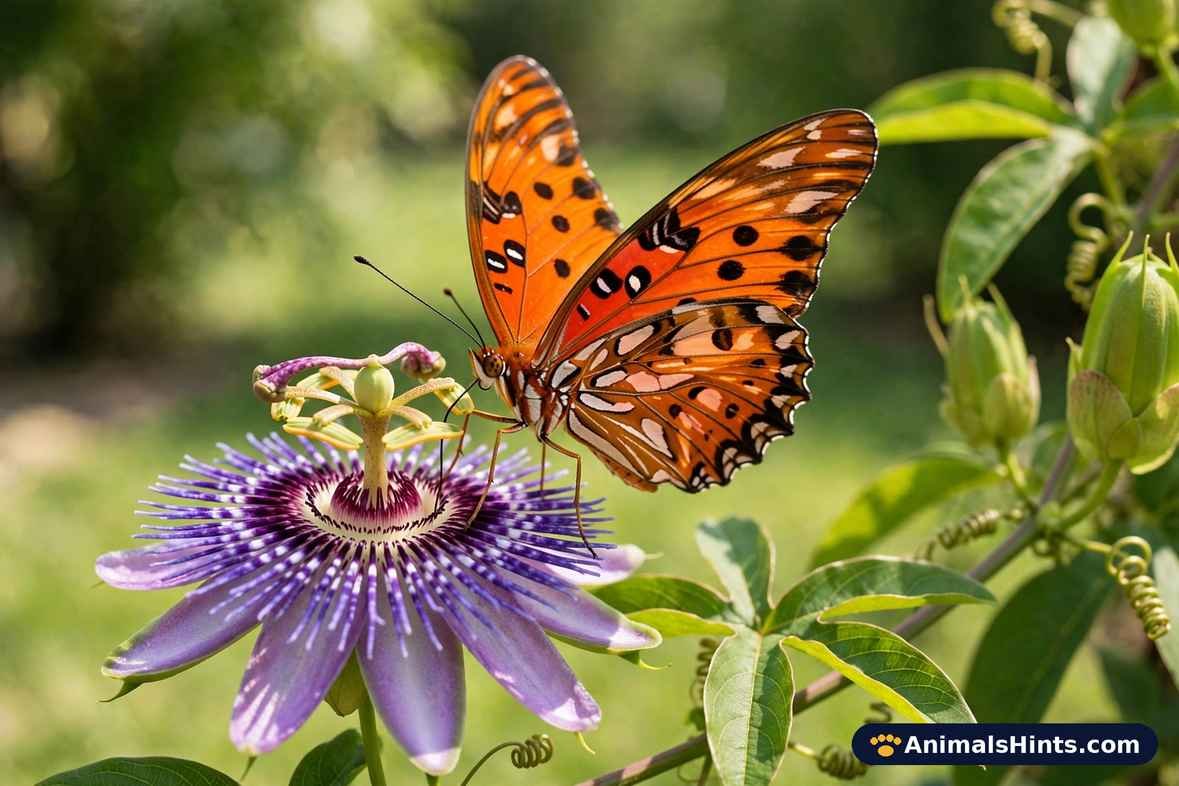
The Gulf fritillary (Dione vanillae, also catalogued as Agraulis vanillae) is the bright orange butterfly of southern gardens. Its upperside is a cleaner, more silvery orange marked with black, and the underside carries elongated silvery-white spots that flash as it flies. Its caterpillars feed only on passion vines (Passiflora), especially maypop (Passiflora incarnata) — another specialist arrangement, one plant family for one butterfly. Its range runs from the southern United States through Mexico and Central America and the West Indies down to Argentina, and in warm regions it is on the wing most of the year.
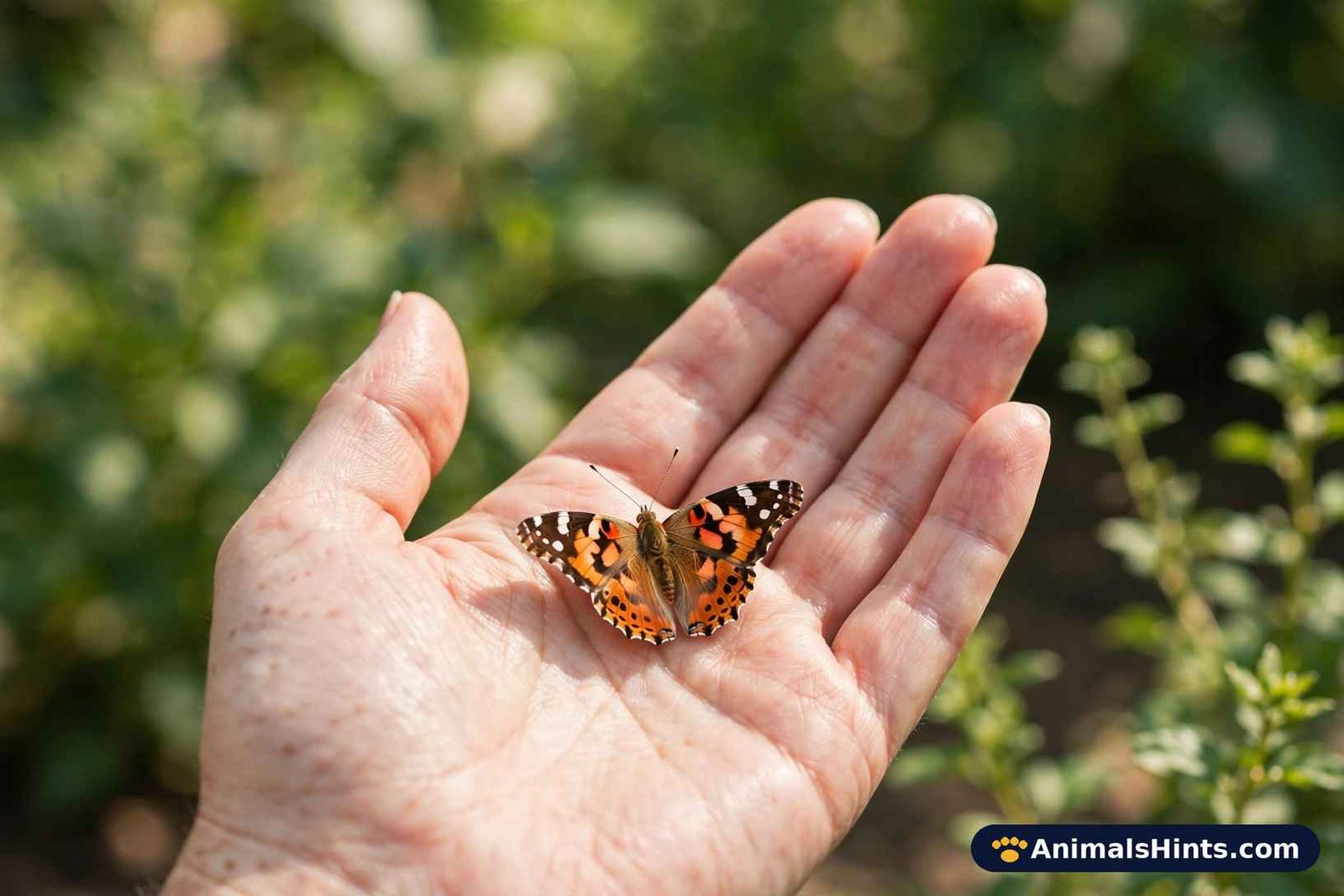
The painted lady (Vanessa cardui) is the orange butterfly the whole world shares. Orange, black and white above with a marbled underside, it is among the most widespread butterflies on earth — in Wikipedia’s careful summary, found on every continent except Antarctica, and rare or only a wanderer in South America. Its caterpillars feed on thistles and a wide range of other plants, which is one reason it can live almost anywhere. And it out-travels even the monarch: painted ladies run a multi-generational circuit between tropical Africa and northern Europe measured at roughly 14,000 kilometres — the longest known migration of any butterfly — flown as a relay of six or more generations, no one butterfly completing it.
One more orange shape deserves a mention, because it causes constant mistaken identity. The viceroy (Limenitis archippus) looks so like a monarch that it was the textbook example of a harmless mimic for over a century. Experiments by Ritland and Brower, published in Nature in 1991, showed the viceroy is just as unpalatable as the monarch — its willow-feeding caterpillars stock their own bitter compounds — so the pair are now classed as Müllerian co-mimics: two genuinely defended species sharing one warning uniform. If an orange butterfly ever seemed to be pretending, it was not. Underneath every orange wing in this section is a real chemical defense, which is a fine foundation for a symbol of honest energy.
11 Spiritual Meanings of an Orange Butterfly in the House
A butterfly indoors concentrates the mind. It has crossed a threshold — left the garden, entered the home, the most personal space a person has — and the tradition reads indoor sightings accordingly, as meanings meant for the household and the inner life rather than for the world outside. In nature, the visitor is usually a migrant or a garden species that has blundered in through an open door or window, drawn by warmth and light as the weather cools; Gulf fritillaries and painted ladies in autumn are the usual callers. The tradition is untroubled by the ordinary explanation. It reads the timing and the color, and it finds eleven meanings. All eleven are given here in the tradition’s own terms.
1. Symbol of Change and Transformation
The first and governing meaning is change. A butterfly is the one creature whose whole biography is transformation — it has already been three other beings before it flies — and an orange one appearing inside your house is read as a sign that a transformation is underway in the household or in you, and closer than you think. The tradition’s emphasis is reassurance: the change is the natural kind, the chrysalis kind, in which the old form dissolves precisely so the new one can exist.
Because orange is the color of autumn as much as of sunrise, this meaning often carries a seasonal note. The sighting is read as an invitation to let a finished chapter actually finish — to stop feeding a form of your life that the year has already ended.
2. Passion and Energy
Orange is the warmest color on any wing, and the tradition reads an orange butterfly in the house as a visit from passion and energy themselves. The specific teaching is about renewal: a project, a relationship or an appetite for life that had gone flat is being warmed back up. Where meaning 1 is about structure changing, this one is about feeling returning — the household’s fire being lit again after a banked-down season.
The energy reading also has a practical edge in the tradition. The sighting is taken as a prompt to act while the warmth is present: start the thing, make the call, book the trip. Orange, in color lore, does not reward waiting.
3. Youth and Creativity
The third meaning belongs to the young and to everyone who makes things. Orange is the color tradition ties to play, appetite and creative risk, and an orange butterfly in the house is read as a sign that the creative and youthful side of the household needs room — a child’s talent asking to be taken seriously, or an adult’s buried one asking the same. It is among the most cheerful of the eleven readings: nothing is wrong; something wants to be made.
Writers in this tradition often connect the sighting to a specific nudge: give the young person the instrument, the course, the afternoon. Creativity, in this color’s teaching, is a plant. It responds to being fed promptly and withers on postponed attention.
4. Spiritual Awakening and Awareness
An orange butterfly indoors is also read as a small spiritual alarm: a sign of awakening, of awareness switching on. In this reading the butterfly has come inside because the message is interior — not about your circumstances but about your attention. The tradition suggests the sighting marks the beginning of a more deliberate inner life: the start of a practice, a return to prayer or meditation, or simply a season of noticing what you had been walking past.
The orange of it matters here too. Awakening in this color is not the stern, renunciation kind. It is warm and embodied — awareness arriving as appetite for life rather than withdrawal from it.
5. Encouragement to Embrace the Present Moment
The fifth meaning is a teaching about time. A butterfly lives briefly and entirely in the present tense — a summer adult monarch may have two to five weeks of life, and it spends them feeding, mating and flying, with no storage and no regret. The tradition reads the orange visitor in the house as a delivered reminder of exactly that: embrace the present moment, because the present is where the color is.
In practice this meaning is usually received as permission. Permission to enjoy the good day while it is happening, to sit in the garden, to let an unhurried hour be unhurried. The butterfly is not telling you the future. It is telling you about now.
6. Symbol of Immortality and Soul’s Journey
Through the old Greek door — psyche, soul and butterfly in one word — the orange butterfly is read as a sign of the soul’s journey and its continuance beyond one form. This is the meaning most often received by the grieving. An orange butterfly in the house, in this reading, is a visit or a message: a loved one’s soul traveling, changed but not ended, the way the butterfly is the caterpillar continued in a form the caterpillar could not have imagined.
The tradition frames immortality here the way the butterfly earns it — not as the old body lasting forever, but as the life passing through forms. It is the deepest of the eleven meanings, and the one people report finding most comfort in, precisely because its central image is a fact of nature before it is a doctrine.
7. Call to Pay Attention and Energy Boost
Sometimes the tradition reads the visit more plainly, as a knock on the door of your attention: pay attention, and here is the energy to do it with. An orange butterfly in the house is taken as a sign that something in your immediate environment — a detail, a conversation, a small symptom, a quiet opportunity — is being missed, and that the missing matters. The color supplies the second half of the message: you are not being scolded, you are being boosted. Energy is available for the thing you notice.
People who work with this meaning often report it resolving into something specific within days — the unnoticed detail surfaces. Whether that is the sign working or simply attention working, the tradition does not much care. It counts the result.
8. Symbol of Rebirth and Reincarnation
Closely tied to meaning 6, but distinct in the tradition’s handling, is rebirth: the soul’s journey read not as one life’s continuation but as a pattern of lives and seasons. The orange butterfly in the house is read as evidence, offered in miniature, that endings in this household are also beginnings — that what has died here will return in another form, as the garden returns, as the migrant butterflies return each spring on wings of generations that never saw the wintering ground.
This is the meaning most explicitly tied to reincarnation in the sources that teach it, and this guide reports it as those sources frame it: a belief about how souls move through the world, held in several traditions, illustrated — not proven — by the butterfly’s own cycle.
9. Spiritual Cleansing and Protection
Orange carries a protective reading in this tradition as well. Fire cleanses, and the warm-colored visitor is read as a small act of spiritual cleansing in the house — stale, heavy or stagnant energy being burned off and replaced. Some households in this tradition treat the visit as the completion of a cleansing they had already begun with prayer, cleaning or a deliberate fresh start, and the butterfly as its confirmation.
The protection half of the meaning is the gentle kind. Nothing in the orange butterfly’s tradition is martial. The protection is the protection of a lit lamp: not a wall, but a warmth that unfriendly things do not settle near.
10. Quality of Life over Duration
The tenth meaning is the one the monarch itself teaches best. The summer monarch lives weeks; the migrating generation lives months; neither lives long by our measure, and the species fills continents anyway. The tradition reads the orange butterfly in the house as a messenger for quality over duration: a rich short season over a long thin one, depth of days over count of days.
Received personally, this meaning tends to land as a question rather than a comfort: where is your life long but thin? The butterfly’s answer, in the tradition, is to pour the available warmth into fewer, fuller things — the meal cooked properly, the friend actually visited, the work done at full attention.
11. Connection with Sacral Chakra
The final meaning is the chakra system’s. In the modern seven-chakra teaching, orange is the color of the sacral chakra, Svadhisthana — the second energy center, seated in the lower abdomen just below the navel, whose element is water and whose traditional territory is emotion, creativity, pleasure and the ability to flow with change. An orange butterfly appearing in the house is read, in this system, as a flare from that center: a sign that the sacral chakra is stirring, opening, or asking for attention, and that the household’s emotional and creative life is the place to look.
The honest framing belongs with it. Chakras are a spiritual framework, not anatomy — no medical text maps them — and the tidy one-color-per-chakra scheme taught today is a modern standardization of older and more varied teachings. Practitioners work with it as a language for inner states, and inside that language this meaning is precise: orange is the sacral color, and its butterfly is read as that center’s messenger — feel, create, flow.
What Does It Mean When an Orange Butterfly Lands on You?
If an orange butterfly in the house concentrates the message, one landing on you personalizes it completely. In the tradition, a landing is the difference between a sign seen and a sign delivered: the butterfly has chosen its surface, and the readings that follow are about contact — blessing, trust, and a message meant for the person touched. Our dedicated guide to what it means spiritually when a butterfly lands on you covers the landing in full; the orange version of it, in the tradition, runs as follows.
The central reading is encouragement with your name on it. The general orange meanings — change, passion, awakening — are held to apply to you specifically and presently: not the household, not someday, but this person, this season. A landing is also read as trust, and therefore as gentleness owed: the creature that can leave at any instant has stayed, and the tradition reads that staying as a picture of how the change coming for you will feel — unforced. Practitioners add the practical teaching every butterfly-lover knows. Do not grab, do not startle, do not treat the visit as a possession. Let it stay as long as it stays, and let it leave when it leaves. The wings are dusted with scales that rub away at a touch, and the tradition and the biology agree, for once in identical words: this blessing is harmed by being held.
One natural note belongs here, because it makes the moment more interesting, not less. Butterflies land on skin partly for salt — they practice “puddling,” sipping minerals and salts from damp ground, sweat and even tears. A landing orange butterfly may be, among other things, drinking your sweat. The tradition has never been embarrassed by the body’s part in its signs, and neither is this guide.
Orange Butterfly Symbolism in Relationships, Love, and Twin Flame
In love, the tradition reads the orange butterfly as warmth arriving at the right temperature. Where the red butterfly of other guides means passion at full heat, orange means the stage love actually lives at: affection, play, desire with friendship in it, the early flame and the long hearth both. An orange butterfly seen by a couple, or appearing around a new relationship, is read as a good omen for warmth — the connection has energy, appetite and joy in it, not just intensity.
For those looking for love, the reading is encouragement of the specific orange kind: be visible, be warm, be in the season. The monarch does not find its mate by hiding, and the tradition’s counsel follows the butterfly — this is a sign for putting yourself in the garden, not for waiting in the chrysalis.
The twin-flame reading is the modern spiritual framework’s own, and this guide reports it in that frame: within twin-flame teaching, an orange butterfly is read as a sign of the sacral connection between the pair — the bond carried in the body and the creative life, not only in the mind — and often as a marker of a warm phase: reunion, thaw, or renewed energy after a separation. It is a contemporary belief system rather than an ancient tradition, and its readings are offered here as its followers hold them. Even readers who keep their distance from twin-flame doctrine tend to keep the smaller, older reading underneath it, which needs no system at all: orange wings near a love are a picture of warmth that moves, and love, at its best, is exactly that.
Dreams About Orange Butterflies
Dream tradition reads animals the way waking tradition does, with the volume turned up: in a dream, the mind is already speaking in symbols, so a brightly colored butterfly is received as a deliberate image rather than a passing sight. Modern dream interpretation — a folk practice, not a validated psychology; psychologists do not endorse fixed dream dictionaries — works with the orange butterfly along four main lines:
- An orange butterfly flying freely is read as joy and freedom on their way: a happy change approaching, usually one you have been hoping for rather than fearing.
- An orange butterfly landing on you in the dream carries the waking landing’s meaning indoors and inwards: encouragement addressed to you personally, often read as a creative or romantic opening you should not wave away.
- An orange butterfly inside the house in a dream is read as change entering your private life — the household, the family, the inner rooms — echoing the eleven house meanings above.
- A fading, trapped or dying orange butterfly is read as the shadow reading: a passion neglected, a creative life postponed, warmth going out of something that needs it. Dream readers treat it as a prompt to feed the fire, not as a prediction.
Across all four, the dream teaching is consistent with the waking one. The orange butterfly in dreams is read as a warm messenger: whatever it is doing in the dream is what your energy, creativity or love is doing in your life, and the dream is asking you to look.
Spiritual Symbolism of Black and Orange Butterfly
Black and orange together is not a rare variation — it is the monarch’s own uniform, and the viceroy’s, and the Gulf fritillary’s markings besides — so this section is really about the most common orange butterfly of all, read with its darkness left in. In the tradition, the black is not a blemish on the orange. It is the second half of the sentence.
The reading runs like this. Orange is the fire: change, passion, warmth, the soul alight. Black, in butterfly symbolism, is the night side of transformation — the chrysalis hours, the unknown, endings, the mystery a life passes through while it is being remade. A black-and-orange butterfly is therefore read as the complete transformation symbol, the only honest one: change that includes the dark part. Followers of this reading point out that a transformation symbol without black in it would be a lie — nothing becomes a butterfly without the dissolved, lightless stage — and that the black-and-orange form shows up precisely when a change is real rather than decorative.
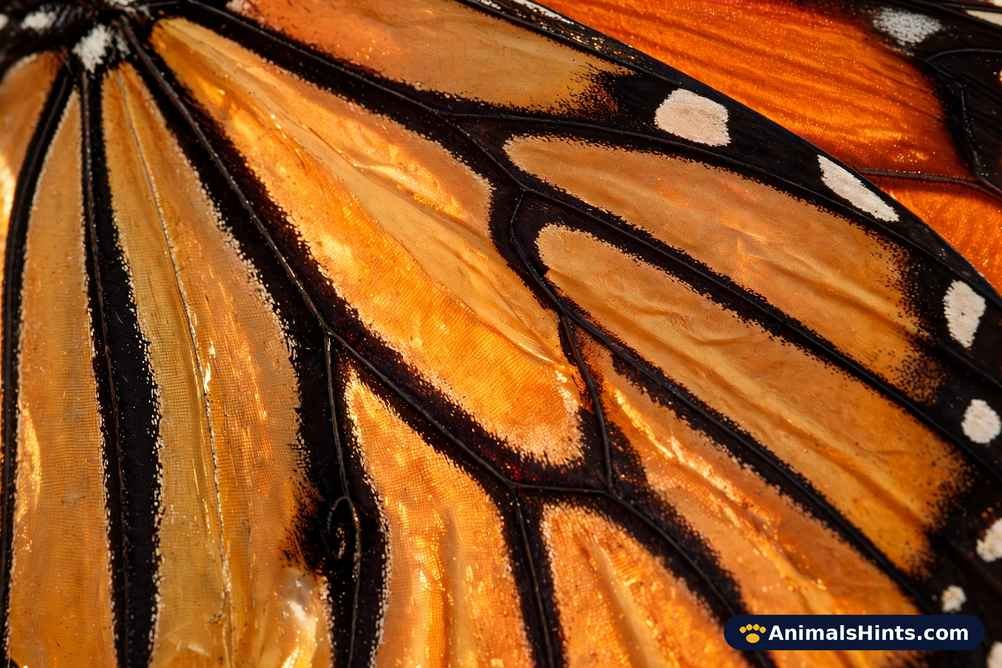
The biology underneath could hardly cooperate better. On the real wing, black and orange are a single functional design: the black veins and borders frame and strengthen the wing, and the whole pattern together is the warning — predators learn the combined signal, orange for visibility, black for contrast, and leave both colors alone. Two genuinely poisonous species, monarch and viceroy, wear it as a shared uniform. The tradition reads the black-and-orange butterfly as transformation with its shadow included; nature built it as honesty with its outline drawn in. Both readings agree that the black is not the opposite of the message. It is what makes the message legible.
Brown and Orange Butterfly Spiritual Meaning
Brown and orange is the autumn end of the orange family — the painted lady’s underside is marbled brown, many fritillaries shade toward russet, and late-season orange butterflies often look browner than their summer portraits. The tradition reads the brown-and-orange butterfly more quietly than the bright one, and the reading is about grounding.
Brown, in color symbolism, is earth: stability, humility, the practical, the home ground. Orange laid over brown is therefore read as warmth that has settled — passion become domestic, energy become useful, the fire banked into the hearth. Where the vivid orange butterfly shouts about change, the brown-and-orange one is read as a sign about staying: tending what you have, preparing for winter, finding the sacred in the ordinary season. It is a favored reading for people in the harvest stage of a project or a life — the work no longer needs sparks; it needs steady heat.
There is a natural footnote that suits the reading nicely. Several orange species genuinely do look browner in their late-season and overwintering forms, and the painted lady — the great migrant — wears its brown-marbled underside folded up at rest, hiding the bright orange until it flies. The tradition reads brown-and-orange as the warmth that only shows itself in motion. As symbolism goes, it is hard to improve on the fact.
How the Orange Butterfly’s Meaning Differs From Other Colors
Color is the variable in all of these readings, so it helps to set the orange butterfly beside its siblings. In the same modern symbolism tradition, a white butterfly is read for purity, innocence and the visiting spirits of loved ones — our guide to the symbolism behind seeing a white butterfly covers that reading in full. A blue butterfly is read for calm, truth, healing and things that need to be said — our blue butterfly meaning guide gives that reading its own page. A black butterfly is more often read for endings, mystery and the shadow side of change. Orange’s territory is distinct from all of them: warmth rather than purity, fire rather than calm, encouragement rather than mystery.
Reading the four together gives the tradition’s grammar. White asks who is near. Blue asks what is true. Black asks what is ending. Orange asks what is beginning, and whether you are warm enough — in energy, in courage, in appetite — to begin it well. That is why the orange sighting is so rarely received as a warning even by careful readers of signs: of all the butterfly colors, it is the one whose traditional grammar is encouragement.
Is Seeing an Orange Butterfly a Good Sign?
In this tradition, yes — about as clearly as signs get. The orange butterfly collects almost none of the ominous readings that gather around other animal visitors. Its meanings run from change through passion to protection, and even its gravest readings — the soul’s journey, rebirth — are comforts rather than warnings. The one caution the tradition attaches is the dream dictionary’s fading butterfly, and even that is phrased as advice: feed the neglected fire.
Why the near-unanimity? Partly the color: warm colors read kindly in almost every symbolic system humans have built. Partly the creature: butterflies are harmless, beautiful and short-lived, and folk systems tend to read gentle animals gently. And partly, this guide would add, the facts underneath are cheerful ones. The orange butterfly is a creature that crosses continents on a few weeks of wing, advertises its honesty in the brightest color it owns, and spends its whole adult life among flowers. Traditions read animals by their natures. This one’s nature, read fairly, is a good sign with wings.
When Orange Butterflies Appear: Migration and the Turning Seasons
The tradition reads timing as part of the sign, and orange butterflies have a calendar worth knowing. In temperate North America and Europe, orange sightings cluster in two great waves. The first comes in spring, when painted ladies push north out of Africa and the desert Southwest, Gulf fritillaries resume in southern gardens, and the first monarchs of the year arrive from Mexico on worn wings to lay the eggs of the summer generations. The second, bigger wave comes in late summer and autumn — peak monarch migration, when the year’s last generation, the long-lived one, turns south; painted ladies streaming back toward Africa at heights too high to see; fritillaries crowding the last flowers. An orange butterfly in autumn is therefore very often a traveler in the middle of one of the great insect journeys on earth.
This is the ground under so many of the traditional readings. The soul’s-journey meaning, the rebirth meaning, the change-of-season meaning — all of them were built by generations of watchers who noticed, correctly, that orange butterflies appear at the turning points of the year, arriving and departing with the light. The painted lady’s circuit alone covers roughly 14,000 kilometres between tropical Africa and the Arctic’s edge, flown by six or more generations in relay, so that the butterfly you see in September is the grandchild, many times over, of the one that left Africa in spring — and its own grandchildren will complete the loop. No individual sees the whole journey. The tradition, which reads the orange butterfly as the soul traveling through forms it cannot remember choosing, did not invent that pattern. It observed it, for centuries, without ever knowing the half of it.
How to Welcome Orange Butterflies to Your Garden
If the readings in this guide have made you want orange butterflies closer rather than merely explained, the welcome is mostly a matter of plants. Orange butterflies are specialists and generalists both, and a garden can be arranged for each.
- Plant milkweed for monarchs. Milkweed is the monarch’s only caterpillar food — no milkweed, no monarchs — and regionally native species are the right choice for your area. The flowers feed the adults too.
- Plant passion vine for Gulf fritillaries. In the South and other warm regions, a passion vine (Passiflora) is a fritillary nursery: expect the leaves to be eaten, and count that as success.
- Give painted ladies thistles and variety. Painted lady caterpillars use thistles and many other plants, and the adults nectar almost anywhere; a long season of varied flowers is the invitation.
- Nectar from spring to frost. Adults of all three species need flowers across the whole season — the autumn migrants are fueling journeys of thousands of miles, and late flowers matter most of all.
- Skip the insecticides. A garden sprayed for insects is a garden arranged against butterflies at every life stage, egg to adult.
- Leave some wildness. A sunny corner, a puddle edge for minerals, and plants left standing into autumn give butterflies food, shelter and overwintering cover.
Expect the caterpillars, and welcome them on the same terms as the adults: the eaten milkweed leaf is the entire point of the exercise, and our guide to caterpillar spiritual meanings reads that humble stage of the story on its own merits. A garden that hosts the whole life cycle — egg, caterpillar, chrysalis, wing — has not just attracted a symbol. It has joined the process the symbol was always about.
Final Thoughts
Hold the folklore in its proper place and it earns its keep: as a way of paying attention. The orange butterfly’s meanings — change, passion, awakening, the soul in motion — are the tradition’s accumulated reading of a creature that genuinely lives all of them at once, and a sighting used as a prompt to begin, to warm, to notice, is a sighting well used. But the deepest fact in this guide needs no folklore at all. The most famous orange butterfly is a poison-bearer whose bright color is a truthful advertisement, raised on a single poisonous plant, that then navigates up to 3,000 miles to a forest it has never seen and could not survive without. Every part of the symbol is already there in the animal: the honesty, the fire, the journey through forms.
So if an orange butterfly crosses your path or your threshold this season, let the tradition say its warm word — and then spare a thought, and if you can a patch of garden, for the plant the whole story stands on. The monarch’s miracle begins as a caterpillar on milkweed, a plant most gardeners are taught to weed out. Plant a little of it, and you are not just honoring a symbol. You are feeding one.
Frequently Asked Questions
What does an orange butterfly symbolize spiritually?
Spiritually, an orange butterfly is read as a sign of change, passion and encouragement: transformation arriving in a warm form. Tradition also ties it to creativity, spiritual awakening and the soul’s journey.
What does it mean when you see an orange butterfly?
It is read as a prompt to pay attention to a change already underway in your life — and as reassurance about it. The tradition treats the sighting as good news: energy, creativity and a new season are available to you.
Is an orange butterfly a sign of good luck?
Yes, in this tradition it is one of the clearest good-luck signs among animal visitors. Its readings run from encouragement to protection, and even its soul and rebirth meanings are received as comforts, not warnings.
How can I work with the energy of an orange butterfly?
Tradition’s answer is practical: act on the warm impulse — start the creative work, make the call, spend time in the sun and garden. Planting milkweed or passion vine gives the energy a literal home in your own ground.